
Metrolinx has published a set of documents containing the “Initial Business Case” for the GO Transit Regional Express Rail (GO/RER) network.
Updated Dec. 13, 2022: Due to a reorganization of Metrolinx’ site, the reports are no longer available there. However, I have archived copies of them. The Summary and Full Report links below are to my site. The Appendices are not yet available as I must break them into chunks small enough that WordPress will allow them to be uploaded.
- Summary
- Full Report
- Appendices A-J
- A: Corridor Specifications
- B: Corridor and System Schematics
- C: Model Assumptions and Results
- D: Record of Assumptions – Direct Demand Model
- E: Financial Performance of RER Systems
- F: Sensitivity Analysis
- G: Wider Economic Benefits
- H: Line Speed Analysis
- I: Environmental Assessment Program
- J: Fare Structure Issues and Solutions
- Appendix K: Station Access Analysis
[Note that except for the Summary, the documents are large PDFs.]
This article begins a review of these documents and of the various RER proposals examined in the Metrolinx studies.
Overview
Work on this review of GO/RER began in April 2014 following the announcement by Queen’s Park of its commitment to the RER concept. Unlike previous reports, this study looks in depth at all of the GO corridors, and reviews the technical issues associated with both increased service and electrification. This is not a final review, and much engineering work remains to be done, but there is a great deal more information now publicly available as the basis for discussions.
These documents were completed sometime in 2015 as is clear from references to future events that will occur later in the year, notably reports from the City of Toronto on SmartTrack. That scheme gets only passing mention, some of it the usual political cover story, because the specifics had yet to be decided. Exactly what the incremental effect of ST will be beyond the proposed GO/RER configuration is not yet known. Preliminary information in City reports implies that ST will amount to considerably less than was foreseen by the Tory election campaign, possibly as little as a few more stations and some sort of TTC/GO fare integration.
Five scenarios were reviewed to compare the effects, benefits, costs and technical issues associated with various possible future networks.
- The “Do Minimum” scenario provides only marginal peak period improvements to the existing system in response to projected demand growth, but with no electrification. This is effectively a “business as usual” model for the base case.
- The “Two-Way All-Day” scenario expands off peak service, but with diesel operation and no electrification. This is a minimal level of service expansion.
- The “10-Year Plan” would provide frequent service on the inner parts of some corridors, but with limited electrification.
- The “Full Build” extends beyond the 10-Year Plan to provide frequent service on the inner parts of all corridors, and with full electrification.
- The “10-Year Plan Optimized” extends the scope of electrification beyond that contemplated in scenario 3.
This progression implies a certain sequence of events during the study where a full build is impractical and the original 10-year plan was not aggressive enough with electrification, a key component of the announced government direction.
The estimated capital costs rise from $5 billion for scenario 1, through $10b, $12b and $19b for scenarios 2 to 4. The price tag for the latter is well above what Queen’s Park has available, and scenario 5 was developed with a projected cost of $13.5b. All but scenario 4 are said to be achievable by 2024. Given that it is now 2016, and this is a 10 year plan, that date probably requires some adjustment.
Scenario 5 is the 10-Year Plan Optimized, it represents significant progress towards implementing the service levels of Scenario 4. It goes beyond the investments and service included in Scenario 3 (10-Year Plan), with electrification also to Bramalea, Barrie, Stouffville and to Pearson Airport. This scenario and the resulting recommended RER program has been defined to maximize return on investment while mitigating risks. Depending on resolving various challenges, it can be delivered over 10 years for approximately $13.5 billion. It does not preclude, but rather prepares for, services to Milton and Kitchener to be eventually electrified and frequent all-day services introduced when agreement is reached on co-existence of GO and freight on these privately-owned corridors. [p. iv, Full Report]
Annual ridership is expected to go up by a factor of 2.5 over the coming 15 years, but operation costs will not rise at the same rate. The study postulates that an operating profit would be possible, eventually, but that will depend a lot on future fare policies, and on the evolution of trip patterns (length, direction, average fare). The ridership model foresees that “hundreds of thousands” of auto trips would be replaced by GO ridership each weekday comparing scenario 5 to scenario 1. The proportion of trips and its relationship to expected growth is not specified in the Executive Summary. (Possibly in the demand modelling later.)
The rate of demand increase on GO overall is projected at 2.3% which is lower than recent levels, but allows for some leveling off in a more mature service.
One big issue is the problem of getting riders physically to and from the GO trains. Either this will be done with substantially improved local transit services (an option that brings many issues associated with fare integration and cross-system subsidies), or with parking. The cost estimates include $750m for 15,000 new parking spaces, or $50k per space. At that scale, simply paving empty lots is not an option. The study notes the possibility that some of this cost “may not be necessary if service integration and fare integration with local transit services can be improved”. [p. v]
Those 15,000 spaces represent nowhere near the ratio of new parking spaces to existing facilities that the projected ridership growth would entail if everyone arrived by car. Parking charges are listed as a way of raising additional capital for the RER project, and of encouraging a shift to ride sharing and public transit feeder services.
It is amusing to read about the benefits of proven technology, something for which Ontario has not been noted in past endeavours.
Virtually all of the works are within existing rail corridors, so environmental and community impacts are limited mostly to noise and vibration. RER will use proven technology that is working around the world. [p. v]
Descriptions of RER cite similar operations in more than 50 city regions worldwide [page 6], and list a number of factors that simplify implementation [p. 4]. I cannot help thinking of how badly past studies have downplayed the benefits of LRT which bears a family resemblance, but at a local rather than a regional level.
The first electric railway opened in 1883 (the Volks Tourist Railway on the Brighton seafront in the U.K.). Ever since that time, electric traction has increasingly become the default source of power for the world’s more intensively used rail systems. [p. 14]
Finding this statement in a Metrolinx report is quite amusing considering some of the remarks made during community meetings on electrification before Metrolinx and GO “got religion” on the subject. The report skirts that debate by observing that GO is now at the threshold where electrification makes sense:
Until recently, diesel traction has been the appropriate mode of traction for the GO rail operation. However, the service enhancements envisaged in the near future will take GO rail beyond the threshold of service intensity appropriate for electrification. Continued use of diesel traction will become a source of financial and economic inefficiency. [p. 14]
Metrolinx intends to pursue discussions with the railways regarding the upgrades needed on their trackage, and also intends to review “modern, proven technology” with Transport Canada and the railways.
This is an “initial” analysis, and changes are likely depending on the evolution of expectations, changes in provincial funding, and who knows what political meddling that could arise.
A decade is a long time in politics, and the likelihood that the current governing parties or councillors will still be in place at that distant time is minuscule. Moreover, changes could come at any level part way through the project, and only a very strong, unshakeable commitment (i.e. very popular and difficult to derail) is likely to survive. This is not simply a case of showing up for a photo op or two with a gigantic prop cheque, but of supporting the plan for the long haul, including building a constituency that can survive beyond current governments. The arrival of a Ford-equivalent who simply wanted to start over with his own plan would be disastrous.
The Vision of Regional Express Rail
This section of the report begins by recounting the history of transit in the GTHA, of the formerly high transit mode share when more jobs were concentrated in central Toronto, of the rise and subsequent fall in subway construction, and of the growth of GO Transit for core-bound commuting trips.
At one point, there is even a claim that GO carries as many people into the core in the peak as the subway does, but this is hard to credit given that total one-way GO ridership is only about 90k. Possibly a restricted definition of the “core” has been used that omits a wide area served well by the subway, but less so by GO. In any event, growth of GO capacity will increase the commuting load it can bring to downtown Toronto.
Ridership into the core area has been growing by transit, at least during the peak period.
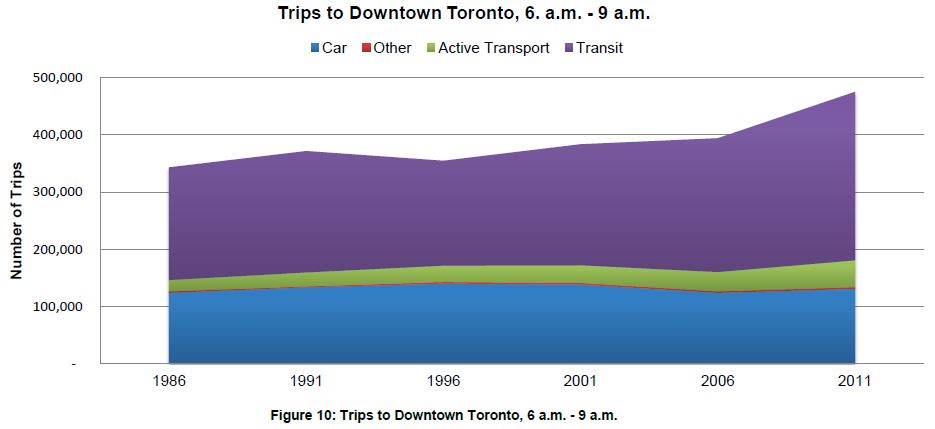
While “Active Transport” (walking, cycling) is a factor with all of the new housing downtown, it is small compared to overall figures during the peak. Their role is greater during the off-peak period, possibly reflecting a different pattern of trip origins more conducive to these modes. (Beware of differences in the vertical scales used in these charts.)
(The Transportation Tomorrow Survey updates these data every five years, but the 2016 numbers will not be available until 2017. The evolution of Active Transportation numbers will be interesting to see.)
Auto trips are growing outside the peak as anyone now dealing with off-peak congestion will know. GO, a peak-only service, has not seen much of the overall increase.
Between 2006 and 2011, average daily car trips to the downtown outside the morning peak period grew by 16,000, compared with less than 4,000 by GO Rail. Meanwhile, over 55,000 new trips were made by walking, cycling and TTC. [p. 10]
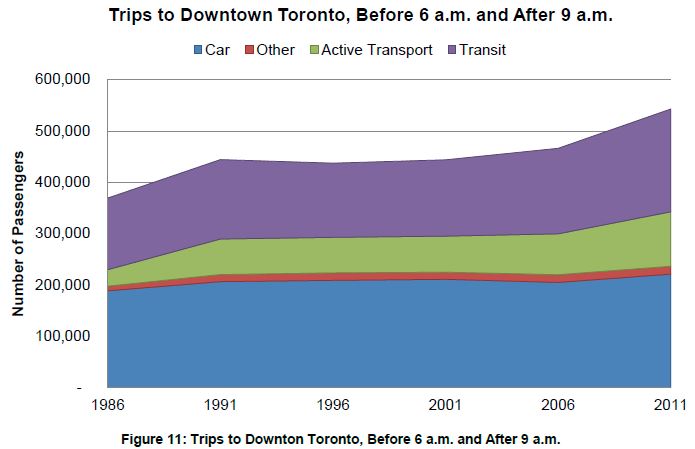
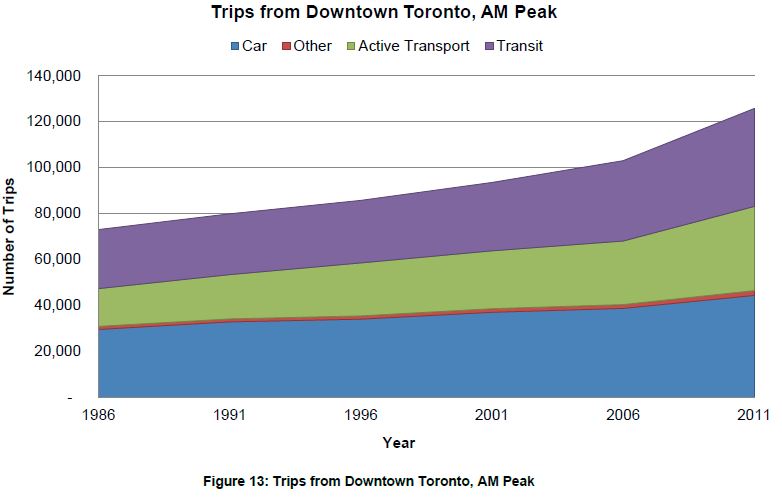
Trips from “downtown” are also growing strongly after a long period when the numbers were almost flat. Again, this will bear watching in the 2016 data when it is available. However, we must be careful about the definition of the “downtown” area which could very well exclude a good chunk of the central city such as the University of Toronto campus. It will be important to distinguish between “outward” trips that are simply among various locations in the old City of Toronto, and those to suburbs where GO/RER would make a difference.
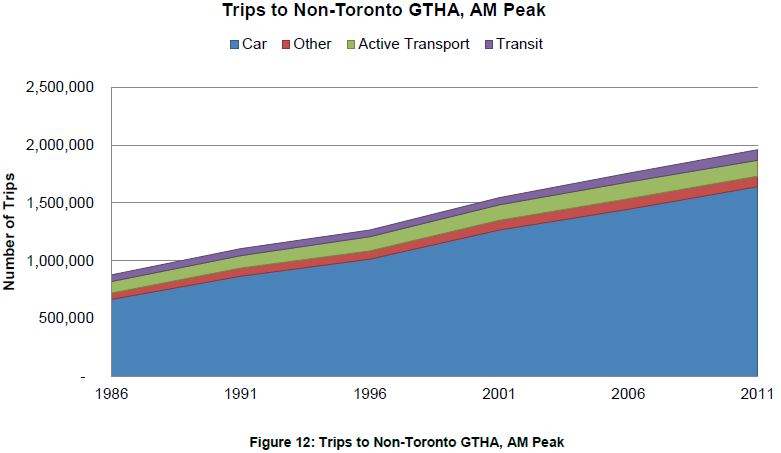
Finally, there is the question of commuting that is not focussed on the City of Toronto. The total trip count is very large, and it is almost entirely served by private autos with little sign of growth in other modes. This is a huge challenge for both the regional rail network, and for transit systems within the communities outside of Toronto.
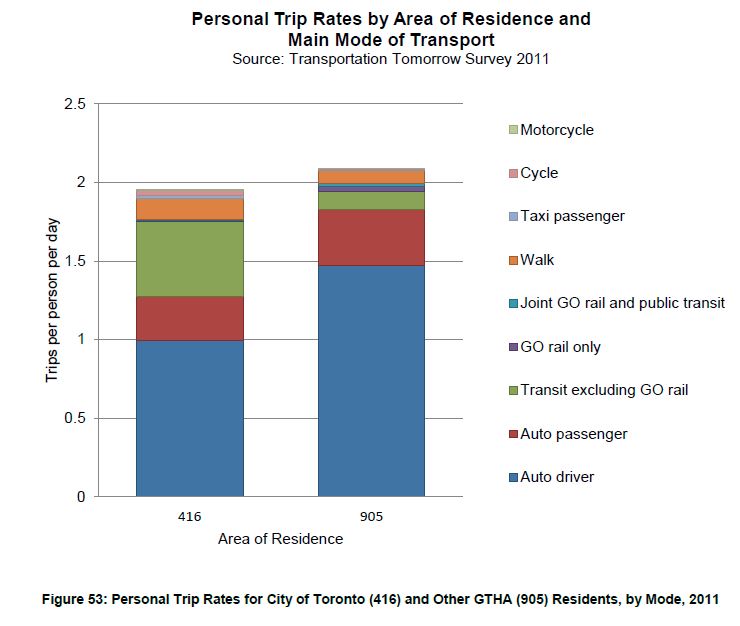
The challenge for transit in the overall travel market shows up in the proportion of trips by each mode taken within Toronto (the 416) and in the region beyond (the 905). GO rail services only have a tiny sliver of the travel market, lower even than walking. The problem here is that this is a chart of all trips from the most trivial journeys to the corner store to a long regional commute. A later chart looks only at trips over 10km, and this shows a different picture. All the same, transit has a lot of work to catch up with auto travel, and its credibility is hampered by decades in which transit simply was not an option for much travel throughout the city and region.
GO’s fleet plans include their current diesel-hauled trains with 10 or 12 bilevel cars, but also 4-car EMU sets running in 4, 8 or 12-car consists. The fleet required to operate the basic off-peak service would be EMUs, with electric locomotives hauling existing bilevels for peak service on routes that are electrified. [p. 20]
The comparative operating costs of different train consists are quite striking.
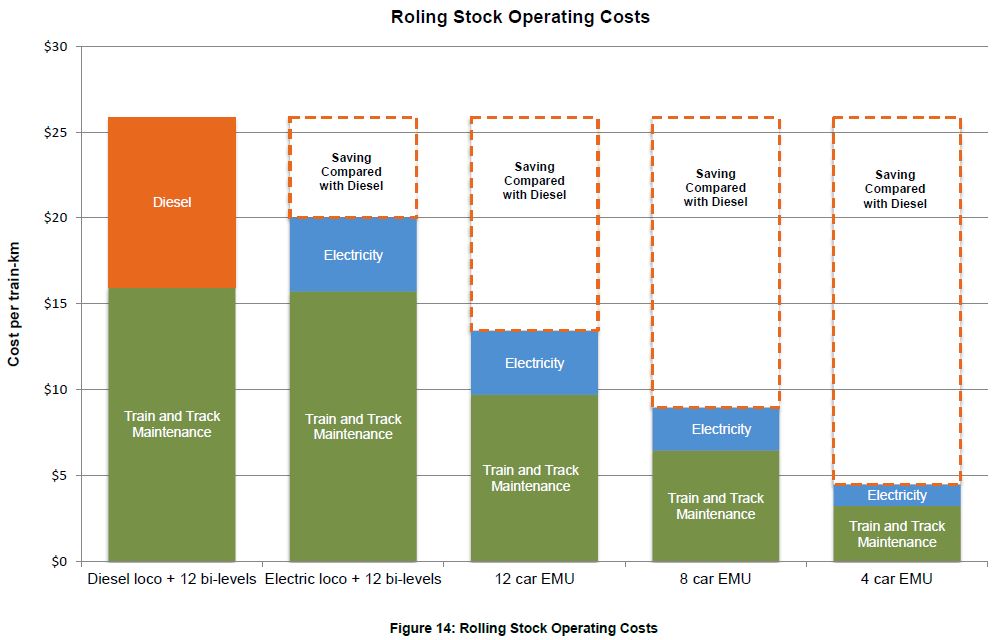
Although there will be additional costs once RER is operating, the report claims that additional revenue will more than offset this because fare revenue goes up more than operating costs, especially considering the savings available with EMU operations over the current diesel-hauled trains.
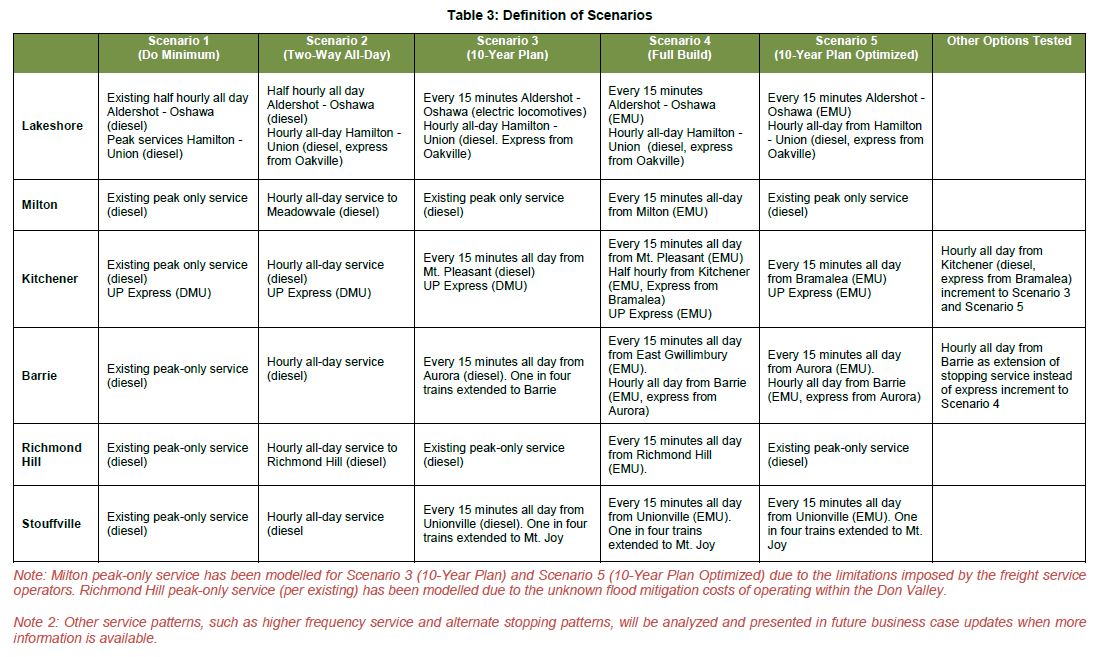
Many service options were tested, and the permutations are too extensive for an article here. I recommend that interested readers download the full reports for all of the details. As an overview, here is a table of the principal options studied (click to enlarge):
For the Lakeshore corridor, as an example, there is a much more detailed look at the options:
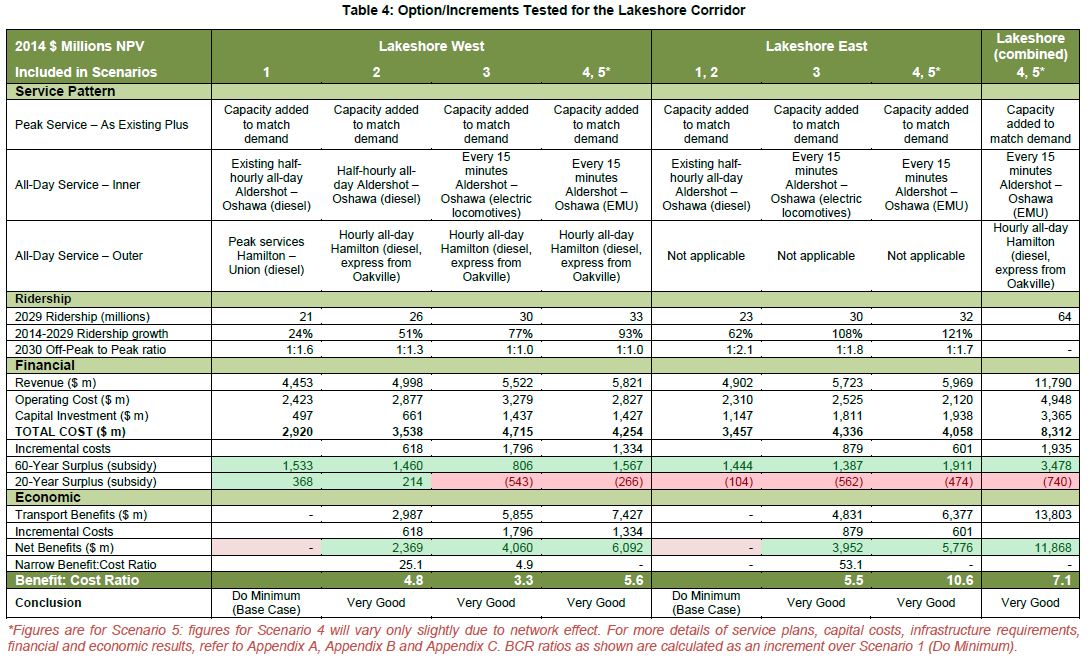
These figures show a very high return on investment assuming that one agrees with the methodology. Some points here are worth noting:
- Although the base 2014 ridership is not shown, it can be derived from the 2029 ridership and the percentage increases this represents. For Lakeshore West, the 2014 number is 17m, and for Lakeshore East it is about 14.5m. The scale of ridership increase has profound implications for the capacity that will be required to and from feeder stations.
- The revenues and operating costs are Net Present Value (NPV) figures over the life of the model, not one-year data. However, the ratios show that different service models produce different riding and revenue patterns. For example, for LSW scenario 5 has 33m riders/year by 2029, or 57% more than scenario 1. However, the revenues are only 31% higher suggesting that proportionately more riders in scenario 5 make shorter trips.
- The operating cost increment is small beyond the base case for LSW, and for LSE it is actually cheaper to operate the scenario 5 service than the base case.
- Capital investments are higher for scenarios with more service, but these are more than offset by the benefits imputed from shifting so many riders onto the RER network from autos.
Similar tables are included in the report for all of the other corridors and service options.
A common thread in all of the analyses is that the more aggressive service options tend to do best on the Business Case Analysis, probably because the additional ridership, revenue and benefits (trip diversion to transit) for well-used infrastructure more than offsets the capital investment required. Each of the lines reaches a point where better service produces proportionately more demand. If this is what might happen looking only to 2029, this has important implications for network growth in the decades beyond when RER really will operate as a “regional subway” rather than an occasional commuter train.
Growth to the full scenario 4 is constrained by the available provincial funding, and the tactic is to get as much value as possible for the $13.5b envelope Queen’s Park has announced.
The service plans for scenario 5 are summarized in the charts below.
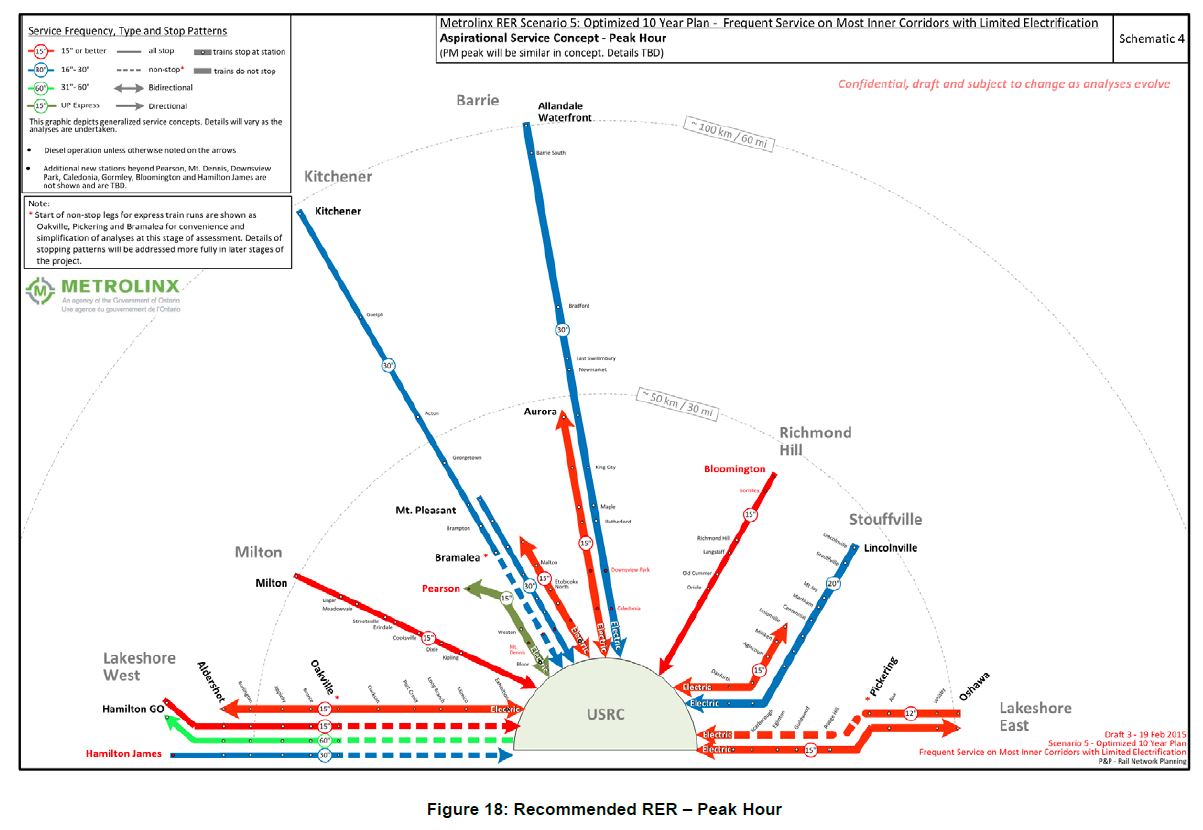
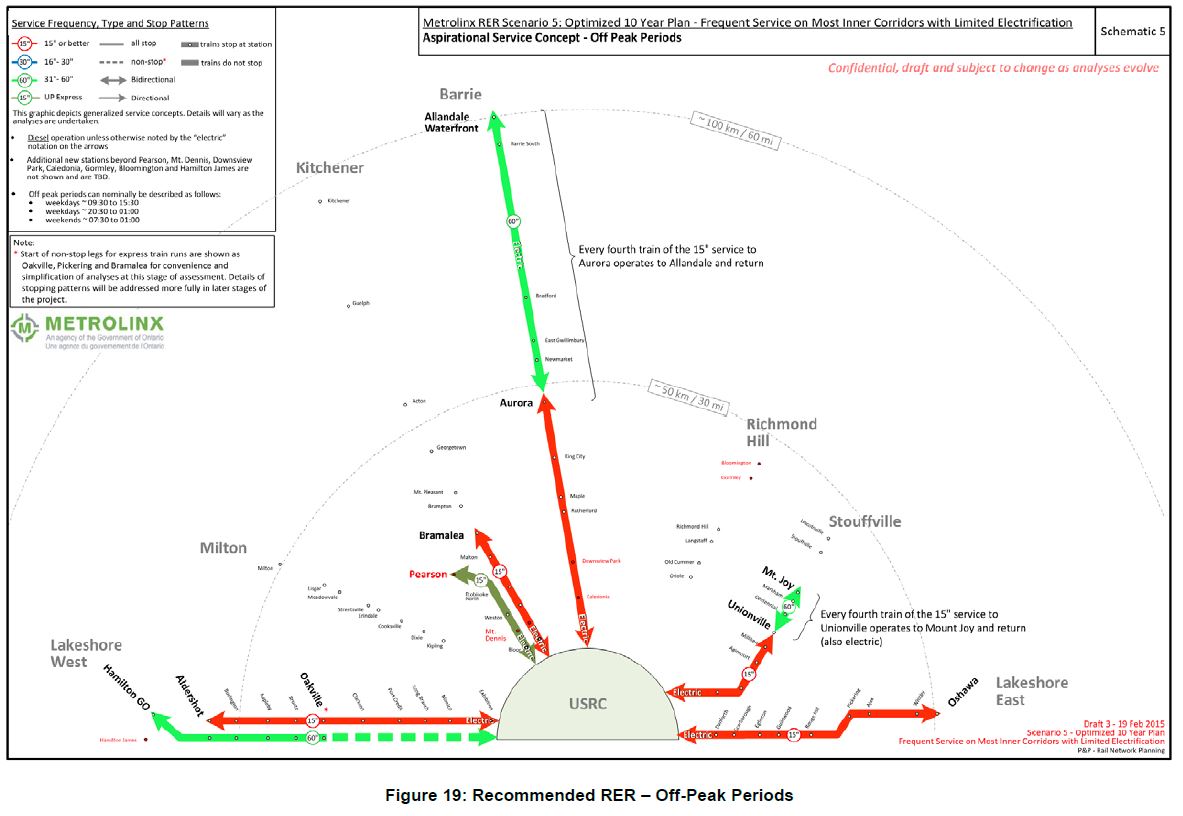
The colours indicate, generally, the level of service with red being 15′ or better through blue and green to the less frequent services. The Milton and Richmond Hill corridors remain with only peak period, peak direction service because of constraints on operation over CP and CN trackage, as well as the need to floodproof tracks in the Don Valley for the Richmond Hill service.
As a point of comparison, here is the “full build” scenario 4 service.
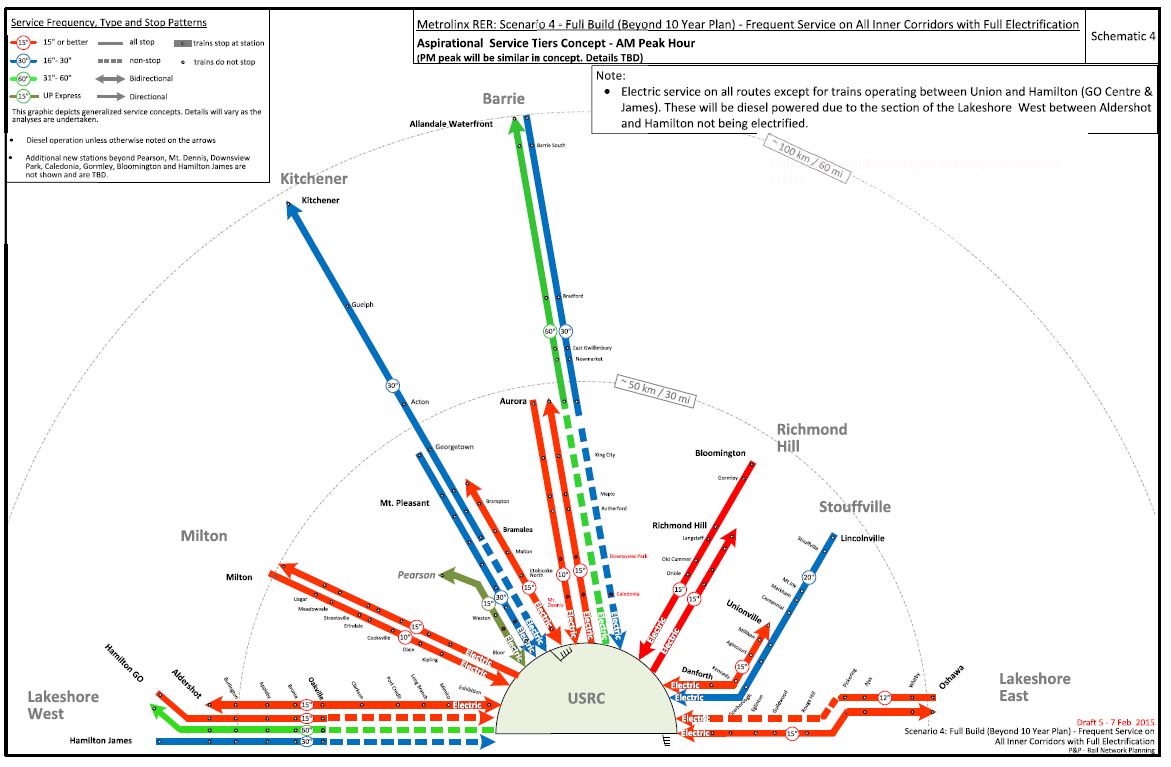
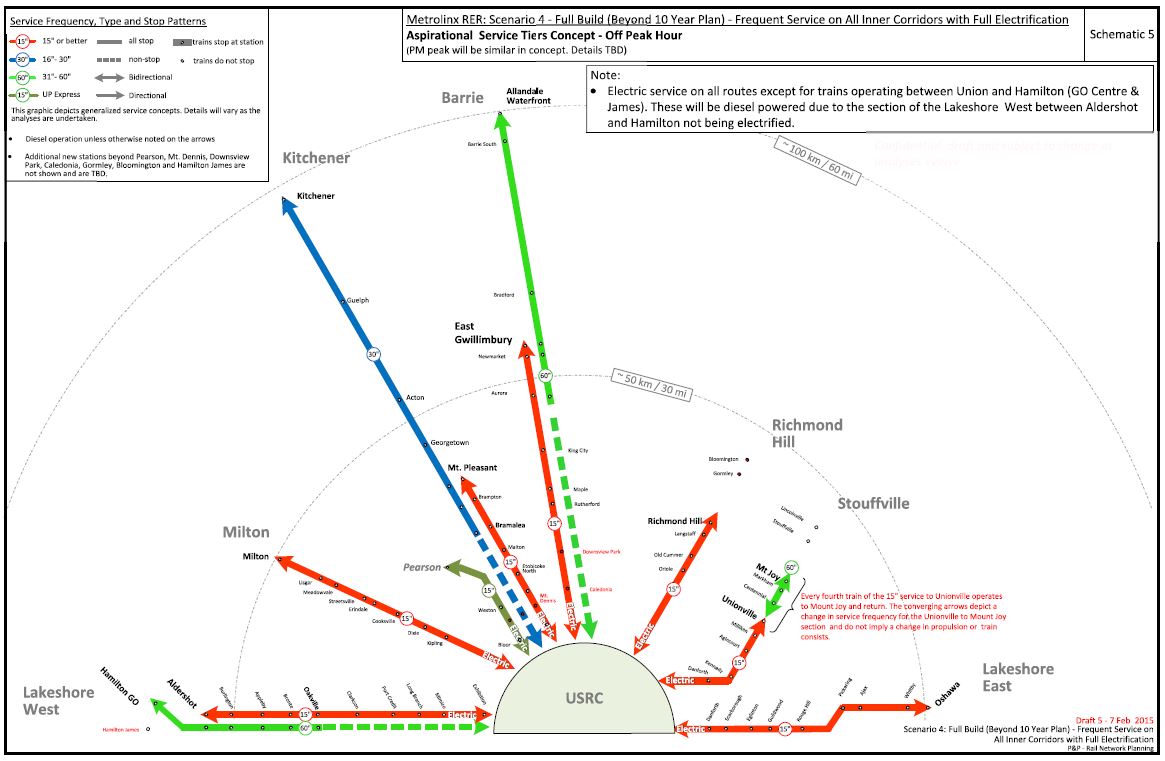
Whether any of us will ever see service at this level (let along just getting to scenario 4) is quite another matter. This will require a sustained commitment and funding, and it will not be paid for with fairy dust schemes such as “tax increment financing”. The Metrolinx report stays away from the “how to pay for it” problem and concentrates on the “what can we build” issue. The obvious variables in the financial picture are:
- Fare structure: should a higher or lower overall farebox cost recovery be attempted?
- Subsidies: is the provision of good transit considered a “social good” and the cost seen as a preferable alternative to continued expansion of road capacity?
- Parking: should GO parking lots charge for this service, and how much can this revenue source contribute to overall financing? The report estimates that parking could contribute $100m annually from 2020 onward, enough to finance $3.8b in capital spending.
Ridership projections for the corridors vary considerably with the largest gains, no surprise, coming in corridors that receive more service.
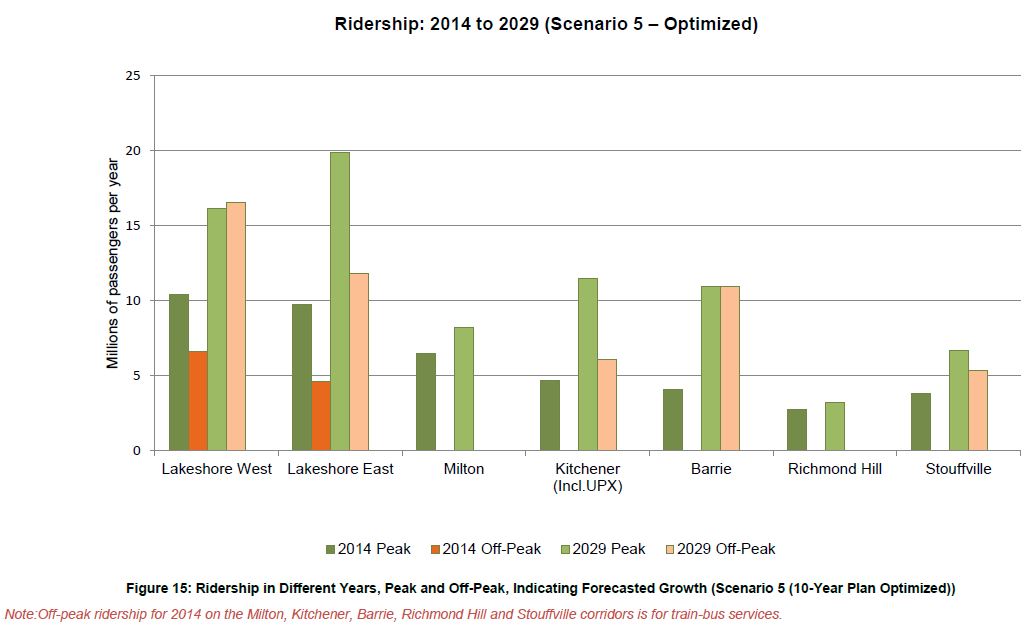
Projections for Lakeshore West, Barrie and Stouffville corridors are noteworthy because off-peak values are similar to peak (albeit they are spread over more service hours). This would put GO/RER in the same situation as TTC where off-peak ridership is an important part of overall demand, and many trips have nothing to do with conventional commuting patterns. As with other parts of the evolving regional travel patterns, this change cannot be achieved without substantial investment in local feeder/distributor services.
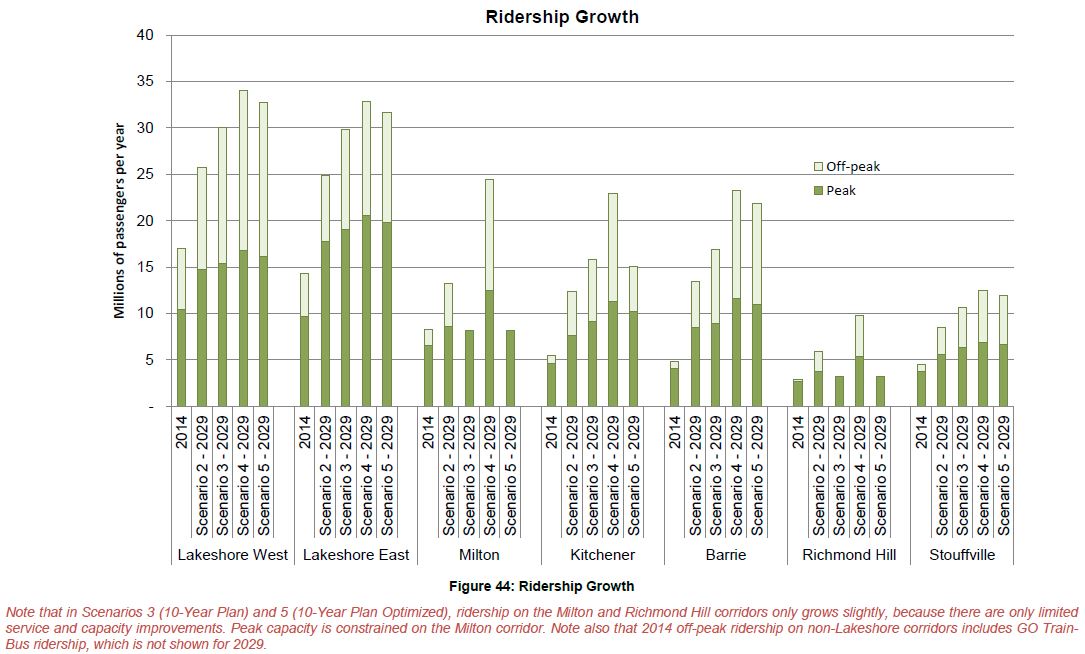
The projected growth for each scenario is shown in more detail in the following chart.
“Business Case” analysis is something of a black art, and much depends on assumptions used in the model such as the value of travel time, presumed changes in road congestion, reduction of pollution, and secondary effects such as reduced health care costs. For the five scenarios, the analysis produces the following result:
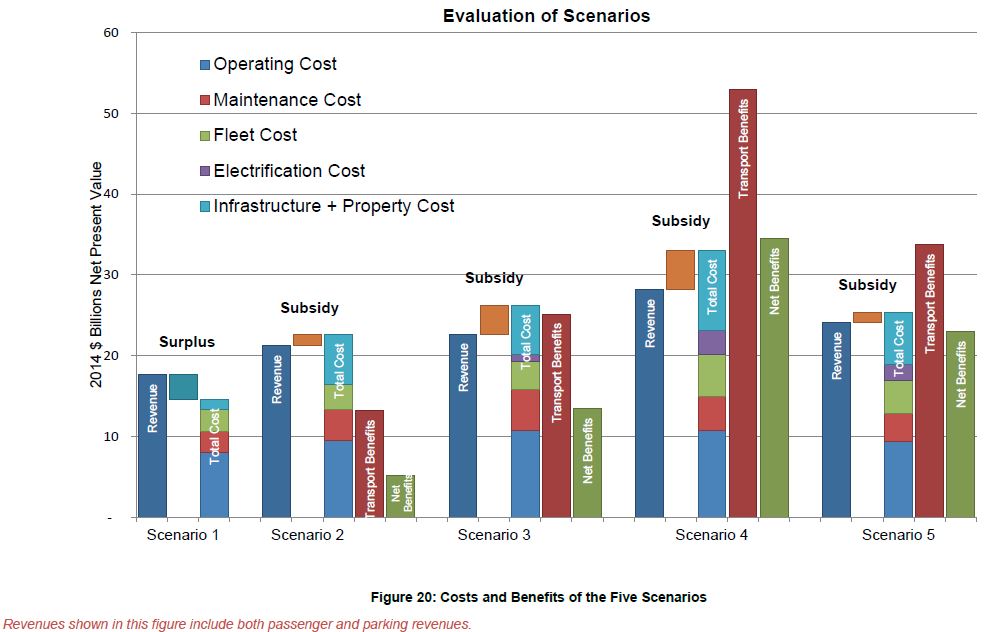
The business-as-usual scenario 1 produces a surplus, but only by virtue of minimal investment. There are no “transport benefits” because this scenario is the base against which others are measured. Other scenarios require varying degrees of subsidy, but the elimination of the Milton and Richmond Hill corridors reduces this quite markedly. However, the large decline in transport benefits between scenarios 4 and 5 shows how much network benefit goes untapped in the recommended scenario.
The electrification cost is a relatively small part of scenarios 3, 4 and 5, much smaller than the fleet, infrastructure and property costs. Although scenarios 4 and 5 provide considerably more service, their operating and maintenance costs do not skyrocket because of the substantial savings with an electrified (mainly EMU) operation.
Another way to look at the costs and benefits is to compare the base case with the four scenarios for improvement.
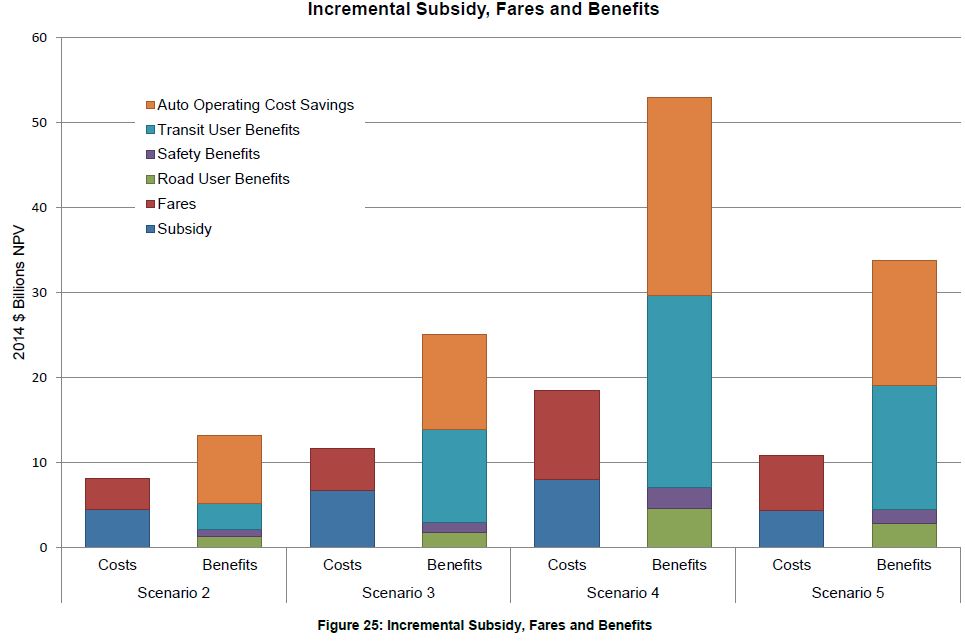
Again, the much more substantial benefits available with the full build scenario 4 are evident, but the cost is not at a level Queen’s Park wishes to undertake. “Transport benefits” are broken down here by type, and this shows an important distinction in the distribution of notional savings. By far the largest benefit accrues to to transit users whose trips become faster, and to former auto users who save on the cost of driving their cars. Benefits to road users in reduced congestion are comparatively small as are the “safety” benefits that flow from supposedly lower traffic volumes. These can easily be understood in the context that roads are full beyond capacity already, and the improvement of transit merely “buys” room for other drivers (and future growth) by shifting many trips onto transit. The idea that roads will ever be uncongested is a pipedream. In that sense, although GO/RER will make life much better for trips that fit well on the rail corridors, its benefit for off-corridor journeys (orbital rather than radial) will be considerably lower.
Journey times are projected to fall with the new network through a combination of frequent service (and thus shorter waits for a train) and improved speed with electrification. This will make transit more attractive for various trips, although the degree will vary from location to location. The report includes a chart of comparative travel times for multi-corridor journeys such as Richmond Hill to Hamilton where transit times will be substantially reduced. However, it is unclear whether the times used include access times at both ends of the journey, an area where autos have a distinct advantage for many trips. Transit’s ability to serve this type of trip will be constrained by the dispersal of origins and destinations across the region even if frequent trunk services were to fill in an east-west grid.
The uphill battle faced by GO/RER is illustrated below in a chart of mode share today and in 2029.
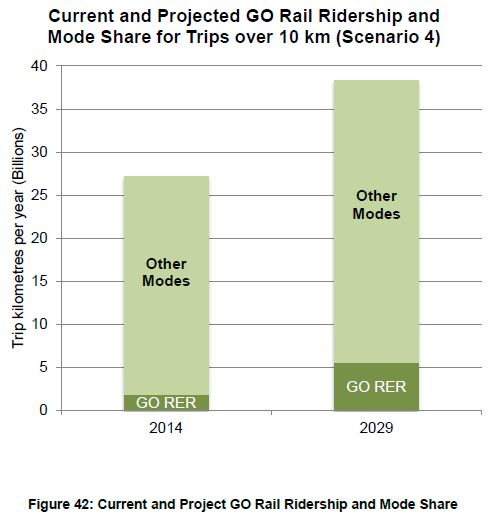
This chart would have been more useful if it included other transit modes and autos, but even as it is, this shows the relative scale of GO/RER growth versus transportation demand overall. Although GO/RER will roughly triple in the medium-to-long trip market, a rate much higher than overall trips, it will still be roughly one sixth of the total travel. The breakdown needs to be much better understood by market segment, and the importance of short trips must not be forgotten. The average TTC journey is under 10km, and so many TTC trips do not contribute to the “other modes” values above. Moreover, many of the “last mile” trips required for riders to access the GO system are short journeys on local transit systems.
On the financial side, the report presents a rosy picture of future profitability for the network. This is possible due to various factors including:
- GO’s existing fare-by-distance structure will generate more revenue as service capacity increases and infrastructure is better-utilized.
- Operating costs for the electrified network do not rise proportionally to the change in service level.
- The cost of capital debt service is not included as a charge against operations.
- Last mile services are borne by local municipal operations and is not counted as part of the GO/RER cost base.
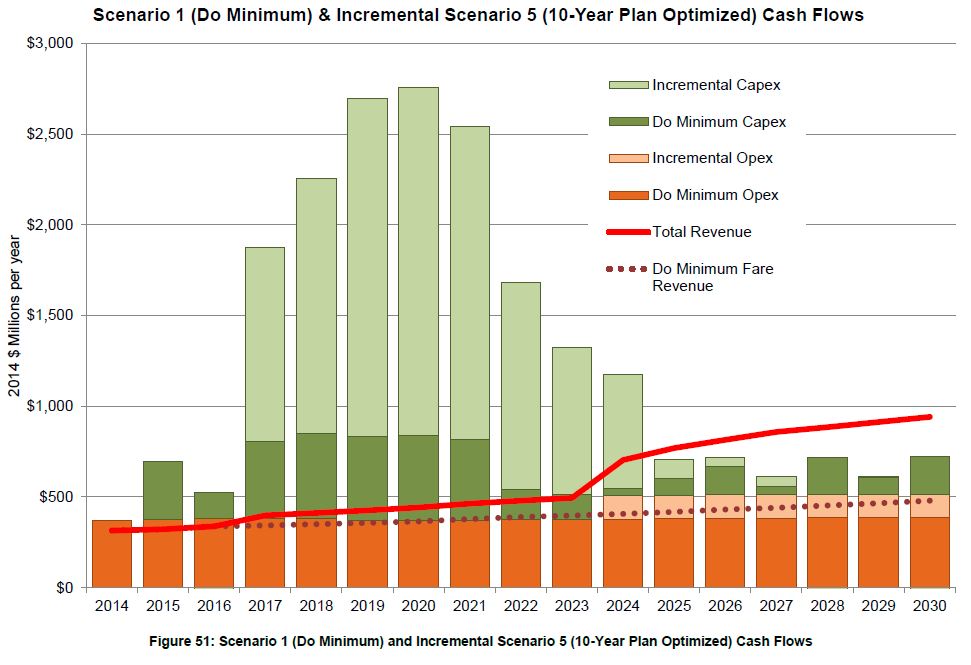
Whether this unexpected state, a transit service that actually shows a profit, is achievable will depend on many factors including political decisions about service, fares and subsidy levels, not to mention the basic task of simply building out the network to support the proposed level of service. As for local services, the report is somewhat evasive on additional local costs suggesting that all of these new GO/RER riders represent a market that might be tapped, and possibly even at no extra cost, by local systems. That really takes us into the realm of fantasy and shows the degree to which Metrolinx continues to avoid the delicate political question of subsidies to local systems. A further report on this issue is supposed to be in the works.
In future articles, I will turn to more details behind this study.
 Steve Munro
I prefer Jonathan English’s description.
LikeLike
I think the major issue with regards to the Eglinton LRT will be the simple issue of it not going far enough at either end. It should really have been extended onto Kingston road to make a proper connection with GO Lakeshore, and the Lawrence bus. The major issue here is, it needed to run, full length, ie airport to Scarborough Malvern LRT, ideally with that being a through running LRT. The impact would be much greater, with the Link to 2 GO lines and the replacement of the buses running on Eglinton to Kennedy at the east end. The link to the airport district, similarly would make a much larger impact in the west.
Steve: The extensions to Kingston Road and thence to UTSC, as well as west to the Airport, are integral parts of the new transit plan just approved by Council. When they will happen is still to be decided, but the need for these extensions is well known.
LikeLike
Thanks for the descriptions of your experience. Every picture I have seen of the system makes it look modern and new.
I did read that its transit cops enforce draconian rules on eating within the metro system. About a decade ago I read an article about a guy being tazered for eating a chocolate bar. He claimed he was finishing chewing his last bite, when he popped it in his mouth outside the fare paid zone. Transit cops said he entered the fare zone without finishing that last bite.
LikeLike
To my mind just this brings the Crosstown to its real potential. However, the fact that they will not be there right out of the gate, is a real issue, as these are critical to integration for regional transit, as well as being huge additions to the areas in question.
Steve: The motions passed by Council included a request that staff attempt to speed up both extensions so that the entire line can open in 2021.
LikeLiked by 1 person
It should be stressed that it should have a through service component rather than having every train running from U of T Scarborough to the airport. Maintaining headway on such a long line will be a headache which can be mitigated by having “local” components.
Steve: It should also be stressed that even at 30 km/hr (subway scheduled speed), it would take over an hour end to end. The issue is not to connect end point to end point, but all of the places in between.
LikeLike
The DC Metro infrastructure is so dilapidated they recently closed the entire system on a for 24 hours on a weekday for emergency maintenance. That maintenance check found so many critical safety problems that their administrators now propose closing down entire lines for 6 months to correct the issues. Not even a part of lines, things are so bad they have to shut down the entire line.
Imagine the TTC entirely closing the subway from Union to Finch for 6 months. They basically must expect people to die in accidents if they keep it open.
Steve: This is another example of the effect of low maintenance in a system living off of its original capital investment, and the basic fact that subways do not, no matter what anyone named Ford says, last 100 years.
LikeLike
If only they could move that fast on a DRL. This leaves as a major concern, the issue of the frustration of ridership core bound, due to a lack of capacity on Yonge. I wonder how much ridership will run through to Eglinton West, in order to bypass Yonge. One of the advantages here, is it does greatly shorten the trip to the other side of the line, and make this a real option further north. Hopefully there will be enough space, as they complete the projects on the Yonge Spadina line.
Steve: Eglinton has completed EAs for both extensions that only require amendments. The DRL has only now reached the point of a decision about its major alingment choice with more detailed work remaining.
LikeLike
To remind anyone who isn’t aware, it reached the point that people ARE dying in accidents several years ago. DC Metro seems closer to collapse right now that New York ever got, though I’ll grant it was easier to keep a largely manual system running with bubble gum and shoe string.
LikeLike
Or alternately anything can be made to last 100 years, so long as you do enough maintenance. Tell me Steve, what year did the first street car run on say Queen Street? Could we not say that this has lasted 100 years? I mean some serious maintenance was required (rebuilding the roadway) but well is this not the only basis that one can make a claim for anything lasting a really long time.
Steve: The Toronto Street Railway began operation on Queen Street in the early 1860s. Neither the cars nor the motive power (horses) are still with us, and the track has been replaced a few times too.
LikeLike
The Eglinton EA’s were for the original Crosstown plan which was LRT underground through to Kennedy Station.
City Council vote in 2012 against Ford’s subway replacement of the SRT and changed the LRT to surface from Leslie to Kennedy. A further amendment buried the LRT Don Mills station.
Steve: You are absolutely wrong on that. The east end of Eglinton was on the surface east of Brentcliffe except for an underground section at Don Mills (now Science Centre) Station. I refer to the May 2010 detailed drawings as my authority. The east end of the line was NEVER grade separated except in some fantasies at Metrolinx and among proponents of the RT technology.
Only after the Council vote for subway instead of LRT in October 2013 did Metrolinx hold the one and only public session in Scarborough describing the Crosstown LRT. The meeting questioned reducing vehicular traffic on Eglinton to 4 lanes and eliminating left hand turns. A project consultant even said he suggested using Civic Road as a “relief route”. That really brought down the house.
Steve: Again you are completely wrong. Public consultation as part of the Transit City project was held back in 2009. As for loss of traffic space, I know some at Metrolinx have since felt that the road should just have been widened, and that remains an option. Some space was expected to be obtained by the rededication of the curb lane from a transit only lane to mixed traffic during peak periods, but the lane is now an HOV/cycling/transit lane and this is unlikely to change.
In Scarborough, the Crosstown Eglinton LRT only brings riders to Kennedy Station and right now, that means loading the Danforth/Bloor subway contributing to Yonge/Bloor.
Metrolinx and SmartTrack cannot provide adequate headways at Kennedy and then there’s that question of a second fare.
At the two recent public sessions in Scarborough, Hilary Holden has said that the Eglinton LRT extension decision will be data dependent based on the new model. If the numbers aren’t supportive it will be killed.
Steve: Considering that the line is the centrepiece of the whole Scarborough plan and makes the one stop subway palatable to those who think it is a piece of crap, it is unlikely to be killed. Keesmaat, Holden et al would have a hard time explaining how the line was not really necessary when they made such an important point of including it in their plan. I doubt that Holden actually said that, and at best you have misunderstood her if not misquoted her.
I put this question to Hilary Holden, and here is her reply:
We are unable to discuss demand flows because we don’t have any published studies. I can only respectfully disagree with those who think the Eglinton LRT extension is a good solution. In my personal opinion, the demand is from northeast Scarborough, Eglinton is currently the sink of that demand to the Kennedy subway rather than using the SRT which is a cumbersome trip.
With a one stop subway all bus routes for east Scarborough converge at the Scarborough Town Centre (STC) (33 routes). McCowan and Progress will be a bus driver’s convention.
A Lawrence station is needed to relieve STC and because SmartTrack can’t deal with Lawrence riders wanting to go south.
I readily concede it is my conjecture and respect differing points of view because I have no data … but neither do you.
Steve: If you have been reading my stuff, you will know that the absence of data is a major concern for me, along with the revisionist history that routinely appears here in comments and in the political environment with bogus claims about the benefits of various schemes. I agree that the whole Lawrence East station situation shows how the plan has been bastardized. Only one of the two ST options has a Lawrence East Station, and trains would not stop there frequently enough to be considered as a replacement for the RT/subway alternative. Then there is the question of fares and transfers between TTC, ST and GO/RER services. Much of this has been glossed over.
BTW, City Planning no longer refers to DRL, it’s just the RL.
Steve: A rose by any other name …
LikeLike
They are going to use a variety of lengths, see this picture.
They will be using both 12-coach EMUs *and* 12-coach BiLevels during peak period (to add peak electric-locomotive capacity & diesel-route capacity). The 4-coach will be use for low-traffic offpeak.
These use rapid-join automatic European style couplers so offpeak trains can terminate at Union just before peak, dock into longer train, and depart as one 12-coach train during peak. It’s even explicitly mentioned as a possible option.
Negotiations with Transport Canada regarding the use of rapid-coupling operations, but negotiations with Transport Canada are already occurring because of RER possibly using European-strength trains (lighter structural strength).
LikeLike
For me, one of the most interesting aspects of GO RER is its requirement for an Enhanced Train Control system, which is already included in the budget for GO RER, for shorter headways. Secondarily, it also brings us closer to using European-style EMU trains. Currently, European style trains uses a lighter European structural strength, rather than FRA (Federal Railway Association).
The price quotes given are:
$200 million for PTC
$800 million for CBTC
And it’s already part of the GO RER budget…
(section 5.6, Page 145 labelled, Page 161 PDF viewer)
The negotiations with Transport Canada to use non-FRA trains will be extremely important to GO RER. I’ve selected several quotes from the big nearly-200-page RER Business Case:
(and more, cementing an ETC system as being germane to RER).
The Scenario 5 is the GO electrification (EMU scenario). If GO is receiving EMUs at all, then we’re getting a form of ETC too, needed anyway to milk the EMU advantages (short headways) — meaning we’d get CBTC to go with them.
FRA structural strength requirements are also possibly being relaxed (Table 30):
The word “important” and “costs” being applied to the discussion to Transport Canada …
Billions from 3 levels of government (… the SmartTrack pitch in to the GO RER budget …) results in many tapping feet and twiddling thumbs at Transport Canada, breathing fire down at them to make a decision on rules & safety requirements — and given the apparent intent of $800M spend for GO-wide CBTC.
… We might see European-style lighter-weight trains rolling on the GO-owned network.
LikeLike
Patience, my padawan. Niagara GO service is coming, there is an announcement coming sometime May/June. Keep tuned at twitter @NiagaraGO and http://www.niagarago.ca … I am an article writer about this, here and here. From several behind the scene sources, Niagara year-round GO service is coming, give it a few years — a few years later than you might like, but it is coming nonetheless. They successfully got a Welland Canal priority guarantee for 4 trains per day, which is borderline miraculous.
Here is a sneak preview.
LikeLike
Urban Toronto: Hamilton Rail Junction expansion last month (route to Hamilton/Niagara)
I have visited 5 different construction sites between Aldershot and Grimsby, which shows a large spend occurring towards extending Lakeshore West service further around the Golden Horseshoe, congruent to eventual year-round Niagara service. I can confirm actual money is being spent rather than empty government promises. Assuming present funding path isn’t rolled back, the question is no longer “if” but now “when”.
LikeLike
I am very curious about the reports of the construction bottleneck occurring because of Eglinton Crosstown LRT, Finch West LRT, Hurontario LRT, Hamilton LRT, and the $13.5bn GO RER initiative, all having overlapping construction schedules. Good time for anyone looking for rail-transit construction jobs, I’ll bet.
Not as frenetic construction as Beijing’s subway system, but this is a ballpark of an order of magnitude acceleration of rail transit/commuter construction about to be happening than usual. How do we squeeze Eglinton East LRT and Eglinton West LRT into this schedule?
LikeLiked by 1 person
Echoing some comments on the DC metro, etc – having ridden the DC, NY, SF (bart), and British systems, all of them differ from Toronto in that their network is superior, but the cleanliness, state of good repair, and most noticeably headways pale in comparison. Talk about squeezing the most you can out of existing trackage…I know of no other system that runs all lines on 2-5 minute headways without interlining!
DC was noticeably the worst in terms of state of repair – “deep” means a 5+ minute escalator ride at some stations, and the stations – while cavernously large – seem explicitly made of dimly lit, barren concrete. Union’s murals may be weirdly depressing, but at least they’re kind of pretty.
I’m glad to see RER going ahead, and while it would be nice to add some lines to new places, I think the biggest impact will be switching over to high frequency electric rolling stock as much as possible. At some point, they’ll have to deal with the elephant in the room that is Union’s capacity constraint, but if that problem can indeed be solved within a lifetime GO will have some incredible potential.
LikeLiked by 1 person
In terms of the subway, the cars, (including power) have all been replaced, we are replacing the switching, are in process of removing the liner, and fixing tunnels in other ways, have we not replaced the tracks for most of the subway? Oh and rushing to replace the switches. How much of the third rail has been replaced? Sounds like remarkably similar levels of maintenance. Like subway you can keep streetcar lines around too, just like subway, basically means replacing everything but the hole in the ground.
LikeLike
If you are looking at trip origins, you can use the same data that the current GTA models are based on (2011 Transportation Tomorrow Survey). It’s clear that the majority of travel in Scarborough stays within Scarborough, so anything that focuses on providing local service will be drawing from a much larger pool than anything designed to move people out of Scarborough to the rest of Toronto.
Are you talking about work for the Lewis St. Layover? If year-round Niagara service is started, it would look like the Kitchener extension at first, current trains relocated farther out and starting earlier and riders displacing those closer to the centre.
LikeLike
As a Niagara Falls native living in Toronto, I continue to be bewildered at “Niagara’s” obsession with a direct rail connection and parking lots. Somehow this circulates with excessive ignorance to thinking about transit as a tool for mobility.
To quote from the NiagaraGO group, the goal is “To bring daily GO service to Niagara.” Are these people unaware that there has been daily GO service for nearly 7 years? Somehow the fact that it’s provided by bus means it does not exist. Meanwhile, Megabus service between either Niagara Falls or St. Catharines and Toronto is already faster than the summer excursion trains, and that is bearing in mind some traffic slowdowns on the QEW and Gardiner. Converting a lane of highway to move people instead of cars with 1.1 occupants is an easy technical solution to that issue.
GO service to Niagara could improve within months with more robust and express bus-to-train connections. This would result in BETTER outcomes than train expansion in terms of connectivity and travel time. It would also allow us to devote resources to actual transit riders – not to creating “an attractive option” for people who will likely not use it. It seems to me that I never see those who are promoting train service to Niagara sitting next to me on the GO #12 route or on Megabus. I am confident that I will not see them on the empty train cars that people will realize are of little use if/when that happens.
Mark – I have no problem with creating a connection with West Harbour and adding another stop on the excursion trains. And I have no problem with more train service to Hamilton, although Hamilton is a test case in showing that a frequent and useful bus carries riders and allows mobility. Hamilton’s bus problem is that it necessitates the busiest parts of the highway network. Niagara’s problem is not the lack of a train, it is the near absence of local transit and the current slow and infrequent GO bus service. GO trains to Niagara might inadvertently help Hamilton, but will also waste resources that could instead be used to simply help Hamilton. Please, somebody put an end to this “Bring GO to Niagara” garbage!
LikeLike
Kudos to TTC for pulling this off, not even New York City does this. They have the numbers of stations and trains in spades, but we win on single-line headways. And it’s only going to get even better with sub-2-minute headway capability after the moving-block signal system is installed. Only a few lines elsewhere in the world is about to get sub-2-minute headways.
I used to live near Washington DC since my father worked in the Canadian embassy, so I have experience growing up near Washington DC. I loved the Washington DC metro system. It was really new in the early 1980s, with high tech automatic trains and stunning Brutalist stations. That said, admittedly, everything was shiny new back then! I do definitely remember the long 5-minute escalator — it’s like having an escalator all the way down to Don Valley River from the Prince Edward Viaduct (similar vertical elevation). This is at only at one station I remember though. I can see how that would be a huge maintenance headache, though.
For me, the station architecture is actually rather interesting (MUCH more interesting than TTC stations — back at the time most were more brightly lit than TTC stations. Unless they changed to crappy low-quality bulbs (hopefully not) or let them wear down quite dim, or run dim, to save money. I always loved the Washington DC stations, and could be freshened up a little rather easily. For example, color-tunable LED lights, to simulate sunrise/sunset — not carnival color, but nice subdued hues, even simple color-tunable color temperature, mixed with full-spectrum white lights — with themes reserved only for special occasions). But a simple static light orange or a static light teal can also break the monotony. They are up-lighted indirectly onto the Brutalist concrete, so this would be a perfect application for ambient LED color.
They definitely have a problem with having to overhaul the automatic train and the train system, given that it’s running off a very old system that is no longer manufactured, and need to transition to something modern.
LikeLike
They are also going to improve public transit between the new GO station and the Niagara businesses.
There is no direct GO service between central Hamilton and Niagara Falls.
You have to go all the way to an uncomfortable GO Park & Ride at the outer reaches of Hamilton almost near Stoney Creek in order to transfer to a GO bus headed to Niagara Falls.
It takes 2 hours to use transit between downtown Hamilton and Niagara Falls, but the train takes only 1 hour between West Harbour and Niagara Falls, and a bit less than that to St. Catharines. You also get transit access to StCat as well, not just Niagara Falls.
This is not excursion service but also commuter service. We have many of Niagara workers living in Hamilton (and even some vice-versa), and they are screaming for this, the train would be faster than driving in some cases, during 403 peak periods.
Hamilton also needs Niagara to justify the spend on Hamilton. West Harbour currently only has 50 commuters per day at the moment, having soft-opened on time for PanAm Games with only 2 departures per day (as an incomplete station, with no parking, and only super-early 6:45 and 7:15 trains) before a “real” 2017 opening. In normal terms, this is a crazy capital expenditure of $50 million dollars for just 50 commuters a day. 1 million dollars CapEx per daily passenger — one would say this otherwise may be stupid spending. But, this does not tell the whole story of the upcoming all-day GO service combined with Niagara service.
With the expected all-day GO service, the Hamilton LRT connection, and projections of roughly one-order-magnitude increase in passengers per day boarding/disembarking at West Harbour. We have the Hamilton 16 Express bus which may eventually be discontinued if express train service takes a similar amount of time (the Niagara seasonal train takes less than an hour between Toronto Union and West Harbour, due to its express nature)
Bottom line … Unfortunately, financially, for the Hamilton investments to make sense, Niagara needs to be part of it all. The Niagara-area mayors are pitching in 1/3rd of the cost already, and pre-emptively. The $150M Stoney Creek GO station ($35M station + $115M infrastructure) and the Lewis Layover Facility — now means only a mere 80 million dollars of capital cost needed to give Grimsby/StCat/Niagara regular daily two-way commuter service.
That’s less than 1/10th the original $1bn cost estimate. At this stage, this capex cost is a no-brainer compared to a 403 widening, given the Hamilton-Niagara commuting.
There are many places to spend $80M, but let’s consider we’re already spending $50M on West Harbour and $150M on Stoney Creek. Just only spending only $80M extra to automatically gain Grimsby AND StCat AND NigaraFalls daily commuter service is a NO BRAINER, full stop — Remember: West Harbour has only 50 daily commuters per day at the moment.
LikeLike
Correction in last post. 6:15 and 6:45 trains, rather than 6:45 and 7:15 trains.
That latter one is a downtown departure. The early nature of the first train timetable at West Harbour means I am not using West Harbour often (yet).
LikeLike
(I mistakenly made my last post according to the name of a blog I made to map minibuses in Zambia; normally I post here under my real name)
My question to you: how much in bus infrastructure could $80M buy? When I take the GO bus from Niagara the biggest delay is the 10 minutes dwell time at the Fairview Mall (St. Catharines) as people pay fares. Why is there not “the mere” investment of an off-board fare machine that would make improvements to travel by transit today?
I am aware – I have taken the HSR #2 from Barton & Nash on a few occasions for this reason. I was also an occasional user of the Coach Canada “direct” service that sauntered up Hwy 20. Your point is precisely why there should be bus service between Hamilton and a well-connected location in St. Catharines, starting as soon as 2-3 buses can be purchased. (According to GoogleMaps it’s 41 minutes from Fairview Mall to Hamilton GO via Burlington St.)
You are aware of how big a feat this is right? To the credit of Niagara Region, a new transit structure was created, and yet the service has been designed to be just sparse enough to be ridiculously terrible. The map of the route I take looks exceedingly like Jarrett Walker’s advice of what not to do. Compare this with this. When you factor in the investment that would be needed to connect any of the proposed stations with … anything … we are now at well over the rosy investment of $80M.
Where are these people screaming to go? To within walking distance of the proposed Beamsville Station? To within a BikeShare ride of the Niagara Falls GO/VIA station?
Investing in infrastructure to placate people who do not ride transit today – but scream about riding potential transit tomorrow – strikes me as a perfect recipe to destroy what works now, abandon what could improve upon what we have now, all while we see those same people continuing to drive tomorrow.
That’s terrible, terrible logic. And it throws good money after bad to ensure that public transit remains a mediocre travel option in Ontario.
LikeLike
The Hamilton and Niagara Peninsula situation is a strange one in many ways.
It looks like Metrolinx is paying to have enough new track built that getting more trains between Aldershot and West Harbour (and further towards Niagara) should be possible, if CN agrees to it. Has an agreement been negotiated with CN to enable this? Has the design work involved with the new construction been designed to be futureproofed for electrification and has there been any discussion with the mainline railways about bringing electrification west of Burlington?
When extending train service past Hamilton towards Niagara, what kind of market is Metrolinx envisioning? I don’t know where it would change from daily commuters travelling into Toronto to people commuting within the Niagara region and tourist/excursion service to Niagara Falls and the type of service needed by each group differs.
The location of West Harbour itself is unfortunate. I’ve only used the station once and it’s a long walk from downtown Hamilton and doesn’t seem to be integrated well with HSR. Metrolinx insisting on the LRT spur to service West Harbour is definitely understandable and a sensible piece of planning but the opening date of the LRT is a long ways away, and it’s far from a sure thing. A change in political direction in the municipal government in Hamilton or at Queen’s Park could cause the whole thing to be dropped just like how Transit City fell apart between Rob Ford and Dalton McGuinty.
The other end of the LRT is another issue. Terminating it at the Queenston Rd. / Main St. traffic circle seems to be a compromise between how far the existing funding would take the line and available land to build a terminal either in the circle itself or on the north side of the road where the City Motor Hotel and My Gym used to be. If this is as far as the LRT is going to go, will the route of the Parkdale bus be changed to meet the LRT there or is it going to be yet another HSR/Metrolinx poor integration near-miss? Or, since the Hamilton LRT was announced, Brampton gave up their section of the Hurontario LRT and the federal government’s announced new money for infrastructure spending along with today’s announcement that money previously made available but not allocated will be doled out over the next three years, has there been any movement on applying for funding from these sources to take the LRT all the way out to Eastgate Square as originally planned?
Integration of Go and HSR service could stand to be improved significantly. The fact that the last QEW Express from Toronto is scheduled to arrive at the Hamilton Go Centre at 12:30 AM while the last set of HSR buses is scheduled to depart at 12:20 AM so that the connection is scheduled to miss by 10 minutes and leave all the Go bus passengers stranded if everything runs on time pretty much says everything that needs to be said about the woefully inadequate co-ordination between agencies. Passengers should not have to depend on the Go bus consistently beating its scheduled running time and/or HSR drivers hanging around late to meet the last bus to make their connection. Nonsensical situations like this shouldn’t exist, period, and until the simple, obvious, easily fixed things like this are dealt with, both in Hamilton and across the GTA in general, claims about system integration between Go and the local transit systems are empty rhetoric.
LikeLike
From page 42 (58 in the PDF) of the GO RER Initial Business Case report:
The only thing that Metrolinx has demonstrated so far is their total inability to finish any project on time or on budget, and their lack of communication skills with affected neighbourhoods. I hope that they don’t consider UPX as a good example of their abilities. Thank god that there are still people within the old GO Transit division who know what they are doing.
It will be an interesting test to see how Eglinton Crosstown does for being on time and on budget. Their record with station upgrades and parking garages is awful.
LikeLike
This is true, if you’re in Scarborough and insist on riding only within Scarborough and disembarking only at a station. If not, you have the option of going to Eglinton Station, or disembarking at a number of other stops which connect with major bus routes, or are destinations of their own. This statement assumes that every rider in Scarborough rides transit to get to the subway to get downtown, which isn’t at all a fair representation of the current reality.
As for whether it will increase pressure on the Yonge line – it undoubtedly will. But so will pretty much every other major expansion of TTC service in Scarborough conceivable. The SSE? More pressure on Yonge. A Sheppard subway to the zoo? More pressure on Yonge. A complete LRT network in Scarborough? More pressure on Yonge. Enhanced bus service? More pressure on Yonge.
As long as Yonge remains the most easterly route into the core, traffic from Scarborough will be directed onto it. And as long as you’re improving service in Scarborough, encouraging more transit use, some of those new users will want to access the core. The only way to avoid this is to build the DRL, but good luck selling the notion that we’ve cancelled the Crosstown East to help fund the DRL, whether it makes sense or not.
LikeLike
I agree with that Metrolinx should go about and fix the easy things about GO and TTC and Transit systems (like connections, schedules and access) before starting grand plans . It would help prove they can handle managing public transit coordination and oversight . They need to build a good track record first otherwise many of these big plans seem risky . I’m really worried that all this is going to cost a lot of us our jobs because few of the stations or routes will serve neither where people work or where we live and that they will raise the costs of driving to support transit to the point of needing to quit . I have set myself up so I can walk to work but that in itself is not a reason to spend public money on transit .
LikeLike
Not disagreeing that transit options need to improve dramatically in St. Catharines/Niagara.
Ironically — several cities in the Niagara area is increasing transit ridership better recently than Hamilton is. Ridership in St. Cat increased (15.3%) almost as fast as Mississauga (19.8%) did while Hamilton public transit ridership increased only 2.98% from 2006 to 2012. (To Hamilton’s credit, there’s a Hamilton 10-year Rapid Ready plan that’s starting to gradually be implemented, hopefully the Canada-wide Federal pitch-in to all cities will be used for this.) On this note, St. Cat is doing better than Hamilton in winning more people over to transit — but all cities will need to pick up their game. Reportedly, it is proposed most Niagara GO trains would turn around at St. Cat, with only 4 Welland Canal transits per day, so ridership capture versus cost is better, given it’s not economically feasible to pay for the cost to Welland Canal for weekday offpeak trains.
Terrible?
Scarbourough Subway, SmartTrack, Eglinton Subway, Sheppard Subway. And yes, the monies spent on DRL studies over the last 100 years already probably exceeds the cost of $80M inflation-adjusted. Need me to keep going on?
Only if Niagara/St. Cat stalls in their transit improvements, which I do agree, are badly needed. But they are increasingly discussing it.
Buses are important and must continue. During peak, the bus is much slower than the train, no matter if you are doing Toronto-St. Cat/Niagara or Hamilton-St. Cat/Niagara. The train ridership dramatically increases during peak, and we’ve seen how overcrowded K
[Steve: There appears to be some text missing here.]
I do repeatedly read that they are talking about many transit improvements, that connects the rail station to downtown businesses. We’re not just talking about Niagara tourists, there are other GO ridership targets, like the existing bus that brings students from St. Cat station to Niagara University, which can be tweaked for better connecting service (improved frequency and/or synchronized train-bus transfer). After all, most Niagara GO trains will short-turn at St. Catharines.
Once properly rolled out as an all-day service, ridership on rail service can be superior to ridership on a bus service, and it’s a semi-express route that stops in core hubs (such as Hamilton, Burlington, Oakville).
I agree a direct all-day two-way bus route between St. Cat/Niagara Falls and Hamilton is needed, and probably would be more cost effective, but I disagree on the “good money after bad” — considering the cost of things like the Scarborough Subway.
Yes, I think bikeshare in Niagara/St. Cat would be an excellent idea, at least using a smartbikes system (which tends to cost half as much to operate as a traditional BIXI smartdock system — the SoBi breakeven tends to be only 2 rides per bike per day).
Note: We haven’t even accounted for the increase in speedier Toronto-NYC train service because of two simultaneous factors: The rail improvements that Metrolinx is funding is going to simultaneously help VIA/Amtrak — AND the recent new customs preclearance agreement between Canada and USA (which now includes provisions to allow trains to zoom through the US border with no stopping), given the US talk of improving the rail speed of the Empire Corridor. Without even raising railroad speed limits to HSR leagues at all, at least 3+ hours is shaveable off the journey, finally turning it into a time competitive to a drive, and potentially dramatically increasing the popularity of rail travel. Historically, rail travel increased in popularity when a rail route is optimized to compete with a drive. In other words, the $80M spend has some non-GO “collateral benefits” over the next 20 years. But I am excluding this paragraph from this discussion, given it being still worthwhile anyway.
It’s the section between Aldershot and West Harbour that’s tricky because both the Hamilton Rail Junction and Bayview Junctions are among the two busiest wyes in Ontario (and maybe all of Canada).
The section between West Harbour and Niagara Falls is relatively easy in comparison (a 4-track corridor with only 2 poorly-maintained tracks that has very few freight trains per day — reportedly it was as low as 3 freight trains a day at one point, though it’s climbing up from that).
Yes. They intentionally built the new Bay overpass higher in Hamilton to the prescribed height needed for catenary. All new pedestrian overpasses and road overpasses rebuilds automatically raise them to be high enough for electrification. The upcoming overpass rebuild of John St overpass in Hamilton (by CN) will also raise it to at least minimum catenary height, too.
The occasional vaporware talk of high speed rail on the Empire Corridor also is resulting in the same rule past the border. Even though it might not happen for 50 years, it is not impossible that GO RER electrification to Niagara Falls would automatically cause a distant-future “Acela Express” to come to Union station. Presumably, this would be 3-level government funding of a Welland Canal Tunnel to permit GO RER + Acela Express HSR to occur. Granted, this is very, very, distant-future stuff (possibly “not in my lifetime” stuff), but they are at least now protecting all new overpasses to be built at least to minimum catenary height now. That’s already happening as part of current specifications.
Nearer term, Hamilton electrification might happen as part of RER Phase II (the next 10-year plan), assuming favorable agreement with CN. A good textbook case study will be the Brampton subdivision which is owned by CN, but needs to be electrified for RER trains to reach beyond Bramalea — if CN lets them, then CN can potentially let electrification happen between Burlington and West Harbour eventually. (CP, anecdotally, is a more difficult negotiation matter at this time, but I could be wrong).
LikeLike
NOTE: The specifications for any bridge rebuilds (road overpasses, etc) are well-studied already. Metrolinx’s document for electrifying to Hamilton is this one.
This certainly didn’t make it into RER Phase I ($13.5bn) but with electrification coming tantalizingly close at Aldershot/Burlington, it’s a no brainer to continue negotiating with CN to do a short-hop electrification between Aldershot and West Harbour.
LikeLike
We *do* have a massive Ontario rail transit boom well under way:
– York TTC under construction
– Waterloo iON LRT under construction
– Ottawa Confederation LRT under construction
– Crosstown LRT under construction
– Many concurrent GO projects
And many funded projects waiting to begin construction:
– Finch West LRT
– Hurontario LRT
– Hamilton LRT
– Crosstown West LRT (redirected already-pledged SmartTrack monies from the chopped Eglinton heavy-rail corridor)
– GO Electrification (the biggest ever transit-related spend in Canada’s history)
And many others not yet mentioned (DRL, Sheppard East rapid transit, Eglinton Crosstown East, Scarborough Subway).
Almost any skeptic has to concede this is far better than the 1995-2015 time period, when there; and it is observed that this is roughly an order of magnitude increase in rail construction if all proceeds.
There isn’t any Crosstown East plans to cancel at all. In all likelihood, Crosstown East and DRL could be separate funding pots (e.g. one of them being funded by a different mix of governments, 33%-33%-33% versus 100% by one level). We won’t know more until ~2018. It certainly is a little further back in the rail projects queue, given the cloudy Scarborough crystal ball, but there *are* clearly more construction cats in the bag than the last couple of decades, not even including the not-yet-started projects.
TTC and Metrolinx is already doing it. The problem is they are taking time (see: Crosstown). But you do see a lot of Yonge-Bloor style combined TTC-GO interchanges already being constructed (see: the Downsview Park combined TTC+GO Station) and/or being designed already for the era of high-frequency GO services.
From the pipeline, I see roughly five highly integrated TTC+GO interchanges already funded (with Downsview Park already under construction). This does not count greatly improved LRT integration too (e.g. Hurontario-PortCredit, and HamiltonLRT-WestHarbour, etc).
There should be better oversight, and they are finally making decisions on UPX that they should have done long ago (UPX fare same as GO fare) and statistically, they are less likely to repeat such mistakes so quickly afterwards.
Perhaps what you are asking for is Metrolinx to slow down so they can “prove” themselves with the currently-being-constructed projects that meet exactly what you’re describing, before doing more. That said, GO still needs to proceed with the $13.5bn electrification that is essentially a de facto conversion of the almost the whole commuter GO system into a high-frequency two-way rapid transit system worthy of being superimposed on all subway maps — and with short waits competitive to many bus/subway routes.
Lakeshore East/West conversion to 30-minute all-day 2-way has been a success in 2013 (weekdays) and 2014 (weekends), with the commuter increase more than paying the cost of this conversion.
LikeLike
It’s also political. Both the city councillor and the MP covering Eastgate Square are both anti-LRT. Having two levels of governments against your LRT will make it hard.
In fact, it might be easier to extend the Hamilton A-Line fully from escarpment-to-waterfront using the Brampton funds, as suggested in another article I wrote.
LikeLike
There will indeed be only two trains a day (one in each direction) going through the new Niagara Falls NY station. But since that station will replace the existing Niagara Falls NY station, two trains to New York will originate there, and two trains from New York will terminate there. The station is not nearly the white elephant Ming portrays.
I’ve never actually spent any time in either Niagara Falls, but as I understand it, the new location is believed to be more convenient for passengers than the existing one: nearer downtown, for example. I don’t know enough to judge that claim, but there it is.
I suspect New York State wouldn’t mind having more New York-Niagara Falls NY trains, and there may be plans for that somewhere. Certainly there is a lot of work going on right now on the Albany-Buffalo main line, to make it both legal and safe to run trains at 110 mph rather than the present maximum of 79 mph, funded by the State.
None of which has anything to do with GO Transit, but I thought I’d set the record straight, or at least straighter.
LikeLike
Electrifying the GO trains sounds like a strange idea right now. Electricity prices are supposed skyrocket in the near future, there are no more coal plants, wind only generates on windy days, and nuclear? Diesel on the other hand works. With poor access to a station or slow boarding at Union why would anyone care if the train is electric? Are we going to get brownouts at home while GO trains are electric? I think we should just run ordinary diesel GO trains until we know if people take to it and if it actually helps our society and economy. The Lakeshore line is the only line that has any history of usage all day and it is only half hourly, not a real reason to electrify unless there is cheap electricity available.
Steve: Actually even with higher power prices, GO will still be ahead of the game with electric operation because of significant savings in other parts of the operation. The amount required to power the GO network is trivial compared to the overall load in the GTHA. If you’re worried about brownouts, you might start worrying about all those subway trains that will run nearly empty on various extensions now underway or planned. They represent a lot more load than the GO trains will.
LikeLike
Yes, however, the worry about rolling out too much too fast is still valid. Increasing frequency, to the limits of what can be done today, and beyond makes sense and is right there on Lakeshore, but well, more traditional GO trains, double tracking, and separation are what is required in lots of other places.
Are we in danger of doing in GO what we have done elsewhere, too big, too expensive, too little return on investment.
Steve: There is also a question of economy of scale. The five lines now targeted for electrification (LSE, LSW, Kitchener, Barrie, Stouffville) will have the majority of service on them for the foreseeable future due to various constraints on the Richmond Hill and Milton corridors. With enough electric trains, it makes sense for one shop (the new one in Durham) to handle electric equipment while the other (Willowbrook) remains a diesel shop.
LikeLike
Yes but how far are we actually from needing electric on any but Lakeshore East and West? Yes, I think we need to expand service on Stouffville and Kitchener, but well, does that not mostly require improving track conditions, double tracking, and eliminating level crossing. Would just having 10 minute service from say Brampton to Stouffville, actually require more than just the trains, that could be released from service on Lakeshore as the service was converted. Yes, it is more cost effective all at once, but are the other 3 lines actually best use of money, in the priorities for the GTA? Barrie would greatly benefit from the acceleration, but where else could the money be spent? Is this costing a couple of LRTs that would concentrate growth, rather than creating more sprawl further out?
Steve: The planned service level between Bramalea and Unionville is already better than one train every 10 minutes, not including UPX. Depending on whatever sort of deal Metrolinx can eventually work out with CN to extend electrification beyond Bramalea, frequent service is likely to be extended further west on that line. I would not be surprised to see that corridor with service comparable to Lakeshore West once capacity and technology issues can be worked out on the shared section.
LikeLike
Brownouts can happen whether electric trains are empty or full. I have also wondered how much electricity is used to power those big flood lights all along the QEW vs an electric GO train ? Every automobile has it’s own light source after all. A train might use more, but those are big lights. I do believe we have to conserve electricity here in southern Ontario until we find a cheap reliable supply. Also I do believe we need the relief line downtown, but it is a relatively short distance with a high rider expectancy.
LikeLike
We know people take the GO train, just look at ridership growth. If we want more people to take it then we have to improve the service’s speed. The cheapest way to do that is with electric multiple unit operation. Look at the savings for EMU over diesel or even electric locomotive hauled trains. Montreal’s Deux Montagne line reduced running times from 55 to 35 minutes on the tunnelled line with modern EMU and similar improvements have been seen elsewhere. The saving is not in the electricity but in the operating costs from running fewer trains and shorter ones in the off peak. It is very difficult and labour expensive to reduce a 12 car locomotive hauled train to 4 to 6 coaches in the off peak and build it back up.
It takes a number of people to disconnect the electrical, communications and MU cables as well as turn off the air cocks on the brake line. Then another locomotive has come to haul it away but brake tests must be done. At the start of the evening rush hour the train has to be made up again. This may also be repeated after the p.m. rush hour. This job usually uses 5 or 6 people besides the crew of the train part that is staying in service.
With EMU’s the air, MU and communications connections are made through the automatic coupler, a 2 person job. One person gets in the cab of the front part and one in the cab in the train where the break is to be made. This person pushes a button and the sections are uncoupled. The brake test can be done as part of the automatic uncoupling. At the start of the p.m. rush the 2 sections are driven together and a button is pushed; train is coupled.
Granted as you mention there are still other problems to work out but the cost of electricity is not one of them. Who knows what oil prices will be in 10 years.
LikeLike
The time savings on the Montreal line is not because it is electric, the older slow train was also electric. Take note of the Lakeshore West line, in 1980 it took only 37 mins with older diesel trains to get from Oakville to Union all stops. Today it is 45 mins same stops (and the on time hasn’t been all that good when I’ve ridden it). So that means the “new” electric train should be considerately faster and more reliable then the old time to seem worth it. I also hope the electric trains will work in our adverse winter conditions better then diesel trains, which is also hard to believe. The inability to shorten and lengthen GO trains was something built into them, it doesn’t have to be that way. I think they should invite other operators besides Bombardier to run more GO trains to give competitive choices for the public. The ticket price is set by GO but the service level would be competitive, the the operators that attract most riders being best compensated. This may sound inconvenient for Metrolinx or GO but it might benefit the traveling public.
Steve: Bombardier is not responsible for the overall service level or management of the lines — that’s a GO Transit role. They just provide the on board staff and maintenance.
LikeLike
I may represent the younger generation, but I think it’s lunacy to think diesel is better than electric in any way possible. Last I checked oil reserves and global warming were much bigger concerns than brownouts in southern Ontario, and EMUs (or electric locos to a lesser extent) had the advantage in every single category – cost, speed, possible frequencies, etc. Never mind that electricity cost is forecast to fall over the coming decades while oil while continue to climb, inevitably, until it ceases to exist at all. The electrical usage, spread across the service area, will be a literal drop on the ocean – and even if there is some incredibly unlikely “electricity shortage” (ha) then we can just build a diesel generator to overcome. After all, a “Diesel” locomotive is actually just an electric one with an on-board diesel generator…
On a less shocking but still somewhat surprising-to-me note, I don’t think building “too much too quickly” will be an issue. At least, if it is a problem, said problem will stem from not having enough integration with local transit networks IMO. Echoing an earlier comment on a potentially different thread (sorry Steve), most of the world is used to *subway* headways at 5-15 minutes, which EMU would reach – we’d turn into more of a BART or WMATA than a regional rail service. And if local transit integrates well both service and fare wise, I’d actually think a larger concern is that the service won’t be enough! Such a fundamental increase in usability should drive significant ridership growth, particularly if they increase station count closer to Toronto and run some express trains…but again, this does all rely on Metrolinx and the TTC doing all the small things like timing transfers, integrating properly, etc correctly. It’s a nice dream though – a train coming as often as your bus, with timed transfers right where you need…
LikeLike
Yes, but even at that, going to 6 trains peak hour is a huge jump from current, 8 would be supportable without electrification. That is a very large increase in service. While I understand still more is required, other transit services are equally important. Oddly, I think the ability to integrate places like Malton in all trains, and really high quality local transit for the airport corporate district is really important, I have an easier time with the idea of spending more of the early money building linking services. Support more local transit, more in Toronto LRT, more local transit service for existing GO stations. The simple ability to add 4 trains on this line, should be enough to hold for a reasonable time, having nearly 8k peak hour growth available seems like quite a lot. Can I see how having capacity will pull growth, yes, and perhaps so quickly as to overwhelm that, but still it is the equivalent of 4 more lanes of traffic into the core. I see no choice in the case of Lakeshore, but unless there are large dollars from the Fed, very few dollars will need to accomplish a great deal, I worry, spending too many on electrification will mean not enough for more critical projects. Do I fully believe a train every 5 minutes and serving all stops will be required? Yes! The question in my mind is: Are there other project whose funding needs to be ahead of this?.
LikeLike