
Metrolinx has published a set of documents containing the “Initial Business Case” for the GO Transit Regional Express Rail (GO/RER) network.
Updated Dec. 13, 2022: Due to a reorganization of Metrolinx’ site, the reports are no longer available there. However, I have archived copies of them. The Summary and Full Report links below are to my site. The Appendices are not yet available as I must break them into chunks small enough that WordPress will allow them to be uploaded.
- Summary
- Full Report
- Appendices A-J
- A: Corridor Specifications
- B: Corridor and System Schematics
- C: Model Assumptions and Results
- D: Record of Assumptions – Direct Demand Model
- E: Financial Performance of RER Systems
- F: Sensitivity Analysis
- G: Wider Economic Benefits
- H: Line Speed Analysis
- I: Environmental Assessment Program
- J: Fare Structure Issues and Solutions
- Appendix K: Station Access Analysis
[Note that except for the Summary, the documents are large PDFs.]
This article begins a review of these documents and of the various RER proposals examined in the Metrolinx studies.
Overview
Work on this review of GO/RER began in April 2014 following the announcement by Queen’s Park of its commitment to the RER concept. Unlike previous reports, this study looks in depth at all of the GO corridors, and reviews the technical issues associated with both increased service and electrification. This is not a final review, and much engineering work remains to be done, but there is a great deal more information now publicly available as the basis for discussions.
These documents were completed sometime in 2015 as is clear from references to future events that will occur later in the year, notably reports from the City of Toronto on SmartTrack. That scheme gets only passing mention, some of it the usual political cover story, because the specifics had yet to be decided. Exactly what the incremental effect of ST will be beyond the proposed GO/RER configuration is not yet known. Preliminary information in City reports implies that ST will amount to considerably less than was foreseen by the Tory election campaign, possibly as little as a few more stations and some sort of TTC/GO fare integration.
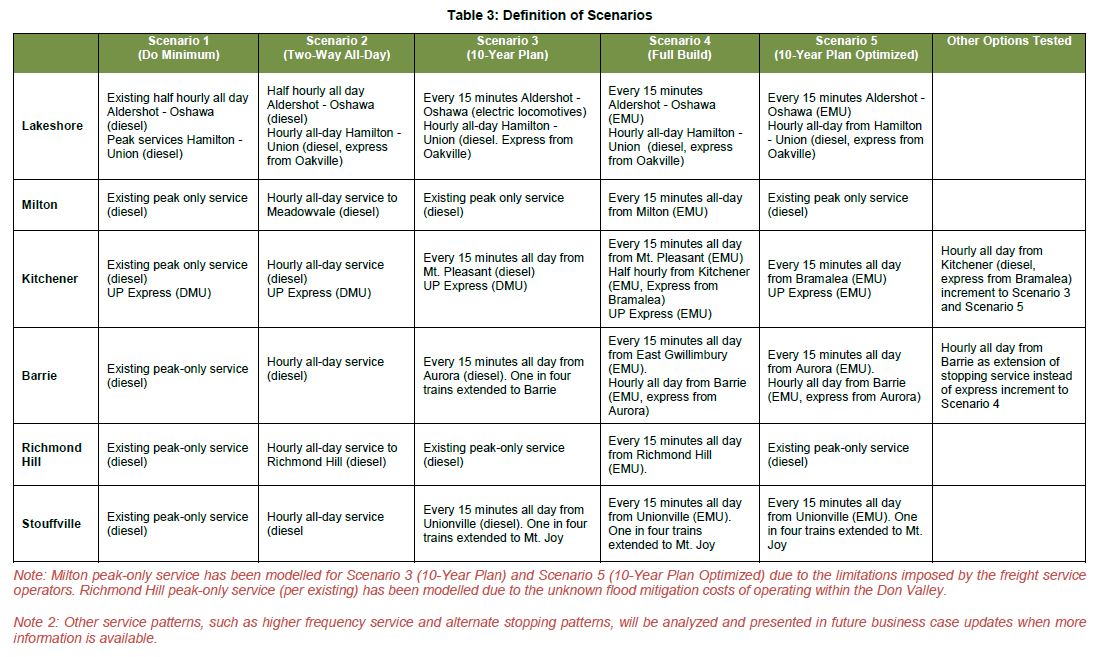
Five scenarios were reviewed to compare the effects, benefits, costs and technical issues associated with various possible future networks.
- The “Do Minimum” scenario provides only marginal peak period improvements to the existing system in response to projected demand growth, but with no electrification. This is effectively a “business as usual” model for the base case.
- The “Two-Way All-Day” scenario expands off peak service, but with diesel operation and no electrification. This is a minimal level of service expansion.
- The “10-Year Plan” would provide frequent service on the inner parts of some corridors, but with limited electrification.
- The “Full Build” extends beyond the 10-Year Plan to provide frequent service on the inner parts of all corridors, and with full electrification.
- The “10-Year Plan Optimized” extends the scope of electrification beyond that contemplated in scenario 3.
This progression implies a certain sequence of events during the study where a full build is impractical and the original 10-year plan was not aggressive enough with electrification, a key component of the announced government direction.
The estimated capital costs rise from $5 billion for scenario 1, through $10b, $12b and $19b for scenarios 2 to 4. The price tag for the latter is well above what Queen’s Park has available, and scenario 5 was developed with a projected cost of $13.5b. All but scenario 4 are said to be achievable by 2024. Given that it is now 2016, and this is a 10 year plan, that date probably requires some adjustment.
Scenario 5 is the 10-Year Plan Optimized, it represents significant progress towards implementing the service levels of Scenario 4. It goes beyond the investments and service included in Scenario 3 (10-Year Plan), with electrification also to Bramalea, Barrie, Stouffville and to Pearson Airport. This scenario and the resulting recommended RER program has been defined to maximize return on investment while mitigating risks. Depending on resolving various challenges, it can be delivered over 10 years for approximately $13.5 billion. It does not preclude, but rather prepares for, services to Milton and Kitchener to be eventually electrified and frequent all-day services introduced when agreement is reached on co-existence of GO and freight on these privately-owned corridors. [p. iv, Full Report]
Annual ridership is expected to go up by a factor of 2.5 over the coming 15 years, but operation costs will not rise at the same rate. The study postulates that an operating profit would be possible, eventually, but that will depend a lot on future fare policies, and on the evolution of trip patterns (length, direction, average fare). The ridership model foresees that “hundreds of thousands” of auto trips would be replaced by GO ridership each weekday comparing scenario 5 to scenario 1. The proportion of trips and its relationship to expected growth is not specified in the Executive Summary. (Possibly in the demand modelling later.)
The rate of demand increase on GO overall is projected at 2.3% which is lower than recent levels, but allows for some leveling off in a more mature service.
One big issue is the problem of getting riders physically to and from the GO trains. Either this will be done with substantially improved local transit services (an option that brings many issues associated with fare integration and cross-system subsidies), or with parking. The cost estimates include $750m for 15,000 new parking spaces, or $50k per space. At that scale, simply paving empty lots is not an option. The study notes the possibility that some of this cost “may not be necessary if service integration and fare integration with local transit services can be improved”. [p. v]
Those 15,000 spaces represent nowhere near the ratio of new parking spaces to existing facilities that the projected ridership growth would entail if everyone arrived by car. Parking charges are listed as a way of raising additional capital for the RER project, and of encouraging a shift to ride sharing and public transit feeder services.
It is amusing to read about the benefits of proven technology, something for which Ontario has not been noted in past endeavours.
Virtually all of the works are within existing rail corridors, so environmental and community impacts are limited mostly to noise and vibration. RER will use proven technology that is working around the world. [p. v]
Descriptions of RER cite similar operations in more than 50 city regions worldwide [page 6], and list a number of factors that simplify implementation [p. 4]. I cannot help thinking of how badly past studies have downplayed the benefits of LRT which bears a family resemblance, but at a local rather than a regional level.
The first electric railway opened in 1883 (the Volks Tourist Railway on the Brighton seafront in the U.K.). Ever since that time, electric traction has increasingly become the default source of power for the world’s more intensively used rail systems. [p. 14]
Finding this statement in a Metrolinx report is quite amusing considering some of the remarks made during community meetings on electrification before Metrolinx and GO “got religion” on the subject. The report skirts that debate by observing that GO is now at the threshold where electrification makes sense:
Until recently, diesel traction has been the appropriate mode of traction for the GO rail operation. However, the service enhancements envisaged in the near future will take GO rail beyond the threshold of service intensity appropriate for electrification. Continued use of diesel traction will become a source of financial and economic inefficiency. [p. 14]
Metrolinx intends to pursue discussions with the railways regarding the upgrades needed on their trackage, and also intends to review “modern, proven technology” with Transport Canada and the railways.
This is an “initial” analysis, and changes are likely depending on the evolution of expectations, changes in provincial funding, and who knows what political meddling that could arise.
A decade is a long time in politics, and the likelihood that the current governing parties or councillors will still be in place at that distant time is minuscule. Moreover, changes could come at any level part way through the project, and only a very strong, unshakeable commitment (i.e. very popular and difficult to derail) is likely to survive. This is not simply a case of showing up for a photo op or two with a gigantic prop cheque, but of supporting the plan for the long haul, including building a constituency that can survive beyond current governments. The arrival of a Ford-equivalent who simply wanted to start over with his own plan would be disastrous.
The Vision of Regional Express Rail
This section of the report begins by recounting the history of transit in the GTHA, of the formerly high transit mode share when more jobs were concentrated in central Toronto, of the rise and subsequent fall in subway construction, and of the growth of GO Transit for core-bound commuting trips.
At one point, there is even a claim that GO carries as many people into the core in the peak as the subway does, but this is hard to credit given that total one-way GO ridership is only about 90k. Possibly a restricted definition of the “core” has been used that omits a wide area served well by the subway, but less so by GO. In any event, growth of GO capacity will increase the commuting load it can bring to downtown Toronto.
Ridership into the core area has been growing by transit, at least during the peak period.
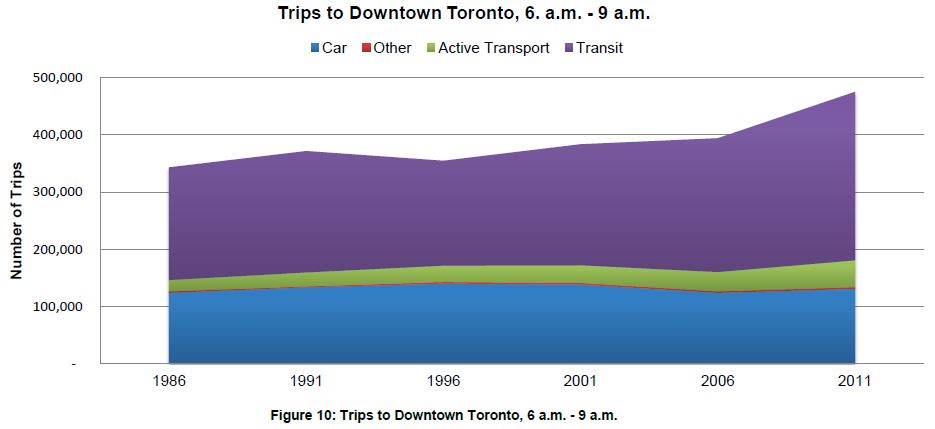
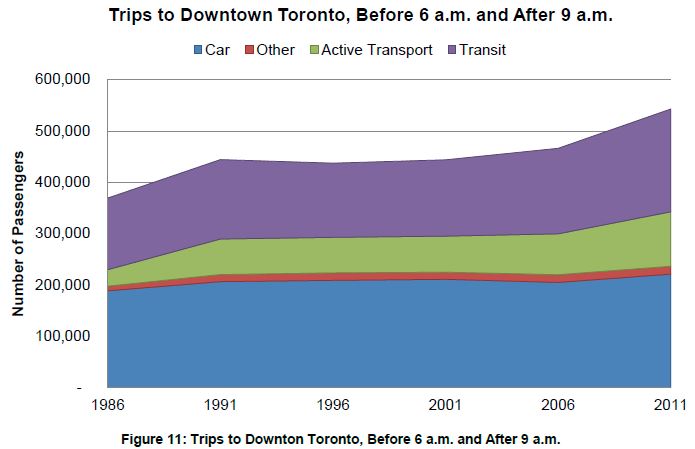
While “Active Transport” (walking, cycling) is a factor with all of the new housing downtown, it is small compared to overall figures during the peak. Their role is greater during the off-peak period, possibly reflecting a different pattern of trip origins more conducive to these modes. (Beware of differences in the vertical scales used in these charts.)
(The Transportation Tomorrow Survey updates these data every five years, but the 2016 numbers will not be available until 2017. The evolution of Active Transportation numbers will be interesting to see.)
Auto trips are growing outside the peak as anyone now dealing with off-peak congestion will know. GO, a peak-only service, has not seen much of the overall increase.
Between 2006 and 2011, average daily car trips to the downtown outside the morning peak period grew by 16,000, compared with less than 4,000 by GO Rail. Meanwhile, over 55,000 new trips were made by walking, cycling and TTC. [p. 10]
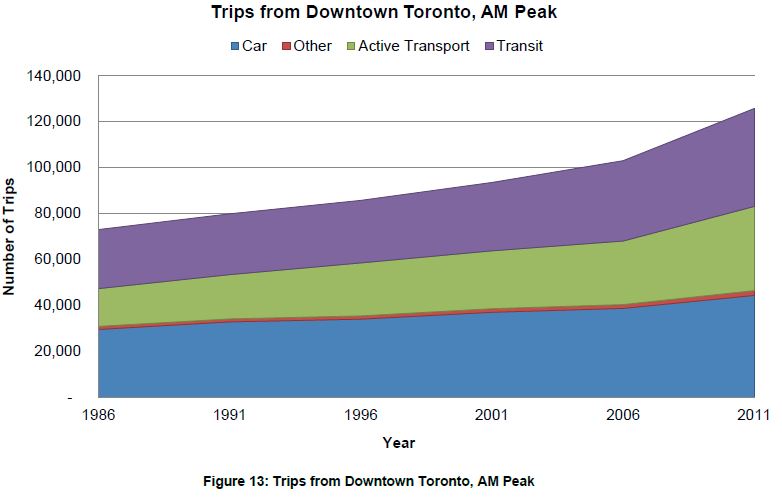
Trips from “downtown” are also growing strongly after a long period when the numbers were almost flat. Again, this will bear watching in the 2016 data when it is available. However, we must be careful about the definition of the “downtown” area which could very well exclude a good chunk of the central city such as the University of Toronto campus. It will be important to distinguish between “outward” trips that are simply among various locations in the old City of Toronto, and those to suburbs where GO/RER would make a difference.
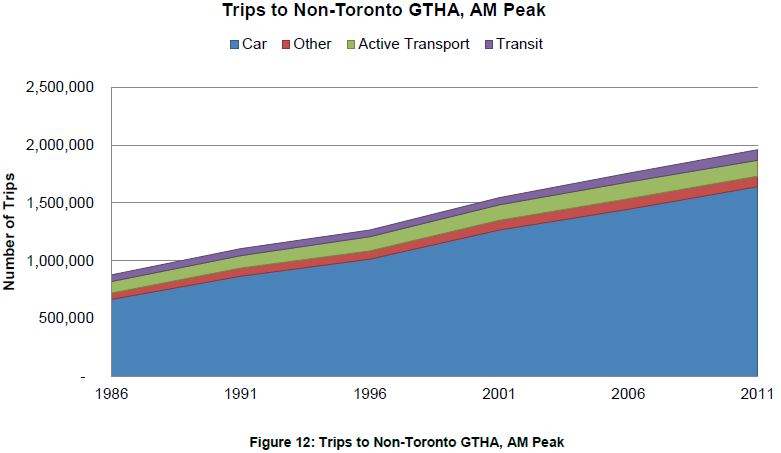
Finally, there is the question of commuting that is not focussed on the City of Toronto. The total trip count is very large, and it is almost entirely served by private autos with little sign of growth in other modes. This is a huge challenge for both the regional rail network, and for transit systems within the communities outside of Toronto.
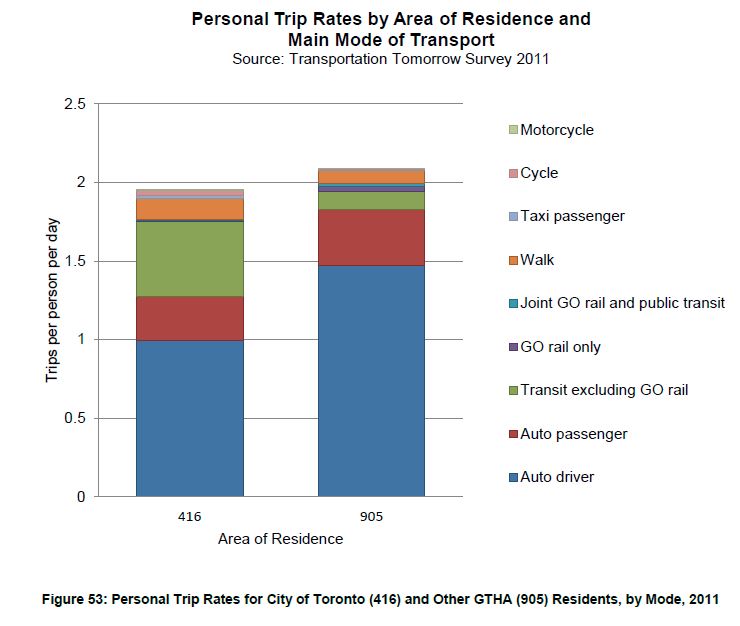
The challenge for transit in the overall travel market shows up in the proportion of trips by each mode taken within Toronto (the 416) and in the region beyond (the 905). GO rail services only have a tiny sliver of the travel market, lower even than walking. The problem here is that this is a chart of all trips from the most trivial journeys to the corner store to a long regional commute. A later chart looks only at trips over 10km, and this shows a different picture. All the same, transit has a lot of work to catch up with auto travel, and its credibility is hampered by decades in which transit simply was not an option for much travel throughout the city and region.
GO’s fleet plans include their current diesel-hauled trains with 10 or 12 bilevel cars, but also 4-car EMU sets running in 4, 8 or 12-car consists. The fleet required to operate the basic off-peak service would be EMUs, with electric locomotives hauling existing bilevels for peak service on routes that are electrified. [p. 20]
The comparative operating costs of different train consists are quite striking.
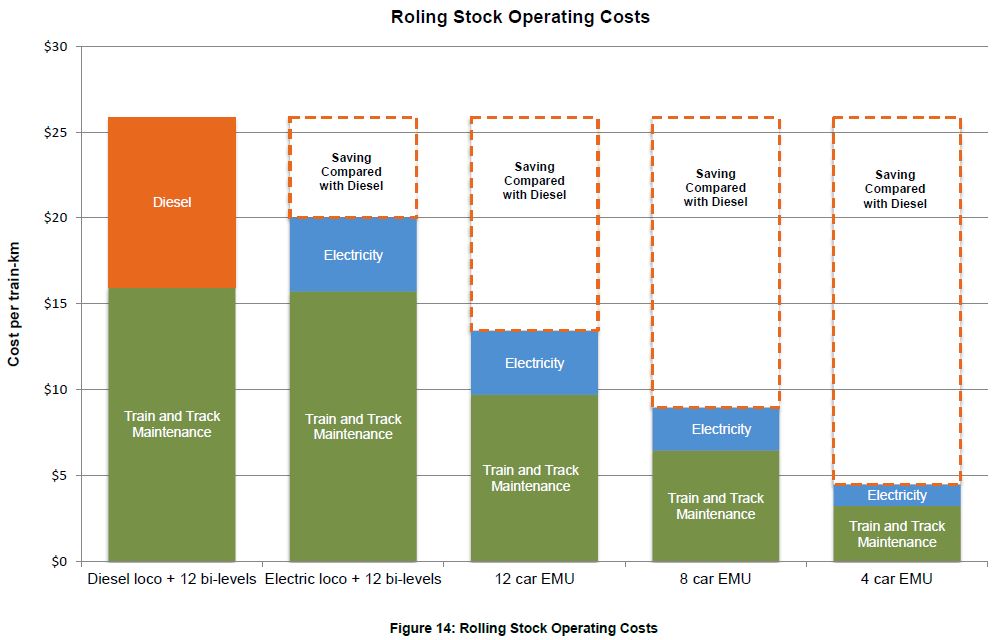
Although there will be additional costs once RER is operating, the report claims that additional revenue will more than offset this because fare revenue goes up more than operating costs, especially considering the savings available with EMU operations over the current diesel-hauled trains.
Many service options were tested, and the permutations are too extensive for an article here. I recommend that interested readers download the full reports for all of the details. As an overview, here is a table of the principal options studied (click to enlarge):
For the Lakeshore corridor, as an example, there is a much more detailed look at the options:
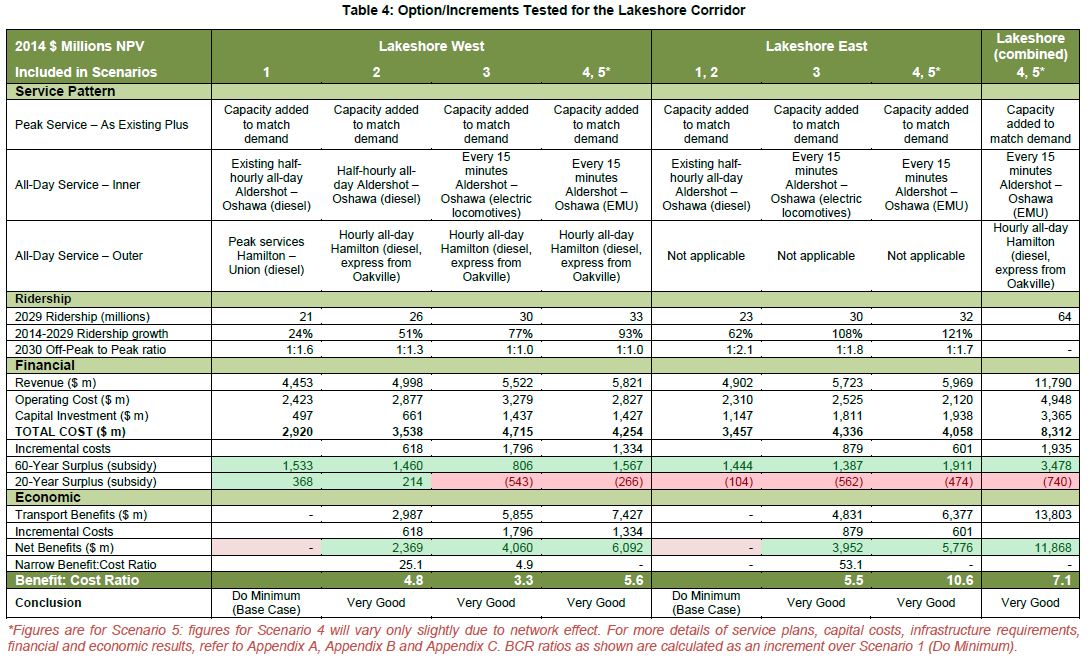
These figures show a very high return on investment assuming that one agrees with the methodology. Some points here are worth noting:
- Although the base 2014 ridership is not shown, it can be derived from the 2029 ridership and the percentage increases this represents. For Lakeshore West, the 2014 number is 17m, and for Lakeshore East it is about 14.5m. The scale of ridership increase has profound implications for the capacity that will be required to and from feeder stations.
- The revenues and operating costs are Net Present Value (NPV) figures over the life of the model, not one-year data. However, the ratios show that different service models produce different riding and revenue patterns. For example, for LSW scenario 5 has 33m riders/year by 2029, or 57% more than scenario 1. However, the revenues are only 31% higher suggesting that proportionately more riders in scenario 5 make shorter trips.
- The operating cost increment is small beyond the base case for LSW, and for LSE it is actually cheaper to operate the scenario 5 service than the base case.
- Capital investments are higher for scenarios with more service, but these are more than offset by the benefits imputed from shifting so many riders onto the RER network from autos.
Similar tables are included in the report for all of the other corridors and service options.
A common thread in all of the analyses is that the more aggressive service options tend to do best on the Business Case Analysis, probably because the additional ridership, revenue and benefits (trip diversion to transit) for well-used infrastructure more than offsets the capital investment required. Each of the lines reaches a point where better service produces proportionately more demand. If this is what might happen looking only to 2029, this has important implications for network growth in the decades beyond when RER really will operate as a “regional subway” rather than an occasional commuter train.
Growth to the full scenario 4 is constrained by the available provincial funding, and the tactic is to get as much value as possible for the $13.5b envelope Queen’s Park has announced.
The service plans for scenario 5 are summarized in the charts below.
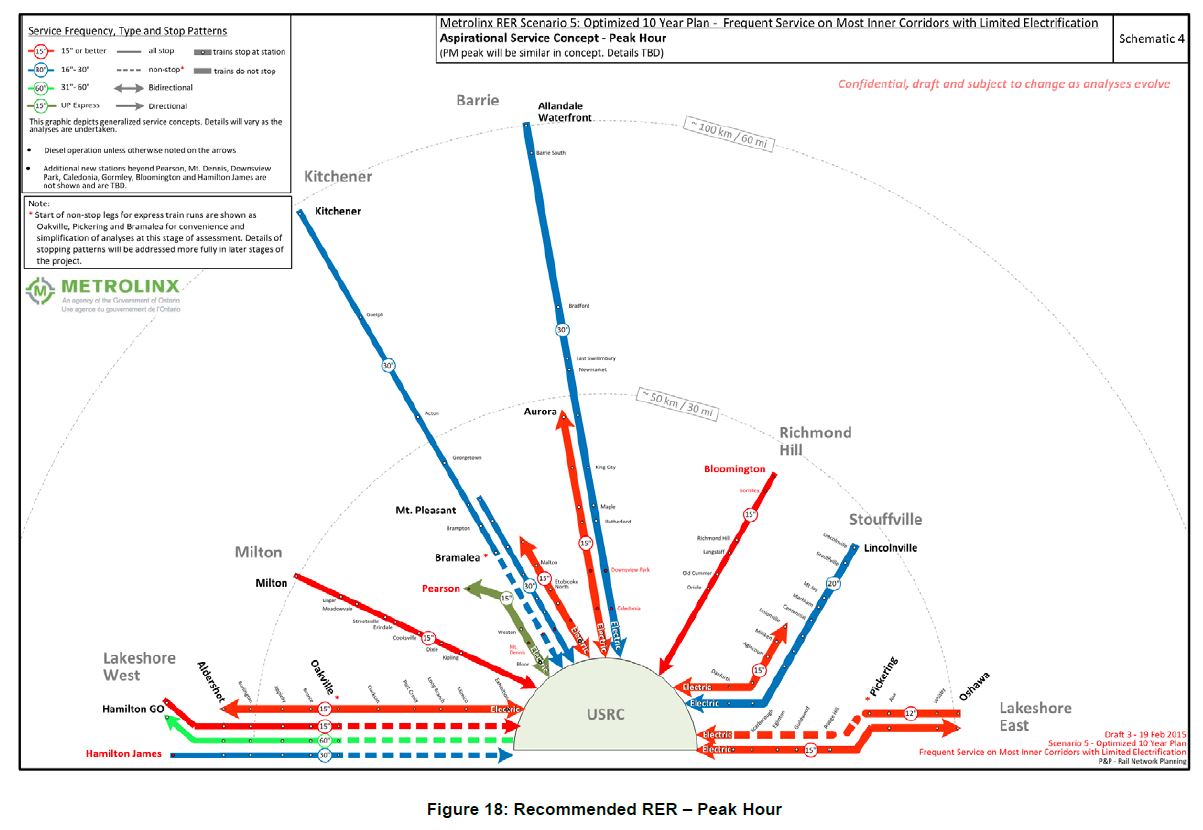
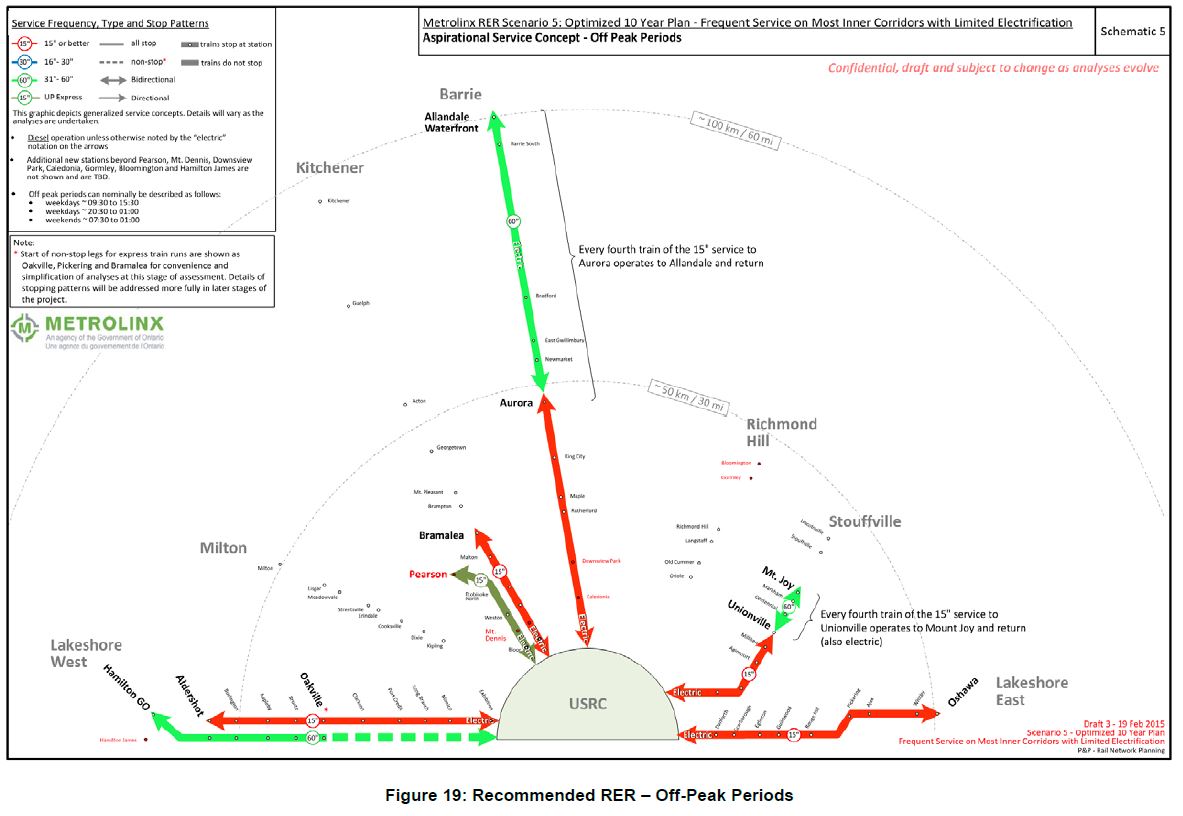
The colours indicate, generally, the level of service with red being 15′ or better through blue and green to the less frequent services. The Milton and Richmond Hill corridors remain with only peak period, peak direction service because of constraints on operation over CP and CN trackage, as well as the need to floodproof tracks in the Don Valley for the Richmond Hill service.
As a point of comparison, here is the “full build” scenario 4 service.
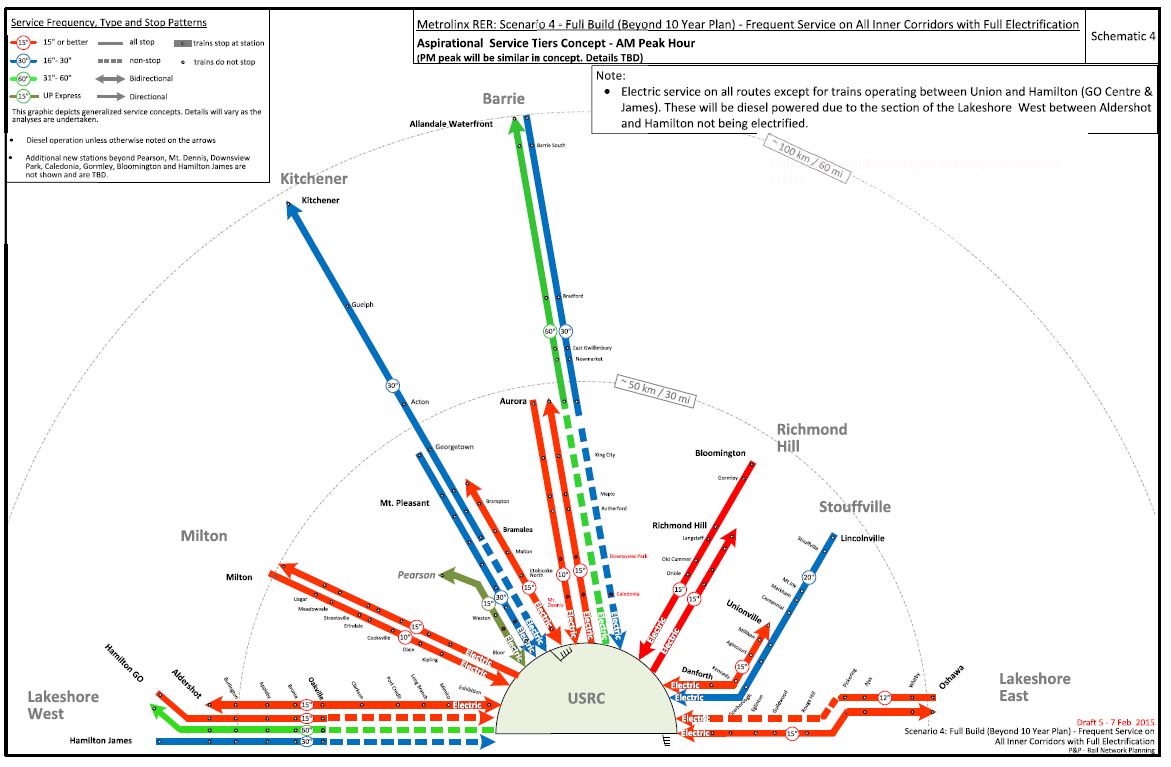
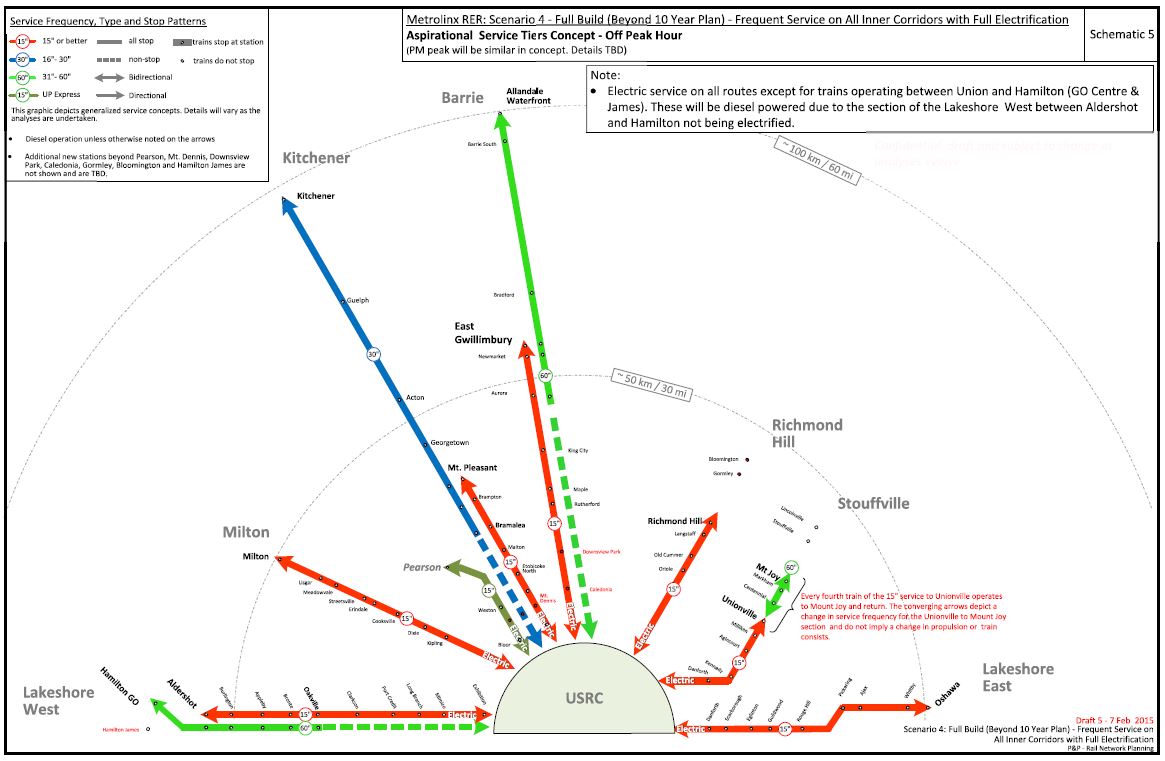
Whether any of us will ever see service at this level (let along just getting to scenario 4) is quite another matter. This will require a sustained commitment and funding, and it will not be paid for with fairy dust schemes such as “tax increment financing”. The Metrolinx report stays away from the “how to pay for it” problem and concentrates on the “what can we build” issue. The obvious variables in the financial picture are:
- Fare structure: should a higher or lower overall farebox cost recovery be attempted?
- Subsidies: is the provision of good transit considered a “social good” and the cost seen as a preferable alternative to continued expansion of road capacity?
- Parking: should GO parking lots charge for this service, and how much can this revenue source contribute to overall financing? The report estimates that parking could contribute $100m annually from 2020 onward, enough to finance $3.8b in capital spending.
Ridership projections for the corridors vary considerably with the largest gains, no surprise, coming in corridors that receive more service.
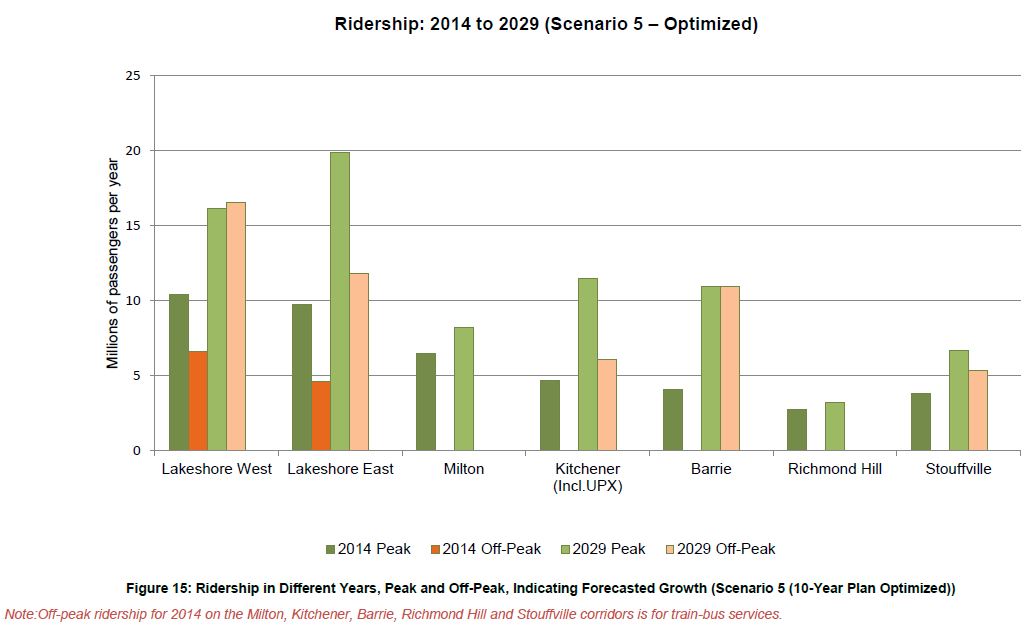
Projections for Lakeshore West, Barrie and Stouffville corridors are noteworthy because off-peak values are similar to peak (albeit they are spread over more service hours). This would put GO/RER in the same situation as TTC where off-peak ridership is an important part of overall demand, and many trips have nothing to do with conventional commuting patterns. As with other parts of the evolving regional travel patterns, this change cannot be achieved without substantial investment in local feeder/distributor services.
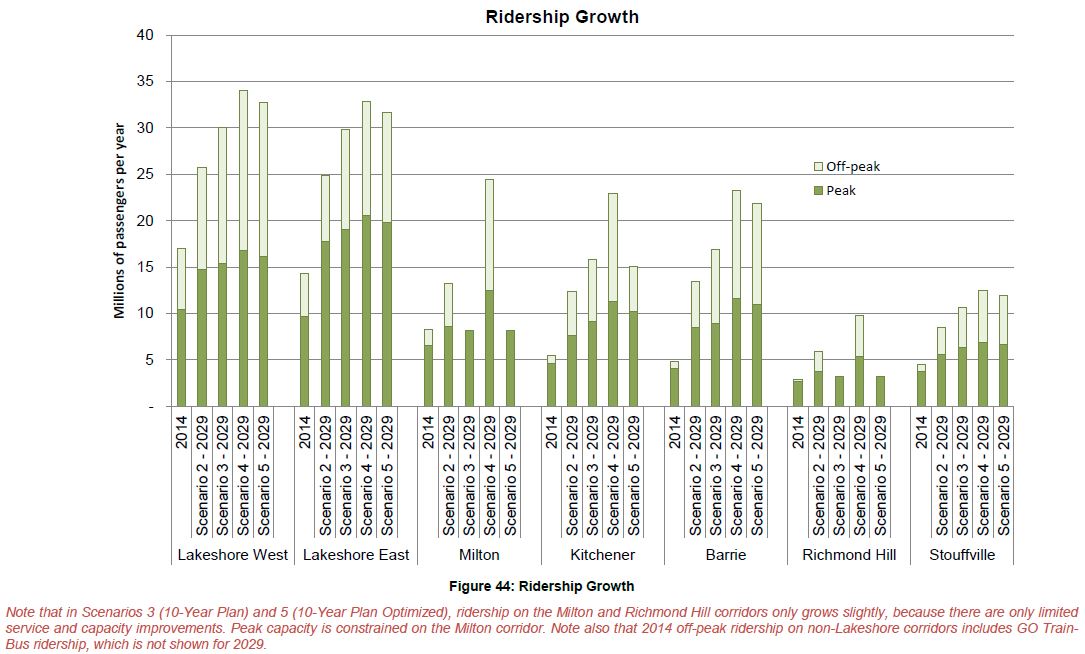
The projected growth for each scenario is shown in more detail in the following chart.
“Business Case” analysis is something of a black art, and much depends on assumptions used in the model such as the value of travel time, presumed changes in road congestion, reduction of pollution, and secondary effects such as reduced health care costs. For the five scenarios, the analysis produces the following result:
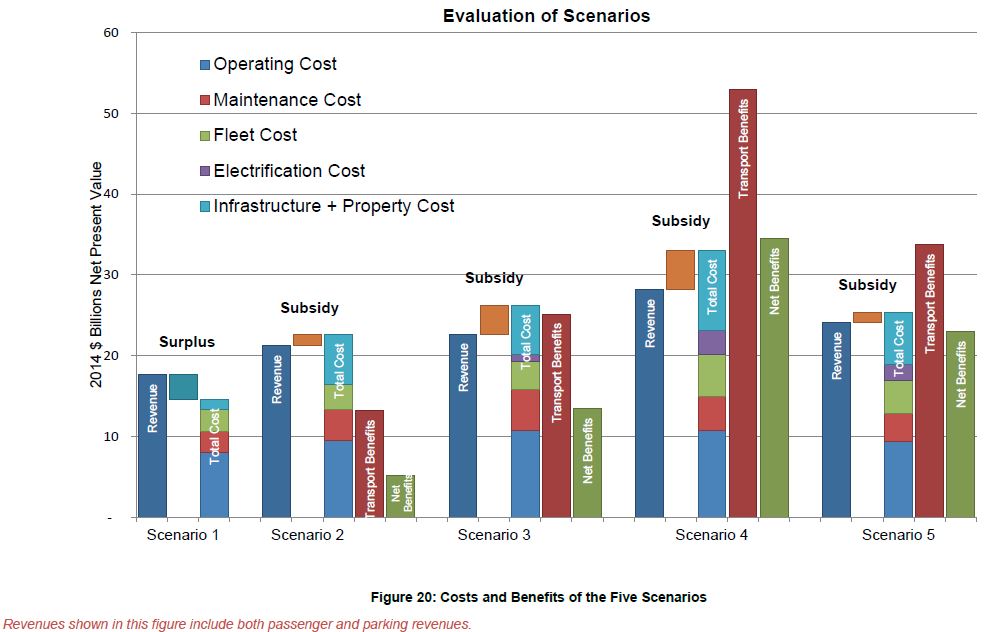
The business-as-usual scenario 1 produces a surplus, but only by virtue of minimal investment. There are no “transport benefits” because this scenario is the base against which others are measured. Other scenarios require varying degrees of subsidy, but the elimination of the Milton and Richmond Hill corridors reduces this quite markedly. However, the large decline in transport benefits between scenarios 4 and 5 shows how much network benefit goes untapped in the recommended scenario.
The electrification cost is a relatively small part of scenarios 3, 4 and 5, much smaller than the fleet, infrastructure and property costs. Although scenarios 4 and 5 provide considerably more service, their operating and maintenance costs do not skyrocket because of the substantial savings with an electrified (mainly EMU) operation.
Another way to look at the costs and benefits is to compare the base case with the four scenarios for improvement.
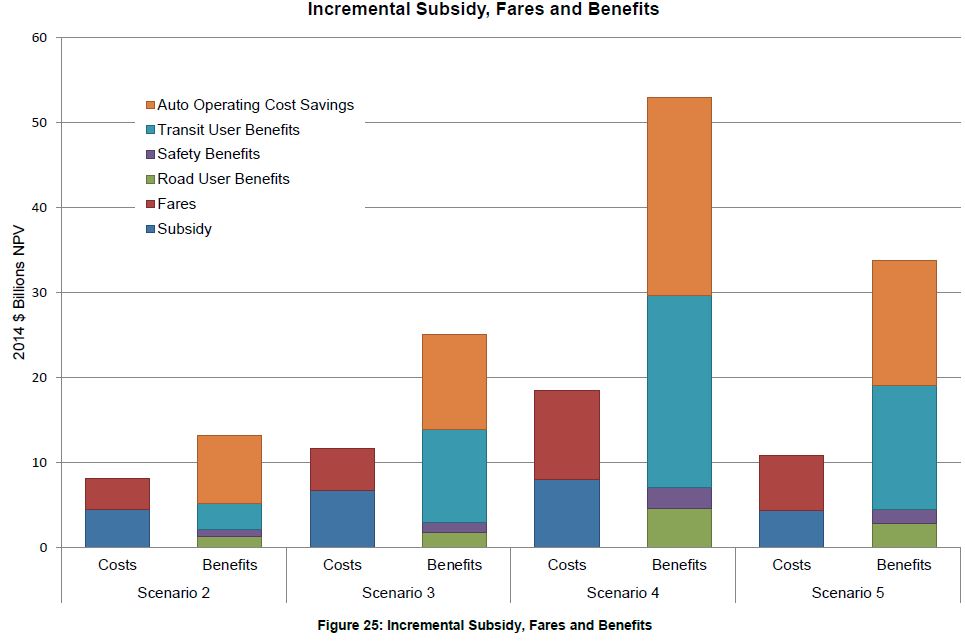
Again, the much more substantial benefits available with the full build scenario 4 are evident, but the cost is not at a level Queen’s Park wishes to undertake. “Transport benefits” are broken down here by type, and this shows an important distinction in the distribution of notional savings. By far the largest benefit accrues to to transit users whose trips become faster, and to former auto users who save on the cost of driving their cars. Benefits to road users in reduced congestion are comparatively small as are the “safety” benefits that flow from supposedly lower traffic volumes. These can easily be understood in the context that roads are full beyond capacity already, and the improvement of transit merely “buys” room for other drivers (and future growth) by shifting many trips onto transit. The idea that roads will ever be uncongested is a pipedream. In that sense, although GO/RER will make life much better for trips that fit well on the rail corridors, its benefit for off-corridor journeys (orbital rather than radial) will be considerably lower.
Journey times are projected to fall with the new network through a combination of frequent service (and thus shorter waits for a train) and improved speed with electrification. This will make transit more attractive for various trips, although the degree will vary from location to location. The report includes a chart of comparative travel times for multi-corridor journeys such as Richmond Hill to Hamilton where transit times will be substantially reduced. However, it is unclear whether the times used include access times at both ends of the journey, an area where autos have a distinct advantage for many trips. Transit’s ability to serve this type of trip will be constrained by the dispersal of origins and destinations across the region even if frequent trunk services were to fill in an east-west grid.
The uphill battle faced by GO/RER is illustrated below in a chart of mode share today and in 2029.
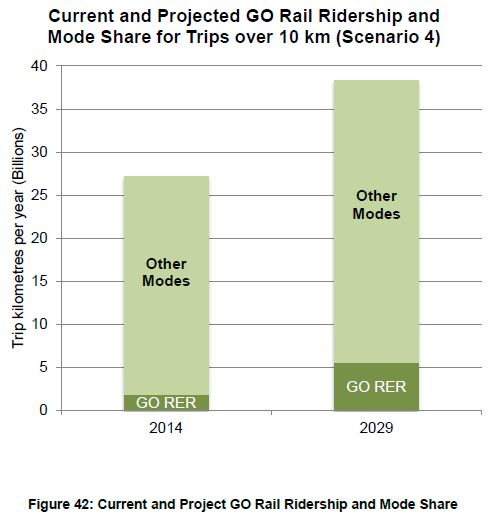
This chart would have been more useful if it included other transit modes and autos, but even as it is, this shows the relative scale of GO/RER growth versus transportation demand overall. Although GO/RER will roughly triple in the medium-to-long trip market, a rate much higher than overall trips, it will still be roughly one sixth of the total travel. The breakdown needs to be much better understood by market segment, and the importance of short trips must not be forgotten. The average TTC journey is under 10km, and so many TTC trips do not contribute to the “other modes” values above. Moreover, many of the “last mile” trips required for riders to access the GO system are short journeys on local transit systems.
On the financial side, the report presents a rosy picture of future profitability for the network. This is possible due to various factors including:
- GO’s existing fare-by-distance structure will generate more revenue as service capacity increases and infrastructure is better-utilized.
- Operating costs for the electrified network do not rise proportionally to the change in service level.
- The cost of capital debt service is not included as a charge against operations.
- Last mile services are borne by local municipal operations and is not counted as part of the GO/RER cost base.
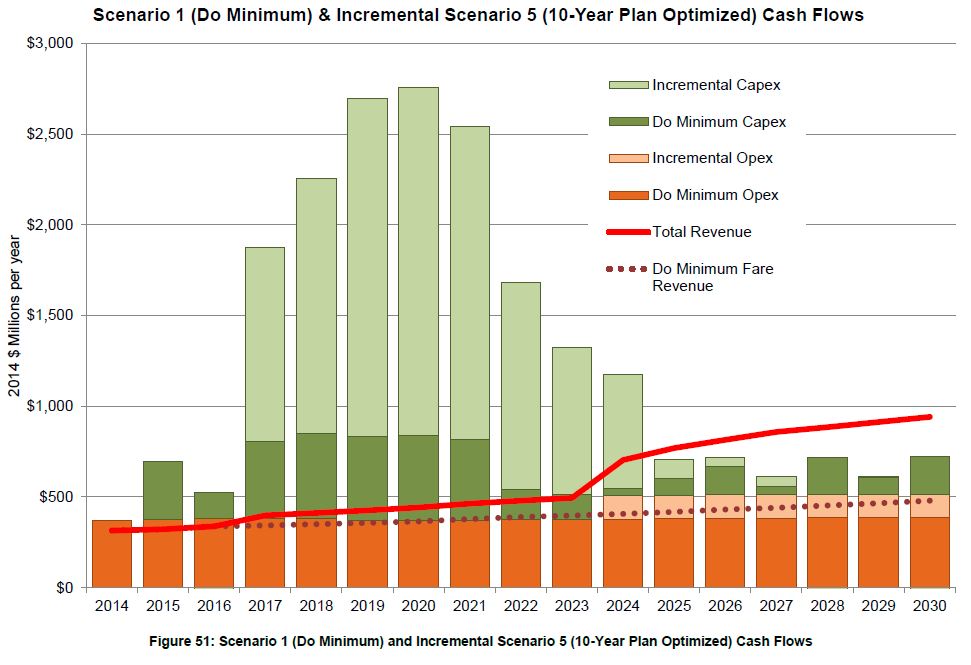
Whether this unexpected state, a transit service that actually shows a profit, is achievable will depend on many factors including political decisions about service, fares and subsidy levels, not to mention the basic task of simply building out the network to support the proposed level of service. As for local services, the report is somewhat evasive on additional local costs suggesting that all of these new GO/RER riders represent a market that might be tapped, and possibly even at no extra cost, by local systems. That really takes us into the realm of fantasy and shows the degree to which Metrolinx continues to avoid the delicate political question of subsidies to local systems. A further report on this issue is supposed to be in the works.
In future articles, I will turn to more details behind this study.
 Steve Munro
I always get the feeling Metrolinx only thinks big picture, yet public transit is very local. Thinking big picture results in the UPX, thinking local would have put EMU’s on that line to serve local transit needs. Thinking big picture treats Stouffville as a vanilla commuter line, thinking local would reveal that Markham is in complete transit chaos (developers were not required to provide public transit routes eg bus lanes, so there’s no way to get to the train station) and Scarborough long suffers with transit challenges (SSE and LRT extension do not address and are a waste of money).
Demand flows are not obvious and meaningful granularity gets lost when thinking big picture.
It is hard to have a conversation, because everyone has a personal experience and perspective towards transit solutions. Rare is a meaningful evidence based big picture conversation. Everyone has their own evidence and opinion.
Metrolinx does not foster strong relationships with the road planning departments of municipalities. Planning artery roads that help get good transit times for buses is a local solution and missed in big picture studies.
Look at the mess Metrolinx is in now: electrification, dual tracking, adding 4th track to Lakeshore corridor, PTC signal and train control, Union Station platforms need to be wider and raised to coach door height with more stairwells, huge fleet of bilevel coaches, and too many switches in Union Station yard.
Too many big picture plans, no implementation strategy. When it comes to implementation, it’s always local. When you double track, the natives get hostile, you need boots on the ground. When you build a bus station, the natives get hostile, it’s local.
There is no local feel to Metrolinx. They don’t speak to me.
LikeLike
Scenario 5 (optimized 10 year plan) varies from Metrolinx’s RER public plans on its website slightly. The differences are:
1) Lakeshore East gains a 12 minute express peak-direction peak service
2) Milton upgraded to 15 minute peak-direction peak service
3) Richmond Hill line loses its 15 minute peak service to Major Mackenzie
Notably, the Metrolinx RER website has recently changed to reflect Scenario 5 for the Richmond Hill line. The two-way 15 minute peak service to Richmond Hill is now gone, while the 15-30 minute peak direction peak service to Bloomington remains. This is not entirely surprising, since the improved service appeared in some documents and not others (sometimes inconsistently on the same page).
The ramifications for Richmond Hill is that it will strengthen demands for the YUS Richmond Hill extension.
LikeLike
The operational cost variable is really intriguing. The extra lifetime cost of Scenario 4 (full build out) is entirely the $5.5B capex. The cost of operations vs. Scenario 5 is the same, but the transport benefits it yields are impressive. In the long term, it’s nearly free, if the model is to be believed.
It’s a shame that the Liberals have driven Ontario’s debt so high with frivolous ‘investments’ in cronies, pet projects and a bloated education bureaucracy. It makes spending on actual investments with real potential returns like this much harder to approve. There’s the truly big cost of incompetent government.
LikeLike
I’m still astounded by the determination to short-change Brampton and the outer parts of the Kitchener corridor. There has never been any explanation of the apparently solid decision to cut all off-peak service to Bramalea, with it’s frankly awful connections to central Brampton and essentially no ability to connect with Peel LRT in whatever form it emerges. On every other longer distance corridor at least some off-peak service is proposed, but Brampton proper gets nothing. Bear in mind that in previous studies the Kitchener/Guelph connections itself generated considerable LOCAL traffic on higher frequencies, let alone whatever is gained running into Toronto.
What on earth is going on here? Yes, we’ere all aware of the complication in electrifying some parts of the corridor, but not even adding mid-day service beyond Bramalea is madness.
LikeLike
This is a little troubling to me, as I firmly believe that the reason the TTC sees so much of its growth off peak, is because it is capped on peak. This to me speaks to a need to really look hard at ways of increasing capacity in TTC as well as integration for GO with the other regional transit services. Also at this level of growth, it begs the question, how much additional within 416 load, can actually find its way onto GO tracks.
LikeLike
It’s all about track ownership. GO owns the tracks between Bramalea and Union, but not between Georgetown and Bramalea. Anything beyond that is according to what CN is willing to permit (like CP on the Milton corridor), so they can’t officially plan on it until any deal is signed and delivered.
LikeLike
Interesting to see that Metrolinx has finally discovered religion and are embracing EMUs.
LikeLike
Forgot to mention parking. The value of $50k per parking spot would seem to indicate that they are looking at parking garages because the last lot cost between $42 and $44k per spot. Maybe they will finally get religion about charging for parking.
LikeLike
Mount Pleasant is to get 60 minute bi-directional mid-day service. The Scenario 5 diagrams don’t show it, because ‘off-peak’ in this case means evening and weekends.
Steve: Their diagrams suffer from only talking of “off peak” although that has more than one flavour. They have a page describing the RER service on the Kitchener corridor which shows the midday hourly service to Mt. Pleasant, but this is not mentioned in the text immediately below the diagram.
The proposed RER service, as has been pointed out elsewhere in the comment thread, is not quite the same as “Scenario 5”, likely thanks to tweaking of the design after the scenarios were put together in early 2015.
LikeLike
As part of the upgrading of the Bramalea to Mount Pleasant tracks, one track has been added all of the way. The travel time from Bramalea to Mount Pleasant is 17 minutes. This effectively prevents anything less than one train every hour.
There were originally plans for adding 2 GO tracks. It would require expanding the existing right-of-way. It also included moving the Brampton station which was vetoed by the historical societies. If you look at the ends of the station you can see where an additional track on the north side would be placed (Right through where the station resides) Also the elevator that was built where the extra track would be after they knew that it would never happen.
LikeLike
As far as I can make out they use EMUs because of favourable operating costs.
All headways are 15 minutes so it’s not for improved frequency.
LikeLike
Brampton killed their end of their LRT so what connection are we supposed to miss? I don’t see the problem to be honest.
LikeLike
Am a bit lost as to how a 4 car EMU “saves” as much as it is claimed in the slide above vs a 12 car diesel unless only 4 cars worth of demand is envisaged. But Metrolinx could probably save quite a bit by operating smaller diesel consists during those periods (e.g. an F59PH and 6 coaches).
LikeLike
It’s presumably because Metrolinx does not own the track beyond that point, nor is that track something CN can give up because there is no alternate in place to reach Macmillan Yard. Any scenario where intense service is offered will require Metrolinx to cross CN’s palm with significant amounts of silver to add capacity between Silver Junction and Bramalea.
LikeLike
In the midst of all these heavenly plans, who speaks for Orangeville, Bolton, and Uxbridge?
LikeLike
I saw a passing mention of the Milton and Barrie GO satellite station on page 152. How is this going to work with a Queen DRL? I’ve heard a station at King is the only one on the table for those two GO lines, not Queen.
If the lines end up terminating at Bathurst, the people on those GO lines would need a new path into the core but streetcars in reserved lanes wouldn’t come close to providing enough capacity to clear incoming trains at 15 minute frequencies.
Are the folks in planning expecting all of those people to walk up to Queen from Liberty Village or downtown from Bathurst?
Steve: In a study of the Union Station Rail Corridor, the option of a satellite station in the North Bathurst Yard was included. The distributor into downtown for it was suggested as the DRL, but this requires that the DRL be further south. The study did include a map showing the DRL swinging south from a Queen alignment diagonally to Front and Spadina, but this would be extremely difficult given the buildings under which it would have to travel.
This is a major reason I have always advocated the Front/Wellington alignment for a DRL, and until recently that seemed to be the preferred route. Then someone decided that avoiding too close a conflict with SmartTrack was an unwritten, but important goal, and Queen Street was selected even though it does not perform as well as the more southerly alignment. As we know, ST is a phantom, but one with the power to force gerrymanders in the proposed network. Meanwhile, a critical corridor that would have allowed relatively easy passage of a subway from Wellington southwest to Front and Spadina has been lost to development.
That GO distributor aspect of a DRL seems to have completely vanished from the current studies by the City and Metrolinx.
As for streetcars, it is not practical to expect a 2000-passenger train to offload onto the King or Queen streetcars.
One point to remember in all of this is that various studies have happened at different times. The assumptions and priorities affecting each study are not necessarily the same.
LikeLike
That is patently incorrect. NO track was added through Brampton Station. It is still only double tracked from John St. to just west of the CP diamond. As someone who rides this line a couple of times a month, the 17 minutes is at least 4 minutes more than is required because the trains sit for at least 2 minutes at both stations.
The off peak trains are given 53 minutes inbound and 48 minutes outbound. This is more than is required. IF there were 4 tracks for the full corridor this service could be run with 2 trains instead of 3.
EMUs will have faster acceleration than either diesel or electric locomotive hauled trains. This would probably result in at least 1 fewer train on each branch. EMUs would hopefully have automatic couplers that would make all air and control cable connections automatically. The making and braking of 12 car consists to 6 car ones before and after the rush hours involves connecting or disconnecting 2 air hoses, 2 electrical cables, EMU cables and communication cables plus another locomotive to remove the decoupled cars. With EMUs this is accomplished by pushing a button and driving off the extra cars.
Metrolinx only has a few F59PHs left as they are replacing them with new locomotives. The locomotive for this type of service would be the newest ones, the MP54ACs which have two 2700 hp prime movers and are capable of operating with only one when loads are low.
As for running any service to Bolton it will be next to impossible with CP owning the line. Only the feds can force them to do anything and even that would be very difficult.
LikeLike
This is one of those things, where I really wish they would start being a lot more reasonable. SmartTracks would not have relieved the longer term need for relief, even it it had been as advertised. The need to actually protect the space, has been clear for a very long time. If you are not prepared to build, you need to at least be prepared to protect the corridor. A short underground or even +15 (a la Calgary) connection would be fine, but the plan needs to be present.
LikeLike
In the 1920’s Toronto Union Station was planned and built to replace completely out dated railway stations then in existence. Today much the same is what is really needed. Union is completely out dated as a railway and the city has grown a lot since. Of course save the architecture of the main buildings but the track and platforms are useless and can never have the capacity needed. A completely new layout in perhaps the same or different or even underground location could work. $$$? Imagine electrifying that complex network of switches only to crawl at slow speeds with powerful electric trains in and out of the station as is?
Steve: The Metrolinx report talks about the need for changes at Union in some detail. I will be covering that part of the report in a future article.
LikeLike
I was secretly hoping that there would be something about GO train service to Niagara Falls in there. Apparently, Niagara Falls, NY is building a giant new $50m train station, and no one can figure out why since there’s only one train going through there each day. But the new Niagara Falls, NY train station is just a few hundred metres away from the Niagara Falls, ON train station (they’re across the border from each other), and there’s been some talk of regular GO train service to Niagara Falls, ON, so I was thinking that there might be a secret plan to provide frequent train service between Toronto and the US. But these RER plans aren’t really showing anything there. I suppose the new Niagara Falls, NY train station is another one of Upstate NY’s white elephant, wishful-thinking attempts to join the GTA, much like the Toronto-Rochester ferry.
Steve: The purpose of this report was to look at the network within its current extent. The government has already made commitments to much of the added service proposed for GO/RER, and so it’s not a problem to have this report out in public. However, if a background study showed up with extensions beyond the current scope of GO (to Niagara Fall for example), it would be a pre-announcement of Government policy.
LikeLike
The shadow of SmartTrack (ST) hardly affects Metrolinx’s view of Toronto. An engaged Metrolinx could contribute to ST Stouffville, with EMU’s providing 4 minute headways that EMU’s can deliver. Metrolinx would need to ensure PTC could control signals and trains, Union Station platforms need to be improved (widened, raised, more stairwells) to reduce dwell times and Union Station provides permanent platform and track assignments for ST.
I didn’t see any mention of 5 minute headways.
Steve: Not in this round, no.
I understand that the TTC RL may dip to King from Queen somewhere between University and Bathurst and go west on King to Liberty Village. Anyone else heard of this?
Steve: That was in the Union Station corridor study a while back, but I don’t take it seriously because there are too many building foundations in the way.
LikeLike
PPP and TIF are proven concepts with which multibillion dollar subway lines have been built in India and China. The only problem with PPP in Canada is the opposition by unions.
Steve: The only problem with PPP advocates is simplistic claims about the applicability of PPP and the idea that if there were no unions there would be no problems.
LikeLike
That’s another point I was wondering about. This report seems to pour cold water on the idea of new elevated or tunneled infrastructure. Would reorganizing the tracks west of Union make a satellite station an unnecessary need for future demand?
Steve: No. Restructuring traffic and platforms at Union helps, but does not solve all problems.
I’m of the belief any Wellington subway line wouldn’t necessarily have to dip south to Bathurst Yard to provide the distributor function. If Metrolinx and the City were to move fast, they could negotiate with Allied and RioCan to design provisions for a transfer station under 410 Front Street West.
If not a station then certainly underground walkways but with the requirements of having to handle upwards of 10,000pph, it would have to be baked in from the day 1 design but time is quickly running out on that swan boat.
Steve: The problem is not with the station site, but in getting south to Front Street in the first place.
LikeLike
But perish the thought of “transit oriented development.”
LikeLike
This comes up a lot. I’m not an engineer. Is it not possible to go under all of these buildings? Too expensive? Improper soil/bedrock/water levels, etc?
Steve: Anything is possible, but at what cost? The station at Front & Spadina would be extremely deep, and the tunnel would likely have to be through bedrock to be under the footings of the buildings northeast to Queen & University. This would also make the City Hall station quite deep in preparation for the journey southwest.
LikeLike
The rail line to Orangeville is totally unsuited for GO trains. The curve at Barrie would be impossible without destroying a number of Heritage buildings and the layout of the line is not suited for operation much over 45 mph. Bolton is on CP’s main transcontinental line so would be lucky to see even two trains per day. The track is still in place to Uxbridge and GO service can be extended by rebuilding the track. Though as Steve said this is about improving existing service and there is not any train service to these places.
Pray tell how would you widen the stair wells? There is no room without removing some existing platforms but the powers that be decided against that. Raising the platforms requires rebuilding the existing stairs and elevators.
Metrolinx decided to re-build Union as the best inter city railway station of the 20th century. Unfortunately it needs to be an RER station of the 21st century. Spending all those millions on rebuilding those engineering marvels the two sets of double slip switches in the throat is probably a great waste of money. They would have been better off to rip out tracks 3, 6 and 9, putting in wider platforms and stairs and running the trains in paired service with trains operating on a rapid transit type of service. But Metrolinx wants to operate the best mainline rail commuter service rather than what is needed.
Steve: There are hints of some of the changes you mention in the Metrolinx study, but whether they will acts on these is quite another matter.
LikeLike
I envisioned keeping the subway line under Wellington and not having dip to Front with a short walking transfer facilitated through underground passageways and the internal shopping mews in the site plan.
Depending on station box location the station could be a key part of extending the PATH southwest from Metro Hall to 410 Front (and the satellite station) but with Metrolinx not having any clue as to what they’re going to do and the City off marching to the beat of their own drum without any concern for future needs, this is all pie in the sky.
Steve: I was speaking of an approach from Queen, not from Wellington. Certainly the site now occupied by the Globe building would be a possible location easy to reach from a Wellington DRL alignment. But if the City insists that the DRL must be on Queen, then I fear this option is lost.
LikeLike
Never write a reply after spending 12 hours in the hot sun. I meant to say Brampton, not Barrie.
Steve: I was beginning to wonder just what sort of curve in Barrie you were thinking of!
LikeLike
I think personally the biggest applicability issue is based on the notion of service, volumes and pricing permitted actually making substantial profit. This is not the way we appear to want to run our core transit services, so perforce we have an issue. Note it we were prepared to build much higher density, had many more riders, had a system that had less transfer integration, all of this would not be an issue.
However, coming up with a model, that reflects inflation fairly for both parties, transfer pricing between routes etc, greatly complicates the situation for many projects, and much of what we want to use transit for is to reduce the “externalities” (economics term) imposed by auto, and to address some of the issues we have created with build form, that transit and new zoning can help address. The number of political risks involved for a private party, increase the rate of return they would need to justify it. Where these things have been successful elsewhere, the density, build form, full days loads, were all present, and the transfer costing model mostly in place. That is the large projects would be fully used day 1, with a pricing model, that allowed profit. So the application for truly massive projects in Toronto is reduced, yes, a structured build with a well defined revenue model, but that hugely limits applicability.
LikeLike
Re Uxbridge and Bolton. If GO can build their own track to Milton, on a busy CP right of way, why not Bolton? As for the ‘existing service’ point used to negate service to Uxbridge; the Richmond Hill line is being expanded, twice, as we speak, by double tracking a very busy right of way.
Steve: I think you are confusing the Stouffville and Richmond Hill corridors.
In the old days, new GO service started out on a small scale. Orangeville doesn’t have to be huge from the beginning; nor does it have to be that quick. Fifty KPH would get a train down to the CP in a hurry, on the most scenic railway line in the GTA.
LikeLike
Not at all: A station and storage yard are already finished at Gormley. Service to that point will begin in less than a year, and be extended to Aurora Road in 2 more years.
Steve: But that does nothing for the long section into the Don Valley which has lots of single track and is subject to flooding.
LikeLike
How much brand new construction is planned in order to implement RER? Going through these plans briefly, looks to me like it isn’t very much. By “new” I mean new railway corridors and new stations. I don’t mean to say that adding extra tracks along existing corridors and electrifying the whole network is trivial, just the electrification in itself is a huge thing. However, when GO RER’s namesake – the Paris RER – was being constructed, they didn’t just take over, upgrade and extend (outwardly) existing suburban lines, they did a lot of expensive construction in – and under – the city of Paris. How transformative can GO’s RER truly be without constructing brand new corridors, in the long run, in the city and outside of it?
Steve: There are no new corridors planned. The former Minister of Transportation, Glen Murray, introduced the “RER” term because it has the sound of doing something big and “European” without being on the same scale. The idea is to squeeze as much as possible out of existing corridors without spending a fortune on new construction.
LikeLike
Hi Steve, thanks for all your hard work maintaining and updating your site. I wasn’t sure where to post this and I figured a discussion of commuter GO/RER would be acceptable for my question. Given the extremely strong auto-centric culture in the GTHA, are there any corridors/routes outside Toronto, and I’m talking about car heavens like Oakville and Vaughan, where LRT or streetcar routes would be viable? And a much broader question: is there any possibility of a large scale cultural shift from the car toward transit? I confess my personal day dream includes LRT, streetcar and other rail options across the entire GTHA – is that remotely realistic?
Steve: I doubt you will see much of a transit shift except in cities where there has been enough growth to lead to a credible level of transit service in major corridors, and with good off peak frequencies. Making converts of auto users takes a good transit service, but if demand is too diffuse and the cost of providing frequent, reliable service too high, it’s very difficult to shift users (let along political support) from cars to transit.
LikeLike
The Orangeville line would be great, just a short train that could terminate at or run thru Brampton instead of Streetsville. Budd cars?
LikeLike
I take series of photos of the progress of construction at construction sites within a kilometer or two of my home, near Parliament and King, and I can confirm that bedrock is at an extremely shallow depth, down south near Front and King. I posted a link here, an month or so ago, to a map of the underground geology of Toronto, that showed cross-sections of the underground geology under the Yonge and Bloor-Danforth lines. How deep into bedrock would tunnels have to go, to go under downtown highrises?
The highrises built near me — in the 10-20 storey range, had basements about 4-5 storeys deep. Steve said that he had been told that a bored tunnel was not supposed to follow a path that was more than one diameter distant from building, or other tunnels. I don’t remember that avoidance distance was supposed to be larger when the tunnel went below a big heavy building. But that makes sense to me.
Steve: Actually, it’s a case that a tunnel should be at least one diameter from another structure, but you have the basic idea correct.
I read that the new building being built on the narrow lot on the NW corner of Yonge and Bloor is supposed to be dug something like 8-10 storeys deep. The very narrow recent building at 5 King West may have a very deep basement. I remember it was built on such a narrow lot that its underground parking used a vehicle elevator, not ramps.
So, how deep would the tunnels have to go, to travel a safe distance under basements? Yipes! Maybe ten storeys! If the exceptionally deep buildings can’t be dodged, maybe deeper.
The Washington and Moscow Metros have very deep stations, near the central government buildings, so that they can be pressed into service as emergency bunkers during an exchange of nuclear warheads.
I’ve seen pictures of the escalators in deep stations in Washington. They are long. From photos it is hard to say how long. Has anyone here used those stations?
LikeLike
Not next to impossible. CP loves it when they get capacity upgrades paid in full by the government.
LikeLike
<blockquote>Carl Harrison | April 2, 2016 at 8:59 pm
“Re Uxbridge and Bolton. If GO can build their own track to Milton, on a busy CP right of way, why not Bolton? As for the ‘existing service’ point used to negate service to Uxbridge; the Richmond Hill line is being expanded, twice, as we speak, by double tracking a very busy right of way.”
GO did not build “their own track to Milton, on a busy CP right of way,..”, they paid CP to add a track between about Cooksville and Streetsville. CP only charged slightly less than it cost to build the transcontinental railway. GO has not built any track on an existing CN or CP line. They have paid the railway to build extra track in order to get permission to run some limited GO service. There is no guarantee that they will not lose some of this service.
Bolton is on the CP’s main transcontinental line which is basically single track from Bolton to the West Toronto Junction. IF, and it is a big IF, Metrolinx can get service up the CP line to Bolton it will only be limited rush hour service, but this document deals only with improvements to existing service, not new service.
Similarly Uxbridge is not an existing service so is not mentioned but there is track to Uxbridge that is owned by Metrolinx. At the moment it is not a need for the service as it already goes to Lincolnville which is only a few miles away and, as Steve points out, is NOT on the Richmond Hill line.
Take a look at the map of the CP line to Orangeville; it goes 55 km (34 mi) down to Streetsville where it joins the Milton line. It cannot make the turn at Brampton to join the Kitchener line and it is a long and winding road via Streetsville. Who, besides you, would want to spend 2 hours getting from Orangeville to Union via that route?
LikeLike
Is this not where Bus is much more practical? Would it not make more sense to just increase the number of buses originating in Orangeville, and if it is felt a large corridor is required, a BRT to Brampton GO? Would this not allow the provision of better overall service? Also if we are going to expend big dollars on tracks, would adding rail for all day 2 way high frequency service to Brampton GO, not make more sense – so that the transfer here, was less painful for Orangeville trips? Would not starting with a queue jump lanes for buses make even more sense as a starting point? How does it make sense to attach Orangeville by rail, when the bus service is currently so sparse? Making an allowance for a dedicated Transit corridor, might just make sense, however, to Brampton GO and the Hurontario-Maine LRT seems like a more reasonable start.
Also do so many stops the bus takes now within Orangeville actually help ridership (20 minutes meandering around)? Should there be a collection point in Orangeville that is also a hub for more frequent local transit?
LikeLike
@arcticredriver:
Spent a couple months living in Silver Spring MD (a D.C. suburb in Maryland) for work in the last year. I assume from your post that you haven’t lived in DC/used the metro there so a few comments:
The WMATA is hardly a crack civil defense force capable of maintaining a network of metro stations equipped to double as bomb shelters. It’s much more like every other American transit agency, a cash-starved public institution that can barely keep the trains running without occasional bailouts from government. Just like the TTC in Toronto, people in DC love complaining about the metro. And they have good reason to as I found service to be generally lacking as compared to the TTC subway. The system is much more analogous to the San Francisco BART (a system conceived and built in the same time period) or a German S-bahn network, with interlined trains running in central tunnels downtown with closer spacing and high frequency that splays outward toward the suburbs with longer station spacing, less frequent service and tracks laid in expressway medians (think Allen road). Off-peak and on weekends trains might only come every 15-20 minutes depending on where you are in the network. Furthermore the TTC’s subway cars are in great shape compared to the shabbiness of many DC trainsets. Just like in TO there is clearly a big tension between operational and capital costs. In spite of this shabbiness and unreliability as evidenced in the article I reference, there is also a big expensive extension to Dulles airport going in as we speak.
Furthermore I doubt the decision to build deep for some DC metro tunnels/stations had anything to do with a possible World War 3 in the first place. Hiding in a metro station might save you from an actual explosion in a nuclear war but would do nothing about fallout etc. and then what would you do after you’re trapped down there ? If you visit DC you’ll probably quickly conclude as I have (I admit I haven’t researched this history in any great detail) that the depth of the stations has more to do with plain old geography. For instance the deepest stations are not in downtown Washington or even in the District of Colombia – rather they are recent additions to the Red line on the east branch (Forest Glen and Wheaton) in Maryland. Used Forest Glen while there and can attest that yes it is DEEP and that adds significantly to one’s travel time (think of the new Porter tunnel to the island airport more than what we’re used to in downtown TTC stations). My best guess for why is that the metro has to dive under the Capitol beltway coming north from Silver Spring station while the elevation at ground level steadily increases and gets quite hilly. Rosslyn on the Orange/Blue/Silver line is also very deep – used it once while visiting Arlington – but this is because it’s a portal station right before a tunnel under the Potomac River.
Some people had talked up the station architecture to me before travelling to D.C. but I personally found the so-called “Brutalist” style of some of the downtown stations more oppressive than anything. I was reminded of the depressing mural on the wall in the new Union subway station or maybe something you’d expect in a movie about a future dystopia. Although they do give it a kind of character. Another thing worth mentioning about the WMATA system is that it’s also affected by the unique geography and urban form of DC as compared to many other big American cities. There is a height restriction in place within the district that limits buildings to maybe a dozen stories even in central Washington. This gives the place a somewhat European feel but also means that things are quite de-centralized. A lot of growth has happened in the surrounding communities of Bethesda, Arlington etc which are not as well served by the metro partly because of this restriction, meaning that there is still a heavy auto dependence for many trips despite having an above-average subway for North America.
LikeLiked by 2 people
Steve said. ” I doubt you will see much of a transit shift except in cities where there has been enough growth to lead to a credible level of transit service in major corridors, and with good off peak frequencies.”
Tess Kalinowski has an article in April 4, 2016 Toronto Star Mississauga ran into gridlock and regrets not planning public transit. It seems a dwelling be it house or apartment in Markham has over 2 cars per unit. They also have gridlock and no public transit plans.
Metrollinx’s mandate was “to provide leadership in the co-ordination, planning, financing and development of an integrated, multi-modal transportation network” for the GTA and Hamilton. This latest “business plan” is about how Metrolinx will be a viable business and routes that it can provide that pay off the investment. It’s not about defining demand and building transit to address it. They lost a lot of money on UPX, Crosstown Eglinton LRT will be a total failure in Scarborough and they have no implementation plan for the mess of projects they’ve lined up, electrification, dual tracking, adding 4th line on Lakeshore corridor, signal and train control PTC, conversion from bi-level coaches to EMU and 383onthetree’s comments on Union Station.
LikeLike