
Updated May 30, 2015: The staff presentation is now available online. Some illustrations from it have been included in the article below.
At its May 27, 2015, meeting, the TTC Board received a presentation from Rick Thompson, the Chief Project Manager for the Scarborough Subway Extension (SSE). This presentation is not yet online.
During the presentation, Thompson noted that the process of winnowing down nine alternative routes for the SSE was nearly complete, and that a report on the three short-listed options would be issued fairly soon.
The original nine proposals included two major groups. The first would see the north end of the line continue east from STC on alignments similar to the proposed Scarborough LRT crossing Sheppard at either Markham Road or Progress. Three routes were proposed to reach the existing SRT corridor:
- Via the SRT as currently constructed.
- Via Eglinton and Midland, then swinging back into the SRT right-of-way north of Eglinton (this would avoid reconstruction of Kennedy Station on a north-south alignment).
- Via Eglinton and Midland, joining into the SRT alignment near the existing Midland Station.
The second group takes a north-south alignment through or past STC and all arrive at Sheppard and McCowan as their terminus:
- A Midland/McCowan option would swing into the Gatineau hydro corridor south of Lawrence to link northeast to McCowan and then follow the McCowan route north.
- A Brimley option would travel east on Eglinton, north on Brimley and then swing northeast through STC to McCowan.
- A McCowan option would follow Eglinton to Brimley, then swing north via Danforth Road to McCowan. This was the original proposal approved by Council.
- A Bellamy option would follow Eglinton to Bellamy, turn north, and then swing back to the northwest to reach the McCowan/STC station.
- A Markham Road option would follow Eglinton to Markham Road (although the exact alignment east of Bellamy is unclear), then turn north and eventually back west to McCowan. This is the most roundabout of the possible routes.

Events overtook the plans, and a report on the shortlisted options that had gone privately to Councillors made its way into the media. The Star’s Jennifer Pagliaro reported that the three remaing options were the original McCowan alignment, the Bellamy alignment and the Midland route running straight north to meet the SRT corridor.
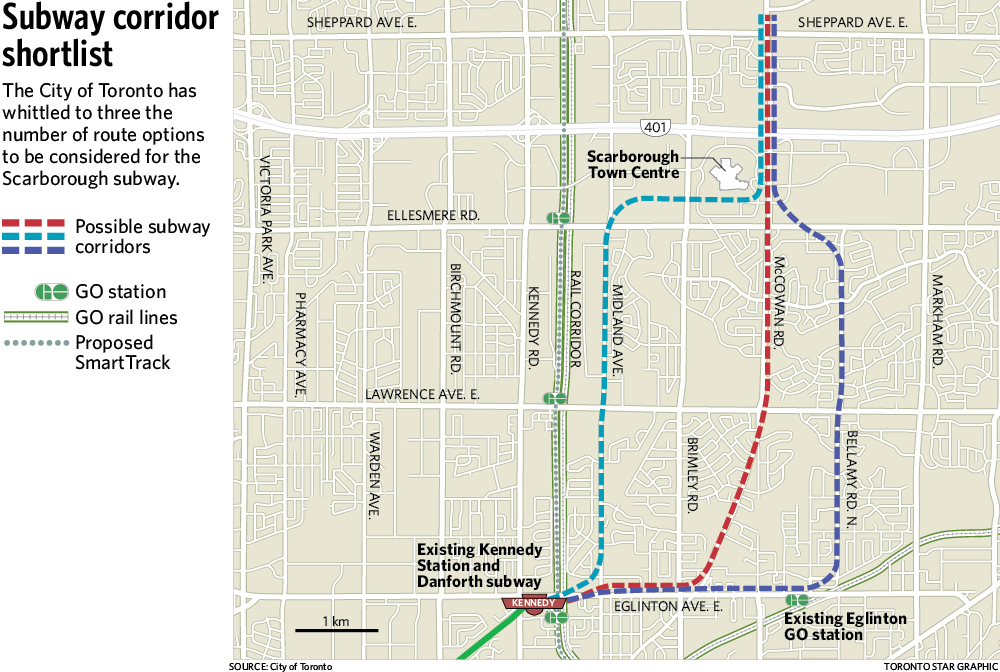
[Toronto Star, from City of Toronto]
Although the study area for the SSE extends east to Markham Road, that option did not make the cut. An obvious reason is that this takes the line too far out of the way adding substantially to the cost and to the travel time from Sheppard and STC down to Kennedy Station. Cost premiums of $600m and $1b have been suggested for the Bellamy and Markham Road alignments respectively.
Why go further east? The problem lies in Mayor Tory’s Smart Track plan in the GO corridor now shared with the SRT. If Smart Track provides frequent convenient service and, like the SRT, is part of the TTC fare system, then it will draw many riders from the SSE, riders who were used to justify the switch from LRT to subway technology in the first place. If the line is further east, advocates hope that it will draw its own demand by intercepting riders first. However, another part of the demand model concerns riders arriving from the north who contributed to the bump in demand estimates for the subway. These riders would come from the very north edge of Toronto and from Markham where any service in the GO corridor will be much more attractive than taking a bus south to a Sheppard/McCowan Station, let alone to STC if the subway is shortened as a cost-saving measure.
The Bellamy route is an odd choice because it runs through a low density area which shows no sign of imminent development. Midland is equally odd because it is closer to SmartTrack even than the McCowan route. Both are compromises that are attractive only if one accepts premises that are as much about politics as planning.
- Bellamy moves the line further east at a comparatively modest cost (“only” another $600m), and may improve the SSE/ST ridership split a bit. This route also has a connection to GO’s Lake Shore East service at Eglinton Station, although the geometry of the location could make this tricky. How many GO customers would opt to ride to midtown via the subway rather than staying on their train to Union is worth investigation lest this connection be played up for more than it might actually deliver.
- Midland is a variant on the scheme advanced by former Transportation Minister Glen Murray for the subway to follow the SRT corridor. That idea would have required a complete replacement of Kennedy Station and a multi-year shutdown. This is a face-saving alternative to retain the spirit of Murray’s proposal.
The existence of this report and its availability to the media raises serious questions about the context of the TTC presentation. At the very moment the TTC Board was told that the shortlist had not been finalized, not only had this been done but the information was in Councillors’ hands.
Estimates for subway projects run agound on the variety of factors that can affect costs including inflation, topography, geology, utilities and operational plans. The Council approval was based on an estimated cost to complete the project of $3.56-billion including inflation. Costs would be shared between Ottawa (19%), Queen’s Park (56%) and Toronto (26%). Any further cost is to Toronto’s account, and this makes the selection of options and features that could drive up the cost an important issue for Council.
The scheme as approved would be 7.6km long with three stations at Lawrence East, STC and Sheppard East using a fleet of seven trains (enough to operate every second train beyond Kennedy Station to Sheppard). Construction would begin in 2018 with completion in late 2023. Already there have been suggestions that a fourth station should be added at Brimley and Eglinton.
The estimated unit costs for construction are $180m/km plus about $200m/station. These are 2015 dollars and are subject to inflation.
To put these numbers in context, the Spadina extension to Vaughan is 8.6km long, and has 6 stations. That is $1.548b worth of running structure plus $1.2b worth of stations, plus ten trains at a cost of about $160m, for a total of roughly $3b. The actual budget for the extension is $2.6b reflecting the fact that some work was done in years past. In any event, the uninflated unit costs are in the ballpark. Things could easily get out of control if, for example, Councillors demand architectural monuments for their stations, or if the route is substantially extended.
Station cost estimates for the original scheme vary considerably:
- Lawrence at $160m. This is a line station that would have no provision for parking. No turnback crossover structure would be provided.
- STC at $200m. This station would include parking and a crossover.
- Sheppard at $500m. This station would not be just a terminal, but would have tail tracks and storage tracks to provide an overnight home for the expanded fleet. Note that this cost will apply to whatever station becomes the terminal because the storage facility has to go somewhere.
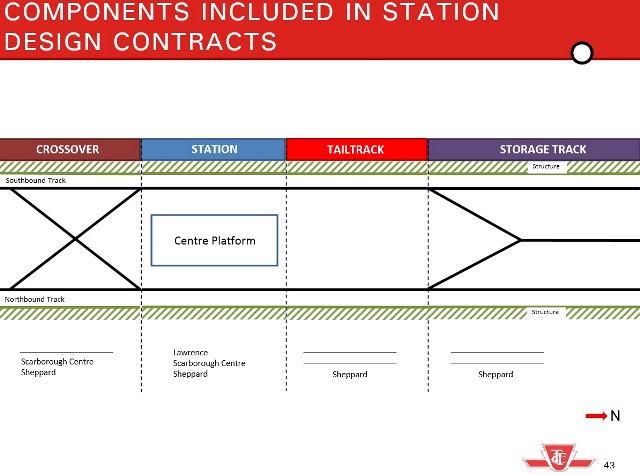
The TTC had planned to undertake public consultation through the summer despite the fact that (as described in the presentation), the shortlisted corridors were still not known. Conversely, a final recommended alignment is supposed to come before Council in Fall 2015 as part of the larger package of studies on Smart Track, GO and the Downtown Relief Line.
All of this is moving with some haste in a “get it done” mode, although the entire process could run aground depending on the financial and ridership projections that will face Council. The TTC is already contracting for basic services such as tunnel design and project management with little defined as to scope of work because the alignment is unknown. The idea is to have everything in place to start work the moment there is an approved project. The scheme would then unfold in three major stages:
- Up to 2016: Project startup, staffing, etc. Preliminary engineering and Transit Project Assessment.
- 2016 to 2018: Property acquisition and design.
- 2018 to 2023: Construction.
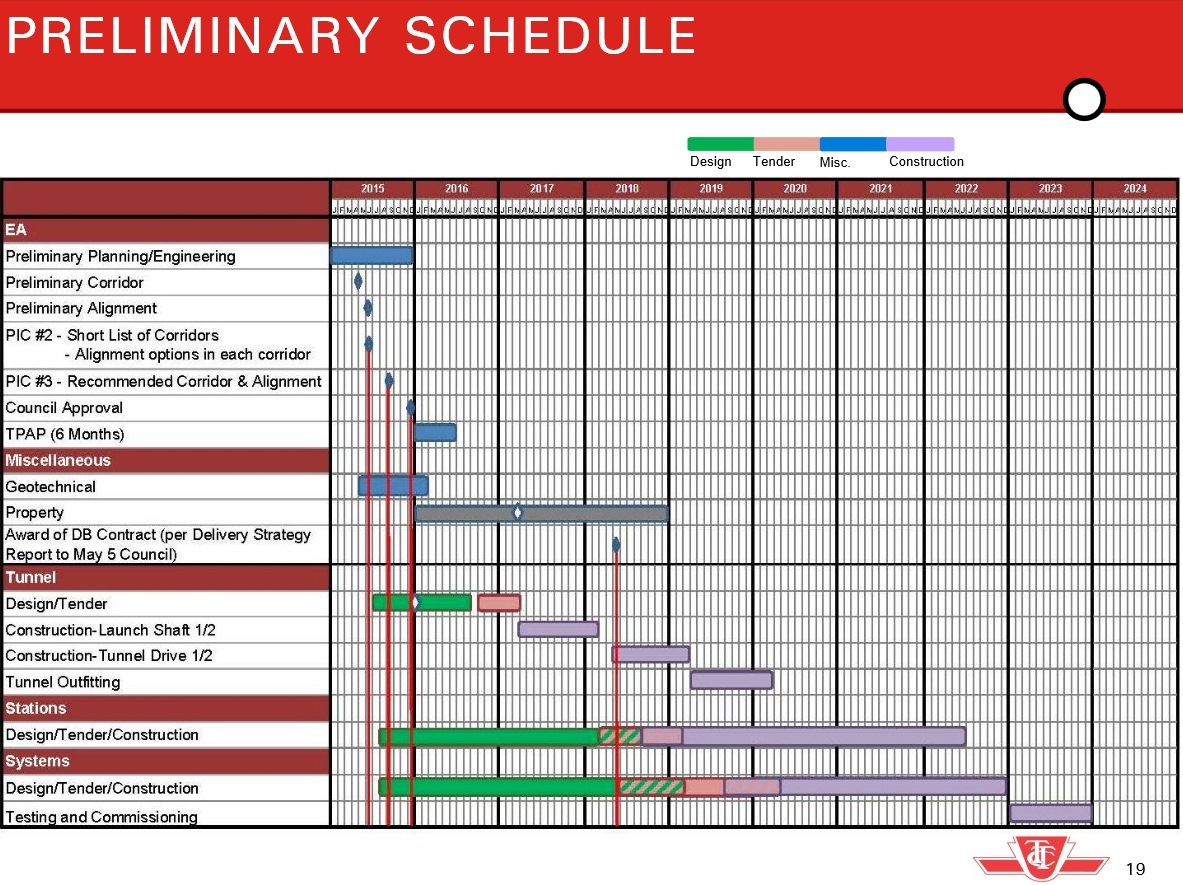
This schedule was described as very optimistic and it could be affected by factors such as unexpected conditions or substantial increase in scope (length, stations). Another factor that could complicate the process could be the extra time needed to design, tender and negotiate some form of P3 arrangement for project delivery. However, that mechanism is a prerequisite for federal funding, and is much beloved of Queen’s Park through its Infrastructure Ontario arm. The City and TTC would have to come up with a significant justification to avoid going the P3 route especially with the history of the Spadina project and the sense that somehow this could have been avoided with private sector expertise and some degree of “risk transfer” to a private partner.
When challenged on the speed at which the project appears to be building up steam, CEO Andy Byford replied that Council has directed the TTC to build a subway, and barring any change in that direction, he is proceeding to do this as quickly as possible. The consulting contracts that have been let so far (or are pending) are to be paid based on work actually done within an upset limit, and they have escape clauses should the TTC need to change plans based on political shifts.
Council will face the combined effects of any cost increases in the SSE, the potential bill for other transit projects, and major non-transit work such as the need to rebuild Toronto Community Housing stock, not to mention budgetary pressures in the 2016 cycle. This will all hit Council in Fall 2015.
 Steve Munro
LOL. Everyone go take a side & debate as we now have a Crappy LRT plan vs. Crappy Subway plan. What a mess
If I understand correct the Markham Rd. option is off the table? Funding aside that’s the only options that provides real “value”. The other plans conflict with the proposed Smartrack.
Scarborough is at the mercy of polarizing politics with these second rate plans on the table. We need a plan that Improves the integration with current infrastructure, Improve the proposed route alignments & Improve the funding to build a some equitable network.
LikeLike
What happened to converting drivers over to transit by building the SSE to save them boat loads of time from eliminating a one stair flight transfer? Am I to assume that particular angle no longer applies when your precious subway would only be viable with an extra 5 minute or longer detour?
LikeLike
Joe, first let me say I think ST is smoke and mirrors, and really should be dropped from the discussion. RER is what should be under discussion in that corridor. However, this service would still remove a large number of riders from the proposed SSE, regardless of route.
The issue in my mind is as much the city’s and to a lesser degree the province’s historical approach to rapid transit in general. This approach seems to have been: build one really big, politically driven project once a decade or so. This now means that most of Toronto effectively expects that people need get the perfect project for their entire region, and that ridership and planning are just so much hot air, politics and power are what matter. The approach Metrolinx had stated they support is really quite reasonable, would mean building in a nearly continuous fashion, however, this has been overridden with painful frequency, and due to history lacks credibility.
The Metrolinx initial proposal for Scarborough transit involved more than one wave. The problem is: anyone who has spent a long time in the GTA believes that the next wave will not be seriously discussed until years after the existing one is built, and the actual content will bear little resemblance to the previous proposals.
This is the mindset, and model that needs to be changed/broken. Yes, just the Scarborough LRT is not enough to serve the area, no just a Sheppard LRT on Sheppard will not suffice, nor is even both enough. However, the plan presented was more, and now the money has been ponied up, lets us see if we can hold all to account and spend the entire sum, on a broader plan for Scarborough, in a single wave. This plan being something that reaches much more of the region, something that actually provides a feeder network to the STC, to help it be a real centre, something that reaches Malvern, the foot of Morningside, north of Sheppard, and Guildwood. I would even suggest an extra 650-700 million to convert the Sheppard subway to LRT, for a through route, and a continuous link, just to get it done, and support real integration.
The 2.8 billion for ST, if it really can be found, should be used to provide a large number of smaller links that will also grow the tax base, things like, extending the Crosstown both ways including onto and along Kingston Rd, or some equivalent to serve southern Scarborough, a Waterfront East LRT a Don Mills LRT to and beyond Finch and a DRL that actually connected to the Don Mills LRT. Let us provide the basis for Transit Oriented Development, and then start to reduce the parking requirements, so that we can start to see some walkable dense neighborhoods, and not just downtown. Building once a decade subway extensions is a failed model, especially on a network, where one of the core links is already overloaded. It perforce means large areas of the city are left great distances from ever less accessible rapid transit, and the network remains focused on a small number of destinations. Not a working model for a city with Toronto’s sprawl.
Steve: Don’t forget that the “2.8 billion for ST” is only the city’s presumed 1/3 share and there’s another $5.6 billion to be found under one or more rocks before ST can be discussed seriously.
LikeLike
I thought the interesting bit of either Bellamy or Markham was the potential for suburb-to-suburb connections supporting growth of the edge city high-rise node at STC — GO riders from Pickering and points east switching at Eglinton GO to get to STC, and perhaps ultimately Markham business areas, rather than switching to a slower milk run to Bloor & Yonge.
Bit of a super long range vision of the LA-sized GTA of 2050, that idea … will be understandable if it’s scrapped.
Markham alignment does hit a lot of high-rise clusters and supports some troubled neighbourhoods.
LikeLike
This is also of course why it could really buy so much, because we are really talking about spending 8.4 billion. This of course presumes the province and fed will both just jump to the table to spend their 2.8 billion each as especially the fed is so anxious to spend money on Toronto transit :> .
LikeLike
Frankly if you want to connect to Eglinton GO, I’d argue that extending the Crosstown to there might make more sense…ie. people coming from the east that may want to cut across the middle of the city. Granted, that was the first third of the proposed Scarborough Malvern LRT.
LikeLike
First of all the Scarborough subway alignments that have been proposed are not even in line with the proposal that won Mayor Ford his mandate. If the Scarborough subway alignment is to actually respect the will of the electorate it needs to pass through the existing SRT corridor.
The best way to harmonize the Ford mandate with the Tory mandate is the Transport-Action plan. It can be designed to provide far better commuter service than the Scarborough subway, and the cost savings would allow the government to build all the support structures you outlined in your comment and more.
Steve: The last time I looked, the Mayor’s name was Tory, and he ran on not changing the alignment approved by Council (via McCowan). That his own SmartTrack competes with the subway is a tiny problem, but I think we can treat whatever mandate Rob Ford might have had as stale dated.
LikeLike
What about the diagonal between Kennedy and Lawrence/Brimley? Looks like and old ravine or creek bed. There are few roads crossing it. Might be easier to tunnel there, or leave it above ground. Also seems like a natural extension of the B-D direction.
Steve: There are actually two diagonals. The one that the subway runs on today is the old Canadian Northern Railway. Beyond Kennedy, this is a very tight corridor close to houses. It was originally proposed for the SRT but dropped after objection from the neighbours. The other crosses the SRT a bit north of Kennedy Station and is the Gatineau Hydro Corridor. Hydro does not want any subway lines in its corridor if at all possible. An important thing to note is that the pylons holding up the wires have very large foundations that must not be disturbed. The original design for the TYSSE went righth through one of them and the line had to be shifted to avoid it.
That corridor was part of the options that turned northeast either from the SRT corridor or from Midland, but neither of these made the cut.
LikeLike
Instead of building this subway to STC, wouldn’t it be more cost effective to refurbish the Scarborough RT line as originally planned, connecting it to the Eglington Crosstown RT, and separately extend the Bloor-Danforth line from Kennedy Station to the Eglington East Go Station?
Steve: That is a variation on the original LRT plan that would have through-routed Eglinton and Scarborough LRTs. As for the subway, it makes more sense to spend the money on the full LRT line via Eglinton and Morningside (which retains the name “Scarborough Malvern” even though the Malvern end was lopped off).
LikeLike
Bellamy, as odd a low density route, is a boon for Lakeshore East users who need to go to Bloor offices. It’s a time-consuming interchange at Union, and some may opt to hop onto the subway at Eglinton GO, especially if their office is quite a walk from the Yonge route.
That said, I wish Scarborough would reconsider the LRT option. More stops, more flexibility, and a longe route for a lower price, especially if they can work to make the Kennedy Station transfer more convenient than the current RT.
[Aside: As a Hamiltonian, any plans for a Hamilton LRT article? Consider that although LRT seems a silly idea to some for Hamilton, consider the topic of converting the urban exprssways into 2-way street, where reportedly developers are currently lined up waiting to develop if that happens). The LRT would force that discussion (now that LINC and Red Hill expressways exist as alternatives). It would massively revitalize Hamilton kilometer-per-kilometer much like the stupidly expensive Boston Big Dig did for Boston. See what happened to James street when it was converted from 1-way to 2-way, but on a more massive scale].
Steve: Considering the number of projects popping up — KW, Ottawa, Hurontario, Hamilton — I may have to think about selected regional correspondents. I have stayed away from covering these projects because I’m unfamiliar with the local politics and route systems on a fine-grained level.
LikeLike
I wonder if the Sheppard/McCowan station should be removed to save money. With the Sheppard LRT basically cancelled there is little point of having it because there is little development there and we will have a second subway line that goes to a freight railway yard. Also if the Stouffville line provides 15 minute service to Agincourt there is no point of having the two stations so close together. I do think that the Scarborough subway to Scarborough Centre is necessary there because there is a large shopping mall and a lot of high density development there.
Steve: There is a larger factor at work here. The subway was “justified” with updated ridership projections that included many riders funneling from the north from as far away as Markham. The combination of a further south terminus and competition from Smart Track will undermine this, and reduce the subway’s potential.
I have been expecting a proposal to cut the subway back to STC for some time, but this will further underline that northeastermn Scarborough will always be riding buses. My preference as you know is for the LRT network, and it is disheartening for the cause of transit in general to see the machinations to keep both Smart Track and the SSE alive for political reasons.
LikeLike
The criticism regarding the close proximity of the SSE to SmartTrack, applies even more so to the original Scarborough LRT route, which duplicates the SmartTrack route between Kennedy and Ellesmere stations.
Overlaying the SmartTrack and LRT routes would be a waste of at least 50% of the LRT’s $1.8 Billion construction costs. Furthermore, is the GO corridor wide enough to accommodate SmartTrack and the LRT? Will Ellesmere and Lawrence stations be shared between the 2 train technologies?
The bottom line is that talk of reverting back to the original LRT route via the SRT alignment is not rational given the emergence of SmartTrack and/or RER.
LikeLike
You must be looking at a different STC from the rest of us or have a different definition of a lot or live in a different reality altogether.
LikeLike
Having the subway reach STC is one of those non-negotiables that has been hoisted on the debate. Seeing how we’re talking about huge sums of money I’m curious as to why branching Smart Track to STC has never been considered as a means to address this requirement?
Steve: There was a proposal to branch off of the GO line put forward by Transport Action. However, there are two fundamental problems. First, if ST is going to perform the function of the SRT, then it must be a TTC fare service and must have sufficient capacity to handle the demand. The SRT already carries over 4k/hour at peak and is projected to carry much more. Given that ST is advertised as a 15 minute service, splitting it to provide an STC branch wouldn’t leave much capacity (and even wider headways) for each leg of the route. The primary function of ST is supposed to be a connection to Markham, not to STC, Yes, a shorter headway would be possible with new signals and train controls, but problems would remain because of the service split. These are two separate demands and attempting to merge them creates many problems.
LikeLike
Joe M:
And at this rate Tory’s SmartTrack will become stale dated next term. It has only complicated transit expansion in Scarborough.
Best case scenario for Tory is to scheme a SmartTrack branch to STC-Malvern . Although even if that possible (more question marks) it will never likely gain enough support without the Eglinton LRT being extended to Sheppard. Tory will then pay the ultimate price for acting as the “Deputy Mayor” of Markham while creating further chaos in Scarborough transit future. I’m all for a line to Markham but you better have a good plan in place for your own City first.
There’s so many different options as everyone here details regularly. But inevitably there is no funded plan in place to build anything fair and efficient. Really can’t see this ending well for Tory.
Again I’m not a big fan of Robby Ford & prefer a fully funded LRT network over the Subway extensions currently tabled. But with this type of chaotic planning the door is creaking open more & more everyday for the return of Mr. “subways, subways subways”
If that the only way we can push to get solid funding from the higher powers & provide a network that at least makes transit riding useful for the majority of Scarborough citizens then so be it.
LikeLike
The same can be said about the Downtown Relief Line: The Pape route is an odd choice because it runs through a low density area.
The subway to Scarborough is inevitable whether you ever accept it or not.
Steve: How many times do I to say this: the DRL would run past a large commercial development at the First Gulf site, inevitable redevelopment at Gerrard Square, a connection to the Danforth subway, the high rise corridor in East York, Thorncliffe Park, and a major development site pending at Don Mills and Eglinton. It is inevitable whether your fantasy world accepts it or not.
LikeLike
Bellamy route is best because it connects to the Eglinton GO station. Markham route was even better. All of these routes are okay except the SRT corridor route.
Both subway to Scarborough and SmartTrack as well as RER on Stouffville line are needed due to heavy ridership due to low car ownership as most people in Scarborough can’t afford to buy a car. The LRT network that people who will never use it (i.e. people from the Greater Downtown Area) are desperate to build can be built in addition to the subway to Scarborough, SmartTrack, and RER on the Stoufville line. SRT should be converted to LRT only after the subway to Scarborough opens to avoid the need for hundreds of high frequency early morning to late at night heavily polluting buses harming the health of the of good citizens of Scarborough. It’s 21st century and it is high time that the subway finally smash it’s way into Scarborough.
Steve: You are aware, I hope, that RER and Smart Track are likely to be the same thing, not two different services, and there is some doubt about whether this will operate with TTC fares and full transfer privileges. I am not sure what your references to buses has to do with the SRT/SLRT conversion.
LikeLike
I do have to wonder why Midland won out over Markham for the, hopefully, last spot. While Markham would have involved a dramatic increase in construction costs, Midland only makes sense if you believe in the philosophy that subways only cost money to build and are free to operate.
The funny thing about the Bellamy option is that the same people pointing to the potential for GO riders to avoid Union by getting off at Eglinton GO to take the subway are also hyping the existing connection at Main station with Danforth GO for the same reason. What also makes it amusing is that the Eglinton GO – Danforth GO – Main route would take about the same amount of time as a subway trip from Eglinton GO to Main station assuming that you are walking between Danforth GO and Main station. The only benefit for a GO connection along the BD extension is for providing an attractive alternative to the 401 for those commuting in from the east to work in the STC area and southern Scarborough.
LikeLike
Thanks! I have been wondering, for ages, why this option wasn’t being considered, and how much it would cost.
Would it really cost $700 million? The stations on the Sheppard Line all seem to have very high ceilings. What would be required to adapt the stations to accommodate low floor Flexity Freedom vehicles? Would it be better to build the track closer to the existing platforms, or to bust up the existing platforms, and replace them with lower platforms? Are the tunnels tall enough for vehicles that collect their power via a pantograph or trolley pole?
The current sleepers hold TTC gauge track. Standard guage track is only a couple of inches more narrow. Could the standard gauge track the Flexity Freedom vehicles use be built on the existing sleepers? Does it even make sense to try to re-use the sleepers?
Steve: We have been through this many times, and it’s a non starter. The Flexities won’t fit in the box sections of the tunnel, and major changes would be needed at stations.
LikeLike
Steve: I am not sure what your references to buses has to do with the SRT/SLRT conversion.
Replacement shuttle buses for every single day from early morning to late at night for at least six years continuously while the SRT is converted to LRT and all that harming the health of our children – No, thank you and Scarborough subway is the way to go.
Steve: The conversion of the SRT to LRT is projected to require at most three years, probably less.
LikeLike
@arcticredriver @Malcolm N
The only opposition to Sheppard LRT is an extra unnecessary transfer. TTC gauge LRT with dual power collection (third rail and overhead) ability is the way to go. The stations need NOT be rebuilt as the LRT can simply run in a ditch (at least where stations are to be situated to provide street level boarding and disembarking or simply build high platforms with ramps for even the surface portions of the route). Or use some other creative idea/s to eliminate the unnecessary transfer.
Steve: The idea being discussed is to reuse the existing subway tunnel for LRT. Subway on the surface is a non-starter as has already been discussed here, and I won’t repeat that thread.
LikeLike
Re Sheppard stations: My understanding is that the box sections of tunnel in stations would need to be redone to allow LRT to accommodate the higher overall vehicle. I believe this to be a massive project and likely involve a temporary shutdown, and suggest it only to allow a through trip. Frankly it is not clear that with an LRT on Don Mills and a DRL that having a transfer here would be bad. The politics however clearly are. However it would encourage routing through the DRL which will be good for the network.
LikeLike
This project appears to be accelerated to create work for TTC after their removal from the TYSSE project (which has been handed over to Bechtel). I was under the impression that TTC was overstretched and did not have sufficient resources to manage large capital projects as per Byford. I hope we don’t repeat the mistakes made on TYSSE by law balling estimates and making decisions on political biases instead of sound engineering and planning. Unfortunately this project feels like TYSSE all over again.
LikeLike
Is there any chance that the idea of elevated subways be studied for both Scarborough and Sheppard extensions? I am sure it saves a significant amount of money and time but it has some disadvantages too.
Steve: No, only underground alignments are being considered. Elevated structures are extremely unlikely to win approval due to their intrusive character.
LikeLike
Eglinton Crosstown LRT has the capacity comparable to a subway. Is it possible that it follows the proposed subway extension route and get in to STC and Sheppard via Mc Cowan? Does McCowan Rd. Have enough space for LRT right of way?
Steve: Danforth Road and McCowan Road are only four lanes wide and houses are built fairly close to the street. Expansion to hold a right-of-way would require property taking. You can see this easily by looking at Google Maps, or go for a ride on the McCowan bus.
LikeLike
The underlying problem is that the SRT does not handle commuter demand effectively, and so it created the demand for a subway to save whatever time that was possible. For a person coming from Malvern Town Center the subway saves 5-10 minutes on a commute to the central business district, whereas the Transport Action plan can be designed to save over 45 minutes and will cost a fraction of the subways build costs. You have some legitimate concerns about headways, however with the money saved by not tunneling the headways can be improved and alternatives for local service transit needs can be met by investing in the LRT on Sheppard, the LRT from Eglinton to Morningside, and building an improved bus network in the region.
My suggestion would be to match service to actual demand to prevent unnecessary over build.
Also if the federal government fulfills its plan to build an airport in Pickering the Transport Action plan has the flexibility to cost effectively meet the need to connect downtown Toronto and STC to the new international airport. Overall the Transport Action plan has a much greater ability to produce wealth and prosperity.
Steve: Let’s try this again without your economic mumbo jumbo. The demand today on the SRT is over 4k/hour, and it was projected to rise to at least 8k for the LRT plan. Beyond that, we run into problems with the assumptions used in various demand models and the assignment of trips that actually originate to the north in ST territory, not on the SRT/SSE corridor. This would require at least 4 full sized GO trains/hour, or more if you plan to operate shorter consists to reduce the station footprint. There are already four inbound GO trains on the Stouffville corridor between 7:20 and 8:27 am at Agincourt Station, and GO would like to run more. This gives a sense of the demand that already exists in the corridor.
Merging the SRT demand in with the future GO demand would require more trains than will fit on the line as it is currently planned. I know there are some who are really keen to see STC served with a branch off of the GO line, but I don’t think this is practical.
As for the airport, taking the line that far would require both (a) more service even than what I have described here and (b) use of the CPR’s line east from Malvern which is possible but unlikely.
Please consider this the end of this thread. “Wealth and prosperity” are lovely buzzwords, but “practicality” has to come in there too.
LikeLike
Hi Steve and tmainframedino:-
I believe that the re-use of the SRT r-o-w is the best alignment for many reasons. Three of which are: first, the optimistic hope that I have that the LRT system will get built when reality hits all who must vote to pay for the overkilll an SSE boondoggle will prove to be. LRT is the wisest re-use of the SRT, not subway as there are too many alignment problems with heavy rail rapid transit there. Since the SRT has, over its checkered career, established traffic patterns for its long suffering riders, continued use of the route will retain them and as well continue online access to downtown Scarborough at STE. Conversion to true LRT technology will give those riders a far more reliable experience and too, if through routed with Eglinton, will also give riders a downtown relief line in its own right. Passengers will have the option of transferring to the BD subway at Kennedy, as they do now, continue to connect with the buses, many of which will still be accessing the station and as well the future RER, but more hopefully for reason two; they will remain on an LRT car for a scoot to Yonge Street or the DRL at Don Mills.
Thus the second reason. If anyone has the insight to realize that a double track subway line through the neighbourhoods of East Toronto and East York, will still be as readily accesible to those who have supported, used and made the darned BD line the success it is, might just want to reflect on that idea. I predict that those supporters inability to even get on a train, let alone a get a seat, by the time it gets to Woodbine will mirror the loading problems that Pape had had in the a.m. rush when the BD subway was extended out to Warden in the late sixties. Passengers were left on the platform there for two or more trains, since those trains were already crowded. We’re just going to re-establish and move that bottleneck a bit east.
And by the way, Pape should be the route of a DRL subway. Better was the relief line that Pape and Danforth had once had. There was that well used, great DRL (from BOTH ends of the City I may add) prior to the BD subway’s opening; the ‘Harbord Car’. Passengers had the option of heading into the City by going south first and thus not being crammed into a wb Bloor Danforth streetcar as the Harbord line would offer them relief to downtown. And they had a ride with a view of other than concrete walls in those days. A psyhcological improvement? Yup, according to many, many mental health studies, a view of the passing scene is preferable to aid one’s well being. (Another positive for LRT in Scarborough) Alas, as has been stated by Steve, the DRL subway will not be built merely for the benifit of the residents of the Olde City of Toronto, Riverdale and East York, but for the wider region, unfortunately therefore a re-built streetcar alternative will likely never be in the cards. The residential centres of Cosburn, (maybe even east Leaside with re-aligned bus routes), Thornecliffe, Flemingdon Park and even Scarborough, oh my really?, will be the intended targeted catchment areas for riders on a DRL subway.
Thirdly, even though Smart Track, but more than likely the RER version, may well yet be established on the Uxbridge Subdivision, will stations actually be constructed for this venue at all three of the SRT locations? I figure that to be unlikely. Even though the two lines parallel each other, as Steve has said, we’re looking at two different intended rider profiles here. North Scarborough and the town of Markham for the RER and local Scarborough riders for the LRT. I would be surprised, if when RER does get built, that the Kennedy Station doesn’t remain as the only stop after Sheppard. This will give RER patrons the chance to use the transfer options the station will provide and then become local commuters and conversely, the locals will be able to transfer to the RER if they so desire.
And Steve, if there ever is the will to convert the linear induction fiasco to LRT, then many projects could be undertaken (could start even as early as next month) as the beginnings of that changeover while the ICTS remains in operation. This would shorten even that three year conversion prediction that you stated and therefore lessen bustitution times for the rail line.
Here’s hoping, even though we’re talking politics, that sanity will ultimately prevail out in the nether reaches of good ole Scarborough thus giving all Torontonians their needed relief.
Dennis Rankin
LikeLike
And you also know that it is inevitable that Scarborough subway would be up and running before construction on the DRL begins which I do accept will happen (i.e. construction of the DRL).
Steve: Resistance is futile.
LikeLike
We are once again wasting money on studies. This subway study comes out & removes the most effective line going to Markham road & obviously didn’t account very much for Smarttrack. We just keep wasting time & money.
This whole exercise has gone beyond absurd & the scariest part is there is no sign of any focus of a “big picture” . It’s a little bit here & a little bit there on both sides of the argument & that is unfair to a City with numerous transit needs.
A LRT study should be done to see how to eliminate transfers, improve routes & provide a full funding model. That can be compared to another part of the study that extends a subway loop from Sheppard to STC to Kennedy. Both should be mindful of Smattrack & let’s then have a proper vote to move forward without stopping.
Steve: In an ideal world, we would study the big picture, but in Toronto we look at each line as if it were the only one on the map. I believe that the work now underway by City Planning takes a wider view, but I know they are still working on fine tuning the demand model, and so it would be premature to talk about performance of the options. I was rather surprised that the alignment choices surfaced, so to speak, as early as this because projections for the Markham Road alignment would have been interesting to see, if only to get a sense of whether moving the SSE some distance east has any real effect. My suspicion is that the greater threat to SSE ridership would come from provision of more frequent service to Unionville via GO/RER/ST.
LikeLike
I am glad that both SmartTrack and SSE are being built. DRL is not needed as SmartTrack will be there. Also the DVP and Gardiner will be closed this weekend for bike rides and so I was wondering if making some of these lanes reserved permanently for bicyclists might be the magic alternative to the extremely expensive DRL that will leave no money for transit in the rest of Ontario for generations to come.
LikeLike
Not to prolong a tangent, but although the idea of running the Sheppard East LRT through to Yonge via the existing subway tunnel keeps coming up here (even though it has been explained many times why that’s unworkable), I don’t recall any discussion of an obvious alternative: run Sheppard East through to Yonge on the surface, and once it is in operation, retire the Sheppard Subway.
Politically I’m sure that idea is a non-starter, but I’m curious whether it has any technical merit at all.
Steve: I suspect that the section near Yonge would have to be underground, and that gets us into the box structure that is Sheppard-Yonge Station starting from east of the crossover. We know already that this type of tunnel is too short.
LikeLike
I doubt that a lot of riders will transfer at Eglinton GO station, since both the subway and the GO line run roughly in the same direction westward. There will be added convenience for riders that travel between STC and GO stations located east of Eglinton GO. But, the number of such riders is too small to spend extra $600 million on a longer route.
Furthermore, the Bellamy route would miss the Scarborough General hospital, which is served by the McCowan route. While the hospital may not generate a lot of riders, having a subway station there is a distinct advantage for the patients and for the visiting relatives.
Steve: I cannot help thinking about the kind of “planning” that looks at intersections (or near misses) on a map without considering how they might be used. Can you say “Main Station”?
LikeLike
This is a valid concern, but it applies to the LRT paradigm almost as much as to the subway paradigm. If the extended Scarborough LRT brings 8K+ riders per hour to Kennedy station, at least 6K of them will board the BD subway.
As someone who rides both bus and subway every weekday, I do not agree with that notion. Riding an unfamiliar surface route once or twice may be fun. But riding the same surface route every day for months and years is just as boring as riding in an underground tunnel.
Though, I realize that other riders may have a different perception.
Steve: I rode the Danforth subway to work for several years when I was based at STC, and the best part of the trip was the stretch from Vic Park to Warden. On the SRT, the open air delights of industrial Scarborough were less entrancing, but I enjoyed the green space, such as it was, along the route.
LikeLike
I would have thought Dennis realizes that a for at least 5 years, the plans show that a passenger cannot stay on the LRT and continue West. When the plan was developed, they realized that on-street LRT could not handle the demand if the route was continuous (about 10k+ ppdph) – so they forced all passenger off the LRT at Kennedy in hopes they would switch to the B-D subway. This could have been solved with the Ford-McGuinty, continuous underground route, or more preferably the Schabas elevated route. This spending of maybe $500M to elevate Eglinton would have saved about $2B+ extra that we are now spending on the SSE. That decision to use the “cheaper” on-street LRT is costing us $2B, but it looks like it is too late to change.
The worst part is that Metrolinx found that this connected SRT/Eglinton route had the best benefit/cost ratio, but it was ignored by the Provincial Liberals and City Councillors.
LikeLike
Not a chance, at least with Phase I of SmartTrack that runs entirely on surface in the existing rail corridors. Its capacity will peak at 8K riders per hour, while the demand forecast for DRL is 16K per hour and will continue to grow as time passes.
A new downtown high-capacity transit tunnel is needed. It could be either DRL tunnel, or SmartTrack Phase II tunnel (that greatly increases the frequency and capacity of SmartTrack). Either way, it will be quite expensive.
The percentage of TTC riders who will be willing to switch to riding a bike is not large enough to offset the downtown transit capacity shortage.
LikeLike
There may be a solution for both issues: cutting the subway back to STC, and complementing it with an LRT line that starts at STC then runs to Centennial Progress campus and then to Malvern Centre. Another branch may go to the Zoo.
Such modification would reduce the cost of the subway to a more tolerable level. At the same time, the lost of ridership originated in the north (due to both the competition from SmartTrack and the loss of Sheppard/McCowan station) will be offset by extra riders coming from the north-east on the LRT. Finally, the existing bus terminal at STC can hopefully be reused, and that can save additional $50 million or so.
Steve: Reusing the existing STC terminal only works if the subway alignment veers through STC itself, and this does not appear to be part of any proposed alignment. All of them focus on a new station at McCowan.
LikeLike
I live downtown, and have not personally encountered the terrible rush hour congestion I have read about on the Yonge horn of the YUS subway. IIUC riders getting on at the most northerly stations completely fill southbound cars, so there is no room for more passengers to get on at the more southerly stations. IIUC this congestion is the reason why the DRL’s priority has been upped.
If I have got that right, shouldn’t the DRL go quite a lot farther north than Danforth, or Eglinton? Shouldn’t it go far enough north that it provides an alternate route south for the riders who currently fill the southbound vehicles at Finch and Sheppard? Ideally, shouldn’t it go as far north as Sheppard, itself — or even Highway 7?
If the purpose of the line is to bring riders from Markham, and the eastern portion of what was once North York, right downtown, should it really matter whether the route it follows goes through relatively low density areas when it gets closer to downtown?
LikeLike
I agree GO/RER/ST will affect the demand & this latest waste if an exercise of choosing “3 routes” has been hijacked into a greater scheme to prevent the SSE from being built.
As a Scarborough citizen it’s beyond frustrating after decades of confusion for Citizens & prospective developers that here is no clarity. If anything things are about to get much worse. Demand can is also very subjective depending on many factors, such as attractiveness, future development, etc.
My biggest concern is that we now have a ton of capital allocated for Scarborough transit & outside Politicians including the Province are trying to get their hands on a large chuck of it instead of looking at multiple ways to effectively use this money for Scarborough alone.
At this stage the silence of this administration is concerning & if they don’t clear the air of their intentions very soon we are about to see this escalate to a whole new level. As seen for years these ongoing Political studies carry no weight & end up collecting dust on a bookshelf when next useless plan come out in 3 years.
It’s not time for secrecy & silence as that either means we are starting over again from scratch or the future of Scarborough transit is being hijacked.
LikeLike
Okay, maybe I arrived late. Maybe you already explained this, but could you link to or summarize your objections to extending the Eglinton Crosstown LRT, along the Scarboro RT right of way, to Sheppard, instead of building a more expensive subway to Sheppard?
Have you ridden on Vancouver’s SkyTrain? It is a beautiful system, beautiful, fast trains, that stop in light, beautiful stations. It is not heavy rail, like the TTC’s subway. Neither, really, is the Montreal Metro. It is my understanding that, if and when demand on the LRT lines rises, they can carry a comparable number of riders to the Vancouver SkyTrain. It is my understanding capacity would be increased by running full length train-sets, and running them with a short headway. It is my understanding that the capacity of an LRT line to STC and Sheppard is several times the anticipated demand.
Since a rider’s experience of riding a fast LRT on a dedicated right of way is at least as pleasant as riding a subway, and more kilometers of LRT can be built for the same price why would you be backing the subway plan? Even if extending the LRT to Scarboro was merely of comparable value to a subway extension, it would make more sense to build it, because the Province committed to paying a greater share of its capital costs.
Steve: Skytrain (the original lines) uses the same technology as the SRT which is reviled in these parts because it is in such decrepit shape and has a fleet too small to provide adequate service. The Canada Line in Vancouver is built like “heavy rapid transit” in the sense that it is completely grade separated with tunnels and elevated running, but the trains (and the stations) are fairly small compared to a regular “subway” line. The term “LRT” is used to describe both of these in Vancouver. I will not attempt to delve into the morass that is the question of “what is LRT” which has been debated here before at length. [Warning everyone: don’t try to start a new thread on this!]
The point is that “LRT” as used in Toronto is most definitely not “LRT” as used in Vancouver. A better analogy would be the Edmonton or Calgary systems.
LikeLike
I ask again why is the time wasted on a transfer from the SLRT to B-D is so much more objectionable and onerous (a point you have made multiple times) than the time wasted by an extra 3km detour of your “most effective” subway subway subway that costs $3 billion more?
I will grant you that the Markham Road bus sees more than double the patronage of the McCowan bus (650 ppdph peak vs 300 ppdph peak) so it has more than double the benefit for certain quantities of people.
LikeLike