
The TTC Board met on April 28, 2015, with what looked on the surface like a light agenda. Maybe a 3:00 pm finish after a short two-hour meeting, but in fact the whole thing dragged on to 6:00. Although parts were tedious, there was comic relief (a classic put-down of Denzil Minnan-Wong on funding of Seniors’ Fares), and some actual discussion of policy. Among the items on the agenda covered in this wrap-up are:
- A request to Metrolinx re audit controls on Presto
- A discussion of Mobility Hubs notably at Danforth Station
- A presentation about TTC’s Procurement Process
- Council decisions regarding the TTC’s 2015 Budget
- A presentation about the quarterly Customer Satisfaction Survey
- A presentation about TTC service to the Pan Am Games
- The April 2015 CEO’s Report
- Lease of additional office space for TTC capital program staff
Separate articles posted earlier on this site deal with:
- Reduced off-peak fares for seniors
- Fare policy for TTC and regional travel
The ability of Presto to provide a complex set of fare options and deal properly with whatever cross-boundary fare sharing might be implemented is in some doubt by TTC board members, given the less than sterling rollout in Ottawa. Of particular concern is the question of how Metrolinx, an opaque provincial agency, will be audited to ensure that Presto fares are correctly calculated and allocated to participating agencies.
On the recommendation of the TTC’s Audit Committee, the board will request that the Metrolinx board provide details on both the collection of and accounting for fares, as well as a governance structure to oversee this process.
This issue started out as a request from Councillors Davis and McMahon whose wards include Main and Danforth stations, respectively, that the TTC support a Mobility Hub study for the Danforth Station area. Metrolinx has undertaken some studies, but it is unclear how these are prioritized or how local municipalities could bump locations up the list. The situation is not helped by the scattershot way in which Metrolinx identified candidate locations placing a dot on the map wherever a GO line wandered near any other transit operation whether this made sense or not.
Councillor/Commissioner Carroll pointed out that she has a potential site in her ward, the long-standing poor link between Oriole GO station and Leslie subway station, and asked whether the city and TTC should be reviewing the list of potential sites for studies to prioritize them for Metrolinx. Initially Chair Colle thought this was really a Metrolinx matter (yes, let’s just cede all planning to an agency that has no public accountability), but the sense of the meeting was that review and prioritization should fall to city agencies. The matter was sent off to staff.
This item had been deferred at previous meetings, and there were signs it might happen again, but the board decided to hear the presentation. The issue arises from concerns about bids the TTC receives on contracts: why are there so few bids at times, are bidders avoiding work on the TTC, is there a problem with the bid process that works against some potential bidder?
The presentation spent much time in a defensive mode telling the board how well organized it is and how the TTC has never lost a legal challenge to its process, in part because the process is defined and followed in all cases. After some time, the nub of the issue really emerged: the TTC is seen by many prospective bidders as having an overly complex bidding process and being a difficult organization to work for. Indeed, TTC management have been meeting with construction industry associations to simplify their processes. There is always a tug-of-war between having a bid process that is simple to work with and fast to process, and very tight controls that can ensure consistency but at the cost of complexity and delay. The TTC (and the City) swung very much to the latter in the wake of the Bellamy Inquiry into the MFP leasing scandal at the City, but this may also have reinforced excessively risk-averse behaviour and procedures.
The procurement process continues to evolve and this will be reported back to the board.
Council Decisions Regarding the 2015 Budget
On March 10, 2015, as part of its budget deliberations, Council approved two motions requesting reports from TTC management:
- “An organizational review of the Toronto Transit Commission, including staffing levels, with a focus on a more efficient, streamlined structure”
- “A detailed analysis of the reasons for the delay of the Automatic Train Control and options to accelerate the implementation of Automatic Train Control on both the Yonge-University-Spadina and Bloor-Danforth lines”
These were not the only motions respecting the TTC budget [the full set of motions is available in the Council records]. Both motions were moved at Executive Committee on March 2 by Councillor Jaye Robinson. In the case of the ATC report, this was amended at Council to specifically include both the YUS and BD subways.
At the TTC board meeting, an incredulous board, management and audience listened while Councillor Robinson harangued the board. Her tone suggested that the end of civilization as we know it would follow were her motions not acted on. With respect to ATC, her big concern was that residents of her ward could not board trains on the YUS to travel downtown. It was an extremely self-centred address unbefitting a member of the City’s Executive Committee, but sadly marking the general lack of civic politeness and poor awareness of issues that infested the Ford administration and continues into the Tory era at City Hall.
Members of the board were clearly astounded not just with the tone from the Chair of the Public Works & Infrastructure Committee, but that she would cherry-pick her own two motions out of the plethora of directions from Council related to the TTC for a special address at the board meeting. In response, Chair Colle and CEO Andy Byford pointed out that a thorough organizational review of the TTC has already been underway, and all growth in headcount is related to improvements in service, maintenance and capital projects. Moreover, extensive reports on project management for the Spadina extension and the resignalling contract (which includes ATC) were before the TTC on February 25, 2015. The requested additional funding for the Spadina project and a review of management issues have already been before Council at its meeting of March 31. The signalling contract changes did not require additional money from the City, and therefore this report has not gone to Council, but it is hardly a secret.
When the TTC does get around to reporting on ATC, they would do well to ensure that claims for added subway capacity reflect what realistically can be achieved, not the blue-sky claims of the early ATC reports when the TTC hoped to stuff every rider from York Region onto one subway line into downtown. Those claims date to a period when the Yonge line carried fewer riders than it does today, and when TTC management’s goal was to downplay any need for “relief” of subway capacity. Moreover, ATC was hyped for its capacity provisions to tap stimulus funding from other governments on what was basically a capital maintenance project – replacing the worn out signal system. Walking back these claims will be an important contribution to well-informed discussion about the needs and options for Toronto’s rapid transit system.
The quarterly customer satisfaction survey report includes data up to the end of 2014 from an ongoing survey process that began in 2012. Each quarter accumulates about 1,000 surveys, and these are conducted on a continuous basis so that they are not skewed by events near the date of a short survey, but rather represent longer-term trends.
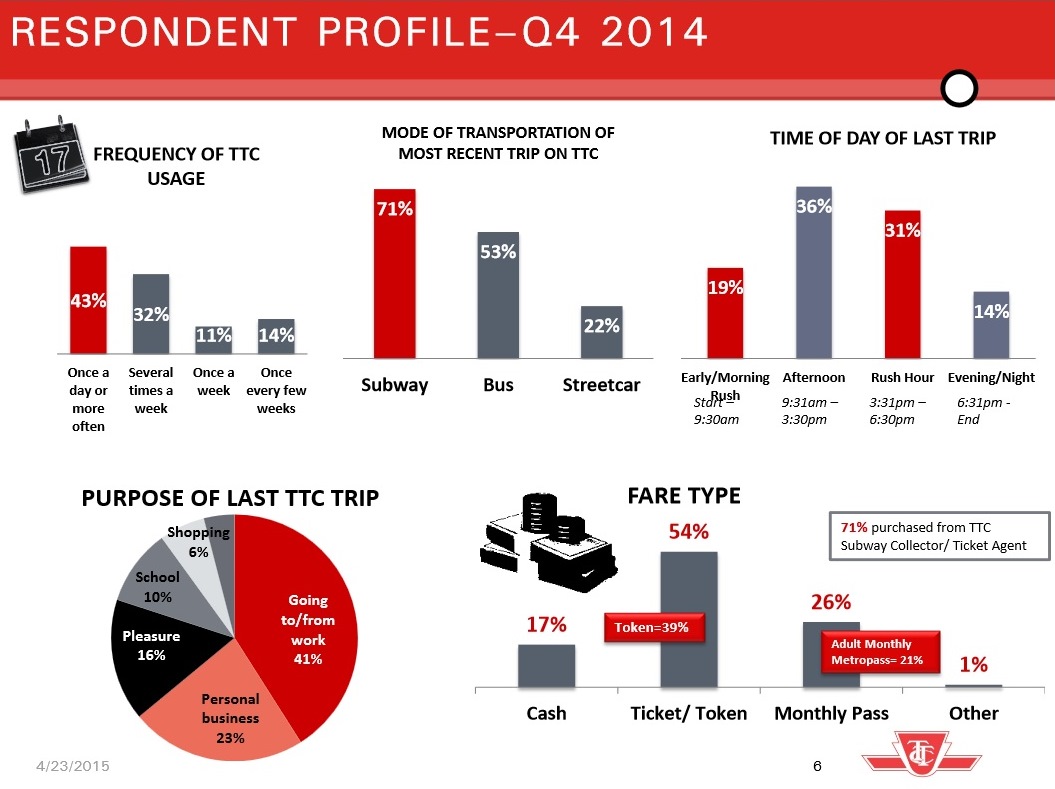
Of particular note is that work trips, while substantial, are only 41% of the total. Also, Metropass users represent about one quarter of the surveyed riders, but we know from other stats that they represent far more rides. This has implications for Presto implementation because half of the riders use tickets and tokens, and a further 17% use cash. These will be the primary market for conversion to Presto in the short term so that the overhead of handling fare media and cash can be reduced.
While overall satisfaction remains at a score above 70%, there is considerable displeasure with quality-related issues:
Areas of lowest customer satisfaction include (≤60% for Q4 2014) [p. 8]:
• Frequency, ease of hearing, clarity and helpfulness of announcements about subway delays,
• Availability of subway station staff,
• The level of crowding inside the subway train, bus, and streetcar,
• The length of time a customer waited for the bus/streetcar,
• Maps and information inside the bus/streetcar
Another intriguing measure looks at “Pride in the TTC” which has declined for many groups of riders, regardless of how the population is subdivided, through 2014. This is especially true among riders who are better educated, full time workers with higher incomes. This should not be surprising as this group has more choices available in making travel plans and is less likely to shrug and accept service as a fact of live to be endured. Similarly, riders who use the TTC regularly rate the quality of service lower than those who ride occasionally, and their approval is trending downward. Riders whose trips are confined to the streetcar system rank service quality lower than those who use other modes.
This trend should be a wake-up call to the TTC which has spent too long on superficial improvements, or small scale tweaks of its operations, while (until quite recently) toeing the line of budgetary restraint and limited service improvements. Moreover, when asked about “value for money”:
“Customers tend to be less focused on fare reduction and more on timeliness and schedule frequency as the most effective ways to improve the perception of value for money.” [p. 14]
Wait time is an important issue for riders, and this speaks to problems with service reliability as well as quantity. The TTC knows that the cheapest form of additional capacity comes through regular spacing of vehicles and minimization of short-turns, but attempts to correct operational problems have been slow to appear on the streets.
“Opportunities for improvement” include key service-related issues:
Recent declines in several subway service areas indicate a need to focus efforts on improving all aspects of subway service, including:
• Reducing subway delays and crowding,
• Continuing to focus on quality and ease of hearing the announcements about subway delays.The gap in satisfaction between frequent and occasional riders is increasing; therefore, providing a reliable service is key. [p. 26]
How many times do Mayoral candidates and Councillors have to be told that service is what the TTC is selling, and that “lower fares” are not a key issue for riders? Too often debates about fares muddle together social goals (cost reduction for the disadvantaged) with a sense that fares are just another form of tax that must be reined in for all riders.
Transit Service to the Pan Am Games
The TTC has now published its overall plan to serve the Pan Am Games sites within Toronto. Much of the service will be provided by bus shuttles from various subway stations given that many venues are not on the rapid transit network.

The service will include two new, temporary routes:
- the 194 Aquatics Centre Rocket from Don Mills Station to UTSC, and
- an accessible 406 Venue Shuttle Downtown between St. George Station and other downtown sites.

For the Parapan Games, there will be two accessible shuttles:
- the 406 downtown shuttle described above, plus
- a 408 Venue Shuttle East linking sites at the University of Toronto Scarborough Campus.
Details of the service levels to be operated have not been published, but the general scheme is to use a mix of scheduled service plus extras that can be deployed depending on the locations and times of events on a day-to-day basis.
During the Pan Am Games, the system will operate with Saturday schedules on Sundays to accommodate travel to venues early in the day, as well as higher demand than is usual on Sundays. On the one Panapan Sunday, a special schedule will be operated to provide early service to the venues requiring it.
Additional service will be provided on the 192 Airport Rocket (which will now have the UPX rail service as competition, assuming that wayfinding at the airport directs travellers with equal ease to both services), and on the 172 Cherry Bus serving the Athletes’ Village.
Anyone with an event ticket will be able to use it as a Day Pass. Special Weekly Passes will be available, as well as an electronic version of a Day Pass (details tba).
Some historical context makes interesting reading. Back in 2010, the TTC had great hopes that new transit lines would provide service to Pan Am Games venues:
The 2015 Pan American and Parapan American games will involve competitions in 40-to-50 sports at more than 50 venues throughout Toronto and the Golden Horseshoe from July 10 to July 26, 2015:
• many of the events within the City of Toronto will take place at existing facilities in downtown Toronto and Exhibition Place – locations which are already well-served by transit;
• a new Pan American Aquatics Centre and Canadian Sport Institute of Ontario facility will be constructed at the University of Toronto Scarborough (UTSC), and improved transit facilities will be required to effectively serve this new sports complex;
• at this time, the TTC’s priorities remain the State-of-Good-Repair work required to upgrade, modernize, and increase the capacity of the Scarborough RT in advance of the Games, as well as proceeding with the priority Transit City light rail projects – such as the Sheppard East LRT line – which will also provide service to events in Scarborough;
• the planned Scarborough-Malvern LRT line would provide excellent direct service to the venues planned at UTSC, as well as providing excellent service to this expanding major educational institution, but the construction of this line is not included in Metrolinx’s near-term funding priorities;
• a new Athletes’ Village is planned for the West Don Lands area, which will be served by a new streetcar line planned for Cherry Street;
• based on the experience of other cities that have hosted major international sporting events such as the Pan American Games and the Olympics, it will likely be necessary for the TTC to temporarily expand its bus fleet and operator staffing to provide the capacity needed to serve some of the non-central event venues; this could be accomplished through various means such as advancing the timing of a future bus order, and then retiring older buses after the Games. [p. 1]
We all know what happened to the Transit City Network. The Cherry Street line will not, in fact, be open for the Games because, in part, it goes through the secure area of the Village, and because plans now call for it to come into service midway through 2016 when the permanent residents start moving into their condos. As for bus fleet planning, that was scuppered by cutbacks in service standards, purchase plans and garage expansions thanks to the Ford administration. York University was not listed as a venue in the 2010 report, and so the completion status of the Spadina extension was not then an issue, but at the time it was added, there was thought the subway would link to that Games site. Instead, it will be another suburban shuttle location.
The dispersed locations of Games venues will prove a challenge for spectators travelling by transit who will easily face hour-long journeys to some locations.
This CEO’s rport includes data on the first quarter of 2015. The summary “scorecard” at the beginning shows many items with a “red” status including almost all of those related to service quality. After a very cold winter, this is not a surprise except that it shows that the transit system is not prepared for this type of weather. The problem extends well beyond the aging streetcar fleet’s reliability problems with frozen air lines.
Ridership is below budgeted levels, but this will be in part due to the extreme cold and in part to the March fare increase. Until “fair weather” data are available, it is difficult to tell whether this will be a shortfall through 2015, or merely a weather-related effect. On a year-over-year basis, ridership is up relative to 2014, but not as much as predicted in the budget. Fare revenue is down both because there is less riding, and because sales of Metropasses continued to grow diluting the average fare to $1.95 (0.9% lower than budget) through to the end of February. In March, after the fare increase, there has been a shift of more riders to discounted passes (VIP, Monthly Discount and Post-Secondary), and regular Adult pass sales are down about 5% relative to budget. Jacking up the Metropass fare multiple does not appear to have been quite the hoped for cash cow. At this point, CEO Andy Byford expects the budgetary variations to even out over the year.
Service reliability fell on all modes and lines except for the Sheppard Subway which is insulated from bad weather and has relatively new infrastructure. Data are reported only up to the end of February and so they represent the worst of the weather-related problems. How this turns around in future reports will be a key item to watch across all modes.
The report triggered a short discussion about whether the TTC has too many operators on staff with reference to an article in The Sun about surplus operators being sent home without work. The explanation for this is that the TTC had fewer retirements early in 2015 than expected, but due to the lead time for operator training, had staffed up in anticipation. The excess situation no longer applies.
Delivery of the new Toronto Rocket (TR) subway fleet had progressed to completing the replacement for all existing “H” class cars, and the trains now being delivered are the 10 added sets for the Spadina extension. By the end of 2015, a further 10 sets for future growth will arrive, although the TTC will not be able to operate them until the signal system is upgraded to permit closer headways in 2020. Meanwhile the subway will have a very large pool of spare equipment.
The new Flexity Streetcar order continues to be a concern for TTC management, but Bombardier claims that they will ramp up to one delivery every five working days. There was to be a meeting about the contract’s status between TTC and Bombardier on May 1, but nothing has been reported from that event. The TTC still hopes to have 30 new cars in service by yearend 2015. Car 4407 is now enroute to Toronto.
Work at Leslie Barns continues with completion of the connection track and overhead to Queen Street now underway. The TTC expects to begin moving into the new barns in mid 2015.
Leasing Additional Office Space
A report on the lease of office space for 100-120 staff assigned to capital projects triggered a discussion of rented space generally, and a question of whether Build Toronto has anything in the pipeline that would suit the TTC.
CEO Andy Byford replied that issue is not just space for small-scale project offices, but for a consolidation of the many staff scattered through multiple buildings (including the aging TTC headquarers at 1900 Yonge). The next candidate site will be at Yonge & Eglinton over the former bus bays which are now used as a staging area for construction of the Crosstown LRT tunnel.
 Steve Munro
Joe M:
And therefore it’s really just pixie dust planning & wont be seriously discussed in the next 150 years. Considering we are selling hydro to barely scrape by on the next wave & no proper funding model its just wasted discussion that has no merit.
If this line was actually funded the LRT plan might have had enough support without leaving a massive chuck of Scarborough as third class. In actuality it is now just used as a pawn in the game to make Scarborough accept the poorly integrated LRT scheme.
Steve: Again you are quoting text from a TTC report as if I said it myself. You really need to get your attributions right, although in this case, and certainly in the timeframe the report was written (2010), I agree with it. We were screwed by the Ford administration and by Queen’s Park.
To give you an idea how close this was to reality, Metrolinx was all ready to announce the UTSC extension of the Sheppard line after the 2010 election was out of the way, but with Ford in office, all of that stopped.
LikeLike
Steve: This issue started out as a request from Councillors Davis and McMahon whose wards include Main and Danforth stations, respectively, that the TTC support a Mobility Hub study for the Danforth Station area.
And that is exactly why DRL should run through Main Station or not [be] built at all. No point building it through low density Pape area where trains will run nearly empty.
Steve: A line through Pape will serve the high rise district of East York and can continue north into Thorncliffe Park, something that is impossible if the line is further east. As far as I am concerned, there is no point in building the DRL without concrete plans to continue at least to Eglinton & Don Mills.
As for Danforth/Main, I don’t think it will ever be a major transportation hub. The two stations are too far apart, and this adds a long transfer (far worse than that “endured” by Scarborough riders at Kennedy Station) to any transferring trip.
LikeLike
Apologies for the accidental reference. Although I was fully aware it was the TTC report not you.
The extension to UTSC hook is not the Scarborough-Malvern LRT. Watching areas around KIngston/Morningside & Kingston/Eglinton continue to deteriorate further due to lack of quality transit is disheartening.
Seriously. Can we really not build a fair & complete transit network in this City? instead of having the Political transit lottery for the richest lobbyists & lies to the other areas to buy votes.
Steve: I agree that we should also have had the rest of the Morningside/Kingston/Eglinton route down to Kennedy Station, not to mention the Scarborough line into Malvern. My point was that Metrolinx was on the verge of pushing ahead with the link to UTSC, and this would have been a strong incentive for further expansion.
LikeLike
Main already has a subway, 2 GO lines, and a Canadian Tire. They have enough.
LikeLike
Looking at your recent tables of annual data, and the projected ridership of 2015.
Shouldn’t the projected 2015 ridership be reduced by the amount of riders between 2 and 12? TTC has never tracked riders below 2 who don’t need to pay a fare, so presumably ridership numbers will no longer include those under 13.
Steve: I don’t know how the TTC is going to estimate the number of children who ride the system, or incorporate this into their annual counts.
LikeLike
Do we?? Don’t forget, 7 bus routes, a streetcar line, a Sobeys, a Timmys, my apartment, a Masonic Temple, a Shoppers, a KFC, Duckworths and a needle exchange centre. But I still want more.
What you want more Dennis?
Yes, please sir!!!!!! I want an LRT route out to Scarberia along the Kingston Road and the Danny from Main Street. And I want it with a side of a rail connection to the Kingston Road car-line to downtown via Vic Park, together with the return of Zellers, world peace and a decent restaurant!!
And I query, two GO lines?? Only one on my map. If’n you’re thinking of the Stouffville line, it bypasses us. Unless one can run at 45 miles an hour, jump and hang onto a handrail, there ain’t no other GO at Danforth.
Yours in anticipation,
Dennis
Steve: Over at Broadview, we are terribly deprived. We have only four bus lines, but we have two streetcar lines. We have GO but it’s down in the valley and most of the harebrained proposals to make it accessible involve Castle Frank over in tony Rosedale, not Broadview here in the more modest Playter Estates. We do have a Timmys and a Starbucks and a Coffee Time and independent coffee shops as well! But we deserve much more!
LikeLike
And a streetcar line. However, as a resident of the Main & Danforth area, “underutilized existing resources” is a better way of putting it than “have enough” when it comes to the dumb idea of putting the DRL there.
LikeLike
In all fairness, the rollout of Presto here in Ottawa was complicated in typical fashion for this city by changes to the card that Ottawa City Council wanted which deviated from what was being done everywhere else. They were advised not to do so, but went ahead anyhow. Once the bugs were worked out, it became very successful and something most Ottawans are happy with. Fare complications are a bit of a ruse: we can use the card on the STO system-a whole different province!- and they can use their version on ours.
LikeLike
I agree with Joshua in that DRL east should be built under Main and what Steve stated is completely false – namely his claim that DRL if built under Main would be impossible to take to Don Mills and Eglinton for in an age of space travel, it is obviously possible.
LikeLike
I believe the funding allocated to the SSE could easily build the entirety of the Scarborough-Malvern line, as well as the extended SRT replacement. That, combined with the Sheppard LRT, would make a pretty good network, and one which I think most people here who support the LRT plans would be happy to get behind.
The problem is that nobody in Scarborough wanted that. Nobody was agitating for that. Hell, I doubt most average people in Scarborough (or anywhere else in this city) had any idea which Transit City lines were funded and which were not. People there didn’t want LRT, full stop. Exactly why is up for debate, but when they voted for Rob Ford, it wasn’t because he was pounding the table over the plan not being fully funded.
LikeLike
For the comments about the Main & Danforth area, I use to live at Main Square and while it has lots of potential, I don’t see it becoming the next Union Station. Lack of transit was not a major issue there however I now live at Birchmount and Sheppard and definitely notice the difference. The buses along Sheppard are good however the North-South routes along Birchmount and Kennedy are lacking. There is also a large number of apartment buildings around Warden and Finch although I don’t hear talk of having a Finch East LRT or BRT. I am shocked that the elected officials in the area still want to extend the Sheppard Subway even though no urban transportation expert would ever approve it and I suspect if Toronto were to hire a Gridlock Tsar, the first thing they would do is shut down the existing Sheppard Subway and use the money for improved bus and trolley service. I wonder if they read the study by Paul M. Hess and Andre Sorensen.
Given the comedy around transit planning and projects in Toronto that are based on politics and truthiness, one would think that the province could simply get a big computer (we’ll call it Big Thought in a salut to Douglas Adams) and then enter the following information:
– population density
– employment density
– travel flows
– capacity of all modes of transit: express rail, subway, LRT, BRT, trolley, bus, gondola, bicycle express lanes, etc
– rate areas for potential future development
With this info in, the computer could then produce the perfect transit system.
Steve: Bearing in mind that the Sheppard Subway was “justified” by employment estimates that were not achieved and may have been impractical even at the time, just as the SSE was “justified” by inclusion of demand from the north that will be carried instead on GO/RER. A computer program can produce a “perfect” system based on gerrymandered input, and will likely not have any built in bullshit factor to know what it is doing.
LikeLike
Steve has said that Main would be too far east for a meaningful DRL and Sherbourne too far west and in other words if it doesn’t go through near my area, then it is either too far east or west.
P.S: Steve leaves near Pape station which according to him is the only possible choice for the DRL.
Steve: I think that you mean “lives”, and I have already explained at some length why Main and Castle Frank are inappropriate (as is Broadview, my home station). Sherbourne is physically impossible as you would have to tunnel under Rosedale just to get to that location. I look forward to the public meeting when this is announced and you are bought off by the good burghers of Binscarth.
LikeLike
I’ve already read this story.
Steve: Or the animated version from the NFB.
LikeLike
I think there are a number of considerations as to where you would want to run a DRL.
1-) Will there be space in the future on the lines it links where it is linking them to absorb transfers.
2-) Is it far enough from an existing line to actually have an opportunity to add to service beyond simply capacity.
3-) Where can it go from its intersection point with the lines it is meant to link.
4-) What complications are you likely to run into in doing so
1- Too far west, and well, if load grows, Danforth will already/still be full at the transfer point.
Steve: I think you mean “east” here.
2- Too far west, and you are talking only minutes away from an existing line – what is the point.
3- If Broadview, Pape or Donlands – it can find find its way through to the high density areas North of the valley, ie Thornville and Flemingdon Parks, look at the density in these areas it is huge. Also look at the bus routes flowing through. Also just north of Danforth around Pape (say Pape and Cosburn) there is a notable area of quite high density. To my mind Pape is best in terms of density, however there may be other considerations.
Sherbourne: The area immediately north will serve relatively low density eastern Rosedale, followed by Moore Park (also relative low density).
Castle Frank – where are you going after this?
4-) Sherbourne immediately faced with the Rosedale Ravine, and then where are you headed for real service
Castle Frank there is nowhere to go really without an impossible valley crossing, or cutting even closer to Yonge.
Pape or Donlands seem to offer a shorter Valley Crossing, to provide access to meaningful concentrations of residential and business areas, and the shortest run to areas from which lower cost extensions of rapid transit are possible. Pape in my mind offers a better route, with the exception that Donlands touches the TTC rail yard – good for serving the line.
I think the logic of the long term design of a TTC system to serve density and create a better system, along with what is there now in terms of yards and services, and the physical geography should be the how the route is located. I also think that this is why Steve (and others – including I believe City Planning) have focused on this general area.
I am sure that Steve could go into far greater detail, and others likely have some details on the Geology (Matthew?) however, the basic route is really not that easy to get around. Yes you could spend a whole lot more money to go further east, avoid the areas that would be better served, and still get something out of it – but why? You could go further west, but well, what about the future of the system, and relieving Yonge north of Bloor? Connecting the Crosstown in a meaningful way – creating an anchor for future service?
LikeLike
Sounds like an application for “fuzzy logic” where the source of data, and real density could be used to discount the BS values. The computer could then spit out 2 solutions
1 – applying political data
2 – using non political only
Of course the input of data and honesty or source would need to be clear. Also, as we all know there would be considerable effort expended in driving the system to an electorally optimal result, which would undermine any well considered application.
LikeLike
Many errors including your simplified judgement of Scarborough citizens:
The SSE funding was never available at the time of Transit City. Therefore that option was NEVER on the table for Scarborough. You are correct that the cost could cover a full LRT Network in Scarborough and that would be worth putting to a vote as a viable option.
The current SRT is not well received out here due to many reasons above the current reliability. The current route design is not well liked & the transfer to the subway just make it that much more special. So you would really have to provide a good alternative to gain much support for this length of track. Also Smarttrack has likely rendered the most ridiculous stop useless anyway so it’ll be interesting to see what happens.
The Sheppard LRT has the most support out of any of the lines out here yet & that’s not saying much because the majority don’t support it for its major flaws. The main being funding to make it a useful loop for the majority. Tough to garner majority support from other areas other than the residents around Markham rd & Morningside. Those to the west are inconvenienced by the subway stub & those left out in the cold are just pissed or apathetic.
I think the main issue is many people don’t care to understand Scarborough’s diverse landscape & would rather force poorly funded, incomplete projects. Since we ONLY have the choice of two dumbed down projects the majority see greater benefit in the Subway extensions.
A post like yours illustrates clearly why Rob Ford was voted in. He is a byproduct of many people’s frustrations of not being listened to, talked down to & having minimal support from the rest of the City. Until there is some type of respect were likely to see another polarizing figure.
Steve: For the record, there was a “loop” in the Transit City plan including the Eglinton/Kingston/Morningside line. That’s what was originally proposed, but thanks to Queen’s Park, that was sliced off of the network. Be careful in dissing LRT supporters with a claim that they [we] only want to build the Sheppard line. No, we want it all.
LikeLike
I am getting tired of this “we deserves” argument from Steve which he makes because he does not have a better argument to make for the proposed DRL subway to serve one of the stations near him. Building a DRL under Main will not only provide a convenient connection to two GO lines (both of which will have two way all day service before DRL gets built and one of it already does actually) but also SmartTrack and not just that but it will free up Main St streetcars thereby also addressing streetcar shortage. If DRL East is ever built at all, it must be built under Main to deserve the best bang for the buck or it should not be built at all for it makes no sense to build it through low density areas around Pape/Broadview.
Steve: You have been mocked kindly, now I am just going to tell you that you are full of crap. There is density in a Pape corridor not to mention in Thorncliffe Park beyond, an alignment that is not available to a Main route. Broadview is not even under discussion (you obviously have not been paying attention), and Main is simply far too far to the east. Don Mills Road lines up with Coxwell, but a dogleg to the west through Thorncliffe Park would pick up a high density area that has a lot of underused land.
LikeLike
Do you actually know the route that the 506 Carlton takes to Main station?
Steve: I am amused at how we address a streetcar shortage by building a multi-billion dollar subway that just happens to go through someone’s favourite station, and, by the way, would not open for at least a decade.
LikeLike
“Proposed”. Certainly not funded & worse Queen’s Park was busy doing playing further political games on the fly with the Sheppard line. In reality the Scarborough Malvern LRT never had a chance. It was standard politicking with no intention to build an effective Scarborough network.
Steve: You have to be careful when saying “no intention” — there was every intention of building it until Queen’s Park took control of the project away from Toronto.
And not even sure what your last line about LRT supporters implied as I never generalized LRT supporters. My comment was to those that clearly don’t understand Scarborough & has nothing to do with the simpleton LRT vs Subway technology debate we’ve been subjected to.
The route design, overall funding, integration, & fairness for Scarborough as a whole completely missed the mark in the proposed LRT plan. Without a better plan there’s really no reasonable debate to be had.
Steve: Since your initial premise is that TC was never really intended to be built in full, and I don’t agree with that premise, then I really cannot address the conclusions flowing from what to me is an invalid premise.
LikeLike
Mark, you cannot use that argument against a DRL under Broadview as a DRL under Broadview too will free up many streetcars and hence improving service on the surviving streetcar routes. Not to mention the DRL will likely go under King or Queen and that will free up further many streetcars to improve service on other streetcar routes. I am all for a mobility hub at Main station comprising Bloor-Danforth subway, DRL east, two GO Lines, and SmartTrack.
Steve: And a lot of walking.
LikeLike
Regarding a downtown subway to main station,
I suspect that both you and Steve are underestimating the potential of a subway line to Main or Victoria Park. If you look at your supposition from the perspective of trip origin/destination coupled with a market value for time the majority of people do not want to be on the Danforth Line to begin with. Much of the volume Danforth experiences come from bus feeder routes that can easily be diverted to the southern subway line to better serve the actual travel demands, instead of forcing unnecessary transfers. If they build a wye at Main station the planned Scarborough subway would be able to provide a one seat ride from Sheppard Ave and McCowan Rd to St. Andrew’s station. You also underestimate the growth potential that the Main alignment would provide both from a quality and quantity perspective. A downtown subway can very easily be designed to have a very high net present value which will make raising money for it easy.
LikeLike
I would advise using caution when trying to justify the DRL by saying that it will serve the Thirncliffe Park community. One, the DRL will not provide the fine grained service that the existing community requires. Two, the significant lack of growth opportunities along the proposed DRL line will force the gentrification of communities that were designed to provide affordable housing.
Steve: That’s an amusing argument by contrast with the bilge we hear from downtrodden Scarborough residents. In effect, you are saying don’t build subways to places where poor people live because (a) the stops will be too far apart and (b) the areas will gentrify thereby pushing people out of their homes. Can you say “Scarborough Subway”?
LikeLike
The transfer between GO Danforth station and TTC Main station is much better than between GO Bloor station and TTC Dundas West station and yet the latter together is projected to be a major transportation hub and that is precisely why DRL West is expected to go to Dundas West TTC subway station and you support this too. It’s funny Steve how you use a double logic system to suit your own preferences of a DRL in your backyard. Also note that, at Danforth GO station there are 2 GO lines (all Stoufville lines will stop there in the future) whereas at at Bloor GO station, there is only a single GO line and soon also the UPX but with gold plated fares, very few people are expected to transfer between UPX and TTC at Bloor GO station / Dundas West subway station (Metrolinx admits this) and yet despite all this somehow the Bloor GO station / Dundas West subway station is expected to be a major transportation hub and yet Steve won’t admit this for Danforth GO station / Main subway station. The DRL West at Dundas West too will knock down some streetcar routes and so I don’t see why you would oppose the same at Main. Instead your arguments should be based on facts and ridership numbers rather than fear of some streetcars being replaced by a DRL. A DRL is needed and will eventually be built and streetcars have a very important role to play in Toronto transit but some streetcar routes will eventually become OBSOLETE as a result of the DRL.
Steve: There have been plans for a direct link into Dundas West from Bloor Station for decades, and I published drawings years ago on this site. Metrolinx is negotiating with the new owner of the Crossways building regarding making this happen. No such connection is possible at Main because the lines are not on top of each other.
Also, I am not entirely convinced that all of the “hub” Metrolinx is planning for Dundas West is entirely necessary, but that’s another matter.
Can you can get over the “DRL in my backyard” argument: a DRL would be of very little benefit to me as (a) I live at Broadview and (b) rarely travel in the peak period. I am reaching a point where comments that take this position will be turned into the electronic equivalent of horse manure, although it may be hard to tell the difference.
A DRL/ST line at Dundas West will not “knock down” some streetcar routes for the very simple reason that a great deal of demand on the streetcar lines arises at local stops that will be nowhere near the rail corridor’s stations.
LikeLike
Steve, are all these pro-Main Station DRL trolls who all seem to have no understanding of the geography of the area, and all seem to think that a DRL at Pape would be convenient for someone who lives at Broadview (what, because you are going to take the subway 2 stops in the wrong direction to get to it!?!?) using the same IP number?
I live near Main Station. I can’t imagine why you’d connect the DRL all the way out here.
And I don’t see how it would decrease 506 usage. The streetcar starts at Main Station. People gradually get on starting at Main/Gerrard (most of those that board at Main itself get off by Coxwell). Few are going to go backwards to get back to the subway.
I’d think putting a subway station at Gerrard Square or Coxwell/Gerrard (which I don’t advocate) would have a bigger reduction on 506 ridership.
LikeLike
You make the mistake of attributing the demographic patterns of the communities in question to the same cause. However the communities are fundamentally different. Throncliffe was designed to provide the very important social function of providing affordable housing to those who need it. Whereas Scarborough was historically middle class, and the socio-economic decline was caused by the government’s failure to make the necessary investments to adapt to significant exogenous macroeconomic competition. What concerns me about your approach is that you willfully undermine communities that should not be undermined, and ignore the core needs of communities that should not be ignored.
Steve: We are going to have to disagree on this. You are basically saying that areas of the city that are earmarked for the poor should never have higher order transit provided. That is a rather condescending attitude. Moreover, Scarborough is not uniformly “middle class” (nor is North York or Etobicoke).
LikeLike
Steve, I think there is many a farmer/rancher that would find your particular position disturbing. Horse manure serves a purpose that is very real in terms of being usable on the fields, comes from a lovely creature, and the stench from it is far less offensive than the particular nature of these comments. I would argue that a large high intensity hog farm (one where there is say 10,000 hogs in a single barn), is more appropriate comparison, as the smell is truly offensive.
The only redeeming value that I can see this approach having, is they clearly believe that you have a massive influence on city planning – as this would infer you would be dictating the debate.
I would note that despite this, in your clear need to minimize your apparent influence, you downplay the area in the western portion of the considered zone, that would be most likely to actually serve you. Clearly Steve, you are the party to be lobbied in terms of determining route … I would like to note to all Steve, has a clearly already dictated the end point as you can see in the city planning version clearly focuses future consideration down to the area very near Don Mills and Eglinton.
Steve: The end point near Don Mills and Eglinton appears on maps of what we now call the Relief Line dating to before the period of my political activity and influence.
As for hog farms, when I visit Stratford and the wind is in the west, the aroma of hogs wafts through the city. Even those poor hogs make their contribution to the economy and to the aficionados of bacon who would be devastated without them. Pigs will fly before there is a DRL at Main Station.
LikeLike
The issue from my mind would be – while Thorncliffe Park may serve the need to provide affordable housing, do we want to create a very low opportunity enclave, or do we want to provide reasonable and easy access to employment? Because they are poor – they should not get subway – is this not contrary to the approach taken in terms of serving high needs communities?
Also to what degree did this area actually start as social housing, and to what degree was it started (1960s) with the expectation that there would be the planned subway, that was to run down Queen, and then up through this area? You could argue that the area initially developed with the reasonable expectation that the “promise” of subway would eventually materialize, and that there is a good reason to now honor that. Why is the government promise here less important that the one on Sheppard? This subway proposal predates Sheppard, was in the plan longer, and has actually been part of government planning docs, not a surprise post election funding announcement, later cancelled/curtailed after the next election. Is this a question of a best before date?
Steve: Another issue at Thorncliffe Park is that the whole light industrial north side of Overlea (not to mention the mall area itself) is ripe for development. Do we want to create yet another car-centric concentration so close to downtown?
LikeLike
This sword cuts both ways. A Scarborough Subway Extension can be described as a standard politicking with no intention to build an effective Scarborough network.
Joe, are you ever going to try to share your knowledge of how Scarborough works, rather than continually railing against the fact that no one else understands?
Your argument is circular. There isn’t a better plan, so there is no reasonable debate. The LRT plan missed the mark, so a subway is the better plan. There can be no debate because the simpleton LRT vs Subway technology debate overlooks an understanding of Scarborough. Let’s get into the nuts and bolts of this, rather than getting limited to rhetoric.
I can confirm that this has been integrated into the current renovations of the Bloor GO Station, with knockout panels at the end of the pedestrian tunnel.
So areas that are poor because of bad planning need better transit to make them less poor, but areas that are poor because of good planning don’t need better transit because it might make them less poor? I’m personally against the divided community approach, and think affordable housing needs to be integrated into every building across a city, and not segregated into ‘slums’.
LikeLike
Steve you should have a “commonly heard comments about my position” link on your site, and whenever someone mischaracterizes your position in a comment, just put a link to that page…and then mark the comment as “junk” – and then we can hide all the annoying comments…
LikeLike
Well I can say it would have the benefit of finally forcing an official renaming of the Don Valley Parkway, to the Don Valley Parking lot, as so many already name it. However, the fact that it would also result in the effective blocking of the small number of roads that lead out of the area (after you are on Millwood/Overlea or Laird – where are you going). I think this would make the traffic down Southvale Dr / Moore Ave. for instance unreal, and given the nature of this road, and the fact that some would drive it right through Moore Park, would make some very interesting politics after it came to pass. Of course we should not worry about the impact on Pape, Donlands, O’Connor (where Don Mills effectively ends) / Broadview, or their associated bus routes. To the extent that people actually chose to ride the bus the other way, it could also have an interesting impact on Eglinton subway station, and the subway that point south. This load would add to the expected transferring load from the EC-LRT.
LikeLike
DRL can be built under Coxwell to provide connection with the hospital or under Main or Victoria Park to provide connection with 2 GO lines and SmartTrack and the latter two also pass through very high density areas unlike Pape or Broadview. I fully agree with Joe M And Jon Johnson in that building a subway under Pape or Broadview will be a huge failure as the density, jobs, feeder routes, etc simply are not there and so we might as well throw our money down the gutter rather than build a subway through an area which does not even have enough density to justify an LRT.
LikeLike
I am not sure what routes you are thinking of in terms of connecting at Vic Park, however, look at the density – really along each route, including the areas north of the Danforth. Pape has good density on both sides all the way down, and all the way over to the valley, much better than being as far east as Vic Park. Also running that far east means building a lot more line, with the possibility of offering fewer future options.
PS – Have a look at the healthy cities map of density along the proposed DRL line, which I think is pretty darned close to the route Steve discusses.
Steve: Please don’t try to confuse them with facts.
LikeLike
Fully agreed. 2 wrongs never make a right. It becomes personal preference to choose between 2 crappy plans. Although BRT could be built in the future while a subway extension only come around once in a lifetime.
Some clearly don’t care to understand. Not sure if even you care for a detailed breakdown of areas which would be left behind for another generation or areas inconvenienced with short transfers and inefficient route planning in the LRT plan. The transfers could be supported if a useful network was being built. But without a fair network the benefit is minimal for the MAJORITY. Hence the lack of support.
Well the plan should be modified shortly so we can debate over the next great scheme soon. Hopefully something better will develop … although I won’t hold my breath
LikeLike
Nobody said that the GO Lines and the 2 subway lines have to connect at the same location. A DRL station can be built under the current Victoria Park station and another one under the GO tracks near Gerrard where a new GO + SmartTrack station can be built and one which will provide a convenient connection to the DRL if the latter is built under Victoria Park. Victoria Park has very high density, a lot of feeder routes, and also a much larger subway station with many more bus bays and a small Pape station (built for low density Pape area) will not be able to handle a DRL. I personally am from Etobicoke and would like to see DRL West built first as the western portion is much more dense than the eastern portion which is very low density except for Main St / Victoria Park area.
Steve, Scarborough was always downtrodden but why is it that only recently did we start hearing demands for equality from them? I support equality too and I was hoping for some kind of equalization payment scheme from the richer areas of Toronto to the poorer areas. This is what we believe in as Canadians and it is enshrined in our constitution too and the very purpose of taxation is to create a slightly more equitable distribution of wealth.
Anyway as I was saying DRL West should be built first (and not because I live there but just look at the density).
Steve: Equalization? The old City of Toronto’s tax base built much of the original infrastructure of the suburbs as part of the “Metro” government.
LikeLike
Anybody claiming that Main is so much denser than Pape clearly refuses to look at a map/satellite image.
Pape has a giant corridor of density around Cosburn, 600 m or so in each direction (east/west). Plus it has the advantage of an easy cross into the dense Thorncliffe Park, and all the redevelopment potential. This is a no-brainer.
The baseless arguments people make to gerrymander transit, all while accusing others of doing this same, are rather hilarious.
Also, people are saying that they should connect the subway to the GO line to make a mobility hub… well, it’s already on a GO line, why does it need a second subway in order to accomplish this?
LikeLike
And as you can see the density in Scarborough (green) is much higher than some of the areas in East York the DRL is proposed to go through (yellow). Scarborough is also much more ethnically diverse (more than 70% non-white) than the proposed route of the DRL around Pape. Scarborough is also poorer than the proposed route of the DRL around Pape. Ironically, the article is titled “Building Transit Equity in Toronto” where equity is defined as a single LRT line in poorer, denser, more visible minority areas of Scarborough compared with subway for the richer, less dense, whiter parts of Toronto (Pape area).
LikeLike
Except for that large sewage line under Coxwell that was in the news a few years ago. You know, the one that could have caused a major ecological disaster if it had failed before the repair work was completed.
LikeLike
Steve, let’s face it – we all know that the Downtown Relief Line (DRL) would never have ridership anywhere close to the Bloor-Danforth or Yonge-University-Spadina lines or else we would need a Downton Relief Line Relief Line (DRLRL). Under the circumstances, I am of the opinion that we don’t need a full-fledged subway but an underground streetcar/LRT line will suffice. The underground streetcar option makes so much sense since we already have so much towards that plan in place and will be the cheapest option for a DRL from Broadview station to Dundas West station.
Steve: Once upon a time, a very long time ago, I too thought the DRL should be LRT, although not under Broadview. However, the projected demand exceeded LRT capabilities unless the line was completely grade separated. However, in that case it might as well be a subway. Unlike the Eglinton LRT line which originally was only to be 1/3 underground (allowing for its extensions), the DRL would never run at grade.
LikeLike
Okay so we can send people to the moon but we can’t build subway under sewer lines? If building a subway under Coxwell won’t help you, then please say so rather than making lame objections.
Steve: It is a very large sewer and is at a depth that would typically be used for a subway. In any event, Coxwell makes even less sense than Main.
Note to all commenters: I consider that this topic is now closed and will delete any further comments on the issue.
LikeLike
Steve – has the TTC actually gotten with Metrolinx to hammer out the basis on what particular points of intersection make the most sense for real linkage in the form of “Mobility hubs”? It makes little sense to link to lines at a point where they are close to another link or there would be virtually no logical transfer traffic, but what is the exact criteria that is being put forward? You have noted previously that possible locations are being dropped on maps at any point of intersection – What will be the determining factors? Also to what extent is the TTC looking to create higher frequency service in the outer 416 to serve RER station, and to increase frequency on bus routes that cross LRT? (ie to generally increase the ease of using transit in the outer 416).
To me there is the notion of natural mobility hubs, for instance if you have LRT (2 directions), RER and subway all at Kennedy – well there is a mobility hub in the making – Crosstown, to MiWay (eventually I hope) a reasonable mobility hub can be had especially if GO and local airport areas services are linked in. However, I do not see a lot of candidates for this type of high order treatment – as the transfer traffic would be minimal in a lot of areas, and not much real synergy is added by random linking, nor would I consider the meeting of anything lighter than a BRT with LRT or subway, to really qualify. The idea of a real mobility hub in my mind is also to create an area that would be good for transit supported development, that would happen at natural meeting point of several meaningful lines, or where regional lines and substantial local lines can be reasonably used to support a single location or small area.
Steve: For the maps and background info, please refer to the Metrolinx Mobility Hubs page.
LikeLike