
May 1, 1980, saw the introduction of Toronto’s Metropass and the beginning of a shift away from pay-as-you-ride travel on the TTC.

The pass did not come without some political battles, and the stock TTC line was that this just wouldn’t work in Toronto. What they really worried about, of course, was lost revenue, a topic that comes up every chance TTC management gets to cry in their beer about the good old days when people actually paid full fares to ride.
The fare multiple in 1980 was 52 – the price of the pass at $26 was the equivalent of 52 tokens at, wait for it, fifty cents each. Over the years it was wrestled down to 46, but has been drifting up again in an attempt to make those pesky pass holders pay more. The ratio stands at 50.5 today for a regular pass with no discounts.
In fact, passholders now represent over half of all TTC rides. In 2014, out of a total 534.8-million rides, 290.7m were paid for with transit passes. It is long past time that we should think of pass users as if they are some small privileged group, but rather that they take the majority of trips on the TTC. It is their fares which are the “standard”, not the higher priced token users nor the real cash cows, those who pay the full cash fare. The chart below shows the evolution of fare media usage over the past three decades.
1985-2014 Analysis of ridership
At its April 29, 2015 board meeting the TTC approved a request that staff report on various fare options including:
- fare by time of day
- 2 hour transfer
- Seniors fares by time of day, including $1.00 seniors fare during off-peak hours
- Fare by distance
- Concession policy overall as informed by Fare Equity Strategy
- Monthly pass versus daily / weekly / monthly capping
- Free regular transit fares for Wheel-Trans qualified passengers in addition to the visually impaired
This report is expected to arrive on the October 2015 board agenda.
Fares are a much bigger issue than the TTC, of course, and Metrolinx is working on its own regional fare integration strategy. Like the TTC with any form of passes, Metrolinx has a built-in aversion to any fare system different from the one they are already using, a pseudo fare-by-distance system. Indeed, in their March 2015 report, Metrolinx leaned heavily on schemes using distance or zone-based fares, and omitted any mention of limited time-based fares such as the two-hour transfer. So much for an exhaustive review of existing practices, especially considering that this type of fare is already used within the GTA and long predates any specialized technology such as Presto in, for example, Vancouver. (I wrote to Metrolinx about this omission and was assured that time-based fares would be added to the review.)
It is quite clear that a flat fare is impractical on a broad geographic scale unless some combination of governments is prepared to greatly increase the subsidy both for fare revenue and for the additional service such a scheme would require to handle induced demand. The problem becomes just what do we mean when we talk about “distance” or “zones”, not to mention classes of service such as “premium express” or “rail vs bus”.
GO Transit’s distance fares are from a formula that allegedly works like this:
- base fare common to all trips, plus
- distance based fare depending on length of journey
In fact, even a simple analysis of GO fares reveals that this formula is at best a goal, not a rigourously applied scheme, and long trips are charged substantially less than short ones relative to distances. This has very serious implications for the proposed RER network that will lie substantially within the higher-cost portion of the network, and for any additional stops made possible through the higher speed of electrified service. Another problem is that RER will depend on local feeder-distributor services, and these must be available at a very low marginal cost over the train fares. Otherwise, the cost of a train plus local transit trip (let alone one using local transit to access GO at both ends of the journey) will be prohibitively expensive.
Regional fare integration between the TTC and its neighbouring systems is very important, but this requires a scheme that will reflect that a shared fare will necessarily be lower than the separate fares now charged to cross-border riders. New riding might offset some of this, but that riding will also require more service and there is no guarantee that things will magically work out without more subsidy dollars.
RER itself faces a challenge in operating costs, and by implication fares, in that it is a departure from GO’s past practices. Until now, GO adds a train here and there with the expectation that the seats will be full and fare revenue will come in at least on a par with existing operations. Only the recent move to a 30-minute service on the Lake Shore trains was a case of putting in service and hoping for the best. Ridership has gone up, but there has been no accounting of the net cost. RER includes a promised 15 minute all day headway on many lines, but there is no guarantee they will generate ridership and fare revenue to support this level of service. Will the balance come from better GO subsidies, or from fare revenue?
On the TTC itself, we commonly hear calls for some sort of distance-based fare. These usually come from people whose trips cross existing fare boundaries, and who hope to see lower combined TTC+905 fare. However, there is a fact of life about TTC trips that must be considered: the average journey is under 10km, and if fares are rebalanced based on distance, then those who have long commutes will pay substantially more for the privilege of spending much of their lives on the TTC. A trip from northeastern Scarborough to downtown could easily cost twice or more the present TTC fare, and such long-haul trips on the TTC could be as expensive as comparable trips on GO Transit.
Toronto eliminated its zone fare system four decades ago precisely because of suburban objections to supporting the TTC through taxes, but getting worse service and paying more to ride a two-zone trip into the core. At a time when the single zone fare was 20 cents, the two zone ticket cost 33.3 cents.

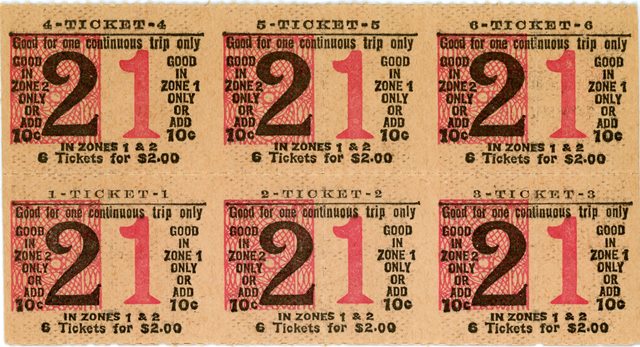
Some “suburban” subway stations were originally built with a fare barrier between subway and surface routes and these were reconfigured after the elimination of “Zone 2” to provide a transfer-free connection from buses to subway.
On top of the question of zones, distance or time as the unit of measure for fares, there are a number of questions about concession fares. Who should receive discounts? How deep should these be? Should discounts be extended to classes of riders such as seniors and students, or to those of limited financial resources? How will various discount schemes on the TTC, GO and the 905 systems be reconciled? Should any existing discounts be eliminated?
What constitutes a “premium service”? GO Transit rail? GO Transit buses? Express buses on BRT routes? Limited stop buses running in mixed traffic? The subway network? Should there be fare premiums at all for the basic network, or should calculations of fare levels be the same for a GO Train to Hamilton as for a TTC bus to York University?
Should fares reflect the capital investments in higher-order infrastructure, or of higher operating costs associated with rail modes, particularly those underground?
These are not just straightforward matters of socio-economic analysis, but of political issues with a long history. Fare systems and revenues have developed over decades on each transit system as they have in other cities to which Toronto might look as potential models. The problem with any change is that what “works” in city “A” has been there for years and is part of the transit political landscape. People might not like fare by distance in, say, London England, but things have always been done that way. However, the degree to which the central city has become the preserve of the well-off raises issues about the affordability of transit in such cities for the transit captives who are likely to be forced into longer journeys as gentrification moves outward.
It is easy to wave one’s hand (usually after lifting it briefly from a steering wheel) and pontificate about how fares should be reorganized, but coming up with a workable “solution” is quite another matter. If this must be done without any investment of general revenues to give some cushion to the elimination of fare “inequities”, then the task is almost impossible. It will provide great political theatre for those of us who enjoy watching insensitive, unthinking politicians being set upon by voters with torches and pitchforks, but this will not address the basic problem that cutbacks in public funding for transit over past decades leave no “wiggle room” to simply rebalance revenues among fare classes with little effect on most riders.
Municipal and provincial politicians should give careful thought to this the next time they trumpet new investments in transit infrastructure. If riders cannot afford to use the systems built in the name of “fighting gridlock” and “improving the economy”, then their benefit will be limited.
 Steve Munro
It is quite clear to me, that those who want to pontificate while driving, should be prepared to see general revenue moved to a system that will improve rides for those on the bus, and increase the number of ROW systems. In the world where economics and transportation cross there has been a long discussion surrounding the notion of having special road user fees for the times/places where an additional vehicle will increase congestion and impose a substantial cost (externality) on others. The roads and their overload is a classic “tragedy of the commons” argument. Well the fact is transit users are choosing to reduce their use of the road “commons” – and since the roads are currently greatly overused, either users should pay more or those who opt out should be rewarded. So from a pure economic theory, we either need to increase the charge to use the commons, as it clearly is not high enough, or start to pay/reward people more to get them to not use it. The former is well political suicide, so the latter should – if properly explained- get more general support.
The questions to those pontificating behind the wheel needs to be: Do you want /more or fewer drivers on the road? Are you prepared to pay a little more to decrease the competition for road space? I think put in that way, most drivers would support improved transit to get all those other ignorant / incompetent / aggressive / slow / dangerous drivers off the road, so that they would no longer block their important personal trip. I am always amazed to see people complain about buses/streetcars blocking their way, as it does not require a genius when you are looking at a bus with say 50 riders on it, to know that otherwise this would be at least 40 cars where there is no space.
LikeLike
Perhaps selfishly, my first thought is: all of the alternatives sound like a major nuisance. I don’t always take quite enough rides to justify my metropass, but I always buy one because I love the freedom and peace of mind over tokens. Being able to hop off and on the network anywhere at any time is important to me. I’d hate to lose that ability. Hopefully any Presto implementation that eliminates Metropasses has a fare cap, like GO.
There are so many complications with time or distance based systems. Assuming we’re using Presto, I don’t want to have to remember to tap every time I leave a vehicle or station, or every time I transfer between lines 1 and 2. And I can’t even imagine the chaos if everyone had to tap the GO style posts between trains at Bloor-Yonge, or on their way out of Union, King, or St. Andrew. And you’d need to install Presto readers on every door for surface vehicles for distance based fares.
The reason I favour two-hour transfers, assuming the existing transfer system is largely retained (don’t need to transfer between subway lines, or to board vehicles in fare paid zones) is because of the simplicity. But I also see it as a problem for things like all-door boarding (if your transfer has expired, how do you prove that you boarded before it expired or in a fare paid zone?).
I think it’s important that any solution implemented be clear to riders. Anything that riders don’t understand will discourage use, particularly among casual users, and that would be unfortunate.
Steve: In a time-based system, expired is expired. If you get on, say, the Queen car Long Branch, but there’s only 30 minutes left on your fare, then it’s a matter of luck whether you don’t get inspected anywhere east of Roncesvalles. Someone taking a really, really long trip should be prepared to pay a second fare at least some of the time. The issue will be that enforcement should be benign in the sense that the rider is not charged a fine, merely a second fare because it is clear they were riding on a recently expired one.
LikeLike
Fare by distance & mode is the only option that is truly equitable, as it is the option that best aligns fare revenue with operating and capital costs. We seem to have fairly universal agreement that transit not a social service or poverty alleviation strategy, and likewise fare structure should not be used to subsidize those who have long trips for one reason or another. If a trip costs more to provide then the fare should be higher; anything else is unfair to those whose trips are less expensive to provide.
Obviously one can make modifications to a fare by distance approach – in London one can be a Metropass equivalent for specific zones, and buses have a flat fare (but no free transfers without an unlimited pass). Toronto’s problem was that it only ever had 2 zones, too arbitrary to be tied to actual costs and too much of a jump in price from zone 1 to zone 2.
LikeLike
I remember when there was no such thing as a “senior” fare. If you weren’t a child, you paid the full adult fare, even students when they weren’t students.
“Student” fares were “scholar” fares, and valid only on school days up to 5 PM. Weekends, evenings, holiday, and summer months meant the “student” had to pay the full “adult” fare. They did allow them to deposit two “scholar” tickets to be collected as an “adult” fare, thankfully.
LikeLike
I’m in favour of a 40-trip Metropass/Presto-cap. I’d raise cash fares to $5 by 2017, Presto/tokens to $3.75, and Metropasses to $150. Combined with the elimination of senior fares, this would be a 5.8% budget increase per year. If you preserve senior’s fares at current levels, it’d be 4.9%. Interestingly, the full senior discount costed $769,528.73 in 2014, while Post-Secondary is $1,241,937.90. If you wanted revenue neutral, then the Presto/token would be $3.45 and MetroPass/Presto-cap at $138.
LikeLike
In any time-based system I’ve ridden, you are fine boarding a bus 2 minutes before it expires. If you are still on the same bus an hour later, you are good. The 3-hour return on GO Transit already works like this.
Presumably the Presto system would note the tap onto the 501 just before the 2-hour mark is good, and the fare inspector would simply see that the card’s last tap on was for the vehicle in question, and was in order.
Steve: The operative word in your comment is “presumably”. It is a bad tactic with Metrolinx to “presume” anything. Also, the need to tap on at every boarding adds a complexity at locations where there is now a free-body transfer between routes.
LikeLike
I would ask the city to look hard at the road budget and the transit budget, and then ask what are the sources of revenue to support each. I do not believe that the gas tax, or other “user” fees cover 75% of the costs of maintaining the roads within the city of Toronto, so the question needs to be asked why should transit not have in effect the same deal.
Also since we already know there is no realistic way within Toronto or in the 905 to build roads to relieve congestion, what is the level of inducement required to in effect ration their use to best effect. The real balance that needs to be struck is how good does the service need have to be and low does the fare need to be so that it makes sense to use transit for trips that would otherwise induce congestion. I personally like the Metropass, because it makes it reduces the incentive to get in the car. We want more of it, not have it raise more revenue, but have more residents become metropass users, and enough service so that their rides are competitive with the car, and they end up on the bus/streetcar/subway/GO train. The idea of fare box recovery is an interesting one, but, we are not attempting this with the city roads, and this is one of the reasons we are struggling.
We need to have a single lucrative fare, for even the longer rides, as these people are giving up a lot more road use. Ideally we should induce people to live closer to work, but we refuse to have those tools, so we end up having to strike a different balance. One of the points that needs to be made and repeated, is that transit is also an important service to those who must drive.
If we had an LRT that ran parallel to the Gardiner, that people could hop on to get where they were going, how much would you pay to get the drivers of say even 3k/hour of the cars you are sharing the road with to use it instead of the Gardiner, {assuming you drove from the west into the core}? Would that be worth a couple of dollars a day? Per trip? I would put to you the cost (externality) imposed by a car on the rest of traffic at peak is worth much more than a transit fare. Why expect the guy who removes himself to pay for giving up his/her share of the common road?
Transit needs to get at least the subsidy that roads do, and the effect on road use, and the level of that required service needs to be discussed in the debate. Metropass use, is especially valuable, as people who buy them, tend to use them rather than drive, and this should be strongly encouraged from a public policy perspective. When I need to use it every day going to work in order to make it worthwhile, there is an issue, it is too expensive. (That multiple is below 43 (43.45 if you assuming no holidays or sick days). The multiple for a pass therefore needs to be below 40, not above 50.
Also from the perspective of externalities – I would think personally that the farebox collections should likely be somewhere below 65% or even 60 not above 70. At this juncture to me that would not really mean reducing the daily fare, although the cost of a metropass should drift down. There needs to be an implicit reward for the good behaviour of choosing not to drive, and imposing your car on others. There are those that require a car to get to and from work, because of where they work or live, however, given better access to the roads should be something they should be happy to pay for with their taxes. The debate needs to be framed in terms of transit being full of riders choosing not to obstruct the roads with their cars.
Sorry for the rant.
LikeLike
This is not the way it is supposed to work. Miway has time expired transfers however, it starts at the time the bus left the origin point (not when you pay your fare), and ends after you board the last bus before expiry. If you board enroute you lose some time from the two hours, however you can gain it back so long as you have any time left when you board the last bus regardless of how long you ride it.
Steve: “Supposed to work” is a system-specific concept. The Miway implementation is a direct result of the timed fare based on paper transfers that indicate the start time of a trip. It simply would not make sense for a 501 Queen rider to lose an hour’s worth of fare by boarding outbound at Queen & Roncesvalles.
In Vancouver, the single fare buys 90 minutes worth of travel counting from the point of purchase. This also applies to ticket-based fares.
In Montreal, a single fare is good for two hours from the point it is validated.
LikeLike
There are two monthly pass implementations with Presto, depending on the transit agency.
The GO model (and I believe Brampton Transit is another example) uses fare capping. This means that at the start of the month, each ride costs the price of a ticket or token (or one-tenth of the former 10-ride price on GO). Once the price of the monthly pass has been paid, one fare at a time, there is no longer any cost to the user for the remainder of the month. GO implements this in two stages, charging the 10-ride price (which is 10% off the cash fare) for the first 36 (or so) rides, then charging a 90% discount until the monthly pass price has been paid (I believe at about 40 rides).
I prefer this model for two reasons. First, one does not have to fork out the whole price of the pass at the start of the month. Just top up one’s Presto card as needed, and the minimum top-up is $10. Second, if one does not use enough rides to pay for the monthly pass, one only pays for what they used. One will never pay more than the price of the monthly pass. That way, if you get sick for a week or have to go away for part of the month, you don’t have to feel the monthly pass was a bit of a waste of money that month.
The other model that is used is one where a monthly pass must be paid for and “added” to the Presto card. HSR and YRT use this method, and the two advantages I mention above are eliminated, and the Presto card is just like a monthly pass in all but one way: instead of flashing it to the driver, you tap it on the Presto reader.
All-door boarding must use Proof Of Payment (POP). Front door loading uses Pay-As-You-Enter (PAYE). YRT uses POP on their VIVA routes, and PAYE on all others. With PAYE, the validity of fare, whether by Presto or by paper transfer, is only necessary when one boards. If you have one minute remaining and the ride will take 45 minutes, it doesn’t matter. If it did, then anyone who boarded and paid cash or with a ticket and did not get a transfer would be in trouble.
On a POP route, one’s fare is supposed to be valid for the entire journey, and it can be inspected as one is stepping off the vehicle (and I have seen this done!). That said, I have had two experiences on a VIVA route, one with a paper transfer and one with Presto, where my two hours had expired while on route. Fare inspectors have some leeway to give you the benefit of the doubt and, at least on YRT/VIVA, they will if your fare recently expired (and you are not some belligerent a-hole). With Presto, fare inspections are done with a hand-held unit that gives a go/no-go result (green or red light and tones). When the red light comes on, the inspector can hit a few keys to place the unit into a mode that give a display of recent history and you tap it again. If the expiry is reasonably recent, you will be alright, since it is the full-out free riders that are their priority. Still, it is at the discretion of the fare inspector.
Personally, I think that there should be no cash concession fares. Concessions should only be for regular riders who purchase tickets, tokens, or monthly passes. One single cash fare for all.
Steve: I was also thinking about system-by-system variations in concession fares between classes of rider.
LikeLike
Our current fare system is incredibly complex, with different rates for seniors, students, post-secondary students, monthly passes, weekly passes, day passes, and family passes. People who want to make it a “fair” system look to add to the complexity.
Whatever fare system is implemented should consider functionality as the prime factor. My preference would be to eliminate any special fares, and charge everyone on the basis of services used, and leave “ability to pay” subsidies to welfare offices, tax returns, and other agencies.
Functionality means looking at the costs of any system that tracks time or distance. We currently have about 1.5 million passengers each day. That means at least 1.5 million boardings, and probably an equal number of transfers. That makes about 3 million fare “transactions” per day. The ratio of bus to subway is about 8:5, so maybe 1.8 million “transactions” are on buses, with unaccompanied drivers who have to attend to traffic safety and meet their schedules. The system used must reflect these limitations.
The current Metropass is extremely cost-efficient, with one monthly financial transaction, and a turnstile swipe to enter the subway, and showing it to a driver elsewhere. Transfers are a non-issue. It also has a big impact on rider retention. The first ride costs $153 and every other ride is free each month. It makes continued TTC use financially preferable to driving.
For a distance-based system, we will need enough reliable technology to ensure riders can tap-on and tap-off on every bus and subway, and at every transfer. Look at Bloor-Yonge station at rush hour, and make sure we have enough stations to handle the volume. Make sure every bus and streetcar has stations at every door, and that they all are working. If we presume every rider has a Presto style card it works, but might be costly to implement. Riders who wish to pay with cash add complexity.
For a time-based system it may be simpler, just time-on and time-off. It may be unpopular when a system failure slows the system to a crawl, and your 15 minute ride takes you 45 minutes.
If the objective is to induce riders to use public transit rather than cars, the monthly pass is probably the cheapest way from a transaction cost basis, and the most effective way of retaining riders. For the rest of the riders, remember the KISS principle when designing fare structures. Make sure the riders know what the ride will cost, and make it quick and easy for them to pay, board and transfer.
Steve: And while we are keeping things simple, resist the siren call of people who say “just look at all the passenger tracking data you can get with tap on/tap off”. They are in love with “big data” and don’t care how much its collection will actually hurt the system’s operation.
LikeLike
The “siren call for big data” can lead to a serious degradation of service. It is easy to think “tap-on tap-off” is as easy as swiping a Metropass, but the Metropass just answers a yes-no question, valid or not valid? TTC put the cut on a corner of the Metropass to reduce the delays from people who put in in the wrong way. At most stations there are at least 2 turnstiles, so a fumbler does not cause a delay.
For a better analogy, look at the self-checkout lineups in grocery stores. The issue with card “fumbles” can cause significant lineups and frustrations, and most stores now have customer assistants to help with self checkouts. Customer assistants cost money, and system complexity adds time.
When shopping, we might be prepared for lengthy line-ups. When commuting, even short delays cause serious annoyances. Now just think of jams caused by riders lining up to tap-on tap-off at Union Station at rush hour, or on a crowded bus at rush hour. The “fairness” of such a fare system is not worth the added costs and added wait times.
There is a time value in the current TTC free transfer system. I watch the unloading/reloading times for buses at Kennedy Station at rush hour. A packed bus can unload about 50 riders using all doors in 30 seconds, drive around the loop, and load 50 passengers using all doors in about 2 minutes, and be back on the road. Total time elapsed is under 5 minutes. If every rider needed to tap on and tap off, the loading and unloading time would triple at least. Time is money, both for the TTC and for the riders.
That is why I support the KISS principle for fare collection systems.
LikeLike
I would like to see concession fares replaced by an income-based policy. Some people (including Steve – I think) have pointed out the complexity of having the TTC administrate that kind of concession. So I had a thought about another way to do it, funded by the City but administrated by the CRA. The CRA knows [who] buys (or claims to buy) Metropasses through the transit tax credit. The government of Ontario (which has the CRA administrate the tax system) already makes determinations about who has low and modest incomes based on who receives monthly Ontario Trillium Benefit payments (refundable sales/rental/property tax/credits) and Ontario Works/ODSP.
So my idea is that someone receiving monthly Ontario Trillium Benefits, Ontario Works, or ODSP would receive an increase in that amount if they are claiming the transit tax credit. The City of Toronto would pay, but the administration would be done easily and efficiently by the CRA which already has the information they need to determine eligibility. It would also be easy to give a larger payment to Ontario Works/ODSP recipients than to those only receiving Trillium Benefits if that was desired.
I feel that this approach is a good compromise between waving off income as “something for welfare to do” and having the TTC become focused on income inequality. Eliminating the other concessions alone would probably not be enough to fund this idea, but maybe some day the city won’t be so scared of raising revenue.
LikeLike
How much would it “cost” to maintain the current system? Or rather, at what point will people start to really miss the revenue that could be brought by other schemes?
I happen to like the flat fare. Without it I probably wouldn’t see as much of the city as I do. A previous commute of mine into Mississauga (on the 70 Keaton, a busy early/rush route which serves reverse commuters from Islington) would also have been much more expensive.
LikeLike
Steve, why don’t you advocate for free transit for the needy? As things stand with our ever increasing fare prices, too many honest people are forced to skip fares or shortchange the TTC. And if TTC thinks that it is doing a good job by ramped up enforcement on the streetcar system, it has become easier to enter subway stations – a much needed relief for the poorest of the poor in our society.
Steve: I have never argued against better services for the needy, but this should be for those who really “need” assistance, not ad hoc groups of people like seniors or children (or for that matter students). The problem is that nobody wants to actually pay for this, and so we wind up with subsidies bit by bit being accepted because they don’t cost “too much”, and because riders are never told what services they are not getting because the money went instead to a fare freeze or to a special subsidy.
While we are on the subject of special subsidies, I am still waiting for the TTC’s report on Premium Express Buses which, I suspect, do not pay their way even with the extra fare. They are a political sop to a few wards where there was political pressure and a physical possibility of a route to downtown.
LikeLike
That is why the tap must be off of the bus like VIVA and that is why the whole transit system should be Proof-of-Payment (POP).
LikeLike
If someone taps on a different bus, subway, then a fare inspector will see the location and time of tap on. It should be pretty easy for them to use some common sense and awareness of that days major transit delays to see if the transfer is anyway close to reasonable. Just like they do now. It’s not like there’s an automatic system that’s going to get anyone.
Steve: You are confusing two functions: the automatic decision to charge a second fare based on elapsed time, and an inspector’s making a “common sense” decision about whether a previous fare has expired. People should not have to tap again when they transfer as this will create a substantial barrier to movement through transfer locations that were not designed for this. One might also ask why the subway, itself a faster premium service, should be one big fare zone with no line-to-line taps while the surface system is less generous. A lot of this comes down to the relative convenience of the system operator vs the rider, and the big “system operators” in Toronto are notorious for valuing fare revenue over everything else.
LikeLike
The question in my mind is can we have a zone fare where MiWay is a zone, as is TTC, as is York Region as is Brampton, and then we can get a significantly discounted 2 or 3 zone fare. So MiWay transfer to say a ZUM would be a 2 zone fare end to end, as would MiWay from Square One to STC. Or could we get past some politics, and have MiWay to Brampton be a discounted second zone fare, and MiWay to GO to TTC be a combined heavily discounted fare. Ideally would have a monthly GTA pass, with the option to include GO that would still be in the 250 dollar or less range. Should be able to arrange an all in regional pass that would encourage people to use transit for all trips, however, still have the option of discounting from there for say only a YRT &TTC , or MiWay &TTC or MiWay & Brampton Transit pass. However, the idea that the trip from Square 1 to STC would be the same price as Lawrence & Yonge to Sheppard & Yonge seems a little much.
LikeLike
Steve the question on tap on / tap off tracking I would have is how representative of overall trips are passes and presto cards? If they are very representative, could we not have these people just be tracked with a generic longer range RFID tag that they use in containerization, that would permit simply being scanned in passing – invisible to the user. I can see a tracked “walk off”. This would obviously not work for basic cash fares, but an RFID label is something like 95 cents. If you were using the longer range version you would be able to “see” boarding and alighting, as someone simply walked past a scanner. Would provide a lot of data, however, would also require adding a fair amount of stations and equipment to connect and track.
Steve: I suspect that rides taken with bulk purchase forms of fares would include more “short hops” because they have zero marginal cost. This could be affected by the availability of a two-hour fare purchased on a one-of basis. I really tire of the desire for “big data” to track riders in detail when there is a basic issue: is the vehicle full? A related question — are people left behind at stops — is not answered by any “tracking” because there is nothing to track — they never board, and may be disheartened from taking future trips.
It would be nice if we could just get the automatic passenger counters working properly on buses and streetcars, and reported the information publicly with up-to-date data.
LikeLike
I’ve been a fan of “big data” before the term arose. Before Google Maps, I’d created an in-house program for the RAF that mapped the support personnel qualifications, home locations, and maintenance requests to provide daily optimized routing based on urgency and minimizing overheads. I see a huge need in our transit network for better knowledge of the basics. Assuming that transit vehicles have GPS and RFID scanners on the doorways, and passengers have RFID tags on their passes, then you can know how full each bus is (as well as real world crowding conditions). The other half of the problem is people left stranded. I would suggest more hardware, where you can can your pass and keeps count of the passengers waiting. For those without a pass, then you might be able to have some level of tracking with a mobile app, but that’s more complicated. The combination of all this would allow much more active management of the network.
Steve: The application you describe for the RAF is one where all data elements are known and the process is one of providing an optimized mapping. Staff did not have to do anything to contribute to the pool of data on an ongoing basis. By contrast, arguments for tap on tap off based on data collection impose a new potential source of delay and a complexity in fare “collection” that does not exist today.
We have been told for years that automatic passenger counters would fix everything, but between technical issues and simple foot dragging, not to mention “we have no money or vehicles for more service”, there is no incentive to pursue this. Moreover, loss of capacity to irregular and badly managed service does not require new passenger tracking technology, only the will to operate the system in a more reliable way.
Bluntly, I believe that even if we knew in advance every trip every person Toronto was going to make for the next year, we would have the same unreliable service with only some minor tweaks around the edges. The problem lies with the lack of will to fund and to manage the system properly. Knowing where the passengers are is a “nice to have”, but a diversion, yet one more reason why we cannot have good service “yet”.
LikeLike
The thing about rfid tracking as Matthew describes, which also occurred to me is that it would also clarify how bad service was – although to your point that doesn’t mean it would be addressed, as your basic point is that the TTC either does not want to fix or does not know how to fix basic service even with perfect advance knowledge of intended trips. To some degree this is a hard point to argue.
LikeLike
That is bull!
As a Presto user (on YRT), I tap my card (still in my wallet) as I pass the reader without breaking stride. I can’t tell you how many times I have to wait for idiots who cannot get out their ticket or change before the bus arrives and has to stop and block everybody behind them while they fart around to pay their fare.
Even those who have their fare ready, but need a transfer, have to stop to wait a few seconds while the terminal prints one out. Multiply this by each person needing a transfer, and this is not a trivial amount of time. In some cases, drivers have the forward-thinking to hit the button to print the next transfer when one is taken, which does wonders to reduce this pause.
LikeLike
I agree that the tap on/tap off system is overly complex for the end-user and much less than ideal. However, this is a fault of system design, not system concept.
Steve: As to design, it depends on whether one is using RFID detection at a distance so that riders don’t have to do anything when they board or leave, or if physical interaction between rider and card reader is required each way. Presto depends on close proximity and therefore creates a queue for reader access.
I completely agree that the utility of data is only as good as the desire and ability to use it to good effect.
Ideally, this would be taught as a standard operating procedure for drivers that expect to issue multiple transfers at a stop.
Steve: “Transfer”? What’s a transfer? We have technology for this sort of thing, and the existence of a transfer printer is a monument to the shortcomings of Presto’s implementation.
LikeLike
Ed: Note that there is a new “Ed” posting here who is not me. A regular reader should know the difference. I have not blown my head gasket!
Steve: Yes, I have noticed this, although it is usually possible to tell the two of you apart by tone and content.
Calvin, just because you can tap out with great efficiency means little. I have my change ready in the grocery check-out line, but there are still so many people ahead of me to whom having to actually pay for what they purchase seems like a heretofore-unknown concept. “Huh” they say, and proceed to root around their wallet/purse/backpack interminably. These are the people who will slow down any tap off to a crawl.
Anyway, how many people get off an average YRT bus, compared to how many get off a average (never mind rush-hour crush-loaded) TTC bus?
LikeLike
Really? Name one farecard system that has totally eliminated single fares? Cash fares will be used by a small number of people for the foreseeable future, so either a pay-upon-entry and get a transfer system is needed, or a self-serve payment machine that issues a transfer/proof of payment that is either onboard or on street is needed. The monumental shortcoming of the Presto implementation on the TTC with the new streetcars is the pay at one terminal and go to another for the transfer/proof of payment idiocy.
Steve: I agree that the TTC implementation is complete nonsense, but my basic point is that transfers or printed fare receipts should become something used by a small minority of riders. One might argue that onboard cash payments should not be supported, but it will take decades to change over to that sort of arrangement, and it will more likely parallel a wider move to a “cashless” society, to the degree that arrives.
It is nonsense that the Presto machines cannot issue fare receipts, or at least be directly linked (i.e beside) a receipt printer.
That just backs up my point. Sure, there will always be people who can’t see beyond their next breath and this will have them add delay even with a Presto card. At least it is only ONE card. Not the idiot who has to dig around for the five or six pieces of change, one at a time, to make up the fare.
It is a matter of how it scales. People farting around for change cause noticeable delays on lightly loaded YRT routes and Presto users don’t. (Note, I said ‘noticeable’.) Scale that up to a TTC crush load and even with some Presto-caused delays, the net effect with a majority of Presto users will be an improvement.
LikeLike
My issues about the “fair” system is to get a practicable system. Currently the concept is that one fare covers one continuous ride, regardless of length or time. We then added complexity by differentiation based on age, family passes, etc. Then we added the Metropass where a bulk payment covers all monthly travel, regardless of length or time. However this only applies to Toronto, and ignores the 50% or more GTA residents outside Toronto.
When we talk of fares based on distance or time – pick one. Charging based on time is easy to measure, but will be badly received. We value our time, so charging us more when the system runs more slowly is a principle bound to fail.
Charging by distance traveled seems more “fair”, but the complexity of measuring trips on the integrated subway/bus/streetcar network may add more costs than we expect. I made comments about unloading/reloading times for buses to ensure that planners keep these types of details in mind when they plan new fare philosophies. Integrating across the GTA will involve something like the Presto card, and will probably require a major housecleaning in TTC fare policy.
I do think the monthly Metropass system is a sound policy. It is easy to buy, efficient to use, predictable in price, and gets users to commit themselves to transit. All are positive points.
The ability to pay should be phased out of TTC, and taken up by a social welfare agency. Then TTC can charge based on costs of the service only.
LikeLike
Even more ridiculous is that the Presto readers at VIVAstations have a print feature, but the button has never been enabled. I do wonder if that is because they just didn’t want to bother (having to refill it), or if the terminals even have a printer in them!
YRT contracts the TTC for a number of routes that intersect with VIVA routes, and transferring to them with proof of having paid the YRT fare is impossible if one only takes a VIVA route to the transfer point. Instead of implementing receipt printers, they decided to make “everything equal” by officially not allowing paper transfers to be given to Presto users on non-VIVA routes that need to transfer to a TTC-contracted route (though, you might get a considerate YRT operator who will).
For as long as YRT has been using Presto the rule for people needing to connect to a TTC-contracted route is to either buy a pass (only the paper pass now that they have it on Presto!), buy tickets (which must be paid for 10 at a time), or pay cash ($4). Forget paying the $3.30 ticket fare using Presto that has a $10 top-up minimum.
Steve: Just keep telling yourself that Presto is a wonderful Ontario invention, and remember that the TTC was forced to implement it on pain of losing their subsidies from Queen’s Park. I hope to live long enough to see the system discarded in a few decades, or to have its guts replaced by something more sensible. They can keep the “Presto” name on the machinery, but change the system design. As someone whose professional life was spent in IT, this is an embarrassing classic example of “the computer can’t do that” work by people who need to pursue a new career.
LikeLike
Or there can be a policy that free transfers are allowed only if you use the fare card, not if you paid cash.
That’s how it works on buses in Los Angeles, or did when I was last there a few months ago. On rail (both heavy and light) it’s just not possible to pay your fare without ending up with a fare card: the machine that adds value to cards, or for $1 extra issues a new card with the fare you’ve just paid for, is the only way to pay at rail stations.
It may have made it easier to push this policy through that, for some years before it appeared, there just weren’t transfers at all. Board a bus, pay a new fare. Board a train, pay a new fare. Even rail-to-rail transfers required paying a new fare. So moving to a system in which you still had to tap your card but weren’t charged for two hours after the first boarding was seen as an improvement.
LikeLike
I seriously wonder here whether this is a question of having an analyst talking to someone who did not have a clue as to what was required. I have seen a few failures simply based on the person providing the input not understanding the actual scope of what was required. I would not pretend to know what is required, but being highly functionally aware would be critical to make it work. I believe the redo, will need to take place within the context of a system rethink of how the various modes, and organizations will share fares and interact. The fare collection system needs to be driven by the reality of what is required by the transit agencies, not the transit agencies conforming to the limits of the system (although at some point placing limits on complexity would be good for users).
Steve: If Presto is so wonderful, the organization as a whole should understand its market. However, this started out as a simple mechanism to collect fares on a relative small and dispersed set of train stations and buses. Addressing a wider market requires real research, and in an environment where the “clients” don’t have a loaded gun to their heads forcing them to buy whatever Presto produces.
LikeLike
I would agree entirely, and should be based on inputs from the transit operator, most especially the one with the most complex situation. It should be involved in selling these services to the operators, not having it mandated. If such a services is to succeed there needs to be a great deal of rethink, and have it driven from the real customer side of the business, ie the rider. If it can make life better for the rider, then great, otherwise, it better offer some other remarkable advantage like offering substantial cost savings to the operator, while making service no worse. There seems to be a great deal lacking in its design, however, the basic idea of a single instrument being useful on all transit throughout the G.T.A. has merit, however yes is needs to work, and fit with the loading patterns and fare patterns in every system involved. Which is why I wonder about where they got the parameters for system design to begin with.
Steve: Consider that earlier this year Metrolinx was talking about its study of fare integration options. Notably absent from their list was the time-based fare even though it is already used in the GTHA and is among the options the TTC has talked about. Only when I pointed this out to them did it get, I hope, put back into the hopper.
Metrolinx has a blinkered view of fares and has been clearly headed to a distance-based scheme, at least partly because that’s what they already use.
LikeLike
Yes, and the fact is that fares need to reflect the cost of service, and the impact on others of the alternative. There is a basic logic in my mind within Toronto, of avoiding distanced based fares, because there is the important impact ie user not being on the road for that distance as well. I think even GO is going to need to reduce the amount it charges as a basic flat fee, for shorter hops if it is going to be relevant beyond strictly 905 to core travel.
I think there needs to be a stronger vision of looking at GO as part of a system, where it is integrated with all local transit, and acts as a link not just to core, but to provide east west capacity in/between Mississauga, Oakville, Burlington, Hamilton Pickering, Ajax, Whitby and Oshawa, not just for core bound trips, but ones to intermediate points using local transit. Service to and from GO to Ford Oakville, and the numerous businesses along the North and South Service roads of the QEW (and 401 in the east end) would be a start to better use of the GO rail, and RER, but not feasible with the current core oriented service and fare structure. GO and local bus services are not structured to effectively support use between points beyond the core. This needs to be considered in how the fares are structured, and collected.
I can see a logic in travel between Mimico and Clarkson, or Oakville GO for work, with the outer station being the destination, if there were support local bus service and a friendly fare and schedule. There are people who work in Oakville and live in Toronto, and I do not believe that this travel is well supported. There would need to be supportive fare and local bus service, as well as a fare that respected the fact that the parking at the destination end is available. This sort of fare structure and service is required to start to deal with congestion in the parking plentiful 905 (of course the aspect of a large excess of parking also needs to be dealt with). Yes this would take RER beyond traditional core centric commuter rail, however, Toronto has some other issues that could be helped with high frequency rail that used its seats more than once in a single trip.
LikeLike
P.S. Steve to make this really work, I mean GO integration for shorter trips requires real fare reform, greatly improved service to GO station by local transit, and a fare collection system that makes moving through the system fast effective, seamless and inexpensive and predictable. This is what PRESTO should be about achieving.
LikeLike
Do you mean perhaps the 23 Lakeshore (Mississauga Transit) bus with its complimentary transfer to Oakville transit at Clarkson go? My favorite way to get to Oakville from the West End when cash is tight. Leaves Long branch, not Mimico though.
LikeLike
@Giancarlo I mean using GO for the hop and then routes like 120 Industrial in Oakville, but with buses frequent enough you don’t worry about missing them because the next will be right along. So a schedule like 23 or more frequent, but serving the business along the service roads as well as well as Lakeshore oh and in Oakville and beyond. That is 15 minute or better service to match current 2 way GO (1/2 hour each way) or come close to RER.
MiWay has come a good way however this needs to be extended to industrial parks and linked frequently to GO, and across the GTA. So a fare like 23 but wider coverage, and GO being used between say Toronto and Oakville, for the price of MiWay. I believe this type of service is an issue across the GTA, 1/2 hour bus will get those who do not have a car, or no parking or only have a single service to catch, but need to make transfers between half hour services and have parking at the end- and drive it is, ( unless perhaps you mix in bike which in good weather changes the game).
LikeLike
I agree. The beginnings are there in that there are several ‘industrial’ services albeit rush (6-9 /3-5) and unidirectional only. There is such an express from Islington to Clarkson area light industry (73). I used to take the 70 from Islington which ran express on the 427/401 to the industrial area between Kennedy and Hurontario just south of the 401. This was great for the morning shift (7-3) but for any other shift I had to take a cocktail of buses usually going up to the Skymark hub on the TTC and taking whatever Miway bus came first.
Long story short expanding these industrial buses would make a lot of workers’ lives easier.
LikeLike
Isn’t the whole idea behind free (or reduced) transfers between systems that you will drum up more business and hence make up for the revenue on return trips? I.e. you would make more in single fares because there are more riders than you ‘lose’ in the reverse direction trips that are being paid to the other agency? I don’t think it would be hard for the TTC to double their ridership on routes to and into the 905 if they offered free transfers to Miway/YRT etc.
Steve: A cheaper fare will induce more riding, but this will come at the cost of more service unless the affected routes are running partly empty today. This affects both Toronto and the 905 regions. The biggest issue is with the subway both inside Toronto and with the northern extension into Vaughan (and a future one to Richmond Hill). The TTC has projected that it will lose money on the operation of this route, and Toronto is responsible for 100% of this cost under the agreement with York Region that lets them off the hook with only some minor costs for surface park-and-ride facilities. Toronto was expecting TTC fares from each rider both ways. If half of that fare revenue disappears, then the riding would have to double to make up the difference. This is not exactly the situation the TTC wants on its already overloaded subway system. The situation would be even worse on the Yonge line if a Toronto lost the revenue from inbound passengers to Finch.
In the 905, there are co-fare arrangements between GO and local systems. I very much doubt that there would be as much service operated as GO feeders by Miway, etc, if they had to give up part of their revenue, and GO is unlikely to fore go any of theirs. That’s another wrinkle in the debate: to what extent should the premium fare GO system participate in “fare integration” beyond what it does today with co-fares? A big sticking point is that these are not available to riders within Toronto even though some of them travel comparable distances to Union. It would be a stretch to ask the TTC (and through them Toronto taxpayers) to absorb the cost of a unified fare with the 905 if GO Transit did not also participate within the 416.
LikeLike
It would also mean a lot more people would ride not drive – relieving congestion. The fact is that driving (or riding transit) is a habit. If you require someone to do so 2 shifts out of 3, well guess what, they will do it on the third as well. Also for some areas, even in the 7-3 shift support is not sufficient, in that all plants do not run that, some 7:00-3:30, others 7:30-4:00, etc, which can with a little OT leave you struggling to get home after a long day. or waiting around for the next bus (Oakville 120 runs every 45-50 minutes on peak only).
If you look in the industrial and light industrial parks around the airport, and along the QEW (and a lot of other places) there is a huge base of employment spread across the GTA, that if served well by transit that would need more local anchors (GO stations in some cases) could go a long way to reducing the congestion. However, the service needs to be frequent and reliable enough to actually get people out of their cars. The issue of course, is that the employment is so dispersed that it can only be locally served by bus, and even that will require a good modal split to begin to be full, if service is extensive enough to be attractive.
LikeLike
Yes, however, Metrolinx is prepared to spend massive capital dollars in order to build massive parking lots. I think a huge part of the problem is that we do not expect cities to operate the roads at break even, or even 70% cost recovery, but we are trying to operate GO and TTC on this basis. Fundamentally, unless we are prepared to increase road user fees (in a manner that actually alters behaviour ie pay now not later), the only other way out of the road overuse – {tragedy of the commons} is to partially offset it with increased transit services and subsidies. Also if we are serious about pursuing green initiatives, this is an area with big bang for small dollars, with lots of other benefits. I would argue that a more reasonable goal for both TTC and GO would be 50% farebox recovery, with most of the difference coming from increased subsidy, and a smaller loss to fare integration.
The bottom line, is something needs to be done to both induce demand for transit, and to increase the service capacity and service enough to serve the demand so induced. Toronto, needs to have its LRT services and some additional BRT beyond Transit City, and DRL and still add at least a couple of hundred buses – and see them nearly as full as the system is today. If we provide real service, we can then have a serious discussion about transit oriented development, which would make the entire thing essentially pay for itself with higher density, better neighborhood integration, and a higher resultant property tax base – without a ton of additional road, water or sewer to support.
LikeLike
Metrolinx has been moving away from the park-and-ride model, but there is a huge amount of inertia in the system to overcome. There goal is that it’s only half of ridership by 2031. Between 2012 and 2013 it’s 24K new parking spots (only more 10K at existing stations) and 45K in new ridership. For 2014-15, there are only building 1.3K new spots. The budget for expansion is $18M.
GO Transit Rail Parking and Station Access Plan
Interestingly, I was looking at the Metrolinx 2014-15 Business Plan, and they have $478.4M gross operating revenue and a charge of $11.6M for fare integration.
Steve: To which I would add one crucial qualification “only $11.6M”.
LikeLike
Absolutely! One thing holding up the GO/TTC co-fare is that it will cost about the same as everyone combined. Personally, I’d like to see GO base fare rise by ~$0.50 and include a free local transit connection at both ends (about 8% increase in ticket revenues) to be cost neutral.
LikeLike
I would note that even 1300 parking spots, is actually a fair amount of investment and space. I understand the reasoning, however, I would really like to see a really solid focus on how to link GO to surface transit in a wider area, and how to use it as part of an integrated, GTA wide transit system. I am with Steve when he says only 11.6 million. I would really like to see, GO be part of a 2 way commuting network, and that means creating a much better service in the outer areas as well.
LikeLike