
After many delays, the Queens Quay reconstruction project will be completed to the point that streetcars can return on the Sunday of Thanksgiving weekend, October 12, 2014.
Years of utility construction, rebuilt sidewalks and a completely new trackbed for streetcars are almost over. When the project finishes in 2015, Toronto will finally see more than beautiful presentations and websites, we will see the street as the designers intended.
Updated October 8, 2014
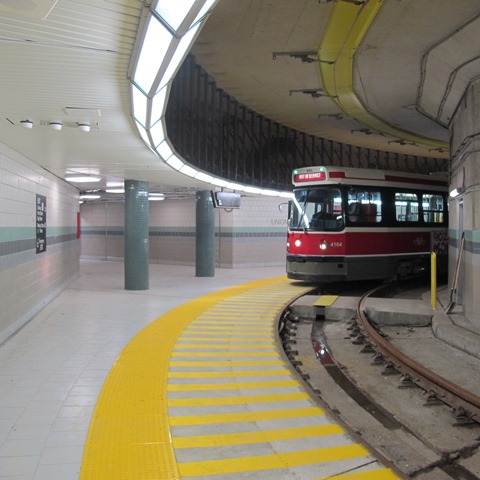
Test car 4164 ran to Union Station on October 7.
Photos from Harold McMann:
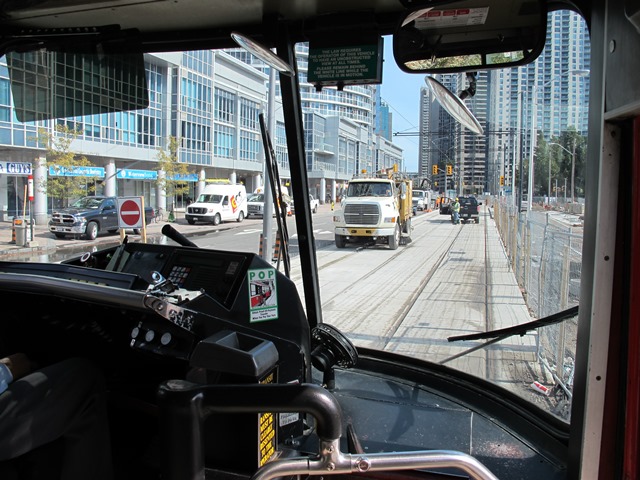
View from 4164 eastbound at Lower Simcoe and Queens Quay:
Union Station Loop:
Photos linked from a comment by “Thomas”:
Approaching Lower Simcoe Westbound
This was a typical scene only a week ago on September 24 looking west toward Rees Street and the Radisson Hotel. All traffic had shifted off of the streetcar right-of-way to the newly paved roadway north of the tracks (to the right in the view below). A fleet of vans from contractors putting the finishing touches on the line filled the streetcar lanes. Work at this point was mainly electrical – TTC power feeders, traffic signals and lighting. Preliminary supports were up for the overhead, but most of the line did not yet have contact wire in place.
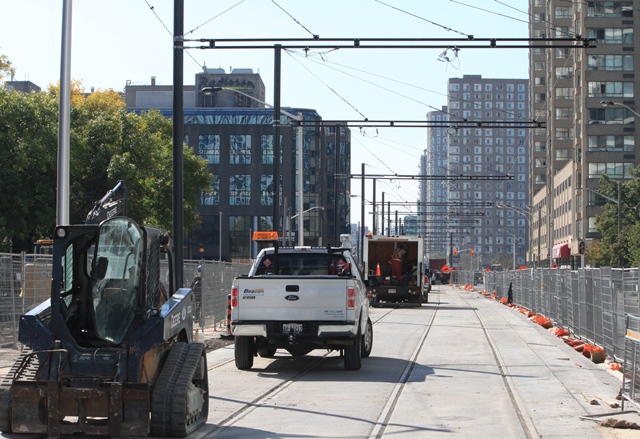
By October 3, 2014, the contact wire is in place (although not yet energized) and much of the fencing around the right-of-way has disappeared in anticipation of test runs starting October 7.
This view looks west at Rees Street where both transit stops are now on the west side of the intersection (the eastbound stop has been changed from farside to nearside). The crew working on the roadway are making saw cuts for the loop detectors that will activate the transit priority signals.
This is a location where Toronto Hydro has not yet completed the shift of its plant into new underground chambers and conduit, and the street still has a mix of temporary and permanent utility poles.
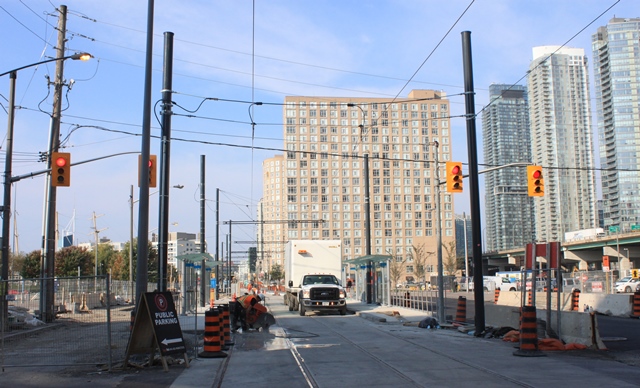
The view below looks in the opposite direction east from Rees Street. The traffic signal will control the exit from the Radisson Hotel at the east leg of Robertson Crescent.
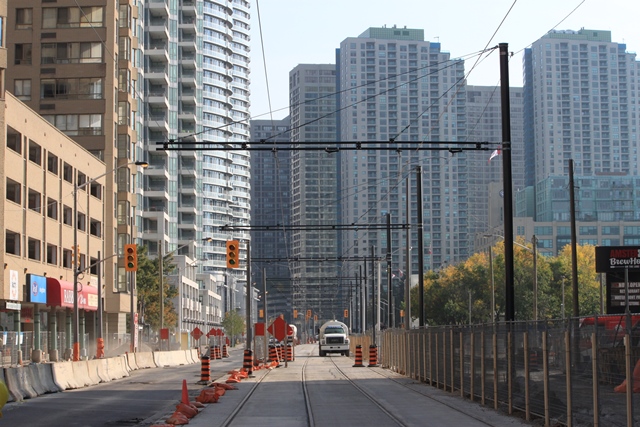
The new street is divided from south to north into three bands. Southernmost is the pedestrian and cycling area including rows of trees. The structures shown here are “silva cells” designed to provide support for the pavement above, but to be open for the growth of tree roots below. The whole area around the cells is filled with fresh soil before the area is closed in. Tree planting will be done in the spring of 2015.
This section will include the Martin Goodman cycling trail linking up existing portions of the waterfront trail from west of Spadina to beyond Bay Street. (Plans for Queens Quay East include a similar layout when the transit right-of-way is built, but for now there is a temporary trail heading east from Yonge.)
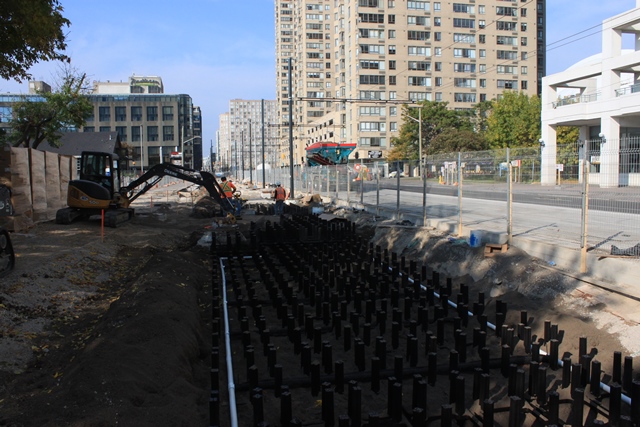
This view is in the same location, but from the streetcar lanes showing the new pavement on the north side of Queens Quay. Traffic operations are still only westbound because the project is not yet at the state where all intersections are ready to switch over to two-way traffic.
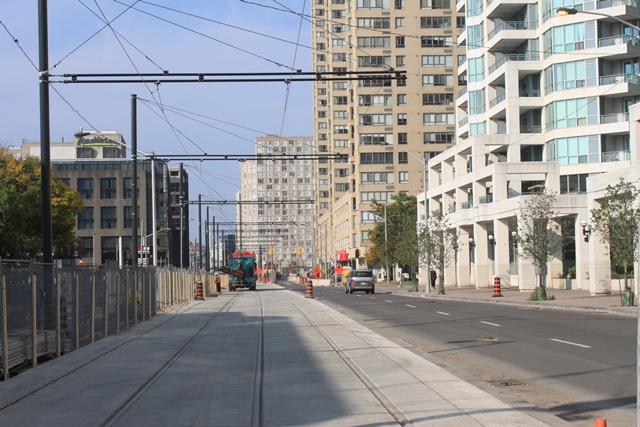
Looking east from Lower Simcoe Street. The eastbound stop at Lower Simcoe has been shifted further east, to line up with the new exit (controlled by the traffic signals) from the Harbourfront Centre site out of frame to the right. The westbound York Street stop remains in its old location and is on the east side of the new intersection.
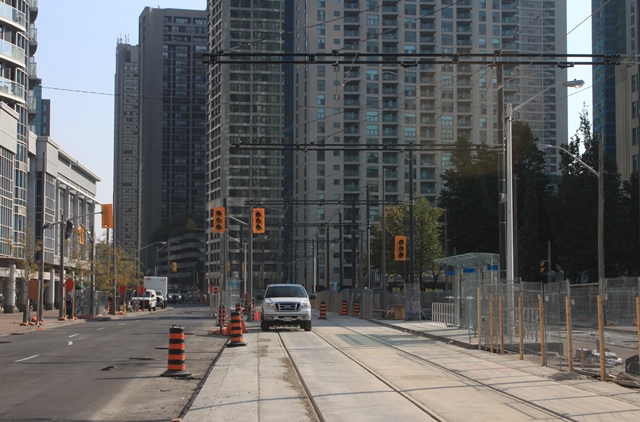
Work west of Spadina is still underway, and I will add photos from that section next week.
 Steve Munro
It’s been a long time coming! It’s been amazing watching the rapid progression of work in these last few months. Hard to believe it’s been nearly 2 and a quarter years since the 509 and the 510 Union branch were closed.
This TTC testing notice was linked in the latest Waterfront Toronto construction update, it states that the LFLRV will be running as a test vehicle along Queen’s Quay between the Union Loop and the Spadina/Queen’s Quay loop from Tuesday October 7 to Friday October 10. The main construction notice indicated the last stop west of Spadina and the remaining overhead work there will be completed this week, so I guess there will be some last-minute testing between Spadina and Bathurst on Saturday October 11 or even in the wee hours of the 12th!
The TTC’s Service Changes webpage has finally revealed details on the 509 Harbourfront and 510 Spadina scheduling effective October 12th! For the 509, “Streetcars will operate every four to nine minutes during the day, and every six to 15 minutes in the evening.” For the 510, “Streetcars will operate every two to six minutes between Spadina Station and King Street, and every five to eight minutes between King Street and Union Station.”
Steve: I published the details of the schedules taking effect October 12 in a previous article.
With the 509 now slated to receive the LFLRVs in 2015 instead of the previous 2014, and especially with the strike delay, I’m really crossing my fingers that 4400 and 4403 will be put on the 510 Union runs 100% of the time, never the King ones, so that at least Queen’s Quay Spadina-Union sees a small percentage of Flexity operation for the next several months while the 509 awaits them. One interesting point is that I have not seen any of the new fare vending machines installed at the Queen’s Quay platforms as of yet, but I suppose that’s not urgent and can be done at any point in the future (on that note, funnily enough, I was riding 4403 the other day and the rear SRVM was out of service!). Guess we’ll have to wait and see on both points.
Steve, on the Flexity note, since the 510 and 509 are at the top of the list this seems an especially relevant question – now that the strike is over is there any word on when new deliveries i.e. 4404+ will resume and how often we’ll get them in, or at least when 4401 and 4402 will finally be retrofitted and enter revenue service?
Also, any idea when the 510 operators will stop opening all doors at stops and passengers will have to start pressing the door open buttons to enter/exit? I was looking forward to that, funny as it may seem.
Steve: I asked recently if there was an updated delivery schedule and was told that, no, that’s not settled yet. As for opening all doors, winter may bring that issue forward.
LikeLike
Will the whole route be opening on Sun, 12 Oct? Is Union station streetcar work complete?
Steve: Yes, the Union end is ready to go. The last bits to be completed are west of Spadina to Bathurst.
LikeLike
Narrowing Queen’s Quay to 2 lanes is a big mistake. This is going to cause more traffic problems on Lake Shore (and indirectly on Gardiner, etc.). This is like the St. Clair streetcar, where narrowing to 1 lane each way seems to cause serious traffic problems in the whole area within the whole area within a few km of St. Clair, made worse by Eglinton construction. There is frequently severe traffic congestion on Eglinton, St. Clair, Rogers Road, Dupont, Davenport, Bloor etc. and this area seems to be one of the worst congested areas in the GTA (look at the Google traffic map if you don’t believe me). This was made even worse during the Gardiner closure last weekend when every east-west road from the 401 to Lakeshore was severely gridlocked.
Steve: There is a fundamental problem in your analysis: you say that “this is going to cause more traffic problems” (future tense), but Queens Quay has been operating westbound only with only one lane for the better part of two years. In other words, the change in capacity and the resulting reshuffling of traffic has already happened. If anything, there will be more capacity when the road is finished because a great deal of space now occupied by construction vehicles will become free. Also, cyclists who are now forced to use parallel routes will have their own dedicated space on Queens Quay.
LikeLike
And now let us await the inevitable formation of rail corrugation, a phenomenon which could clearly be seen on the rails formerly laid along Queen’s Quay. This will lead to enhanced rail-wheel noise levels unless a regular programme of rail grinding is carried out.
Steve: The track originally laid on QQ was not built with a resilient foundation. It dated from the period just before the TTC adopted that style of construction and needless to say had corrugation problems (among other things).
LikeLike
The only change I (as Dear Leader of Toronto) would have made would have been to use grass between the streetcar tracks, instead of concrete. Guess they made the very same excuses as on St. Clair, need a path for emergency vehicles.
Steve: The original proposal for the revised QQ included grass, but that was nixed as you say.
LikeLike
It’s really nice to see the extensive use of single-side poles for the overhead. Was this a quiet acknowledgement of the mistake made using hefty and numerous centre-poles in other rights-of-way or did this design have other, indirect origins?
Steve: This seems to be a trade-off with the TTC who insist on having their own poles rather than sharing with hydro (a former practice). TTC claims that the wider spans are impossible, but that’s a huge laugh considering that spans on Spadina are slung curb to curb. Personally, I think the installation on QQ is needlessly heavy and emphasizes the very thing people don’t like about overhead power supplies.
LikeLike
There’s a complementary project to extend the Martin Goodman trail west from Yo Yo Ma Lane to Stadium Road, to be tendered this fall.
LikeLike
I wonder if there are any plans for a spectacular grand opening much like the new streetcars had? I personally would like to see a procession of Swanboats in the tunnel ahead of the first streetcar 😛
In all honesty though it will be a welcome change. Not knocking the replacement bus but the insane route for the past couple years has added travel time along Queens Quay. Anytime an event occurred at the Amphitheater, Exhibition Place, Rogers Centre or ACC the traffic backlog made for major delays on the 509. I recall waiting half an hour for a bus sometimes along the route. That plus all the people attending the aforementioned events made the route very unpopular. Hopefully the return of streetcars will make things more palatable.
LikeLike
I was on Queens Quay today (Saturday) and it was a beehive of construction activity. It certainly looks like they will be ready for some test runs in a few days.
Regarding the lack of grass on the streetcar right-of-way, aren’t there lattice-like support systems like they use adjacent to airport runways that can support the weight of an emergency vehicle and protect the turf? Might still be hazardous to drive on but I’ve seen someone use it on their driveway. It looks much better than asphalt but must be very confusing to guests.
LikeLike
So in other words, the road network is well-used in those areas. No money wasted building lanes that are usually empty.
Sorry, I couldn’t resist. For some reason reading the comment I found it translating into public transit terms in my head: “The buses are always full on Eglinton, St. Clair, Rogers Road, Dupont, Davenport, Bloor etc. — I’ve had to wait for a second bus to arrive”.
In just a few years Eglinton is getting a huge capacity upgrade which should help quite a bit, between the LRT being available and construction no longer occupying road space. Don’t forget the benefits of St. Clair’s car lanes being fewer, including an improved pedestrian realm.
Steve: Of course, the TTC seems to be incapable of running reliable service at times on St. Clair, to the point where they have added running time claiming that this is for transit priority signals that don’t work. However, there is also going to be much higher supervision because of operators taking liberties with the schedule. A classic TTC screw-up.
LikeLike
And much of Lake Shore had gotten serious upgrades in wiring and distribution, and probably a majority of suspensions are set up for pantographs, yet the wires are slung curb to curb.
The only problem I’ve seen is a major fire, when the span wires were removed for better ladder truck access. But it was not like streetcars–or any traffic–was running past the scene along Lake Shore anyway.
LikeLike
@Andrew
It’s worth noting that the new QQ includes numerous westbound laybys for vehicle loading/temporary parking, as well as dedicated right- and left-turn lanes for both directions of travel at several intersections. More provisions for cars/trucks/etc have been made than are obvious at first glance.
LikeLike
I agree. Last Monday, six eastbound streetcars showed up at the same time at St Clair West station during rush hour (after a long delay with hundreds of people waiting). With the right of way, shouldn’t the St Clair route be one of the most reliable? Instead it is one of the least reliable. Why would the TTC not fire drivers goofing around while they should be driving? Why can a select few bad apple drivers delay thousands of people – day after day, week after week, month after month, year after year – with absolutely no consequences whatsoever? These bad apples bring a bad name to the rest of the hard working ones as well.
LikeLike
Streetcars should only operate on right of way. Jarrett Walker said so. He only likes the right of way routes (St. Clair, Spadina, etc).
Streetcars that operate on mixed traffic routes are overrated and should be replaced with bi-articulated buses.
Steve: Jarrett Walker also wants all routes now broken at the subway to run through even though this may not make sense from a geographical, demand or operational point of view. I beg to disagree.
Jarrett is not infallible. Nor am I. Between the two of us, we are right much of the time.
It’s a case of picking which “expert” you choose to believe (today).
LikeLike
By bi-articulated buses I assume you mean the ones with 3 sections and 2 articulation joints. These buses are almost always trolley buses as they need more than one axle powered (it can be done with diesels but they get complex) in order to do hills. The problem with them is that each axle tends to turn inside the one ahead of it and this makes it difficult to do tight corners.
Every bus line in the old city operates at a slower speed than the street car lines, even the trolley buses did. Jarrett’s argument is mainly about US cities that are building street car lines to operate at headways of about 10 minutes. There is almost no justification for this except that they get an FTA grant from the feds to cover capital costs. Don’t cherry pick your arguments and quotes.
LikeLike
There always seem to be a belief that having one more lane in a roadway, one more subway line, one less streetcar track, one less bike lane, etc. will solve the gridlock problem for car drivers. The fact is that even if you did all these things times 10 or times 100 you will still have gridlock. Because use of the road is perceived by drivers as free, there is essentially infinite demand and there will never be enough supply. Any new road capacity will be full within the first few years of operation. The only exceptions to this are toll roads such as highway 407 which is priced to ensure that traffic will always be free-flowing. This is the fundamental law of road congestion. There are numerous scholarly papers on the web discussing this but you will rarely hear politicians mention it. I think your typical voter is hoping that everyone else will get off the road so they themselves can continue driving – only faster and of course it must still be ‘free’. Sorry drivers, it’s never going to happen so you better get used to gridlock.
LikeLike
And of course many of the same people who would probably go into shock if somebody suggested charging drivers to use the roads feel no embarrassment at all when they leave a comment somewhere suggesting that LRT and bus riders should pay a high enough ticket cost to cover all the expenses associated with building and running those services. Guess what guys, government is — everywhere — responsible for making local transportation convenient.
Ok, I just said “everywhere”, which is pretty dangerous in a discussion like this. Everybody’s challenge for this week is: can you find a single example where local transportation is made convenient due to the efforts of for-profit companies? I don’t mean that they are contracted by the government to build or maintain something, I mean a company exists whose business model and profits rely on providing local transportation — roads, transit, even bike and/or pedestrian routes — without government involvement, much as grocery stores’ business model and profits rely on providing food to their customers.
LikeLike
I think any taxicab company would qualify. Also, UBER, car sharing services, and at a regional level the Highway 407 consortium would qualify. Private local minibus services are common in many developing countries. Most of these are small scale in comparison to major transit initiatives like we are seeing in the GTHA. The financial costs and risks of these are just too great for most private firms.
Really, I do think assets like roads and the transit network should be held in the public realm. But in the same way you shouldn’t allow unlimited electricity or water use for a fixed price, you need some sort of road pricing mechanism if you want to reduce gridlock. This would never fly in Toronto today but perhaps in 20 or 30 years after traffic volume has doubled again?
Steve: The Highway 407 consortium was “sold” their road by the Harris government looking for a quick infusion of cash, and have since been milking users for all that they can get. The “convenience” came from the original public investment, not from the consortium.
LikeLike
@Isaac Morland – the examples abound, except none I can think of in a first world country. Bus, mini bus, rickshaw, and other services ply the streets of India, large parts of south east Asia and Africa. However, in Europe and North America examples are harder to come by except where tightly licensed and protected, cabbies, and private bus operators required limited licences, where government recoups some of its investment.
In fairness though when originally imposed gas tax was meant to pay for provincial highways, (although I do not believe municipal ones).
LikeLike
In fairness Steve, as you know some of the convenience comes from the fact that the pricing itself limits its use. This arguments has also been made as a way of getting more out transit. The concern in that case needs to be with regards to what segments of society must ride at peak and are those the same who can afford it? Same issue with the 407, the users who can afford to use it, are not perforce the drivers with the most need, but rather those to whom the cost makes the least difference.
I would suggest that transit has both a much larger capacity, and much smaller 3rd party negative effects. Therefore, if we are going to pay for roads from the public purse…
Steve: The point is that the consortium had nothing to do with building the 407 as a toll road.
LikeLike
This was true until the 60s when the government decided that that they were giving away too much money with the rebates to people who bought gas for their boats or lawn mowers so they made it part of general revenue though the continued to give rebates to certain groups like farmers, commercial fisherman and road construction.
LikeLike
Which means in essence that the government, while it may have recouped cash, still absorbed the construction risk. This is a fairly important point in terms of the nature and extent of the risk that a private partner will absorb. This is especially true since some of the benefit accrue to users and potential users of parallel routes.
LikeLike
Nope. They rely on a massive government subsidy in the form of free roads.
Additionally, in many cities in North America, the incumbent taxi services benefit from a legal prohibition on new taxi services in the form of a fixed number of taxi licenses. In a normal business, anybody can set up shop, subject to following the relevant laws and regulations. For example, I could in principle open a grocery store and compete with Zehr’s. But it is illegal for a new entrant to come into the taxi market unless they buy the license from an existing license holder. This is like if I could not open a grocery store without buying a grocery store license from an existing grocery store (which would then have to close down).
It’s reasonable to mention the 407, although it received a massive subsidy in the form of a sweetheart deal from the ever-so-businesslike Harris administration, but I’m talking about local transportation. I’m well aware that toll roads, not to mention buses, trains, and airplanes, operate on longer routes all over the world, in many cases on a for-profit basis.
Again, the roads themselves on which the jitneys, etc., run, are a government project, to the best of my knowledge, and not operated by a private company for profit. Additionally, in many countries, the gasoline they require in order to operate is hugely subsidized by the government, which is just an utterly insane policy, especially, ironically, in those countries where this is done.
Just to clarify, what I am claiming is that the road that goes by in front of your house is not run for profit, and just to put myself out there, I’m saying this is true everywhere in the world. Local roads are a public service, not a business in the usual sense, even if private industry may be involved in some capacity.
LikeLike
Yes, so it largely remains a tax specifically on roadway and waterway users. Having said that I think most would be happier calling this a carbon or pollution tax now, than a road tax. If you believe that this is only enough (or not enough) to cover pollution, then clearly tax payers are subsidizing all roads heavily.
LikeLike
I hope that all traffic lights along Queens Quay have working transit priority lights. As I believe the streetcars now have to deal with 9 traffic lights on their travel along Queens Quay.
Steve: It will be intriguing to see what testing happens this week. Of course, the real effect won’t be seen until the roadway switches to two-way operation and the pedestrians and cyclists return in full force on the south side of Queens Quay. If we see traffic signals turning red in the face of oncoming streetcars, we will know what “transit priority” really means.
There are new signals at the Beer Store parking lot, at Robertson Crescent (east side of the Radisson) and at the exit from the Queens Quay parking lot between Lower Simcoe and York. I will be astounded if some of these are not transit-hostile especially during high season at Harbourfront, and will monitor their effects with reviews of CIS tracking data.
LikeLike
So…. if the new northbound platform at Union station replaced the old access area to the streetcars there, do you know where the new access point is? I go there every time for work and back and I have yet to see/figure out where it will be. Although I did see on the northbound platform a glass wall loosely covered showing the tunnel to streetcar area, there weren’t any doors or anything.
Steve: That’s the access. The new platform swallowed the space that used to hold the escalator down from the mezzanine to the streetcar loop.
LikeLike
During summer weekends there are a lot more pedestrians then transit riders, so giving them priority makes sense.
It would be nice if the signals took into account if it was a weekend, holiday or an Exhabition day and adjust priority accordingly.
LikeLike
The insanity is based on political stability. This can create the situation where the lower and lower middle class in effect is paying for a large part of the gas cost of the middle and higher class voter.
Also I would agree that there are few exceptions (a couple of major toll highways) where roads are not offered as common goods by the government, and thereby suffer from the classic tragedy of the commons too many cars in too little space instead of too many sheep on too little pasture.
LikeLike
Of course the obvious observation is why are the transit priority signals not fixed? Or is too hard for the poor TTC to deal with? The more I hear about, and experience, issues with the TTC, the more convinced I am becoming that the TTC has no idea what they are doing and have no concept of customer service.
LikeLike
Roadway users have a lot of “other costs” besides road maintenance. There are increased health cost from pollution and accidents, policing costs, lighting costs at night. I doubt if all the revenue from fuel sales and licence fees covers the “whole” cost of roadways. I do not believe that it is referred to as a “Road Tax” in any official Ontario or Federal documents.
LikeLike
Steve, regarding rail corrugation the rails have a very rough surface on Spadina between Willcocks and Harbord. I believe this was caused by construction vehicles with their steel tractor treads which were often stored here when the boulevards were installed south from Spadina Circle. Technically this would not constitute rail corrugation but it is noisy and could use some grinding. But with what since the rail grinders are gone?.
LikeLike
Bombardier to name just one of many. Who do you think makes trains, streetcars, etc? Certainly not non-profit organizations.
LikeLike
People continue to see that the TTC is the source of all problems they face when they use the TTC.
They complain to the TTC about the bus shelter, when it’s a private company that put them wherever and maintain them. They complain to the TTC about transit priority and traffic lights, when it’s the transportation department that put them in and uses its own computers to control them. They complain to the TTC about the doors on the subway trains, when it’s the passengers themselves holding the doors open. They complain to the TTC that the buses and streetcars are slow, when it’s the single-occupant automobiles that are causing all the congestion.
LikeLike
@ Robert Wightman, given basis on which they levied, fuel taxes are pollution taxes with some polluters exempted. Having said that, when you factor third party impact I would suggest they are low. I suspect that it is in part our proximity to the US that to some degree limits this tax, and makes it so politically charged. Clearly road use by a Jetta diesel, or Prius is nearly as high as a Suburban, but the fuel hence tax take is not.
LikeLike
They don’t. Simply put, how much does the federal government contribute to road maintenance and construction compared to how much they take in from fuel taxes?
LikeLike
The Las Vegas Monorail. Privately built, owned & operated as a public transit service. It doesn’t service a huge area, but in the area it does service, it does the job well (although tickets are rather expensive). Do I get a cookie? 🙂
LikeLike
At one time the feds did make some contributions to local roads and transit, now it is mainly to buy votes. Usually in some province other than Ontario with money raised in large part in Ontario.
LikeLike
The traffic signal for streetcars at Lower Spadina and Queens Quay for the S to E curve is set at about 5 seconds to proceed through (This allows one car through at a time). This streetcar signal should be activated between every traffic direction change, instead of once through the whole cycle. As it is now, streetcars sit there and wait and wait. This, of course, is much like the other end of the line at Spadina Station where fully loaded cars sit in the tunnel, awaiting unloading space. One wonders, sometimes, if the people that make the big decisions ever ride the cars and buses to see what the paying passengers do experience in the day to day operation!
This 5 second light for the streetcar movement should also be added at Spadina and Lakeshore between the Lakeshore east bound traffic cycle and the Spadina S to E turn lane cycle. A small thing, but every bit helps keep the streetcars moving.
The TTC would also do well to have the “bar” aspects installed on all transit signal heads at signalized intersections on lines with right-of-ways, instead of just at few sporadic locations around the city. I’m sure this would help take some of the confusion out of the maze of traffic lights that confront drivers and pedestrians on streets like Spadina.
It will be interesting to see what procedure will be in place at Union Station Loop when a fully loaded LFLRV arrives and a there is an equally large crowd standing there waiting to depart! The station has been idle for over two years and probably the biggest change, except to walking directly onto the new subway 2nd platform, will be the new wall tiles in the walkway to the streetcar loop. I believe the loop loading/unloading platform is still the same, cramped poorly designed area, capable of taking one LFLRV at a time.
LikeLike
I’m not really sure it does the job all that well. It’s too far off the strip to be of that much use unless you have a fairly specific set of destinations.
The one time I used it when I was in Vegas for a conference, I only used it twice for novelty, even though my hotel was at the same cross-street as a stop. The buses the conference ran were quicker to get back to my hotel because of the monorail’s low capacity led to long lines, and I could walk between most casinos just as quick if they faced on to the strip, because of the monorail’s low frequency and inconvenient walk to the station.
Also, though privately funded it is a legal non-profit organization and had to file for bankruptcy in 2010.
LikeLike
Yes. I did not know the Las Vegas Monorail was privately operated (or maybe I had forgotten — it doesn’t feel like a completely unfamiliar fact). Based on the fairly short distance between stops I think it qualifies. I would be interested to know about its capital financing — was that fully private? If so, two cookies. Also, did they pay something that is defensible as being a market rate for their use of airspace over public streets? If so, three cookies.
Of course, it’s important to note that even within its service area a local network of roads is still needed and provided, presumably by the municipal government as usual. So even there, government still provides much of the local connectivity, even if some of the local connectivity is privately provided.
Steve: And that monorail went bankrupt. The cookies have been repossessed.
LikeLike