
Updated August 19, 2014 at 10:50 pm: The TTC board unanimously adopted the proposals in this report with amendments. Some of these were intended to ensure clear understanding that approval was only in principle and subject to the review process in the 2015 budget.
In what proved quite a surprise to me, Chair Maria Augimeri moved a request for a set of reports related to service and fleet plans. The text of this came directly from a deputation on the CEO’s report which, at that point in the meeting, I had not actually presented because the Board took the agenda items out of sequence.
Here are my deputation texts, one on the “Opportunities” report itself, and one on the CEO’s report. The motion I proposed and which the Board adopted is in the second item below.
Although there were questions about details and about the manner in such a far-reaching set of proposals appeared on the Supplementary Agenda of the last Board Meeting before the election, there was broad support for the content.
Of the Mayoral candidates, even Mayor Ford has spoken favourably about many of the proposals with the exception of the widespread rollout of PoP (self service) fare collection and the move to time-based transfers/fare receipts.
Only John Tory has been strongly opposed choosing to take a hard-line tax-fighter stance that is hard to swallow in light of his own multi-billion dollar transit plans. Tory also does not understand that a staff report at the TTC only makes proposals for what should or might be done — it is up to Council to decide on priorities and funding mechanisms. Tory continues to disappoint as a candidate who has more bluster than substance, a trait he shares with the current Mayor.
Updated August 15, 2014 at 8:00 pm: Detailed comments about the proposal have been added.
The Supplementary Agenda for the TTC Board Meeting of August 19, 2014, contains a report that is breathtaking in its scope:
Opportunities to Increase Transit Service in Toronto
The report recommends a program to include the following initiatives:
a) implement all door boarding and proof-of-payment on all streetcar routes;
b) reduce wait times and crowding on bus and streetcar routes;
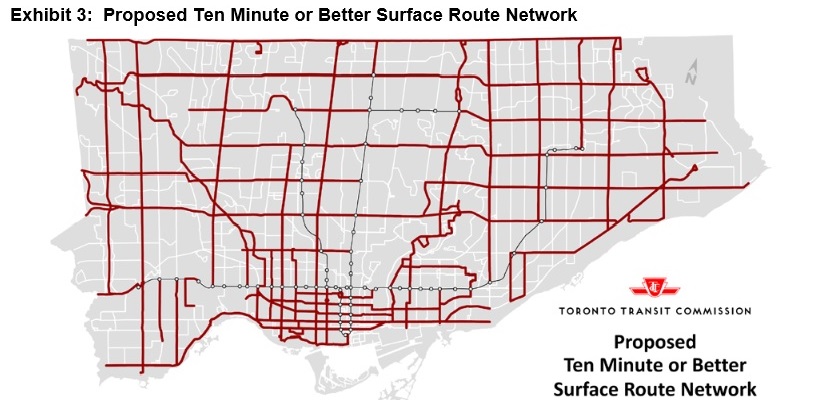
c) establish a city-wide network of Ten-Minute-or-Better bus and streetcar services;
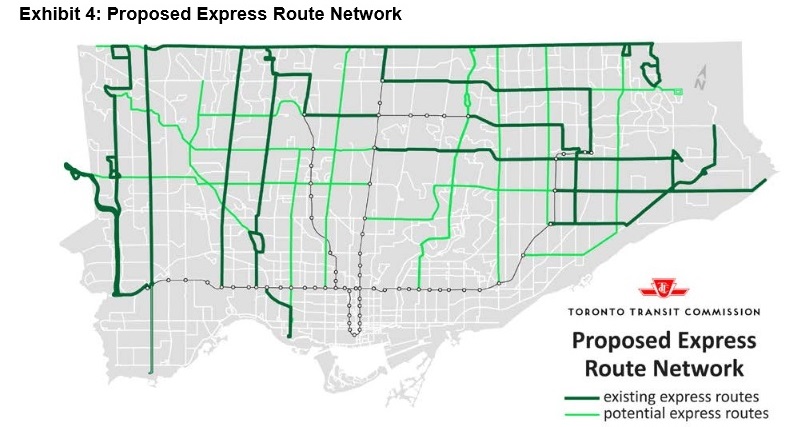
d) expand the Express Route Network with new and improved express bus routes;
e) implement more transit priority measures;
f) add resources to improve service reliability and route performance;
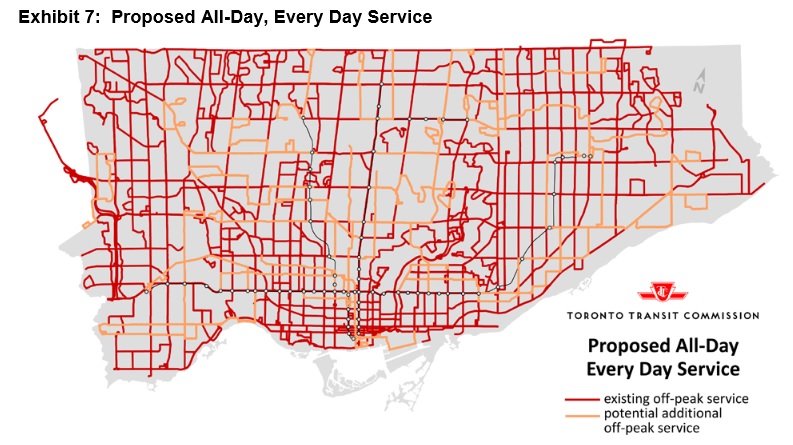
g) operate all routes all day, every day across the city;
h) change the one-trip-per-fare to a two-hour-travel-privilege-per-fare;
and
i) expand the overnight bus and streetcar network.
[The agenda will also include presentations on the new streetcar implementation, and on “Customer Journey Times”, a new way to measure the usefulness of transit service to riders. These presentations are not yet online.]
Introduction
At the heart of this report is a recognition that Toronto’s transit needs to improve not just with the construction of a few rapid transit lines serving limited parts of the city in the mid-to-distant future. What riders need and will use is a service overall that is more convenient and less crowded. This requires improvements to the bus and streetcar system that have been ignored for too long.
Many of the proposals here will be familiar from the Ridership Growth Strategy (RGS) and the Transit City Bus Plan (TCBP) of the Miller/Giambrone years, and it is no surprise that TTC management wants to return to an operating environment that welcomes passengers rather than treating them like so much baggage to be jammed in wherever it will fit.
This improvement takes several forms:
Scheduling service for lower crowding
This was a feature of RGS although it had a notable exception when it came to peak streetcar service because already the standard line was “we have no more streetcars”.
Reduced crowding isn’t simply a matter of giving folks more elbow room, but of reducing the situations where passengers cannot move around especially at stops where it may take ages to get one or two riders out the door, and one or two in to replace them. Statistics that measure “efficiency” by packing density, but don’t consider the wasted time of the operator or the vehicle, are self-defeating.
All-door-loading and Proof of Payment (POP) fare collection will also improve space usage in vehicles, at least on those routes where the practice is not already common. Many operators already load through the rear doors during peak periods if only to get people into their buses and streetcars.
Service scheduling and management are also important. If buses and streetcars cannot achieve their scheduled trip times, they will always need to be short-turned. However, even worse are the convoys of vehicles that form either because short-turns are not managed properly to fill gaps, or because vehicles travel across the city in packs (some originating at terminals) with little evident attempt to space out service and even the load among vehicles. A low “average” load can represent simply a pack of buses with a few stuffed full and the rest over half-empty because everyone tries to get on the first vehicle.
Evening out the service will no only make better use of its capacity, it will reduce the frustration riders feel when they peer into the mist (or into a NextBus display) and find there is no bus or streetcar nearby.
Improving service frequency and reducing trip times
Aside from the changes that more generous loading standards will bring, the TTC would establish a core network with various classes of improved service.
At its most basic, this network would operate at least every 10 minutes, all day. Riders would know that certain routes could always be guaranteed to show up fairly soon, even if they have just missed their bus or streetcar. Actually implementing this is less costly than it may seem because many routes already fit the pattern during most or all of their operating periods.
The proposed map has changed somewhat from the TCBP in that it includes some routes whose branches might operate on headways wider than 10 minutes, but the trunk of the route has 10-or-better. Also, the streetcar service on Lake Shore Blvd in Etobicoke, omitted because it was not a bus route, is on the map.
(“All Day”, by the way, means from roughly the start of subway service in the morning until at least 1:00 am the following day.)
For the network as a whole, all-day service would be provided to many locations where it now disappears during some off-peak periods. This recognizes that “access to transit” requires that it be available for both the “to” and “from” trips, and that a superficially dense transit network is meaningless if half of the service vanishes at off-hours.
Two changes are proposed for the express bus network.
First, there would be more routes with express operations, and more routes that already have peak express service would see off-peak express buses as well.
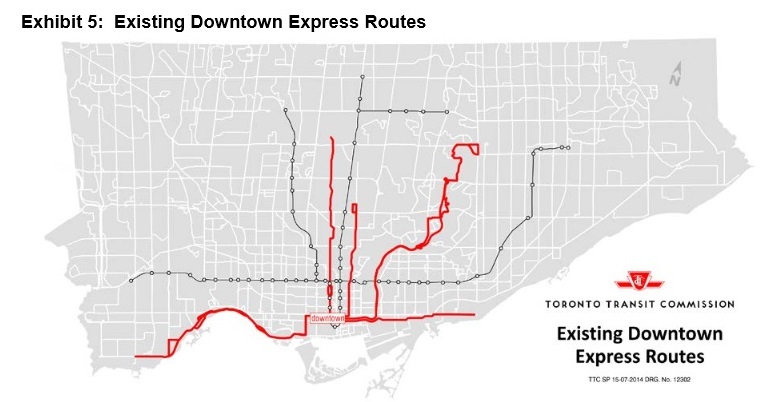
Second, the 14x Downtown Express routes would have improved service and would convert to a regular fare rather than the supplement they now charge.
Finally, the Blue Night network would be expanded to reflect the growing demand for late night service and to fill in some gaps in the current network.
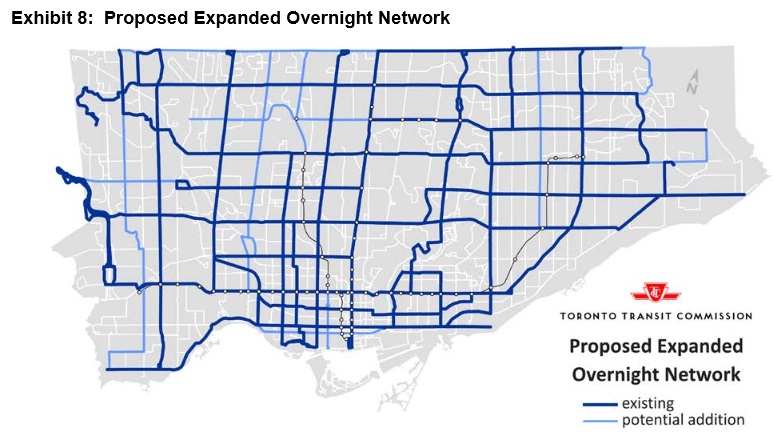
Time-Based Fares
The TTC makes limited use of time-based fares, in effect making a transfer a pass good for two hours, but they now propose making this the standard system-wide. This will accomplish several things in one move:
- All fares, be they monthly passes or single cash payments, will buy unlimited travel for some period of time without regard for the niceties of rules about transfers, stopovers, and riders who give up and walk only to be overtaken by a vehicle.
- Riders whose travel requires multiple short trips will no longer be penalized compared with long-haul commuters who get the same amount of travel for one fare.
- There will be no question of whether a “transfer” is valid as this will depend only on the time “stamped” on it either in ink (for a hard copy fare receipt) or in their fare card.
- The Presto system will not have to “learn” about transfer rules and its implementation as a time-based scheme will be greatly simplified.
- When integrated regional fares arrive, the “two hour fare” can be valid across boundaries.
Improved Operations in Traffic
Two changes are proposed to improve transit vehicle flow:
- Additional Transit Signal Priority (TSP) with the rate of installation being doubled from the present 40 sites per year to 80.
- Provision of “queue jump lanes” at busy intersections where right turning traffic can interfere with bus movements.
TSP has been around on some routes, notably the streetcars, for many years, although the degree to which is kept in working order is open to question. Two important questions need to be asked about “priority”.
- Should transit get priority even at intersections where there is a strong demand in the cross-direction and every available second of green time needs to be available to any traffic that can use it? Nearside stops can actually waste green time by holding traffic while a transit vehicle serves the stop.
- Should TSP be designed not just for “standard” operations, but have support for unusual conditions such as giving left turn priority to diversions and short-turns, not just at a few locations where left turn movements are scheduled?
Queue jump lanes have been on the TTC’s wish list for years. They are specific to bus routes, and can only be implemented where there is space to widen the approach to an intersection. This layout may not fit well with others who design for cars, cyclists or pedestrians. A related issue is that these lanes require dedicated space 7×24 even though the problem they address may only exist for a few peak hours.
The Need for More Vehicles
Some of the proposed changes do not require any additional peak vehicles, but a few do, and this brings us to a debate about how the TTC should address growing peak demand in the short term, even without any new service policies.
On the bus fleet, the report notes that not only are more buses required, but also the new McNicoll Garage where they can be stored and serviced. To its credit, the report does acknowledge that a short-term alternative might be possible:
“Many of the initiatives could not be implemented until the TTC buys more buses and streetcars, and has the facilities to house and maintain them. Alternatively, shorter term and off-peak improvements could be made through leased maintenance and storage facilities. Immediate approval of these initiatives by Council would allow the TTC to proceed to procure and construct these prerequisites on a fast-track basis.” [Page 3]
It is unclear what the need for more storage has to do with off-peak service, but there is certainly the question of leasing space for some short-term overflow pending the availability of McNicoll Garage. However, the TTC seems to be double-counting that garage here both for policy-based service improvements and for McNicoll’s original intent, the ability to expand the fleet for additional demand.
What is missing from the proposal is an integrated view of requirements both due to “normal” transit growth, and the additional needs brought on by the new policies (including any induced peak ridership). In other words, is McNicoll Garage enough, or should the TTC be planning for a second new garage? How do future rapid transit lines (whatever their technology) affect long-term planning?
Similarly, some peak period streetcar improvements are said to require some of the 60 new streetcars proposed, but not yet funded in the “below the line” Capital Budget. The real issue for the TTC, short term, should be how long it will keep its CLRV fleet in operation in parallel with the Flexities to supplement service while the Flexity Fleet builds up and represents a real net addition to fleet capacity, not simply a trade-in of old vehicles for new.
There is no mention of the additional vehicles that will be required for the Waterfront services should construction of the eastern line be advanced.
The Continuing Need for Standards
The report proposes that bus routes be scheduled to be less crowded and presumes that they will continue to have some level of productivity. What is missing is any cutoff line by which new services such as express buses would be compared to the regular service. Does The Beach, for example, get a regular fare express bus just because the route is already in place? How many parts of the city should get parallel express services while others must make do with their “ordinary” bus routes?
If new buses are to be ordered and garages built to house them, should this capital cost go toward more “regular” service, or should it be concentrated on express routes to downtown? How will the TTC decide to allocate new vehicles and operators?
Conclusion
This report is a long-overdue overview of what Toronto’s transit system could be, advocacy for the riders who are here today and may be attracted in the near future rather than being driven away with indifferent service and calls for lower costs and “efficiency”. There are details to be debated and priorities to be set, but the basic idea is sound:
Treat the transit network as something that needs system-wide improvements, not a quick fix here and there where residents can get politicians to take an interest.
Toronto is in the midst of an election campaign where candidates are preoccupied by drawing rapid transit lines on maps. For most candidates, the surface system simply does not exist even though without it, most riders would never reach the subway lines some are so eager to build. Surface transit has been strangled by an administration that values tax cuts over the quality of service and clearly feels that transit users are a coddled, oversubsidized bunch.
When this report comes to the TTC Board for debate, there will inevitably be claims that this is a policy for candidate X or a repudiation of candidate Y. There may even be some factional jousting to defer this report so that it does not officially become part of the record with a TTC recommendation attached.
That would show just how little some politicians care about transit riders.
This proposal is a plan to improve transit for everyone, and it should not be claimed as any candidate’s exclusive property even though aspects certainly overlap elements of some platforms. Transit is too important an issue for good ideas to be held hostage to party colours, for a “red” idea to be dismissed out of hand by “blue” supporters.
Toronto deserves a Council debate that will address head on the basic question “Where is my bus” with an answer that does not involve yet more doodling on the rapid transit map of decades to come.
 Steve Munro
Hi Steve,
Since his announcement that he’s running for Mayor, I am convinced a large portion of the things John Tory is saying is to blunt any attacks from the Ford camp. What do you think the chances are that Tory wakes up (the day after he’s elected Mayor, if he’s elected) and comes out with his support for the TTC plan on top of his smart track plan? And, to carry it further, show support for a Scarborough LRT?
Second, do you have any confidence any of the more popular candidates will implement some or all of this plan from the TTC?
Thanks!
Steve: I have been very disappointed in Tory’s campaign on the transit front because it is a 180-degree reversal of much of what he touted as the head of Civic Action. He has turned into a tax-fighting, simplistic pol with one poorly thought-out proposal to solve everything. SmartTrack is only a slogan, not a plan. Who knows, he could have a miraculous conversion, especially if the balance of Council refuses to let him continue down this road, but I am not confident we would see a more enlightened set of policies from a Tory regime than we did from Ford. Tory will, however, have the good graces not to be found drunk at City Hall, and Council will cut him a fair amount of slack especially early in his term.
As for the other candidates, we already know that Chow, Stintz and Soknacki support much of the TTC plan.
LikeLike
Yes, could be a revelation he had while in rehab. Scary to think he could swing that much. However, I think he does read the tea leaves of what will win an election fairly well, and this would certainly unbalance the process in which he is not currently in the ascendancy.
If we are going to spend bigs bucks on transit, better to do the DRL and LRT, than waste money on subway extensions the inner portion of the network clearly cannot support. Yonge needs to have more turning capacity not load. Danforth and Bloor will get some relief from the Crosstown, but Yonge will see more load.
Steve: Swing that much, no, the comment may as well have come from The Onion.
LikeLike
Rob Ford vowing $30 million is pocket change. May not even cover inflation.
LikeLike
The other thing I really like is that along with more 10 minute or better service they are looking at Express Routes that form more of a completed grid. Couple of areas they need to fill eventually, however, it will provide more of an opportunity for people to ride transit, without being directed to modes that are best designed to support riders going to the core. I would ideally like to see more of this filled in, however, it is a good start, should help ridership, and to Ernie’s point, will provide additional information to form the basis of a higher level of service in the future.
As Steve has said, we have a network that is designed for low ridership especially in the outer areas. This helps to address these areas both as origins and destinations. The Express and 10 minute service routes, form the basis of a reasonable grid. I think that the Express services will also need to be on a relatively frequent basis, likely somewhat more that what is proposed at this point, however, the plan as is, is quite ambitious (56 extra buses). These buses of course could be added, as load appears on the new routes. We just need to ensure that the crowding is not excessive.
LikeLike
Steve, maybe it was just the booze, crack and media that made such him such an angry person. You know he had a realization in rehab, of the error of his ways, found a love of man, and actually read an report on transit technology in his utter boredom, or because he was told he could get a day out if he did.
Steve: I doubt it was “love of man” that he found in rehab. In any event, the idea that Ford would actually embrace transit has the feel of a desperate political move, and it comes only with the presumption that he can cut an equal amount of money elsewhere in the city budget to pay for this. He has no sense of the damage his policies have inflicted on transit, and will continue to inflict for years after he is so deservedly retired from office.
LikeLike
Here’s a crazy thought about where additional buses could be stored. They could be out in service on an expanded and increased frequency Blue Night Network.
LikeLike
Yes, but it would represent no greater a change in position than whether he did drugs or not. I also expect that he is very desperate, however, you are quite correct that a change this dramatic, would go well beyond, ridiculous, crazy, breathtaking or stunning, and is remarkably improbable. Although ridiculous and crazy has been the defining character of his administration.
LikeLike
It would certainly be interesting to see if the TTC is ready to create such a grid using the bus system. Currently corridors that do cross the city are broken up at the Bloor-Danforth and Yonge lines … but Toronto’s topography also has an effect on route design.
Looking at “crosstown” options there is only really one possibility to build a mainline route … Steeles. St. Clair is broken up by the Don Valley, Eglinton will have the Crosstown itself, Lawrence is broken up by tony neighbourhoods, Sheppard by the Sheppard subway, and Finch will have the Finch West LRT.
So how about a Steeles Rocket that bypasses the subway. Keep the Steeles E and Steeles W Express buses, but offer riders an option that gives them a continuous trip across the top of the city and avoids the trip to Finch Station.
I do understand that a route that long would be tough to operate but if TTC has a desire to offer a grid-based network that is basically the place to start.
Cheers, Moaz
Steve: More generally there is the question of demand that is not subway-oriented. I would love to see origin-destination information that would give a sense of where such services would attract riders. One cannot just draw lines arbitrarily because a grid “looks nice” or fits into a philosophical design goal, but equally the distortions produced by major subway stations can skew the network’s usefulness away from some trips.
LikeLike
TTC can use their own land instead of leasing elsewhere. Like Lansdowne and Danforth garages. MTD garage has a bit of room for about 50-60 buses north of the TTC employee parking lot. TTC doesn’t have to go far for extra storage space for their buses.
LikeLike
In Germany, Frankfurt am Main has had 2 hour fares for more then 40 years. IIRC only the boarding time is important. If your transfer runs out at 4:15 and you board a bus at 4:14, the driver doesn’t go back to you a minute later and demand another fare. If however you board at 4:16 you need another fare. This is all managed through the driver’s fare clock, which are probably all tied together digitally now.
You have also the ability to increase sales in general. If I am going from say Fairview Mall to Yonge and Sheppard to pickup something, I am not going to spend $6 to do so. However for $3 round trip, saving the stress of finding parking sure. The TTC also gains another ability, the ability to sell different time periods, for example a $4 ticket for 3 hours, or a $5 ticket for 4 hours. Something I think that Frankfurt does.
I think the issue for buses is simple, they have plenty of 40′ buses, any new buses they buy now should be the 60′ slinky buses. Any new stops, bus bays and bus cut-outs should be designed for the longer buses.
The real key is that we need not a 4 year transit plan, that gets changed every election, before anything gets built, but a 20 year transit plan. A plan that comes from the TTC, not the Mayor’s office.
LikeLike
New buses still need to be serviced and this would require more service and fuelling facilities. Also 200 extra buses on night service would be a major increase in service levels and cost money.
I too have wondered why they don’t reactivate some of the garages. One problem might be that they are in the inner city and the demand is in the outer areas to reduce dead head mileage.
Steve: A great deal of Danforth’s property has been redeveloped, and the building itself houses other TTC functions that would have to be relocated. I don’t know the structural condition of the building and its suitability today for indoor bus storage. Lansdowne is a vacant site that the city has been trying, unsuccessfully, to sell. It was once considered as a future police station. There is a problem with underground contamination from a neighbouring industrial property, and this is the subject of legal action.
Your point about deadhead mileage is particularly apt and it includes not just driving the buses to and from the parking site, but also shuttling the drivers because they won’t just be trading one bus for another on all trips.
LikeLike
The question I would have is whether the data exists, or if there is a will to create it. I agree entirely that getting a handle on what trips are intended is the way to design a transit network. However, bus routes can be expanded, reduced or redirected, based on demand and usefulness in a way that heavier modes simply cannot. If people are strongly attracted by notably increased bus service, especially if they are not bound to a subway station but a location on that route or destined to another bus route, that is very useful information. Ideally Presto will help track this type of transfer activity, and help to provide the information required to make a much better network.
A really good transit network would provide reasonable service between points, where little expressed transit demand now exists because of the travel time that is involved in using transit. The provision of a higher level of service may result in an eventual expression of demand, and to a small degree actually change travel patterns. The bus routes should then evolve to suite this expressed travel pattern.
Steve: This is a chicken-and-egg situation. Obviously any new service will induce demand that was previously badly served if at all. There is, however, always a problem with a route that does not have an “anchor” destination in that many riders will have to get both to and from it at both ends of their trip. A subway-oriented trip does not have this problem, and there is a good chance that the inner end of the trip will be somewhere close to a subway station. On Steeles, by contrast, the only anchor destination is York U, and all other trips would likely have to deal with access problems at their “work” ends.
The problem of diverse origins and destinations was recognized three decades ago when travel across the northwest boundary of Metro Toronto and Mississauga began to develop. It will also be important than any OD information be sufficiently granular that it gives a good indication of transit travel paths. A lot of road modelling is done on a fairly coarse grid because the “first mile / last mile” parts of trips are simply assumed as a drive to and from the local arterial network. That does not work for transit trips which are more sensitive to access distances, paths and service levels.
I am more concerned personally that someone have access to a frequent grid, or rather highly destination neutral service, so that they can ride say 2 km east and then 1 km north from the middle of Scarborough, to get the them to the office, plant, or retail employment, or to shop, mere kilometers away, quickly and painlessly, so that they will ride. Also so they can ride quickly 7 or 8 kilometers along a line, and transfer to another without going a long ways out of their way, or waiting a very long time for a bus.
If a rider has to ride a couple of kilometers out of their way on a 25 kilometer trip, I do not think you can readily avoid that. That they can get out to the area they are destined reasonably quickly is important, even if that is not the core.
Steve: There has been a lot of discussion about linking up routes where they cross the subway, and I have had a spirited conversation with Jarrett Walker about which routes in Toronto warrant such hookups. However, the subway is not the only source of distortion in the network. In Scarborough, the route structure is badly skewed both to the subway and RT, especially around STC, and it works against local travel within Scarborough by route layout and by service design. The kind of orthogonal trip you describe is difficult if not impossible in some locations.
If GO Transit’s RER becomes another major network, we will have to avoid gerrymandering the bus system around GO stations to the detriment of other travel patterns.
LikeLike
This of course is the rub, the network does not serve that sort of more local trip not along own route travel well, but ideally should. Also the routes should serve both subway bound travel, and GO in order to achieve the goal of encouraging transit for longer routes.
The issue becomes how do you support enough service, in the same area, serving the conflicting ends. If the service was there, chances are that over time the ridership would appear, but based on current loads it is very hard to justify. I suspect that a fair amount of the low ridership in the outer areas, is because of this sort of conflict, however, even phenomenal service will not attract the levels of ridership that exist in the core. The reason I like the new direction that the TTC appears to be taking, is that they appear to be prepared to offer higher levels of service on more routes, that may induce the demand to justify even more.
I agree that the nature of the data required however, is much finer than current. Ideally (I dream on) you would have the information from all of the employers across the city as to the location of residence of their employees, and for all shops their customers. {You would also thereby be able to see glaring holes in the network, based on where people were not drawn from}. However, in the real world we are unlikely to have access to that type of data.
Steve: Some of this may be available in the Transportation Tomorrow Survey (the 2011 edition just came out), but I don’t know at what granularity.
LikeLike
I’ve been using 60 Steeles West for about 15 years and while there are some people transferring at Steeles/Yonge from East to West, I don’t think it is enough to warrant a separate route. From what I have seen most of the people transferring are students who wouldn’t necessarily benefit from express service since it most likely wouldn’t stop at their local stop anyway.
The frequency of current express services is drastically different on 53 vs 60 (6-7 min on 53, 13-15 min on 60 and a combined route will be quite long (30 km and will have quite a lot of congested areas).
LikeLike
Good comments on the Steeles Rocket idea. Yes I don’t know if it would work without seeing the data but if there is an opportunity for a “Crosstown” Rocket on top of the existing express service (assuming one is even necessary) Steeles would be the “best” candidate.
I agree that beyond York U and IBM at Warden I cannot think of many anchor destinations on Steeles but development will have to occur eventually. A Steeles West station, a GO RER at Milliken etc .. .plus redevelopment along Steeles have the potential to change demand patterns over time.
That must have been an interesting conversation. Another interesting conversation would be related to how the Crosstown might affect TTC bus routes that currently go past Eglinton (like Jane or Bathurst) and routes that finish at the Bloor-Danforth subway which have a “south” branch.
Cheers, Moaz
Steve: The nub of my critique of Walker’s generic love for lines to continue through completing the grid is that in almost all cases in Toronto where they don’t, there are valid geographical or other reasons. Part of this arises from the fact that the BD subway is so far south, and there is far less “there” south of the subway than north of it in many locations. Some routes such as Ossington and Dufferin that do run through do so (a) because they are old routes and (b) they connected a residential neighbourhood north of Bloor with the industrial area at King. Their riders were not primarily interested in going downtown because there were east-west routes that provided this service.
Out in Etobicoke, I am not sure there is a strong demand between the area north of Bloor and the waning industrial lands further south. Indeed, all demand in Etobicoke that is not core/subway oriented probably has a fairly dispersed O-D pattern. In any event, given the tangle of streets, which routes would be the “through” ones, and which would end at the subway? In southern Scarborough there is a similar problem with there being more north-south streets than there are stations, and with a disparity in demand on either side of the line. The tangle of routes at STC is at least as much of a barrier to travel, and any subway plan (e.g. Sheppard East) that went just to STC would reinforce this.
On the Yonge line, obviously the stations at York Mills, Sheppard and Finch are potential candidates, and Steeles is another as this thread has discussed even though it does not have its own station (yet). Sheppard is already broken by the subway, a situation that will only be marginally improved if the line were extended west to Downsview because it still would not link Scarborough to Etobicoke (presuming that there is actually a demand for such travel on Sheppard with widely-spaced stations. This should not be confused with the “through service to York U” which is (a) not operationally possible and (b) not necessarily the best way to get people from northeastern Toronto to York U.
While I agree in principle with Walker, there are far fewer locations in Toronto where his principle is applicable than would appear at first glance.
LikeLike
I’d say that idea would depend on how badly the TTC wants to use the Vaughan extension to take pressure off of the Yonge segment of the line and whether they want to maintain express bus service between Pioneer Village station and Yonge along Steeles.
Steve: My gut feeling about trips that will divert to the Spadina line when it opens to Vaughan is that these will be primarily trips where the new line will be a shorter route. Yonge will benefit from trips that now come east to Finch Station shifting to Spadina, but I don’t see folks going out of their way to ride even an express bus 7km west along Steeles (from Yonge) instead of simply going south to Finch. For people in between, it will be a judgement call depending on how close they live to the new subway and whether their destination downtown is closer to a station on University than on Yonge.
LikeLike
If this was reduced to the block level or better (not for human viewing purposes) as linked origin destination information (both ends of the trip as an identified set, if you had work hours to add OMG), it would make for very interesting and valuable data for network models to build around and to play with. You would need it in a manner that was easy to load in a special model, but the network modelling opportunities would be spectacular. Combine this with a bus fleet with the capacity to add routes, in order to validate etc. and you would have the makings of an ideal tool to build a network that would serve Toronto extremely well.
LikeLike
“While I agree in principle with Walker, there are far fewer locations in Toronto where his principle is applicable than would appear at first glance.”
The Danforth from Pape to Woodbine seems like an ideal location for this, especially looking 5-10 years down the line. The 91/92 would be the longest route created, which is still only York Mills to Queen.
As the east part of downtown continues to grow upwards and with the proposed developments just over the Don, connections to the 501 increase in utility. In the other direction, connections to Eglinton become more useful if the Crosstown drives the even some of the expected development.
Steve: But I am not convinced that linking the routes for its own sake is going to make much of a difference, especially on a route like Woodbine that takes a rather indirect route to get to Eglinton from Danforth. The growth east of downtown is happening along Queen, Kingston Road and Gerrard, all of which have east-west streetcar lines on them. It is unclear what the market would be for a through service from north to south of Danforth, or vice versa. We have far more important improvements in service quality to consider before we start linking up comparatively minor routes just to show continuity on the map.
LikeLike
The counter argument of course is that these are relatively minor changes that shouldn’t be hugely costly or disruptive but could have a decent impact on apparent service quality. It would certainly be something that could played up as quick wins in terms of surface improvements while we wait for more substantial things that need major capital.
I’m not convinced we need or even want these connections, long routes definitely are harder to manage and its often not clear the frequencies should match, but I do think that especially the cross Danforth connections are interesting and easy enough that we should take a serious look at them.
Steve: For an example of a long route that has been a complete disaster the TTC refuses to fix, just look at the merger of 507 Long Branch and 501 Queen.
Sure, the cross-Danforth routes may be interesting, but the area where they really are a problem is to the south where the route structure and service frequencies don’t exactly encourage use. Whether they cross the subway is a secondary concern to their simply operating on routes and headways that are attractive. Some cross-Danforth routes just don’t make sense such as Don Mills and Pape for which I doubt there is much through demand, and the two routes have wildly different service levels.
LikeLike
I was wondering this as well. YRT has moved from long east-west routes to shorter routes with some overlap.
YRT used to have routes on Rutherford/Carrville/16th and Major Mac that were the beyond the equivalent to what is being suggested here. Up until a couple of years ago, YRT’s route 85 ran from Napa Valley Road, between Highway 28 and Islington, roughly in line with Martin Grove Road in the west to Bur Oak Road, east of 9th line which places it in line with Morningside Road in Scarborough in the east. That is very similar to the combined length of TTC’s routes 60 and 53F (60’s west end is about the same distance further west, and 53F’s east end is a similar distance further west). Major Mac’s route 4A was just a bit shorter with a western end just west of Weston Road, but a similar eastern end.
A year or two ago, these were broken up, but with some overlap. Route 85 now only runs as far east as Leslie, while a new route 16 serves the eastern portion from a block west of Bathurst. Route 4A now only runs as far east as Woodbine (which the basic route 4 did), while a new route 25 serves the eastern portion from a block west of Yonge Street.
LikeLike
I think the answer has to be exactly that, who wants to make that trip, and do enough people want to make it a direct trip to justify a through bus, and how much time is saved for riders by so doing. The longer the run, the more likely there are to be issues that cause large variances in travel time, and hence creating very uneven service across a much broader area.
I would like to see some through routes to city wide destinations, like possibly the airport, however, even here, there are serious issues with regards to ensuring quality of service, if they are run long distances without having serious protection from traffic. Would love to see such a route in the Finch Hydro corridor, however, on the street (Finch or Steeles) running from east of Markham Rd to the airport, would be very subject to traffic issues and make headway management a nightmare.
Steve: You just made a common error about the Finch corridor. First off, it is not flat and runs into a severe obstacle at the west branch of the Don River. Second, while the western part heads toward the airport, it does not actually go there directly. At the 400 (which you have to get past) it turns southwest and runs partly in the Humber River valley ending up at the Richview switching station at 401 and 27.
Some of this corridor has been proposed for the western extension of the Finch LRT to the airport, but given Hydro’s less-than-receptive stance about using their land (see Kipling Station standoff), it’s hard to say whether this route is actually available.
LikeLike
@Steve, yes it would hard to use the Finch corridor exclusively, 400 is bridgeable although costly, not sure about Don, in terms of space and cost for roadway, and Humber valley, well I am sure somebody would be very unhappy. However, if you used the corridor for long sections, you could likely get room for a median ROW for some of the rest by moving over to Street for some of the rest. Should have actually gone through entire length. However, as I said would love to see it, however not sure it is really required, and to your point would likely be hard to use. Crosstown completed to the airport fills most of the function cross city. The fact is a cross city route will require a closed ROW, which will have issues in many areas near Yonge, (or south of Danforth or Bloor going other way) to work well. I think the Finch corridor has potential, although not without complication. Most important however is I am not sure load would justify cost construction or issues in getting access.
LikeLike
You missed one. While it’s not a single road, Wilson, York Mills, and Ellesmere form a contiguous east-west corridor through the city from Weston Road to almost Port Union. Better yet, it intersects with two subway stations and the SRT, as well as both current plans for SRT replacements.
So you could, for example, run a bus from Humber College, down Finch/Albion Rd to Wilson, and then all the way east to the UTSC bus terminal, with stops at Martin Grove, Kipling, Islington, Weston, Jane, Keele, Dufferin, Wilson Station, Bathurst, Avenue, York Mills Station, Bayview, Leslie, Don Mills, Victoria Park, Warden, Birchmount, Kennedy, Midland, McCowan, Markham, Neilson, and Morningside. This is just me looking at a map, I’m sure it could be revised based on what makes sense to transit experts and those who know the regions with which I’m not familiar.
This could offer a faster crosstown option that doesn’t require coming south to Bloor, and doesn’t require 8 more years to become operational, like the Eglinton Crosstown. It would give faster options to UTSC and (I presume) Humber college students years in advance of the Sheppard and Finch LRTs. And for anyone who isn’t going to the subway, it would give them a continuous route that doesn’t require transferring (as long as they want to go from one major intersection to another).
LikeLike
I think it is going to be valuable to make sure there is viable service across the city, without using the subway. However, as long as the buses are frequent enough, I think it makes as much sense to use transfers as not.
The problem for a long route, especially one that has to work its way through dense traffic, or busy intersections, or close to exits that are used by people jumping on and off a plugged 401, is that they are very subject to large delays at certain times of the day. I think transfers are fine, as long as the service is frequent enough, and to make a long service manageable, it needs to be able to have a reasonable degree of predictability.
Toronto, is now at the point in some areas, where, additional buses are going to be required to warehouse passengers stuck in traffic, {as Robert Wightman noted of a comment made of Calgary transit head prior to the LRT there}. Routes crossing the city, especially close to the 401 can become impassible when the 401 has a major issue. Buses then are also stuck in traffic, and do not complete the route affecting service along its entire length.
If there is room to put in a dedicated lane/BRT great, however, short of this I suspect that a very long line will have substantial issues. Short of closing a ROW I would be concerned with regards to actually getting compliance in Toronto, and such construction would take time. However, more such closed ROW routes would likely be very useful in Toronto, with the proviso, that to the extent they direct traffic to the Yonge subway (even if that is not their primary purpose), they will also likely increase the load and issues there.
LikeLike
I have to agree that combining bus routes will not always improve transit for the majority of customers.
However, I would introduce some combined routes on a trial basis, and then keep or discontinue them dependent on their performance. TTC can have 2-3 trial combinations at a time.
One possibility is an express north-south route in Etobicoke. If TTC wants to add express service on Islington or Royal York north of Bloor, that express route could be extended south to Lakeshore, and then west to Long Branch. The 145 Humber Bay express may be discontinued if its ridership counts are poor. The new express will complement the Lakeshore streetcar, and give the residents a better connection to Bloor subway.
The Finch E express bus can be extended to the Finch West subway station once the subway construction is completed, improving access to York U and connecting to Finch West LRT.
The 196 Sheppard-York U rocket will no longer need to go to York U once the subway starts running. It can be re-purposed as Sheppard West express, and run to Weston Rd. Or, it could even continue down Weeston and via Albion and John Garland to Humber College.
LikeLike
The TTC and the City of Toronto should look into using bus rapid transit only roadways to fill in missing connections. By “only”, I mean only buses and emergency vehicles would have the use only, with allowances for pedestrians and bicyclist on the side. A Lawrence Avenue East bus roadway, east of Bayview, is one such connection. Another would be a Sheppard Avenue West bus roadway west of Weston Road, over the Humber River, would be another.
Other bus-only connections would be of benefit in other routes as well, where the arterial roads terminate.
LikeLike
The reason I think Steeles has the most potential for a Rocket service is that there is probably (here is where an actual survey is needed) latent demand from passengers who want a fast transit trip across the top of the city but balk at the time lost to traveling down a very congested Yonge St to Finch, alighting, waiting, boarding, traveling back up Finch and continuing along Steeles (and if coming from Steeles East and bound for Steeles West, add the time taken for two left turns … Steeles WB-Yonge SB and Yonge NB-Steeles WB).
In any case … as the TTC works out the service plans based on the funding that they receive in the 2015 budget, there will be more information about what the TTC can actually do.
Cheers, Moaz
LikeLike
Steve, thank you for agreeing with me about the apparent “transit desert” in the midtown. Touché regarding Sunnybrook Hospital! When I mentioned a Yonge streetcar, I had in mind something better on Yonge than what is now, with 10-minute service. More of a dream than a realistic proposal. So, I had to agree with your comment that it is “overkill”.
However, upon reflection, I am thinking, maybe it isn’t overkill after all. And more realistic than a dream.
First of all, it is not reasonable to expect a Yonge streetcar track to be built and functioning in short order. More likely we are looking at eight to ten years or more into the future. It is not on the transit planning radar at this time.
Second, there are a number of condominium buildings under construction or being planned, and so the population of North Toronto is set to increase quite a bit in the next ten years. By then, the Crosstown LRT will be running, but it goes east-west.
Third, the streetscape is more like College or Queen Streets, lots of small shops, lots of pedestrians. A streetcar line has an appearance of permanence & belonging which buses do not provide. The vehicular traffic through midtown is nothing like Yonge Street north of Hwy 401. Drivers looking to make time do use Avenue Road or Mt. Pleasant instead of Yonge, and a bigger percentage of traffic is local, not suburban. Therefore, streetcar tracks do not pose a major traffic problem here.
Fourth, streetcars offer high capacity and comfortable passenger movement on closely-spaced stops. Underneath, we would continue to have a severely overcrowded subway offering stops far apart from each other, a service meant for commuters travelling to the suburbs. But, the streetcar would mitigate the crush. Perhaps we will see a Downtown Relief Line (Don Mills subway) in 20 years? But, installing a relief line streetcar track is much quicker and cheaper than building a subway.
Currently, the Yonge bus runs all day from Davisville station to York Mills station on Route 97A, and from Lawrence station to Steeles on Route 97C. Rush hours only 97B runs from Queen’s Quay to York Mills.
I suggest that the streetcar line run from Bloor to Wilson (York Mills station). These are significant anchor points on east-west TTC routes. The streetcar would replace 97A completely, while 97B and 97C would be shortened. The night bus would not change.
I can see this route being very busy during morning and evening rush hours. It is difficult to predict the demand at other times. With that in mind, the streetcar line could loop at St. Clair station at off-peak times. Where it could loop at or near Bloor during peak periods I am not sure.
Steve: Whether or not it is a streetcar route, there will be a need for improved service on the 97 Yonge route. The idea that everyone can just walk to the subway up to 1km distant in an increasingly dense area is very bad planning. A task, no doubt, for whoever replaces Karen Stintz on Council (west side of Yonge) and Jaye Robinson (sitting member on the east side of Yonge).
LikeLike
You do realize that both the 53E/F and 60E stop at Yonge/Steeles, right? So all you need to do is get off at Yonge/Steeles to continue either east or west. Going from 53 to 60 you need to wait for a left turn and the cross Steeles, while 60 to 53 is a right turn and cross Yonge.
LikeLike
Would the traffic in the area between stops be enough to justify a streetcar, also how many boarding a streetcar a block or two before a subway stop, ride such a streetcar through a couple of subway stops. I could personally easily see riding from south of St Clair to Lawrence or even further without bothering to board the subway. As long as the ride is not going to be more than a couple of minutes longer, there would likely be some competition.
The most congested part of the line however, is south of Bloor, would such a service have much of a chance here with the stops so close? It would be nicer to make a trip that way, but I can see it being dominated by very short trips and riders who have a pass. Although even here would many board near Bloor and ride as far as say the Eaton’s centre.
The one concern with regards to it helping crowding is I would have is that I expect the peaks in demand for the 2 services to be quite different, and therefore, not as good at actually helping when the subway really needs it.
LikeLike
Mike V., afternoon Steeles east express buses turn south at Bayview and run express to Finch station via Finch. It’s awkward to connect east to west in that case.
LikeLike
As with anything, there are tradeoffs to consider when you start trying to make fantasy into reality. A Steeles rocket across town would not make sense because there isn’t the demand for express services outside the rush hour on Steeles West and barely enough demand on Steeles East. A long route would run into the same problems that plague Bathurst from Bloor to Steeles. The new UTSC rocket made sense in that Morningside express buses were running into the early evening (albeit not as frequently as the current rocket) and it was only a matter of reorganizing services to make it a reality.
As for people taking the University line after it is extended to Vaughan, don’t bet on more people taking it downtown in the morning because the demand isn’t there. It was mainly a project for York University, Vaughan and Greg Sorbara, not the citizens of Toronto.
1) The old Finch Via Allen bus, which ran on Finch and express to Wilson Stn only ran during the rush, and was cancelled once the Harris cuts were implemented due to unacceptable financial performance.
2) Trains are still short turning at St. Clair West, even when many bus services north of Sheppard are running into Downsview station (Viva Orange and Zum continue to operate at 15 min intervals during the rush hour, how is that gonna change once it extends to Vaughan? Even the Yorkdale bus to Maple runs at 40 min intervals.). Even the projections for more frequent service to the subway in Vaughan seem ludicrous given the current frequency and demand outside the peak.
LikeLike
Mike Vainchtein said: You do realize that both the 53E/F and 60E stop at Yonge/Steeles, right? So all you need to do is get off at Yonge/Steeles to continue either east or west. Going from 53 to 60 you need to wait for a left turn and the cross Steeles, while 60 to 53 is a right turn and cross Yonge.
Yes I do realize this. I also realize that transferring between buses takes time, it is not convenient for every passenger, and there is always the risk of missing your connecting bus and being forced to wait.
And while it is only a few minutes to wait, consider the typical passenger behaviour of running to catch subway trains or crowding to board the first vehicle in a conga line of streetcars/buses.
In any case … if TTC does a study there will be real data to show whether a Steeles Rocket bus is needed or not. Until then it is all anecdotes and speculation.
By the way, Steve … I find it a bit confusing that the maps for the service expansion plan don’t seem to show the Toronto York Spadina Subway Extension to Vaughan, or its effect on bus routes (for example, the York University Rocket). Is TTC hoping to have this service expansion ready before the subway extension opens and is this realistic?
Cheers, Moaz
Steve: Certainly the off-peak portions of this are possible today, if only the City will fund them. Peak period improvements depend on fleet size, and even that can be dealt with before the subway extension opens.
LikeLike
Yes, but my gut tells me that the flow of people transferring between 53 and 60 in the afternoon peak is in the east direction rather than the west. All in all though, I don’t know why people are so hung up on making extremely long bus routes. While they are convenient for some (and potentially quite inconvenient for operators since unlike most passengers they will need to get from one end of the line to the other), unless you create hundreds of routes, most people will still need to transfer to get to where they are going.
Final thought on crosstown Steeles express, there is no point it in it if isn’t frequent enough because people would grab the local or current express service, but to make it frequent you would need a lot of buses (probably something like 15-20 to provide 10 minutes service from Markham to at least the university) in addition to the buses currently on 53/60 expresses since I presume under this scheme you’d still have those?
While not really anecdotal, I’ll tell you that the amount of incremental passengers that are getting on at Steeles/Yonge in the afternoon peak on to the 53 pales in comparison to the masses that are getting on at Finch. Seemingly there are more people getting onto the westbound 60 (quite a few York students I suspect) throughout the day. I’ve never gone on packed eastbound 60 buses in the evening (after 7 or so, i.e. after the express services stop running) so I can’t say where they get off.
If the Yonge north extension is ever built, that should solve this issue of left turns and awkward transfers, but who knows when that might happen.
My thought would be that for Blue Night making one seat routes on major roads would be great since no one wants to wait for 30 minutes at 3 in the morning so if at some point there is a Steeles West night bus I would interline it with the 353.
LikeLike
The question becomes how busy does a route have to be. Steeles East and West both have significant ridership, on the order of 28-29k per day (more than Sheppard East where an LRT is proposed).
I am not sure that there would not be the demand, however, I do think that there would likely be service issues like there is on Bathurst without significantly improved line management. However, this in my mind is a slightly different problem. To the extent that there is through traffic, however, unlike the other routes, there is no natural, on the line transfer point. If there was a mobility hub where the routes met, it would likely make more sense to the rider to transfer there.
Without fairly resolved information on travel intentions, I am not convinced we really know whether such a route makes sense. The question in my mind would be how do you ensure that you have reasonably even service. Here, I believe that Ernie has a point, figure out how to make routes like Bathurst work, and then have a look. However, this route would not have the issue of being on top of the 401 etc, (or near Bloor) in terms of unpredictable surges in traffic due to accidents on the 401 (would just have the predictable traffic overload). I would say attempt it as a BRT, however, I think such a notion on Finch East and West as far as the Spadina extension is likely more of a viable notion, in that ridership there is higher, and perhaps Hydro could be convinced to allow a BRT in just the central area. This would still allow a transfer at the Finch subway Station to break up the route.
LikeLike
I’ve taken the Yonge 97 bus north from the Queen area during rush hours. It’s a decent alternative to trying to cram yourself on a peak-period subway train and then trying to get off at just about any station south of Eglinton except Bloor. However the bus comes only every 20 minutes and the schedule is science fiction at best. A route with frequent headways could handle delays due to congestion, but wide headways make things impossible.
One thing I haven’t seen mentioned is that in the late 1980s, when the Yonge subway was similarly overcrowded downtown, the Bay Street clearway was implemented and there were many, many trolley coaches out on Bay 6. They were well-used those days (I preferred them to taking the subway), and the TCs were much quicker in operation than the diesel buses. People in their nostalgia forget how slow GM New Looks really were.
LikeLike
The 97B branch (York Mills Stn to Queens Quay) runs every 30 minutes, not every 20. Reliability-wise, ever since the 97 Yonge has been split into two separate portions (three during rush hours) that operate independently, the service is far more reliable and schedule adherence is much better at all times, with the exception of weekday early evening on the York Mills Stn – Davisville Stn branch (because of too little running time during the PM peak). The 97B and especially 97C do very well.
Before the route was split, it was a daily occurrence for Wilson CIS to pull one or two buses off of frequent routes such as 95 York Mills or 196 York U Rocket to fill massive gaps on 97 Yonge during rush hours. That is no longer the case. Even though the reason for the route split was ‘road construction’, the new arrangement works so well it will likely be made permanent, just like the temporary additional running time added for construction on 7 Bathurst in May 2014 was made permanent on weekdays.
Steve: There are other running time and service changes that were temporary or seasonal that are to become permanent as well as reviews of running times on various routes. I will be posting the overview of all changes for August 31 (a very long list) soon.
LikeLike
Sometimes, I’ve seen (new?) automobiles parked on the grass between the Downsview Station and the runways of Downsview airport. It’s too bad that diesel buses do not like being parked outdoors in winter. If they could pave that area, it could have been used as a temporary annex for the Wilson Bus Garage, at least in the non-winter.
LikeLike
Steve, do you think a candidate would have the courage to run on a platform, where their transit slogans were focused on, enforcement, signal priority and rights of way. I cannot help but think that these combined where there are lane restrictions would make a difference to the speed of transit, and its efficiency. The faster the trip the fewer vehicles required to maintain headway, and the better the odds, of a single vehicle actually making a couple of extra round trips.
As you have said before, while the TTC needs more vehicles to make transit work, and needs to build an additional high capacity route into the core, its resources could go much much further if it was given help moving through the streets of the city.
Steve: A major problem, and not just for transit, is the declining level of enforcement of bylaws by the police. Council has been debating the shift of paid duty work to other types of staff, and generally TPS has claimed that they do not have the manpower available for some of the more routine matters. It is important that any move to increase enforcement be accompanied by a mechanism to actually do this, not simply to pass bylaws. Will any candidate do that? David Soknacki is already on record as being critical of the TPS budget, but has not linked this to traffic enforcement duties. I suspect everyone will wait for Council as a whole to grapple with this as an offshoot of the paid duty issue and the decline in revenue from HTA violations.
LikeLike
Yes, this has been a major issue in terms of lawmakers generally. Adding to regulation, without an reasonable and predictable enforcement mechanism does not improve the situation. I believe this to be true in most areas, better to have fewer laws, and bylaws,(ie only the ones that are really worth enforcing, and that have wide support) and actually make a meaningful effort to enforce these bylaws. In the case of Toronto and transit, I suspect much more effort (and funding) on the enforcement of lane, left turns and parking (including business vehicles that camp out) restrictions would improve transit notably.
If Toronto, actually intends to sustain a viable transit system, such enforcement effort will be well rewarded in the fact that it will reduce the number of additional buses and streetcars that will otherwise be required to move people. The purchase of transit vehicles to warehouse riders, instead of enforcement of existing bylaws and more transit oriented signals, seems seems a horrible waste of resources. The fact that such enforcement will also result in revenue, should be purely viewed as an incidental impact.
LikeLike