
Updated August 19, 2014 at 10:50 pm: The TTC board unanimously adopted the proposals in this report with amendments. Some of these were intended to ensure clear understanding that approval was only in principle and subject to the review process in the 2015 budget.
In what proved quite a surprise to me, Chair Maria Augimeri moved a request for a set of reports related to service and fleet plans. The text of this came directly from a deputation on the CEO’s report which, at that point in the meeting, I had not actually presented because the Board took the agenda items out of sequence.
Here are my deputation texts, one on the “Opportunities” report itself, and one on the CEO’s report. The motion I proposed and which the Board adopted is in the second item below.
Although there were questions about details and about the manner in such a far-reaching set of proposals appeared on the Supplementary Agenda of the last Board Meeting before the election, there was broad support for the content.
Of the Mayoral candidates, even Mayor Ford has spoken favourably about many of the proposals with the exception of the widespread rollout of PoP (self service) fare collection and the move to time-based transfers/fare receipts.
Only John Tory has been strongly opposed choosing to take a hard-line tax-fighter stance that is hard to swallow in light of his own multi-billion dollar transit plans. Tory also does not understand that a staff report at the TTC only makes proposals for what should or might be done — it is up to Council to decide on priorities and funding mechanisms. Tory continues to disappoint as a candidate who has more bluster than substance, a trait he shares with the current Mayor.
Updated August 15, 2014 at 8:00 pm: Detailed comments about the proposal have been added.
The Supplementary Agenda for the TTC Board Meeting of August 19, 2014, contains a report that is breathtaking in its scope:
Opportunities to Increase Transit Service in Toronto
The report recommends a program to include the following initiatives:
a) implement all door boarding and proof-of-payment on all streetcar routes;
b) reduce wait times and crowding on bus and streetcar routes;
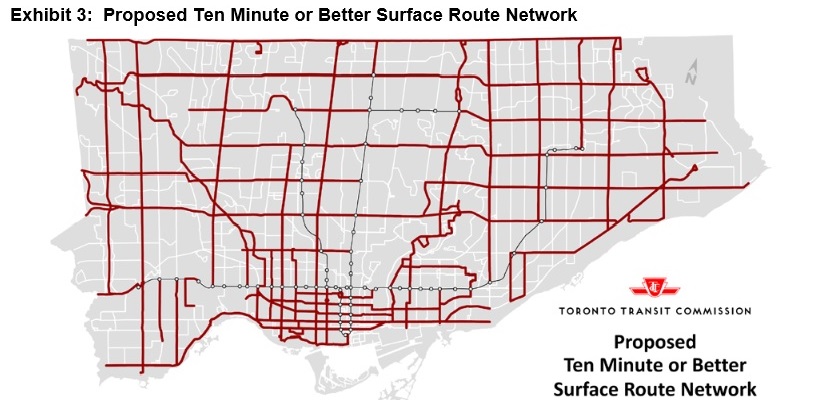
c) establish a city-wide network of Ten-Minute-or-Better bus and streetcar services;
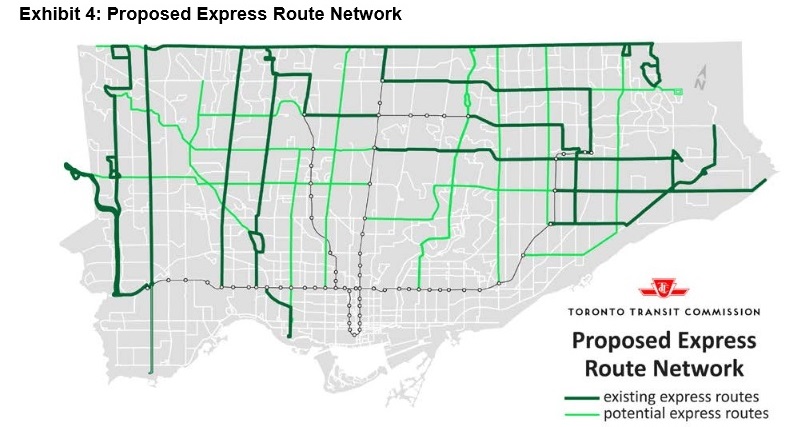
d) expand the Express Route Network with new and improved express bus routes;
e) implement more transit priority measures;
f) add resources to improve service reliability and route performance;
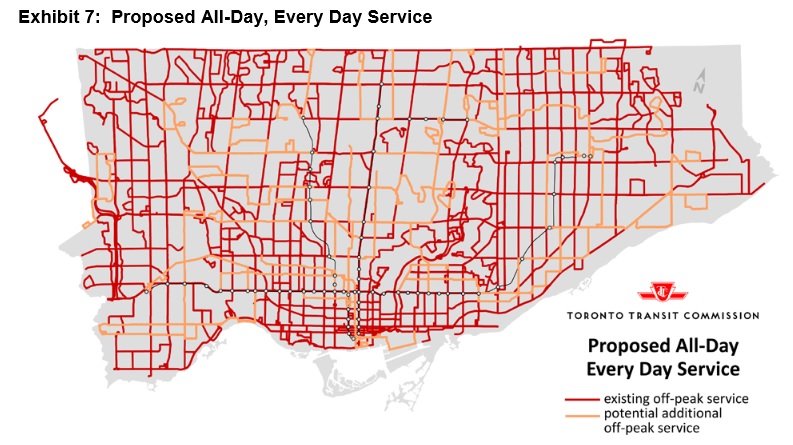
g) operate all routes all day, every day across the city;
h) change the one-trip-per-fare to a two-hour-travel-privilege-per-fare;
and
i) expand the overnight bus and streetcar network.
[The agenda will also include presentations on the new streetcar implementation, and on “Customer Journey Times”, a new way to measure the usefulness of transit service to riders. These presentations are not yet online.]
Introduction
At the heart of this report is a recognition that Toronto’s transit needs to improve not just with the construction of a few rapid transit lines serving limited parts of the city in the mid-to-distant future. What riders need and will use is a service overall that is more convenient and less crowded. This requires improvements to the bus and streetcar system that have been ignored for too long.
Many of the proposals here will be familiar from the Ridership Growth Strategy (RGS) and the Transit City Bus Plan (TCBP) of the Miller/Giambrone years, and it is no surprise that TTC management wants to return to an operating environment that welcomes passengers rather than treating them like so much baggage to be jammed in wherever it will fit.
This improvement takes several forms:
Scheduling service for lower crowding
This was a feature of RGS although it had a notable exception when it came to peak streetcar service because already the standard line was “we have no more streetcars”.
Reduced crowding isn’t simply a matter of giving folks more elbow room, but of reducing the situations where passengers cannot move around especially at stops where it may take ages to get one or two riders out the door, and one or two in to replace them. Statistics that measure “efficiency” by packing density, but don’t consider the wasted time of the operator or the vehicle, are self-defeating.
All-door-loading and Proof of Payment (POP) fare collection will also improve space usage in vehicles, at least on those routes where the practice is not already common. Many operators already load through the rear doors during peak periods if only to get people into their buses and streetcars.
Service scheduling and management are also important. If buses and streetcars cannot achieve their scheduled trip times, they will always need to be short-turned. However, even worse are the convoys of vehicles that form either because short-turns are not managed properly to fill gaps, or because vehicles travel across the city in packs (some originating at terminals) with little evident attempt to space out service and even the load among vehicles. A low “average” load can represent simply a pack of buses with a few stuffed full and the rest over half-empty because everyone tries to get on the first vehicle.
Evening out the service will no only make better use of its capacity, it will reduce the frustration riders feel when they peer into the mist (or into a NextBus display) and find there is no bus or streetcar nearby.
Improving service frequency and reducing trip times
Aside from the changes that more generous loading standards will bring, the TTC would establish a core network with various classes of improved service.
At its most basic, this network would operate at least every 10 minutes, all day. Riders would know that certain routes could always be guaranteed to show up fairly soon, even if they have just missed their bus or streetcar. Actually implementing this is less costly than it may seem because many routes already fit the pattern during most or all of their operating periods.
The proposed map has changed somewhat from the TCBP in that it includes some routes whose branches might operate on headways wider than 10 minutes, but the trunk of the route has 10-or-better. Also, the streetcar service on Lake Shore Blvd in Etobicoke, omitted because it was not a bus route, is on the map.
(“All Day”, by the way, means from roughly the start of subway service in the morning until at least 1:00 am the following day.)
For the network as a whole, all-day service would be provided to many locations where it now disappears during some off-peak periods. This recognizes that “access to transit” requires that it be available for both the “to” and “from” trips, and that a superficially dense transit network is meaningless if half of the service vanishes at off-hours.
Two changes are proposed for the express bus network.
First, there would be more routes with express operations, and more routes that already have peak express service would see off-peak express buses as well.
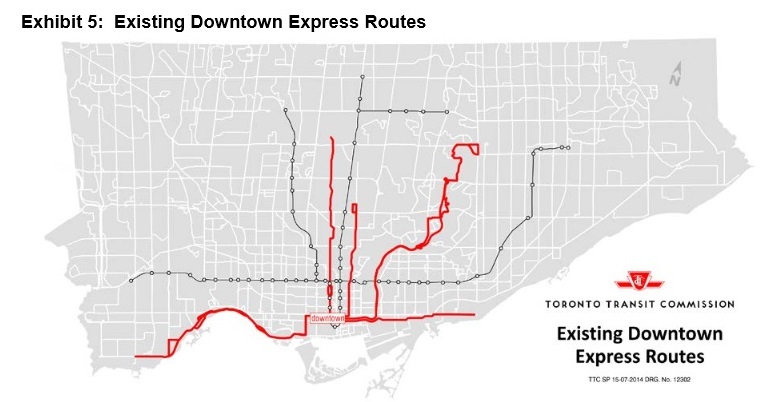
Second, the 14x Downtown Express routes would have improved service and would convert to a regular fare rather than the supplement they now charge.
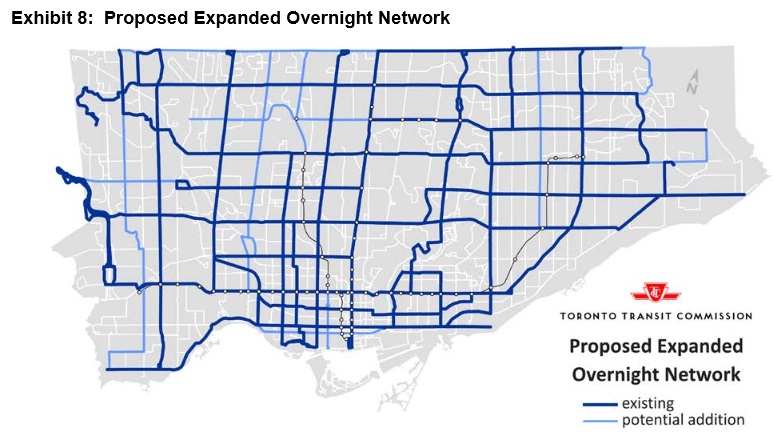
Finally, the Blue Night network would be expanded to reflect the growing demand for late night service and to fill in some gaps in the current network.
Time-Based Fares
The TTC makes limited use of time-based fares, in effect making a transfer a pass good for two hours, but they now propose making this the standard system-wide. This will accomplish several things in one move:
- All fares, be they monthly passes or single cash payments, will buy unlimited travel for some period of time without regard for the niceties of rules about transfers, stopovers, and riders who give up and walk only to be overtaken by a vehicle.
- Riders whose travel requires multiple short trips will no longer be penalized compared with long-haul commuters who get the same amount of travel for one fare.
- There will be no question of whether a “transfer” is valid as this will depend only on the time “stamped” on it either in ink (for a hard copy fare receipt) or in their fare card.
- The Presto system will not have to “learn” about transfer rules and its implementation as a time-based scheme will be greatly simplified.
- When integrated regional fares arrive, the “two hour fare” can be valid across boundaries.
Improved Operations in Traffic
Two changes are proposed to improve transit vehicle flow:
- Additional Transit Signal Priority (TSP) with the rate of installation being doubled from the present 40 sites per year to 80.
- Provision of “queue jump lanes” at busy intersections where right turning traffic can interfere with bus movements.
TSP has been around on some routes, notably the streetcars, for many years, although the degree to which is kept in working order is open to question. Two important questions need to be asked about “priority”.
- Should transit get priority even at intersections where there is a strong demand in the cross-direction and every available second of green time needs to be available to any traffic that can use it? Nearside stops can actually waste green time by holding traffic while a transit vehicle serves the stop.
- Should TSP be designed not just for “standard” operations, but have support for unusual conditions such as giving left turn priority to diversions and short-turns, not just at a few locations where left turn movements are scheduled?
Queue jump lanes have been on the TTC’s wish list for years. They are specific to bus routes, and can only be implemented where there is space to widen the approach to an intersection. This layout may not fit well with others who design for cars, cyclists or pedestrians. A related issue is that these lanes require dedicated space 7×24 even though the problem they address may only exist for a few peak hours.
The Need for More Vehicles
Some of the proposed changes do not require any additional peak vehicles, but a few do, and this brings us to a debate about how the TTC should address growing peak demand in the short term, even without any new service policies.
On the bus fleet, the report notes that not only are more buses required, but also the new McNicoll Garage where they can be stored and serviced. To its credit, the report does acknowledge that a short-term alternative might be possible:
“Many of the initiatives could not be implemented until the TTC buys more buses and streetcars, and has the facilities to house and maintain them. Alternatively, shorter term and off-peak improvements could be made through leased maintenance and storage facilities. Immediate approval of these initiatives by Council would allow the TTC to proceed to procure and construct these prerequisites on a fast-track basis.” [Page 3]
It is unclear what the need for more storage has to do with off-peak service, but there is certainly the question of leasing space for some short-term overflow pending the availability of McNicoll Garage. However, the TTC seems to be double-counting that garage here both for policy-based service improvements and for McNicoll’s original intent, the ability to expand the fleet for additional demand.
What is missing from the proposal is an integrated view of requirements both due to “normal” transit growth, and the additional needs brought on by the new policies (including any induced peak ridership). In other words, is McNicoll Garage enough, or should the TTC be planning for a second new garage? How do future rapid transit lines (whatever their technology) affect long-term planning?
Similarly, some peak period streetcar improvements are said to require some of the 60 new streetcars proposed, but not yet funded in the “below the line” Capital Budget. The real issue for the TTC, short term, should be how long it will keep its CLRV fleet in operation in parallel with the Flexities to supplement service while the Flexity Fleet builds up and represents a real net addition to fleet capacity, not simply a trade-in of old vehicles for new.
There is no mention of the additional vehicles that will be required for the Waterfront services should construction of the eastern line be advanced.
The Continuing Need for Standards
The report proposes that bus routes be scheduled to be less crowded and presumes that they will continue to have some level of productivity. What is missing is any cutoff line by which new services such as express buses would be compared to the regular service. Does The Beach, for example, get a regular fare express bus just because the route is already in place? How many parts of the city should get parallel express services while others must make do with their “ordinary” bus routes?
If new buses are to be ordered and garages built to house them, should this capital cost go toward more “regular” service, or should it be concentrated on express routes to downtown? How will the TTC decide to allocate new vehicles and operators?
Conclusion
This report is a long-overdue overview of what Toronto’s transit system could be, advocacy for the riders who are here today and may be attracted in the near future rather than being driven away with indifferent service and calls for lower costs and “efficiency”. There are details to be debated and priorities to be set, but the basic idea is sound:
Treat the transit network as something that needs system-wide improvements, not a quick fix here and there where residents can get politicians to take an interest.
Toronto is in the midst of an election campaign where candidates are preoccupied by drawing rapid transit lines on maps. For most candidates, the surface system simply does not exist even though without it, most riders would never reach the subway lines some are so eager to build. Surface transit has been strangled by an administration that values tax cuts over the quality of service and clearly feels that transit users are a coddled, oversubsidized bunch.
When this report comes to the TTC Board for debate, there will inevitably be claims that this is a policy for candidate X or a repudiation of candidate Y. There may even be some factional jousting to defer this report so that it does not officially become part of the record with a TTC recommendation attached.
That would show just how little some politicians care about transit riders.
This proposal is a plan to improve transit for everyone, and it should not be claimed as any candidate’s exclusive property even though aspects certainly overlap elements of some platforms. Transit is too important an issue for good ideas to be held hostage to party colours, for a “red” idea to be dismissed out of hand by “blue” supporters.
Toronto deserves a Council debate that will address head on the basic question “Where is my bus” with an answer that does not involve yet more doodling on the rapid transit map of decades to come.
 Steve Munro
Buses require secure parking overnight, where they will not be easy targets for vandals (remember the Vincent yard?). As such, parking buses on the street (even if we didn’t have snow), or in a parking lot used by an existing mall that lacks perimeter fencing will not suffice.
Exhibition Loop works because it’s a contained location. There are limited points of entry that can be secured by staff as needed. This is not a simple matter of repurposing existing paved surfaces. There may also be pavement engineering issues with existing lots designed for use by smaller vehicles.
LikeLike
In other workplaces, it’s not uncommon to have a particular responsibility added to certain individuals’ role for extra pay for the duration of that task (e.g., I used to get an extra $3/hr to open and lifeguard a pool by myself until a second guard’s shift started). The TTC could train all of its drivers to operate as in-the-field dispatchers. Buses parked in the field would almost certainly be in groups – management would simply assign one driver per batch per day to act as ‘dispatcher,’ arriving early and assigned to operate the last-departing route. This driver would be the liaison with transit control, advise them of any unscheduled absences, send out the buses on time, be on the hook for late departures, etc. Another driver would be assigned as dispatcher in the evening, making sure the required buses arrive for next day’s service and departing later.
Drivers assigned to these buses would be required to make their own way to and from the site.
The biggest problems of this scenario are organizational: making sure the ‘dispatcher’ status is assigned for each batch; ensuring that each bus parked at night’s end has been serviced and fuelled prior to arrival; managing the lease to use the (likely) private space for parking; and tracking dispatcher pay per driver. Also important is ensuring that drivers who start their shift at these locations end their shift at same, so if they drove over they can take their cars home. Ditto for those who start mid-day and park the buses at night. Maybe even a special staffer in transit control to tackle some administration that the driver-dispatchers can’t do without an office.
Perhaps too complex to be worthwhile, but definitely doable.
Steve: Having a “dispatcher” is easy. Many other issues, notably servicing buses at the end of their shift and then getting them to the satellite parking area, are far more complex that the process you describe. Note that a different set of buses would likely be cycled through the satellite area on different days, and this function would not be coupled with the operating scehdule (i.e. to a driver’s assigned work).
LikeLike
Steve, I have to say I like this report a lot. A lot, maybe even a majority of the complaints about the TTC, are due to bus service. This goes a long way in improving that. I love the frequent bus map the most, because most people in the city, don’t live near the subway. I have a question though: Why include the streetcars on the map? In most cases, they are supposed to arrive withing 10 minutes, and most routes like Queen and King have very frequent service as is.
Steve: The idea is to advertise all routes with “frequent service”, and the streetcar routes certainly qualify, although not every one. For example, service beyond Humber Loop on Lake Shore, and on Kingston Road northeast from Queen both have periods of greater than 10 minute headways. Kingston Road is particularly galling because the evening and weekend service provided by the Coxwell bus is actually more frequent that the daytime weekday streetcar service (and that’s assuming that the 502 isn’t short turned before it even gets onto that part of the route).
LikeLike
Actually TTC has 3 different types of express buses (Rocket, E-Branch and Downtown Express) and within each type there are differences in how the routes operate, hours of service, where and when they stop, etc.
I’m all for the TTC to consolidate their express buses into one limited stop “Rocket” Network with all-day frequent service stopping at major transfer points and going non-stop as needed.
Cheers, Moaz
LikeLike
I’m very impressed with this report and it really goes to show that there are good people at the TTC who know what this city needs. One thing that needs to be mentioned is how even-handed the service improvements would be with major benefits for both suburban and downtown riders.
As a matter of perspective, the annual operating expenses of this entire service improvement program is roughly equal to the revenues that the city derived from the cancelled vehicle registration tax ($60 million per annum). Similarly, the capital expenses are about 2% of the $15 billion allotted to the GTHA by the provincial government for the next phase of the Big Move.
In many respects this report is drawing a line in the sand for the new mayor and council. Will they be as narrow-minded as the odious Ford/Stintz combination or will transit regain the support it needs from council?
After seeing this report, I’m feeling more optimistic.
Steve: Even moreso, will Council forge ahead with these improvements rather than using that old saw “we’re waiting for [insert another government’s name here] to give us more money”? Totonto has taxing powers and untapped room to use them. Do we want a “world class” city, or a backwater that screams “cheap” at every turn? Do we really believe that transit is “the better way”, or is transit something for “everyone else”, preferably as tightly packed as possible?
LikeLike
Yes, I think it will require smaller service areas, and as long as we have this and are parking in decent sized groups, there could also be a proper check in etc. I would think there should be some empty space in industrial parks where there would be room for a locker room, a time clock, an employee parking lot etc. Buses could be parked either here or nearby, but it in my mind it would make sense if possible to create small service centres. If you are grouping 50+ buses anyway this is a fair number of drivers and vehicles to support (and a large chunk of parking lot). You would likely want reserve drivers and buses as it would make some sense to have such a centre actually support a specified district etc. While I think this is likely a logical thing to do, the best way to do it would likely to be to replicate as many of the daily needs as possible. If you are adding 200 buses now and 200 shortly beyond current capacity, this is a couple (or even 5-8) reasonable sized centres. If the buses are stored on a separate site after service, moving drivers to and from that site will need to be considered, and will result in the requirement of an additional vehicle and person.
LikeLike
Two comments:
The new 195 Jane Rocket is _fantastic_. I now use it in preference to another route because it is FAST! This is the way to go. Express all the way not local at the far end. The only improvement I would suggest is all Rocket routes should stop at all transfer points. Jane does not stop at St.Clair even though the new 79B all-day everyday branch has been in use for months and it too is a big success. Does not stop at Annette either to transfer to/from 26 Dupont forcing people to use a Jane local.
Years ago I suggested far more Jane 35E buses since the volume of riders was so high and the distance so long. Riders were taking forever to get to far points. Being a big believer in the KISS principal I suggested making every rush hour extra an Express. TTC’s response was, too much mileage would be operated by the faster runs. To Hell with the rider, don’t wear out the bus.
As for “out post” parking lots this could work since GO does similar with its trains at out of town end of the line places. Although on their own property (or leased from the railway). They employ a small independent contractor (some are ex railwaymen retired) with one or two helpers to service the equipment, clean etc. Refuel is done by another contractor including one called “Refuel” ! Equipment can be cycled in to the shops at Willowbrook in Mimico as needed for repair and bigger inspections etc.
Forget about thinking outside the box. I say get rid of the box!
LikeLike
There were comments on this thread about supervisors on the street as opposed to centralized line management (Transit Control).
I don’t understand the purpose of supervisors on the street given there is Transit Control. The supervisors seem to stand in one place along the sidewalk, make notes in their notebook and chat with drivers when a vehicle finally comes by sometimes after a long gap. (I make this comment from glancing at a supervisor on McCaul Street during the 505 diversion.) I’m not sure if they have a device to view the entire route or a telephone to communicate with drivers farther away like Transit Control does. If vehicles are bunching up somewhere else along the line, how can street supervisors detect the problem let alone address it?
I could see a mobile supervisor being useful to address line problems such as investigating a suddenly blocked route.
Steve: The problem is that supervisors out on the street don’t really do much because their goal is simply to keep service more or less on time. The fact that both of the King supervisors (I have seen as many as four) spend their days in front of the Tim Horton’s at John Street only makes matters worse. In theory, someone at CIS Control could manage the service, but they have not had tools to give them a fine-grained view of service ever since CIS was created. For example, short turn points should be managed so that service is properly spaced, but one needs accurate information about vehicle location to do this. Until CIS changed over to GPS locating, the info about actual car locations was a bit dubious.
There is something to be said for having someone with their “feet on the ground” running a line if only because they know what it means to throw a whole carload of passengers off for a short turn, something easily done from a control room far away, not so easy when all of the happy passengers have just become your “best friends” wondering where their next car is coming from.
All of this said, I think there is something even more fundamental — the TTC years ago lost the sense that operating a reliable service was not just a nice thing to do, it is essential to their being. There are lots of excuses — traffic congestion, accidents, ill passengers, unreliable equipment — that have explained away all manner of problems for years. Even their performance stats, unremarkable as they are, have been treated as an aggregate target averaging routes, times of day and locations together giving a number that’s not “too bad” until one considers just how bad the service can be and still meet the goal.
Service management needs a big shakeup, and having enough vehicles on the street to handle the demand, plus schedules that reflect actual operating conditions, will go a good way toward making most service better most of the time. The first problem is to acknowledge and measure just how bad it really is, something I hope to see in the “Journey Time Metric” to be introduced at this week’s Board meeting.
LikeLike
I have seen, and heard of, operators going ‘by the book’ and insisting on a second fare if a passenger – on a cold day – goes inside a store to wait for the bus or streetcar because they had the opportunity to “shop” inside the store.
However, I do agree, that I think the $20 million is a bit of a stretch. For example, does it consider impact of people using the TTC more thanks to the time-based transfer? For example, I will normally try to plan my TTC so I only need to pay two, or a maximum of three, fares. However, with time based transfers, I don’t need to do this, so I would (or hopefully will) be able to use the TTC more as I will be able to do three round trips in what would be one round trip now, but while paying three fares not two.
LikeLike
I understand the TTC like any agency can always do better. But I see a lot of criticism of the TTC that I really do not think is warranted.
Comments like this plan showing the TTC has good people.
The TTC does not have one of if not the highest ridership per capita rates in North America because it does not know what it is doing. It has that because it does know what is important in transit, and has and continues to do that, even when funding and politics limit it.
The fact that the 10 min network is planned to be until 1:00am shows just how great TTC planning is. Every other city in North America only wants to run frequent service until 9:00pm in most cases. The fact the TTC wants to push that, and is going for 10 minutes instead of the 15 minute norm is a great step.
We should complain and always demand better. But I also think we need to commend and appreciate what we have. And the fact is, the TTC is still the best, and yes it even beats New York City. Because I challenge you to go to the outskirts of New York City, and check their bus service. It pales in comparison to what the TTC provides on the outskirts of its service area.
This plan while mostly the RGS, takes already pretty good service and elevates it a little more.
LikeLike
The system they use to calculate their losses is mind boggling. On one hand they lose 12 million through “fare scoffers” — people walking stations, boarding vehicles through rear doors without paying and similar situations. What we as operators are perplexed with is, if you can count the people who cheat WHY can’t you make them pay the proper fare. Using a time based transfer eliminates all doubt, time is up pay again. No arguing, no fuss. We would surely give folks an added few minutes grace time but than pony up so EVERYONE is treated fairly.
LikeLike
Does the TTC not have radios in its buses???
Steve: Yes, but for many years, the TTC had only rudimentary info about where the buses actually were located. You can’t just ring them up one by one and say “where are you”. Also, the communications available through the dashboard message unit are quite primitive and restricted. More recently, the issue of “distracted driving” has come up, and operators are really not supposed to be chatting with control while driving down the street with a busload of passengers. There is also a limit to the number of concurrent conversations possible.
LikeLike
I think I’ve read about the outdated technology used to communicate with drivers in the vehicles, and that it causes route management issues.
Could they simply buy iPads (or any other device) with cell connectivity, write the software, and mount them on the vehicle dashboards, and use that for communications and route management (GPS location sharing)?
Steve: One of the design problems for systems like this is that the technology changes a lot more often than the vehicles it is used in. An important part of the spec for the new system will be that it not lock the TTC into “iPad” or equivalent technology on vehicles with a lifespan many times longer. Even when it was new, the existing CIS was dated because of technology change between its early design days and actual implementation.
It’s tempting to say “just buy iPads”, but the device has to physically fit on the dash, be easy for drivers to use, and be robust enough for 7×24 service in a wide variety of environments.
LikeLike
I think the idea of having the frequent bus, and express/rocket bus networks be set up and fully implemented for a couple of years prior to committing the larger funds to LRT makes a great deal of sense, especially in the context of bus queue jump lanes etc.
If you are filling frequent, and relatively express buses, there will be a good argument to be made for a heavier route, if you are not, it begs the question of whether going LRT makes sense on that route. Ideally you would go so far, on the busier queue jump routes to start to try to run the buses in exclusive lanes, and even start to protect those lanes. Transit City type services would just sort of creep in as a natural extension where they made the most sense. Adding frequent express services especially to the outer extremes of the network just makes so much sense, in terms of attracting riders, and saving the most lane miles of roadway.
LikeLike
Even if you broke the service areas into 10 distinct communication regions, you would have the possibility of 200 conversations going on simultaneously. I would think that without using a computer system, that would actually permit a management by exception type approach, any management would be very hard.
The vast majority of the work to manage timing on a fleet of 2000+ surface vehicles would need to be done automatically, where humans managing issues was the exception not the rule. If you are targeting a 10 minute headway on a route, I would expect that the operator would get continuous feedback in terms of how far behind the previous vehicle he is, in terms of an onboard equivalent of green, yellow, red in turns of running. Operators and control can do little to catch up a bus behind headway, but can do something in terms of slowing one that is too close. There would be little point in control being involved at all until there was a substantial deviation from targeted headway (say 2+ minutes on 10). At this point there may be a need to dispatch a vehicle if the trailing vehicle is running into a large gap and therefore running slow. That would require substantial spare capacity in the system, or a very good understanding of where this was likely to occur, and having vehicles standing by. Right now, I suspect that even with a much improved system, it will be hard to address much beyond vehicle convoys (although even that would be huge), due to a simple shortage of vehicles to fill.
LikeLike
The political response to this has been tepid.
I would have thought Chow at least would welcome the discussion. But, they all seem to be afraid of spending money.
I suspect this will go to the Commission and be referred until November.
LikeLike
Good to see this support but odd coming from someone who wanted to use the ‘surplus’ to put off fare increases and to postpone building the new bus garage that is necessary but …
LikeLike
This report is long overdue, and I can only hope that changes in leadership in October will offer an environment more conducive to reasonable transit improvements that can be implemented within the short term. Thanks for bringing attention to it.
One item not in the report but that I thought had merit is David Soknacki’s idea to reduce peak demand by implementing free travel for a limited time prior to peak hours, replaced by discounted fare once Presto is widely implemented. The idea that the fares lost will be at least partially recouped by avoiding the need for more peak service (both in capital and operating expenditure) isn’t unreasonable, and can be implemented relatively quickly.
On a separate note, I wish the TTC tracked any headway more than 150% of the scheduled headway. Such gaps are unacceptable for riders, and tracking them would help provide more data to prevent them in the future. They’re just too common an occurrence, particularly on the 501 line (Queen West is such a badly designed street it deserves a report all to itself).
LikeLike
John Tory made a few comment on the plan, saying council should wait until next year to discuss the plan. I don’t get why council can’t discuss it now. An election year isn’t a good enough excuse.
Steve: Tory does not appear to want policy issues debated during an election campaign, but would rather that this process wait until a new Council is in place. The whole idea of an election is to chose from alternate views of our city’s future. After all, the candidates all have their plans and nobody tells them that this isn’t a discussion for the campaign trail.
I’m willing to bet that Tory has a warehouse full of Smarttrack literature and he cannot conceive of a change, or a friendly improvement, to his platform for fear of rendering the whole thing just so much landfill.
I was very disappointed with his “how will we pay for it” response to a plan that is about 3% of the TTC’s 10-year capital budget, and about 4.5% of its operating budget. Saying that huge tax increases would follow suggests that Tory does not understand how municipal finance works, but I am not the first person to make this observation.
LikeLike
So no, not “no fuss”. But, clearly less fuss than the bizarre rules currently in place, which are unreasonable on their face and even if all service runs perfectly on time — why should stopping at the coffee stop while waiting for my transfer invalidate the transfer? One can even imagine extending the time of all times transfers in the event of bad weather — buses run more slowly, so give everybody some more time to make their trip. And of course actually managing to eliminate early buses.
LikeLike
Just saw John Tory’s presser by Union Station this morning. I’m not encouraged by his response. He basically whined that there was no costing strategy for everything in the entire report, estimated at about $500 million. Then he brazenly pushed his $8 billion Smartrak plan as a viable alternative to the fine-grained city wide improvements to service and policies such as 2 hour transfers the report recommended. Shaking my head.
Steve: Tory, in lumping together capital and operating costs, does the typical trick of making numbers sound bigger than they really are, especially considering that the bulk of the proposed spending is in the latter years of the plan. The short-term stuff can be implemented at reasonable cost.
LikeLike
The policy change that no one has remarked on yet is the change to the Downtown Express buses going to regular fare — and increased service, but I think the regular fare is the most interesting.
There certainly are people convinced that downtown express buses are the bee’s knees and we need lots more of them. This proposal will certainly show the validity, or not, of that conviction.
Steve: I am waiting for the lecture from TTC Planning the next time someone talks about how an overlapping Long Branch and Queen car are an inefficient way to run service.
LikeLike
These proposals are great ideas, and I hope to see them implemented. However, the TTC needs to do a better job at marketing improvements.
I would like to see all E-branch express buses become Rocket express lines with all day service. As Raymond mentioned, the conversion of the 35E to the 195 rocket has been an amazing success. From a marketing perspective, the TTC should consider better branding of the rocket service, to distinguish it from a regular local bus. Look to Viva, Zum, miExpress, B-line, etc. for examples.
From a PR & marketing point-of-view, the TTC should schedule its improvements to be implemented on the same day as a fare increase. That way the public would see a benefit to a higher fare. Frame the conversation as “fares are going up, but now you’ll get a 2-hour transfer.”
The 14x express service should remain as a premium fare. It is a premium service, and as Steve has said in the past, its operational costs are much higher than a regular service. I think people are willing to pay more for the service. (I think people are also willing to pay more for the airport rocket, but that’s a different conversation).
I think that a good “Phase 1” of TTC-GO fare integration would be merging the fares of the GO system and the TTC 14x express system. I would like to see a GO trip starting in Toronto and ending in Toronto (e.g. Weston to Union) have the same fare as a downtown express, and include transfer to/from the TTC. The TTC could then adapt its network: for example, replacing the 145 Humber Bay Express with a GO shuttle along Lakeshore Blvd that feeds to Mimico and Long Branch GO stations. Yes, fare integration will result in lost revenues: but how much?
Steve: Yes, we need to have an “adult conversation” about the degree to which duplicating routes for the benefit of those who wish to pay a higher fare is a valid exercise. The fares go toward the operating cost, but they don’t cover the capital investment in a vehicle that might be better used elsewhere.
LikeLike
Despite most stunning report from TTC, there are some weak points in the report. Disappointing to see Queue-jump and Transit-priority proposals. Not sure what criteria was used for selecting 25 intersections for queue jump. TSP proposal without changing the current but ineffective strategy is also confusing. Most importantly, no strategy on how fast and frequent services will be provided through full-time or part-time bus lanes (or reusing the existing lanes). Transit planning issues are weak as expected, opening the door for City’s new “Transit Initiatives” team to develop guidance and strategy to fill the big gap in TTC.
LikeLike
Thanks for replying Steve.
Could they not just have a spot in the dashboard so that any future computer like an iPad could be swapped in and out easily?
It doesn’t seem like it would be difficult for a small computer like a tablet to fit on the dash. Ease of use would be determined by the software, and software updates could happen to fix problems or improve or change the app over time. Of course, they aren’t very expensive either.
Having said that, maybe I’m missing some reason why this can’t be done, it’s pure speculation on my part, but to me it seems like a simple tablet could handle the functions of communication and location sharing.
Steve: Might be easy for a new vehicle designed with this in mind, but harder for one already in service.
LikeLike
Could they simply buy iPads (or any other device) with cell connectivity, write the software.
It would be much better to buy an off the shelf solution, where you get support – along with a whole army of people that focus on solutions to this problem….there are thousands of transit systems in the world, they all have the same problem…much better to pool resources and solve it together than to go it alone.
We saw what happened when Ontario decided it would be easier to just build our own transit mode…lets not keep repeating these mistakes…
LikeLike
I would suggest what really matters here, is that it find the light of day in terms of public discussion. The media discussion is likely just as critical. Now that it is the media the candidates are being required to stake out positions, and Olivia Chow is saying in essense that it is an opportunity for improvements that “can be made right away”.
The media coverage should allow the TTC to frame the debate, which is ideally what is desired. Move the debate back within what the TTC and Council can make happen, or have real impact on, and away from things that require action largely within the realm of the province.
Further discussion will be required around RER, and where the stops will, and how this interacts with the TTC, what fares will be etc. However, most of this is really a question of how council, and candidates can influence provincial policy, not will be done by the city and the TTC, and perhaps not really a matter for city elections.
LikeLike
True – I know of an operator who told me that on at least one occasion while driving the Warden 68 bus, he insisted that a passenger boarding at Sheppard while eating a Big Mac pay another fare, based on the fact there is McD’s at Warden and Sheppard.
Sure, stopping to pick up a burger while waiting for a bus is breaking the stop-over rules, but how is this morally different than someone making the same purchase at a location in the fare paid area of a subway station?
Then there was the faux pas by Adam Giambrone when he was TTC chair and saying in a news interview that being able to know when the next bus was coming, either using Next Bus or some possible future display at stops, would allow one to go grab a coffee while waiting.
Growing up near Birchmount and Sheppard in Scarborough, there were quite a few times I needed to go over to Agincourt Mall and opted to walk instead of using the TTC because it was just not worth the price of two fares. Had there been time-based transfers, a good number of those trips would likely have used the TTC and they would have collected a single fare each time with virtually no impact on the cost of operating the service. Multiply this across the city and there is likely a couple of million that gets shaved off that $20 million figure.
LikeLike
Kevin’s comment:
So cancel the $505 million Gardiner boondoggle. Problem solved. And an extra $5 million left over to throw a big city-wide party to celebrate how great we are.
LikeLike
I have commented before about the concept of “setting the agenda”. Rob Ford is wrong in almost every respect. It is sad that his principal opponents persist in trying to conform to his approach to spending and city building and are ashamed to fully support a different approach.
It is disappointing to hear John Tory’s response to the issue at hand today. As you have pointed out, the amounts in question are minuscule in the scheme of things and parts of the expense are spread over a very long time. Instead of providing real feedback, John Tory retreated to silly nonsense and throwing apparently big numbers around – but without any context to show that they are really rather small numbers.
This seems to be John Tory’s big failing. As a shoo in for Premier he ruined his campaign by sucking up to the Harris fringe with a wacky policy rejected by the mainstream. Now he sounds positively Ford like because he focuses on “where will the money come from” rather than the benefits. John Tory doesn’t understand that Ford supporters will never vote for him – no matter what. It is small “c” conservatives who understand that Ford is a buffoon that he needs for core support and some support from the left as well to form a winning coalition.
Olivia Chow (my preferred choice – though a little too populist for me) also is guilty. All that nonsense about growing up in an immigrant family and knowing the value of a dollar is also kowtowing to Ford. Today she was lukewarm in her support of this report. Olivia (or her campaign manager (I think it is John Laschinger who is highly over rated) also don’t understand is that her potential supporters don’t need a Ford clone. We need vision, services and a liveable city. She should admit that this costs money and explain how it will be raised. Let Ford and Sue Anne rant away all they want and call her names. David Miller has proven that a majority of Torontonians think Ford and SAL are lacking in any vision.
LikeLike
Dewan Karim: Not sure what criteria was used for selecting 25 intersections for queue jump.
The selection process and 20 intersections were described in a previous report – the Transit City Bus Plan pages 45-47.
As great as this report is, much of the ideas and $ are simply from previous reports. Really it’s a summary of various outstanding proposals. Which is what makes John Tory’s comments so unfortunate. Rather than sounding like he’s being responsible, all it’s doing is demonstrating that he’s completely ignorant of what’s already been proposed.
Steve: The queue-jump proposal is probably the weakest of all those in the new “Opportunities” report. It’s an idea the TTC keeps harping at although I am not convinced it will bring as great rewards as claimed, and worry about potential side effects of making intersections “faster” for buses. As I said in my article, these lanes require permanent changes to intersections on a 7×24 basis when the real problem may be comparatively short-lived.
LikeLike
Rob Ford and John Tory’s view of transit can be summed up like this: If you do not live on or use the subway, you are not a transit user and therefore you do not exist in their transit plans. Why do you think both candidates are so hung up on the costs of this report yet silent on their own technological fantasies? The surface network does not register with both John Tory and Rob Ford, and you will see the same service cutting from John Tory that we saw with Rob Ford to justify their technological fantasies.
The TTC is a network of buses, streetcars and subways. To shovel 30 years of taxes only on subways is inequitable to transit users who don’t use the subway for their daily needs. It would be saying that overcrowding on the subway will be dealt with but overcrowding on the bus and streetcar will be a fact of life, and nothing will be done about it because our funding has to go to the Scarborough subway. That is how you destroy a public transit network.
LikeLike
This is all pretty good, including comments. But isn’t there a simpler way to find a big pot of money? Reverse AWAY from the Scarborough subway scheme and revert to the funded yet still effective Scarborough LRT plan, though of course more needs to be done in all parts of the City.
We could also re-instigate a Vehicle Registration Tax, and put the proceeds to transit, though really, road repairs are a big issue too.
And that’s what’s good about this report – it’s city-wide. So one way of looking at it is either the system or a subway extension. I opt for the system, though I’ll be offering a range of other fixes and projects for east of Yonge at the TTC today, just ensuring that the other function of transit, jobs for men and machines and concrete usage, gets a good workout.
LikeLike
Yes it is the way to destroy a public transit network. However, there is nothing in a Ford proposal that will reduce overcrowding on subway. I would argue that most of his notions will make subway crowding much worse. Extending Danforth will pull riders off of GO, and probably overload that line everywhere west of Vic Park, if not Warden. If even 25% of that extra load gets to Yonge, well, what is already a mess will get much worse.
Extending Sheppard, if it were to actually have any ridership, would likely make a very bad situation on Yonge a disaster everywhere south of Sheppard.
Ford’s subway plans are not just bad in that they are a waste of resources, they would actually make the ride on subway worse for most.
I would argue that to make rides better for bus riders and subway users, there needs to be a network of rapid transit, to which bus rides can transfer after a shorter bus ride, and leave more room for those continuing down the same route, and not just direct so much traffic over such great distances to subway. Rocket buses are a start. However, more transit needs to be protected from traffic, bypass lanes help, but adding a small number of closed ROWs would be better (even having buses in them would make a big difference). Just extending existing subway lines is simply goofy. At least the idea of parallel capacity, that intercepts bus lines in more places would help.
Personally however, I see Tory’s notion as only making sense as RER, in the existing ROW which makes it a version of an already existing provincial plan. Where he has sketched in a little detail (although he did something weird on the west side).
The province can step up in doing a Stouffville- RER, and if they offer reasonable stops, (Steeles, Finch, Sheppard, Eglinton) and TTC fares, it really does beg why would the city even consider doing a Danforth extension.
LikeLike
Steve, Rob Ford has come out in support for this report apparently, what are your comments on this?
Steve: The article has been updated. Ford’s support is not total, and he proposes to pay for the new services with an unspecified saving of $30m elsewhere in the budget. More Ford creative accounting.
LikeLike
When did Toronto develop this addiction to subways all of a sudden? We can’t build these things except in certain parts of Toronto, and yet people who should know better want them built where they can’t be. It seems that nobody can read about LRT, or are unwilling to at least make the attempt.
LikeLike
What I want to know is: are those scarey hordes of stealth raccoons riding the TTC to Etobicoke? Without paying the fare?
LikeLike
The “unspecified saving” is reverting to the LRT plan in Scarborough, which I believe will free up more than enough City funds to pay for the entire service improvement report. He’s just waiting for an opportune time to cut the support out from under the other Mayoral candidates by springing it on them at a debate.
But seriously, using the Scarborough subway money to implement this report really would make sense (although it would preclude using it towards the Don Mills line).
LikeLike
Well-said Steve. In my mind this type of service, is a large part of what both improves access for all, and breeds the transit habit. These are critical to the long-term well being of the city, as riding transit or driving are both habits. I would like to see the services pushed past 2:00 am especially on weekends to allow people to get home, however, on at least the Yonge line that will have to wait until the maintenance required is somewhat closer to complete.
To what degree is there an opportunity here to correct this by increasing the number of Artic buses so as to permit the TTC to limit the increase in the number or drivers required in the short term, and allow a training period to work additional drivers in? Clearly we do not have the buses in hand, but should the Artic order be increased, with a request for additional buses sooner.
Here I wonder whether a relatively small increase in capacity, and better line management, will not enable a huge improvement in service. However, we cannot kid ourselves, there is a point where a small increase in crowding has a disproportionate impact on service. We must make sure we stay below that point. The fact that there is as much of an issue as there is now, to me indicates that we are well beyond that point. Also on bus routes, with known timing on super-peak point loads, the TTC needs fleet availability to run empty buses to those points to prevent them from generally overloading the lines. I think a 10% increase in fleet well deployed will have an impact out of keeping with its apparent size. However, the city needs to be ready to do more than that quickly, as this will likely trigger a period of very rapid ridership growth, especially closer to peak.
Steve, good presentation. Too bad they went out of order on the Agenda. It is nice to see that the board is supporting a more service driven agenda. It is also interesting that there must be some sense of this being a electoral issue, where being perceived to support increased spending on transit is a good thing. The previous transit agenda may actually get a lot more traction, now that people have had a few years to see the evolving impact of transit neglect.
LikeLike
Congratulations Steve: dare I say that when a respected advocate such as yourself gets his motions adopted before even presenting them, it’s an example of the system working well? Albeit after an ice age of inaction and contradiction; it’s a good thing you’re tenacious.
I applaud the TTC and you for showing just how much meaningful improvements can be made now or in the near future, with modest sums of money compared to the cost of a subway extension or Gardiner expressway rehabilitation.
LikeLike