
Updated August 19, 2014 at 10:50 pm: The TTC board unanimously adopted the proposals in this report with amendments. Some of these were intended to ensure clear understanding that approval was only in principle and subject to the review process in the 2015 budget.
In what proved quite a surprise to me, Chair Maria Augimeri moved a request for a set of reports related to service and fleet plans. The text of this came directly from a deputation on the CEO’s report which, at that point in the meeting, I had not actually presented because the Board took the agenda items out of sequence.
Here are my deputation texts, one on the “Opportunities” report itself, and one on the CEO’s report. The motion I proposed and which the Board adopted is in the second item below.
Although there were questions about details and about the manner in such a far-reaching set of proposals appeared on the Supplementary Agenda of the last Board Meeting before the election, there was broad support for the content.
Of the Mayoral candidates, even Mayor Ford has spoken favourably about many of the proposals with the exception of the widespread rollout of PoP (self service) fare collection and the move to time-based transfers/fare receipts.
Only John Tory has been strongly opposed choosing to take a hard-line tax-fighter stance that is hard to swallow in light of his own multi-billion dollar transit plans. Tory also does not understand that a staff report at the TTC only makes proposals for what should or might be done — it is up to Council to decide on priorities and funding mechanisms. Tory continues to disappoint as a candidate who has more bluster than substance, a trait he shares with the current Mayor.
Updated August 15, 2014 at 8:00 pm: Detailed comments about the proposal have been added.
The Supplementary Agenda for the TTC Board Meeting of August 19, 2014, contains a report that is breathtaking in its scope:
Opportunities to Increase Transit Service in Toronto
The report recommends a program to include the following initiatives:
a) implement all door boarding and proof-of-payment on all streetcar routes;
b) reduce wait times and crowding on bus and streetcar routes;
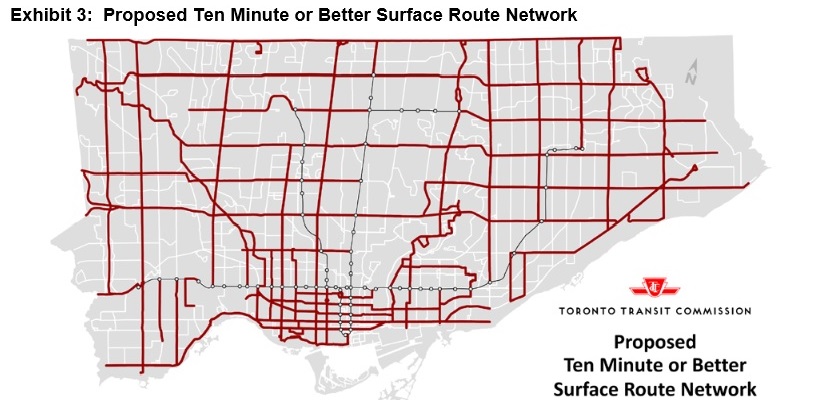
c) establish a city-wide network of Ten-Minute-or-Better bus and streetcar services;
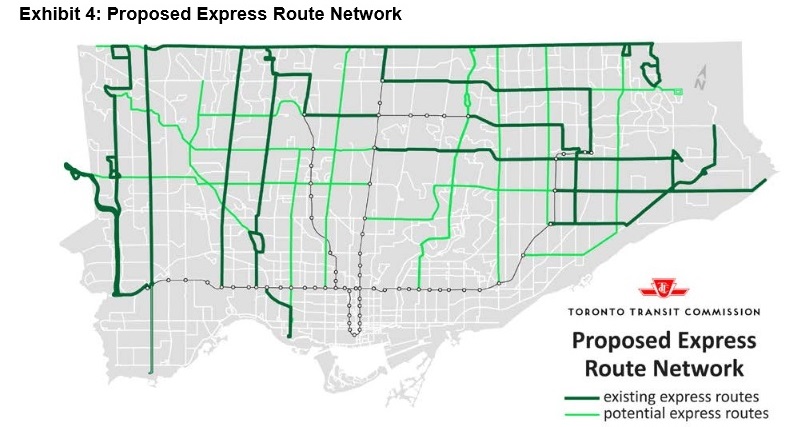
d) expand the Express Route Network with new and improved express bus routes;
e) implement more transit priority measures;
f) add resources to improve service reliability and route performance;
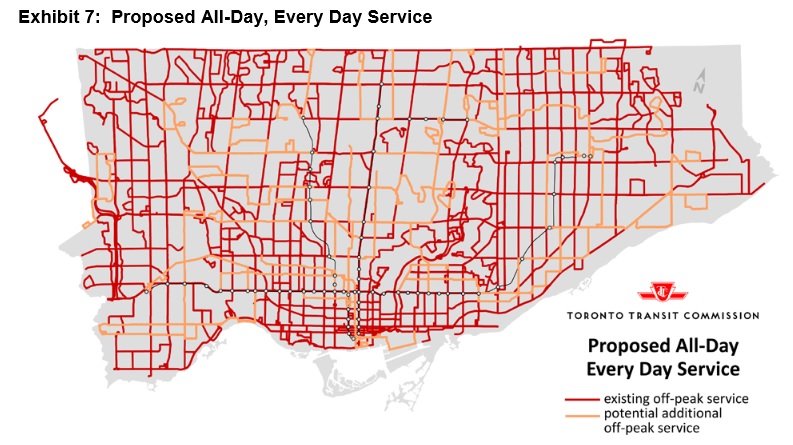
g) operate all routes all day, every day across the city;
h) change the one-trip-per-fare to a two-hour-travel-privilege-per-fare;
and
i) expand the overnight bus and streetcar network.
[The agenda will also include presentations on the new streetcar implementation, and on “Customer Journey Times”, a new way to measure the usefulness of transit service to riders. These presentations are not yet online.]
Introduction
At the heart of this report is a recognition that Toronto’s transit needs to improve not just with the construction of a few rapid transit lines serving limited parts of the city in the mid-to-distant future. What riders need and will use is a service overall that is more convenient and less crowded. This requires improvements to the bus and streetcar system that have been ignored for too long.
Many of the proposals here will be familiar from the Ridership Growth Strategy (RGS) and the Transit City Bus Plan (TCBP) of the Miller/Giambrone years, and it is no surprise that TTC management wants to return to an operating environment that welcomes passengers rather than treating them like so much baggage to be jammed in wherever it will fit.
This improvement takes several forms:
Scheduling service for lower crowding
This was a feature of RGS although it had a notable exception when it came to peak streetcar service because already the standard line was “we have no more streetcars”.
Reduced crowding isn’t simply a matter of giving folks more elbow room, but of reducing the situations where passengers cannot move around especially at stops where it may take ages to get one or two riders out the door, and one or two in to replace them. Statistics that measure “efficiency” by packing density, but don’t consider the wasted time of the operator or the vehicle, are self-defeating.
All-door-loading and Proof of Payment (POP) fare collection will also improve space usage in vehicles, at least on those routes where the practice is not already common. Many operators already load through the rear doors during peak periods if only to get people into their buses and streetcars.
Service scheduling and management are also important. If buses and streetcars cannot achieve their scheduled trip times, they will always need to be short-turned. However, even worse are the convoys of vehicles that form either because short-turns are not managed properly to fill gaps, or because vehicles travel across the city in packs (some originating at terminals) with little evident attempt to space out service and even the load among vehicles. A low “average” load can represent simply a pack of buses with a few stuffed full and the rest over half-empty because everyone tries to get on the first vehicle.
Evening out the service will no only make better use of its capacity, it will reduce the frustration riders feel when they peer into the mist (or into a NextBus display) and find there is no bus or streetcar nearby.
Improving service frequency and reducing trip times
Aside from the changes that more generous loading standards will bring, the TTC would establish a core network with various classes of improved service.
At its most basic, this network would operate at least every 10 minutes, all day. Riders would know that certain routes could always be guaranteed to show up fairly soon, even if they have just missed their bus or streetcar. Actually implementing this is less costly than it may seem because many routes already fit the pattern during most or all of their operating periods.
The proposed map has changed somewhat from the TCBP in that it includes some routes whose branches might operate on headways wider than 10 minutes, but the trunk of the route has 10-or-better. Also, the streetcar service on Lake Shore Blvd in Etobicoke, omitted because it was not a bus route, is on the map.
(“All Day”, by the way, means from roughly the start of subway service in the morning until at least 1:00 am the following day.)
For the network as a whole, all-day service would be provided to many locations where it now disappears during some off-peak periods. This recognizes that “access to transit” requires that it be available for both the “to” and “from” trips, and that a superficially dense transit network is meaningless if half of the service vanishes at off-hours.
Two changes are proposed for the express bus network.
First, there would be more routes with express operations, and more routes that already have peak express service would see off-peak express buses as well.
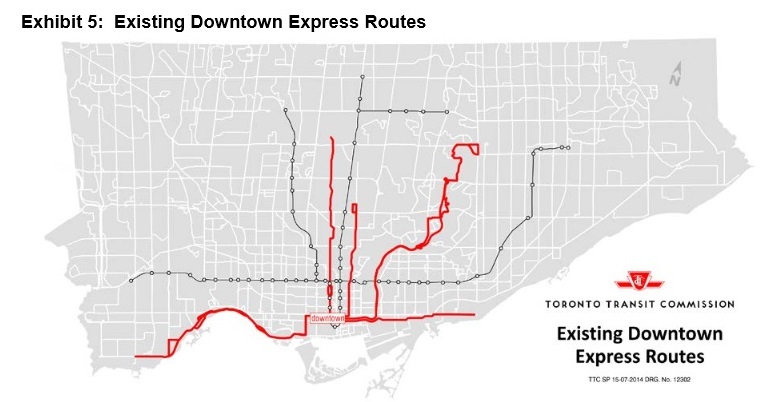
Second, the 14x Downtown Express routes would have improved service and would convert to a regular fare rather than the supplement they now charge.
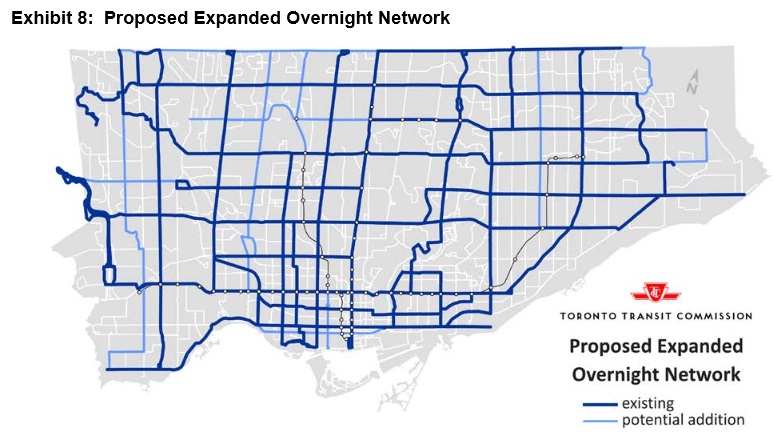
Finally, the Blue Night network would be expanded to reflect the growing demand for late night service and to fill in some gaps in the current network.
Time-Based Fares
The TTC makes limited use of time-based fares, in effect making a transfer a pass good for two hours, but they now propose making this the standard system-wide. This will accomplish several things in one move:
- All fares, be they monthly passes or single cash payments, will buy unlimited travel for some period of time without regard for the niceties of rules about transfers, stopovers, and riders who give up and walk only to be overtaken by a vehicle.
- Riders whose travel requires multiple short trips will no longer be penalized compared with long-haul commuters who get the same amount of travel for one fare.
- There will be no question of whether a “transfer” is valid as this will depend only on the time “stamped” on it either in ink (for a hard copy fare receipt) or in their fare card.
- The Presto system will not have to “learn” about transfer rules and its implementation as a time-based scheme will be greatly simplified.
- When integrated regional fares arrive, the “two hour fare” can be valid across boundaries.
Improved Operations in Traffic
Two changes are proposed to improve transit vehicle flow:
- Additional Transit Signal Priority (TSP) with the rate of installation being doubled from the present 40 sites per year to 80.
- Provision of “queue jump lanes” at busy intersections where right turning traffic can interfere with bus movements.
TSP has been around on some routes, notably the streetcars, for many years, although the degree to which is kept in working order is open to question. Two important questions need to be asked about “priority”.
- Should transit get priority even at intersections where there is a strong demand in the cross-direction and every available second of green time needs to be available to any traffic that can use it? Nearside stops can actually waste green time by holding traffic while a transit vehicle serves the stop.
- Should TSP be designed not just for “standard” operations, but have support for unusual conditions such as giving left turn priority to diversions and short-turns, not just at a few locations where left turn movements are scheduled?
Queue jump lanes have been on the TTC’s wish list for years. They are specific to bus routes, and can only be implemented where there is space to widen the approach to an intersection. This layout may not fit well with others who design for cars, cyclists or pedestrians. A related issue is that these lanes require dedicated space 7×24 even though the problem they address may only exist for a few peak hours.
The Need for More Vehicles
Some of the proposed changes do not require any additional peak vehicles, but a few do, and this brings us to a debate about how the TTC should address growing peak demand in the short term, even without any new service policies.
On the bus fleet, the report notes that not only are more buses required, but also the new McNicoll Garage where they can be stored and serviced. To its credit, the report does acknowledge that a short-term alternative might be possible:
“Many of the initiatives could not be implemented until the TTC buys more buses and streetcars, and has the facilities to house and maintain them. Alternatively, shorter term and off-peak improvements could be made through leased maintenance and storage facilities. Immediate approval of these initiatives by Council would allow the TTC to proceed to procure and construct these prerequisites on a fast-track basis.” [Page 3]
It is unclear what the need for more storage has to do with off-peak service, but there is certainly the question of leasing space for some short-term overflow pending the availability of McNicoll Garage. However, the TTC seems to be double-counting that garage here both for policy-based service improvements and for McNicoll’s original intent, the ability to expand the fleet for additional demand.
What is missing from the proposal is an integrated view of requirements both due to “normal” transit growth, and the additional needs brought on by the new policies (including any induced peak ridership). In other words, is McNicoll Garage enough, or should the TTC be planning for a second new garage? How do future rapid transit lines (whatever their technology) affect long-term planning?
Similarly, some peak period streetcar improvements are said to require some of the 60 new streetcars proposed, but not yet funded in the “below the line” Capital Budget. The real issue for the TTC, short term, should be how long it will keep its CLRV fleet in operation in parallel with the Flexities to supplement service while the Flexity Fleet builds up and represents a real net addition to fleet capacity, not simply a trade-in of old vehicles for new.
There is no mention of the additional vehicles that will be required for the Waterfront services should construction of the eastern line be advanced.
The Continuing Need for Standards
The report proposes that bus routes be scheduled to be less crowded and presumes that they will continue to have some level of productivity. What is missing is any cutoff line by which new services such as express buses would be compared to the regular service. Does The Beach, for example, get a regular fare express bus just because the route is already in place? How many parts of the city should get parallel express services while others must make do with their “ordinary” bus routes?
If new buses are to be ordered and garages built to house them, should this capital cost go toward more “regular” service, or should it be concentrated on express routes to downtown? How will the TTC decide to allocate new vehicles and operators?
Conclusion
This report is a long-overdue overview of what Toronto’s transit system could be, advocacy for the riders who are here today and may be attracted in the near future rather than being driven away with indifferent service and calls for lower costs and “efficiency”. There are details to be debated and priorities to be set, but the basic idea is sound:
Treat the transit network as something that needs system-wide improvements, not a quick fix here and there where residents can get politicians to take an interest.
Toronto is in the midst of an election campaign where candidates are preoccupied by drawing rapid transit lines on maps. For most candidates, the surface system simply does not exist even though without it, most riders would never reach the subway lines some are so eager to build. Surface transit has been strangled by an administration that values tax cuts over the quality of service and clearly feels that transit users are a coddled, oversubsidized bunch.
When this report comes to the TTC Board for debate, there will inevitably be claims that this is a policy for candidate X or a repudiation of candidate Y. There may even be some factional jousting to defer this report so that it does not officially become part of the record with a TTC recommendation attached.
That would show just how little some politicians care about transit riders.
This proposal is a plan to improve transit for everyone, and it should not be claimed as any candidate’s exclusive property even though aspects certainly overlap elements of some platforms. Transit is too important an issue for good ideas to be held hostage to party colours, for a “red” idea to be dismissed out of hand by “blue” supporters.
Toronto deserves a Council debate that will address head on the basic question “Where is my bus” with an answer that does not involve yet more doodling on the rapid transit map of decades to come.
 Steve Munro
All routes all day… does that mean 24/7 service on all routes beyond the blue night services?
Steve: No. “All day” service means same or similar hours to the subway.
LikeLike
Reading the proposal, this seems to be a rehash of the transit city bus plan along with fare policy proposals. While the goals seem laudable, I wonder if it is feasible given the problem with the hybrid buses, the need for buses for streetcar replacements and additional Metrolinx construction (e.g. Sheppard and Finch LRT), and the need for McNicoll garage to be complete on time. If the bus fleet was not so stretched as it is now this plan would have been easily implemented.
P.S. They should name the frequent bus network as “Transit City phase 1”, just to spite Rob Ford. Let Transit City phase 2 be the LRTs that come from the frequent bus network.
Steve: This may be a reprise of earlier proposals, although there are changes here and there, but the important thing is that they are here as a package, not a raft of one-of requests or pet projects. Yes, the bus fleet is a challenge, but do we simply give up?
LikeLike
They forgot about expansion of the streetcar network. For example, extending the 512 St. Clair streetcar from Gunns Road (Keele) to Jane/Scarlett.
Steve: That was intended to link the “city” streetcar system with the “Transit City” LRT system. Jane LRT is not exactly top of the list, and in any event with the gauge difference, the point is moot. I can think of LRT extensions we need sooner than St. Clair West.
The whole point of this proposals (as it was of the Ridership Growth Strategy) is to do things that make a difference “now”, not in some distant future after billions in capital construction have been approved and completed.
LikeLike
If the TTC wants to significantly improve bus service, it needs to fix the issue of having only a limited number of north-south buses go north of Steeles and the high extra fare. I realize that this would need more funding from York Region Transit (or funding from the province), but this is one of the biggest annoyances with using the TTC bus system right now.
This is far less of a problem at the western and eastern boundaries of the city, because there are fewer routes crossing these boundaries, the Mississauga/Brampton routes tend to be more frequent and DRT now has route 900 connecting with UTSC. However, it would be useful if Mississauga route 22 were consolidated with TTC route 36, or if the duplicate Mississauga and TTC routes on Bloor and Burnhamthorpe were merged.
Steve: The two separate fares exist eiter side of Steeles because in York Region, those are York routes, not TTC, no matter the colour of the paint. When we get a proper regional fare union (something the move to a time-based fare will make simpler), and properly fund services, then this will be a non-issue (as will cross border ops by TTC and MiWay.
LikeLike
Amazing, not at all what we’ve grown accustomed to seeing lately — more like what we see on this site. It’s not ghost-written by you, Steve, is it? 😉
Steve: I had nothing to do with writing this report, although I applaud its existence.
LikeLike
VERY exciting news and not, I hope, only coming up now because there’s an election coming. On the ‘2-hour pass’ they say:
I cannot really see how they could NOT move to a “short-term pass” when they are moving to all-door boarding. Policing all-door-boarding will be hard enough without trying to catch ‘criminals’ who have walked to the next stop. As the Report notes, ‘short-term passes” will greatly reduce customer/operator conflicts and be far simpler to administer.
LikeLike
Is this in response to Chair Augimeri’s motion back at the April 30 meeting? I thought that was voted down by the Stintz faction.
Steve: I think that there were too many initiatives brewing at the staff level to hold everything down to the new year, notably the full POP rollout. Also, some of the Stintz faction wanted any new policies to be part of the 2015 budget process, but that is already underway at the staff level and should be informed by detailed proposals from the TTC in advance, not as an afterthought to be put off to 2016 or later.
LikeLike
Now if only our mayoral hopefuls (Ford doesn’t count) transit strategies would sound like this.
They are all being strangled by polling (well except for Soknacki).
LikeLike
Two hour time based transfers? From the TTC? Really? People are having talking about this for years, and TTC management is only now talking about implementing it. I can’t believe they finally woke up and realized that this is the 21st Century, not the 19th.
LikeLike
On page 7 where it discusses the 10 minute or better network, the table shows a requirement of 2 extra streetcars and rolls that into the capital cost.
Would these be for Lake Shore West? (assuming the vehicles aren’t short turned at Humber Loop)
I also see King and Spadina on the list of potential 24 hour routes.
This report gives all the more reason to get out there on October 27 to get that idiot obstructionist MINO out.
LikeLike
It seems that in certain cases they just drew lines on a map.
For example, a Blue Night bus on Allen Rd/Dufferin from Wilson to Steeles — what is the point of that? There is absolutely nothing on Dufferin between Finch and Steeles and on Allen Rd between Sheppard and Wilson and only a few houses between Kennard and Finch. If the route went on Faywood or Wilson Heights then it would be a different story.
Steve: The report is clear that the final design of the various networks would be subject to consultation with Council. That’s where things like this should be fixed, provided that the local Councillors can get their head out of subway fantasies long enough to think about the issues.
LikeLike
Some big developments are being built or proposed for parts of downtown with significant walks to transit (West Don Lands near the river) or with a long wait for higher order transit (Portlands south of rail corridor). This would be a significant challenge even without the need to bolster transit elsewhere.
LikeLike
Oh, these TTC-proposed Widespread Service Improvements sound so wonderful. Fine, that is what management wants to deliver, but can they? Sounds expensive. Where is the money coming from? Certainly not from the current City Council, but maybe from the next one if it is truly transit friendly? Plus, generous operating subsidy improvements from the newly re-elected majority provincial government, and the federal Conservatives in an election year?
I do not mean to look a gift horse in the mouth, but I would like to point out a teensy disappointment.
My main like about the improved service is the 10 minute service plan. (The two hours unlimited travel ticket is great, too.) However, looking at the map on Exhibit 3, you see a big empty area in the mid-town. No ten minute surface service on Yonge, Bayview, or Leslie on the north-south, and east-west no such service on St.Clair-Moore or Lawrence, though Sheppard has the subway with closely-spaced stations.
Myself, though I live in Bolton, my City of Toronto base of operations is with family in North Toronto, about half-way from Eglinton to Lawrence and from Yonge to Avenue Road. Sure, a tony area, but very poorly served by transit for an area that has a lot of pedestrians and transit commuters.
Yes, the subway zips by, but I cannot walk as far as Eglinton or Lawrence stations with my feeble legs. No station in the middle like the Spadina line has. The buses are supposed to be every 15 minutes, but often I am waiting half an hour.
I am not asking for another Glencairn station on the Yonge subway line, but I would certainly appreciate better Yonge and/or Avenue bus service. The way it is now is pathetic, an afterthought.
Here is an offbeat idea: put a streetcar on Yonge. Perhaps from Bloor to Wilson, for example. Yes, there was one sixty years ago, and the subway rightly replaced it. But as time has gone on, the subway is no longer sufficient. We need better surface transit in this area. And this would do a lot in relieving the crowding on the subway, as well.
Steve: Although I think a streetcar is overkill, I do agree that the surface routes doubling the subway do need better and more reliable service. Those 2km station spacings are real killers. Also, it is surprising that Sunnybrook Hospital isn’t on the 10-minute network. It is right in the middle of the transit desert you describe.
LikeLike
WOW. This is nirvana. And it would cost only a fraction of the cost of building unneeded subways on low transit volume streets. It could help people now and not in the future,
One comment you made resonated with me. When you talked about crowding that is too much for functionality resulting in delays unloading (alighting as the British delightfully call it) and loading, I think of my recent transit experience. As an overweight person, I have to manage my location on the bus or streetcar to make sure I can make it to the door at my stop. It means that I can’t “move back” if the crowd to the rear doors means that I couldn’t get to them in time. That means I have to hang around at the front – in the way – adding to the disfunction of an overcrowded vehicle. Even then – especially on the Orion buses – I sometimes have difficulty getting out.
I really only travel off peak and do not appreciate that 90% of daylight weekend trips on the bus and streetcar seem to be “rush hour” crowded. As you have pointed out many times, there are vehicles available during these times. The reason we suffer from inadequate service is because the TTC (really The City) does not provide sufficient service.
LikeLike
Four wasted years. Four years penny-pinching years, resulting in reduced service on the TTC. In 2009, the Transit City Bus Plan was presented, but not forgotten. That plan was not “archived” or worse, “deleted” from the TTC website. Its still there, available for download for everybody to read.
Some of those suggestions have been partially implemented. However, most have been waiting for better times.
The new report has re-presented most of the original Transit City Bus Plan’s suggestions. However, it also added some new suggestions.
Will the TTC actually implement them? I hope so. Maybe the current administration will become cowards and delay it. They should become brave and support it. Hopefully the next administration will turn their backs on the old, and actually implement them.
LikeLike
There are a lot of interesting ideas. I would note that the majority of the new express routes are north south, potentially shortening east west rides and offering some riders alternatives to the busiest subway route. Some of the ideas such as improved transit priority, and queue jump lanes offer real opportunities to improve the efficiency and effectiveness of transit. If there was a better route management system, and spots for buses to hold for headway, overall headway performance could be raised even more.
To really get best use of the surface fleet means making sure that these vehicles can make the fastest trips, and be most attractive. This means dwell times need to be shorter, so better loading standards. I would suggest that overloading, also increased run times by more than the extra load would justify, which will result in an overall reduction in operator efficiency as well as a less attractive service. I would suspect that the TTC is either near or past the point where increased loading of vehicles on a single trip, actually increases their overall carrying capacity over a reasonable period of time (say 2 or 3 hours). This would mean a small improvement in headway management, and a moderate increase in fleet size, would bring a disproportionately large increase in service and capacity. Some of this will be lost in that it cannot be matched on the subway. If only there was a corridor to the core that could be dedicated to transit.
If the improvement in terms of signal priority is really fully implemented, it may further this general idea. Then when additional buses and new streetcars appear, the benefits may be out of keeping with their numbers and theoretical capacity.
I would say that the idea of squeezing more out by pushing more riders on the same number of buses may actually be reducing efficiency. The city needs to push first for better route management, signal priority, and general service reliability. Improve service and reduce the loading standard, then gain efficiency through increased ridership that comes with faster, more comfortable, and reliable transit.
LikeLike
This is exciting. A system as vast as the TTC faces a huge challenge in trying to be everything to everyone (well at least to every passenger) … so a focus on building customer service is much appreciated.
I’m pleased to see distinct maps of the different networks proposed … something I’ve been wanting to see for the past few years. On the whole, distinct maps (and information breakdown pathways) that showcase the different services the TTC offers will help passengers choose the TTC “network” that works for them.
Admittedly not everyone will have the option of (or access to) multiple TTC network with which to make their trip,but if the base (All-Day Everyday) network and the 10 Minute (Frequent Service) network are reliable then the majority of people’s needs will be met, and the Subway/RT/LRT /BRT (ok let’s just call it Rapid Transit) and Rocket networks will be an added benefit.
If the TTC wants this report to be successfully received by the Board and acted on by Council, they need to promote it to the public and councillors, focusing heavily on the benefits to passengers (and any possibility of congestion reduction for non-users) and the plan to make it happen.
The quiet conversion of E-branch routes to Rocket Buses, for example, could be used as an example of how the new service plan will improve things for passengers … but promoting future conversions as being part of this Service Plan would probably help gather more support from the public. The same can be said for expansion and promotion of the Frequent Service network.
This being Toronto, there will be a lot of criticism too (much of it unjustified) and I hope the TTC will look at the RGS and TCBP and see what didn’t “work” within those plans, and make sure the new plan has a better chance of success.
Cheers, Moaz
LikeLike
I’ve noticed in the Opportunities to Increase Transit Service in Toronto report an interesting aspect. That is the use of quotations around “Scarborough Subway”, unlike the other projects such as Eglinton-Crosstown Light-Rail Line and the Finch and Sheppard Light-Rail Lines.
Seems to me that the TTC are dragging their feet, so to speak, and maybe considering that the “Scarborough Subway” is not a firm project and could be very subject to change.
Steve: I would not go that far. All other projects have official names, but the Scarborough extension of the BD line does not.
LikeLike
I’m a little surprised, though pleasantly so, to see a proposal like this come from the TTC itself, mostly due to Andy Byford. I remember when he was first appointed that it seemed like a breath of fresh air – he spoke important truths and seemed to echo much of the sentiment on your (excellent) blog, Steve. But then I kept reading your summaries of board meetings where the CEO’s report continued to have obviously substandard reporting, poor metrics for service standards, etc. Seemed at times like he talks a better game than he walks. I haven’t been able to form a solid opinion of his performance as CEO yet.
Obviously this report wouldn’t have seen the light of day without Byford’s go-ahead, so hope remains. Any insight into how much his best intentions are hamstrung by politics, and even small changes like headway management seems to be stymied. Any insight into the glacial pace of change, Steve?
Steve: The replacement of Karen Stintz as Chair certainly moved us away from a need to defend the service cuts she introduced and the general penny-pinching attitude to transit of the Ford administration. How this report fares at the TTC Board and later at Council remains to be seen, but I can’t wait for all the doublespeak we will hear from mayoral candidates who are willing to spend billions on rapid transit (with taxes to match), but are pikers when it comes to day-to-day service.
LikeLike
Here is an idea for an express route. Why not implement a route that would follow the exact routing and stoppage along Eglinton from Kennedy Station to Weston Rd. This would allow people to get used to the actual stop locations of the LRT and use this same concept for future proposed rapid transit lines. Just a thought.
Steve: “Express” is not the way I would describe traffic on Eglinton these days with all of the Crosstown construction. It’s bad enough that riding has fallen off on 32 Eglinton West and the TTC will reduce service there to compensate in September.
LikeLike
As an operator we’ve been asking for such things as 2 hr. transfers for years but have always been brushed off. Funny that it can work on St.Clair as a 7 yr “pilot project” and no complaints. They claim it will lose $20 million, but lost revenue through people not paying a fare and causing a dispute is more of a pain than having a transfer that says it expires at a certain time. Can’t argue with a clock. I’ve worked on St.Clair doing shuttle work and the system is great.
LikeLike
It would appear that the TTC management and board are approaching the notion of advocacy again. Either they believe that there is more to be gained from doing so than lost, despite the firing of a previous CEO, or the people behind that firing are seen to have lost their teeth, and not perceived to be in jeopardy or regaining them. I this is a correct read, or they succeed in moving the debate it should be a real lift for the TTC.
Steve: A challenge with an unreceptive political environment arises when management takes an attitude that “we can get by, things are ok” in the face of advocacy for improvements. Some times, this is little more than ass-covering for their political bosses who don’t want to address the issues (financial, policy) about the role of transit and what it should strive to be. With this report, the TTC puts all of the new Council and all candidates on notice about what is really needed, and the ideas can’t simply be dismissed as the ramblings of bloggers or “special interest groups”.
LikeLike
The other thing of course about a return of the TTC to this type of advocacy, is that perhaps they can start to actually be the one that is framing the debate with regards to the extension, and intensification of their network within Toronto, and how it is connected to the areas beyond.
This would be a critical change, especially if they are prepared to adopt LRT and BRT as a regular part of their tool chest. I suspect that a couple of LRTs with relatively short tunnels, along with BRTs would make a huge difference, but the planners and engineers need to lead the debate, not follow it.
Steve: It is amusing that we hear politicians talk about the need to let the professionals do their work unimpeded, and yet there is always a hint that this really means “build the network I want”. The moment a “professional” contradicts his political boss, wait for an outside consultant to appear, or for the pols to simply say “don’t confuse me with facts, this is what I want”.
LikeLike
It is intriguing to see just how helpful Presto can be in implementing all these fares. On board fare issues are relegated to a computer, far away from ticket collectors and operators. Riders can examine their recent riding history on line which will likely resolve most queries quickly.
I think there may still be a case down the road for a short ‘zone 1’ (downtown) one ride fare, Presto only, at say $2.00 but that can be implemented thru Presto later.
Steve: I would argue that a “short trip fare” good for, say, 30 minutes, would achieve what you want without the hassle of selling a “downtown” fare. Problems would remain in the suburbs just because trips tend to be longer.
There are huge advantages to getting Presto adopted by riders, and to achieve that, Presto discounts are essential. Even raising cash fares substantially while holding Presto at current token prices, will quickly encourage Presto adoption. London buses used to charge GBP2.00 for a ticket from curbside machine and GBP1.00 by Oyster (I think it is now 1.40). A substantial difference!
Steve: Another important change will be the disappearance of the “cash” fare and a consolidation into one “single ride” fare that buys two hours of transit. It will take some time to achieve this because TTC finance folks are absolutely wedded to the cash fare, a “cash cow” that disproportionately hits riders who don’t pre-buy multi-ride media.
Yes, getting in or out of an overcrowded vehicle takes time. I watched a King car take four light cycles to get past Bay, what with people trying to get on at front despite no space, and others on steps at rear refusing to get off so doors can close. Needs speakers at each door to announce ‘doors closing’ with operator able to speak also! Perhaps the new cars with flat floor and non hinge doors might help this.
Regular fare on downtown express busses! So much sense. Next up: a more comfortable vehicle!
Even with TSP, streetcar turns downtown still take an age, and an ‘enhanced TSP’ might stop the whole intersection, pedestrians and all, with say flashing blue lights, to expedite a streetcar through. It should apply to frequent diversions/short turn routes also such as Church. It would likely make car drivers happy too since it would be done in seconds instead of a whole light cycle or more currently.
Steve: The white bar call-on signal, now used at some locations such as Broadview & Queen eastbound, will do exactly what you want — provide a streetcar-only phase. The pedestrians don’t always notice, but at least this stops conflicting auto movements.
Why is it that far side stops seem so obvious but implemented so rarely. Instead of waiting for a streetcar to stop near side, then extending the green, the traffic light controller could be informed of the streetcar’s approach when it left the previous light/stop, plenty of time to adjust the cycle to expedite the car through, even without stopping, and even allow time to clear traffic in front of it. Even with very busy cross streets, this would minimize the time taken out of the cycle for the transit vehicle, a win for both.
Steve: Far side stops are a challenge on streetcar routes where there are no loading islands. Among other problems, they would cause traffic turning off of the intersecting street to be blocked because the streetcar and passengers would occupy the outgoing lanes. This could block the entire intersection.
Ideally, the traffic signal should have a way of “knowing” whether a streetcar needs priority “now”, or “later” after serving the stop.
LikeLike
The all-day everyday map shows Redpath Ave to already have off peak service. How’s THAT possible?
Steve: Maybe they have extended the hours of the Mt. Pleasant Express without telling anyone. It loops via Redpath.
Also, OC Transpo has had one fare lasting almost two hours for years. It’s very popular. It also allows seniors to ride free on Wednesdays.
LikeLike
It is good they are bringing out a comprehensive plan at this time. However, much of it smells like the RGS Ridership Growth Strategy which was an excellent plan. Unfortunately, it went nowhere. A long time ago I sent in a suggestion RTTT which while not very fancy simply stood for Reduce Total Travel Time. In it I suggested in off-hours buses running 15-20 minutes headway or worse have MANDATORY transfers with all routes. In other words stop and WAIT for the other bus which I often noticed myself came along within a minute or two or even five and you miss it only to have to wait in the cold and wet 20-30 minutes or more. Even if this resulted in slower service on a route the TTT would be less for everyone making a transfer.
Of course if we actually get this 10 minute service there would be no need to hold a bus for a transfer.
I also suggested the popular “time expired transfer” in use elsewhere.
What I don’t see in this new plan is any mention of MANAGEMENT. There are far too many drivers keeping their own schedule and the only way to control this is with on-the-street management. This can be done without any cost. A new position would be created as an entry level supervisor (non-union) position. A “starter” would be placed at terminals and at key transfer points. No car or bus could leave without his/her signal. I would reduce one driver position to pay for this. If the union members cannot follow the rules they loose.
Multiple buses going through an intersection should be prohibited if there is a bus bay to wait in for the next signal. Nothing more annoying to be standing on the other side of the street to see 2 or 3 buses half empty going through on the same light then you have to wait “forever” to get a ride because the last guy was “sharp” (ahead of time). There can be many reasons for a bus to be late. There is NO excuse for a bus to be ahead of time.
An annoyance is riders who insist on exiting the front doors prohibiting people getting on and missing the light. The stupidest ones are in the rear, walk past the rear door to get off the front door and the walk back past the rear! Idiots! I suggest manually open rear doors to show these morons there is another door that works!
Strollers are STILL not being dealt with. SUV sized ones plug up the aisle, pay nothing and block multiple seats. Buses have lift up seats, newer ones two sets, at the right front. These should be in UP position as normal. Stroller goes there and aisle is clear, Simple. Recently I rode a bus between rush hours and watched as a long double stroller blocked three seats behind the driver with person sitting there also taking up another seat (remember ONE fare). Shortly a young woman got on with a nice little stroller and could not get down the aisle. She stood right at right front blocking the aisle 90%. Person after person struggled to get past. All the while the entire right front seats were empty! The driver could see the problem and did nothing. He should have gotten up and lifted the seat. In fact he should have done this with the first oversized stroller. People don’t all know this is possible. I am sure she was embarrassed by this but could do nothing. When we arrived at the subway I spoke to her explaining she could unlatch the seat herself. She did not know this as it was her first time to take her young daughter on a bus.
Seniors get the opposite side seats coloured blue.
Lots remains to be accomplished.
LikeLike
I don’t want to flog a dead horse again, but what about the idea of rearranging the seats on the buses (removing the double-rows from the rear section and making them all inward-facing) to accommodate more passengers?
I looked up STM’s bus capacity, and they claim a capacity of 65 with their low-floor buses. That’s a huge improvement over the TTC’s crush load of 55. Even in their diagram, they only envision 2 people standing in the entire rear section.
Not only would it fit more people, but it would also be more accommodating to people in wheelchairs or with strollers. Whenever I try to board the Wellesley or Sherbourne busses, there’s always a stroller that’s blocking the aisle and making it even harder to use the space efficiently.
LikeLike
The politicians should be setting broad goals, like reducing congestion, tying in outer areas, balancing needs. However, detailed implementation in terms of meeting those objectives should be left to those who actually study the issues. There is more to the decision between various forms of transit than just speed and efficiency, however, the first pass, and the discussion then needs to centre around these somewhat less tangibles issues in the debate. LRT and streetcar provide a local visibility that subway cannot, and a sense of stability and permanence than bus will not. These are valid points of argument that can be made in terms of a wider planning environment.
The debate has to be beyond the lack of familiarity that the public has with the choices to be made. This is the basic reason why we are supposed to have professionals who specialize and representative democracy.
The expert opinion on transit suggested the idea of LRT in Scarborough in the 1970s, and if so implemented, I suspect today transit in Scarborough and Toronto generally would look very different, with likely many more rights of way, and more planning choices that would have supported exclusive transit rights of way.
Toronto needs to step back, and allow a broad imagination to work. Also this needs to be applied to both the city proper, and the areas beyond. We cannot think the areas beyond can be excluded from professional planning, and have a non-politically driven solution win the day. We need to either return to the days of when the Metro government was formed, and the greater region was considered, or the province will need to dominate transit planning in the area.
LikeLike
Miscellaneous comments:
Two hour fares have been successful in places (eg Hamilton) where they have been implemented. I predict equal success in Toronto.
Kevin’s comment:
And just who is it that pays so much extra for cash fares? Yes, it is disproportionately poor people. It is time for this regressive fare strategy to go.
LikeLike
If most of the buses are in-service during the day, they only need parking in the middle of the night. Why not just park them on the street when the roads are empty?
Of course, you could also lease mall parking lots during times when the mall is closed.
LikeLike
Kingston Road and Lake Shore Blvd. W. to get 10 minute service interval during the mid-day? Does that mean the 502 Downtowner will actually see an increase from its current 16 minutes to 10 minutes? Ditto for the 501 west of the Humber?
We’ll see. We’ll see. We’ll see. (Have to say things three items these days to make it happen.)
LikeLike
It still leaves the issue of servicing the buses. However, I think that the city needs to start looking at more ideas like this. Could you arrange a similar idea with an industrial mall nearby where you could lease the space to service the buses, and then move to a mall for parking. The other questions are how long would be need to take this approach, and how many buses in each area are we needing to do this with really.
If you could find room for say 200 additional buses would that be enough to have a large enough impact even this year. You would likely need to match this type of growth again every other year. Is a reasonable fleet target not about 400 buses more than the current within a couple of years? (then a growth of about 100 buses a year thereafter?)
The idea of having additional smaller spaces to service all these buses dispersed around the city is interesting. Might improve time to getting into service, but would it not represent dramatic change in operations?
Steve: The time getting into service is determined not just by the location of the buses, but also of the operators. A simple parking lot is not going to have an office for operators to report and be despatched, and they are likely to travel from a nearby division office. An example of this can be seen with the tempoary storage of cars for Roncesvalles at Exhibition Loop with a bus shuttle to ferry operators to and from the division.
LikeLike
Buses don’t just need parking. They need refueling, and cleaning, and maintenance….
The express buses: currently, TTC’s express routes pick up people far from a subway line, then run non-stop until they reach the subway line (and vice versa). This is great for people going to the subway, but less useful for trips generally perpedendicular to the subway. I’d like to see more ‘express’ routes with stops only at major arterial roads (or major trip destinations) to facilitate the longer cross-city trips.
LikeLike
It would be good if the TTC (or Toronto OpenData website) published a list of intersections with the type of transit priority (and their operational status) … this could be useful for analysis and prediction purposes (as well as keeping them honest about the state of the transit priority). Especially if they will be creating 80 a year it would be useful if this was updated on a quarterly or monthly basis.
LikeLike
Because we have a thing called winter which doesn’t restrict its precipitation to just daylight hours.
LikeLike
It’s not just residential areas that could use additional Blue Night service. I’m sure there are probably late-night shift workers in industrial areas like the northern stretch of Dufferin St. who would appreciate the service. Whereas I’m not sure how welcoming residential streets through Wilson Heights will be having a buses run at least twice an hour overnight. Other industrial areas with potential new service include Horner St. in south Etobicoke via a Kipling/Martin Grove route.
LikeLike
Steve, you’ve repeatedly documented the inability of TTC to get buses and streetcars to leave their garages on regular headways, and the consequent problems. This naturally prevents “ten minute service”, or indeed of any form of “X minute service”.
But … it seems that this report doesn’t even consider this as an issue to be solved. Is this an oversight? Does this issue have the attention of anyone in management?
Steve: The need for better supervision is there in the report, and this hints at the need for headway reliability. It will be interesting to see how the TTC tackles this.
One important aspect lies in the software specifications for a new automatic vehicle tracking system. The ability to easily monitor and manage headways needs to be built in, including a mechanism to advise an operator about their position relative to nearby vehicles, not just relative to the schedule. Centralized line management cannot work unless the tools to monitor and communicate with the operators are available, even if the best intentions exist in all staff.
LikeLike
I have wondered for sometime just how the TTC has managed to come up with a magical mathematical formula that allows them the calculate that time-based transfers will cost them $20 million, yet they can’t seem to come up with a similarly magical formula that can calculate how much they are currently using due to “creative” transfer use. The $20 million figure is meaningless unless it is reduced by that other number, that I suspect is at least $10 million.
One note about arguing with a clock. Vancouver has had time-based fares for years (only 90 minutes – which seemed fantastic when it was unheard of here, but after getting used to the 2-hour time in the rest of the GTHA, 90 seems awfully short). Back when the buses used paper-cut transfers, the time would be adjusted in 15-minute increments and an operator could give some leeway in some situations, such as when it was known there was a delay on Skytrain. At some point, they moved to a system where ticket users had their tickets franked by a machine when boarding and the system would indicate if it was still valid or not. Any discretion or leeway went out the window.
Two hour fares are the standard for ALL GTHA agencies on Presto, and was a requirement for signing on to Presto for them. Not only that, but one’s 2-hour fare is good on ALL agencies (except GO and the TTC). If I boarded an HSR bus and paid with Presto, then got off the bus and grabbed a ride to Pickering where I boarded a DRT bus withing 2 hours of the HSR boarding, Presto would treat it as a transfer and not charge me another fare.
It would be nice if this applied to the TTC, but I wouldn’t hold my breath. Though, in order to balance out the operational costs, other agencies would likely have to operate some routes into Toronto with full two-way operation within Toronto’s borders. For instance, YRT’s route 90 would be able to take on and let off passengers both ways between Don Mills station and Steeles and the TTC could reduce its operations on the Don Mills 25 bus north of Sheppard. This would likely have to be extended to provide a more or less equal sharing of cross-border operating routes.
LikeLike
George Bell suggests that the City (or TTC) should publish a list of signalised intersections with Transit Priority. The City do publish one which lists ALL signalised intersections and notes those with APS (Audible Pedestrian Signals) so I suspect the information on transit priority could fairly easily be added to this pdf. Of course the City would then need to ensure the transit priority actually worked!
LikeLike
Having lived in this area for years, I am not convinced that any of the factories in the Alness/Flint area have night shifts. Even if they do start times are typically covered by the late evening service with start time of 12/1 a.m.
With service on Sheppard West (proposed), Bathurst, Finch West and Steeles West (proposed), I think service on Allen/Dufferin isn’t needed. The 15 minute walking radius will be covered by the other routes.
LikeLike