
Updated October 2, 2013 at 12:30 pm:
Metrolinx has released a transcript of a press conference held earlier today regarding their letter to the City Manager about the Scarborough subway.
In related news, Metrolinx advises (through a separate email) that they are “approximately 3 months away from making [a] formal recommendation on Sheppard and Finch” LRT lines, and the possible acceleration of these projects.
Also, regarding Eglinton-Yonge Station, they “hope to have a final concept that Metrolinx, City and TTC agree on in the coming weeks and will present in the public session of the Metrolinx December Board meeting”.
Updated October 2, 2013 at 10:30 am:
Metrolinx has sent a letter to Toronto’s City Manager regarding the proposed Scarborough subway. Unlike some pronouncements from Queen’s Park, this takes a more conciliatory tone for discussions between Ontario and the City of Toronto. Notable points include:
- Metrolinx continues to believe that LRT “would provide an effective rapid transit solution to the transportation challenges in this area” within the available funding, but bows to the desire by all three levels of government to build a subway.
- Metrolinx is not dictating that a specific route be chosen, but wants a proper alternatives analysis as part of the Environmental Assessment. This contradicts earlier statements by the government implying that only one route was to be funded. It also implies that the shorter “Transit Project Assessment” process (which does not include the potentially embarrassing need to review alternatives) will not be used.
- The Province is sticking with a figure of $1.48-billion in available funding, from which must be deducted the $85m in sunk costs for the Scarborough LRT project and unspecified costs of scaling down the LRT car order from Bombardier.
- Although the $320m reserved for the Kennedy Station reconstruction with both the Eglinton and Scarborough LRT lines may not all be required, additional costs are expected at the Yonge-Eglinton interchange beyond the current project budget. Savings from Kennedy may be redirected to Yonge-Eglinton. If there is anything left of the $320m between the two projects, then it could be directed to the Scarborough subway.
- The Scarborough subway will be entirely a City/TTC project contrary to previous schemes for the LRT that would have seen provincial ownership and a PPP arrangement similar to that proposed for the Eglinton line. This begs a question regarding the accounting for the provincial funding contribution: if you don’t own the line, you can’t book the asset as an offset to the money spent on it. Does this mark a shift away from the creative accounting used to justify taking Toronto’s transit projects away from the TTC in the first place?
- Provincial funding will begin to flow in the 2018/19 fiscal year implying that no serious construction will be underway until then. The City and/or Federal government will have to front end the project with funding for the EA and preliminary engineering. All risk for project cost overruns will be to the City’s account.
- Infrastructure Ontario remains available to participate in this project, but this is no longer a requirement of the Province for funding. The decision on whether to use IO or to proceed with a conventional procurement (as on the Spadina extension) is up to the City of Toronto.
Not included in the letter, but reported through Twitter by John Michael McGrath, is a comment from Metrolinx that they are reviewing the timing of the Sheppard and Finch LRT projects.
This letter provides a more balanced response to Scarborough subway issue than some recent statements by Ontario Transportation Minister Glen Murray, and it is good to see Metrolinx acting as a reasonable broker rather than simply as a rubber stamp for ministerial musings. The next major step will be Council’s discussion of the matter at the October 8-9 meeting.
Updated September 25, 2013 at 10:30 pm:
Today’s TTC Board meeting was a procedural shambles when the time came to discuss the Scarborough Subway. The contentious name-calling and parochialism of some past debates lives on for at least one Commissioner, Glenn De Baeremaeker, who is so busy puffing up the importance of his own subway that he overstates his case. At one point, Councillor Josh Matlow spoke of the subway proposal as vote buying. De Baeremaeker did not take umbrage but Chair Karen Stintz did and asked Matlow to withdraw the remark. He refused and left the meeting as did another visitor, Councillor Carroll. Smug and over-confident do not begin to describe De Baeremaeker’s attitude which focuses on getting “what Scarborough deserves” above all other considerations.
Three sets of motions were proposed:
- The original recommendations of the staff report which asks that the Commission endorse the McCowan alignment for a subway extension from Kennedy Station to Sheppard.
- A set of motions by Chair Stintz:
- that the Commission continues to support LRT implementation on Eglinton, Sheppard East and Finch as per the master agreement with Metrolinx,
- asking that Metrolinx confirm their support for these projects, and
- asking that Metrolinx confirm that the Downtown Relief Line is the next priority for a subway project after the Scarborough extension.
- A motion by Commission Alan Heisey seeking a meeting between the TTC and Metrolinx boards to arrive at a mutually agreeable plan for future transit in Toronto.
- Commissioner Parker proposed an amendment that would have supported the original LRT proposal.
Some members of the Commission were uneasy with the large exposure for the City in future debt and the tax increases needed to finance the City share for the project. The “citizen” (non-Council) members of the Commission appear uneasy about the fact that they have never been asked to vote on the subway alternative until now, and as articulated by Commissioner Heisey, it would appear that their counterparts at Metrolinx have similarly been excluded from the debate.
When it came time for the vote the Stintz and Heisey motions passed easily, but Parker’s motion failed on a 2-9 vote. However, things came unglued on the main motion. Five Commissioners voted in favour, five against, and one, Nick Di Donato, wanted to abstain because he did not feel he had enough information to make a commitment to the subway line at this time. In this situation, the motion would have lost on a tie vote. Di Donato had not left the table, and so technically abstaining was not an option.
At this point, realizing what might happen, Chair Stintz called the vote again and Commissioner John Parker, who had voted in the negative, left the room to ensure that the motion supporting the McCowan alignment would pass unless Di Donato voted “no”. In the end, the vote was 6-4 in favour with Parker abstaining. This shows how divided the Commission is and how poorly support for the McCowan option was organized by the Chair before the meeting started.
In related news, some members of Council are swallowing hard to accept the level of taxation that may be required to finance the City’s share of the project. Some money will come from Development Charges, but the lion’s share, about 80%, will have to come from general tax revenue.
Meanwhile a Forum Research Poll shows general support for the subway, but splits along regional lines and relative to past mayoral support. There is some support for the LRT option, but the poll question specified a level of tax support for the subway considerably lower than what is actually required to finance it. Support for the subway is higher among non-transit users than transit riders.
The whole matter will be debated at Council’s October 8 meeting.
Updated September 23, 2013 at 8:20 pm:
Today federal Finance Minister Jim Flaherty announced that Ottawa would provide $660-million in funding for McCowan alignment of the subway as proposed by City Council, and reaffirmed funding of $333-million for the Sheppard LRT. This simply quantified the amounts available from yesterday’s announcement by the Prime Minister.
Also today, the TTC released a report comparing the Murray subway alignment via the existing RT corridor with the Stintz alignment via Eglinton and McCowan. Unsurprisingly, the TTC report endorses the McCowan alignment, although it does not go into much detail in critiquing the RT alignment.
A fundamental issue is that the provincial funding of $1.4b is inadequate for either proposal:
Neither the Provincial (RT corridor alignment) nor TTC (McCowan corridor alignment) subway option to Sheppard Avenue estimated at $2.9 billion and $2.5 billion ($2010) respectively, are achievable within the current Provincial funding envelope. Even when the options are truncated at Scarborough City Centre both Provincial and TTC options estimated at $1.7 – $1.9 billion and $1.9 billion ($2010) respectively require additional funding. [Page 1]
Much of the history of these proposals and related correspondence has already been reported here. The TTC notes that there is an outstanding request for information from Metrolinx regarding:
- Ridership projections for both Provincial options;
- Average operating speed and trip time for both subway options;
- Location of the bus terminal;
- Walking distance from the TTC bus terminal and GO station to the subway platform; and
- Any other advantage of this proposal over the TTC proposal. [Page 4]
Minister Murray has claimed ridership for his proposal equal to the number cited by the City and TTC for their scheme, but the latter depended on the route going all the way to Sheppard. As with other claims for his proposal, Murray selectively quoted full-line benefits for his truncated subway scheme ending at STC.
The TTC notes that curves on the Murray line would impose speed restrictions that would add to travel times (not to mention fleet and operator costs) and potentially be a source of wheel squeal that could annoy neighbouring residents. The tight curves would also lead to faster rail and wheel wear. However, the TTC’s estimate of fleet requirements for the two proposals appears to be based only on the length of each option, not on any speed restrictions.
What the TTC does not address is the fact that the Metrolinx consultants claim to have used TTC specifications in their design. Either this was done erroneously, or less than ideal specs were used in good faith for the proposed design. The TTC needs to set out specifications that anyone (Metrolinx, say) should use in designing any future subway lines. This is not a trivial issue given the likely wandering nature of a new Downtown Relief Line (or whatever it is called).
The TTC is concerned about the design of the new Kennedy terminal and how transfer moves between buses and GO passengers and the subway would be affected. This is a valid question especially if the importance of Kennedy as a hub increases. Although RT trips will be diverted onto the subway, much of the bus traffic will continue to arrive on existing routes and the convenience of their transfer connection is important. Equally, if GO improves service on the Stouffville corridor, this connection also should be a convenient one.
Other effects of the project both during construction and under operation include:
- A three-year shutdown of the SRT for the construction project, plus an unknown shutdown of the east end of the subway during the cutover from old Kennedy Station to the new one.
- A more intrusive elevated structure for subway trains which are wider and which require longer platforms at stations.
- The combination of open-air track and steep grades could lead to problems during bad weather, notably icing, and also have issues with wheel slip due to leaves. This is true to a point, but the system already has a comparable area north of Rosedale Station. This can be a problem for TTC operations, but only under the worst of circumstances, and far less often than the annual SRT shutdowns thanks to power and reaction rail icing. It is worth noting that the same problems would have affected an LRT line in the same corridor, but the TTC was silent on these issues.
Cost comparisons are provided for both the RT and McCowan alignments for Kennedy-to-STC and Kennedy-to-Sheppard options. As previously reported here, the Metrolinx study omits several key items such as vehicles to operate the line, and the total value of these is estimated at roughly half a billion dollars. All costs here are only order-of-magnitude given the lack of detailed study, and a variation of $100-million (roughly 5% on the total project) is considered a wash.
If the line runs only to STC, then the RT alignment is slightly cheaper than the McCowan alignment, subject to detailed review. However, for the line continued through to Sheppard, the RT alignment is more expensive because it is longer and has more stations.
               Kennedy to            Kennedy to
                  STC                 Sheppard

Via RT           $1.8b                 $2.9b
Via McCowan      $1.9b                 $2.5b

Source: Table on page 24 of pdf, page 12 of slide deck.
It should be noted that the RT alignment pays the considerable penalty of replacing Kennedy Station, and the costs would be quite different without this factor.
For either alignment, construction will not start until 2019, no matter what Minister Flaherty said at today’s press briefing.
The main report is followed by a slide deck that will be used at the TTC Board meeting on September 25. This deck includes information and raises issues not included in the main report. It acknowledges that the RT alignment has well-sited stations, is beneficial to Centennial College and improves opportunities for a mobility hub at Kennedy, but warns that these factors are offset by the design issues and service shutdown requirements detailed above.
The table cited above also includes an estimate of the number of trains that would be required. For the TTC’s option, the count is 7, and this is in line with previous estimates I have given here that only half of the service would run through to Sheppard. (A 15.2km round trip at 30km/h is about half an hour’s worth of trains. On a 2’20” headway, this would require about 13 trains. Therefore, the TTC may be planning to run only half the service beyond Kennedy Station.)
However, if only 7 more trains would be used compared to existing service, these can be accommodated within existing storage facilities and the allowance of about $200m on that account is not required. It is unclear whether the number of trains is relative to the existing service level or to the existing T1 fleet of which the TTC has a surplus. This is an important distinction that will affect the project cost and scope.
Finally, a question for the McCowan alignment is the location of the new STC station. As shown on the maps, it is actually at McCowan, not in the STC itself. The TTC should examine alternate alignments veering west so that the station could be better connected with existing and future development at STC. Although the details would be something for an EA/TPA study, the issue should be openly acknowledged as part of TTC and Council debates.
We now await word from Queen’s Park on whether they are firmly resolved to build on the RT alignment, a posture that would guarantee a head-on collision with Ottawa and City Council, or if the province will return to making its funding available to a generic “Scarborough subway” project. A related issue is the amount of the holdback for the Kennedy Station adaptation for the LRT project(s). Now that the LRT-via-RT line is not part of the design, the projected $320m cost for the combined Eglinton/Scarborough LRT station at Kennedy should be reduced, and this should release additional provincial funding. This is a question that must be answered as part of whatever provincial response will come to today’s announcement.
Updated September 22, 2013 at 9:45 pm:
Today Prime Minister Stephen Harper announced that the federal government would provide funding in an unspecified amount to the proposed Scarborough Subway. At the announcement, a map clearly showed the McCowan alignment with stations at Lawrence, STC and Sheppard. Needless to say, Mayor Ford is ecstatic.
Further details will come in a press conference to be held tomorrow by Finance Minister Jim Flaherty, and there will also be comments from Premier Kathleen Wynne.
A few observations at this point:
- Toronto Council’s motion clearly set September 30, 2013, as a deadline for a response from other governments on funding the proposed McCowan alignment. Ottawa has met that date with a week to spare.
- Ontario Transportation Minister Glen Murray’s ham-fisted “I’ll do it my way” announcement of a subway via the existing SRT corridor was guaranteed to provoke a response from other potential funding partners. Rather than showing how Ontario might built a transit network in Scarborough, Murray chose to focus on one line, and a truncated version of it at that. Even if Ottawa had been delaying in offering funds for the McCowan alignment, Murray’s action and political rhetoric guaranteed a tit-for-tat response.
- Queen’s Park is now in a position of backing and funding only one version of a subway line, and rejecting out of hand any idea that the $1.4b previous available for a Scarborough project might go to the McCowan scheme. Now, they are left not only with a subway proposal that cannot be built for the price claimed, but are potential deal-breakers for the McCowan alignment.
- Prominent at today’s announcement was a map showing the Sheppard East LRT line, a route that Mayor Ford would love to convert to a subway. That this happened at a federally organized press conference and with Rob Ford standing right beside the sign (see CTV news coverage) suggests that the LRT scheme isn’t dead yet. Ford no doubt awaits the election of a Tory government at Queen’s Park to deliver the coup de grâce. It will be interesting to see whether Metrolinx puts this project on ice, and what position Toronto council takes on LRT for Sheppard at its October 2013 meeting.
Toronto Council needs to contemplate several important factors if it opts for the McCowan alignment:
- Are any stations to be added, or at least protected for, notably one near the turn north onto McCowan?
- How close to the centre of STC should the subway pass? Should the station be under McCowan on the eastern edge of the site, or should the line swing west to a more central location?
- What will the demand be for the new line, and to what extent is this a function of regional commuters choosing to travel by subway to downtown? If GO transit service is improved in the Stouffville corridor, how would this affect projected subway demand?
- What service plan will be operated on the subway? Will all trains run through to Sheppard or will some turn back at Kennedy? This affects the fleet and yard requirements for the extension.
- How does additional demand on the Danforth subway fit into transfer problems at Bloor-Yonge?
- What is the likely cost of the project, net, to Toronto and how will this affect proposed property taxes to finance it?
If Council simply yells “hurrah we got a subway” and then buries its collective head in the sand, they will be in for a big surprise. More likely, Council will put money in the 2014 budget for detailed studies and punt a real decision beyond the next municipal and provincial elections.
As for the Scarborough LRT, it is a dead issue, a victim of crass politics and misrepresentation, not to mention a rogue Minister.
Updated September 13, 2013: A review of the letter from Metrolinx Chair Rob Prichard to TTC Chair Karen Stintz has been added after the break.
Updated September 12, 2013: A review of the Metrolinx feasibility study has been added.
The Metrolinx feasibility study of a Scarborough Subway via the SRT right-of-way is now available on the Metrolinx website.
I will comment on it at a later time, but am putting up the link so readers can peruse the document.
Updated September 11, 2013:
Further details of the provincial position and Toronto’s responsibility for costs are in a letter from Rob Prichard, Metrolinx Chair, to Karen Stintz, TTC Chair.
My analysis of the political background and of the misapplication of the feasibility study to a truncated Scarborough subway is on the Torontoist website.
On September 10, 2013, following the Metrolinx board meeting, Chair Rob Prichard wrote to TTC Chair Karen Stintz setting out the provincial position on the various subway and LRT plans.
Among other things, this letter states:
We undertook a preliminary feasibility study. It suggests the route using the SRT alignment announced by Minister Murray has a number of advantages: it has greater opportunities for economic growth and employment along its length, relative to the route earlier proposed by the city and the TTC; it takes advantage of an existing transportation corridor instead of incurring the cost of building a new one; our preliminary analysis suggests that it could potentially delivered at a lower capital cost as it requires much less tunnelling; and assuming rapid transit is subsequently extended to Sheppard Avenue East, it serves more priority neighbourhoods and double the population within walking distance. In addition, preliminary work suggests that the subway from Kennedy to Scarborough Town Centre could be delivered close to the existing provincial funding commitment of $1.48 billion. [Page 1]
Let us take these statements in turn.
- Economic growth and employment. Little in the feasibility study supports claims for growth and employment especially along the truncated version of the subway announced by the Minister.
- Avoiding building a new corridor. This is rather like renovating a house by retaining the bird feeder in the garden. The line will require a new Kennedy Station, completely rebuilt trackage, new stations at Lawrence East and at STC, a new power distribution and signal system, and new elevated structures east of what is now Ellesmere Station.
- Lower capital cost. The feasibility study’s estimate comes in at roughly the same price for an SRT to Sheppard alignment as the City’s McCowan alignment, but the Metrolinx estimate omits several key items, notably a fleet to actually provide service.
- Better coverage. Prichard’s letter is explicit in stating that this claim depends on the line continuing to Sheppard, but that is not what the Minister announced when he claimed better coverage for his scheme. The feasibility study is silent on this issue in part because it was not intended as a comparative study of the proposals.
- The line to STC can be delivered within available provincial funding. Again, because significant items are not included in the cost estimate, this is not true.
Prichard goes on to clarify the funding available.
- $1.48-billion 2010$ are available from Queen’s Park, and this money will flow no sooner than 2018/19.
- Toronto is responsible for the sunk costs ($85m) related to the already-agreed LRT plan, as well as for any penalties involved in reducing the size of the LRV order to Bombardier.
- Toronto will be responsible for the project including any cost overruns plus any future operating and maintenance.
- Queen’s Park would like to see a role for Infrastructure Ontario in delivering this project.
The letter is silent on the money earmarked for reconstruction of Kennedy Station as part of the Eglinton-Crosstown plan. If we are to get a totally new station, then it is not credible that the ECLRT’s share will be on the order of the $300m reserved for this purpose.
Prichard goes on to talk about Durham’s Pulse system and the extension of BRT to the Scarborough Town Centre. Oddly, although the feasibility study and some of its conclusions depend on a subway to Sheppard, this portion of the route is dismissed as unnecessary by the Minister. Prichard’s press scrum differed from Murray’s position in that Prichard was still open to an LRT spur south from Sheppard to link with STC while Murray dismisses the need for anything beyond the Pulse service at Centennial College.
Our interest is in moving forward with the Scarborough rapid transit project as quickly as possible based on a strong partnership with the TTC and the City of Toronto. [Page 3]
Minister Murray made a unilateral announcement over a month before the known deadline (September 30) when various conditions affecting Toronto’s position would kick in. There was no “partnership” and, indeed, there was considerable acrimony caused by political grandstanding.
For his part, Rob Prichard repeats the message he is told to deliver, and in the process makes statements that are at best inaccurate and at worst untrue. How can anyone trust Metrolinx for unbiased, professional advice?
The Metrolinx Feasibility Study
This study was conducted for Metrolinx by 4Transit, a joint venture of major engineering consultants (Delcan, MMM, Hatch Mott MacDonald) who regularly work in the Toronto area. The purpose was to determine whether a subway extension could be built from Kennedy Station north and east to Sheppard via the proposed LRT replacement route for the Scarborough RT.
Such schemes have been discussed in the comment threads on this site many times. Whether readers will agree with conclusions of the study, there is now a public document that includes details of design constraints rather than the abstract supposition that has dominated the debate.
The proposed subway infrastructure would include:
- A relocated Kennedy Station aligned to make the turn north onto the RT corridor possible.
- Stations would be located at Lawrence East, Scarborough Town Centre, Centennial College and Sheppard East.
- Shifting the GO Transit rail corridor west to the current position of the RT tracks.
- At grade operation of the new subway from north of Kennedy Station to Ellesmere.
- Elevated operation on a new guideway from northeast of Ellesmere Station through Scarborough Town Centre to roughly the location of McCowan RT Yard.
- A short at grade section east from McCowan Yard leading to an elevated structure that would run from west of Bellamy east and north across Highway 401.
- Underground operation at Sheppard East station including the south approach and tail tracks to the north.
Turnback facilities would be provided only at Kennedy (a new crossover west of the relocated station) and Sheppard East, although a crossover at STC is also possible (but not included). There are no pocket tracks planned that would be used for partial turnback of service and the operational plan is that all trains would run through to Sheppard East. The study contains no estimate of additional rolling stock requirements, nor of the yard space required to service the added trains.
Although there has been talk of making provision for additional stations (notably from Minister Glen Murray when challenged on the subject), the vertical alignment of the subway includes many grades (shown in detail on the alignment drawings) that would make insertion of the level sections needed to provide for future stations difficult.
By analogy, the North York Centre Station was allowed for in the original subway design, but this was not a hilly section of the route. Adding a level section to a long grade requires that grades on either side of the station are steeper than they would be otherwise. The implications of such provisions are not included in the study.
Kennedy Station
Two designs for Kennedy Station were considered.
- The first option continues the subway on the same path it follows northeast from Warden Station diagonally under the Hydro corridor.
- The second option places the new station further south to avoid conflict with the Hydro towers.


Kennedy Station to Ellesmere
Two separate alignments for the new north-south section were considered.
- If the subway stays on the west side of the corridor where the RT tracks are today, then the new Kennedy Station must be positioned to minimize the curve turning north into the corridor. This alignment also requires replacement of the tunnel and curve at Ellesmere from the RT corridor onto the elevated structure west of Midland.
- If the subway is moved to the east side of the corridor where the GO tracks are today, the requirements for new Kennedy Station are relaxed because there is more room for the curve turning north. Moreover, an eastern alignment eliminates the need for a tunnel at Ellesmere and therefore reduces the height the subway must climb to reach the elevated structure.
The study did not address the implications of cutting off rail service to the existing freight spurs to industries on the east side of the corridor.
Ellesmere to McCowan
The existing elevated structure is not useable for subway trains because the distance between the tracks is closer than would permit subway car operation. Moreover, the structure is old and its alignment is not ideal for subway operating speeds. A totally new structure will be required.
At Scarborough Town Centre, a new station would be built with a centre platform that would share vertical access by stairs, escalators and elevators. A restructured bus terminal would be underneath the subway station. Because the study only considered a through route to Sheppard East, it did not examine alternative designs at this location based on different levels and numbers of feeder bus services required if STC remains a terminal.
McCowan to Sheppard East
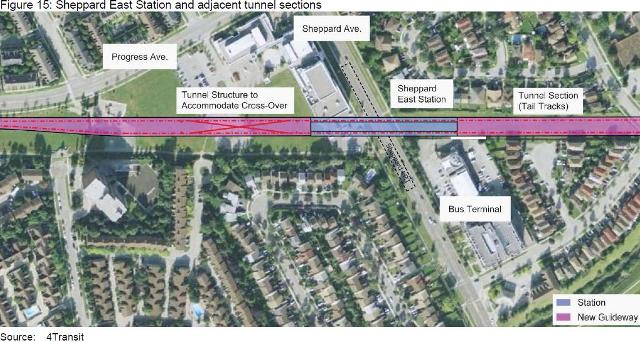
The line would descend to grade east of McCowan (as the RT does today to enter McCowan Yard), but would rise again onto an elevated structure west of Brimley. This is required because the route follows the Highland Creek ravine until it crosses Progress Avenue east of Markham Road.
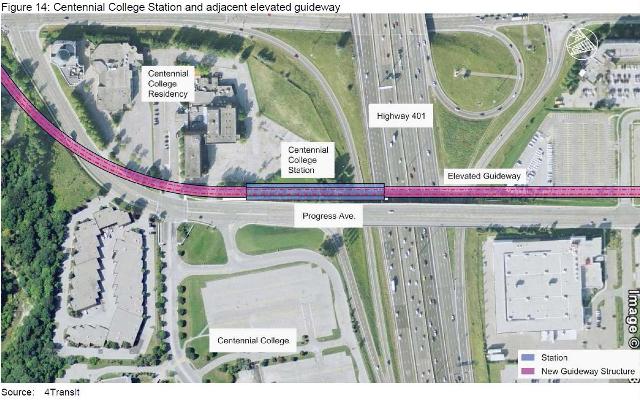
The Centennial College Station is located on the west side of Progress immediately south of Highway 401 which the station would partly overhang. North of the 401, the line drops into a tunnel for the approach to Sheppard East Station.
Curves
Several of the curves along this alignment would have a speed restriction of 55km/h and would require wheel lubricators to prevent squeal. On an elevated structure, this is a significant issue, one which has arisen at other locations on the subway system, notably west of Islington Station.
The study is silent on the issue of noise control and effects on existing or potential future development. Considering that noise along corridors is a major issue elsewhere in the Metrolinx universe (Weston corridor, for example), this is an amazing omission for a route that would largely operate in the open air.
Land Use and Potential Ridership
Much has been made of the claim that the RT alignment for a subway serves more priority neighbourhoods and walking-distance population. This was, in fact, a benefit of the proposed LRT service, and the only difference for the subway scheme is the absence of stations at Midland and Ellesmere which eliminates these as locations for future development. However, the lands there are industrial and unlikely to change in the near future.
The study is silent on the development potential of the RT alignment and makes no comparison with what might happen on the McCowan alignment.
Similarly, there is no reference to ridership in the study and the number claimed in the Minister’s announcement appears to simply have been copied from the McCowan alignment’s projection. This number is suspect because it may contain demand that properly belongs on an improved GO service in the same corridor, but was assigned to the subway by the demand model.
Moreover, if the subway ends at STC, then the demand forecast to Sheppard cannot be used because it presumes a fast, transfer-free trip eliminating changes in vehicles at both STC and at Kennedy.
Construction
Construction of the subway on this alignment would obviously have significant effects on current operations:
- Construction of the proposed new Kennedy Station would conflict with existing operations for a period during which subway service would terminate at Warden.
- Replacement of existing RT structures would require this line to shut down. The time required has been claimed to be roughly equal to that needed for the proposed LRT upgrade (3 years), and this is not credible considering the substantially larger scope of work for the subway scheme. (Alternately, the shutdown period cited for the LRT proposal has been overstated.)
- Temporary bus terminals would be required to accommodate construction and shutdowns.
Moreover, the project would likely delay the opening of the Eglinton-Crosstown line because Kennedy Station would not be available for the 2020 target date.
The proposed staging of the project is optimized around concurrent activities where possible, and a minimum shutdown period. By contrast, plans for the LRT scheme were saddled with the need to fit into provincial cash flow constraints, and construction of the LRT was artificially extended in the plans as a result.
Cost
The total cost of the project is $2.4-billion in 2011$. This includes provisions for property, professional services and contingency to a total of 60% over the basic estimate of $1.4b. The study claims that some of this may be saved through alternative procurement strategies, but there is little on which to base such a claim given our lack of experience with such schemes for large-scale transit construction by Metrolinx and Infrastructure Ontario.
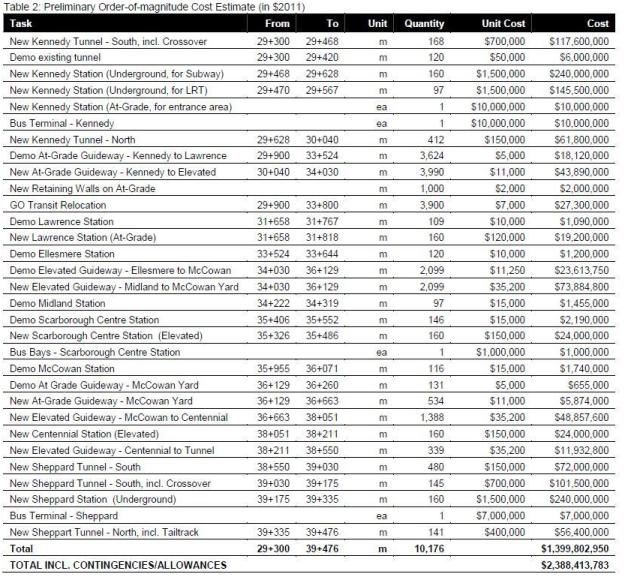
Approximately 40% is due to the section east of STC making the announced Kennedy-to-STC section roughly a $1.4b project. This conveniently fits within the $1.48b the province has on the table.
An unanswered question is the status of the $320m carved out of the $1.8b LRT project for the original scheme to rebuild Kennedy Station for the LRT projects. Some or all of that money should be available for the new Kennedy Station, but it has not been included in the proposed funding for the subway project.
The cost estimate does not include replacement bus service, new trains, yard and maintenance facilities, new substations or HST. Any comparison with other proposals must include these items.
Although the TTC does have surplus T1 subway cars, by the time the line opens (2023) these will be close to retirement age. Moreover, if all service runs through to Sheppard, the extra cars are not sufficient to operate the line. Presuming a route length of 11km (same as the LRT proposal), or 22km for the round trip from Kennedy to Sheppard, at 30km/h average speed, this would represent 44 minutes of running time. On the current headway of 2’20”, this would require 19 trains plus spares, or about 22 in total.
At $15m per trainset, that is $330m worth of trains. If half of the service turns back at Kennedy, this would be roughly halved, but there is no provision in the study’s design for a scheduled Kennedy short turn.
Where a yard might be added is unclear. Greenwood is full and the once-proposed LRT yard site between McCowan and Bellamy may not be suitable for full-length subway trains. (The Murray/RT alignment shares this problem with the McCowan subway proposal.) The TTC prices a new yard and maintenance facility at $500m. If only storage is needed, and the number of trains is lower than would be found at a typical yard, this cost will be reduced, but it won’t be trivial.
Summary
The Metrolinx feasibility study achieves its purpose as far as it goes. There is a potentially viable route for a subway from Kennedy to Sheppard via the RT corridor, although this requires many details to be worked out that could add to costs and/or reduce the line’s attractiveness. The omission of major components in the total cost must be rectified to allow valid comparison to other proposals.
 Steve Munro
Closer to home it appears similar to the Yonge-Union-University route which effectively covers the downtown area with transit…although Ed Levy suggests that would have been better off if the line ran up Bathurst rather than University.
As for Singapore, the north-south was built to connect downtown Singapore with the Housing Development Board public flat (apartment) developments north of the City, as well as the Woodlands Customs, Immigration and Quarantine complex at the Johor Causeway, Singapore’s main border crossing with Malaysia. The extension to Jurong (Singapore’s industrial heartland) is possible because of HDB development on the northwest side of the island as well as the military barracks, and the Jurong depot.
There is also the Bukit Timah nature preserve and reservoirs (Singapore is water scarce and has to import bulk water from Malaysia) which are vital to Singapore’s sustainability.
Like Hong Kong, Singapore is very high in density, has a significant amount of leasehold land and public housing, and can connect public transit projects with development. Singapore’s version of LRT (automated Mitsubishi Crystal Mover people mover vehicles operating on elevated concrete tracks), connecting housing developments to the stations on the NorthEast Line, has to be seen to be believed.
So the comparison is really superficial. Building the ‘loop’ connecting the Bloor Danforth line to Sheppard will require billions in construction costs, the reconstruction of the Sheppard line stations, a crossing under the 404, new trains and a new depot in Scarborough.
Cheers, Moaz
LikeLike
I wonder what issues will come from further delays by having to now do a totally new EA and build the line.
There has been so much conflict of opinion of light rail vehicles versus heavy rail rapid transit. I do not understand all of this talk of certain regions of the city versus another. We are one city now.
This extension of a subway/metro line will produce questionable financial results, similar to the Sheppard line, where many can still prefer to take a private automobile.
What we need is a web of reliable efficient transit infrastructure that can be built fast for less money. The last time that this city under the Metro federation tried to talk seriously about subways back in 1994, four proposed rapid transit extensions went down to two lines, further down to just one line. The Harris government honestly did not want to build any of the lines if they could, which only worsened the delay of meeting the transit needs of the GTA.
We need a better leadership from this city, one that supports neighbourhood and city building, more public spaces and public libraries, a city government that will meet the urgent needs of it’s priority neighbourhoods as soon as is possible. More needs to be done to partnership developers with TCHC so that we can make affordable housing as financially self sustaining as possible. This whole city is like an urban ecosystem, one thing connects and relates to another, all things are relative.
Light Rail Transit/Tramways will bring a more urban, downtown living feeling to more of this city, coupled with more urban friendly development and traffic calming measures. At the same time more needs to be done to curb sprawl and start to roll back the sprawl with further urban intensification. Suburban development is a horrendous waste of natural resources and is the worst place imaginable for the low income to live.
Perhaps there can come a day where there is even no seperate buildings to accomodate the differing aspects of the income spectrum; perhaps there may one day come a time of mixed income estate living, the poor and disabled sharing home with more successful members of society, until we can finally shed ourselves of what we percieve as “differences”. None of us are “different”. We do not live in “Scarborough” or “downtown”. We are all equal to one another and the same.
We are one city united under amalgamation, and we will not stand for shoddy grade city leadership that does not show long term vision for the best benefit of all. And this city will stand for nothing less than for the best quality leadership this city has to offer.
LikeLike
Steve,
If the funding gap can be closed, wouldn’t one then ask the question that with an extra billion dollars, what would Toronto want? As subway extension to Sheppard or an LRT line to Malvern and a DRL line (even if it ends up as a one-stop from Pape Station to King or Queen St). I suppose building the stations in between can be done at a later time. The 5 minutes lost transferring over at Kennedy you’ll get back taking the “express” at Pape. 😉
I think the biggest issue with Torontonians is that when they see money made available for subways they will take whatever they can get out of it even if it’s not the best option for the city as a whole. I wish someone can give an alternative option with the same money. If we decide to increase taxes for subways then perhaps there must be someone that crunch the numbers and see if that extra billion dollars can be used to build a partial DRL. One that has no stops in between Pape and Queen stations. The line can be open only during rush hours (5 days/week, 6 hours/day). I think given a partial DRL like that and the Scarborough LRT with the same money is better than simply upgrading the SRT to a subway. Is there anyone with the technical knowledge to see if that is feasible and then champion it? I’m willing to bet that Torontonians would gravitate to that option if put on the table than the current route championed by Karen Stintz.
LikeLike
It seems to me, very approximately, that $660M in federal funding, coupled with $1.4B from Queen’s Park, is about enough to build a subway along the RT route to STC.
$660M from the feds (plus Ford’s 0.25% tax hike) is also almost enough to build a Scarborough-Malvern Transit City line (absent rolling stock and storage, but hey, if Murray can do it…)
I propose a plebiscite then: Do we build a 2-station subway to STC, or BOTH of the LRT lines in Scarborough with about 22 stops?
The better plan is so obvious, yet I suspect it would handily lose a plebiscite in Scarborough.
Wait, I have a better idea. How about we use the $660M to extend the Scarborough LRT from Shepherd to Malvern Centre, which is largely underground – and call it a subway. Voila, everyone gets what they want (except a transfer at Kennedy), and we save a couple billion.
LikeLike
I can not understand why people who generally rail at wasting taxpayer’s money are all for one of the biggest wastes of taxpayer’s money that will happen in this city this century.
And then I remember that various members of the left on council who support this because they’d rather have Glen De Be around than not, or mayoral candidates that are afraid of ticking off Scarborough (Ms. Chow comes to mind on that point).
I wonder if there are people with integrity anymore who could actually be a decent mayor.
I would call it sad if it didn’t directly affect a few million people.
LikeLike
The poll results are in. Mayor Ford’s approval ratings are up. Mayor Ford’s approval rating will go up even more if he delivers the Eglinton Line as a full feldged subway. Any money available for the Sheppard LRT (including the $333 million just promised by the Harper government) should be used to build the Eglinton Line as a subway. Just build whatever subway you can on Eglinton and frequent articulated express buses with all doors boarding will do the rest (a lot of time is wasted on boarding and disembarking on regular buses but this can be speeded up dramatically with articulated buses and articulated buses also provide very high capacity). The last time you tried to replace a subway with an LRT, we are now already having to replace it (SRT). SRT is very new compared to the Yonge Subway Line for example but already we are having to replace it. This would not have happened if a subway was built in the first place. Eglinton Ave East will become another St Clair with streetcars running on the middle of it. Eglinton tunnels are of a higher diameter than our subway tunnels so it is still not too late for a subway on Eglinton. If this poll had been done after the Scarborough subway federal support was announced, Mayor Ford would have had an even higher approval rating (the poll results were released today (Wed) but the data was collected before the Prime Minister Stephen Harper announced financial support for Mr Ford’s Scarborough subway plan). Mayor Ford was elected for his promise to build subways and so the more subways he gets built, the higher his approval rating is going to be. The only way that anyone can defeat Mayor Ford in the elections is if he/she promises to build even more subways. Simply speaking, subways are highly popular and sell well. You are not going to win an election by promising to build LRTs (i.e. fancy streetcars) in the middle of our streets as George Smitherman found out the hard way. Prime Minister Harper will also gain a lot of 416 seats by his support of the Scarbrough subway and he can gain even more if he promises support to build the Eglinton Line as a subway. The Progressive Conservatives can win the Ontario election if they promise to build the Eglinton Line as a subway and I am confident that that’s what they will do. A lot of the money can be diverted away from unnecessary things like community centres, libraries, employment centres, etc and put into building more subways, doubling / tripling / quadrupling GO tracks, and to electrify GO Trains.
Steve: You have made this rather biased and ill-informed point many times before, and this time I am not going to bother editing your text. As for Ford’s rating, what we don’t see yet is the acceptance of the level of taxation that will be needed to fund the City’s share of the project. Ford is lying to people by claiming it can all be done for a miniscule increase.
LikeLike
I propose that we scrap the Sheppard and Finch LRTs and pour the savings into the DRL. Then we focus on extending the Sheppard subway to McCowan, creating a Bloor Danforth Sheppard superline. Toronto wants subways, not LRTs. With the scarborough subway now a done deal, Ford Nation has proven that they can make it happen.
Steve: Ford Nation has not proved anything beyond the fact that enough lies will convince some people of anything. That same Ford Nation will be none to happy when the tax bills to pay for all of this arrive.
LikeLike
A couple of comments:
1. The TR trains CANNOT be uncoupled and operated in shorter consists. There are two different types of “middle cars” in terms of the equipment they contain. Yes, they are shipped separately and joined up at Wilson, but they must assembled as six-car consists in the appropiate order, which is A-B-B-C-B-A. Both types of “middle cars” (B and C) are needed in any operable consist. So if the trains were to be split up, more A and C cars would need to be purchased at a cost of at least $ 1.5-2 million each. Moreover, reprogamming of the TR systems to allow a shorter consist is no trivial task and certainly not something that can be done every day by carhouse operators.
2) The Sheppard line would require extensive changes for it to accommodate six-car trains. First of all, the fixed block signalling is designed for four-car trains only. Assuming the current fixed-block system would be preserved, it would be possible for the signalling system to accept six-car trains, by relocating several signals, mainly in the interlocking areas. But this is tricky business, because it would require a complete re-design of the track circuits and the associated testing. When the signalling system was commissioned, even testing of a simple interlocking like Don Mills required at least one month of testing. If this were to be done under service, with shutdowns only late at night or on weekends, the implementation time would be stretched out considerably.
Also, the track circuits on the east and west “wyes” at Sheppard-Yonge linking up to the YUS lines are configured to check train length. Right now, if a six-car train enters the wye – detected by three consecutive track blocks being occupied simultaneously – an alarm is sounded both on the “zone” control panel at Sheppard-Yonge and at Transit Control. This would have to be changed, too.
A more basic constraint is the physical length of the tracks that would be a major problem under a failed train recovery scenario. Currently, both the Welbeck tailtrack and the Don Mills tailtrack cannot accommodate a twelve-car train (which would be needed to manoeuvre a disabled six-car train out of the way, without blocking up the mainline). At Don Mills, MTO did not allow tunneling under Hwy 404, so the tailtrack is too short. As a result, the interlocking was specifically designed for a maximum train length of two trainsets, or eight cars. A twelve-car train would not fit. Similarly, at the west end, the “westbound” track extends only about ten car-lengths beyond the switch leading to the west wye. So more tunelling would be needed at both ends of the line, before even talking about running six-car trains up there. It is not just a matter of knocking down a few walls.
3) If the BD line is extended beyond Kennedy, this would stretch the T1 fleet quite a bit. I suppose the cars could be retrofitted with ATO and since only the end cars need ATO equipment, only one third of the fleet would need to be equipped. It would really be a shame to retire the T1s prematurely, as they are very reliable cars and certainly better than the newer TRs. A more basic limitation is in the number of trains per hour that can be dispatched from Greenwood, so we would probably end up with the same situation as on the YUS where there won’t be enough time to field all service on the line in time for the peak of the morning rush hour.
LikeLike
So this extension would not get underway until 2018-2019. Therefore, the subway “champions” can promise anything in the upcoming elections without actually having to build anything for the next 4 years. This is great!
So it seems like in the next municipal elections we will have to choose between two competing “visions”:
1) The Rob Ford plan: BD extension to Sheppard, Sheppard subway extension to STC or McCowan/Sheppard, and a fully underground LRT on Eglinton all the way to Kennedy. I suppose the last two projects would be funded by the sheer power of the imagination, at least as far as the election promises will go.
No Sheppard LRT east of McCowan, no Scarborough LRT to Centennial College and no LRT on Finch West. Folks in those areas can go to hell, as far as the “subway champions” are concerned.
2) The Stintz plan, most likely a re-hash of her OneCity, presented last summer. The funded projects, including the three LRT lines would likely survive in their current form.
What would a sensible person choose?
LikeLike
When I think about this whole debate between LRT and subway that was carried first by Ford, then Stintz and de Baeremaeker, then Murray, and finally Flaherty and Harper, I can’t help but think of this newspaper article. I know I posted this article before, but I can’t help but think that had Metrolinx been more forceful, transit planning would not have become a farce that it is today. All Metrolinx had to say was ” We plan to pursue using LRT, as it is the least complex option to build and maintain. Should city council prefer subways, we welcome them to give us the money to build subways” and Stintz, Ford and Murray would shut it.
Now that the debate is in the hands of city hall, can Rob Ford convince city council that the TTC subsidy won’t increase more than the tax increase needed to fund construction, and future maintenance?
Steve: I wouldn’t be too quick to champion Metrolinx. When the organization was founded, they didn’t really understand LRT and their first chair, Rob MacIsaac, considered me persona non grata for questioning this obvious gap in their plans. They were dragged kicking and screaming to include LRT in The Big Move by David Miller, and wound up embracing it because of the cost savings possible. When the wind turned with Ford’s election, Metrolinx and Queen’s Park did not say “but we want to build an LRT network”. Instead they took advantage of the situation to defer actual spending on any line even further into the future. More recently, Metrolinx meekly aped the Minister’s announcement of an alternate Scarborough Subway route without even a public debate by their Board. If Queen’s Park relents on supporting only that alignment, I look forward to Metrolinx having to explain its ringing endorsement of the Minister’s original position.
LikeLike
Why people who generally rail at wasting taxpayer’s money are all for one of the biggest wastes of taxpayer’s money that will happen in this city this century? Simple: because despite their public discourse, their main goal is not building more and improved transit. They simply don’t want those ‘damned streetcars’ getting in the way of their cars. It’s not LRT vs. subways. It is private autos vs. public transit. By the way, the Mayor himself declared during the Council transit debate back in July that the Scarborough LRT would block up traffic. So he did not know that the Scarborough LRT would be completely grade-separated, essentially identical to a subway. If he is not aware of even the basic parameters of the debate, it is crystal clear that he doesn’t give a damn about transit. ‘Ford Nation’ doesn’t understand this yet.
I find it amusing that folks who go to great lengths extolling the virtues of subways and explaining why slow-moving streetcars would ‘block up our streets’ fail to realize that for the most part no traffic lanes would be removed, and all of the buses that currently ‘block up our streets’ would be gone. Therefore, by putting in ‘streetcars’ on Finch or Sheppard, the road capacity would go up, not down. I suppose this argument is too difficult to grasp for a university dropout – no offense intended to anyone who may be commenting here – however, it is curious that even sensible people are parroting this argument now.
Anyone who prefers linking up the BD and Sheppard subways into one ‘superline’ should be prepared to take into account the extra 500 million required for a new subway yard somewhere in the corridor. The existing yards are full.
LikeLike
Although they may secretly want to, I don’t think any politician would be silly enough to cancel the Sheppard LRT. The optics are just really poor.
The Chinese community has been pretty quiet on the transit file, but if the city spends $3bn dollars on a subway that only serves south Scarborough and completely bypasses the Chinese communities around Sheppard, Finch, Kennedy, etc., the Chinese aren’t going to be too happy. How is a politician going to explain how they ended up designing a rapid transit system for Scarborough that mysteriously bypasses all the Chinese communities of north-west Scarborough? The Chinese may not be too politically active, but they don’t like being taken for granted. Even if the politicians don’t have enough money to build a subway down Sheppard, they need to spend a few hundred million building *something* on Sheppard to keep everyone happy.
LikeLike
This is not China. And so no special treatment will be given to the Chinese or any other nationality, race, etc PERIOD. Also the Chinese community is well served by the extensive subways downtown (think in and around Chinatown). And if you want subways, LRTs, or whatever catering especially to the Chinese, then go back to China and it will be worth it as they have the best transportation systems in the world (rivalled only by Japan, South Korea, Taiwan, and Singapore). If you are going to have special treatment for the Chinese in Toronto, then you have to give special treatment to the almost 200 other nationalities living here in Canada. I am sorry to say this but the Chinese are not special here as in Canada everyone is equal (you are no better than me and I am no better than you).
Steve, I appreciate your respect of freedom of speech allowing us to post comments that might get arguments flaring and allowing us to post views that you disagree with but perhaps you should not allow comments which might be (perceived as) racist (like Ming’s post demanding special treatment for the Chinese in Canada when race/nationality has absolutely nothing to do with transit in Canada).
Steve: For your brilliant analysis, including the assumption that all Chinese live downtown, you have earned yourself a ban on this site.
LikeLike
Is this satire? If not, I shake my head. First of all, these items don’t cost much at all. You could build about a centimetre of subway by cancelling them all. Second, they are amongst the very things that helps to make our City an attractive place to live and creates the demand for, amongst other things public transit. A sterile City that does not meet citizen’s need will fail, and no subways will be needed. Even employment will wither if “top people” don’t want to live here because there are no services.
LikeLike
Great commentary report Steve.
Perhaps the most important question no one is addressing could be….
Where is the best Subway for Scarborough?
In my opinion, the Sheppard Extention Subway DOES NOT FEED the Y/B Problem.
Sheppard has the highest growth potential.
Sheppard has the highest density.
Sheppard has the highest traffic congestion.
Sheppard Subway, allows a “smart transfer” at Kennedy, in case Kennedy GO Station is a key DRL relief line connection location, as part of the bigger equation solution.
Why isn’t there a report based on facts (whatever they may be) in planning the right location for a Scarborough Subway?
Could Ford have been right from the beginning about the Sheppard Subway?
Your thoughts…
Steve: Any route that feeds into the Yonge line feeds the network problem that there isn’t enough capacity into downtown. There is a physical limit to the number of trains (and hence riders) that the line can handle, and this problem is gradually extending onto the BD line as well. We have been very badly served by a TTC who for years told us that they could stuff thousands more onto the Yonge line without an expensive new line (while ignoring the cost of all the upgrades needed to even theoretically make their higher capacity possible).
We keep hearing about how people in the suburbs don’t all want to get to downtown, but then we build (or propose) networks that focus on core-oriented travel. The whole idea of the LRT network was to break that pattern.
LikeLike
This was exactly the 1980’s concept of City Centres that got us into this mess in the first place and prevented a DRL from being built. The Scarborough Town Centre, Yonge-Sheppard, and the Kipling six-points areas were all supposed to be new high-density town centres for employment, shopping, culture, and places to live. The Sheppard subway was intended to link two of these future town centres. Unfortunately, employers were not interested and either:
a. Wanted to be downtown in the central business district where the real action is.
OR
b. Wanted the cheapest land, taxes, and workforce available and moved outside of Toronto (initially) or completely offshore (more recently).
The one thing that did happen is that these failed city centres became suburban transportation nodes and magnets for big Condo developments because the zoning laws were in place. But virtually none of the people who live there work in the same community.
By the way, the same mistakes are being repeated today in the city of Vaughan which is also planning a grandiose city centre.
What’s really happening in Toronto and will continue is a very gradual process of re-urbanization where the inner suburbs are absorbed into the city itself. The phrase ‘re-urbanization’ is already in use in some of the city’s planning documents but will never be mentioned by suburban politicians for it may frighten their voters. The term re-urbanization is a misnomer because it is really about moving from an existing suburban form to a new urban form.
These changes are not confined to Toronto and are occurring in most major cities of the developed world.
LikeLike
Any motion to reinstate the lrt should request that all fed money be reallocated to expanding the lrt to morningside and beyond (to the border?) and the remaining funds either to expand lrt in Scarborough or to extend the Eglington line to the airport. Run it right through Ford country. The additional couple of stops would make fair comparison of how crazy a tunnelled subway extension is with only 3 or 4 stops.
LikeLike
I think there should be an immediate halt to all new LRT lines except Eglinton so we can see if the ECLRT is a success or not. If it is a disaster (blocked traffic, gridlock, under-utilization) then all future LRT plans should be canceled and subways should be built instead. If it is a huge success then it will be overcrowded and we will know that we should have built a subway instead to handle the crowds.
Steve: I love people who presume that the option they don’t want will fail either way. We could instead have a route that works well for the demand it has and does not screw up traffic. But you presume that such an outcome is impossible. Enjoy your tax increase to pay for subways everywhere, or alternately no tax increase and no subways or anything else.
LikeLike
Hi Steve,
I like your comment, that states how LRT, “breaks that pattern”.
In other words, some take LRT, while others take subway. Well described. What I meant was, when you feed the Yonge Line, you avoid the y/b transfer, that exasperated the longer dwell problems, meaning less train count coming southbound. My proposed solution, is feed the Yonge Line, and then build a shorter more cost effective Relief Line Subway, Eglinton and Yonge to Downtown as an Express train, with no in between station costs, and the shorter subway, cost is about 1/3 to 1/4 less $ to that of the traditional subway, while doubling capacity where the demand actually is, 21,600 new peak hour demand (2031) as opposed to 1,200 (2031) expected new demand from the east. Who supported the TTC Subway extension, Karen, Glenn, and 3 others, who were the other 3?
Steve: The problem with your idea is that it still focuses on the Eglinton to Downtown corridor where there is no room to add a parallel subway line, and does nothing to relieve the focus on that one way of getting downtown. It is important to prevent people from getting on the Yonge line in the first place by diverting them onto a relief line and onto GO.
LikeLike
Without access to the blueprints of the T35A08, there is no way to measure the cable length from cab to cab. On a 12 car configuration, the cable length will be much longer than the vehicle length of 720ft (12 cars, 60ft in length). Cables need to be routed around various obstacles and connections between cars will most likely be connected by harnesses. A wiring harness introduces resistances which pushes up latency.
Keep in mind that copper wires are great conductors up to a certain distance. In long cable runs, repeaters might be needed which pushes up latency some more. So, 20ms to 100ms is a good estimate. The MOVIA metros are modular, so it is built with this in mind.
On critical applications where low latency is prized, fiber optics are used. On something like Airbus a350-900 the overall length is only 215ft, but due to the way cables are routed, it could be a mile from the cockpit to the tail. Fiber optics are also immune to RF interference.
The TTC cannot just break apart the T35A08 and re-configure it as a 4 car trainset. But, it can be ordered from Bombardier this way. The integration and validation have already been done since MOVIA metro systems are modular. There should be no cost difference between the ones used today on the Yonge line.
Bombardier has customer service support centers throughout the world. If the TTC really wanted to join or unjoin trainsets, it could be done with the support of Bombardier’s engineers. Given that all the control programs are located on ROM chips, it can be flashed or replaced with different ROM chips. It is doable just not something one wants to do all the time.
LikeLike
I found an old (well 8 years) report about the SRT and LRT. A lot of it is the standard for the time “must have LRT” stuff. But, in the middle, they did a little map on who was taking the SRT at the time, AM trips.
Go to page 6
People living along the subway routes don’t take the SRT right now.
Any idea that the proposed subway will have more rider potential then the LRT options is ludicrous.
The biggest need is Finch and Kennedy area and around Malvern.
We are building another series of Glencairn like stations.
Steve: According to comments made by staff at the July Council meeting, the “extra” demand on the subway is an artifact of the model having no improved service on GO with the result that a lot of traffic from Markham was attracted to the subway by default. We built the Sheppard Subway with a similar justification.
LikeLike
No one is talking about doing this everyday, but rather having a set of 4 car TR trains for Sheppard. Traditionally subway cars came in married pairs; one car had the air compressor and the other had the motor generator set to provide low voltage DC. Now we have electronic converters inverters which produce the low voltage DC plus AC for lighting but with LEDs that need might disappear.
What equipment is on the C cars that is not on the A car? True the A cars have cabs but leaving off the cab doesn’t mean that the car cannot have all the other equipment. As Benny says the MOVIA design allows for different length trains; the only way this is possible is if a BC pair of cars contains everything an AB pair contains except for a cab.
I am in Rotterdam today and it is amazing how those “street cars” manage to travel at relatively high speeds with out blocking automobiles. One line has on street running with bump outs like Roncesvalles, except the bike lanes are behind, not on, the loading platforms. In a make work project each tram has a conductor who sells tickets to those who don’t have one, helps “little old ladies, and men” to their seat and greets regular passengers. He also helps tourists.
LikeLike
Further to Bruce K’s comment, the same pattern happened in Mississauga. Missisauga’s City Centre area stagnated for years because the city wanted to preserve the land for offices and employment, but the office development happened not in the centre but in other areas like Hurontario north and in the Airport Corporate Centre. Only in the last decade or so has development taken off in the city centre area, as the land use permissions have been relaxed to allow for condos and institutional uses.
LikeLike
One finds it fascinating that those who proclaim to be conservative supporters don’t want the free market to decide where people and businesses locate in the city and want the government to force their hand.
Steve: When their economic theories don’t pan out, the right wing wants to rearrange things a bit to suit their philosophy. Rather like deciding that delivering on a subway “promise” is more important than a no tax “promise”.
LikeLike
Such a line could also re purpose the elevated section of the SRT over to the Stouffville railway sub, then divert to Ellesmere Road itself and continue west along Ellesmere. Perhaps there could be a “GO” station added at Ellesmere to allow another interchange. If you consider Kennedy, Ellesmere, Agincourt (at Sheppard) and Milliken (at Steeles) that does a good job of serving west Scarborough … provided that GO and Metrolinx can be convinced to offer the service.
Moaz: Similarly, Mississauga is attempting to develop a “City Centre” around a mall and ignoring the growth opportunities in the more urbanized Port Credit and ‘stuck in the 1960s’ Cooksville which has some massive parcels available for urbanized development.
Moaz: indeed, I was shocked to read a news report about Mississauga suggesting a ‘downtown vs. suburban’ divide … within Mississauga Council itself. The ‘suburban revolution’ conference is starting today at York U and it will be interesting to read more about re urbanization and suburban maturity as it progresses.
Cheers, Moaz
LikeLike
This work in the same community thing is a big part of the problem. Heck, transit city was premised around the idea of making more live and work communities.
But ask people about getting to work, and it’s not about getting to work down the road where they can take a street car. It’s about driving all around this massive region we all call the GTA.
The urban planners would like this live and work community model, but all of reality seems to fight them. Land gets more expensive. Property taxes become a burden. They move to cheaper land. Housing in the city gets too expensive. The middle class work force moves to the burbs. People want more space to live and raise their kids…
What is really needed is efficient transit to get people to and from work. I like to point out that for example the Mississauga BRT connects a massive number of commerical and industrial employes in their little office parks. It’s a very practical line. And of course connecting it to the TTC or Eglinton LRT or even GO… oh that’s way out in the future.
In this manner, even if the work location is in the burbs/semi-burbs… at least there is good transit to get there. Yes, it might not be the nicest work location, but that’s most of the GTA.
Best of all, it does link to the city center, which you rightfully point out is not the hub of employment opportunity it could be. Yet, the hub is on the line. And with the long term goal of connecting such hub to other hubs, it would have a very practical impact on transit.
I’m not as negative on the suburban transit model. I think with the right connections and integration with GO/TTC… they will serve their purpose quite well and connect people to their day to day jobs.
Steve: There is both local and regional demand in the suburbs, and we have to build transit that will serve both of them. We will most definitely not be able to afford a widespread network of subways to every corner of the city.
LikeLike
I wish we would have stuck with the first modified option after Ford was elected.
It was reported in the Globe that the Province asked Ford to compromise. Allow Eglinton to remain LRT and the rest of the funds would go to Sheppard (from Downsview to STC). Ford refused on principle and this mess is what we’re left with.
A completed Sheppard Subway would give Scarborough their subway option. I disagree with most on here – I think a fully completed subway on Sheppard would be a success the day it opens…especially if it can get to Downsview. The Eastern leg would have finished first and given a subway for people to use while the SRT shuts down for conversion to Eglinton so they weren’t stuck with now famous 3 year bus ride from STC to Kennedy. Then the Eglinton line could be run above ground to Malvern in the East and the Airport in the West as funds become available while concentrating on the DRL for subways. That seems like a perfect compromise to me.
And let’s be honest here. When we are talking about “relief” we are talking about the U south of Bloor. With a fully completed Sheppard, a Mayor/Premier on the same page could strong arm Metrolinx into a co-fare for 5 Go Stations/TTC subway stations (Bloor, Downsview, Oriole, Agincourt, Kennedy) and just those 5 only.
A TTC rider could take a Go Train from Union and jump back on the subway line at little to no extra cost at the nearest one of the 5 stations closest to their destination. A co-fare exists in Durham and York and many other municipalities so why can’t it work in Toronto? Why don’t people try to make it work in Toronto? Get them out of the U and put them on the subway network at any of the 5 Go/Subway stations for essentially the same cost. Who wouldn’t want to stand on a Go Train for 11 minutes and then transfer instead of standing in a crush of people for 45?
London doesn’t have one Union. They have “Union” stations all over the place (Heathrow/ Paddington, Gatwick/Victoria, Euston, King’s Cross, Waterloo, Liverpool Street, etc). These major train stations all have one thing in common…they’re all on the tube. Why can’t our overground stations (heavy rail/light rail) work in connection with our underground?
There has to be another (easier) way!
LikeLike
So, where is the tax increase to pay for the $505 million Gardiner boondoggle?
As is typical for right wing politicians, public transit for us peasants requires an up-front in-your-face tax increase.
At the same time, when born-a-multi-millionaire Rob Ford wants to spend $505 million on the Gardiner boondoggle so that he can keep driving his Cadillac SUV to City Hall, the money seems to magically appear from thin air. Perhaps flying unicorns will carry bags of cash from fairies in the clouds to pay for it.
Or perhaps he will scrape together enough cash to start the project, leaving a future City Council with the unpalatable choice of wasting this money by cancelling the project or putting the screws to us peasants to cough up the cash to pay for it.
I know which alternative is appearing as a vision of the future in my crystal ball.
LikeLike
Yes, but I think that there is a big, big difference between North York Centre and the other “centres” that I think is likely to result in it being a lot more successful in the future. North York Centre is surrounded by some of Toronto’s wealthiest neighbourhoods, and is a pretty vibrant area. I suspect that the lack of job growth in that area is basically the same reason that there was so little job growth downtown in the 1990s and early 2000s, that is the huge increase in Toronto commercial taxes in the 1990s, which is now starting to be reversed. Now we are seeing a bit of new office space being built there, and we might see a lot more if downtown office space rents go up and higher end employers move to North York Centre because they can’t attract better employees in suburban office parks.
I sometimes get the impression that North York Centre, Yonge/Eglinton, and Yonge/St Clair form one long northern extension of downtown. It is sort of like Midtown Manhattan vs Lower Manhattan or like the west side of Los Angeles (which is wealthy and has a lot of office space) vs downtown Los Angeles. Though my impression is that North York Centre will be more successful than Yonge/Eglinton in terms of office space because Yonge/Eglinton is too far from the 401. Whereas Scarborough Centre and Mississauga Centre are lower income areas, the latter has poor transit connections to downtown, high end employers do not want to locate there and low end employers find office park developments a lot cheaper, so they are mostly residential.
Also the eastern end of the GTA (including Durham Region) has not seen very much office space built anyway. Meanwhile Kipling/Bloor never really even got off the ground, and “Vaughan Centre” will likely be even less successful because it is surrounded by industrial areas and a giant rail yard and will end up with hardly any new development at all. So I could easily see the Sheppard subway having much higher ridership in the future and the Eglinton line could easily become overcrowded due to traffic going towards the huge office park/industrial areas near Pearson Airport, but the SRT replacement will never end up creating any significant amount of job growth.
LikeLike
Steve, it was so exciting to be present during the unveiling of Transit City. I can’t imagine how disheartening this must feel to see good plans tossed aside. Is there any light in the gloom?
Steve: We need a new administration at City Hall, and a shakeup at Queen’s Park (but not a Tory government). I don’t foresee any of this being sorted out until late 2014 or early 2015 at best.
LikeLike
Great.
I will be in Japan from Oct. 5 to Oct. 20.
Where people know what they are doing with regard to transit. OK they do not have to worry about density, and maybe the locals are really annoyed. But sometimes it’s good to copy the best ideas from others.
Away back when the Japanese copied the best from, I think, the Han Dynasty.
Sorry to be blunt.
So when I return, all issues will be addressed, and a plan will be finalized. The present plan in short $.5 to $1.0 billion.
Steve: You can extend your vacation. I don’t think the final decision will be made for some time yet.
LikeLike
Robert, the main difference between the A and C cars of the Toronto Rockets is that the A are not motorized, while the C (and B) are. Unlike the older trains where all cars are powered, the TR trainsets have only the four middle cars powered, with the end cars essentially being ‘driving trailers’. The B cars differ from the C cars in a few respects; notably the B cars have air compressors, while C cars don’t. There are a few other differences as well I can’t remember off the top of my head, I would have to check again the training materials to see what they are.
Obviously this arrangement is not standard for all Bombardier Movias worldwide, but this is how our trains are configured. It seems though, that most six-car consists worldwide are assembled in the same pattern (i.e. ABBCBA) as our trains with only the middle four cars powered. An exception would be Delhi Metro, where only three “B” cars out of a six-car fixed consist are powered, with the “A” end cars and the middle “C” cars used as trailers.
Steve: No surprise that the TRs feel so underpowered.
Regarding the Sheppard line, it is now operated with four trains which are kept in continuous service for ~ 21 hours/day for 7-10 days in a row on average, before they are changed off (although depending on the timing of scheduled inspections on the cars and assuming no breakdowns occur while in service, a train is sometimes kept in service continuously for as long as 27-28 days in a row with no problems).
It may be feasible to order shorter four-car trainsets just for Sheppard, however, with the way the line is operated, part of the fleet would need be continuously rotated into “storage and maintenance” for extended periods of time without being able to use it anywhere else on the network in the meantime. While the ‘average’ monthly mileage would balance out, in practice you would always have a fair number of operable cars sitting around in the yard due to incompatibility with the other lines. Not the best use of resources.
Ideally, the Sheppard order could be bundled with a bigger order for the DRL rolling stock, presuming the demand model for that line is in four-car territory and we would actually start building the DRL by the time the T1 cars retire.
P.S. If you are in Rotterdam, I would recommend you take a ride on the ‘interurban’ LRT line #25. It is one of the best illustrations of the flexibility of LRT’s. It also shows what an effective and extensive rapid transit system those granola-crunching, latte-sipping, car-hating European ‘Socialists’ have built, why we squabble where to dig the next couple of kilometres of subway tunnel.
LikeLike
Let’s just hope that the DRL gets built. It is certainly long overdue.
LikeLike
It was one of the first lines I rode, amazing at the speed it achieves and the areas it goes through.
LikeLike
And similarly, a GO rider from Milton or Mississauga could hop off the GO Train at Bloor (or maybe Agincourt one day) and take the TTC to their destination. Except that Milton line GO Trains don’t stop at Bloor. And unfortunately a lot of GO Trains run express in from/out to the suburbs without stopping in Toronto. Express trains on Lakeshore west stop at Clarkson…the west end of Mississauga.
This is of course during peak hours where frequencies for local trains are actually not that frequent. Off peak hours there are no trains except on Lakeshore and buses are infrequent (as compared to the subway) and not 99% reliable.
You have an interesting idea with the co-fare in the U but there will be costs. More trains, electrification and better signalling system to allow higher frequencies etc.
The big question is why has Metrolinx ignored the opportunity to talk about GO expansion (perhaps starting with the Stouffville line though Richmond Hill might be a greater priority) in favour of shilling for BRT lite and the Murray proposal?
Cheers, Moaz
Steve: Metrolinx does not exist as an independent agency and will “shill” for whatever comes out of the Minister’s or Premier’s office. Murray does not sound very supportive of LRT and chose instead to talk about an infrequent BRT service to Durham as the “solution” for eastern Scarborough. A recent article in NOW suggests that there is an active campaign to kill off the LRT network proposal. Some will cheer, but others will weep because what we will wind up with is nothing at all more than a few painted lines on roads where the motoring lobby deigns to give transit a hypothetical “priority” status that will never be enforced.
LikeLike
In one sense Scarborough Transit has been studied to death, but on the other hand it hasn’t been studied at all.
Wouldn’t the right question be, relative to the big picture, which is the best and right subway for Scarborough be?
Sheppard – Eglinton – or Bloor Extension and why?
Not one has asked or answered that question.
My thoughts, Sheppard happens to be the right subway, simply because of high density, higher traffic problems, higher growth potential, reaching more commuters, York Region and North Pickering etc. and prevents the Yonge / Bloor Transfer !
Your thoughts Steve, which subway do you think is best and why?
Steve: Sheppard may “avoid” the Yonge/Bloor transfer but that does not deal with the overcommitment of north-south capacity into the core. As to demand and density, I am not convinced that subway-level demand is there now or will be in the reasonable future.
You talk about what has not been studied. What we are really missing is a public document that shows the demand flows today (road and transit), and what they would look like with various future scenarios for population, jobs and transportation networks. Instead what we get is single-project projections that are commonly tweaked (as the original Sheppard subway study was) with unrealistic future conditions and only one new line added to the mix (whichever one is under study). Even the Metrolinx Big Move projections are all-or-nothing looks at a complete network that will never be built rather than at what incremental versions of the net might look like and how they would (or would not) make an effect on transportation congestion, both road and transit.
I remember projections over twenty years ago for “now” that assumed no change in the GO Transit network and, as a result, loaded a great deal of regional travel onto the subway system thereby “justifying” massive investment in it.
During roughly the same period (the early 90s recession) demand fell on the subway so much that the then-crisis that might have brought us the DRL vanished allowing money and attention to focus on suburban routes with no thought for what would happen when downtown recovered.
LikeLike
After spending 2 days riding Rotterdam’s tram, LRT, network I wish we could get some local politicians to ride them. On lines 23 and 25 we were running along for many stretches at nearly 80 km/h. They don’t slow down traffic but beat it handily. The trams are Alstom Citalis(?) low floors and move along very quietly and smoothly but, as one operator told me, “They hang over at the ends and if you hit a curve going too fast you can get thrown when the car starts to turn.” He also let me ride in the cab and showed me the internal wiring system so, as my wife told him, I was in seventh heaven.
The cash fare is 3 Euros ($4.20 to $4.50) for a 1 hour ticket so it isn’t cheap but you can get reduced fares for using their version of Presto. One day passes are 7 Euros for adults and 3 Euros for seniors. Headways are 7 to 10 minutes in day time with 10 to 15 in evenings and weekends. The population of Rotterdam proper is 620,000 for the city proper so it has a very extensive transit system for a city of its size. Tomorrow Amsterdam.
LikeLike
Personally, I never like the use of the term “right wing” because it implies the sort of binary thinking that gets us into messes like this entire Scarborough subway fiasco. The problem lies with those who call themselves conservatives but couldn’t balance a chequebook if their lives depended on it and want governments to impose their worldview on others (sound familiar).
Steve: Yes, it is difficult trying to deal with various flavours of political opinion. In some ways, I am a “conservative” in the “Red Tory” sense that I would like there to be enough money available so that governments can fund things we really need like good transit for everyone (not just for future generations in one part of the city), health care, education, etc. However, that flavour of conservative has been driven from the land and we are left with those whose simplistic theories depend on endless statements about “waste” as an excuse to cut taxes. Except when their pet project or agency or corporation is looking for a handout.
LikeLike
I am trying to understand why the subway would attract more ridership especially since the LRT would run at subway speeds.
From previous comments, I understand that the TTC feels that a subway would attract more people from the 905 area than the Scarborough LRT, and that there may be some bias or optimistic estimates to make the subway option look better.
Could it be that there would be a large bus terminal at a Sheppard/McCowan subway to attract regional buses but that none would be contemplated at the Sheppard end of a Sheppard LRT? Perhaps LRT is viewed as a local service that could have been extended further north of Sheppard.
Steve: It is important to know when various projections of demand were made and what underlying assumptions they included. The LRT projections are older than the subway ones, for starters, and may not have the same underlying land use assumptions. Also, the models are usually very sensitive to travel times and will tend to assign trips to faster routes. For some potential users, a three-stop subway to Sheppard without that pesky transfer at Kennedy is a substantial advantage, but I would love to see a detailed breakdown of who is actually benefitting from the new line. When one asks about the details, the usual response is that the model is “too complex” to publish this info. Sorry, but that’s a sham for either “we cooked the numbers” or “we don’t understand our own model”.
Definitely with the LRT going further east, it is better set up to continue into Malvern, but I doubt that was even considered in modelling future demand.
LikeLike
If I were Metrolynx, I’d be laughing too hard to schedule any meeting with the TTC until it irreversibly made a decision. And there wouldn’t be much policy to talk about — only political expediency.
But it is sad to see Wynne learned nothing from McGuinty’s power-plant fiasco. Her pandering to Ford Nation–Scarborough division for a by-election meant throwing $1.4 billion of provincial public money into Ford’s re-election. This in turn supported Hudak and enabled Harper to throw $660 million of federal money into Edsel’s re-election. Hard to see how this benefits the provincial Liberals.
LikeLike