
Updated October 2, 2013 at 12:30 pm:
Metrolinx has released a transcript of a press conference held earlier today regarding their letter to the City Manager about the Scarborough subway.
In related news, Metrolinx advises (through a separate email) that they are “approximately 3 months away from making [a] formal recommendation on Sheppard and Finch” LRT lines, and the possible acceleration of these projects.
Also, regarding Eglinton-Yonge Station, they “hope to have a final concept that Metrolinx, City and TTC agree on in the coming weeks and will present in the public session of the Metrolinx December Board meeting”.
Updated October 2, 2013 at 10:30 am:
Metrolinx has sent a letter to Toronto’s City Manager regarding the proposed Scarborough subway. Unlike some pronouncements from Queen’s Park, this takes a more conciliatory tone for discussions between Ontario and the City of Toronto. Notable points include:
- Metrolinx continues to believe that LRT “would provide an effective rapid transit solution to the transportation challenges in this area” within the available funding, but bows to the desire by all three levels of government to build a subway.
- Metrolinx is not dictating that a specific route be chosen, but wants a proper alternatives analysis as part of the Environmental Assessment. This contradicts earlier statements by the government implying that only one route was to be funded. It also implies that the shorter “Transit Project Assessment” process (which does not include the potentially embarrassing need to review alternatives) will not be used.
- The Province is sticking with a figure of $1.48-billion in available funding, from which must be deducted the $85m in sunk costs for the Scarborough LRT project and unspecified costs of scaling down the LRT car order from Bombardier.
- Although the $320m reserved for the Kennedy Station reconstruction with both the Eglinton and Scarborough LRT lines may not all be required, additional costs are expected at the Yonge-Eglinton interchange beyond the current project budget. Savings from Kennedy may be redirected to Yonge-Eglinton. If there is anything left of the $320m between the two projects, then it could be directed to the Scarborough subway.
- The Scarborough subway will be entirely a City/TTC project contrary to previous schemes for the LRT that would have seen provincial ownership and a PPP arrangement similar to that proposed for the Eglinton line. This begs a question regarding the accounting for the provincial funding contribution: if you don’t own the line, you can’t book the asset as an offset to the money spent on it. Does this mark a shift away from the creative accounting used to justify taking Toronto’s transit projects away from the TTC in the first place?
- Provincial funding will begin to flow in the 2018/19 fiscal year implying that no serious construction will be underway until then. The City and/or Federal government will have to front end the project with funding for the EA and preliminary engineering. All risk for project cost overruns will be to the City’s account.
- Infrastructure Ontario remains available to participate in this project, but this is no longer a requirement of the Province for funding. The decision on whether to use IO or to proceed with a conventional procurement (as on the Spadina extension) is up to the City of Toronto.
Not included in the letter, but reported through Twitter by John Michael McGrath, is a comment from Metrolinx that they are reviewing the timing of the Sheppard and Finch LRT projects.
This letter provides a more balanced response to Scarborough subway issue than some recent statements by Ontario Transportation Minister Glen Murray, and it is good to see Metrolinx acting as a reasonable broker rather than simply as a rubber stamp for ministerial musings. The next major step will be Council’s discussion of the matter at the October 8-9 meeting.
Updated September 25, 2013 at 10:30 pm:
Today’s TTC Board meeting was a procedural shambles when the time came to discuss the Scarborough Subway. The contentious name-calling and parochialism of some past debates lives on for at least one Commissioner, Glenn De Baeremaeker, who is so busy puffing up the importance of his own subway that he overstates his case. At one point, Councillor Josh Matlow spoke of the subway proposal as vote buying. De Baeremaeker did not take umbrage but Chair Karen Stintz did and asked Matlow to withdraw the remark. He refused and left the meeting as did another visitor, Councillor Carroll. Smug and over-confident do not begin to describe De Baeremaeker’s attitude which focuses on getting “what Scarborough deserves” above all other considerations.
Three sets of motions were proposed:
- The original recommendations of the staff report which asks that the Commission endorse the McCowan alignment for a subway extension from Kennedy Station to Sheppard.
- A set of motions by Chair Stintz:
- that the Commission continues to support LRT implementation on Eglinton, Sheppard East and Finch as per the master agreement with Metrolinx,
- asking that Metrolinx confirm their support for these projects, and
- asking that Metrolinx confirm that the Downtown Relief Line is the next priority for a subway project after the Scarborough extension.
- A motion by Commission Alan Heisey seeking a meeting between the TTC and Metrolinx boards to arrive at a mutually agreeable plan for future transit in Toronto.
- Commissioner Parker proposed an amendment that would have supported the original LRT proposal.
Some members of the Commission were uneasy with the large exposure for the City in future debt and the tax increases needed to finance the City share for the project. The “citizen” (non-Council) members of the Commission appear uneasy about the fact that they have never been asked to vote on the subway alternative until now, and as articulated by Commissioner Heisey, it would appear that their counterparts at Metrolinx have similarly been excluded from the debate.
When it came time for the vote the Stintz and Heisey motions passed easily, but Parker’s motion failed on a 2-9 vote. However, things came unglued on the main motion. Five Commissioners voted in favour, five against, and one, Nick Di Donato, wanted to abstain because he did not feel he had enough information to make a commitment to the subway line at this time. In this situation, the motion would have lost on a tie vote. Di Donato had not left the table, and so technically abstaining was not an option.
At this point, realizing what might happen, Chair Stintz called the vote again and Commissioner John Parker, who had voted in the negative, left the room to ensure that the motion supporting the McCowan alignment would pass unless Di Donato voted “no”. In the end, the vote was 6-4 in favour with Parker abstaining. This shows how divided the Commission is and how poorly support for the McCowan option was organized by the Chair before the meeting started.
In related news, some members of Council are swallowing hard to accept the level of taxation that may be required to finance the City’s share of the project. Some money will come from Development Charges, but the lion’s share, about 80%, will have to come from general tax revenue.
Meanwhile a Forum Research Poll shows general support for the subway, but splits along regional lines and relative to past mayoral support. There is some support for the LRT option, but the poll question specified a level of tax support for the subway considerably lower than what is actually required to finance it. Support for the subway is higher among non-transit users than transit riders.
The whole matter will be debated at Council’s October 8 meeting.
Updated September 23, 2013 at 8:20 pm:
Today federal Finance Minister Jim Flaherty announced that Ottawa would provide $660-million in funding for McCowan alignment of the subway as proposed by City Council, and reaffirmed funding of $333-million for the Sheppard LRT. This simply quantified the amounts available from yesterday’s announcement by the Prime Minister.
Also today, the TTC released a report comparing the Murray subway alignment via the existing RT corridor with the Stintz alignment via Eglinton and McCowan. Unsurprisingly, the TTC report endorses the McCowan alignment, although it does not go into much detail in critiquing the RT alignment.
A fundamental issue is that the provincial funding of $1.4b is inadequate for either proposal:
Neither the Provincial (RT corridor alignment) nor TTC (McCowan corridor alignment) subway option to Sheppard Avenue estimated at $2.9 billion and $2.5 billion ($2010) respectively, are achievable within the current Provincial funding envelope. Even when the options are truncated at Scarborough City Centre both Provincial and TTC options estimated at $1.7 – $1.9 billion and $1.9 billion ($2010) respectively require additional funding. [Page 1]
Much of the history of these proposals and related correspondence has already been reported here. The TTC notes that there is an outstanding request for information from Metrolinx regarding:
- Ridership projections for both Provincial options;
- Average operating speed and trip time for both subway options;
- Location of the bus terminal;
- Walking distance from the TTC bus terminal and GO station to the subway platform; and
- Any other advantage of this proposal over the TTC proposal. [Page 4]
Minister Murray has claimed ridership for his proposal equal to the number cited by the City and TTC for their scheme, but the latter depended on the route going all the way to Sheppard. As with other claims for his proposal, Murray selectively quoted full-line benefits for his truncated subway scheme ending at STC.
The TTC notes that curves on the Murray line would impose speed restrictions that would add to travel times (not to mention fleet and operator costs) and potentially be a source of wheel squeal that could annoy neighbouring residents. The tight curves would also lead to faster rail and wheel wear. However, the TTC’s estimate of fleet requirements for the two proposals appears to be based only on the length of each option, not on any speed restrictions.
What the TTC does not address is the fact that the Metrolinx consultants claim to have used TTC specifications in their design. Either this was done erroneously, or less than ideal specs were used in good faith for the proposed design. The TTC needs to set out specifications that anyone (Metrolinx, say) should use in designing any future subway lines. This is not a trivial issue given the likely wandering nature of a new Downtown Relief Line (or whatever it is called).
The TTC is concerned about the design of the new Kennedy terminal and how transfer moves between buses and GO passengers and the subway would be affected. This is a valid question especially if the importance of Kennedy as a hub increases. Although RT trips will be diverted onto the subway, much of the bus traffic will continue to arrive on existing routes and the convenience of their transfer connection is important. Equally, if GO improves service on the Stouffville corridor, this connection also should be a convenient one.
Other effects of the project both during construction and under operation include:
- A three-year shutdown of the SRT for the construction project, plus an unknown shutdown of the east end of the subway during the cutover from old Kennedy Station to the new one.
- A more intrusive elevated structure for subway trains which are wider and which require longer platforms at stations.
- The combination of open-air track and steep grades could lead to problems during bad weather, notably icing, and also have issues with wheel slip due to leaves. This is true to a point, but the system already has a comparable area north of Rosedale Station. This can be a problem for TTC operations, but only under the worst of circumstances, and far less often than the annual SRT shutdowns thanks to power and reaction rail icing. It is worth noting that the same problems would have affected an LRT line in the same corridor, but the TTC was silent on these issues.
Cost comparisons are provided for both the RT and McCowan alignments for Kennedy-to-STC and Kennedy-to-Sheppard options. As previously reported here, the Metrolinx study omits several key items such as vehicles to operate the line, and the total value of these is estimated at roughly half a billion dollars. All costs here are only order-of-magnitude given the lack of detailed study, and a variation of $100-million (roughly 5% on the total project) is considered a wash.
If the line runs only to STC, then the RT alignment is slightly cheaper than the McCowan alignment, subject to detailed review. However, for the line continued through to Sheppard, the RT alignment is more expensive because it is longer and has more stations.
               Kennedy to            Kennedy to
                  STC                 Sheppard

Via RT           $1.8b                 $2.9b
Via McCowan      $1.9b                 $2.5b

Source: Table on page 24 of pdf, page 12 of slide deck.
It should be noted that the RT alignment pays the considerable penalty of replacing Kennedy Station, and the costs would be quite different without this factor.
For either alignment, construction will not start until 2019, no matter what Minister Flaherty said at today’s press briefing.
The main report is followed by a slide deck that will be used at the TTC Board meeting on September 25. This deck includes information and raises issues not included in the main report. It acknowledges that the RT alignment has well-sited stations, is beneficial to Centennial College and improves opportunities for a mobility hub at Kennedy, but warns that these factors are offset by the design issues and service shutdown requirements detailed above.
The table cited above also includes an estimate of the number of trains that would be required. For the TTC’s option, the count is 7, and this is in line with previous estimates I have given here that only half of the service would run through to Sheppard. (A 15.2km round trip at 30km/h is about half an hour’s worth of trains. On a 2’20” headway, this would require about 13 trains. Therefore, the TTC may be planning to run only half the service beyond Kennedy Station.)
However, if only 7 more trains would be used compared to existing service, these can be accommodated within existing storage facilities and the allowance of about $200m on that account is not required. It is unclear whether the number of trains is relative to the existing service level or to the existing T1 fleet of which the TTC has a surplus. This is an important distinction that will affect the project cost and scope.
Finally, a question for the McCowan alignment is the location of the new STC station. As shown on the maps, it is actually at McCowan, not in the STC itself. The TTC should examine alternate alignments veering west so that the station could be better connected with existing and future development at STC. Although the details would be something for an EA/TPA study, the issue should be openly acknowledged as part of TTC and Council debates.
We now await word from Queen’s Park on whether they are firmly resolved to build on the RT alignment, a posture that would guarantee a head-on collision with Ottawa and City Council, or if the province will return to making its funding available to a generic “Scarborough subway” project. A related issue is the amount of the holdback for the Kennedy Station adaptation for the LRT project(s). Now that the LRT-via-RT line is not part of the design, the projected $320m cost for the combined Eglinton/Scarborough LRT station at Kennedy should be reduced, and this should release additional provincial funding. This is a question that must be answered as part of whatever provincial response will come to today’s announcement.
Updated September 22, 2013 at 9:45 pm:
Today Prime Minister Stephen Harper announced that the federal government would provide funding in an unspecified amount to the proposed Scarborough Subway. At the announcement, a map clearly showed the McCowan alignment with stations at Lawrence, STC and Sheppard. Needless to say, Mayor Ford is ecstatic.
Further details will come in a press conference to be held tomorrow by Finance Minister Jim Flaherty, and there will also be comments from Premier Kathleen Wynne.
A few observations at this point:
- Toronto Council’s motion clearly set September 30, 2013, as a deadline for a response from other governments on funding the proposed McCowan alignment. Ottawa has met that date with a week to spare.
- Ontario Transportation Minister Glen Murray’s ham-fisted “I’ll do it my way” announcement of a subway via the existing SRT corridor was guaranteed to provoke a response from other potential funding partners. Rather than showing how Ontario might built a transit network in Scarborough, Murray chose to focus on one line, and a truncated version of it at that. Even if Ottawa had been delaying in offering funds for the McCowan alignment, Murray’s action and political rhetoric guaranteed a tit-for-tat response.
- Queen’s Park is now in a position of backing and funding only one version of a subway line, and rejecting out of hand any idea that the $1.4b previous available for a Scarborough project might go to the McCowan scheme. Now, they are left not only with a subway proposal that cannot be built for the price claimed, but are potential deal-breakers for the McCowan alignment.
- Prominent at today’s announcement was a map showing the Sheppard East LRT line, a route that Mayor Ford would love to convert to a subway. That this happened at a federally organized press conference and with Rob Ford standing right beside the sign (see CTV news coverage) suggests that the LRT scheme isn’t dead yet. Ford no doubt awaits the election of a Tory government at Queen’s Park to deliver the coup de grâce. It will be interesting to see whether Metrolinx puts this project on ice, and what position Toronto council takes on LRT for Sheppard at its October 2013 meeting.
Toronto Council needs to contemplate several important factors if it opts for the McCowan alignment:
- Are any stations to be added, or at least protected for, notably one near the turn north onto McCowan?
- How close to the centre of STC should the subway pass? Should the station be under McCowan on the eastern edge of the site, or should the line swing west to a more central location?
- What will the demand be for the new line, and to what extent is this a function of regional commuters choosing to travel by subway to downtown? If GO transit service is improved in the Stouffville corridor, how would this affect projected subway demand?
- What service plan will be operated on the subway? Will all trains run through to Sheppard or will some turn back at Kennedy? This affects the fleet and yard requirements for the extension.
- How does additional demand on the Danforth subway fit into transfer problems at Bloor-Yonge?
- What is the likely cost of the project, net, to Toronto and how will this affect proposed property taxes to finance it?
If Council simply yells “hurrah we got a subway” and then buries its collective head in the sand, they will be in for a big surprise. More likely, Council will put money in the 2014 budget for detailed studies and punt a real decision beyond the next municipal and provincial elections.
As for the Scarborough LRT, it is a dead issue, a victim of crass politics and misrepresentation, not to mention a rogue Minister.
Updated September 13, 2013: A review of the letter from Metrolinx Chair Rob Prichard to TTC Chair Karen Stintz has been added after the break.
Updated September 12, 2013: A review of the Metrolinx feasibility study has been added.
The Metrolinx feasibility study of a Scarborough Subway via the SRT right-of-way is now available on the Metrolinx website.
I will comment on it at a later time, but am putting up the link so readers can peruse the document.
Updated September 11, 2013:
Further details of the provincial position and Toronto’s responsibility for costs are in a letter from Rob Prichard, Metrolinx Chair, to Karen Stintz, TTC Chair.
My analysis of the political background and of the misapplication of the feasibility study to a truncated Scarborough subway is on the Torontoist website.
On September 10, 2013, following the Metrolinx board meeting, Chair Rob Prichard wrote to TTC Chair Karen Stintz setting out the provincial position on the various subway and LRT plans.
Among other things, this letter states:
We undertook a preliminary feasibility study. It suggests the route using the SRT alignment announced by Minister Murray has a number of advantages: it has greater opportunities for economic growth and employment along its length, relative to the route earlier proposed by the city and the TTC; it takes advantage of an existing transportation corridor instead of incurring the cost of building a new one; our preliminary analysis suggests that it could potentially delivered at a lower capital cost as it requires much less tunnelling; and assuming rapid transit is subsequently extended to Sheppard Avenue East, it serves more priority neighbourhoods and double the population within walking distance. In addition, preliminary work suggests that the subway from Kennedy to Scarborough Town Centre could be delivered close to the existing provincial funding commitment of $1.48 billion. [Page 1]
Let us take these statements in turn.
- Economic growth and employment. Little in the feasibility study supports claims for growth and employment especially along the truncated version of the subway announced by the Minister.
- Avoiding building a new corridor. This is rather like renovating a house by retaining the bird feeder in the garden. The line will require a new Kennedy Station, completely rebuilt trackage, new stations at Lawrence East and at STC, a new power distribution and signal system, and new elevated structures east of what is now Ellesmere Station.
- Lower capital cost. The feasibility study’s estimate comes in at roughly the same price for an SRT to Sheppard alignment as the City’s McCowan alignment, but the Metrolinx estimate omits several key items, notably a fleet to actually provide service.
- Better coverage. Prichard’s letter is explicit in stating that this claim depends on the line continuing to Sheppard, but that is not what the Minister announced when he claimed better coverage for his scheme. The feasibility study is silent on this issue in part because it was not intended as a comparative study of the proposals.
- The line to STC can be delivered within available provincial funding. Again, because significant items are not included in the cost estimate, this is not true.
Prichard goes on to clarify the funding available.
- $1.48-billion 2010$ are available from Queen’s Park, and this money will flow no sooner than 2018/19.
- Toronto is responsible for the sunk costs ($85m) related to the already-agreed LRT plan, as well as for any penalties involved in reducing the size of the LRV order to Bombardier.
- Toronto will be responsible for the project including any cost overruns plus any future operating and maintenance.
- Queen’s Park would like to see a role for Infrastructure Ontario in delivering this project.
The letter is silent on the money earmarked for reconstruction of Kennedy Station as part of the Eglinton-Crosstown plan. If we are to get a totally new station, then it is not credible that the ECLRT’s share will be on the order of the $300m reserved for this purpose.
Prichard goes on to talk about Durham’s Pulse system and the extension of BRT to the Scarborough Town Centre. Oddly, although the feasibility study and some of its conclusions depend on a subway to Sheppard, this portion of the route is dismissed as unnecessary by the Minister. Prichard’s press scrum differed from Murray’s position in that Prichard was still open to an LRT spur south from Sheppard to link with STC while Murray dismisses the need for anything beyond the Pulse service at Centennial College.
Our interest is in moving forward with the Scarborough rapid transit project as quickly as possible based on a strong partnership with the TTC and the City of Toronto. [Page 3]
Minister Murray made a unilateral announcement over a month before the known deadline (September 30) when various conditions affecting Toronto’s position would kick in. There was no “partnership” and, indeed, there was considerable acrimony caused by political grandstanding.
For his part, Rob Prichard repeats the message he is told to deliver, and in the process makes statements that are at best inaccurate and at worst untrue. How can anyone trust Metrolinx for unbiased, professional advice?
The Metrolinx Feasibility Study
This study was conducted for Metrolinx by 4Transit, a joint venture of major engineering consultants (Delcan, MMM, Hatch Mott MacDonald) who regularly work in the Toronto area. The purpose was to determine whether a subway extension could be built from Kennedy Station north and east to Sheppard via the proposed LRT replacement route for the Scarborough RT.
Such schemes have been discussed in the comment threads on this site many times. Whether readers will agree with conclusions of the study, there is now a public document that includes details of design constraints rather than the abstract supposition that has dominated the debate.
The proposed subway infrastructure would include:
- A relocated Kennedy Station aligned to make the turn north onto the RT corridor possible.
- Stations would be located at Lawrence East, Scarborough Town Centre, Centennial College and Sheppard East.
- Shifting the GO Transit rail corridor west to the current position of the RT tracks.
- At grade operation of the new subway from north of Kennedy Station to Ellesmere.
- Elevated operation on a new guideway from northeast of Ellesmere Station through Scarborough Town Centre to roughly the location of McCowan RT Yard.
- A short at grade section east from McCowan Yard leading to an elevated structure that would run from west of Bellamy east and north across Highway 401.
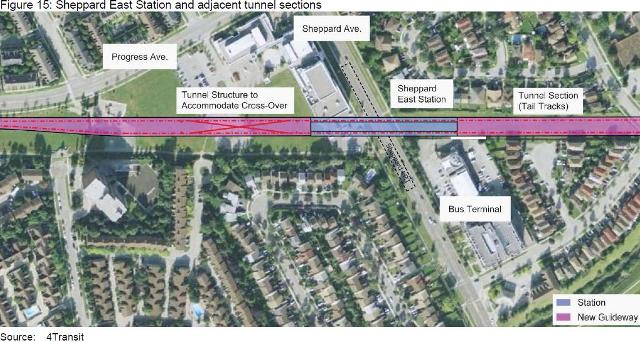
- Underground operation at Sheppard East station including the south approach and tail tracks to the north.
Turnback facilities would be provided only at Kennedy (a new crossover west of the relocated station) and Sheppard East, although a crossover at STC is also possible (but not included). There are no pocket tracks planned that would be used for partial turnback of service and the operational plan is that all trains would run through to Sheppard East. The study contains no estimate of additional rolling stock requirements, nor of the yard space required to service the added trains.
Although there has been talk of making provision for additional stations (notably from Minister Glen Murray when challenged on the subject), the vertical alignment of the subway includes many grades (shown in detail on the alignment drawings) that would make insertion of the level sections needed to provide for future stations difficult.
By analogy, the North York Centre Station was allowed for in the original subway design, but this was not a hilly section of the route. Adding a level section to a long grade requires that grades on either side of the station are steeper than they would be otherwise. The implications of such provisions are not included in the study.
Kennedy Station
Two designs for Kennedy Station were considered.
- The first option continues the subway on the same path it follows northeast from Warden Station diagonally under the Hydro corridor.
- The second option places the new station further south to avoid conflict with the Hydro towers.


Kennedy Station to Ellesmere
Two separate alignments for the new north-south section were considered.
- If the subway stays on the west side of the corridor where the RT tracks are today, then the new Kennedy Station must be positioned to minimize the curve turning north into the corridor. This alignment also requires replacement of the tunnel and curve at Ellesmere from the RT corridor onto the elevated structure west of Midland.
- If the subway is moved to the east side of the corridor where the GO tracks are today, the requirements for new Kennedy Station are relaxed because there is more room for the curve turning north. Moreover, an eastern alignment eliminates the need for a tunnel at Ellesmere and therefore reduces the height the subway must climb to reach the elevated structure.
The study did not address the implications of cutting off rail service to the existing freight spurs to industries on the east side of the corridor.
Ellesmere to McCowan
The existing elevated structure is not useable for subway trains because the distance between the tracks is closer than would permit subway car operation. Moreover, the structure is old and its alignment is not ideal for subway operating speeds. A totally new structure will be required.
At Scarborough Town Centre, a new station would be built with a centre platform that would share vertical access by stairs, escalators and elevators. A restructured bus terminal would be underneath the subway station. Because the study only considered a through route to Sheppard East, it did not examine alternative designs at this location based on different levels and numbers of feeder bus services required if STC remains a terminal.
McCowan to Sheppard East
The line would descend to grade east of McCowan (as the RT does today to enter McCowan Yard), but would rise again onto an elevated structure west of Brimley. This is required because the route follows the Highland Creek ravine until it crosses Progress Avenue east of Markham Road.
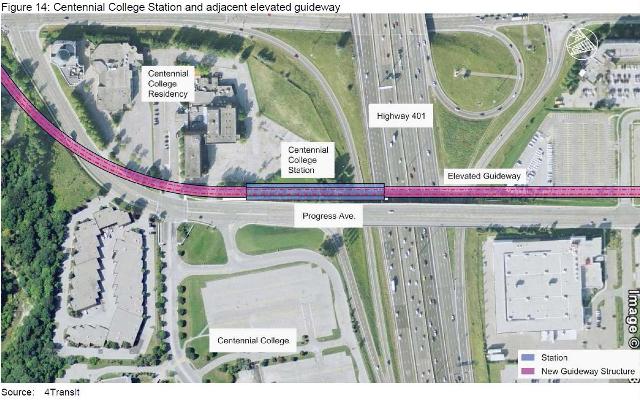
The Centennial College Station is located on the west side of Progress immediately south of Highway 401 which the station would partly overhang. North of the 401, the line drops into a tunnel for the approach to Sheppard East Station.
Curves
Several of the curves along this alignment would have a speed restriction of 55km/h and would require wheel lubricators to prevent squeal. On an elevated structure, this is a significant issue, one which has arisen at other locations on the subway system, notably west of Islington Station.
The study is silent on the issue of noise control and effects on existing or potential future development. Considering that noise along corridors is a major issue elsewhere in the Metrolinx universe (Weston corridor, for example), this is an amazing omission for a route that would largely operate in the open air.
Land Use and Potential Ridership
Much has been made of the claim that the RT alignment for a subway serves more priority neighbourhoods and walking-distance population. This was, in fact, a benefit of the proposed LRT service, and the only difference for the subway scheme is the absence of stations at Midland and Ellesmere which eliminates these as locations for future development. However, the lands there are industrial and unlikely to change in the near future.
The study is silent on the development potential of the RT alignment and makes no comparison with what might happen on the McCowan alignment.
Similarly, there is no reference to ridership in the study and the number claimed in the Minister’s announcement appears to simply have been copied from the McCowan alignment’s projection. This number is suspect because it may contain demand that properly belongs on an improved GO service in the same corridor, but was assigned to the subway by the demand model.
Moreover, if the subway ends at STC, then the demand forecast to Sheppard cannot be used because it presumes a fast, transfer-free trip eliminating changes in vehicles at both STC and at Kennedy.
Construction
Construction of the subway on this alignment would obviously have significant effects on current operations:
- Construction of the proposed new Kennedy Station would conflict with existing operations for a period during which subway service would terminate at Warden.
- Replacement of existing RT structures would require this line to shut down. The time required has been claimed to be roughly equal to that needed for the proposed LRT upgrade (3 years), and this is not credible considering the substantially larger scope of work for the subway scheme. (Alternately, the shutdown period cited for the LRT proposal has been overstated.)
- Temporary bus terminals would be required to accommodate construction and shutdowns.
Moreover, the project would likely delay the opening of the Eglinton-Crosstown line because Kennedy Station would not be available for the 2020 target date.
The proposed staging of the project is optimized around concurrent activities where possible, and a minimum shutdown period. By contrast, plans for the LRT scheme were saddled with the need to fit into provincial cash flow constraints, and construction of the LRT was artificially extended in the plans as a result.
Cost
The total cost of the project is $2.4-billion in 2011$. This includes provisions for property, professional services and contingency to a total of 60% over the basic estimate of $1.4b. The study claims that some of this may be saved through alternative procurement strategies, but there is little on which to base such a claim given our lack of experience with such schemes for large-scale transit construction by Metrolinx and Infrastructure Ontario.
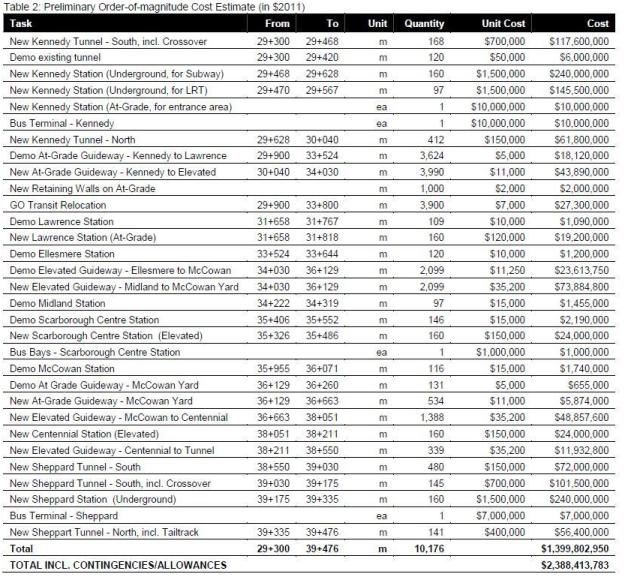
Approximately 40% is due to the section east of STC making the announced Kennedy-to-STC section roughly a $1.4b project. This conveniently fits within the $1.48b the province has on the table.
An unanswered question is the status of the $320m carved out of the $1.8b LRT project for the original scheme to rebuild Kennedy Station for the LRT projects. Some or all of that money should be available for the new Kennedy Station, but it has not been included in the proposed funding for the subway project.
The cost estimate does not include replacement bus service, new trains, yard and maintenance facilities, new substations or HST. Any comparison with other proposals must include these items.
Although the TTC does have surplus T1 subway cars, by the time the line opens (2023) these will be close to retirement age. Moreover, if all service runs through to Sheppard, the extra cars are not sufficient to operate the line. Presuming a route length of 11km (same as the LRT proposal), or 22km for the round trip from Kennedy to Sheppard, at 30km/h average speed, this would represent 44 minutes of running time. On the current headway of 2’20”, this would require 19 trains plus spares, or about 22 in total.
At $15m per trainset, that is $330m worth of trains. If half of the service turns back at Kennedy, this would be roughly halved, but there is no provision in the study’s design for a scheduled Kennedy short turn.
Where a yard might be added is unclear. Greenwood is full and the once-proposed LRT yard site between McCowan and Bellamy may not be suitable for full-length subway trains. (The Murray/RT alignment shares this problem with the McCowan subway proposal.) The TTC prices a new yard and maintenance facility at $500m. If only storage is needed, and the number of trains is lower than would be found at a typical yard, this cost will be reduced, but it won’t be trivial.
Summary
The Metrolinx feasibility study achieves its purpose as far as it goes. There is a potentially viable route for a subway from Kennedy to Sheppard via the RT corridor, although this requires many details to be worked out that could add to costs and/or reduce the line’s attractiveness. The omission of major components in the total cost must be rectified to allow valid comparison to other proposals.
 Steve Munro
To those comparing the Scarborough transit upgrades with the DRL. Please stop. Both are highly important. A subway through Scarborough is the correct form of transit as it makes sense for those who live here to have a direct artery to downtown from the heart of Scarborough. I’ve heard the arguments on both sides. Its clear to those who live here what will be the best bang for our tax dollar.
The DRL needs to get moving. I fully agree. But lets not try to take from one project to feed another just because a “proper” fully integrated transit plan had not yet been developed.
LikeLike
Steve:
I am probably repeating myself here, but this makes me mad as all get out. (I won’t be repeating as often as some people talk about disrespect for them when a Cadillac transit system is not built in a Chevrolet Corridor however.) Our City has been damaged by the current Mayor in his quest to “respect taxpayers” by freezing taxes or having tax increases under inflation. My pet peeve is the High Park Zoo (and I guess Riverdale for east enders) which I really enjoyed as a child. I have very fond memories. To defund this attraction to save $500,000 is to my mind a disgrace, especially as our City evolves to include more children who do not even have a backyard, as I did. I won’t even get into our City’s disgraceful approach to TCHC and other social welfare issues under the current administration.
This is all happening against a background of destruction and chaos for the TTC. Cutting and freezing the subsidy in a time of high growth is a recipe for disaster. Demand is spiralling, and the TTC – at best – is stagnant. We do have social need for transit improvements in areas considerably worse off than Scarborough. Finch and Steeles East and West are obvious examples, though there are many routes in the “inner suburbs” where the demographics are skewed to poorer people and the service is beyond poor. Transit City was going to relieve a bunch of that misery, but instead we get an unneeded subway at a cost of an additional wasted billion dollars or more. The Federal Government, who have treated Toronto with disdain, now wade in with $660mm to help reelect The Buffoon and perhaps increase their chances in the next election in the East end. In the meantime, Canada as a whole suffers from spending cuts.
Our Provincial Government abandons all principle to win just one or two seats in a General Election or By-election. Gas plants or subways, no decisions are made based on principle or sound planning. Billions of our dollars are squandered to win a 3 or 4 seats. Now, in the mad rush to win votes in Scarborough, I am faced with a significant tax increase to pay for an unneeded subway based on resentments fuelled by politicians with only self interest in mind. Now don’t get me wrong. I was denied the opportunity I wanted to pay more taxes to help end the inequity at TCHC. I was denied the opportunity I wanted to pay more taxes for the High Park Zoo. I was denied the opportunity to pay more taxes I wanted to pay for the Transit City Bus Strategy. All of the things I wanted to pay more taxes for (not just the above) were denied to me. I am proud to pay my taxes and I really care about this City. I want to pay more to preserve and improve what makes this City great. I bitterly resent my tax increase that will be squandered on an unnecessary unneeded subway crafted by crass politicians for their advantage.
LikeLike
Look what happened at Leslie / Oriole Stations. The connected station was one of the first things to be dropped when the project went over budget. Expect the same for Kennedy.
Steve: More to the point, the fact that GO/Metrolinx has left the situation at Oriole for so long shows just how committed they are to integration of services.
LikeLike
@Michael Greason
I very much agree with most of what you said. Except for the part about your needs in the West’s needs being more important than the East. Wait another 25-40 years and maybe (although I doubt) the West becomes a starved political poker chip and you’ll be lucky enough to be part of the next Scarborough. Until then enjoy your outdoor hockey rinks and pools. Oh we lost our petting zoo years ago. I could go on… But if you care about details you can investigate further.
Again I’m not saying your needs are not being met. I know they aren’t & I know full well this administration has been shifting the money around to meet their own personal agenda. A big part of the reason this buffoon has power is because those who are not residents of Scarborough could give a crap about the East and this administration is lapping it up. But most haven’t got the full picture yet because they are understandably keyed into their own issues.
LikeLike
Kevin’s comment:
And don’t hold your breath in that year either. If born-a-multi-millionaire Rob Ford had not killed the Sheppard East LRT (and been subsequently overruled by City Council) it was scheduled to have opened on September 11, 2013. Yes, Scarborough would have high-quality rapid transit right now. Instead, we got nothing.
LikeLike
Steve,
If the funding gap can be closed, wouldn’t one then ask the question that with an extra billion dollars, what would Toronto want? As subway extension to Sheppard or an LRT line to Malvern and a DRL line (even if it ends up as a one-stop from Pape Station to King or Queen St). I suppose building the stations in between can be done at a later time. The 5 minutes lost transferring over at Kennedy you’ll get back taking the “express” at Pape. 😉
Steve: This has always been the issue. It’s not enough to be willing to spend money on transit, but to spend it to the best effect. I am waiting to hear how we can’t afford some new project because all our money and borrowing room are committed in places like Scarborough.
LikeLike
Hi Steve… Is is it possible to know at this point how large the funding shortfall is for the aligment McCowan alignment? I’m having trouble keeping track.
Thanks.
Steve: Presuming that the TTC does not adjust the numbers they presented in July, it would be roughly $400m, the difference between what the city assumed it would get from Queen’s Park and what it is likely to receive. I would not be surprised to see “add ons” such as a station at Brimley that could increase the total, but at this point the city will be on the hook for anything like that.
LikeLike
Historical question. I haven’t been around for a long time – is this how infrastructure has always been built like in practice? I feel disgusted thinking about the politics in play here and it doesn’t seem like anyone cares about a ‘best’ outcome measured in any way except for votes in the next election.
But is this how it always happened? Is that why Kipling and Kennedy and Downsview were one-station extensions? Was this effectively why the subway follows the Allen? Sheppard and SRT too? Was there ever a good time when things were actually different? Should I just accept that this is the only way things happen in Toronto?
Steve: The Scarborough Subway is probably the worst of political pandering and vote buying. Kipling and Kennedy were logical extensions of the BD subway, and originally both sites were to see major development. You may have noticed it didn’t happen, and in Scarborough’s case, it was because the then city of Scarborough didn’t want competition with their precious town centre, a development whose location was dictated by land ownership by Eaton’s, not by popular uprising. Similarly, Yorkdale’s location dictated the alignment of the expressway and subway. Downsview Station exists as a compromise between a proposed Sheppard subway and a line to York U — Downsview was the only element the two sides could agree on. Sheppard is a monument to Mel Lastman’s ego and North York’s aggrieved need to feel it was a real city (rather like the way Scarborough has been exploited today).
And so, yes, to some extent it has been “that way” for decades, but this is the worst I have seen. Meanwhile, we pretend that we have an arm’s length regional planning agency.
LikeLike
Kevin’s comment:
I fully agree with what you wrote, and will just point out a few things in particular.
Kevin’s comment:
$500,000 is the amount of taxpayer’s money that born-a-multi-millionaire Rob Ford paid Gary Webster to fire him without cause for the horrible offense of telling the truth.
Everything you mention, from the High Park Zoo to TCHC to Transit City Bus Strategy to the TTC subsidy could have been paid for with the money that Mr. Ford has wasted. Wasted on everything from $500,000 to fire Gary Webster to the $505 million Gardiner boondoggle to the irresponsible car licence plate tax cut of $64 million annually to the latest madness of wasting another billion dollars on the inappropriate technology of a Scarborough subway.
How could we have spent the wasted money instead of flushing it down the toilet?
The TCHC $751 million backlog is equal in cost to the Gardiner boondoggle plus 5 years of the irresponsible car tax cut. After 5 years the irresponsible tax cut could have paid for many, many more needs including transitioning the Gardiner to something useful along the lines of the High Line park in New York. But we’ll never really know because Rob Ford and his ilk trash canned the EA that would have costed out the alternatives.
Similarly, the billion dollars wasted on inappropriate Scarborough transit technology would have topped up the TTC subsidy and paid for Transit City Bus Strategy for many, many years to come.
LikeLike
Even though Ford seems to be all for subways, subways, subways, it is interesting to note that 3 of the first 4 Transit City routes are being completed as planned – and all 3 of those are being built in the median of a major arterial road. The only LRT that is being changed to a subway is the SRT, which was completely grade-separated already. I would say it looks like this was orchestrated by the Pro-LRT faction, and Ford is not aware that he has done nothing to get transit off the roads. We are paying an extra $1B to bribe Ford and some others with the idea of a subway – even though Transit City is actually being implemented.
Steve: Did you listen to Ford’s statement this morning? He is dead set on getting a subway on Sheppard to link up with the Scarborough line. All he needs now is a Hudak government at Queen’s Park and his own re-election at the city. You can bet it will be part of his election platform to save poor Scarborough from those pesky “streetcars”.
The rest of Transit City doesn’t have a chance until both Ford and Hudak are consigned to the garbage heap they so richly deserve.
LikeLike
You are dead wrong. Last time I checked, only 1 of the first 4 Transit City routes are being built as planned: the Eglinton Crosstown LRT. Nothing is happening on Sheppard and Finch Avenues currently. It is naive (and stupid) to think that these projects are safe.
Which is why it’s important to assign probability/importance values to factors like this. I can argue that we shouldn’t have streetcars because they get blocked by car accidents, but accidents are, by definition, occasional events that really don’t outweigh the benefits of streetcars.
LikeLike
Just for the record, I don’t live in the West End, though I grew up there and went to the High Park Zoo. I now live close to the middle, though a little to the west. I hope my comments are reflecting the greatest benefit to the City as a whole and not my personal benefit. I love this City, from east to west, but do not believe The Buffoon has that interest in his heart.
LikeLike
Based on Ford’s support of the combined SRT/ECLRT (underground), the Province’s subway extension and the City subway extension, it appears that all he wanted was to eliminate the transfer at Kennedy. Unfortunately, the direction he (and the City) got from the transit experts was quite poor indeed:
1. In early 2011, Metrolinx (through the Provincial Liberals) said that the only way to eliminate the transfer was with a combined SRT/ECLRT (underground) – even though it cost $2.0B more. The vehicle had to be LRT, since they were already ordered.
2. In mid 2013, Metrolinx said that the best way to eliminate the transfer was not the original LRT, but a subway along the SRT corridor – even though they had earlier stated that a subway in this corridor was not possible. Now it seems that LRT vehicle order is not a big issue.
3. In mid 2013, TTC (through Karen Stintz) said that the best way to eliminate the transfer was not the LRT that they had campaigned for for over 5 years, but a subway essentially the same subway they studied in 2006 and found to be by far the worst solution. The extra cost of this solution would be over $1.0B.
It still seems the best solution to eliminating the transfer would have been to have a combined SRT/ECLRT, with the portion from Don Mills to Kennedy elevated. This would provide a line from Malvern to Mt. Dennis (eventually Pearson) – with the full length and stations into northeast Scarborough, plus the advantage of a continuous line. It would also better distribute passengers to the Yonge line by splitting those from northeast Scarborough to the Yonge/Eglinton Station and those from southern Scarborough to Yonge/Bloor – whereas, both the subway options and the SLRT option dump all the passengers onto the B-D subway for a transfer at Y-B. When the DRL is completed, this combined SRT/ECLRT does an even better job since it would have 4 transfer points (Y-Eg, DM-Eg, Y-B, Pape-Danf) instead of 2 (Y-B & Pape-Danf), and the new DM-Eg station would be much easier to make into a major interchange than the existing Pape Station. Almost regardless of what is done, the Yonge line will be constrained by Y-B so its relief is the critical point.
The cost premium of this combined SRT/ECLRT would probably be in the $300 to $400M range, since only one LRT station would be needed at Kennedy and not 2, the underground loop would not be needed at Kennedy, the underground portion would begin east of Kennedy instead of west, and a 3 track station would not be required at Don Mills (not sure if this is still in the plans – or maybe it has been moved to Laird). It would be along the already approved route so the EA (revision versus new) process would be easier and faster, and the +/-$320M (difference between $1.8B and $1.48B) would not be lost since the station design at Kennedy would not be that dissimilar to the current LRT design.
The inability of anyone to propose an alternative to the transfer at Kennedy is why Toronto is preparing to spend an extra $1.0B or more, when a lot less could have been used to create a better result.
LikeLike
Sooner or later you’re going to have to accept the fact that we live in a democracy, and if the majority want subways, so be it. I admit that the planning on this file has been a complete joke, but it no longer makes sense (from a network perspective) to link the Sheppard and Scarborough subways with an LRT line that is not connected to other LRT lines. You’ll just be creating another isolated “SRT”, but in LRT form. I seriously doubt the Sheppard LRT will ever be built. Attention will probably shift to a downtown subway next.
Similarly, the technology that was chosen for Eglinton was based on a Scarborough LRT using the same technology. Now that needs to be revisited as well. What’s the point in having another “one of”? This change essentially kills the entire light rail concept.
As for the question about whether subway planning in Toronto has always been a joke, the answer is yes.
LikeLike
Nobody deserves a subway because of personal feelings. That’s like saying the people in Richmond, BC deserve those Canada Line stations in order to not feel left out in the cold. Translink wouldn’t dare treat citizens of Richmond as second class now would they?
Oh speaking of Canada line, I think Metrolinx should of built a Canada Line style technology elevated from Union station to Brampton GO Station and the tracks would also jog of to Pearson airport. And don’t forget those stations in the middle (yes there will be a station at Liberty Village)! Now that’s a relief line!!! Plus there’s no dirty diesel pollution so no need for noise walls!
LikeLike
Robert, I split apart the costs to my best guess, and I have to agree that the TTC data is reasonable. After deducting direct costs (labour, benefits, and fuel), I get about 25% overhead. That’s pretty good. The overhead covers depreciation, maintenance, infrastructure, and administration.
However, you went off track calculating costs based on TTC onto the micro-bus. I already said that the cost structure in Europe is different than in Canada. And, instead of 20 minute headway, it is more like in the 8 to 15 minute range. Over there, the only cost disadvantage they have is the fuel cost. And let me clarify – the bus leaves point A and arrives at point B in 20 minutes. Along the way, it drops off & picks up passengers, the pickups wave down the vehicle because there are no designated stops. So, instead of merely 12 (seated) passengers on the 20 minutes, there can easily be 18 or more. I forgot to mention that standing fares are allowed, though they are hanging on for their lives. Then, the bus takes another 20 minutes to make the run from point B to point A, etc. Three lengths of the route per hour. Of course, this is just an example that I have personally observed, there will be longer & shorter routes, different cities will have different fares, and so on.
Robert, your comment regarding Wheel-Trans does not apply here – the typical vehicle has only 3 passengers an hour, all pre-arranged. The Wheel-Trans fare is just a gesture, a token payment.
The micro-bus is hardly a quarter in size of a TTC bus, just a bit bigger than a SUV, uses auto tires. These are well-maintained and recent model municipal vehicles, not free-lance jitneys, not ragged.
Consider also that European cities are ancient as compared to Canadian cities. Streets zig-zag in all directions, there is no grid pattern. Cities are much more compact than in North America. Here, 80% of commuter do TTC (“Take The Car”), over there 80% take public transit. There they tend to have urban enclaves (instead of sprawling suburbs) which have only one main road towards the centre. This is where the mini-buses come into play. A captive consumer group, indeed. But, my Bolton is just like that with reference to Toronto – highways 50 and 427 are the route to Toronto, sometimes King Road and Hwy 400, but there is virtually no transit along these routes. Just an aside, one time at a public meeting regarding stuffing more population into Bolton, I made a joking comment that what we need is an LRT down Hwy 50 to Toronto – was I surprised in the positive response, nearly everyone thought that it was a great idea!
However, let’s bring the whole thing back to Canada. After all, my argument used as an example GO bus service (not the train service), that it is too inefficient. And that is part of my argument that everything tends to be over done. “Grandiose” is a word I have seen others use to complain. Instead of a fancy coach every few hours, what about different mini-buses every half hour or less, which go to various places that I might actually want to go to? “Grandiose” is the correct word to describe what Steve said is the required $1 million per CLRV for upgraded control systems to keep them on the road.
But, let us also take a look at my conservative calculation of $72 per hour revenue on the European micro-bus. First, how many Toronto cab drivers would turn down $72 / hr? Not many, that is for sure. They run empty 80% of the time. The meter pays for the car and the tip pays the driver. Airport limo drivers have a similar fate. Though they have a generous fare rate running out from the airport, mostly they go back empty and have to wait an hour or two in queue.
It was mentioned in this blog that some TTC routes more than break even. Obviously, these routes have a very good load factor. Consider that the TTC cash fare is $3.00, the most expensive fare. There are Metro passes, student fares, and free transfers from connections. So, what is the average fare per passenger on these money-making routes? Maybe $2.00 or 2.25? Double the European fare, but Canadian costs are double, too. The Europeans are running at 100% load factor, they must be breaking even or better. Consider the airlines – load factor is the most important operating statistic, it affects the stock price, even.
Steve: I have to jump in here. In a flat fare system, revenue allocation is not possible, and the TTC stopped doing it some years back. Routes with many short trips to which a flat fare (or a flat partial fare) is allocated will always be “profitable” because the amount of service consumed per trip is low. Meanwhile, the same allocation scheme the TTC once used (a partial fare for each leg of the trip) would overallocate fare revenue to longer, multi-leg trips, and underallocate it to short ones. This completely distorted where riders actually “spent their money”.
And now, back to the SRT, as I am posting in the Scarborough subway thread of Steve’s blog.
I am actually pleased that the feds are bringing the $660 million in new funding to build the subway up McCowan to Sheppard. Yes, this is not the ideal route, that has been discussed here previously. But, he who pays the piper calls the tune. Even though it is really our money, but, then why do we keep electing these people? Yes, this is not the best use of the money. But, it does allow the SRT to continue to operate while the subway is under construction for the next 10 years.
So, once again, if the SRT is falling apart, cannot we fix it and upgrade it economically? On this same thread I previously mentioned using Bombardier Mark III (Innovia Metro) vehicles to replace the current Mark I’s. I suggested moving away from third rail power source to overhead wiring & pantographs. After looking at the problems with the LIM “fourth rail”, the best solution would be to just use electric rotary propulsion. Cannot we continue to use the ICTS-style vehicles? All the platforms could remain as is, there would be minimal track rebuild, could retain the existing storage & maintence facilities, the line can easily be extended. Basically, maintain the status quo. Funny how Vancouver can do this but not Toronto. How much would this cost? However, if we went to the ECLRT-style of vehicle, rebuilding the route would cost $1.8 billion, and the money is being recommitted, this option is dead. Furthermore, by what logic would the SRT need to be shut down once the McCowan subway route starts up? You could argue the same thing – why the Lansdowne bus is still operating when the Dufferin bus is adjacent? It is because they are not the same route.
Steve: There is a fundamental difference between the SRT and the Lansdowne/Dufferin buses. The primary function of the SRT is to transport people from bus routes feeding into STC station to Kennedy. The route they take is immaterial from a network travel point of view. A smaller group of riders travels from Lawrence East Station to Kennedy, but again they are delivered to the station mainly by the Lawrence East bus.
If the bus feeders are redirected to the Scarborough Subway, there will be almost no ridership left for the “SRT” to carry.
By contrast, the Lansdowne and Dufferin buses have different, if nearby, catchment areas, local to each route and they serve a fine-grained collection of origins and destinations.
LikeLike
Events of the last few days have proven extremely interesting. The announcement by Harper and the follow-up by Flaherty are a way of helping out the PCs and Ford, but also an effective way of knocking the legs out under Murray and his proposal. The province is now in an impossible position: go it alone, and push forward on a plan that no-one else wants; or quietly climb down, welcome the cash, say it is what you wanted all along (even though it wasn’t), and tell Murray not to utter a squeak of disapproval. I suspect the latter is likelier.
I think Ford’s dream of ‘completing the loop’ will stay a dream, however. Flaherty re-affirmed funding for the Sheppard LRT yesterday, which he was not compelled to do. If Ford is hoping that Hudak will win the next provincial election and sweep away any talk of LRT, the flaw in the plan is Hudak winning the next provincial election. As noted elsewhere, the man is about as cuddly as a rattlesnake. If the PCs were led by someone like Mike Harris, then I’d begin to seriously worry about the Sheppard LRT. Right now, though, the Sheppard LRT is still on life support, and with a fighting chance of pulling through.
LikeLike
That is not a fair description of the situation. I don’t recall any plebiscite on the subject. What is true is that a majority does not realize that many parts of the City could have high-quality transit for the cost of this ill-conceived subway extension vote-buying exercise.
If we build a couple of LRT lines, operate them for a few years, then hold a preferential-ballot referendum on how to spend another $10 billion:
– return to the taxpayers (or don’t raise the money in the first place);
– spend on a specific many-line LRT expansion;
– spend on a specific 2 or 3-line subway expansion;
… and the result comes in for something other than my top choice of LRT expansion, then I will accept that the result is democratically correct even if I disagree with it. Until then, references to democracy and majority rule are either just a cheap rhetorical ploy, or a way for supporters of evidence based planning to convince themselves things aren’t as bad as they really are.
LikeLike
The Globe and Mail today seems to be a few cars short of a TR. The Marcus Gee column is A-OK with the subway expansion, making some blather about the famous “one seat ride”, and the editorial makes a reference to Scarborough’s transit future becoming clear. Do they have entirely new staff since Transit City was released? Is chronic amnesia a job requirement for editorial staff?
LikeLike
Team Ford/Flaherty can guarantee itself reelection if it promises to convert the Sheppard LRT to a subway from Don Mills to Sheppard / Mccowan and create a continuous Bloor Danforth Mccowan Sheppard superline. If Hudak gets on board, he will make the necessary breakthrough in Toronto. Sadly the downtown relief line will be shelved since Tories won’t bother with futile attempts to get votes in downtown Toronto. The city will have to find money for the DRL on its own.
LikeLike
The problem is, dreams (or hallucinations) can sometimes be used to keep reality at bay. Simply by beating the “unfinished business” drum, politicians like Ford can keep the DRL line from getting started.
The sad thing about that is by building the BD line to Sheppard, demand for travel from Scarborough to Yonge along Sheppard may drop to the point where an argument could be made about whether even any form of BRT would be overkill on Sheppard. I even begin to wonder if Flaherty had yanked the funding from the Sheppard LRT to fund the BD extension, would the Sheppard LRT still be successful if it only ran as far west as Consumers as a pure surface route with a subway connection at McCowan; ignoring the dangers of delaying the start of construction again of course.
LikeLike
Leaving aside the pointlessness of converting the Sheppard LRT to a subway given both ridership projections, the cost, and the time involved: surely you don’t think that the DRL is a benefit to people living in downtown, as such? They’re the one set of people least likely to care, on an individual basis, about crowding on the existing lines, because they don’t use them. It’s residents in the inner suburbs who will be most affected by the presence or absence of the DRL.
I also suspect that any conservative government in Ontario which tried to create such a superline but also held to a no tax increase policy would be destroyed at the polls after one term by voters upset about little things like health care and education, given the costs involved and the inability to expand the revenue pie.
Steve: I’m not sure who you’re addressing here, but my feeling has always been that the purpose of the DRL is to provide an additional path into the core for people arriving, broadly speaking, from the northeast. This would create new new capacity on the subway network benefiting folks from many places. Whether it would be possible to get on westbound at Broadview at 8:30 am is another matter, but even if the riders filling “my” trains are a new group coming from northern Scarborough while some existing users shift to the DRL, that’s a net benefit on a network wide basis.
We cannot keep extending lines in the outer 416 and 905 without providing more capacity downtown where the jobs and the peak demands are.
The DRL needs to be called the Don Mills Subway to give it a suburban focus, and we have to start talking about a Union to Eglinton (at least) route separately from whatever might happen in the Weston corridor. Make these one big project, and the price tag takes off into the stratosphere.
Please don’t tell me we need to make York/Weston feel the love with their own subway. What they really need is for the UPX to be repurposed as a local transit service.
LikeLike
Both are correct, just looking at both sides of the same coin. We elect them, and then they do it to us.
I do not think that the average voter (already a minority of eligible citizens) knows or cares too much about the issues and options of public transit. (For example, my own family members, all university educated, know & care nothing about transit, except that they don’t want “streetcars”!) All the average voter knows & cares about, once they get out of their car, is getting to where they want to go as easily as possible. Those of us who are regular readers of this blog are but a tiny group. We can only hope that staff of elected officials reads & pays attention to what is said here.
The average person does not read the newspaper, and sometimes watches the TV news. So, when you ask their opinion, the way the question is phrased will determine the outcome.
A referendum has the hope that proponents of the various options will use facts, not innuendo, grandstanding and sloganeering to put their option across to the voters. “Subways, subways, subways, folks!”
It is wisely said that the only poll that counts is on election day. Nevertheless, Mayor Ford is losing any chance of reelection, he was rated at only 27% support just before Murray and Harper made their respective subway announcements. Olivia Chow has wide support across all of Toronto, and has transit credentials. The mayoralty is hers for the taking. Provincially, what is more troubling (regarding public transit) is that the Conservatives are polling ahead of the Liberals. If they form the next provincial government, we can expect chaos. Meanwhile, the NDP cannot get their act together. What is their transit policy, if any? They are polling a very close third place, and might squeak into a minority government if the Liberals get trounced. If the NDP want to form the government, then they should start behaving like a responsible government-in-waiting, rather than as a frustrated opposition as they do now.
Steve: What I find annoying, no offensive, if the premise that if I disagree with someone, I am being undemocratic. That is demagoguery of the worst flavour.
LikeLike
I guess I have a question of the number of additional Subway cars that will be needed to provide adequate service? Will there be enough to provide for the extension?
Just to add fuel to the flame, could you take the cars from the Sheppard line and use it on the Bloor extension? Then convert the rest of the Sheppard line to LRT and be done with it.
Steve: First off, by the time the Scarboro line opens (2023), the T1 cars will be due for replacement. Any surplus we might have today won’t really matter. There are enough spare trains now to operate the Scarboro line with alternates turning back at Kennedy, and with the line on the same 2’20” headway we have today. More frequent service requires (a) more trains and (b) changes to terminal operations and (c) new signals. This leads inevitably to a big order for TR trains, a resignalling contract, and some serious questions about where we would actually store the fleet.
The TTC is reactivating Keele/Vincent Yard which can hold 8 trains, and they are adding a storage track at Kipling that can hold 2 (I believe). That, plus some shuffling at Greenwood, frees up enough for the existing T1s, but nothing more.
As for Sheppard, it might be possible to operate it with TRs with part of the train roped off so that only four cars’ worth was available to passengers. The stations are already sized for six cars, but the platforms don’t extend the full length. One challenge is that the unfinished part of the station is not consistently at the same end — at Yonge it’s to the east, at Don Mills it’s to the west, and this would make selective use of cars tricky because the “overhang” would not consistently be in the right place relative to the station and signals. What the TTC really will need is a small set of TRs built in a shorter consist.
LikeLike
Kevin’s comment:
That isn’t true, and reflects a serious misunderstanding that I have frequently ran across. This is particularly important in the context of a Scarborough line where a large number of passengers will arrive by feeder bus routes.
Suppose, for example, that a bus arrives at STC fully loaded during the morning peak hours. People are jammed in like sardines with 100% maximum crush load. If we assume that the bus started empty at the end of the line and picked people up evenly through its run, then the average load is… 50%.
But wait, it gets worse! Suppose there is very little counter-flow demand so that the bus is making its return trip back to the end of the line essentially empty. Then the average load on the round trip is 25%, even although the passenger demand pattern means that the bus capacity is maxed out and simply cannot carry any more passengers.
Then the Rob Ford types start screaming “25% load! What a waste! Its time to cut, cut, cut!”
Sigh…
Steve: This is the same type of “analysis” that led to service cuts of “unproductive” routes.
LikeLike
I tend not to comment too much on areas that I don’t know that well. But I am really exasperated with what I now term “Clowncil” after the seemed-reasonable LRT plan was shunted aside, and now there’s about $85M in costs – which is not any respect for taxpayers.
Just two years ago, a signed EA contract to do an EA on what I have also seen as a small efficiency issue for the Bloor/Danforth subway, a good bikeway, that EA was killed to save a big half-million. That sum went on the severance pay for Mr. Webster.
And now there’s another $85M and within the report there’s this gem: “Based on the lack of detailed engineering analysis the $100 million difference is not material to the decision making process.”
Even on the respect for taxpayers angle, this is a gong show. Very sad as well…
Steve: To be fair to the TTC, that $100m is, as I said in the article, roughly 5% of the total project cost (over $2b). Without detailed design work, it is impossible to get an estimate to that level of accuracy. Estimates for two versions of the project that are within $100m are essentially “equal”. Yes, it sounds like “what’s $100 million”, but the real point is that estimates that close cannot be said to be higher or lower than each other. Also, relatively small changes in assumptions could change the balance without making a definitive difference.
LikeLike
A majority of Torontonians didn’t support the Scarborough Subway when told it would have fewer stops than the LRT and a majority didn’t support a property tax hike to pay for it, just as a majority of like-minded Torontonians didn’t vote for Rob Ford in the last election.
LikeLike
I don’t think so. Spadina extension tunneling machines are already free with tunnelling already complete. With funding in place, construction will start soon.
Steve: You have not been paying attention. According to the TTC, it will be five years before construction begins. You don’t just go out and start digging based on a design that is at this point little more than a sketch on a napkin.
I have written to Mr Ford encouraging him to use the $333 million to instead bury the Eglinton line as much as possible and some of my friends have done the same. If enough people email or call him urging him to do the same, we might get the whole line buried or at least buried as much as possible. The Sheppard subway benefits me more but Eglinton is more urgent as construction has already begun on it and it is now or never if we are going to stop slow moving streetcars running in the middle of our communities. Steve, how much of additional burial of the Eglinton Line is possible with $333 million? There is no guarantee that the mayor will accept my suggestion but hypothetically speaking, how far will it get us? Metrolinx was already willing to bury it till east of the DVP (till about Wynford Dr) and how much more can an additional $333 million bury? Can it get us from Wynford to Kennedy or at least Wynford to Victoria Park? If we get it buried till Victoria Park, then there is a good chance (with both rivers already crossed) that any streetcars that do run on Eglinton East say between Victoria Park and Kennedy) will eventually be replaced with underground transit when more funding becomes available. The rivers can be crossed with bridges and/or tunnels.
Steve: The marginal cost of going underground is roughly $200m/km, and so you are looking at less than 2km. This will not get you to Victoria Park. As for Metrolinx burying the line to Wynford, yes they were looking at this, but it drives up the project’s cost, and they are already bumping into budget constraints. The East Don crossing would have to be on a bridge because there is not enough clearance between the bedrock and the valley floor for a tunnel.
LikeLike
It’s easy for politicians to make promises on big ticket infrastructure because objections are often easily overrun or ignored, while funding arrangements take time and construction takes even more time. In many cases the politicians themselves won’t even be around when the projects are finished.
For a long time the narrative has been that Toronto has “no money for new transit” and we had to “accept” LRT rather than seeing it as the best option. In such an environment angry feelings emerge … especially when some zones *are* getting new transit and others are not. It is the rare politician who doesn’t try to take advantage of hurt feelings in order to shore up support.
Steve: And that was precisely the wrong way to sell the LRT network. The message should have been that with LRT’s lower cost and shorter construction times (except for Eglinton), we could have a bigger network faster. The many delays thanks to provincial foot-dragging on actually spending the money they “committed” gave the impression that nothing was happening regardless of the technology.
And now that money appears to be available, can we be surprised that suddenly the prospects of ‘subways for everyone’ will not reemerge at the next Council Meeting, or that Doug Holyday won’t be interested in his commitment to a subway extension to Sherway Gardens?
I expect that, in order for the DRL/RL to remain relevant it will need a political champion at the same level of stridency and/or “aw shucks” reasonableness as the current crop of “subway champions”.
That (to me) would be Denzil Minnan-Wong John Parker, Shelley Carroll or (let’s hope) Jaye Robinson, all of whom have “Don Valley” in their ward name. They will be the ones to convince people that the “RL” benefits people living in west Scarborough as much as it does people living in Flemingdon Park, Thorncliffe Park (and to a lesser extent, Don Mills).
Steve: What the TTC really will need is a small set of TRs built in a shorter consist.
How much would that cost in comparison to just removing the walls and finishing the stations? Can TTC assemble smaller versions of the existing TR trains at Davisville (earlier you mentioned that there are some tracks only good for storing 4 car trains) themselves or would they need Bombardier’s involvement?
Cheers, Moaz
Steve: There are three types of car in the six-car TR consist, and I am sure that Bombardier has already thought about alternate configurations. This would probably need their help, but that would most easily come as part of an order for new trains when the T1s reach end of life in the early 2020s. The shorter trainsets could be designed so that, if desired, two more cars could be added in the future lest someone worry that we would doom Sheppard to forever running with shorter trains. This would be a routine capital maintenance cost for new equipment that would be needed anyhow, rather than a major construction project to expand the stations. Don’t forget that the capacity of the line can be more than doubled simply by running trains at the same headway as on YUS (2’20” rather than 5’30”).
LikeLike
It seems to me like with the new federal funding, that it would almost be possible to replace the Sheppard LRT with a subway if you delayed the Finch LRT and the section of the Eglinton LRT east of Don Mills (the purpose of the planned “revenue tools” would be to restore funding for these sections, though the latter ought to be elevated). Rob Ford’s proposal to join the Bloor-Danforth Line and the Sheppard Line reminds me of the North-South Line in Singapore, which goes north from downtown Singapore then loops west and south and joins the East-West Line at Jurong East. I would think that this would be less expensive than previous proposals for the Sheppard subway, because the 401 crossing would already be built, and there is no need to build 2 stations at Scarborough Centre. This would simply require moving the McCowan/Sheppard station further south to near the CTV building to allow for a curve, and extending the 5 existing Sheppard subway stations to 6 cars.
LikeLike
You are absolutely right, but unfortunately the public perception is different. The problem is that only a minority of suburban residents are transit riders. Furthermore, riders who travel to the downtown core comprise a large percentage of all transit riders, but definitely less than 100%. As a result, a relatively small percentage (perhaps 15-20%) of all suburban residents / taxpayers / voters will actually benefit from DRL, and are willing to vote for it.
In contrast, a few subway stations in a suburban neighborhood are seen by many as an investment in the area, even if those stations are lightly used. Many residents will get excited about their local subway, even if they always drive or always ride buses in a different direction and will not use their new subway on a regular basis.
This kind of distortion cannot be totally avoided in a democratic system; the goal is to find reasonable trade-offs between the utility and popularity of the transit expansion projects.
LikeLike
And what makes what is said on this blog the holy grail of transit planning? Why should they listen?
You said people don’t care that much, and that all they care about is getting where they are going as easily as possible.
You got that point exactly right. People want to get from point A to B as easily and fast as possible. If transit cannot offer them an attractive alternative, then they will continue to drive.
I think instead of commenting that people who do not think like you are somehow wrong, etc. Maybe you should ask why your ideas were not embraced by the populace at large. And instead of saying they are not interested, or don’t care. Maybe you should go back and look at that comment you said that they want to get where they are going as easily as possible.
Could it be that the LRT plan you like so much, does not deliver transit that will get them where they are going as easily as possible?
And if so, you have to ask what were the flaws in the LRT plan that led to it not being embraced by the populace, and our elected officials.
We always hear how great a plan is. But explain why the subway plan is going to attract vastly more people to transit? Could it be because it gets them where they are going as easily as possible? I think so.
Steve: The LRT plan for the Scarborough RT corridor differs from the subway only in the complete elimination of the transfer at Kennedy (which would be greatly improved for the LRT). Moreover, the LRT would serve areas that the subway will not touch, and would be positioned for an extension northeast into Malvern. People have been told that the LRT is inferior, but that does not make it so.
There is more to debate about technology and trip times/convenience for Sheppard itself where a median-running LRT would be compared to an underground subway. In that case, the issue is the extent of the route with the LRT reaching to the eastern part of Scarborough and eventually to the UTSC campus, while the subway proposal at best reaches McCowan and with more widely-spaced stations. Is the value of a subway from Don Mills to McCowan greater than the value of an LRT line to Morningside and its companion line east and north from Kennedy via Eglinton and Kingston Road?
The “flaws” in the LRT plan, as you call them, are emphasized for effect by politicians, the same folks who have been telling Toronto for years that large scale spending of any kind is a waste of money, especially when the result is a facility vastly excessive for the job it needs to do.
LikeLike
Assuming that Scarborough Subway is a done deal, it may be interesting to think what other corridors in Scarborough can receive LRT or BRT lines:
1) Sheppard LRT, which is already funded. In my opinion, the subway station at Sheppard and McCowan will make this light rail line more useful. All people living in the vicinity of Sheppard LRT will be within a short ride from either the Don Mills subway [station] or the Sheppard / McCowan subway.
2) The Eglinton – Kingston Road – UTSC corridor (formerly Scarborough – Malvern LRT). It is not funded, but the high combined ridership of the #86 and #116 bus routes (16,300 + 22,400 = 38,700 daily riders in 2012) hints that LRT is still a viable option.
3) Kennedy North LRT is an interesting possibility. Assuming that the existing SRT north-south corridor is not needed for GO enhancements, it can be used for a new LRT line, starting and Kennedy station. At Ellesmere, the line would swing west and continue north up to Steeles in the Kennedy street median.
The ridership of the Kennedy bus is not stellar (15,500 daily), but the potential benefit of this LRT line is that it might be relatively cheap to build, and might be able to attract more riders compared to the bus. Another benefit is that the rail service to the Lawrence East station cluster will be preserved.
Steve: This corridor is needed for substantially improved GO service to handle traffic originating in northern 416 and southern 905 areas. Such a line would contribute to relief of north-south travel into the core area on the subway system.
4) It wold be nice to run an LRT line from STC to Centennial College and then to Malvern. However, the stated ridership of the 134 Progress bus is only 8,100 daily in 2012. If this is correct, then maybe an LRT is not warranted and a BRT is more suitable. Or, Centennial may be served by the Durham’s Pulse BRT, while Malvern can get a short LRT spur off Sheppard, running up Neilson.
Steve: The real question for UTSC is where their students actually live and where they want to travel easily. A related question is where do the folks living in Malvern want to go?
Malvern to UTSC does not strike me as a strong enough demand corridor to warrant an LRT line on its own. The original version of the “Scarborough Malvern” LRT line in Transit City did just what you propose (running up Neilson to Malvern Centre), but this was dropped in favour of extending the Scarborough (L)RT line northeast.
I realize that LRT is out of fashion these days, but the planning of such projects takes many years anyway, and things may change.
LikeLike
The T35A08s cars are not joined together at the factory. They are carried from Thunder Bay to Toronto on tractor trailers using the Trans Canada Highway. There is nothing stopping the TTC from joining them in any configuration as they like as long as the cab cars are located at the front and the back.
MOVIA metro cars are designed to be modular. As long as the on board computers are programmed for 2 cab cars and 2 non cab cars, all it needs are further system quality check and tunnel testing. The MOVIA platform is certified for at least 12 car operation. The longer the train, the more signal delay becomes a problem. For example, when the driver hits the accelerator in car 1, by the time the acceleration signal reaches car 15 would be at least 20ms or so. Add the time for solenoids to activate and the delay can easily reaches 100ms. Shortening cars is never a problem. The motors on each car must spin at the same time. This is why the Bombardier Bilevel cars are so much cheaper as they only need to be pulled.
LikeLike
Did you check with people living near Sheppard about diverting the funding for their LRT? Don’t you think they “deserve” good transit too?
Ah, here’s the problem. I’m not sure what to say. Do I jump straight to an accusation of dishonesty, or do I patiently explain, for the thousandth time, that LRT and streetcars are not the same thing? This is not some sort of debatable matter of opinion: the dedicated right of way makes a huge difference in the way transit vehicles and other traffic affect each other, and there are other differences besides. For that matter, even streetcars can run pretty quickly when traffic isn’t clogged up. Where and when streetcars run slowly, traffic would hardly rush along without them, and would jam up entirely if everybody on the streetcars got out and drove their own vehicle.
LikeLike
I was not suggesting a Malvern to UTSC connection; indeed, such a route is unlikely to match any major travel patterns.
Steve: Sorry, I misunderstood you as there are two Centennial campuses in Scarborough, one near UTSC.
I am thinking of a line that starts at STC, goes along Progress to Centennial (not UTSC), then turns north, crosses Sheppard, and goes into Malvern. This more or less follows the eastern section of the SLRT route, but would run at grade rather than elevated.
Another possibility is two separate services. The Malvern line would start at the Sheppard / McCowan subway terminus, share tracks with Sheppard LRT up to Neilson, then branch off north and serve Malvern. A completely separate line (aka Durham Pulse BRT) would start at STC, go to Centennial College, then to UTSC, and then to Durham along Kingston Rd.
LikeLike
It looks like the Danforth Rd/McCowan team is winning this particular game.
If so, does this give us an opportunity? Re-use some or all of the existing SRT ROW for a BRT or at least a short cut for express buses. The structures should certainly be able to support buses, and at the stations the base could be raised to support bus doors. This could be used to add some E-W capacity to the bus system, express from Don-Mills to STC during the Sheppard LRT construction, a north-south shortcut for selected routes going north from Kennedy. Travel times along the new busway should be comparable to the existing SRT – a half decent headway could be supported with not a lot of vehicles. Details such as eliminating the fare booths would need to looked at to keep operating costs down… but the structures should be sound. The systems (power, track, comm) would largely be pulled out and turned into Toyotas and a nice paved base put in.
Final check is the width of a bus which matches the SRT vehicles within a few inches. Without the power collection gear on the opposite side of the platform, there should be enough space to steer a bus through the station.
I’m sure I’m not the first one to think of this, but it’s something that offers a bonus to the outcome.
Steve: Actually it’s not just the width of a bus that is at issue. Unless it is a guided vehicle, the “roadway” would be too narrow especially on the elevated section if you want to include service to/from STC.
LikeLike
Team Ford needs to ensure that the Sheppard subway is extended from Don Mills to McCowan/Sheppard. Therefore it is essential that the Sheppard LRT is canceled. Also, the Sheppard /McCowan station on the BD line must be built in a way that will allow trains to turn west and become the Sheppard subway without a transfer. This superline will encourage tremendous growth along the Sheppard corridor and the additional tax revenue will pay for the line.
Instead of a DRL, we need to encourage population and employment growth to occur OUTSIDE the downtown core. Downtown Toronto is too overcrowded and dehumanized. The STC, York Centre, and the Sheppard and Eglinton corridors are places where growth can occur.
Steve: The level of additional development needed to pay for any subway very substantially exceeds anything that is likely to (a) be acceptable to the surrounding communities or (b) viable from a developer’s viewpoint because the entire GTHA market would be flooded with new units.
Population growth is happening downtown because that is where people want to live. The whole idea of suburban growth was tried decades ago and has failed with a combination of sprawling office parks and residential development that is very badly suited to transit. Indeed what growth has occurred is straining the suburban road systems that were not designed for the level of demand they see today, let alone what further intensification will bring.
Meanwhile, demand into the core from outlying areas continues to grow and this is not going to vanish just because you think we should stop building employment centres downtown. Tell that to the developers and to the companies who rent office space, and they will laugh you out of the building.
LikeLike
So how many people would use the full stretch between Don Mills and McCowan and beyond, to say nothing about Yonge to McCowan and beyond, on this proposed “magnum asinum” subway line? The former strength of the Sheppard subway design was that it would be a feeder to the Yonge line where “underground commuter rail” would be of some benefit by slowly collecting riders along its route and you would theoretically have a full train by the time you reach Yonge. By adding a new north-south route at the east end of the line, you cut the ridership catch basin in two with a dead section between both of them. And that’s just during both rush hours when the line has the appearance of being useful.
To put it another way, by pushing the BD line up to Sheppard, the case for extending the Sheppard subway has been significantly weakened while the case for building the Sheppard LRT has been strengthened. This is due to the shortened distance to the point where the number of riders using the Sheppard Subway and originating/travelling to east of Don Mills will drop off to zero once the BD extension opens. Of course, that is only applicable if you are not of the mindset that “It’s never gravy so long as it’s my gravy”.
Steve: It is also worth noting that the original Ford proposal for a Scarborough Subway would have followed the RT alignment — exactly the route proposed by Queen’s Park and now dismissed by Ford.
LikeLike
Are not the control circuits digital? I doubt that anyone would design a system these days were the signal had to be implemented in each car before be sent on to the next car. In 100 ms a signal that propagated at 0.1c,, which is much slower that the propagation rate for electric signals in wires would travel 3,000,000m, far beyond the end of the train. There will be some other delays because of inductance and capacitance but I cannot see the delay in getting the signal from the first to the fifteenth car being anywhere that great. All cars would have a similar delay in the starting of acceleration.
You are correct in saying that 4 car TR trains would be possible. Right now they are connected in an ABBCBA configuration where A cars are cabs with either air compressor or low voltage converters and B cars are cab-less with the other package. C cars are the same as A with out the cab. As long as cars are added or removed in BC pairs the configuration can have 4, 6, 8, 10, etc. cars up to the systems maximum capability. Four car TRs for Sheppard should be no problem.
LikeLike