
Updated October 2, 2013 at 12:30 pm:
Metrolinx has released a transcript of a press conference held earlier today regarding their letter to the City Manager about the Scarborough subway.
In related news, Metrolinx advises (through a separate email) that they are “approximately 3 months away from making [a] formal recommendation on Sheppard and Finch” LRT lines, and the possible acceleration of these projects.
Also, regarding Eglinton-Yonge Station, they “hope to have a final concept that Metrolinx, City and TTC agree on in the coming weeks and will present in the public session of the Metrolinx December Board meeting”.
Updated October 2, 2013 at 10:30 am:
Metrolinx has sent a letter to Toronto’s City Manager regarding the proposed Scarborough subway. Unlike some pronouncements from Queen’s Park, this takes a more conciliatory tone for discussions between Ontario and the City of Toronto. Notable points include:
- Metrolinx continues to believe that LRT “would provide an effective rapid transit solution to the transportation challenges in this area” within the available funding, but bows to the desire by all three levels of government to build a subway.
- Metrolinx is not dictating that a specific route be chosen, but wants a proper alternatives analysis as part of the Environmental Assessment. This contradicts earlier statements by the government implying that only one route was to be funded. It also implies that the shorter “Transit Project Assessment” process (which does not include the potentially embarrassing need to review alternatives) will not be used.
- The Province is sticking with a figure of $1.48-billion in available funding, from which must be deducted the $85m in sunk costs for the Scarborough LRT project and unspecified costs of scaling down the LRT car order from Bombardier.
- Although the $320m reserved for the Kennedy Station reconstruction with both the Eglinton and Scarborough LRT lines may not all be required, additional costs are expected at the Yonge-Eglinton interchange beyond the current project budget. Savings from Kennedy may be redirected to Yonge-Eglinton. If there is anything left of the $320m between the two projects, then it could be directed to the Scarborough subway.
- The Scarborough subway will be entirely a City/TTC project contrary to previous schemes for the LRT that would have seen provincial ownership and a PPP arrangement similar to that proposed for the Eglinton line. This begs a question regarding the accounting for the provincial funding contribution: if you don’t own the line, you can’t book the asset as an offset to the money spent on it. Does this mark a shift away from the creative accounting used to justify taking Toronto’s transit projects away from the TTC in the first place?
- Provincial funding will begin to flow in the 2018/19 fiscal year implying that no serious construction will be underway until then. The City and/or Federal government will have to front end the project with funding for the EA and preliminary engineering. All risk for project cost overruns will be to the City’s account.
- Infrastructure Ontario remains available to participate in this project, but this is no longer a requirement of the Province for funding. The decision on whether to use IO or to proceed with a conventional procurement (as on the Spadina extension) is up to the City of Toronto.
Not included in the letter, but reported through Twitter by John Michael McGrath, is a comment from Metrolinx that they are reviewing the timing of the Sheppard and Finch LRT projects.
This letter provides a more balanced response to Scarborough subway issue than some recent statements by Ontario Transportation Minister Glen Murray, and it is good to see Metrolinx acting as a reasonable broker rather than simply as a rubber stamp for ministerial musings. The next major step will be Council’s discussion of the matter at the October 8-9 meeting.
Updated September 25, 2013 at 10:30 pm:
Today’s TTC Board meeting was a procedural shambles when the time came to discuss the Scarborough Subway. The contentious name-calling and parochialism of some past debates lives on for at least one Commissioner, Glenn De Baeremaeker, who is so busy puffing up the importance of his own subway that he overstates his case. At one point, Councillor Josh Matlow spoke of the subway proposal as vote buying. De Baeremaeker did not take umbrage but Chair Karen Stintz did and asked Matlow to withdraw the remark. He refused and left the meeting as did another visitor, Councillor Carroll. Smug and over-confident do not begin to describe De Baeremaeker’s attitude which focuses on getting “what Scarborough deserves” above all other considerations.
Three sets of motions were proposed:
- The original recommendations of the staff report which asks that the Commission endorse the McCowan alignment for a subway extension from Kennedy Station to Sheppard.
- A set of motions by Chair Stintz:
- that the Commission continues to support LRT implementation on Eglinton, Sheppard East and Finch as per the master agreement with Metrolinx,
- asking that Metrolinx confirm their support for these projects, and
- asking that Metrolinx confirm that the Downtown Relief Line is the next priority for a subway project after the Scarborough extension.
- A motion by Commission Alan Heisey seeking a meeting between the TTC and Metrolinx boards to arrive at a mutually agreeable plan for future transit in Toronto.
- Commissioner Parker proposed an amendment that would have supported the original LRT proposal.
Some members of the Commission were uneasy with the large exposure for the City in future debt and the tax increases needed to finance the City share for the project. The “citizen” (non-Council) members of the Commission appear uneasy about the fact that they have never been asked to vote on the subway alternative until now, and as articulated by Commissioner Heisey, it would appear that their counterparts at Metrolinx have similarly been excluded from the debate.
When it came time for the vote the Stintz and Heisey motions passed easily, but Parker’s motion failed on a 2-9 vote. However, things came unglued on the main motion. Five Commissioners voted in favour, five against, and one, Nick Di Donato, wanted to abstain because he did not feel he had enough information to make a commitment to the subway line at this time. In this situation, the motion would have lost on a tie vote. Di Donato had not left the table, and so technically abstaining was not an option.
At this point, realizing what might happen, Chair Stintz called the vote again and Commissioner John Parker, who had voted in the negative, left the room to ensure that the motion supporting the McCowan alignment would pass unless Di Donato voted “no”. In the end, the vote was 6-4 in favour with Parker abstaining. This shows how divided the Commission is and how poorly support for the McCowan option was organized by the Chair before the meeting started.
In related news, some members of Council are swallowing hard to accept the level of taxation that may be required to finance the City’s share of the project. Some money will come from Development Charges, but the lion’s share, about 80%, will have to come from general tax revenue.
Meanwhile a Forum Research Poll shows general support for the subway, but splits along regional lines and relative to past mayoral support. There is some support for the LRT option, but the poll question specified a level of tax support for the subway considerably lower than what is actually required to finance it. Support for the subway is higher among non-transit users than transit riders.
The whole matter will be debated at Council’s October 8 meeting.
Updated September 23, 2013 at 8:20 pm:
Today federal Finance Minister Jim Flaherty announced that Ottawa would provide $660-million in funding for McCowan alignment of the subway as proposed by City Council, and reaffirmed funding of $333-million for the Sheppard LRT. This simply quantified the amounts available from yesterday’s announcement by the Prime Minister.
Also today, the TTC released a report comparing the Murray subway alignment via the existing RT corridor with the Stintz alignment via Eglinton and McCowan. Unsurprisingly, the TTC report endorses the McCowan alignment, although it does not go into much detail in critiquing the RT alignment.
A fundamental issue is that the provincial funding of $1.4b is inadequate for either proposal:
Neither the Provincial (RT corridor alignment) nor TTC (McCowan corridor alignment) subway option to Sheppard Avenue estimated at $2.9 billion and $2.5 billion ($2010) respectively, are achievable within the current Provincial funding envelope. Even when the options are truncated at Scarborough City Centre both Provincial and TTC options estimated at $1.7 – $1.9 billion and $1.9 billion ($2010) respectively require additional funding. [Page 1]
Much of the history of these proposals and related correspondence has already been reported here. The TTC notes that there is an outstanding request for information from Metrolinx regarding:
- Ridership projections for both Provincial options;
- Average operating speed and trip time for both subway options;
- Location of the bus terminal;
- Walking distance from the TTC bus terminal and GO station to the subway platform; and
- Any other advantage of this proposal over the TTC proposal. [Page 4]
Minister Murray has claimed ridership for his proposal equal to the number cited by the City and TTC for their scheme, but the latter depended on the route going all the way to Sheppard. As with other claims for his proposal, Murray selectively quoted full-line benefits for his truncated subway scheme ending at STC.
The TTC notes that curves on the Murray line would impose speed restrictions that would add to travel times (not to mention fleet and operator costs) and potentially be a source of wheel squeal that could annoy neighbouring residents. The tight curves would also lead to faster rail and wheel wear. However, the TTC’s estimate of fleet requirements for the two proposals appears to be based only on the length of each option, not on any speed restrictions.
What the TTC does not address is the fact that the Metrolinx consultants claim to have used TTC specifications in their design. Either this was done erroneously, or less than ideal specs were used in good faith for the proposed design. The TTC needs to set out specifications that anyone (Metrolinx, say) should use in designing any future subway lines. This is not a trivial issue given the likely wandering nature of a new Downtown Relief Line (or whatever it is called).
The TTC is concerned about the design of the new Kennedy terminal and how transfer moves between buses and GO passengers and the subway would be affected. This is a valid question especially if the importance of Kennedy as a hub increases. Although RT trips will be diverted onto the subway, much of the bus traffic will continue to arrive on existing routes and the convenience of their transfer connection is important. Equally, if GO improves service on the Stouffville corridor, this connection also should be a convenient one.
Other effects of the project both during construction and under operation include:
- A three-year shutdown of the SRT for the construction project, plus an unknown shutdown of the east end of the subway during the cutover from old Kennedy Station to the new one.
- A more intrusive elevated structure for subway trains which are wider and which require longer platforms at stations.
- The combination of open-air track and steep grades could lead to problems during bad weather, notably icing, and also have issues with wheel slip due to leaves. This is true to a point, but the system already has a comparable area north of Rosedale Station. This can be a problem for TTC operations, but only under the worst of circumstances, and far less often than the annual SRT shutdowns thanks to power and reaction rail icing. It is worth noting that the same problems would have affected an LRT line in the same corridor, but the TTC was silent on these issues.
Cost comparisons are provided for both the RT and McCowan alignments for Kennedy-to-STC and Kennedy-to-Sheppard options. As previously reported here, the Metrolinx study omits several key items such as vehicles to operate the line, and the total value of these is estimated at roughly half a billion dollars. All costs here are only order-of-magnitude given the lack of detailed study, and a variation of $100-million (roughly 5% on the total project) is considered a wash.
If the line runs only to STC, then the RT alignment is slightly cheaper than the McCowan alignment, subject to detailed review. However, for the line continued through to Sheppard, the RT alignment is more expensive because it is longer and has more stations.
               Kennedy to            Kennedy to
                  STC                 Sheppard

Via RT           $1.8b                 $2.9b
Via McCowan      $1.9b                 $2.5b

Source: Table on page 24 of pdf, page 12 of slide deck.
It should be noted that the RT alignment pays the considerable penalty of replacing Kennedy Station, and the costs would be quite different without this factor.
For either alignment, construction will not start until 2019, no matter what Minister Flaherty said at today’s press briefing.
The main report is followed by a slide deck that will be used at the TTC Board meeting on September 25. This deck includes information and raises issues not included in the main report. It acknowledges that the RT alignment has well-sited stations, is beneficial to Centennial College and improves opportunities for a mobility hub at Kennedy, but warns that these factors are offset by the design issues and service shutdown requirements detailed above.
The table cited above also includes an estimate of the number of trains that would be required. For the TTC’s option, the count is 7, and this is in line with previous estimates I have given here that only half of the service would run through to Sheppard. (A 15.2km round trip at 30km/h is about half an hour’s worth of trains. On a 2’20” headway, this would require about 13 trains. Therefore, the TTC may be planning to run only half the service beyond Kennedy Station.)
However, if only 7 more trains would be used compared to existing service, these can be accommodated within existing storage facilities and the allowance of about $200m on that account is not required. It is unclear whether the number of trains is relative to the existing service level or to the existing T1 fleet of which the TTC has a surplus. This is an important distinction that will affect the project cost and scope.
Finally, a question for the McCowan alignment is the location of the new STC station. As shown on the maps, it is actually at McCowan, not in the STC itself. The TTC should examine alternate alignments veering west so that the station could be better connected with existing and future development at STC. Although the details would be something for an EA/TPA study, the issue should be openly acknowledged as part of TTC and Council debates.
We now await word from Queen’s Park on whether they are firmly resolved to build on the RT alignment, a posture that would guarantee a head-on collision with Ottawa and City Council, or if the province will return to making its funding available to a generic “Scarborough subway” project. A related issue is the amount of the holdback for the Kennedy Station adaptation for the LRT project(s). Now that the LRT-via-RT line is not part of the design, the projected $320m cost for the combined Eglinton/Scarborough LRT station at Kennedy should be reduced, and this should release additional provincial funding. This is a question that must be answered as part of whatever provincial response will come to today’s announcement.
Updated September 22, 2013 at 9:45 pm:
Today Prime Minister Stephen Harper announced that the federal government would provide funding in an unspecified amount to the proposed Scarborough Subway. At the announcement, a map clearly showed the McCowan alignment with stations at Lawrence, STC and Sheppard. Needless to say, Mayor Ford is ecstatic.
Further details will come in a press conference to be held tomorrow by Finance Minister Jim Flaherty, and there will also be comments from Premier Kathleen Wynne.
A few observations at this point:
- Toronto Council’s motion clearly set September 30, 2013, as a deadline for a response from other governments on funding the proposed McCowan alignment. Ottawa has met that date with a week to spare.
- Ontario Transportation Minister Glen Murray’s ham-fisted “I’ll do it my way” announcement of a subway via the existing SRT corridor was guaranteed to provoke a response from other potential funding partners. Rather than showing how Ontario might built a transit network in Scarborough, Murray chose to focus on one line, and a truncated version of it at that. Even if Ottawa had been delaying in offering funds for the McCowan alignment, Murray’s action and political rhetoric guaranteed a tit-for-tat response.
- Queen’s Park is now in a position of backing and funding only one version of a subway line, and rejecting out of hand any idea that the $1.4b previous available for a Scarborough project might go to the McCowan scheme. Now, they are left not only with a subway proposal that cannot be built for the price claimed, but are potential deal-breakers for the McCowan alignment.
- Prominent at today’s announcement was a map showing the Sheppard East LRT line, a route that Mayor Ford would love to convert to a subway. That this happened at a federally organized press conference and with Rob Ford standing right beside the sign (see CTV news coverage) suggests that the LRT scheme isn’t dead yet. Ford no doubt awaits the election of a Tory government at Queen’s Park to deliver the coup de grâce. It will be interesting to see whether Metrolinx puts this project on ice, and what position Toronto council takes on LRT for Sheppard at its October 2013 meeting.
Toronto Council needs to contemplate several important factors if it opts for the McCowan alignment:
- Are any stations to be added, or at least protected for, notably one near the turn north onto McCowan?
- How close to the centre of STC should the subway pass? Should the station be under McCowan on the eastern edge of the site, or should the line swing west to a more central location?
- What will the demand be for the new line, and to what extent is this a function of regional commuters choosing to travel by subway to downtown? If GO transit service is improved in the Stouffville corridor, how would this affect projected subway demand?
- What service plan will be operated on the subway? Will all trains run through to Sheppard or will some turn back at Kennedy? This affects the fleet and yard requirements for the extension.
- How does additional demand on the Danforth subway fit into transfer problems at Bloor-Yonge?
- What is the likely cost of the project, net, to Toronto and how will this affect proposed property taxes to finance it?
If Council simply yells “hurrah we got a subway” and then buries its collective head in the sand, they will be in for a big surprise. More likely, Council will put money in the 2014 budget for detailed studies and punt a real decision beyond the next municipal and provincial elections.
As for the Scarborough LRT, it is a dead issue, a victim of crass politics and misrepresentation, not to mention a rogue Minister.
Updated September 13, 2013: A review of the letter from Metrolinx Chair Rob Prichard to TTC Chair Karen Stintz has been added after the break.
Updated September 12, 2013: A review of the Metrolinx feasibility study has been added.
The Metrolinx feasibility study of a Scarborough Subway via the SRT right-of-way is now available on the Metrolinx website.
I will comment on it at a later time, but am putting up the link so readers can peruse the document.
Updated September 11, 2013:
Further details of the provincial position and Toronto’s responsibility for costs are in a letter from Rob Prichard, Metrolinx Chair, to Karen Stintz, TTC Chair.
My analysis of the political background and of the misapplication of the feasibility study to a truncated Scarborough subway is on the Torontoist website.
On September 10, 2013, following the Metrolinx board meeting, Chair Rob Prichard wrote to TTC Chair Karen Stintz setting out the provincial position on the various subway and LRT plans.
Among other things, this letter states:
We undertook a preliminary feasibility study. It suggests the route using the SRT alignment announced by Minister Murray has a number of advantages: it has greater opportunities for economic growth and employment along its length, relative to the route earlier proposed by the city and the TTC; it takes advantage of an existing transportation corridor instead of incurring the cost of building a new one; our preliminary analysis suggests that it could potentially delivered at a lower capital cost as it requires much less tunnelling; and assuming rapid transit is subsequently extended to Sheppard Avenue East, it serves more priority neighbourhoods and double the population within walking distance. In addition, preliminary work suggests that the subway from Kennedy to Scarborough Town Centre could be delivered close to the existing provincial funding commitment of $1.48 billion. [Page 1]
Let us take these statements in turn.
- Economic growth and employment. Little in the feasibility study supports claims for growth and employment especially along the truncated version of the subway announced by the Minister.
- Avoiding building a new corridor. This is rather like renovating a house by retaining the bird feeder in the garden. The line will require a new Kennedy Station, completely rebuilt trackage, new stations at Lawrence East and at STC, a new power distribution and signal system, and new elevated structures east of what is now Ellesmere Station.
- Lower capital cost. The feasibility study’s estimate comes in at roughly the same price for an SRT to Sheppard alignment as the City’s McCowan alignment, but the Metrolinx estimate omits several key items, notably a fleet to actually provide service.
- Better coverage. Prichard’s letter is explicit in stating that this claim depends on the line continuing to Sheppard, but that is not what the Minister announced when he claimed better coverage for his scheme. The feasibility study is silent on this issue in part because it was not intended as a comparative study of the proposals.
- The line to STC can be delivered within available provincial funding. Again, because significant items are not included in the cost estimate, this is not true.
Prichard goes on to clarify the funding available.
- $1.48-billion 2010$ are available from Queen’s Park, and this money will flow no sooner than 2018/19.
- Toronto is responsible for the sunk costs ($85m) related to the already-agreed LRT plan, as well as for any penalties involved in reducing the size of the LRV order to Bombardier.
- Toronto will be responsible for the project including any cost overruns plus any future operating and maintenance.
- Queen’s Park would like to see a role for Infrastructure Ontario in delivering this project.
The letter is silent on the money earmarked for reconstruction of Kennedy Station as part of the Eglinton-Crosstown plan. If we are to get a totally new station, then it is not credible that the ECLRT’s share will be on the order of the $300m reserved for this purpose.
Prichard goes on to talk about Durham’s Pulse system and the extension of BRT to the Scarborough Town Centre. Oddly, although the feasibility study and some of its conclusions depend on a subway to Sheppard, this portion of the route is dismissed as unnecessary by the Minister. Prichard’s press scrum differed from Murray’s position in that Prichard was still open to an LRT spur south from Sheppard to link with STC while Murray dismisses the need for anything beyond the Pulse service at Centennial College.
Our interest is in moving forward with the Scarborough rapid transit project as quickly as possible based on a strong partnership with the TTC and the City of Toronto. [Page 3]
Minister Murray made a unilateral announcement over a month before the known deadline (September 30) when various conditions affecting Toronto’s position would kick in. There was no “partnership” and, indeed, there was considerable acrimony caused by political grandstanding.
For his part, Rob Prichard repeats the message he is told to deliver, and in the process makes statements that are at best inaccurate and at worst untrue. How can anyone trust Metrolinx for unbiased, professional advice?
The Metrolinx Feasibility Study
This study was conducted for Metrolinx by 4Transit, a joint venture of major engineering consultants (Delcan, MMM, Hatch Mott MacDonald) who regularly work in the Toronto area. The purpose was to determine whether a subway extension could be built from Kennedy Station north and east to Sheppard via the proposed LRT replacement route for the Scarborough RT.
Such schemes have been discussed in the comment threads on this site many times. Whether readers will agree with conclusions of the study, there is now a public document that includes details of design constraints rather than the abstract supposition that has dominated the debate.
The proposed subway infrastructure would include:
- A relocated Kennedy Station aligned to make the turn north onto the RT corridor possible.
- Stations would be located at Lawrence East, Scarborough Town Centre, Centennial College and Sheppard East.
- Shifting the GO Transit rail corridor west to the current position of the RT tracks.
- At grade operation of the new subway from north of Kennedy Station to Ellesmere.
- Elevated operation on a new guideway from northeast of Ellesmere Station through Scarborough Town Centre to roughly the location of McCowan RT Yard.
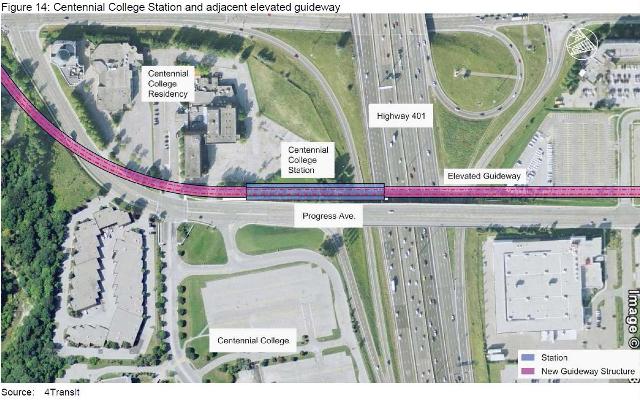
- A short at grade section east from McCowan Yard leading to an elevated structure that would run from west of Bellamy east and north across Highway 401.
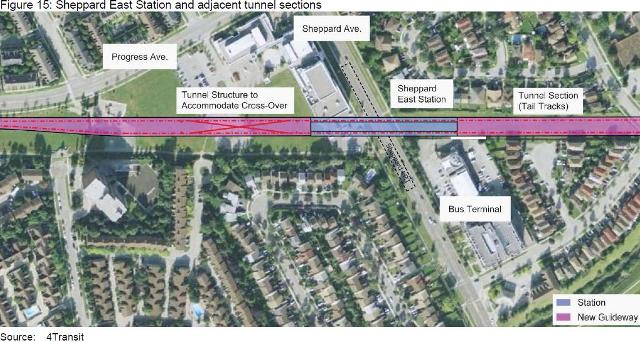
- Underground operation at Sheppard East station including the south approach and tail tracks to the north.
Turnback facilities would be provided only at Kennedy (a new crossover west of the relocated station) and Sheppard East, although a crossover at STC is also possible (but not included). There are no pocket tracks planned that would be used for partial turnback of service and the operational plan is that all trains would run through to Sheppard East. The study contains no estimate of additional rolling stock requirements, nor of the yard space required to service the added trains.
Although there has been talk of making provision for additional stations (notably from Minister Glen Murray when challenged on the subject), the vertical alignment of the subway includes many grades (shown in detail on the alignment drawings) that would make insertion of the level sections needed to provide for future stations difficult.
By analogy, the North York Centre Station was allowed for in the original subway design, but this was not a hilly section of the route. Adding a level section to a long grade requires that grades on either side of the station are steeper than they would be otherwise. The implications of such provisions are not included in the study.
Kennedy Station
Two designs for Kennedy Station were considered.
- The first option continues the subway on the same path it follows northeast from Warden Station diagonally under the Hydro corridor.
- The second option places the new station further south to avoid conflict with the Hydro towers.


Kennedy Station to Ellesmere
Two separate alignments for the new north-south section were considered.
- If the subway stays on the west side of the corridor where the RT tracks are today, then the new Kennedy Station must be positioned to minimize the curve turning north into the corridor. This alignment also requires replacement of the tunnel and curve at Ellesmere from the RT corridor onto the elevated structure west of Midland.
- If the subway is moved to the east side of the corridor where the GO tracks are today, the requirements for new Kennedy Station are relaxed because there is more room for the curve turning north. Moreover, an eastern alignment eliminates the need for a tunnel at Ellesmere and therefore reduces the height the subway must climb to reach the elevated structure.
The study did not address the implications of cutting off rail service to the existing freight spurs to industries on the east side of the corridor.
Ellesmere to McCowan
The existing elevated structure is not useable for subway trains because the distance between the tracks is closer than would permit subway car operation. Moreover, the structure is old and its alignment is not ideal for subway operating speeds. A totally new structure will be required.
At Scarborough Town Centre, a new station would be built with a centre platform that would share vertical access by stairs, escalators and elevators. A restructured bus terminal would be underneath the subway station. Because the study only considered a through route to Sheppard East, it did not examine alternative designs at this location based on different levels and numbers of feeder bus services required if STC remains a terminal.
McCowan to Sheppard East
The line would descend to grade east of McCowan (as the RT does today to enter McCowan Yard), but would rise again onto an elevated structure west of Brimley. This is required because the route follows the Highland Creek ravine until it crosses Progress Avenue east of Markham Road.
The Centennial College Station is located on the west side of Progress immediately south of Highway 401 which the station would partly overhang. North of the 401, the line drops into a tunnel for the approach to Sheppard East Station.
Curves
Several of the curves along this alignment would have a speed restriction of 55km/h and would require wheel lubricators to prevent squeal. On an elevated structure, this is a significant issue, one which has arisen at other locations on the subway system, notably west of Islington Station.
The study is silent on the issue of noise control and effects on existing or potential future development. Considering that noise along corridors is a major issue elsewhere in the Metrolinx universe (Weston corridor, for example), this is an amazing omission for a route that would largely operate in the open air.
Land Use and Potential Ridership
Much has been made of the claim that the RT alignment for a subway serves more priority neighbourhoods and walking-distance population. This was, in fact, a benefit of the proposed LRT service, and the only difference for the subway scheme is the absence of stations at Midland and Ellesmere which eliminates these as locations for future development. However, the lands there are industrial and unlikely to change in the near future.
The study is silent on the development potential of the RT alignment and makes no comparison with what might happen on the McCowan alignment.
Similarly, there is no reference to ridership in the study and the number claimed in the Minister’s announcement appears to simply have been copied from the McCowan alignment’s projection. This number is suspect because it may contain demand that properly belongs on an improved GO service in the same corridor, but was assigned to the subway by the demand model.
Moreover, if the subway ends at STC, then the demand forecast to Sheppard cannot be used because it presumes a fast, transfer-free trip eliminating changes in vehicles at both STC and at Kennedy.
Construction
Construction of the subway on this alignment would obviously have significant effects on current operations:
- Construction of the proposed new Kennedy Station would conflict with existing operations for a period during which subway service would terminate at Warden.
- Replacement of existing RT structures would require this line to shut down. The time required has been claimed to be roughly equal to that needed for the proposed LRT upgrade (3 years), and this is not credible considering the substantially larger scope of work for the subway scheme. (Alternately, the shutdown period cited for the LRT proposal has been overstated.)
- Temporary bus terminals would be required to accommodate construction and shutdowns.
Moreover, the project would likely delay the opening of the Eglinton-Crosstown line because Kennedy Station would not be available for the 2020 target date.
The proposed staging of the project is optimized around concurrent activities where possible, and a minimum shutdown period. By contrast, plans for the LRT scheme were saddled with the need to fit into provincial cash flow constraints, and construction of the LRT was artificially extended in the plans as a result.
Cost
The total cost of the project is $2.4-billion in 2011$. This includes provisions for property, professional services and contingency to a total of 60% over the basic estimate of $1.4b. The study claims that some of this may be saved through alternative procurement strategies, but there is little on which to base such a claim given our lack of experience with such schemes for large-scale transit construction by Metrolinx and Infrastructure Ontario.
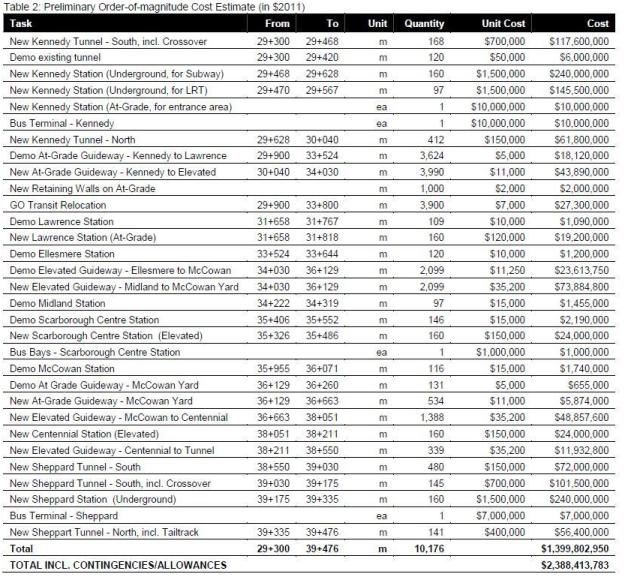
Approximately 40% is due to the section east of STC making the announced Kennedy-to-STC section roughly a $1.4b project. This conveniently fits within the $1.48b the province has on the table.
An unanswered question is the status of the $320m carved out of the $1.8b LRT project for the original scheme to rebuild Kennedy Station for the LRT projects. Some or all of that money should be available for the new Kennedy Station, but it has not been included in the proposed funding for the subway project.
The cost estimate does not include replacement bus service, new trains, yard and maintenance facilities, new substations or HST. Any comparison with other proposals must include these items.
Although the TTC does have surplus T1 subway cars, by the time the line opens (2023) these will be close to retirement age. Moreover, if all service runs through to Sheppard, the extra cars are not sufficient to operate the line. Presuming a route length of 11km (same as the LRT proposal), or 22km for the round trip from Kennedy to Sheppard, at 30km/h average speed, this would represent 44 minutes of running time. On the current headway of 2’20”, this would require 19 trains plus spares, or about 22 in total.
At $15m per trainset, that is $330m worth of trains. If half of the service turns back at Kennedy, this would be roughly halved, but there is no provision in the study’s design for a scheduled Kennedy short turn.
Where a yard might be added is unclear. Greenwood is full and the once-proposed LRT yard site between McCowan and Bellamy may not be suitable for full-length subway trains. (The Murray/RT alignment shares this problem with the McCowan subway proposal.) The TTC prices a new yard and maintenance facility at $500m. If only storage is needed, and the number of trains is lower than would be found at a typical yard, this cost will be reduced, but it won’t be trivial.
Summary
The Metrolinx feasibility study achieves its purpose as far as it goes. There is a potentially viable route for a subway from Kennedy to Sheppard via the RT corridor, although this requires many details to be worked out that could add to costs and/or reduce the line’s attractiveness. The omission of major components in the total cost must be rectified to allow valid comparison to other proposals.
 Steve Munro
Steve – regarding today’s Toronto Star and the announcement from our wonderful Premier Wynne:
Do we really need yet another committee?
Have we not had enough delays already?
Steve: Yet another way to defer actually making a decision. OF course since Queen’s Park loves to delay actually building transit projects, delaying the revenue to pay for them fits right into the pattern.
What this does show, however, is a distrust of Metrolinx as an agent of consultation and a need for a more politically savvy panel to review the situation.
LikeLike
Steve, there is an opinion piece on the Globe and Mail website advocating for subways by a professor at York U, Thomas Klassen. It might seem strange for a political science professor to be commenting on transit but he also has an urban planning degree from U of T dating back to the 1980’s.
I thought the conference you had at Toronto City hall with the York U students a while back was quite good and demonstrated that York had a dynamic and progressive urban planning faculty. In comparison, Professor Klassen’s comments seem as retrograde as our Mayor.
Assuming you get behind the Globe’s paywall, could you comment please?
Steve: Klassen starts off with a gratuitous slap at “glorified streetcars” the standard 100-year myth argument that we would be paying for something cheap that would not last as long. No, that’s not true. What you get with a subway is an expensive structure that must be built to last 100 years because it is underground and replacing it would be a mammoth undertaking that would severely disrupt service. He goes on to claim that subways generate more economic development than LRT. Again untrue when considered in the context of a subway with widely spaced stops versus an LRT with more stops closer to existing and potential demand.
He cites the Sheppard line, but forgets that a good deal of the development there is not occupied by people who are using the subway, but who are using the equally close-by 401 and DVP. The silence and solitude in Bessarion Station are tributes to the lack of demand from nearby development. Don Mills is busy mainly because it is fed by many bus routes bringing riders from the north and east. “During rush hours, cars are standing room only.” Well, yes, maybe but I am not sure about the plural “hours”. Off peak, the line is deserted showing that there is little in the land use above the subway to attract riding. Compare to off-peak demand on the Yonge line.
Citing the population of the GTA is meaningless in this context. The population of outer Peel and Halton regions has nothing to do with demand on or need for a Sheppard line. Other cities with quite respectable populations have both subway and LRT where they are appropriate. We are told that European cities with one to three million population can make do with LRT. They do so because of their land use and the distribution of their transit demand. Toronto proper has not yet crested three million and many parts of the region will easily support LRT lines. Would Klassen build a subway in Hamilton because of the millions more elsewhere in the GTHA? Of course not.
Politicians have not done “the right thing” in Scarborough as we can see from competing views of a subway line intended simply to prove each group’s allegiance to the fiction of Scarborough’s wounded pride. The provincial proposal is not even properly costed, and is being sold on the basis that a subway to the Town Centre can be built for much less than the likely final cost. I’m not making this up — the omitted items are in the feasibility study for anyone, including the Minister, to see.
More generally, the question is always whether spending $3-billion (which is what the McCowan to Sheppard proposal will cost once inflation is factored in) will crowd out other projects that could have been built. For the past two years, Rod Ford has bemoaned the way that the city’s $800m share of the new streetcar purchase is crowding the City’s capital budget. It’s the same problem. What transit won’t we build — a new bus garage here, a new LRT there, and a few station renovations thrown in for good measure — because all of money goes to paying for one subway line? Ditto for provincial and federal contributions. “We’ve done our bit for Toronto already” will be a familiar refrain.
Klassen may have an urban planning degree, but that doesn’t make him omniscient. His facile dismissal of LRT, a mode used in cities around the world that Toronto can only dream of matching in stature, shows that he prefers an appeal to simplistic emotion, not to careful analysis. I don’t want him planning my city.
I am pleased to see many who commented on the Globe’s site eviscerated Klassen’s argument as it so richly deserves.
LikeLike
Yes, I noticed that too. I am glad to see that most Globe readers weren’t being fooled by him and tore the article to pieces.
It does make me wonder though what people of Klassen’s generation were being taught in their 1980 urban studies courses. I took an urban geography course in high school way back in the day (circa 1973) and it was mostly about highways, traffic planning and zoning and land use segregation. Public transit was never mentioned. My classmates who continued in this field of study might be the senior planners of today, perhaps in Vaughan or Peel regions.
When I think about that, I’m glad Toronto’s chief planner, Jennifer Keesmaat, is from a new generation.
Steve: Years ago, I thought of taking university or college training that would be relevant to transit. At UofT, the only vaguely relevant course was in the third year of the architecture program. At Ryerson, the best I could hope for was one term in Civil Engineering Technology. A lot of the course material in those days was completely focussed on highways. (I’m sure there was something in the Engineering Faculty too, but I didn’t want to go down that road, so to speak.)
LikeLike
Your comments on Sheppard Avenue being popular for Condos because of its proximity to the 401 seems to be borne out by the statistics. According to Toronto Traffic Services, six of the 10 most congested intersections in Toronto are on Sheppard Avenue – not downtown where you might expect them to be.
I wish I could remember where I read it (maybe during the Metrolinx funding debate) but someone said that traffic congestion in Toronto is really a suburban problem. Traffic volumes in the old city of Toronto haven’t grown in 20 years.
LikeLike
Is it a valid generalisation that many people with an urban planning-only background tend to support subways? I know of a few, and although I was initially surprised by their stance, it became clear that they neglect to consider technical aspects such as capital/operating costs, service quality, capacity, etc.
I also know some urban planners who support LRT, streetcars, and BRT as well. I’d hate to generalise about certain groups of people, but is there something about the urban planning field that lets “planning experts” get away with ignoring the above technical aspects of public transit? What’s your experience been with these people, and is what I’m noticing really representative of non-engineering planners?
Steve: To be fair to planners, I have heard engineers whose grasp of transit reality is tenuous at best. One might be an expert on land use, or on designing bridges, but know nothing about transit. Whatever the professional credentials, what really frosts me are those who throw their weight around because they have a degree on the wall and are, therefore, “correct” when what they are really doing is serving their own biases, or those of whoever hired them.
LikeLike
If the Fed’s come up with no money then its time to go back to Transfer City and just take the isolated network. If the Feds somehow step up then the Subway can proceed Scarborough will get the proper transit for the future.
Its almost sickening to think that we are this far along into Fords term and he has not delivered a penny for Subways.
LikeLike
And are you sure that the delay in the Sheppard LRT was entirely due to financial reasons, and not political? I’m not, especially when shit like this still goes on:
Steve: It started out as an accounting exercise with Queen’s Park wanting to push the bulk of the spending out into years beyond the point where they would have a balanced budget. Then with Ford’s election, the anti-LRT forces found a champion. So money, then politics.
LikeLike
I am sorry, but I have to comment on some of the comments made above.
This statistic has nothing to do with Sheppard subway usage. My mom worked on Sheppard Ave well over 15 years ago, and even back then Sheppard Ave had horrific traffic.
This traffic is not new, and the TTC’s own reports show that transit usage rates by residents in and adjacent to the Sheppard subway have gone up by something like 140%. So transit is being used.
Steve: The question, however, is what that 140% increase means in the overall scheme of things. If it was already low, then 140% still does not represent a large market share. Moreover, we need to tease apart growth in transit use from growth in population. Is the population growing faster or slower than transit trips?
Steve please don’t take this the wrong way. But I am surprised to see someone so well versed in Toronto’s transit system and history make a comment like that.
So what if Don Mills is busy because of feeder buses? The whole TTC success story is built on the feeder bus/subway connections, which I might add are arguably the best multimodal transfers of any transit system in the world.
Whether it is to inner city or suburban subway stations, the TTC got it right from the start with the feeder bus concept to the subway. Our suburban transit usage rates and our subway ridership would both be dismal without this concept.
I would also like to add that even in the inner city, it is the stations fed by feeder buses which are the busy stations. The extremely busy downtown stations are busy, because of all those suburbanites on the subway who were taken to the subway by a feeder bus.
Steve: I agree with your argument up to this point. Indeed, the degree to which lines like Sheppard and the SRT depend on feeder services rather than walk-in traffic really mocks all the talk of “transit oriented development” around stations. If it happens, it will be useful, but it is not strictly necessary provided that there is a strong demand fed into the line. That said, Sheppard is notable for very light off-peak demand indicating that it has not developed local demand for its stations as destinations in their own right, and that even the feeder services are very strongly skewed to peak commuting patterns.
On the topic of Bessarion Station. The station is at the centre of a massive new housing development, and station usage is expected to grow from that.
Even taking current ridership at Bessarion Station, it is no worse and actually better than many subway station ridership levels in other big cities like New York, Chicago, etc.
Toronto is obsessed with sometimes over the top ridership goals. It is good to hold ourselves to a high standard. But you guys would be freaking if you saw what are considered good ridership levels in other world cities for both rapid transit stations and entire rapid transit lines.
Steve: Bessarion gets about 2,000 passengers per day. It will be interesting to see how this develops with the residential build-out, but this is a very low starting level considering the cost of building and operating an underground station. It’s worth noting that the current usage is well below that of other stations except Midland and Ellesmere on the SRT. What troubles me about claims of “transit” development along Sheppard is that I have yet to see stats on the proportion of trips taken from the new developments by transit versus by car on the nearby expressways.
The attempt to force-feed Metropasses to some of the new condo residents failed, and that tells me something about the relative attractiveness of the subway line. Part of that is a function of the walking distance to the station, an issue that may also arise at Bessarion.
LikeLike
On another note, the report states in section 3.5.1:
The existing platforms at the east end, where the GO buses are located, are also used for Megabus service. I know that Megabus uses different models of double decker buses than GO, but is there that much difference in the clearance requirements?
LikeLike
Prof. Klassen, Prof. Sorensen, ‘Dr.’ Chong and many other ‘experts’ have great opinions but provide nothing that cam be called research. I did 5 years in Malaysia dealing with ‘experts’ (politicians, planners, civil engineers, and public transport company executives) who knew everything about constructing a rail line but surprisingly little about what a day to day public transport experience is like in their cities.
When a guy like me can get into high level discussions, advise CEOs and government ministers, because I rode public transport regularly and was familiar with the issues and international best practices, and could write and speak about it … then maybe the level of professional planning is not that high.
On the other hand … I’m 34 and I’ve been following public transit for 30 years (no joke) … so maybe I’ve got to more to offer than I think. Perhaps it’s time to get reeducated and get my piece of paper too.
Cheers, Moaz
LikeLike
Steve, what happened to the Islington and Kipling station redevelopment? Are MiWay buses still planning on moving to Kipling station from Islington station? Are GO buses still planning on coming to Kipling? The proper integration of TTC and GO at Kipling and MiWay moving to the redeveloped Kipling station was supposed to be complete by 2010 but I guess that it just got pushed under the rug and nobody talks about it anymore.
Steve: The Kipling Station project was taken over by Metrolinx as a regional facility, and then the project got bogged down in issues regarding use of the hydro lands. I believe that these have been resolved, but don’t know a completion date. The Islington Station redevelopment included a new building to house offices for SNC Lavalin. They bowed out of that development, and the project died.
There is a page describing the Kipling Mobility Hub in general, but no mention of the new terminal project.
LikeLike
We have just heard that Ottawa is to contribute towards the McCowan route subway! Perhaps in this crazy world minister Murray can claim credit; after all, would the Feds have re-acted this way without Murray’s SRT route only dictum? He could say this was his plan to get Fed money all along! Far fetched? Lets see!
Irrespective of route, the catchment at Lawrence East will lose service sooner or later. One possible solution would be a temporary (if SRT route is built) or permanent GO station there.
Or perhaps it is time to take another look at the original plan, replacing RT with LRT. The tunnel issue could perhaps be resolved by building a new tunnel on top of old, using existing concrete as a form, then cutting out original roof and outer walls from inside, all without significant service interruption! Crazy? Take a look at the second platform construction at Union, with trains running.
Steve: where might one find the report that studied SRT options.
Steve: There is no report that compares the three options: an LRT replacing the RT and running through to Sheppard, the Murray subway to STC and the Stintz subway via McCowan to Sheppard. With luck will we at least see a comparison of the two subway proposals when Andy Byford publishes the TTC’s review on Monday (probably).
As for your tunnel proposal, there is a small problem with building a new tunnel on top of the old one. You presume there is enough room between the existing roof and ground level for a new tunnel. There isn’t. I suggest that you actually look at sites like this before making proposals as it undermines your credibility.
LikeLike
You might have already heard: Prime Minister Stephen Harper and Finance Minister Jim Flaherty announced at a photo op that the federal government will provide substantial funding for a Scarborough subway. The amount pledged was not specified, other than described as substantial. The City was looking for $660 million in additional funding for their subway plan. Monday will bring new information.
According to the Globe & Mail,
This is the counter-attack in the War of the Scarborough Subway!
When Ontario Transportation Minister Glen Murray’s made his unilateral announcement a couple of weeks ago that Ontario was going alone to build a Scarborough subway, but on an ostensibly cheaper plan along the SRT right-of-way, it was a logical salvo, the next escalation in the War. Despite that, Mayor Rob Ford took credit for it.
With Harper’s announcement, the federal Conservatives are protecting and enhancing the Provincial Conservatives and right-wing Mayor Ford. After all, municipal elections are a year from now, and the next provincial election might be as soon as this coming spring at budget time.
I wonder how the Ontario Liberal government is going to retaliate?
LikeLike
Steve, you forgot one other issue when it comes to several important factors Toronto Council needs to contemplate with the subway extension. That being, will the combination of a Sheppard LRT and BD subway extension have an impact on ridership on the Sheppard subway. I say that because if demand patterns shift significantly because of this combination, it may kill any chances of the Sheppard subway being extended unless it is built all the way to the BD line in one shot.
Of course, ending the dreams of extending that white elephant wouldn’t exactly be a bad thing.
LikeLike
Robert, how do you figure such a high subsidy per passenger? If that were the case, the service would not last long under any circumstances. Let’s say 12x$1.25=$16.00 per depot load, 3 loads per hour = $48.00 income. Add pickups along the way, brings it to $72. Though fuel costs a lot more over there, drivers’ pay is much less. The drivers might be on commission, because they drive crazy fast. I am sure they’re not using gasoline fuel, probably diesel or propane. Maybe the fare is higher today, this was 4 years ago. The vehicle would probably cost only half as much as in Canada due to European taxation and pricing, plus they can stretch the service lifetime of the vehicle. I would expect this micro-bus service to be breaking even financially. What is the subsidy per passenger on GO coaches, especially on 45-minute trips with four passengers?
Steve, maybe I wasn’t clear, but the bus leaves when it is full or within 15 minutes, whichever comes first, daytime.
Steve: And my point is that a rider may face a delay of up to 15 minutes depending on the demand at the instant they attempt to use the service.
This is discussing my argument that transit plans tend to be fancied up to the point that there is sticker shock, and the plans get cancelled by subsequent politicians or managers. Hence, paralysis in transit capital investment. Instead of where an LRT would be the logical choice, we have subway proposals. Not just to replace the SRT, but everywhere. Hudak has never promised that he would not cancel the Eglinton Crosstown LRT. He said he wanted a transit clean slate.
LikeLike
Things are getting very interesting. Still scared these politicians are full of it on both sides… But as a Scarborough resident having a 3-4 stop subway addition up McCowan is the right decision for the future of the “City”.
I like Transfer City, but Love this subway alignment and the One City “plan”.
Liberals better get on board or they won’t do so well in the future elections in the so called “suburbs” going forward.
LikeLike
The pledge of federal funds to support the McCowan alignment is great news. Now, we need to cancel the Sheppard LRT and extend the Sheppard subway from Don Mills to McCowan to form a continuous Bloor/Danforth/Mccowan/Sheppard loop. No tranfers required! This is the service Scarborough deserves.
Also, we need a stop at Brimley/McCowan.
LikeLike
As a Scarborough resident who incidentally took the 16 McCowan from Warden station to the town centre on Saturday I can say that running up McCowan is a good idea. You hit the hospital, the residential areas and an up and coming neighbourhood. I will say this though, a new station at the STC will be hard to build. The land where the new condos are adjacent to the mall and station would have been ideal but it’s no longer doable. Would it be possible to route the subway under the mall and into it like the Eaton centre and York mills centre in terms of integration with multi-modal service? York Mills for example lets out into the York Mills centre and has a long walkway to the buses. The only other option I can see would be on the far side of the mall near Triton where there is a patch of land as parking is tight at the mall making me think it won’t be given up so easily.
LikeLike
Well this is all very amusing.
Technical question: If Karen, Glen, Andy, Rob, Doug, Jim, and now Stephen get their way, a Scarborough subway along McCowan up to Sheppard, will it still be possible to shoehorn the Malvern lrt alongside the subway tunnels and down into Kennedy station? Has anyone given this any thought?
I realize that you think transit city is falling like a house of cards, but try your best to humour me!
Kent
Steve: The Malvern LRT would be on a completely separate route, and could exist separate from the subway extension, but it doesn’t make sense to build it all the way down to Kennedy Station. If the Sheppard LRT survives, then a spur to Malvern would be possible with service connecting to the subway at Sheppard East Station.
LikeLike
From the TTC data for “ridership and costs for bus and streetcars” most lines that run 2 buses cost about $6000 per day to operate. If you run 3 loads per hour that is a 20 minute headway. If your seating capacity is 12 then off peak design capacity would be about 12, a fully seated load. I don’t know where you are getting the extra passengers along the way from to get an extra $48.00 as there is no room on your bus.
If your service ran for 18 hours a day each vehicle on a 20 minute headway would carry 648 passengers if full every trip, (12x3x18). Assuming you ran 2 buses that would be 1296, say 1300 passengers per day if running at full capacity. As these would by definition be short routes there would not be a lot of extra passengers long the way but lets be generous and say you picked up an extra 700 passengers per day for you 2 bus service. That brings us up to 2000 passengers per day. Divide that into $6000 and you get a fare of $3.00 per passenger to break even if non of the fare has to be given to support the services with which they connect.
Your service will not be full every trip and will not carry anywhere near 2000 passengers per day. I may have been high with my subsidy figure but it would be substantially higher than the $1.00 per passenger the regular service is subsidized. That is why mini buses and “Dial a Ride” services have mainly disappeared. I think I got my figures from wheel trans numbers.
GO transit subsidy level is around 20% as they charge fare by distance for their routes. Don’t forget that transit vehicles have to make a return trip so they can make another trip in the main direction. I have not ridden on any GO bus that is less than 75% full but I have not done much reverse flow riding.
Remember that fares have to cover a lot more than the cost of the driver and fuel for that vehicle. They have to cover maintenance, cleaning, administration, benefits and their share of all services to which the passengers transfer. You system might work if people were only riding in a small area but it falls apart when it is expanded to larger areas.
The other problem is that with your method of dispatching there is no way to tell when the next vehicle will be leaving as there is no schedule; just a promise that there will be one with in 15 minutes. Then if there is a large number of people you would need a second bus to follow right behind the first or everyone who doesn’t get on must wait for the next bus. This service is only economical if you have very low wages and no problem with running a ragged service.
LikeLike
So Murray & Stintz managed to goad a response from the Federal Government. At least, that’s what they may think.
I’m not surprised to see Ford taking credit for both the Murray plan and this recent announcement. Nor am I surprised to see that the Scarborough LRT is (for the moment) buried under the politics.
Toronto’s problem is that there has never been clarity about what Toronto wants from public transit. “Subways for some” has been presented as the “ideal” for the past 30 years, while “rapid transit for all” was presented as a choice dictated by the lack of money (with loaded words like “deserve” and “afford” presenting a negative association).
Over time “rapid transit for all” turned into “LRT for some” and then “LRT for very few” as projects were further delayed and politicking was ramped up.
Is it any wonder that “build something, I don’t care what anymore” has become the current mantra of those who are tired of the public frustration process?
In any case…we’ll have to see what happens with tomorrow’s announcement and the next moves.
If Metrolinx, Murray and Wynne are prepared to climb down from the Murray proposal (I’d particularly love to see Bob Prichard explain that climbdown), and perhaps talk about upgrading GO train service on the Richmond Hill and Stouffville lines (and maybe even the Kitchener line up to Bramalea)…well, it would be a nice step forward….
Although, I do wonder how GO commuters from the 905 would feel about losing their express seats in favour of some kind of limited-stop “GO Urban” service.
I’m curious though…is there any study that projects how many TTC users would switch to GO for medium-to-long distance trips if the option were available. Or how many drivers would switch to GO with more frequent train service?
For example, I live in Mississauga and since GO trains were hourly to Port Credit, I would most likely take MiWay plus TTC if I were heading to Toronto alone, or drive if I were going with friends/family. But, now that Lakeshore West trains are every half hour I will be more likely to take the GO train (though parking downtown may actually cost less than the GO tickets).
Cheers, Moaz
LikeLike
Interesting analysis on The Metrolinx Feasibility Study.
Before Sept. 22, with no federal money, it was a comparison of “truncated” Scarborough subway, which was the only viable option achievable by $1.48B, versus a McCowan subway that has no viable funding.
Now with the federal funding available, plus the $550M possibly from the city, I think the city needs to consider this 4-station Metrolinx option to Malvern versus the 3 station City option to McCowan.
I don’t know if it’s fair to put the cost of operation, e.g., the fleet for providing the extended service, to the cost of building. I see a quite informative plan for the SRT corridor option, but I don’t see such plan / detailed estimate for the McCowan corridor proposal.
Steve: The cost of equipment must be included because you cannot operate the extension without it. If you buy cars, you also need some place to store them, and this must be counted also. Conversely, if you are not going to include this cost, then any proposal must be based on the same assumptions. The City’s McCowan proposal included an allowance for fleet and yard expansion, but the Murray SRT proposal did not. This makes Murray’s proposal artificially cheaper.
LikeLike
Cynical, disfunctional politics at its most destructive. Everyone gets to pander to Scarborough before the upcoming elections without actually having to spend a dime.
Of course, the fact that three levels of government cannot even agree on the basic alignment means that absolutely nothing is going to happen for a loooooong time.
Note the unspecified amount of money. I too can hold a big press conference and declare that I’ll put an unspecified amount of money toward my favorite scheme.
If the original Transit City plan had actually been implemented we would be seeing actual, real transit on the ground by now. Instead of endless talk and nothing happening.
Of course, the Gardiner boondoggle of $505 million in 100%Toronto property tax dollars goes full steam ahead. Gotta make sure that born-a-multi-millionaire Rob Ford can drive his Cadillac SUV to City Hall while us peasants get nothing.
LikeLike
With regard to the tunnel on tunnel plan, special hangers are made to join the old and new concrete roof layers and the new tunnel poured. Then the old tunnel roof (supported by the hangers) and outer walls are cut into sections and removed from the inside. Thus the new tunnel is higher and wider, retaining the existing center support. Or it could be a new roof only, retaining all walls if they are wide enough for proposed vehicle. I have looked at the site (from) Ellesmere station, but what I do not know is whether the intentionally restricted height tunnel was accomplished by lowering the roof or raising the floor. If the latter, then it would be necessary to see if there is sufficient vertical height (to the GO tracks) for the extra concrete layer.
At Union the 2’ thick concrete outer wall is being cut by a ‘diamond wire’ into sections which are then removed, all with trains running.
Steve: Your original description implied building the new tunnel on top of (ie above), not around the existing tunnel, and that’s what I was addressing. I believe the reduced tunnel height was accomplished from the bottom, not from the top, as this also reduced the grade and/or length of the approaches.
LikeLike
Oh boy, we in Scarborough get our wish – the Feds have just brought a delivery of fairy dust and we will soon see a subway!! Gee, just cry and complain loud and long enough and you’ll get what you want! Got to love the way transit is planned here in TO.
This leaves me to ask exactly what it is that will be built, how soon we will see it operating and whether what is built will actually provide a real improvement to transit for this part of the City. And what impact will this have on operating costs for the TTC?
Councillor De Baeremaeker was on Metro Morning and felt this would be big improvement in transit and would not increase operating costs.
Phil
Steve: De Baeremaeker does not understand transit operating costs and subsidies, or is willfully ignorant for his own purposes. Of course the Scarborough extension will not pay for itself any more than the Sheppard line or future Spadina extension do/will. Many of the riders on these new lines are existing users who will contribute no new revenue to the TTC. Those who are new will be carried long distances on the system for a single TTC fare at a considerable cost, particularly if added riding from 905-ers on the expanded subway creates a capacity crisis downtown.
I have no problem with De Baeremaeker advocating for a subway in Scarborough, but pretending that it (or any other line) won’t add to city subsidy requirements is a flat out lie. Will Council provide the funds, or will we see service cuts to balance the books?
Also, subway infrastructure will incur higher long-term costs for operations and maintenance than an LRT line would have done. If we believe that the subway is justified for demand and convenience, then we must also accept the additional cost of our choice.
LikeLike
All of your facts and reasoning are helpless in the face of all this ignorance and political posturing.
Steve: Yes, but I try. The real debate down the tracks, so to speak, will be on day-to-day funding of transit in Toronto and beyond, and service levels that will actually attract riders to the system. Promises of new lines ten years from now may buy votes, but leave people driving cars, stuck in traffic, of packed onto buses that don’t show up reliably. Where will the “subway champions” be when there are demands for better service today, not a decade out?
LikeLike
Would Metrolinx and/or TTC have to go out buy more or new tunnel boring machines for this project? I’ve read somewhere that a pair from the Spadina extension have already been sold. Would the price of buying the machines be in cost estimate to date and if so what kind saving would there be to use ones already here?
Steve: There is another pair still available from Spadina. The cost estimate published in July for the subway has little detail, so it’s unclear whether this possible saving is included. It’s 10s of millions at best. They will need a refurb, but by whom since Lovat/Caterpillar isn’t in business any more.
LikeLike
@Moaz
The real issue with transit riders switching from TTC to GO (or vice versa) is the lack of fare integration between the 2 systems. Yes Presto allows you to pay for both systems with a single card, but that’s not fare integration, just a transit payment card. Users of both systems get no incentive, as they have to pay both fares.
Most European cities have realized that a zonal system is the best incentive to attract riders to transit. No matter what technologies a rider takes, subway, bus, LRT, commuter train, the rider is charged on the number of zones from origin to destination. It’s one fare, very simple to understand, that cover all transit systems in the zones.
However, it costs more, hence we won’t see it in the GTA for decades, if ever.
LikeLike
Steve. I don’t get how you can say the line won’t attract new ridership, and yet be concerned at the same time about additional ridership from the 905 overwhelming the system.
Steve: When asked about the increase in projected demand as compared to earlier estimates, city staff replied (at Council in July) that the demand model was picking up a lot of trips from the 905 because of service levels and fares on the GO Stouffville corridor not being competitive. However, many of the subway riders are already on the TTC and will represent no new revenue. If we attract too many riders who should be on GO, we will overload the central part of the subway network and that’s no good for anyone.
As for higher operating costs, once this is built, I hope we will finally have a discussion in this city on fare by distance.
Steve: We need to have a discussion about fares, and integration with GO, much sooner than after the line is built. There are similar problems for the Spadina extension and proposed Richmond Hill subway.
But for now, I’m thrilled. As a Malvernite, this is huge. It will change transit in northeast Scarborough completely. In a few years, I’ll be able to get to Union in 1.5 hours and two transfers flat.
Also glad to see the SELRT going forward. Now to convince people to convert the subway to LRT….
LikeLike
Still waiting for the “business sector” to help pay for “subways, subways, subways”. It’s the “public sector” that is, hopefully, paying for it. But, will it continue. Will it be sustained?
Will the federal government support urban public transit for both capital and operation budgets, continuously, like other western democracies? Or is this a one time, pre-election (for whom?) goodie?
LikeLike
Re: the Malvern lrt
Steve,
I was really thinking about the eglinton/kingston/morningside lrt east of Kennedy, the one that was to connect UofT Scarborough, I noticed during the transit debate that the TTC has this line in their top ten list of priorities. This line was to have been on the surface but descend into Kennedy station and connect with the crosstown and subway. Perhaps it’s all moot now, who knows.
Kent
Steve: Sorry, I thought you meant the north end of the Scarborough LRT or an extended version of the Murray subway. It’s really hard to tell the status of the LRT lines until we know who will be in power a year from now at Queen’s Park and at City Hall. If Ford is still at City Hall, not LRT will be built. If Hudak is in power at Queen’s Park, the LRT lines will be stripped out of the regional plan. Otherwise, there is a fighting chance we may see some of Transit City built.
LikeLike
So with the subway question essentially decided, is examining retaining (even some) of the already-built SRT right-of-way for lower-capacity use sensible, even with something like the newer-generation Mark II vehicles??
(http://upload.wikimedia.org/wikipedia/commons/4/4c/Skytrain_Mark_II-300.jpg)
My assumption is that this would require maintenance-level work on the guideway, vs a much costlier retrofit…
Steve: Why would we keep the SRT and build a subway? This would require that we reinvest in the ICTS technology not just for new cars, but also for updated control systems, and we would still have little-used stations (with Lawrence East and STC dropping off thanks to competition from the subway line. The real need is for upgraded GO service in the Stouffville corridor to handle demand from Markham that will otherwise flow to the subway, not a very expensive local ICTS line.
If there is one silver lining to this whole escapade, it is that ICTS as a mode in Toronto is dead. One less orphan Bombardier product line for us to prop up at taxpayer expense.
LikeLike
Which means the end of any proposals to repurpose the elevated SRT guideway for other transit uses….unless there is a plan to take the Malvern LRT spur south of Sheppard and the 401 to serve Centennial College.
Steve: Don’t hold your breath.
I’m so confused. What is supposed to happen to the McCowan yard now?
Steve: It will be abandoned.
Offhand I’d say the real issue is the lack of train service outside of peak hours, followed by the low frequency of GO services (bus or trains) … if service is available … rather than the fare differences. There are thousands of people who use a 905 transit agency and the TTC every single day who pay 2 fares each way (approximately $5.50 each way) and receive no subsidy.
Id say that even without fare integration people would switch between GO and TTC if the service was available and reasonably frequent.
Cheers, Moaz
Steve: But GO is so fiercely proud of its high cost recovery that it doesn’t want to run good, if lesser used, services off-peak and counter-peak, even if that would avoid a much greater capital and operating investment in the TTC. GO/Metrolinx has got to get past thinking of itself as an independent budget line from the rest of the GTHA.
LikeLike
To add to that last comment….following the TTC/city plan and taking TTC out of the Stouffville rail corridor means an opportunity for Metrolinx and GO Transit to substantially improve service on the Stouffville line. It will be interesting to see if any plans crop up soon.
Cheers, Moaz
LikeLike
So at what point can we expect the members of Ford Nation to start talking about there only being one taxpayer and raising issue with this “tax and spend” policy with local taxes being raised to cover the Toronto portion of the costs since the city is on the hook for this subway extension for about 800 million at best?
LikeLike
Kevin’s answer:
I am not aware of any such study, but the information that I do have suggests that people will use the transportation method that is fastest, easiest and most convenient – even if substantially more expensive.
For example, according to CAA, the annual cost of ownership of a typical car is around $10,000 per year excluding car parking costs. That is much more expensive than any combination of GO/TTC/cycling/905 local transit.
Which leads us to the conclusion that those particular people are not motivated by price. They are choosing a much more expensive method of travel, presumably because it is faster, easier and more convenient. So if a combination of GO/TTC/cycling/905 local transit can deliver a faster, easier and more convenient way of travelling to their various destinations, they will switch.
Steve: I tend to agree with this analysis, but believe that the demand model used for projecting loads on the Scarborough Subway does include fare as part of the calculation of which service a rider might take. This is probably more sensitive for a transit-versus-transit comparison, but not for auto-versus-transit. In any event, the real question is what will happen to the modelled demand for the subway if we also assume good service in the GO corridor.
LikeLike
Greenwood may be full, but what about the yards at Davisville and Wilson, plus Vincent yards? Also could some trains not be stored in the tunnels overnight on a regular basis (as they do on cold nights during the winter now)?
Steve: Davisville has problems with the TR unit trains because some of its tracks are not long enough for a full 6-car consist. The TTC is planning to centralize the Plant Operations fleet at Davisville (this has been mentioned in the CEO’s report regularly, and is also in the capital budget details) so that some space can be released at Greenwood.
Wilson is not strictly full, but adding trains there does nothing for the BD subway extension. There is already a problem projected for the Spadina extension that they won’t be able to get all of the trains out of the yard in time for the morning rush hour. The eventual solution is a proposed underground “yard” as part of the Yonge extension either north of Finch Station or in Richmond Hill.
As for Vincent Yard, it is already being refurbished to store trains, and there is to be an additional storage track at Kipling. All of this will barely contain the T1 fleet (or its equivalent in TRs post Scarborough opening), and there would be no provision for growth for shorter headways.
Storing trains in tunnels is not practical except on pocket tracks because work cars have to get through. This arrangement also increases operating costs because yard personnel and operators must get to these trains at out-of-the-way locations relative to their home base. In any event, there are only three centre tracks on BD: Islington, Ossington, Chester.
LikeLike
Satire right? Who would ride around the loop unless they were going to Ikea or Scarborough General?
LikeLike
I remember reading a comment about “the first time in Toronto’s history that we would abandon an established right-of-way corridor.” We can do better, like only Toronto could, I propose:
> a full rebuild of the RT corridor, including moving the northbound trackage east, (at full, or better, inflated cost) and extending it … not to Sheppard, to Finch! ALL OF IT NON-REVENUE!!!! Connecting the Eglinton Crosstown & the Sheppard East with a new, exclusive non-revenue trackage from Markham Road to Keele Street along Finch, entering service as the Etobicoke-Finch West LRT
Sounds like an astonishing savings, incredible reliability, and guaranteed boondoggle. #TorontoStyle
Steve: You just want a fun piece of track for railfan charters to play around on, don’t you!
LikeLike
I’d rather see the LRT be built as originally planned and instead have the federal money go to a separate Relief Line from downtown to Scarborough. There’s already $85 million in signed agreements to build the LRT; throwing that money away would be like Harris canceling the Eglinton West subway all over again. And extending the Scarborough line will do nothing to alleviate the congestion downtown. Building both an LRT and a separate subway line would benefit all of Toronto, and not just a handful of voters in the east end.
LikeLike