
Updated October 2, 2013 at 12:30 pm:
Metrolinx has released a transcript of a press conference held earlier today regarding their letter to the City Manager about the Scarborough subway.
In related news, Metrolinx advises (through a separate email) that they are “approximately 3 months away from making [a] formal recommendation on Sheppard and Finch” LRT lines, and the possible acceleration of these projects.
Also, regarding Eglinton-Yonge Station, they “hope to have a final concept that Metrolinx, City and TTC agree on in the coming weeks and will present in the public session of the Metrolinx December Board meeting”.
Updated October 2, 2013 at 10:30 am:
Metrolinx has sent a letter to Toronto’s City Manager regarding the proposed Scarborough subway. Unlike some pronouncements from Queen’s Park, this takes a more conciliatory tone for discussions between Ontario and the City of Toronto. Notable points include:
- Metrolinx continues to believe that LRT “would provide an effective rapid transit solution to the transportation challenges in this area” within the available funding, but bows to the desire by all three levels of government to build a subway.
- Metrolinx is not dictating that a specific route be chosen, but wants a proper alternatives analysis as part of the Environmental Assessment. This contradicts earlier statements by the government implying that only one route was to be funded. It also implies that the shorter “Transit Project Assessment” process (which does not include the potentially embarrassing need to review alternatives) will not be used.
- The Province is sticking with a figure of $1.48-billion in available funding, from which must be deducted the $85m in sunk costs for the Scarborough LRT project and unspecified costs of scaling down the LRT car order from Bombardier.
- Although the $320m reserved for the Kennedy Station reconstruction with both the Eglinton and Scarborough LRT lines may not all be required, additional costs are expected at the Yonge-Eglinton interchange beyond the current project budget. Savings from Kennedy may be redirected to Yonge-Eglinton. If there is anything left of the $320m between the two projects, then it could be directed to the Scarborough subway.
- The Scarborough subway will be entirely a City/TTC project contrary to previous schemes for the LRT that would have seen provincial ownership and a PPP arrangement similar to that proposed for the Eglinton line. This begs a question regarding the accounting for the provincial funding contribution: if you don’t own the line, you can’t book the asset as an offset to the money spent on it. Does this mark a shift away from the creative accounting used to justify taking Toronto’s transit projects away from the TTC in the first place?
- Provincial funding will begin to flow in the 2018/19 fiscal year implying that no serious construction will be underway until then. The City and/or Federal government will have to front end the project with funding for the EA and preliminary engineering. All risk for project cost overruns will be to the City’s account.
- Infrastructure Ontario remains available to participate in this project, but this is no longer a requirement of the Province for funding. The decision on whether to use IO or to proceed with a conventional procurement (as on the Spadina extension) is up to the City of Toronto.
Not included in the letter, but reported through Twitter by John Michael McGrath, is a comment from Metrolinx that they are reviewing the timing of the Sheppard and Finch LRT projects.
This letter provides a more balanced response to Scarborough subway issue than some recent statements by Ontario Transportation Minister Glen Murray, and it is good to see Metrolinx acting as a reasonable broker rather than simply as a rubber stamp for ministerial musings. The next major step will be Council’s discussion of the matter at the October 8-9 meeting.
Updated September 25, 2013 at 10:30 pm:
Today’s TTC Board meeting was a procedural shambles when the time came to discuss the Scarborough Subway. The contentious name-calling and parochialism of some past debates lives on for at least one Commissioner, Glenn De Baeremaeker, who is so busy puffing up the importance of his own subway that he overstates his case. At one point, Councillor Josh Matlow spoke of the subway proposal as vote buying. De Baeremaeker did not take umbrage but Chair Karen Stintz did and asked Matlow to withdraw the remark. He refused and left the meeting as did another visitor, Councillor Carroll. Smug and over-confident do not begin to describe De Baeremaeker’s attitude which focuses on getting “what Scarborough deserves” above all other considerations.
Three sets of motions were proposed:
- The original recommendations of the staff report which asks that the Commission endorse the McCowan alignment for a subway extension from Kennedy Station to Sheppard.
- A set of motions by Chair Stintz:
- that the Commission continues to support LRT implementation on Eglinton, Sheppard East and Finch as per the master agreement with Metrolinx,
- asking that Metrolinx confirm their support for these projects, and
- asking that Metrolinx confirm that the Downtown Relief Line is the next priority for a subway project after the Scarborough extension.
- A motion by Commission Alan Heisey seeking a meeting between the TTC and Metrolinx boards to arrive at a mutually agreeable plan for future transit in Toronto.
- Commissioner Parker proposed an amendment that would have supported the original LRT proposal.
Some members of the Commission were uneasy with the large exposure for the City in future debt and the tax increases needed to finance the City share for the project. The “citizen” (non-Council) members of the Commission appear uneasy about the fact that they have never been asked to vote on the subway alternative until now, and as articulated by Commissioner Heisey, it would appear that their counterparts at Metrolinx have similarly been excluded from the debate.
When it came time for the vote the Stintz and Heisey motions passed easily, but Parker’s motion failed on a 2-9 vote. However, things came unglued on the main motion. Five Commissioners voted in favour, five against, and one, Nick Di Donato, wanted to abstain because he did not feel he had enough information to make a commitment to the subway line at this time. In this situation, the motion would have lost on a tie vote. Di Donato had not left the table, and so technically abstaining was not an option.
At this point, realizing what might happen, Chair Stintz called the vote again and Commissioner John Parker, who had voted in the negative, left the room to ensure that the motion supporting the McCowan alignment would pass unless Di Donato voted “no”. In the end, the vote was 6-4 in favour with Parker abstaining. This shows how divided the Commission is and how poorly support for the McCowan option was organized by the Chair before the meeting started.
In related news, some members of Council are swallowing hard to accept the level of taxation that may be required to finance the City’s share of the project. Some money will come from Development Charges, but the lion’s share, about 80%, will have to come from general tax revenue.
Meanwhile a Forum Research Poll shows general support for the subway, but splits along regional lines and relative to past mayoral support. There is some support for the LRT option, but the poll question specified a level of tax support for the subway considerably lower than what is actually required to finance it. Support for the subway is higher among non-transit users than transit riders.
The whole matter will be debated at Council’s October 8 meeting.
Updated September 23, 2013 at 8:20 pm:
Today federal Finance Minister Jim Flaherty announced that Ottawa would provide $660-million in funding for McCowan alignment of the subway as proposed by City Council, and reaffirmed funding of $333-million for the Sheppard LRT. This simply quantified the amounts available from yesterday’s announcement by the Prime Minister.
Also today, the TTC released a report comparing the Murray subway alignment via the existing RT corridor with the Stintz alignment via Eglinton and McCowan. Unsurprisingly, the TTC report endorses the McCowan alignment, although it does not go into much detail in critiquing the RT alignment.
A fundamental issue is that the provincial funding of $1.4b is inadequate for either proposal:
Neither the Provincial (RT corridor alignment) nor TTC (McCowan corridor alignment) subway option to Sheppard Avenue estimated at $2.9 billion and $2.5 billion ($2010) respectively, are achievable within the current Provincial funding envelope. Even when the options are truncated at Scarborough City Centre both Provincial and TTC options estimated at $1.7 – $1.9 billion and $1.9 billion ($2010) respectively require additional funding. [Page 1]
Much of the history of these proposals and related correspondence has already been reported here. The TTC notes that there is an outstanding request for information from Metrolinx regarding:
- Ridership projections for both Provincial options;
- Average operating speed and trip time for both subway options;
- Location of the bus terminal;
- Walking distance from the TTC bus terminal and GO station to the subway platform; and
- Any other advantage of this proposal over the TTC proposal. [Page 4]
Minister Murray has claimed ridership for his proposal equal to the number cited by the City and TTC for their scheme, but the latter depended on the route going all the way to Sheppard. As with other claims for his proposal, Murray selectively quoted full-line benefits for his truncated subway scheme ending at STC.
The TTC notes that curves on the Murray line would impose speed restrictions that would add to travel times (not to mention fleet and operator costs) and potentially be a source of wheel squeal that could annoy neighbouring residents. The tight curves would also lead to faster rail and wheel wear. However, the TTC’s estimate of fleet requirements for the two proposals appears to be based only on the length of each option, not on any speed restrictions.
What the TTC does not address is the fact that the Metrolinx consultants claim to have used TTC specifications in their design. Either this was done erroneously, or less than ideal specs were used in good faith for the proposed design. The TTC needs to set out specifications that anyone (Metrolinx, say) should use in designing any future subway lines. This is not a trivial issue given the likely wandering nature of a new Downtown Relief Line (or whatever it is called).
The TTC is concerned about the design of the new Kennedy terminal and how transfer moves between buses and GO passengers and the subway would be affected. This is a valid question especially if the importance of Kennedy as a hub increases. Although RT trips will be diverted onto the subway, much of the bus traffic will continue to arrive on existing routes and the convenience of their transfer connection is important. Equally, if GO improves service on the Stouffville corridor, this connection also should be a convenient one.
Other effects of the project both during construction and under operation include:
- A three-year shutdown of the SRT for the construction project, plus an unknown shutdown of the east end of the subway during the cutover from old Kennedy Station to the new one.
- A more intrusive elevated structure for subway trains which are wider and which require longer platforms at stations.
- The combination of open-air track and steep grades could lead to problems during bad weather, notably icing, and also have issues with wheel slip due to leaves. This is true to a point, but the system already has a comparable area north of Rosedale Station. This can be a problem for TTC operations, but only under the worst of circumstances, and far less often than the annual SRT shutdowns thanks to power and reaction rail icing. It is worth noting that the same problems would have affected an LRT line in the same corridor, but the TTC was silent on these issues.
Cost comparisons are provided for both the RT and McCowan alignments for Kennedy-to-STC and Kennedy-to-Sheppard options. As previously reported here, the Metrolinx study omits several key items such as vehicles to operate the line, and the total value of these is estimated at roughly half a billion dollars. All costs here are only order-of-magnitude given the lack of detailed study, and a variation of $100-million (roughly 5% on the total project) is considered a wash.
If the line runs only to STC, then the RT alignment is slightly cheaper than the McCowan alignment, subject to detailed review. However, for the line continued through to Sheppard, the RT alignment is more expensive because it is longer and has more stations.
               Kennedy to            Kennedy to
                  STC                 Sheppard

Via RT           $1.8b                 $2.9b
Via McCowan      $1.9b                 $2.5b

Source: Table on page 24 of pdf, page 12 of slide deck.
It should be noted that the RT alignment pays the considerable penalty of replacing Kennedy Station, and the costs would be quite different without this factor.
For either alignment, construction will not start until 2019, no matter what Minister Flaherty said at today’s press briefing.
The main report is followed by a slide deck that will be used at the TTC Board meeting on September 25. This deck includes information and raises issues not included in the main report. It acknowledges that the RT alignment has well-sited stations, is beneficial to Centennial College and improves opportunities for a mobility hub at Kennedy, but warns that these factors are offset by the design issues and service shutdown requirements detailed above.
The table cited above also includes an estimate of the number of trains that would be required. For the TTC’s option, the count is 7, and this is in line with previous estimates I have given here that only half of the service would run through to Sheppard. (A 15.2km round trip at 30km/h is about half an hour’s worth of trains. On a 2’20” headway, this would require about 13 trains. Therefore, the TTC may be planning to run only half the service beyond Kennedy Station.)
However, if only 7 more trains would be used compared to existing service, these can be accommodated within existing storage facilities and the allowance of about $200m on that account is not required. It is unclear whether the number of trains is relative to the existing service level or to the existing T1 fleet of which the TTC has a surplus. This is an important distinction that will affect the project cost and scope.
Finally, a question for the McCowan alignment is the location of the new STC station. As shown on the maps, it is actually at McCowan, not in the STC itself. The TTC should examine alternate alignments veering west so that the station could be better connected with existing and future development at STC. Although the details would be something for an EA/TPA study, the issue should be openly acknowledged as part of TTC and Council debates.
We now await word from Queen’s Park on whether they are firmly resolved to build on the RT alignment, a posture that would guarantee a head-on collision with Ottawa and City Council, or if the province will return to making its funding available to a generic “Scarborough subway” project. A related issue is the amount of the holdback for the Kennedy Station adaptation for the LRT project(s). Now that the LRT-via-RT line is not part of the design, the projected $320m cost for the combined Eglinton/Scarborough LRT station at Kennedy should be reduced, and this should release additional provincial funding. This is a question that must be answered as part of whatever provincial response will come to today’s announcement.
Updated September 22, 2013 at 9:45 pm:
Today Prime Minister Stephen Harper announced that the federal government would provide funding in an unspecified amount to the proposed Scarborough Subway. At the announcement, a map clearly showed the McCowan alignment with stations at Lawrence, STC and Sheppard. Needless to say, Mayor Ford is ecstatic.
Further details will come in a press conference to be held tomorrow by Finance Minister Jim Flaherty, and there will also be comments from Premier Kathleen Wynne.
A few observations at this point:
- Toronto Council’s motion clearly set September 30, 2013, as a deadline for a response from other governments on funding the proposed McCowan alignment. Ottawa has met that date with a week to spare.
- Ontario Transportation Minister Glen Murray’s ham-fisted “I’ll do it my way” announcement of a subway via the existing SRT corridor was guaranteed to provoke a response from other potential funding partners. Rather than showing how Ontario might built a transit network in Scarborough, Murray chose to focus on one line, and a truncated version of it at that. Even if Ottawa had been delaying in offering funds for the McCowan alignment, Murray’s action and political rhetoric guaranteed a tit-for-tat response.
- Queen’s Park is now in a position of backing and funding only one version of a subway line, and rejecting out of hand any idea that the $1.4b previous available for a Scarborough project might go to the McCowan scheme. Now, they are left not only with a subway proposal that cannot be built for the price claimed, but are potential deal-breakers for the McCowan alignment.
- Prominent at today’s announcement was a map showing the Sheppard East LRT line, a route that Mayor Ford would love to convert to a subway. That this happened at a federally organized press conference and with Rob Ford standing right beside the sign (see CTV news coverage) suggests that the LRT scheme isn’t dead yet. Ford no doubt awaits the election of a Tory government at Queen’s Park to deliver the coup de grâce. It will be interesting to see whether Metrolinx puts this project on ice, and what position Toronto council takes on LRT for Sheppard at its October 2013 meeting.
Toronto Council needs to contemplate several important factors if it opts for the McCowan alignment:
- Are any stations to be added, or at least protected for, notably one near the turn north onto McCowan?
- How close to the centre of STC should the subway pass? Should the station be under McCowan on the eastern edge of the site, or should the line swing west to a more central location?
- What will the demand be for the new line, and to what extent is this a function of regional commuters choosing to travel by subway to downtown? If GO transit service is improved in the Stouffville corridor, how would this affect projected subway demand?
- What service plan will be operated on the subway? Will all trains run through to Sheppard or will some turn back at Kennedy? This affects the fleet and yard requirements for the extension.
- How does additional demand on the Danforth subway fit into transfer problems at Bloor-Yonge?
- What is the likely cost of the project, net, to Toronto and how will this affect proposed property taxes to finance it?
If Council simply yells “hurrah we got a subway” and then buries its collective head in the sand, they will be in for a big surprise. More likely, Council will put money in the 2014 budget for detailed studies and punt a real decision beyond the next municipal and provincial elections.
As for the Scarborough LRT, it is a dead issue, a victim of crass politics and misrepresentation, not to mention a rogue Minister.
Updated September 13, 2013: A review of the letter from Metrolinx Chair Rob Prichard to TTC Chair Karen Stintz has been added after the break.
Updated September 12, 2013: A review of the Metrolinx feasibility study has been added.
The Metrolinx feasibility study of a Scarborough Subway via the SRT right-of-way is now available on the Metrolinx website.
I will comment on it at a later time, but am putting up the link so readers can peruse the document.
Updated September 11, 2013:
Further details of the provincial position and Toronto’s responsibility for costs are in a letter from Rob Prichard, Metrolinx Chair, to Karen Stintz, TTC Chair.
My analysis of the political background and of the misapplication of the feasibility study to a truncated Scarborough subway is on the Torontoist website.
On September 10, 2013, following the Metrolinx board meeting, Chair Rob Prichard wrote to TTC Chair Karen Stintz setting out the provincial position on the various subway and LRT plans.
Among other things, this letter states:
We undertook a preliminary feasibility study. It suggests the route using the SRT alignment announced by Minister Murray has a number of advantages: it has greater opportunities for economic growth and employment along its length, relative to the route earlier proposed by the city and the TTC; it takes advantage of an existing transportation corridor instead of incurring the cost of building a new one; our preliminary analysis suggests that it could potentially delivered at a lower capital cost as it requires much less tunnelling; and assuming rapid transit is subsequently extended to Sheppard Avenue East, it serves more priority neighbourhoods and double the population within walking distance. In addition, preliminary work suggests that the subway from Kennedy to Scarborough Town Centre could be delivered close to the existing provincial funding commitment of $1.48 billion. [Page 1]
Let us take these statements in turn.
- Economic growth and employment. Little in the feasibility study supports claims for growth and employment especially along the truncated version of the subway announced by the Minister.
- Avoiding building a new corridor. This is rather like renovating a house by retaining the bird feeder in the garden. The line will require a new Kennedy Station, completely rebuilt trackage, new stations at Lawrence East and at STC, a new power distribution and signal system, and new elevated structures east of what is now Ellesmere Station.
- Lower capital cost. The feasibility study’s estimate comes in at roughly the same price for an SRT to Sheppard alignment as the City’s McCowan alignment, but the Metrolinx estimate omits several key items, notably a fleet to actually provide service.
- Better coverage. Prichard’s letter is explicit in stating that this claim depends on the line continuing to Sheppard, but that is not what the Minister announced when he claimed better coverage for his scheme. The feasibility study is silent on this issue in part because it was not intended as a comparative study of the proposals.
- The line to STC can be delivered within available provincial funding. Again, because significant items are not included in the cost estimate, this is not true.
Prichard goes on to clarify the funding available.
- $1.48-billion 2010$ are available from Queen’s Park, and this money will flow no sooner than 2018/19.
- Toronto is responsible for the sunk costs ($85m) related to the already-agreed LRT plan, as well as for any penalties involved in reducing the size of the LRV order to Bombardier.
- Toronto will be responsible for the project including any cost overruns plus any future operating and maintenance.
- Queen’s Park would like to see a role for Infrastructure Ontario in delivering this project.
The letter is silent on the money earmarked for reconstruction of Kennedy Station as part of the Eglinton-Crosstown plan. If we are to get a totally new station, then it is not credible that the ECLRT’s share will be on the order of the $300m reserved for this purpose.
Prichard goes on to talk about Durham’s Pulse system and the extension of BRT to the Scarborough Town Centre. Oddly, although the feasibility study and some of its conclusions depend on a subway to Sheppard, this portion of the route is dismissed as unnecessary by the Minister. Prichard’s press scrum differed from Murray’s position in that Prichard was still open to an LRT spur south from Sheppard to link with STC while Murray dismisses the need for anything beyond the Pulse service at Centennial College.
Our interest is in moving forward with the Scarborough rapid transit project as quickly as possible based on a strong partnership with the TTC and the City of Toronto. [Page 3]
Minister Murray made a unilateral announcement over a month before the known deadline (September 30) when various conditions affecting Toronto’s position would kick in. There was no “partnership” and, indeed, there was considerable acrimony caused by political grandstanding.
For his part, Rob Prichard repeats the message he is told to deliver, and in the process makes statements that are at best inaccurate and at worst untrue. How can anyone trust Metrolinx for unbiased, professional advice?
The Metrolinx Feasibility Study
This study was conducted for Metrolinx by 4Transit, a joint venture of major engineering consultants (Delcan, MMM, Hatch Mott MacDonald) who regularly work in the Toronto area. The purpose was to determine whether a subway extension could be built from Kennedy Station north and east to Sheppard via the proposed LRT replacement route for the Scarborough RT.
Such schemes have been discussed in the comment threads on this site many times. Whether readers will agree with conclusions of the study, there is now a public document that includes details of design constraints rather than the abstract supposition that has dominated the debate.
The proposed subway infrastructure would include:
- A relocated Kennedy Station aligned to make the turn north onto the RT corridor possible.
- Stations would be located at Lawrence East, Scarborough Town Centre, Centennial College and Sheppard East.
- Shifting the GO Transit rail corridor west to the current position of the RT tracks.
- At grade operation of the new subway from north of Kennedy Station to Ellesmere.
- Elevated operation on a new guideway from northeast of Ellesmere Station through Scarborough Town Centre to roughly the location of McCowan RT Yard.
- A short at grade section east from McCowan Yard leading to an elevated structure that would run from west of Bellamy east and north across Highway 401.
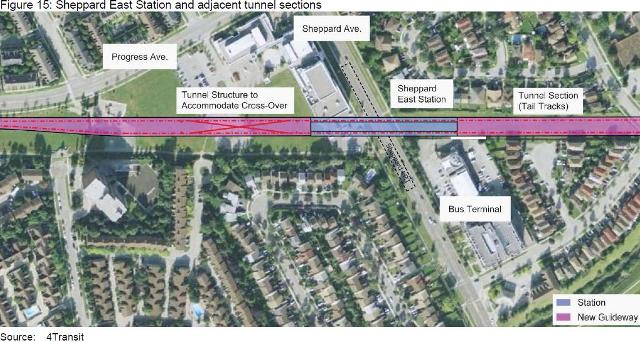
- Underground operation at Sheppard East station including the south approach and tail tracks to the north.
Turnback facilities would be provided only at Kennedy (a new crossover west of the relocated station) and Sheppard East, although a crossover at STC is also possible (but not included). There are no pocket tracks planned that would be used for partial turnback of service and the operational plan is that all trains would run through to Sheppard East. The study contains no estimate of additional rolling stock requirements, nor of the yard space required to service the added trains.
Although there has been talk of making provision for additional stations (notably from Minister Glen Murray when challenged on the subject), the vertical alignment of the subway includes many grades (shown in detail on the alignment drawings) that would make insertion of the level sections needed to provide for future stations difficult.
By analogy, the North York Centre Station was allowed for in the original subway design, but this was not a hilly section of the route. Adding a level section to a long grade requires that grades on either side of the station are steeper than they would be otherwise. The implications of such provisions are not included in the study.
Kennedy Station
Two designs for Kennedy Station were considered.
- The first option continues the subway on the same path it follows northeast from Warden Station diagonally under the Hydro corridor.
- The second option places the new station further south to avoid conflict with the Hydro towers.


Kennedy Station to Ellesmere
Two separate alignments for the new north-south section were considered.
- If the subway stays on the west side of the corridor where the RT tracks are today, then the new Kennedy Station must be positioned to minimize the curve turning north into the corridor. This alignment also requires replacement of the tunnel and curve at Ellesmere from the RT corridor onto the elevated structure west of Midland.
- If the subway is moved to the east side of the corridor where the GO tracks are today, the requirements for new Kennedy Station are relaxed because there is more room for the curve turning north. Moreover, an eastern alignment eliminates the need for a tunnel at Ellesmere and therefore reduces the height the subway must climb to reach the elevated structure.
The study did not address the implications of cutting off rail service to the existing freight spurs to industries on the east side of the corridor.
Ellesmere to McCowan
The existing elevated structure is not useable for subway trains because the distance between the tracks is closer than would permit subway car operation. Moreover, the structure is old and its alignment is not ideal for subway operating speeds. A totally new structure will be required.
At Scarborough Town Centre, a new station would be built with a centre platform that would share vertical access by stairs, escalators and elevators. A restructured bus terminal would be underneath the subway station. Because the study only considered a through route to Sheppard East, it did not examine alternative designs at this location based on different levels and numbers of feeder bus services required if STC remains a terminal.
McCowan to Sheppard East
The line would descend to grade east of McCowan (as the RT does today to enter McCowan Yard), but would rise again onto an elevated structure west of Brimley. This is required because the route follows the Highland Creek ravine until it crosses Progress Avenue east of Markham Road.
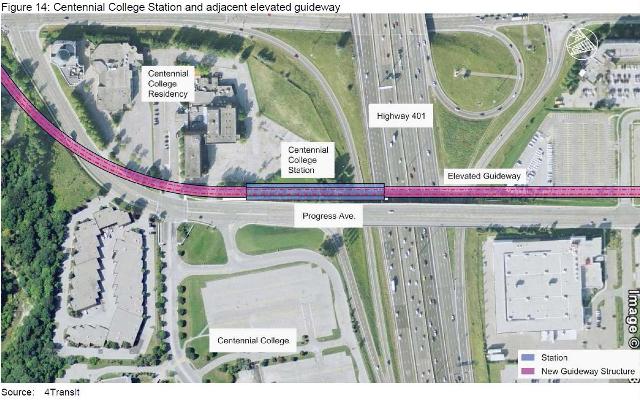
The Centennial College Station is located on the west side of Progress immediately south of Highway 401 which the station would partly overhang. North of the 401, the line drops into a tunnel for the approach to Sheppard East Station.
Curves
Several of the curves along this alignment would have a speed restriction of 55km/h and would require wheel lubricators to prevent squeal. On an elevated structure, this is a significant issue, one which has arisen at other locations on the subway system, notably west of Islington Station.
The study is silent on the issue of noise control and effects on existing or potential future development. Considering that noise along corridors is a major issue elsewhere in the Metrolinx universe (Weston corridor, for example), this is an amazing omission for a route that would largely operate in the open air.
Land Use and Potential Ridership
Much has been made of the claim that the RT alignment for a subway serves more priority neighbourhoods and walking-distance population. This was, in fact, a benefit of the proposed LRT service, and the only difference for the subway scheme is the absence of stations at Midland and Ellesmere which eliminates these as locations for future development. However, the lands there are industrial and unlikely to change in the near future.
The study is silent on the development potential of the RT alignment and makes no comparison with what might happen on the McCowan alignment.
Similarly, there is no reference to ridership in the study and the number claimed in the Minister’s announcement appears to simply have been copied from the McCowan alignment’s projection. This number is suspect because it may contain demand that properly belongs on an improved GO service in the same corridor, but was assigned to the subway by the demand model.
Moreover, if the subway ends at STC, then the demand forecast to Sheppard cannot be used because it presumes a fast, transfer-free trip eliminating changes in vehicles at both STC and at Kennedy.
Construction
Construction of the subway on this alignment would obviously have significant effects on current operations:
- Construction of the proposed new Kennedy Station would conflict with existing operations for a period during which subway service would terminate at Warden.
- Replacement of existing RT structures would require this line to shut down. The time required has been claimed to be roughly equal to that needed for the proposed LRT upgrade (3 years), and this is not credible considering the substantially larger scope of work for the subway scheme. (Alternately, the shutdown period cited for the LRT proposal has been overstated.)
- Temporary bus terminals would be required to accommodate construction and shutdowns.
Moreover, the project would likely delay the opening of the Eglinton-Crosstown line because Kennedy Station would not be available for the 2020 target date.
The proposed staging of the project is optimized around concurrent activities where possible, and a minimum shutdown period. By contrast, plans for the LRT scheme were saddled with the need to fit into provincial cash flow constraints, and construction of the LRT was artificially extended in the plans as a result.
Cost
The total cost of the project is $2.4-billion in 2011$. This includes provisions for property, professional services and contingency to a total of 60% over the basic estimate of $1.4b. The study claims that some of this may be saved through alternative procurement strategies, but there is little on which to base such a claim given our lack of experience with such schemes for large-scale transit construction by Metrolinx and Infrastructure Ontario.
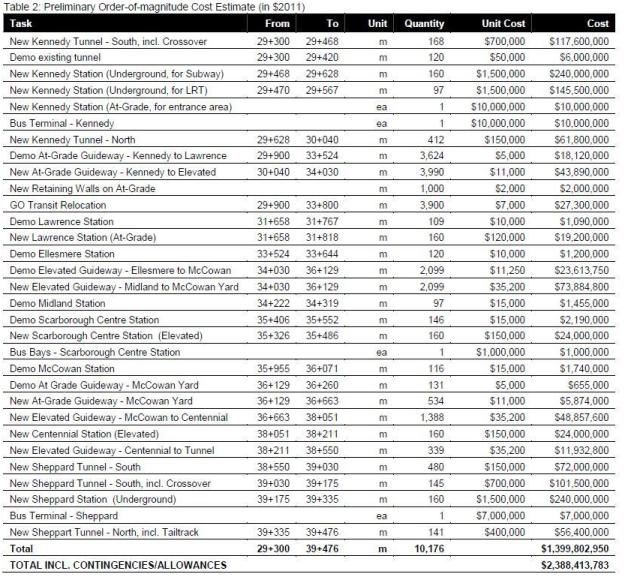
Approximately 40% is due to the section east of STC making the announced Kennedy-to-STC section roughly a $1.4b project. This conveniently fits within the $1.48b the province has on the table.
An unanswered question is the status of the $320m carved out of the $1.8b LRT project for the original scheme to rebuild Kennedy Station for the LRT projects. Some or all of that money should be available for the new Kennedy Station, but it has not been included in the proposed funding for the subway project.
The cost estimate does not include replacement bus service, new trains, yard and maintenance facilities, new substations or HST. Any comparison with other proposals must include these items.
Although the TTC does have surplus T1 subway cars, by the time the line opens (2023) these will be close to retirement age. Moreover, if all service runs through to Sheppard, the extra cars are not sufficient to operate the line. Presuming a route length of 11km (same as the LRT proposal), or 22km for the round trip from Kennedy to Sheppard, at 30km/h average speed, this would represent 44 minutes of running time. On the current headway of 2’20”, this would require 19 trains plus spares, or about 22 in total.
At $15m per trainset, that is $330m worth of trains. If half of the service turns back at Kennedy, this would be roughly halved, but there is no provision in the study’s design for a scheduled Kennedy short turn.
Where a yard might be added is unclear. Greenwood is full and the once-proposed LRT yard site between McCowan and Bellamy may not be suitable for full-length subway trains. (The Murray/RT alignment shares this problem with the McCowan subway proposal.) The TTC prices a new yard and maintenance facility at $500m. If only storage is needed, and the number of trains is lower than would be found at a typical yard, this cost will be reduced, but it won’t be trivial.
Summary
The Metrolinx feasibility study achieves its purpose as far as it goes. There is a potentially viable route for a subway from Kennedy to Sheppard via the RT corridor, although this requires many details to be worked out that could add to costs and/or reduce the line’s attractiveness. The omission of major components in the total cost must be rectified to allow valid comparison to other proposals.
 Steve Munro
That wasn’t me. That was the Subway Champion who said that.
Steve: You are correct. My apologies.
The people of Scarborough are demanding subway as that is the best option that has been floated around. GO Transit has not floated around any alternatives. Since the RT has to be replaced anyways (whether with subway, LRT, buses, GO Trains, or whatever), one possible alternative is that the Stouffville line be at least double tracked and serve the existing Lawrence East and Ellesmere RT stations (with stations rebuilt and properly connected with TTC buses and all this can be done very cheaply) but that would require that GO Trains start serving the people of Toronto by stopping at all Toronto stations and it would also require GO being made more affordable and integrating GO fares with TTC and TTC would also need to accelerate the adoption of PRESTO. Until now the people of Toronto have been given only 2 choices with regards to the aging SRT: Subways and LRT (the former is expensive and the latter the people of Scarborough just don’t seem to want). But if GO decides to float another option, then I think that that would be welcome and that option may be cheaper than even the LRT.
Steve, are you going to cover the BRT lane construction that Durham Region is beginning this month? It’s a good idea to make BRT lanes but I think that the curbside lanes are a huge mistake as median lanes are much faster. Median lanes can be done for the same amount of money and space, so I personally think that this is a mistake unless they want to permanently ban right hand turns for private vehicles and ban street parking (I don’t know if there is any street parking on the route in question).
Here is the link.
Steve: I was not planning to cover the construction as this is basically a road widening for the creation of a “BRT Lite” implementation. I was intrigued by some of the planned service levels used in the alternatives evaluation which were at headways at a range where conflicts with traffic signal cycles and signal-created platooning are inevitable. This has been discussed in the context of downtown streetcar operations in Toronto. As with VIVA, the real test will be the level of service actually operated, and whether this (a) is improved to drive ridership growth and (b) is sustainable through areas where BRT is not implemented due to local constraints.
LikeLike
I agree but no one is taking the initiative to talk about these problems and so these won’t get solved. Perhaps Steve can pick up the cause of bringing attention to these problems and then they might get solved as a lot of people read and respect Steve.
I agree but there are no reporters covering these issues. Our best hope is that Steve can blog about them. We can email our MPPs too but most such requests fall on deaf ears. GO has a lot of potential (much more than subways) but unfortunately it is not being made good use of.
Steve: Actually, this sort of thing will finally be part of a Metrolinx study when they consider the possible role of GO in relieving subway crowding in the Yonge corridor. I hope that any benefits found in that corridor will be applied elsewhere in the network.
It’s a real shame nothing like this was included in Murray’s announcement and his map didn’t even acknowledge that GO exists.
LikeLike
Prichard’s letter to Stintz is fascinating, although probably not for the reasons that Prichard intended. Note the crossing out in the salutation of the formal title ‘Chair Stintz’, and substitution of the presumably-friendlier ‘Karen’ (was this Prichard’s idea, or one of his aides’?).
When dismissing council’s motion for their choice of where the subway should go, I detected more than a touch of arrogance, a “we know better than you pipsqueak politicians” attitude. If I detected it, so did Stintz. There were real shades of Robert Moses, an (in)famous planner in New York City who would contemptuously dismiss the concerns of anyone else regarding his plans as idiots who couldn’t see the bigger picture and/or his genius.
Just like his lord and master, Prichard cherrypicks evidence to suit his case, hurling it away when it doesn’t suit him (council’s choice of subway applauded, council’s chosen route rubbished). What a way to run a (possible) railroad.
LikeLike
The feasibility study explicitly identifies the priority neighbourhoods surrounding the proposed route but these shaded areas of the maps can be very misleading. Dorset Park lying to the west of Kennedy between the Gatineau hydro corridor and the 401 is a designated priority neighbourhood. In reality most of the neighbourhood is quite affluent with 2-3 cars per household and very little transit demand.
The area that is truly a priority neighbourhood is at the northern edge of Dorset Park – the cluster of apartments on the north-west corner of Kennedy and Ellesmere which includes several Toronto Community Housing buildings. This area will be far removed from any station on the proposed subway line.
When this sort of thing is combined with some questionable engineering justification, I am left with the impression the consultants were TOLD to write a report justifying the subway on this alignment.
LikeLike
No need for Pocket track or crossover at Kennedy. Trains can be turned back at warden crossover. Warden to Kennedy is never over crowded.
Steve: This depends on razor sharp scheduling so that there is always a gap available westbound for the eastbound train to enter. This almost never would happen and a short turn train would block the through service. That’s why you need a tail track — some place to store a train waiting for it’s spot. Warden does not have one.
LikeLike
Transport for London gave up trying to run the Circle Line as a circle because it became too difficult to manage. Check the latest map and you will see that it is no longer a circle.
Do a little home work and check you facts before you make a claim. It used to run in a circle but hasn’t for a while. You are using a factoid instead of a fact.
Steve: Another rather obvious fact is that connecting Sheppard to Spadina at Downsview does not “close the loop” operationally because this gets you to the wrong line. Sheppard will always be a separate line because the level of service it requires is considerably lower than on other routes, and we wouldn’t want to waste taxpayers’ money running excessive service.
LikeLike
Walter:
I know what we can do with the old Kennedy station; store trains in it; use it to train janitors and as a movie set.
LikeLike
The current GO schedule shows a 27 minute running time from Oriole to Union Station for 4 trains on a 30 minute headway. With 12 car trains this gives seated capacity of about 8000 passengers. I would bet that most, if not all, of those seats would be full by the time the trains get to Oriole. In order to increase service GO would have to buy more trains at a cost of between $30 and $40 million each for a single, short trip in each rush hour plus build more storage.
As long as the line is single tracked and run under railway operating rules it will have a maximum headway of 10 minutes. This would allow 4 more trains per hour for a capacity increase of 8000 each hour. Then there is the problem of platform space at Union. As long as Metrolinx runs GO under railway rules there is not much hope of using GO to do much in the way of increasing capacity in Toronto. You are thinking like a rational human being and that does not work with railway rules and Metrolinx. There are very few “cheap fixes” that Metrolinx can put in to make major improvements; however, there are still a lot things that they could improve.
LikeLike
The transpo-scene in and around Toronto has become a sad PR and reality show merged with the famous gong-show.
It didn’t start with current bunch of councillors or current Mayor and his spokesperson his brother, it is not about non-existent friction between downtowners and suburbanites — it is all about denial, absence of long term plans, (non-)merging of long-term population growth (immigration) plans with transportation plans, transportation technology perception and knowledge (ICTS, long-overdue conversion to pantographs among others), knowledge who lives in which location, what are the needs of people in those locations and so on.
The latest participants in this gong-show are new minister of transportation, his boss new Premier and subway-pusher Ms. MH, who go hand-in-hand with their “non-political cousin” Metrolinx, while in the other corner stands quite surprised TTC chair, who can only gasp (for air) and faintly says — but what about me? FYI — there was a “quickie ad ” yesterday (12th of Sept. 2013) in Global (channel 3) pointing to half-hour discussion about proposed subway, that will be broadcast on Monday the 16th of Sept. at 1730 hrs (half-past-five at the afternoon).
LikeLike
It’s funny that Metrolinx started out looking for ‘quick wins’ but missed out on (or otherwise delayed) some of the significant ones. They really need to have a ‘Department of Quick Wins’ that is specifically tasked to go out and make things better for all public transport users over the lifetime of “The Big Move” … after which of course, everything will be perfect ( 😉 )
Cheers, Moaz
LikeLike
I’m seriously wondering if now is the time for Toronto to beg Detroit and Vancouver for their Mark I cars, if only just for the parts.
Vancouver’s Mark I trains are 25 years old now (or thereabouts) and probably due for retirement, and Detroit could use the money (and more importantly, they are moving ahead with LRT and BRT).
Cheers, Moaz
LikeLike
Steve, why do buses not use the streetcar right of way? Is it not wide enough? Countless times I have seen buses crammed into the only lane of traffic on St Clair (after parking takes the other one). Is it not a good idea to finally ban on street parking on major streets and remove on sidewalk patios from major streets so that these right of ways can be made wide enough for buses to use safely (perhaps a middle barrier can be installed too)? This will also allow more right of ways to be built for transit (streetcars and buses). This will actually be better for the businesses as well as both transit and cars will move better and people can get to and from these businesses quickly. The patios can go on the roofs and balconies and on to smaller streets. With right of way, the cars will not have to stop whenever a streetcar stops at a stop and hence cars will move faster and people will be safer as not all cars stop when the streetcar doors open (if everyone followed all traffic laws, there would be almost no accidents). Also as a cyclist myself, I would love to have safe cycling infrastructure through parks, hydro corridors, elevated roads (just for cyclists and pedestrians) and bridges (just for cyclists and pedestrians) but it really is not safe for cyclists on streets shared with cars (as you can see from a cyclist being killed every few days with hundreds more injured who are not reported of in the news), so would that space not be better used to make right of ways for transit (streetcars and buses)?
Steve: Buses have problems on the St. Clair right-of-way because of the centre pole overhead suspension. There were big arguments between the LRT advocates and the TTC at the time, but they stood firm in wanting centre poles. This took an extra metre for clearance on either side of the poles, space that could have been used on the sidewalks.
The whiz-bang planners who designed the new street assumed that new lighting fixtures could be further apart, and that spacing was ill-suited to holding up span wires. When they installed the lights, they discovered that they were too dim, and the pole spacing was changed back to roughly the same as the old layout. By that time, however, the centre poles had been installed.
Also if the Eglinton LRT is not going on the south side near Leslie, then why bury it under Don Mills? Not burying it will save time and money and will also justify not having moved it to the south side near Leslie but to take full advantage of the cost of burial of the Don Mills station, moving it to the south side at Leslie is a must. Also Victoria Park and Eglinton intersection is pretty busy, so why was that station proposed to be neither buried nor elevated when Don Mills was proposed to be buried?
Steve: Don Mills and Eglinton is a very large intersection where, eventually, two rapid transit lines will cross. In the medium term, there will be multi-bay bus terminal on the northeast corner. All of the transfer traffic needs to be isolated from the roadway. The situation at Victoria Park is quite a bit different — much less feeder service and no plans for a Victoria Park subway/LRT.
LikeLike
Moaz, The Vancouver cars are not for sale and Translink has no plans to retire them in the near future. The ’30-year lifespan’ for rail vehicles is by no means a standard in the industry. Just look at the operating fleet in New York or Montreal. I am not familiar with Detroit system, so I cannot comment on that.
A more basic limitation is at McCowan yard which cannot accommodate a lot more cars than at present. The 4 storage tracks in the yard can potentially store eight four-car trains in total (2 trains on each track), and you could get 6-8 more cars in the carhouse building itself. Even if you stash one more train in the eastern tail track, and a couple of married pairs on the carhouse tracks just outside the building, you might be able to store maybe 50 cars maximum. That’s not very much.
Steve: Vancouver’s attitude to sale of the Mark I’s has always been that they are not being retired now, and if they were, this would accelerate the need to purchase more new trainsets. That capital is not in their short to medium term budget.
LikeLike
Going through to near the end of the Feasibility Study, I studied the Implementation Schedule a little. Noticed that after construction is “completed”, there is about twelve months set aside for “Testing / Commissioning”.
Did most of the “rapid transit” lines in Toronto (Yonge, Bloor-Danforth, Spadina, SRT, etc.) had such long “testing” periods? Would all future “rapid transit” (Eglinton, Sheppard East, Finch, etc.) have such long “testing” periods as well?
I hope they study well before the tests.
Steve: Yes, that is common. The signal system, for example, cannot be tested until the line is basically in operational status and can handle trains at regular speeds. All of the subsystems that are provided by others and which must work together have to be tested and formally accepted so that liability for defects and maintenance passes from the provider to the TTC/Metrolinx. The same issue would apply even with a 3P operating the line because that company will need to ensure that all of the systems work.
LikeLike
Kevin’s comment:
Suppose we take one of the car lanes each way (with I assume are approximately 3.6 M wide) and convert them to protected cycle lanes. If we do this we get a capacity of 9,400 vehicles per hour each way. Source at P. 14.
I note that only a few of these cyclists have to be carrying child passengers to exceed the peak load of the BD subway 4 months after it opened. Source:
My question then becomes: What is the capacity backlog on the BD subway? Is it greater than 10,000 passengers per hour during peak hours?
Steve: First off, Hamish was only talking about extending a standard bike lane, not taking a road lane and I was responding to that proposal. One subway train carries about 1,000 passengers and with 3,600 seconds per hour, that is equivalent to one cycling passenger per 3 seconds. However, at intersections, cross streets get at least 40% of the green time, and so the time available for cycling flow is only about 2,000 seconds/hour or 1 cyclist every 2 seconds. Queueing at traffic signals would be substantial and would almost certainly run into severe problems with turning motorists.
In order to create the capacity equivalent of one subway train requires a very dense concentration of cyclists, and you are not going to achieve this on Bloor-Danforth.
Taking a full traffic lane has significant implications for other road traffic and for intersection operations. That has a “cost” in terms of lost road capacity and interference with other modes of travel. It is not just a question of painting lines on the road.
LikeLike
Bomardier can still crank out new Mark Is, and Metrolinx and the TTC could have insisted that they do so when awarding them the TR and LRV orders for YUS and ECLRT. Why didn’t they bundle the order?
But, “purist” LRT advocates, in their religious overhead wire technology fanaticism and fetish, demonized the poor RT technology. Now they’re getting a taste of their own nasty medicine in return, and the term “LRT” has been equally demonized by the subway advocates (and Scarborough residents) to the same level of toxicity. If they had simply called the SLRT the SGRT (Scarborough Grade Rapid Transit), the result may have been different. The term LRT shouldn’t even be used anymore as there’s simply too much stigma associated with it now.
To be honest, I always thought the RT was kinda cute and quaint, although the area it runs through north to Midland is depressing beyond comment — feels like being on Mars. The first time I rode it I got a case of the creeps, not because of the trains themselves, but because the line looked like it was in the middle of nowhere. OK, OK, those weird sounds the ICTS cars make when they accelerate also gave me the creeps. It was in 2-car operation at the time with 1/2 the headway that is scheduled today, but the thing was fast and futuristic for 1985.
Because of all of this pigheadedness, we have Kennedy joining the ranks of Lower Bay. In 50 years, it will be a urban legend, with gutted escalators no doubt. It always bothers me when perfectly good infrastructure goes to waste like that.
LikeLike
A friend of mine brought up a good point the other day, that totally has slipped under my radar.
Why are we judging passengers per hour on any portion of the Scarborough LRT or Subway plans?
Peak passengers per hour are measured at the peak load point, which would be on the Bloor subway near the downtown core.
We do not generally count peak passengers per hour on the outskirts of any rapid transit line, LRT or subway.
So what is Scarborough different? It is completely stupid to expect an LRT or subway line to be carrying so many people on the outskirt of the line, as it all it will do is create crowded conditions further down, like we already experience.
Steve: Ah, but a real city with a real subway needs loads and loads of real passengers to establish its legitimacy. There is also a faction that wants us to build for centuries to come in the odd expectation that Scarborough’s population and transit demand will skyrocket.
Lots of bogus arguments playing on the theme that “real cities don’t use streetcars” (to quote former Mayor Mel Lastman when he was pushing for the Sheppard subway). The insecurity extends to puffing up the claimed demand for the line lest it be regarded as excessive spending, aka gravy.
LikeLike
Ford can still crank out new Edsels, but would they?
Sure, the TR and LRV orders were very substantial, but were they substantial enough to twist Bombardier’s arm into putting them into production without a premium charge? It was always known that Mark-I cars could still be acquired, but a premium charge would be needed to put them back into production, making other alternatives no more expensive.
Please provide some basis for such a statement.
Steve: It is extremely unlikely that the tooling for Mark I cars still exists, and a new design would be required to outfit Mark I sized cars with modern subsystems. This is not a trivial undertaking.
LikeLike
Because the TTC had no interest in buying further Mark I cars. They realized that it was a waste of money to restart production on the Mark Is and it was cheaper to rebuild Kennedy and go with the Mark IIs.
At the same time, the choice to go with the Mark IIs was based upon it being only a replacement of the Mark Is and not a replacement and extension to Sheppard. When you add the extension, it makes sense to go with LRT technology or replace the line entirely with a subway due in part to the need for a new storage and maintenance yard to replace McCowan yard.
LikeLike
So, wanting transit that actually works in all weather, and not wanting to have more modes of transit than necessary, is now a form of religious fanaticism?
Meanwhile, dismissing a non-subway transit proposal because Scarborough “deserves” subway while ignoring the extra $1000000000 the subway proposal costs while providing worse service is just rational planning.
Amazing. There is no end to what one can learn on the Internet.
Steve: It is amusing that ICTS advocates hereabouts point to Vancouver as the great success story, but forget that the much-praised Canada line is really a mini-subway, and is most definitely NOT ICTS. Translink has no choice but to extend the ICTS/Skytrain network where it is building from existing lines, but when they had a chance to build something completely separate, they waved goodbye to Bombardier.
LikeLike
I rode PCC #4500 today as part of the Centennial of the St. Clair streetcar today! It has been a while since I was on any PCC, and first time on this one, but I was pleased with the smooth and comfortable ride, even with an enormous amount of passengers. Why did they ever get rid of these?!!! Tomorrow (Sunday) a Witt streetcar will pose at Oakwood loop. (Steve, I was hoping to meet you today on the streetcar, you are an advertised attraction.)
Steve: I will be on the car on Sunday.
A display at the Wychwood car barns (across the street from where I grew up) had a TTC map from 1948. I was surprised, as I have the same map which my Dad gave me. “Peter, why don’t you throw out all those old maps? They are obsolete!”. Because, once 99.999% of all examples have been destroyed, the remainder are museum pieces.
Please see info here.
My comments and questions are about the ICTS trains on the SRT. I read somewhere that Mark I is obsolete and no longer available, used to be sourced from UTDC and eventually taken over by Bombardier. I also read a comment from Steve that Mark II trains from Bombardier are larger in size than Mark I’s, and would require reworking the Ellesmere tunnel so that they fit. Recently it has come to my attention that the Ellesmere tunnel exists so the SRT train can pass under the railway tracks. However, Murray’s subway plan calls for replacing the rail tracks to the west side of the right-of-way, putting the subway tracks on the east side, and no need for a tunnel. Cannot we do the same for LRT or ICTS options, too? Furthermore, Bombardier is apparently offering the Mark III model in place of previous models.
I might be going out on a limb here, but I am going to assume that Mark III trains will run on Mark I track, subject to a tweak or two here and there.
So, really, since “LRT” is a swear word in Scarberia, would not Mark III trains make sense? Extend the line all the way to Malvern Centre. We are not talking about a new technology, but updating one that the TTC is using now. Makes a lot more sense than an expensive subway.
Steve: If we are going to go to the trouble of shifting the tracks between Kennedy and Ellesmere Stations (including an underpass north of Kennedy to get over to the east side of the right-of-way), then the technology one way or another is not in question. However, if we keep the ICTS technology, we will still need a dedicated carhouse for it. Moreover, it is a technology that can never run in a street median.
LRT may be a swearword in Scarborough because some politicians have chosen to demonize it, but that does not mean we should waste billions on a technology we do not require.
LikeLike
A better solution would be to build LRT but call it something else. Maybe the “Scarborough Eglinton Subway Extension”. Part of the “Eglinton Subway” would run in median at grade for most of the distance from Don Mills to Kennedy, but that is just a “fun fact”.
Alternately, all higher-order transit expansion in Scarborough should be cancelled until there is agreement on a reasonable-cost plan that Scarborough actually wants and which fits well with proposed transit expansion in the rest of the City.
LikeLike
Just a comment regarding the decision to build the Canada Line using conventional electric motors in the rolling stock instead of Bombardier’s ART. That decision had a lot more to do with politics than with technology. Specifically, the consortium of which Bombardier was a part of was specifically forbidden by the rules of the bidding process from factoring in any efficiencies of using the same technology as the existing network. This was done in the name of fairness but it often seems as though this decision was meant to send a message to Bombardier, that the Province (who is, just as in Ontario, the final arbiter in BC) did not intend to be locked into a single supplier.
There has also been a small and frankly, fanatical group of LRT adherents who have been obsessively angry over the introduction of Skytrain to Metro Vancouver, stemming in part from anger at the Socreds, who were then the governing party and have since been retired from the political scene. Every opposition party has been opposed to Skytrain but whenever they are in power, they build more. Even the Canada Line still had to meet the same performance standards and there is a lively ongoing debate amongst transit watchers, advocates, railfans and assorted hangers-on as to whether or not the Canada Line will be able to meet future needs, particularly after ProTrans BC’s contract ends.
While I am by no means an expert on these matters, the entire P3 process so muddled the waters that the Canada Line as an example, in my opinion, doesn’t really support your comment regarding Vancouver and ICTS to Isaac Morland. And while the Canada Line is much praised, most of that praise comes from outside of Vancouver (although a lot of the residents of Metro Vancouver love having a train to the airport) and the ‘on the ground’ opinion is that it’s the inferior cousin to the rest of the network.
Keep in mind, the next two extensions of the Skytrain, the Evergreen Line and the Surrey Line both had viable and competitive LRT options. The Mayor of Surrey in particular, is quite married to her LRT plan. The Evergreen Line was planned as an LRT until almost the last minute when the money came available. Translink is perpetually blamed by everyone for not having enough money and has been audited to the nth degree in search of mythical gravy and found virtually none. And despite being this squeezed, Translink continually and consistently concludes that the more expensive Skytrain plans will serve the public better than the competing LRT plans. This won’t always be the case, but for the main network, it makes sense. And yes, part of it is definitely because Skytrain is what’s already here, but it’s also that these are intended the major metro lines of the region, which is what ART is meant to do. The SRT on the other hand, aside from being hamstrung by the TTC and being the prototype is also the wrong application for the technology. Which is also likely (again in my not-expert, limited opinion) to be the result of trying to shoehorn a subway extension down that route. I don’t envy Toronto’s current predicament one bit.
As near as I can tell from my observations the only commonality amongst the LRT-bad crowd is that they are all somehow deeply offended by pantographs and the operation of trains powered by pantographs. It seems to be the only consistency in their positions. Perhaps Metrolinx may wish to contact Amsterdam’s transit operator, one of their metro lines uses vehicles that switch from third rail to pantograph operation as it comes out of the city headed south. Not exactly standard vehicles, but at this point, I’m willing to bet any option is on the table. Might also make the matter of linking the Sheppard Subway and the Sheppard East LRT a little easier to do.
Steve: I was in Vancouver shortly after the original Skytrain opened, and a few times since, and was quite impressed with how the operation ran. In particular, the Expo shuttle service showed a good example of what can be done with closely-spaced automated operation (but also with short trains). An important difference between Vancouver and Toronto (aside from the weather which has a big part in many failures of the SRT) is that Skytrain is Vancouver’s “Yonge Street Subway”, and it has to work. Tinkering, complaining and just getting by simply are not acceptable in Vancouver, as compared to the SRT which is an outpost and poor cousin of the rapid transit network here. Years later, TTC was still kvetching about the reliability of the control systems which Vancouver had already replaced with updated equipment.
We were stuck with the SRT because it was an acid test for the Vancouver sale. Ontario had to prove they could “sell” their new technology into their own market before BC would buy in. Another pre-requisite was that Ontario guarantee the UTDC contracts for the original Skytrain line. The bill to allow this to happen with the supposedly arms-length UTDC was considered a motion of confidence in a minority Davis government, and they threatened an election if the opposition, already distrustful of UTDC activities, voted it down. That’s how desperate they were to prop up that company.
As for “subway trains” with pantograph operation, you don’t have to go to Europe — just visit Boston or Chicago
LikeLike
As I understand it, the Scarborough RT was originally supposed to be an elevated streetcar route. During the same time the province attempted to develop mag-lev technology, and while that project was a failure, it ultimately lead to the ICTS. In order to show some results for their efforts the province basically forced the ICTS down Toronto’s throat in order to get a demonstration line going.
Seeing as mag-lev was the province’s original goal, I wonder how much has developed since then. Out of curiosity, has mag-lev technology matured to the point where it might be worth taking a look at it again?
Steve: Actually, it was going to be an LRT line. The original studies and project progress reports have nice pictures of CLRVs on them. Part way through the construction phase, Queen’s Park needed a demonstration of good faith in ICTS, and forced the mode conversion on Toronto.
Maglev was NOT the original goal. The TTC had planned a streetcar line using modernized PCCs in the late 60s. Then Queen’s Park got the maglev bug, but that technology failed. We had an LRT interval, followed by ICTS.
Maglev is not an appropriate technology for low speed urban operations. High speed, dedicated tracks, enough passengers to justify the capital investment, then maybe. But TGV and other high speed conventional rail technologies have the advantage that they can share infrastructure with ordinary railways where necessary, notably for access to city cores where building a dedicated line would be impossible.
LikeLike
I suppose that is because of the public safety issue in having an electrified third rail. I also suppose that the “fourth rail”, the reaction rail in the middle of the track, is not a problem at all. But, replace the 3rd rail with overhead power lines together with pantographs like LRT’s (shhh!!).
That is my point – I, too, believe that #$%#!! LRT is the right way to go to provide rapid transit to many areas of Scarborough, and that full-blown subways are like using sledge hammers to swat flies, hence wasted billions. So, what is in between and reasonable? Answer: ICTS, locally available from Bombardier, articulated trains. Dedicated storage & repair facilities are needed regardless of the vehicle type, as well as the acquisition of vehicles, par for the course. That most of the existing track could be retained is a bonus. That is why I am wondering if updated ICTS is the most cost-effective choice within the given parameters.
Steve: The reaction rail would be a problem at any street crossing. Also, its presence would prevent the right-of-way being designed for use by other vehicles such as buses, police, etc. Also, if the line runs on street, it cannot use automatic train control. If we’re going to put the technology in an LRT environment, why not just build LRT?
No, ICTS is not the most cost-effective when one considers the network context. Storage, for example, would be shared with other lines just as the streetcar system now operates many routes from two, soon to be three, carhouses.
While we’re on the subject of Bombardier being “local”, don’t forget that it’s a stretch for them to get up to 25% on Canadian content, and that’s mainly from final assembly and commissioning.
You seem to be going to great lengths to preserve an orphan technology.
LikeLike
TTC is planning to replace all the CLRV and ALRV streetcars with the Bombardier Flexity model, each new unit with significantly increased passenger carrying capacity. What a big mistake!
This mistake is akin to Scarborough wanting subways at all cost, when smaller & cheaper ought to be the way to go.
In Europe, I have seen mini-buses with 12-passenger capacity running at 15-minute intervals or better on routes which do not warrant a bus or streetcar. They have the flexibility to go off-route for elderly & disabled passengers. The mini-bus leaves the depot as soon as it is full, not according to the clock. There’s another right behind. About $1.25 fare.
Here in Ontario, GO runs huge luxury coaches, on a rarified schedule, with only a handful of passengers aboard each. Would it not make sense to run a lot more often, using smaller vehicles, with a greater variety of routes?
I live in Bolton. According to the GO website, if I want to go to Pearson International Airport for a midday Monday flight, I need to catch a GO coach early on the previous Friday morning. After three transfers and three nights in a hotel, (3 days, 3 hours, and 21 minutes later) I arrive at the airport! Probably the wrong terminal. This is beyond insane. Why doesn’t GO go into the airport????? Except for one route?
I complained to GO management, who advised me that nothing could be done. That’s final, shrug, sorry.
That is the problem with public transit in areas outside of downtown Toronto, but especially worse further out – the service comes too little and takes you where you really don’t want to go, and the connections are bad to non-existent.
Meanwhile, one grandiose plan after another. They are talking about restoring the GO train to Bolton. However, the new depot would be 3.5 km. outside of town, not in town. Three buses go to Toronto in the morning, and three buses return in the evening. Woe if you miss the last one. During the day, you have to catch a bus at Yorkdale, which takes you to Malton, right past the (ahem) airport, and drops you off about 2 km south of Derry Road on Airport Road. Then you have to hike 2 km across fields, parking lots and train tracks to the Malton GO train station, where the coach to Bolton comes by every few hours. I was the sole passenger. While I waited for about 90 minutes for the Bolton coach, I never saw a train. Are they nuts!!!!!???? It took me 5 hours to get home, only because I also took a taxi part way.
My point about the streetcars is this: The old CLRV’s are only half the size of the new Flexities. Why not keep some of them for “flexibility” in running routes off-peak and all day on smaller routes? Bigger is NOT better!
Steve: While there is a valid debate about the length of the new LFLRVs, keeping some CLRVs is not a long-term answer. The cars are not accessible, and updating their control systems with modern technology will cost about $1m per car. Your problems with GO have nothing to do with the Toronto streetcar system and everything to do with the fact that Queen’s Park has starved GO for years, throttled the growth of its operation, but been more than happy to pontificate to Toronto about what it should be doing with transit.
LikeLike
Nagoya, Japan, may beg to differ.
Steve: I am always suspicious of lines installed essential as demonstration projects for a World’s Fair, or similar. They are clearly intended to impress visitors and possibly lead to industrial development, and are not the result of a conventional technology assessment.
The article you linked speaks of technical problems such as the inability to levitate when trains are heavily loaded, and of problems due to winds. (The levitation force is primarily vertical and lateral winds can cause the vehicle to strike its own guideway. The Krauss-Maffei system that was to be installed in Toronto had the same problem.) Attractive magnetic fields are the opposite of the design for high speed maglev which uses repulsive fields.
I note also that a proposed line for Taiwan was cancelled.
A much more extensive overview of maglev research for urban applications is available in a November 2012 FTA research report. Many questions remain to be answered, and it is unclear how widely applicable the technology would be. That, in turn, will limit market development and implementation as cities seek to avoid “orphan” systems.
LikeLike
The other big problem is that the LIM (Linear Induction Motor) must be between 10 and 11 mm from the reaction rail. This would require it to be on the top surface of the road which means that salt, dirt stones and other debris would get caught between the two. I suppose you could put a brush in front of it. The other concern is that tires would skid more on the aluminum rail than on pavement. Then there is the problem that the LIM cause repulsion so that the tracks do not make a good ground connection.
Steve: I have visions of an RT car fitted with a 19th century cow catcher.
Do you know what the subsidy is per passenger for this type of service? it is on the order of $25 to $40. We can’t get any level of government to increase the operating subsidy for regular service so who would pay for his?
Steve: Also, a 15 minute interval is not “one right behind”. It may be standing waiting for passengers, but it won’t depart until it’s full.
Restoring? when was the last time any passenger train ran to Bolton? The requirements for a station are that it must be near the tracks, good roads and lots of empty fields for parking. I don’t know of many locations in Bolton that meet those criteria.
Steve: And the Bolton GO train has now been pushed down to the “25 year” tier of The Big Move. Don’t plan on using it soon.
LikeLike
How quickly people in Toronto forget.
Peter Witt streetcars and trailer trains ran on Yonge Street and other routes. There were usually a driver and two conductors.
PCC multi-unit streetcars ran as streetcar trains during the rush hours on Bloor & Danforth, and later on Queen Street. The lead operator would act as driver and conductor, while the following operator would act as a conductor.
Both versions of streetcar trains were about the same length as one of the new Bombardier Outlook streetcars. However, only one operator will be on board only as a driver.
With the Bombardier Freedom light rail vehicles, one car will also about the same length. However, they will be operated in multi-unit trains of two, three, or more, depending on platform lengths. Only one operator would operate the train as a driver.
LikeLike
Steve, what do you make of this, from the official TTC report of January 3, 2013:
A quote from page 9, paragraph 1:
My personal experience (particularly in snowy winter weather) has been quite different.
If this was not an official TTC report, but was coming from the usual suspects, I would simply dismiss it.
Steve, is there any truth to this?
Steve: It depends on what one means by “reliable”. When it runs, it runs, but it doesn’t run far too much of the time and tends to fail completely. The TTC has a hard time fielding full service on the route, and the schedule has had to be stretched (and headways too) to account for the per performance and reliability of the trains. On the other hand, if one is counting something like “failures per vehicle km” (a common measure of “reliability”, the numbers are probably great because (a) many vehicles make up one train and (b) operating speeds are high enough to rack up a lot of mileage per car.
Something the report does not mention is the tens of millions spent over the years on technical fixes to make the line more reliable.
Although the TTC were forced into using this technology, they became apologists for it if only because it wasn’t LRT, and they consistently misrepresented the benefits of LRT on this route even after Transit City was announced. Only when the diseconomy of continued use of ICTS became obvious did the TTC embrace LRT for this corridor.
In the context of the report, from actual experience of my own using the line daily from about 2001-2009, and from regular reports of service outages and the general contempt in which the line is held by many in Scarborough, I can only say that someone at the TTC is misrepresenting actual conditions by using selective statistics. That’s a kind way to put it. Draw your own conclusions.
LikeLike
I think you mean Cleveland not Chicago. The last overhead in Chicago was on the Skokie Swift, Yellow Line, and it disappeared a while ago.
Steve: Ah yes, you can’t visit that one any more. I included Chicago because it is the City the Fords love. It does, however, have a lot of “subways” in the open air including the line to the airport. Karen Stintz would be mortified!
LikeLike
With respect to MagLev.
From You Tube videos there are 3 cars in each train so the design capacity is about 81 per car. This is an improvement from the UTDC Kraus Mafei (sp?) cars which were to hold 30 passengers. If you watch the video you will hear a high pitched squeal which sound like wheel squeal except there are no wheels.
The UTDC design used 4 levitating magnets per car which consumed 7.5 kW each of power ALL the time. This was to avoid a friction loss of 7.5 kW per axle on the existing Hawker cars. So 30 kW loss per car full time for, lets use the Linimo capacity, 81 versus a part time loss of 30 kW per car for 160 passengers on a subway car.
Next we need to look at motor efficiency. It has been a long time since I have seen these numbers but they were about 27% for Linear Induction Motors versus 85% for AC induction motors. If you build the line as a demonstration project to try and sell an inferior product then these cost are not a problem if you can convince someone to buy your toy. If you are forced to operate these cars and absorb all the extra costs then it is a problem.
Two of the big advantages of ICTS were supposed to be reduced noise and rail maintenance costs. We can see how well those points worked in reality. I read in a computer magazine once “Never buy any software product with a version number that ends in .0, especially 1.0, as it does not have all the bugs worked out.” I think that it is also true for new transit technology.
LikeLike
While I have a nostalgic streak (old cars, buses, trains, streetcars, boats, planes, memorabilia, etc.), my argument is that Toronto transit is suffering from grandiose plans, fancy everything, pet projects, political empire-building, vehicles and technologies too big and inflexible, and, politically-correct catering to a tiny minority that might on rare occasion use public transit.
The original Yonge subway from Union to Eglinton was bare bones –- there was no art, just pure function, everything built as economically as possible. Every extension of the subway system was just a tad fancier than the one before. I remember the opening of the Spadina line from St. George to Downsview, that art played a big part in station design for the first time. Have you seen the designs for the Spadina subway extension?
Steve: These were designed during a period when people equated good looking stations with local pride and status. Downsview and Vaughan’s equivalent of subway envy, I suppose, based on photos and personal observations by many residents to systems world-wide where design is an important part of location building.
I was comparing GO’s nearly-empty luxury coaches with European micro-buses. GO has rarified, inflexible service and high fares, whereas the Europeans have very frequent, very flexible service and cheap fares. One might argue about having to hire more drivers at union rates. So what? The micro-bus costs about $50,000, the coach maybe $1.5 million, just a guess. The difference can pay for a lot of drivers, gives people work and income, nothing wrong with that.
The CLRV’s are operating fine right now. Nobody with a wheelchair tries to board one. For some reason, to keep a CLRV in service in the future, a $1 million control system upgrade is required. What? Why? Saturday I rode a PCC, everybody loved it. Hey, I am looking forward to the new Bombardier Flexities. But, just like a luxury GO coach, they will be running less often.
In the 1920’s, 1930’s, 1940’s, they would slap a set of streetcar tracks on just about any street. Now, we are talking mega-millions for any new track, look at Harbourfront, Cherry Street, and Leslie Street. There used to be neither heat nor AC on any vehicle, now you get internet.
As for the SRT, the least expensive and least disruptive option would be to replace the Mark I trains with Bombardier Mark III (Innovia Metro) trains which use linear induction motors, or, even better, switch to the same train model but with the commonly-used electric rotary propulsion system and pantographs. That ought to work very well in winter. Let’s say that the biggest tweak to the system would be redoing the Ellesmere tunnel. How long could that take? Can work be done during off-peak hours? No rebuilding of stations, keep them all as is. I bet the whole project could be completed in the $100-250 million range in less than a year, new vehicles included. With the savings, the route could be extended. Meanwhile, we have Minister Murray suggesting scrapping & replacing the SRT with full subway, which is hardly any net improvement, at a cost of $1.4 billion (or more), and that is just track & station costs, with 10 years time for planning, financing & construction.
Take a lesson from nature. Their massive size did not save the dinosaurs. Microscopic viruses and germs will kill most of us eventually. Mosquitoes and flies nibble at us at will. Small birds chase the hawks away. There’s moss under every tree. Small is good.
Steve: I am not going to bother critiquing this proposal in detail, but you are miles off. The vehicle you propose, one with rotary motors and a pantograph, already exists. It is called an LRV.
No, you cannot rebuild the Ellesmere tunnel during off-peak hours. It is too small and has to be deepened and widened. This is not a job for two guys with a shovel in the spare time. The fleet alone plus the new carhouse for the longer route and more peak capacity will eat up all of your $100-250m and more. The line also needs a new signal system and power distribution no matter what technology, and then there is the small matter of that annoying transfer at Kennedy.
And now a few words about wheelchair accessibility. Myself, I am “mobility-challenged”, too young to be a senior. I was in a wheelchair this morning! I walk with a limp, but sometimes my legs freeze up completely and I cannot move, at the worst of times. I have volunteered many years with seniors, and I take care of my 92-yo Mum, who is mostly bedridden. So, I know seniors’ mobility issues very well and first-hand. Just like the heat, the AC and internet, vehicles are getting fancier just to make them wheelchair and scooter accessible. But that costs a lot of money for a small minority. Most seniors who travel are still using their legs. Until now, we have Wheel-Trans. They are trying to put people out of Wheel-Trans and directly into the streetcar! How much does this cost? Wheel-Trans gives you door-to-door service, you do not have to go to your local LRT stop. Though, Wheel-Trans has its own problems, like needing to pre-book pickup times, limited hours, rough ride, drivers cannot assist the passenger getting out of their home, etc.
Steve: I am going to jump in here and note that there is a major issue with “second class transit” and Wheel-Trans.
A good example of the accessibility silliness is the elimination of the Swift/Credit Union stop on the Eglinton Crosstown LRT. Due to the slope of the road, wheelchair accessibility is not possible here, though no problem for the virtual unanimity of passengers or for the vehicle. But, currently, lots of seniors and disabled use this stop with the Eglinton bus, including me. Nobody with a wheelchair uses this stop, obviously. I doubt that the number of wheelchair users at this location makes any kind of difference. I cannot walk as far as Bermondsey, so I and hundreds of others will not be able take the LRT, we will all have to drive. Total silliness in politically-correct policy.
But, I am not complaining here about any of the niceties. The PCC streetcar is certainly more stylish in Art Deco than the stoic CLRV. Sure, I want heat and air-conditioning. Sure, I want a pleasant environment and tree-lined pedestrian-friendly streetscapes. Sure, I want good lighting, clean floors, plenty of seats to rest along the way, escalators that are operating upwards. I am not begrudging that a scooter user could get onto a streetcar or LRV, but the lack of accessibility is reasonable, too.
But, the petty empire-builders and over-sized everything costs untold $billions. They say mobility congestion costs the GTHA from $6 to 12 billion a year. The soonest any transit project still in planning stage can get finished is 2020. In the old days, they would have had that LRT up to Malvern Centre by Christmas. Time is money, so get moving, build it now!
Steve: The original plans were for the Sheppard LRT to be running in late 2012. The original delay is entirely the fault of Queen’s Park, with follow-up assistance from the Mayor’s office.
As for “political correctness”, I invite you to take on the Ontarians With Disabilities Act. Sit in your wheelchair and tell a room full of people that they should make do with Wheel-Trans. They know perfectly well that the level of service required to bring their experience even close to the convenience of a regular transit user will never be funded. Would you prefer to be burned at the stake, drawn-and-quartered or tarred and feathered? We would probably have to do an environmental assessment and or health-and-safety review before undertaking any of these options.
LikeLike
You have to take local transit too, but it is possible to get from Bolton to the airport in about an hour. Take the #38 GO bus to Malton GO, then catch the 115 (BT), 58 (TTC), or 7 (MiWay) from Airport and Derry to the airport. Probably better to avoid the TTC, so you can get a co-fare.
LikeLike
Is it worth mentioning that Kathleen Wynne has ‘doubled down’ on the Murray proposal and states that the province will go ahead with the Murray proposal no matter what the TTC and city of Toronto have to say.
When Wynne was chosen as Liberal leader many (including me) were saying that she would make an ideal premier because of her experience in multiple cabinet portfolios…plus there was that promise of a more conciliatory approach to government, in contrast to the high handed approach of Dalton McGuinty.
Instead I’m seeing a government that talks a lot but inevitability does what it wants.
“Meet the new boss, same as the old boss”
Cheers, Moaz
Steve: Not long after Wynne became Premier, I saw her at a theatrical event. She was chatting with passersby and asked how I thought her government was doing so far. I replied, not bad, but if the question were asked today, the answer would be different.
LikeLike
Sometimes the government has to step in and do what is right for the community at large.
In this case the Ontario Government has the right idea with stepping in and mandating the subway for two reasons:
1. The city itself can’t make up its mind and keeps changing transit plans every other week. I don’t think any other city has spent years debating how to spend over $8 billion in transit expansion dollars.
2. The transit expansion debate in Toronto has been taken over by LRT fanatic ideas.
We need more level headed planning that brings us the transit we need, without building what is just the fad at the moment.
Steve: LRT advocates are not “fanatics”, but people (like me) who are trying to see the transit system expand with a technology that will provide greater coverage than subways and won’t bankrupt whoever might be paying for it. If anything, transit expansion has been taken over by people who want subways (and underground ones at that) with no regard for the cost, and who play on the sense of “entitlement” and wounded pride to justify bad transit planning.
As for Queen’s Park, it is uncertain why they are going it alone with a proposal that is full of holes (notably the cost estimate) without at least waiting until Council deals with the issue, as it planned to do, in early October. Is Premier Wynne trying to prepare the ground for an early election by pre-empting further debate and substituting a scheme for what was already agreed?
LikeLike
Then reality hit. Most people would not consider heat or air conditioning to be useless frills and your other comparisons are disingenuous at best.
LikeLike
Who knew that Rob Ford’s mind was overcome with LRT fanatic ideas since his Eglinton subway proposal involved using the exact same LRT technology that would be used to build the Transit City network.
But then, it’s easy to demand more when you expect others to pay for your desires.
LikeLike
I wonder how much it would cost to install some escalators and buy some new trains for the SRT?
LikeLike
Michael Hall wrote:
A separate fare is required on TTC’s route 58 west of the airport. Thus, it is a contracted service which means that the co-fare applies to is as it does to the other routes. That said, I would hope that the TTC’s operators are aware of this, but would not be surprised if they were not.
LikeLike