
King & Spadina is the last of the TTC’s three Grand Unions to be replaced in as many years. Work began on August 6, and is planned to reach the point by August 20 that streetcar service can resume on 504 King, 508 Lake Shore and 510 Spadina (to King only).
This post will track the progress of the reconstruction.
Updated August 16, 2013
Paving of the track lanes is substantially complete, and work has now moved to the curb lanes and sidewalks.
Concurrently with the reopening on Tuesday, August 20, the TTC will begin operation of the 521 King Exhibition streetcar service between Church Street and Exhibition Loop, although the cars will be signed “504” because the “521” exposures were removed from the roll signs years ago.
Many of the pedestrian bypass routes through the intersection are now via the roadway.
Updated August 14, 2013
The TTC has clarified the arrangements for service through King/Spadina starting Tuesday, August 20.
504 King and 508 Lake Shore will resume their normal King Street routes rather than diverting via Shaw, Queen and Church.
510 Spadina will remain a bus operation until the next schedule period (Sunday, September 1) when streetcars will return. The bus diversion via Richmond/Adelaide, Peter, etc., will cease on August 20 and buses will operate straight north-south through King/Spadina. Some buses will short turn via Charlotte Loop.
Updated August 12, 2013
Assembly of the intersection was substantially complete late today with most of the new rail in place. Work remains on the approaches as well as levelling, connection of grounding cables and other finishing touches before the track can be set in concrete.
Updated August 11, 2013
The east quadrant has been installed and work is in progress on the north quadrant of the intersection.
Updated August 10, 2013
The diamond plus the west and south quadrants of the intersection have been installed, and the foundation is in place for the remaining two quadrants. Placement of the grounding cables for the new track has begun.
Updated August 8, 2013
A substantial portion of the new foundation slab is now in place, and the track panels for the intersection are spotted nearby ready for installation.
Photos follow the break.
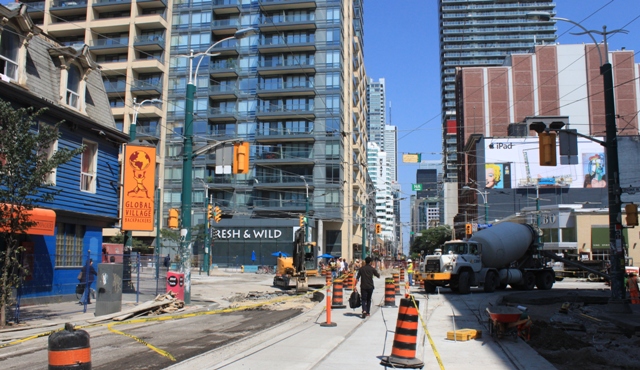
August 16, 2013
Looking east on King with most pedestrian traffic moved onto the car tracks while work proceeds on the curb lanes and sidewalks.
August 12, 2013
Looking west on King across Spadina.

Looking northeast across the intersection.
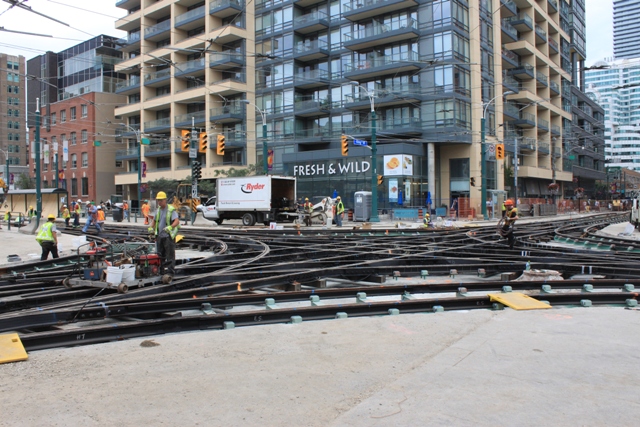
Looking south across the intersection. Note the slab in the foreground where new stop rails will be clipped to the existing structure remaining in the concrete from the original installation. This is an example of only removing the top layer of concrete containing the old track, not going all the way down to the foundation, as mentioned in earlier photos of the excavation.

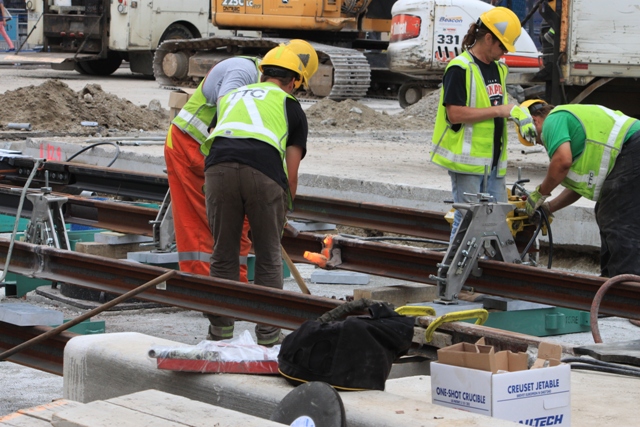
Track sections are welded using thermite charges. Here, rails at the new joint are held in a jig while a torch heats them to the appropriate temperature for the weld.

When the rails are hot enough, a one-shot crucible containing the charge is placed on the jig.

The contents of the crucible is ignited and, initially, the reaction is contained there.

The molten metal that will form the weld begins to pour out of the bottom of the crucible. Just in front of it (to the right) is an overflow bucket to catch excess metal and the lighter slag that is a byproduct of the reaction.

The metal flows into the jig making the weld between the rails.

A short while afterward, the crucible and overflow are removed along with the jig itself. Also visible here is the form within the jig that held the metal pouring out of the crucible.

Excess metal is chipped away from the weld.
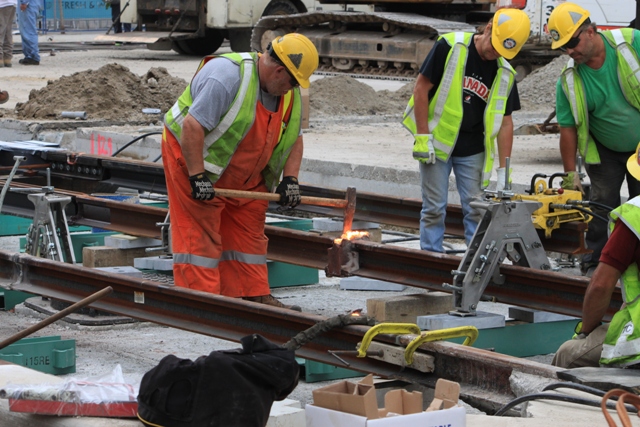
An earlier weld with most of the excess metal removed is visible on the left side on the rail behind the welding crew. This will be further polished to give a smooth running surface.
August 11, 2013
Looking north on Spadina across King. The panel for the northbound trailing switches is being positioned.
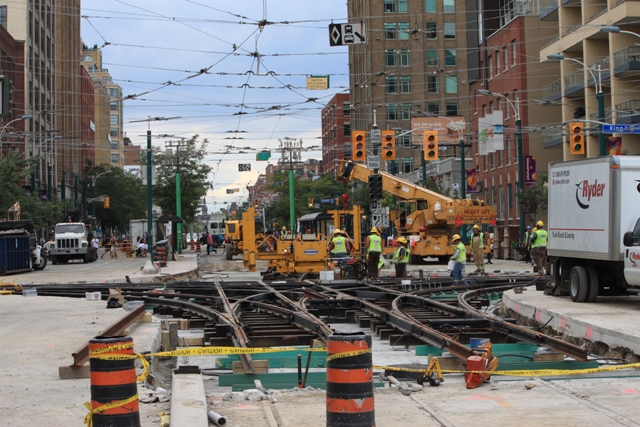
Two track cranes sit on the panel. These are used to “walk” the panel into position. In this view, note that the feet are not touching the pavement. The panel was not in quite the right position when this shot was taken.
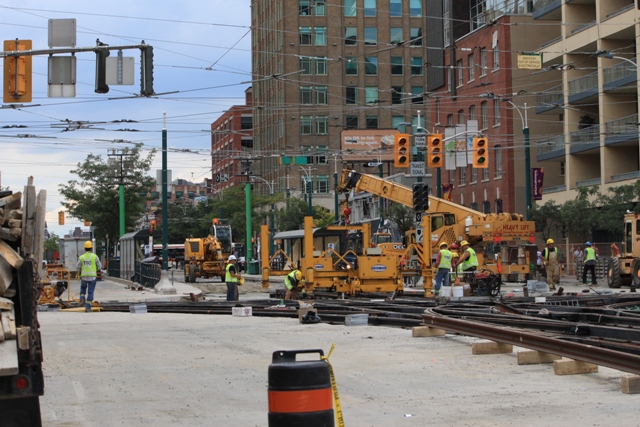
Here, the cranes have lowered their feet and the panel is lifted a short distance off of the pavement. This allows the cranes to move relative to their feet either side to side or forward and back. After a short adjustment, the panel was lowered again and bolted into place.
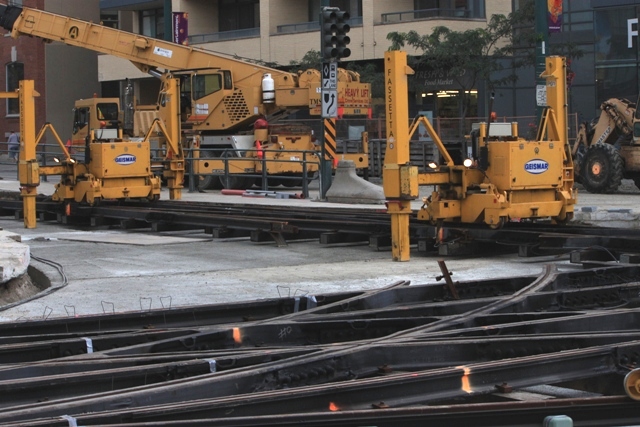
Looking southeast across the intersection.

Looking east on King across Spadina. New tangent rails have been placed on the old foundation and ties excavated a few days earlier on the western approach (see August 8).

August 10, 2013
View from the northeast corner showing the half-completed intersection.

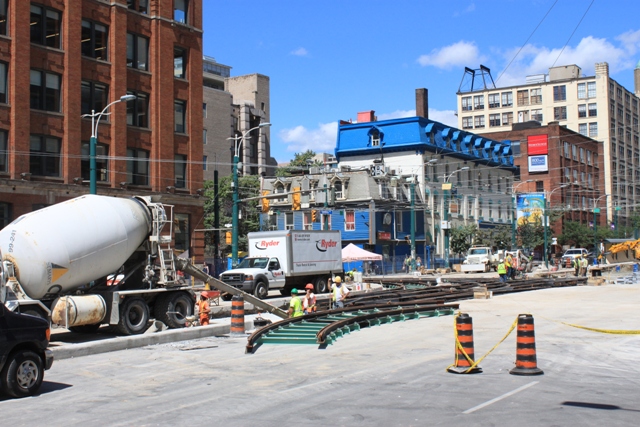
View from the east side of Spadina south of King looking northwest. A panel of curved track (reminiscent of a Lionel set) for the north to east curve awaits installation in the foreground.
August 8, 2013
Pouring the foundation slab at about 10:00 am. View from the northeast corner.

Panels for the southern quadrant are parked on the streetcar right-of-way south of the intersection at Wellington. The eastern and western panels are also sitting in their respective locations nearby on King.

Looking east on King to Spadina at about 5:00 pm. New rails for the eastbound stop have been placed in the curb lane, but they are not yet welded together. Note that the excavation has removed only the top layer of concrete. Invisible under the rubble are the steel ties with Pandrol clip mounts to which the new rails will be attached.
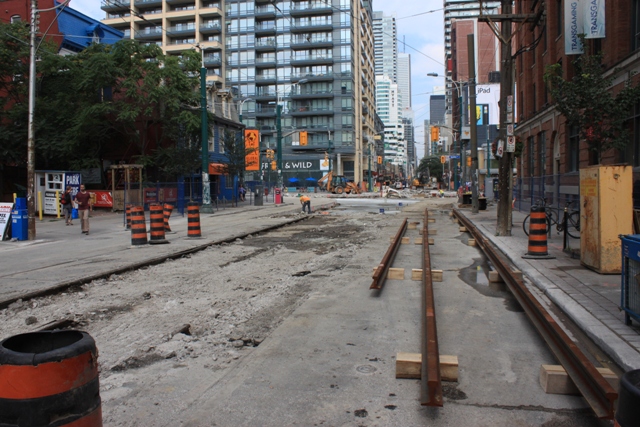
Looking southeast across the intersection at about 5:00 pm. Surveying is in progress to re-establish the location of the track panels (some of the original survey marks vanished when the pavement was ripped up), especially the critical diamond that will sit in the middle of everything and off of which the entire assembly will be built.

The panel containing the diamond sits on Spadina north of King awaiting installation.

August 6, 2013
Looking south on Spadina toward King at about 5:15pm. Demolition work began after the intersection closed at 10:00 am today.

Looking northeast across the intersection.
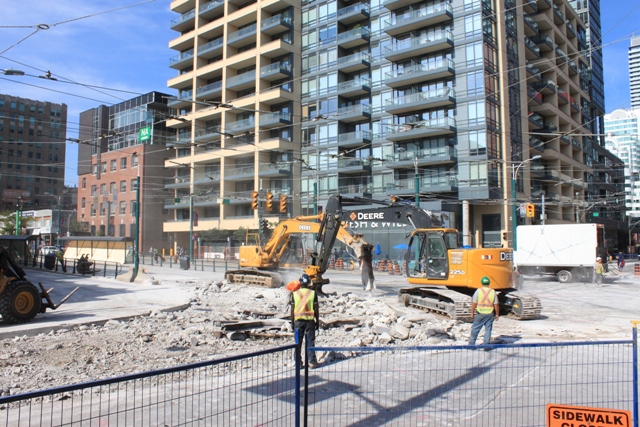
Looking north across King.
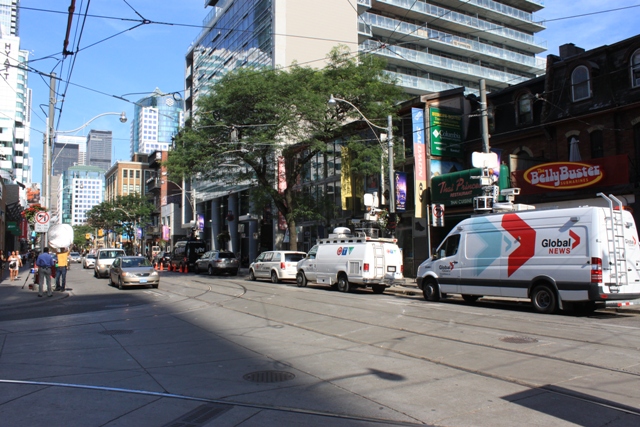
It was a slow news day, and no fewer than four TV stations attended to report on the construction and its effect on downtown. The CBC’s Steven D’Souza stands on the northeast corner of Charlotte and King as the shadow of a condo slides across his shot.
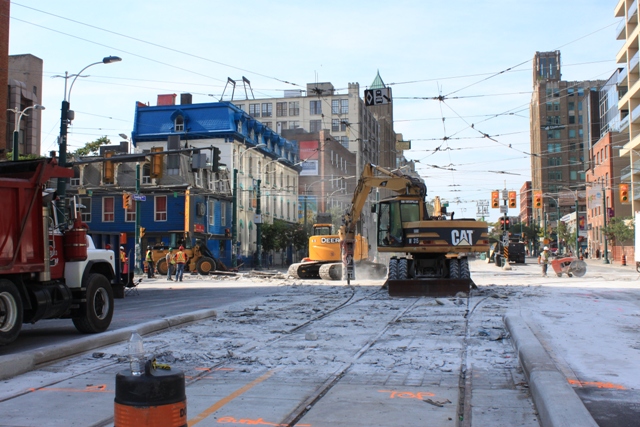
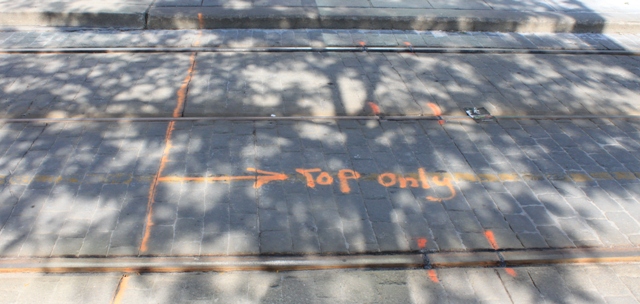
I have noted in various places that “new” track requires removal of only the top layer (of 3) in which old track was built. Here an instruction to the demolition crew shows where this should be done at the carstops north of the intersection. The main part of the intersection will be completely removed to allow its replacement with “new” style track.
Typical stop pole signage, this one westbound at Simcoe. The “Stop not in use” card tells people to board cars on Queen Street, but the yellow sign does a better job. These are at most but not all locations. Large placards are in subway stations but not on transit shelters where they exist. Some riders are lost, but a lot are just walking along King rather than going up to Queen where, because of the scheduled service levels, there are now actually more King cars than Queen cars.

 Steve Munro
The King/Spadina track work will see all diverted King cars travel south on Church and (except short turns) turn east onto King. This maneuver results in virtually every trolley pole take the westbound wire and then come off. The streetcar is then stuck diagonally in the intersection blocking most traffic while the driver walks to the back and re-connects the pole.
This overhead problem has existed for years. Right now is certainly a good time to fix it. Better still accelerate the pan conversion work and fix it both. Kill two birds with one stone as the old proverb goes.
Or of course the TTC can choose to maintain its successful negative advertising campaign and further increase the number of streetcar hating drivers. My estimate would be that each dewirement results in six drivers cursing the ‘g.d. things’, although some may have other words.
LikeLike
Either an extraordinary coincidence, or someone is reading your blog, Steve. At about 1pm an overhead line crew showed up at King and Church and made several valiant attempts to realign the overhead frog so the trolley poles would follow the car, but were unsuccessful and had to leave. Next a staff person nursed each car through the turn by pulling on the pole cord to reduce upward pressure, which worked, but he was gone as of 4.30pm. Another crew showed up about 5pm and spent over 3 hours tightening this and loosening that, and after 4 poles went east it was deemed corrected.
Not so lucky with signage; a new and slightly better pole sign but no bigger and still with scribbled ‘Queen Street’ on it, including at Church Street. Wouldn’t those big glass panels on shelters be an ideal place for a big 30×40 sign (inches not mm). There were two staff on street at King station at 11am but gone at 1pm. I did my thing and told about 8 people at various stops along King.
LikeLike
Mark: The overhead problem on the ‘south to east’ curve at Church & King has been ‘solved’ for now by having an employee positioning himself at the back of each streetcar as it arrives at the intersection, grabbing the trolley rope and walking along with the streetcar as it is making the turn onto eastbound King, and repositioning the trolley shoe onto the correct wire, if required. Stone-age TTC. When will we learn?
LikeLike
It just occurred to me that if service was managed properly, one could tell right away if service was running normally. Just stand at a stop for 5 minutes. If no streetcar in either direction, service is not running. As it is, this case is indistinguishable from an ordinary gap.
LikeLike
The issue with the overhead at Church & King appears to have been solved. Glad to see a swift reaction to the problems.
Unfortunately for the riders on King, there is no provision in the schedule for the added mileage, so service is worse, particularly on the outer ends (Broadview and Roncesvalles) due to the larger number of short turns required.
To add to the riders’ confusion, people on King West can still catch an occasional streetcar on King between Bathurst and Shaw, because CIS is using Wolseley loop as a short turn point for the 504 cars (via Bathurst and King). The same routing is also used for the deadhead moves on the 512 St. Clair.
LikeLike
Will you be posting pictures and an article on the new trackwork on Cherry St., Steve?
Steve: The article has been up since mid-July!
LikeLike
Now you’re thinking. The diversion should be changed to Bathurst-Queen-Church via Wolseley Loop.
Steve: Do it in both directions, and Wolseley Street could have the most frequent service in the network, albeit only for about 100 feet.
LikeLike
Steve, with regard to future rail replacement by removing only the top layer of concrete, a little of which was done on straight track at Queen/York, is the method intended for use with ‘special work’ which is preassembled mostly on wooden ties.
Steve: I expect that they will go down two layers for that to the bottom of the ties, but will not replace the foundation slab.
LikeLike
When was this intersection last redone and how often do Grand Unions need replacing?
Steve: Previous rebuilds of the three grand unions were at King & Bathurst (1995), King & Spadina (1996) and Queen & Spadina (1996). These intersections were assembled on site and much of the track was only bolted together, not fully welded as the assemblies now used are. The track was not mechanically isolated from the concrete which started to break apart almost immediately after the track was installed.
The “new style” intersections are still fairly young, but they are holding up better in the short term. Examples are at Church & Queen, Parliament & Queen, Roncesvalles & Howard Park, Queen & Bathurst.
LikeLike
I rode the 504 last night and things were running surprisingly smoothly. There were lots of cars in both directions but most bunched into pairs. My westbound car de-wired turning off Victoria to Queen. We were quickly underway because our ‘companion’ directly behind us was kind enough to leap out and put it back on the wire.
Also surprising was that most riders seemed to be well-aware of the diversion. The eastbound operator wasn’t even offering any announcements whatsoever.
Steve: Once the diversion is established, it is the occasional riders, especially tourists at this time of year, who have the most problems. They are half-lost to begin with, and an announcement that a car is diverting hither and yon means nothing to them.
As for the service quality, congestion is bad especially during the PM peak and at the end of the AM peak when the restriction on parking ends at 9:00 am. Many intersections could benefit from traffic cops to manage things like turning streetcars and buses, and preventing motorists from entering when they cannot cross. It appears that all of the police in downtown Toronto are on vacation this week, and that shows just how carefully this whole escapade was planned.
LikeLike
Timur:
Repositioning trolley wires might not be stone age, just a 40 year old technique.
Story here.
Vancouver trolley wire map here.
LikeLike
So, 1996 was still within the period when TTC couldn’t or wouldn’t build track as Toronto conditions require? 17 years between major(ly inconvenient) rebuilds doesn’t much deflect the capital-intensive criticisms of steel wheel technology.
Steve: The TTC started to build tangent rail with welded track and mechanical isolation in 1993, but it took much longer for special work to get the same treatment. There was a test application of a limited amount of resilient track at the Don Bridge in 2002, and then King/Dufferin was the first full intersection to get this treatment in 2003. Even then, track was not being delivered in panels because the TTC did not yet have the technology to move such panels around. It is truly astounding that it took 30 years after the decision to retail streetcars for the TTC to catch up with rail construction techniques from other systems in the world.
LikeLike
I am wondering why streetcars were not run from Spadina Station to either the McCaul or Wolseley loop during the grand union construction with buses south of Queen. Was there a fear of crowding on Queen due to the King diversion, or did it just simplify scheduling?
Also given that the 510 is buses-only during construction, why don’t the buses use the streetcar ROW until at least Queen Street? The ROW has no centre poles. It seems a pity to waste the ROW.
Steve: The number of streetcars of Queen would have been quite high, and Spadina cars turning both ways at Queen would have been added to an already very congested area. Buses operating on the right-of-way would be a bit dodgy as it’s tight for vehicles passing, but even in one direction would have helped. The challenge would have been the move off of the right-of-way into regular traffic, but this could have been handled with an adjusted transit only signal phase.
As a general observation, the complete absence of police from traffic duties at any of the badly congested locations speaks volumes about Toronto’s real attention to traffic management.
LikeLike
Interesting to watch the track being plopped in. Gives a sense of completion.
While on the topic of track installation, any idea when the track will start to be laid along Queens Quay? I take the 509 to work but its starting to seem almost stagnate in terms of TTC work. Even the loop is not really being worked on.
Steve: Track construction on Queens Quay is planned for the fall when the utilities work gets out of the way. Some of the infrastructure for the power supply is now being built including splicing chambers for the underground power feeds and preliminary work for construction of pole bases for lighting and TTC use.
LikeLike
Steve:
I was thinking of this as I walked from Queen station to King & Bathurst rather than take the Queen/King car home – wouldn’t it have made sense to short-turn eastbound King at Bathurst (turnaround at Exhibition) and westbound King via Church-Wellington-York? That way most of the King route is serviced.
Just a thought.
Steve: Given that this is only supposed to be a two-week diversion, a complete restructuring of the route would probably be more trouble than it’s worth from a scheduling point of view. York/Wellington is not available due to construction on that street, and a “King East” route would have to turn back at Church. Bringing the “King West” route only to Bathurst would not really “serve” the folks east of Shaw any better than the what they now have because the line wouldn’t really go anywhere, and they would be forced to use the 501 Queen without benefit of any supplementary service.
What is quite annoying, however, is the absence of a service design that takes into account the congestion on Queen.
Another thought: does it take 2 weeks to rebuild the King/Spadina intersection?
Steve: If you look at articles documenting work of similar scope at King/Bathurst in 2011 or Queen/Spadina in 2012 (you will have to scroll down some distance in the article), you will see that it takes about one week from the start of demolition to the point where the new trackwork is substantially assembled, but not yet set in concrete. The King/Spadina project appears to be moving on a similar timeline.
Once the track and the grounding cables are in place, the concrete must not only be poured, it must be given time to cure before service resumes. The TTC has found that premature operation of service damages the concrete and undoes part of the value of doing a project on this scale.
When this eventually must be repeated in 25 years, the TTC will not have to replace the foundation, only the layer containing the track structure and this will shorten the project a bit.
I am rather surprised at your question as a visit to the site during the past few days would reveal the sheer amount of work to be done to remove the old track and prepare the roadbed for the new structure.
LikeLike
I was down in the area yesterday around noon dropping by MEC and on my way back to work took a look at the progress – saw the central slab being poured. Looks like they are moving along fairly quickly. I’m guessing this track work will last a fair bit longer than 15-17 years?
One thought did occur to me – with this latest intersection shutdown for major track work, I would have thought the Fords and Co would have been lathering once again over streetcars and how they should be phased out, yet not a peep. I’m guessing it’s trackwork such as this that have inspired the comments that subways last for a hundred years? A yet, this weekend a section of the subway downtown will be shutdown for signal work.
Phil
LikeLike
Subways last a hundred years! Not according the shutdowns on both #1 & #2 subway lines. This is despite the normal subway shutdowns between 1:00 AM and 6:00 AM (9:00 AM on Sunday), when maintenance work is done.
Why can’t they work on the streetcar tracks between 1:00 AM and 6:00 AM (9:00 AM on Sunday)? Because of the noise regulations (generally 11:00 PM and 7:00 AM as a rough guide), so no jackhammers at three o’clock in the morning when traffic should be light.
LikeLike
When will the streetcars be running to the Queens Quay loop and Spadina? I find that once this construction planned at King and Spadina is complete we will only have a limited route at least again. It’s really unfortunate that we can’t coordinate this line to at least provide access to the waterfront.
Steve: The work at Queens Quay will not be completed for a few months. Utility work is still underway. TTC plans to resume streetcar service south to Queens Quay in mid-November. Service to Union cannot start until February because the access to the loop at Union is blocked off for construction.
LikeLike
Thanks for the detailed play by play, Steve. I work a block away and it’s great to understand what’s going on.
They were pouring concrete in the centre of the intersection yesterday, and along the segment leading east on King. Seem to be closing in on the final stages of this project.
Steve: They are on roughly the same two-week project cycle that we saw in two previous jobs of this scale.
LikeLike
Steve, is there plans to replace the Dundas/Spadina intersection this year? I remember reading somewhere that the intersection needs to be replaced too. I’m not sure if I missed anything or is that deferred to later.
Steve: Originally, Dundas was going to be done this year, but it has been put off to 2014. College/Spadina also. These dates may change once we see the updated list in the 2014 budget.
LikeLike
Regarding Dundas/Spadina and College/Spadina, do you know if the proposals to add missing curves had any influence on delaying re-construction? Will any of them be added?
Steve: I do not believe any curves are to be added (neither intersection was included on the report on that subject). The delay is a question of timing of works projects. There is just too much else going on this year.
LikeLike
In reading about cars having to be rewired and having read links about Vancouver’s trolleybuses on here, I was reminded about a visit to San Francisco in 1983 when trolley buses turning onto Market Street in the downtown area kept dewiring as they turned and a Muni worker was having to rewire (I guess that’s the right term) every bus that made the turn there.
LikeLike
For a preview of work to come, the TTC has issued a tender for the encapsulation of specialwork at intersections which are on deck for construction in the near future. Earlier in the year, the tender went out for the specialwork itself. However, details of the intersection configuration are also included in the current tender, for those curious of what (if any) changes to the configurations are proposed (I don’t believe there are any).
Steve: The intersections shown in the tender are unchanged from their present layouts.
LikeLike
Which is a shame really. The TTC never does anything proactively. The next chance to make any changes will be some time from now.
That west to north curve at College and Spadina is what I’m talking about here. It seems to make sense to fill in the two missing curves here but as it is that curve is pretty useless so why spend money to replace it (and slow down operations with stop and proceed for westbound cars).
LikeLike
While it’s not on the books in the immediate future, I had heard that there were plans in place to add the missing curves at the Church/Carlton intersection when it is next reconstructed. Apart from this, I suspect the TTC is waiting to get a better idea of what operational movements will be required by the new fleet before committing to additional infrastructure. While I agree that adding a south to east curve at College would likely provide a useful short turn via Spadina station loop, Bathurst is really not that far west and enables a similar short turn not too far away. I would hope that the TTC conducts a careful operational review prior to finalizing design of such expensive intersections to ensure that they are not missing out (either by adding needed or removing unnecessary) specialwork to achieve an optimum balance between operational flexibility and capital/maintenance cost. It would not make economic sense to install specialwork which would only get used 100 times over its life, which is why, I suspect, the west to north curve at Howard Park and Roncesvalles was removed, and why we’ll see the demise of some runaround tracks and perhaps even the turnback at Kingston road and Queen.
Steve: The curve at Howard Park & Roncesvalles was part of the access trackage to Dundas Carhouse that stood on the block north of Howard Park and west of Dundas. The east to north curve at Howard Park and Dundas was part of the carhouse access, and the overhead for this curve outlived the track by several years. The north side of the site was accessed via track on Ritchie Street which is wider at the Dundas end because of the extra space for the car tracks.
Yes, I would not be surprised to see Woodbine Loop lose some trackage when it comes up for reconstruction.
LikeLike
Note that the track drawing of the Dundas carhouse that you describe does not show this curve, although it may have been added later to serve the carhouse. Given how long ago that carhouse was abandoned, they must have reconstructed it several times after it was no longer needed for carhouse movements.
Steve: Yes, I remember a previous reconstruction in 1978 when the curve, partially removed for sewer work, was reinstalled, and again 20 years later. The east to north at Dundas was finally removed in 1999, but it had been rebuilt in 1982.
LikeLike
Michael S is correct that the TTC seems to be planning an additional curve at Carlton and Church. (Westbound Carlton to Southbound Church) This is one of five projects the TTC seemed to agree to in 2009. Of course when the time comes this “approval” may be ignored.
Interestingly, this report seems to reject installing a loop at Queen and Broadview – despite the fact that the TTC insisted on getting the land for it when the former Parliament loop was sold off as part of a land exchange to get the First Parliament Site back into public hands. (This held up that project for quite a while!)
Steve: Yes, I was highly amused at all the machinations to get the Broadview/Queen site in spite of its being rejected as a worthwhile project. Left hand, right hand, I suspect.
LikeLike
At least they own the site, so the ball is in their court to make the decision if they wish. Encouraging to also see that while the funds aren’t available, consideration has been given to a few additional diversion tracks. Perhaps sometime in the future when the Fords don’t rule the roost. It wouldn’t surprise me to see some of these projects put on ice until after the next municipal election. Once something gets scrubbed by the politicians, its harder to turn back, but if it’s not in the news, it can be brought to light during more favourable times.
LikeLike
The TTC posted signs at King station that note it is a “521 Exhibition” stop. Given how most streetcar users have a tenuous understanding of route names and numbers, and that the cars will be signed 504 Exhibition, I expect quite a bit of confusion. The signs are 75% empty space, why not provide even a one sentence explanation of what is happening?
Steve: I believe that the cars are supposed to have window cards with the “521” number, but we will have to wait until tomorrow to see how well co-ordinated this is.
LikeLike
Why wouldn’t they take advantage of the never-used red/white “Express” exposure on the rollsigns in combination with the dash-mounted cards? What exactly was this intended for when it was added?
Steve: I do not have the faintest idea. How the TTC could run an express streetcar is a mystery, unless they were thinking of running local buses alongside (say for 511 Bathurst service to the CNE).
LikeLike
great photos!
LikeLike
Now that is an interesting idea, especially since they could run it from St. Clair West down to the Exhibition Loop and run replacement buses north and south of Bloor. It wouldn’t have to be a ‘non-stop’ express but rather, a limited stop express service.
Speaking of the Ex … I know there are probably a million reasons “why not” but I would have loved it if TTC had brought the LFLRV down to Exhibition loop to park it for the public to see (but not enter) … if TTC is reading this … there’s still time to get it ready for the Labour Day weekend.
Cheers, Moaz
LikeLike
Why not allow the 521 designation to pass into history? Passengers wanting a King car to the EX should be told to look for a car signed 504 EXHIBITION.
Steve: I agree. Once they knew that the cars no longer have 521 signs, the publicity materials should have used route number 504.
LikeLike
Uh, why were the 521 exposures removed from the destination signs? I’ll bet there are exposures on the rollsigns that never, ever see the light of day.
Steve: Who knows. Probably some management decision now many years back that CNE service would forever more be provided by buses. The original reason for this change was a lack of streetcar operators.
LikeLike
The removed the 521 because they assumed it would forever be replaced by the “reliable” 509 Exhibition streetcar which they added at the same time.
Steve: Ah yes. It was the 522 Dundas West car that became the “193 Rocket” due to a lack of operators at Roncesvalles, or so it was claimed.
LikeLike
At least some CLRVs have 521 on the rear roll sign, and some 521-drivers were setting that sign. (Today I saw 2 cars with the rear 521-sign displayed). Front-end signage appears to be varied. I think there are 2 versions of the cardboard sign. One version shown 521 EXHIBITION on one side and 521 CHURCH on the other. This is in addition to the overhead 504 EXHIBITION / 504 CHURCH signs. The other version had type so small that I could not read it from the curb. Because I could not read it, I am not sure it was a 521 car as in 2 cases a blank or erroneous overhead roll sign was displayed on cars going westbound on King from the curve at Church.
LikeLike
I would be willing to bet that most people pay FAR more attention to the destination sign than the route number. If the streetcar is on Queen and says Neville Park, it’s a Queen car, if it’s on Dundas and goes to Broadview, it’s a Dundas car, and if it’s on diversion, and says where it’s going, then there is a chance it’s going to get there. Whether it says 521 or 504, if it says “EXHIBITION” it’s probably going to get there. I expect that with the full implementation of LED displays on streetcars, the number will become increasingly more irrelevant, with more space to communicate what was implicit by the number: ‘Destination’ via ‘Route’, although for bookkeeping reasons I don’t expect route numbers to go away any time soon.
Steve: Sadly the route numbers came to us with the CLRVs and their one-piece roll-signs. We used to have route names that meant something. I will certainly be happy to see the end of the confusion caused by two routes, 504 and 505, whose destinations are almost identical and which confuse everyone. Even if we had letters, like San Francisco, we could have had meaningful values for almost every route.
(I am sure some wag would complain that letters would be a bad idea because we might run out of them some day.)
As for style of display, I prefer “Route” to “Destination” rather than burying the route name at the end.
LikeLike
I’ve always has the idea that the reason for converting streetcar routes from their route name to the present route numbers had to do with the signboxes not being wide enough due to the tapering of the CLRVs and the ALRVs at each end of the car. In any event, the head-on view of either end of any of these cars compared to, say, a PCC can seem quite pronounced.
Steve: Yes, there was that problem with the width of the sign boxes, but elimination of the route name from everything except the transfers was not the best of ideas.
LikeLike
I saw a couple 521 cars today.. ugh the TTC has managed to screw things up again! The cars are not signed 504 EXHIBITION or 504 Dundas West Stn VIA King. The ops are throwing up the blank white signs and the only indication the cars are in service are the tiny little cards in the window.. if I had not seen the sign I would have thought the cars are out of service!
In a bit of good news the two 521 cars I did see managed to display the 521 rollsign in the rear!
LikeLike
If they were willing to wind the rollsigns all the way to the start to get blank white then they just as easily could have wound them all the way to the other end to get “Express”. (It’s almost ‘Ex-press’, a perfect pun.) This is being handled so poorly. Please someone at TTC reading this, try it out!
LikeLike