
Updated November 10 at 4:45 pm: Photos of the mockup have been added to this article.

This shows the mockup (actually three sections of the five-section vehicle) including street level (front door) and island level (at the second door with a ramp deployed) comparisons for boarding heights.
For more photos, scroll down to the bottom of the article.
See also coverage on the Torontoist, Urban Toronto and blogto websites.
Updated November 9 at 5:20 pm: In response to questions that have come up in this thread and previous articles about the new cars, I have added information at the end regarding the issues of weight-per-axle and the Toronto requirement that the cars negotiate single-point track switches.
The TTC will display a mockup of the new streetcar fleet for public viewing.
TTC Hillcrest Yard
November 12 to 15, 2011
10:00 am to 7:00 pm
Additional information about this event and the new cars is on the TTC’s LRV Page.
39 years ago, the TTC decided to retain its streetcar system, and this will be the second generation of new streetcars. Toronto joins the rest of the world with a modern car based on designs used in other major cities.
They’ve been a long time coming, and design changes have added almost a year to the process that TTC and LRT advocates expected when the order with Bombardier was approved. When I have details of the delivery schedule, I will update this post.

For additional hi-res views of the new cars, visit the “Meet Your New Ride” page. Something that’s immediately obvious is a family resemblance to the interior of the new Toronto Rocket subway cars.
Two observations about the TTC’s website:
- Comments about the improvement of capacity on routes and the approach to scheduling service are now out of sync with statements in the TTC’s budget papers. Originally, the TTC was committed to improving capacity on streetcar routes and keeping wait times reasonably short. Today, this position is no longer as definite because running service above a full standard load is transit gravy.
- The new cars will operate, according to the TTC, on new routes for the eastern waterfront. Considering the foot-dragging on this project, the cost escalation and the low priority given to waterfront transit generally, it’s hard to say whether these routes will ever actually be built.
Updates regarding technical issues with the cars follow the break below.
I exchanged emails with the TTC’s Stephen Lam, Chief Engineer, Rail Vehicle Engineering on some the technical subjects readers have raised about the new cars. The sections below are based on his responses.
Comparing weight-per-axle of LVLRVs with other cars
Yes, the weight-per-axle is greater on the new cars than those we now operate. The new cars, like the ALRVs, have three two-axle trucks, but these carry longer, heavier cars.
The axle load is higher on the new low floor cars than that on the ALRV because it is a longer car with higher capacity, air-conditioned, more auxiliary equipment, with structure and metal still built for 30-year life, but on the same number of axles. The axle loads on the CLRV and ALRV are almost identical because the ALRV is approximately 1.5 times longer than the CLRV, with 1.5 times more axles to carry the additional 50% weight.
What really matters, however, is the “unsprung load”, the portion of the total load that is not supported through some form of resilient suspension.
Vibration that could cause track and equipment degradation, however, is more caused by the mass below the suspension system – in other words, the weight on the wheel-axle set, or what is known as “unsprung” mass.
The new low floor vehicle still employs three layers of suspension – super-resilient wheels with soft rubber blocks between the wheel tyre and the axle; a rubber primary suspension system; and a coil spring secondary suspension system that supports the carbody.
More importantly, the “un-sprung” mass on wheel axle set of the new vehicle is lower than that on the current fleet of vehicles by approximately 10%.
Vibration and noise
Vibration problems with the roadbed arise from a number of sources, and this was described in detail in a research paper prepared in response to early problems with the CLRV fleet. The original “Bochum” wheels on those cars have a rubber layer to damp vibrations, but it is a completely different configuration from what existed on the PCC fleet and a similar arrangement with the super-resilient “SAB” wheels now used.
On the Bochum wheel, the axle hub is separated from the steel tire (the ring of metal that actually runs on the track) by a rubber ring. This ring is placed in compression by the force of the wheel on the track, and so the wheel is stiff in that direction. This aids in transmission of vibration to the trackbed. The concrete slab acted as a resonator.
When these wheels were introduced, Toronto was building non-resilient track with rails laid directly in concrete. By contrast, older tracks sat in asphalt or paving setts and the roadway would not vibrate.
The SAB (and PCC) wheels also have rubber between the hub and the tire, but in a vertical sandwich. On the PCC wheel, it is a single piece of rubber on each side while on the SAB wheel there are 16 separate “hockey pucks” (8 on each side of a wheel) providing a similar, but greater effect than the PCC design.
This puts the rubber in shear vertically, the direction the wheel bears on the track. It also changes the vibrating frequency to one that is high enough that solid pavement cannot resonate. Moreover, for many years the TTC has been building track that is mechanically isolated from the slab with a rubber sleeve so that any vibration from the wheels is damped out.
The new LFLRVs have skirts that cover much of the truck and block the transmission of noise from the wheels into the air.
Single-point switches
Unlike the switches found on many LRT systems, the TTC’s streetcar network is built in the North American standard layout using single-point switches. This means that there is a movable blade only on the “inside” rail of a curve. By contrast, railways and the subway use double-point switches where both rails have a movable blade.
A single-point switch is cheaper to build and maintain, especially for street trackage, because there is no need to link the two blades so that they move as one unit. That’s why it was so common on streetcar systems. When a streetcar enters a switch that is in the curved or “open” position, the wheel on the inside of the curve (the right side of the car on a right turn) is pulled into the turn, and through the axle this directs the wheel on the outside into the correct track.
When the CLRVs operated with Bochum wheels, this arrangement caused derailments because the Bochum wheel, with its rubber ring, is not stiff horizontally. Rather than turning into a curve, the wheel would deform. Because the inner wheel was not pulling its mate on the other side of the car into the curve, the outer wheel would follow the straight track.
The SAB wheel is stiff horizontally and this pushes the inner wheel into the curve as desired with a corresponding move in the outer wheel.
One concern the TTC had with low floor car designs that used split axles (a separate half-axle for the wheel on each side of the car) is that there was no mechanism to transfer the force between inner and outer wheels at switches.
Truck design also affects how well a car will follow track on a curve, but that is independent of the type of switch used. The specification for the new cars improves on the CLRV truck in this regard.
Stephen Lam provided a set of illustrations of the design illustrating some of the points discussed here. Page 2 shows the design used for the Bochum wheel (left) and for the super-resilient wheel. Pages 3 and 4 show details of the suspension system. Page 5 shows the full truck (bogie) and skirting.
Photos of the Mockup added November 10, 2011:
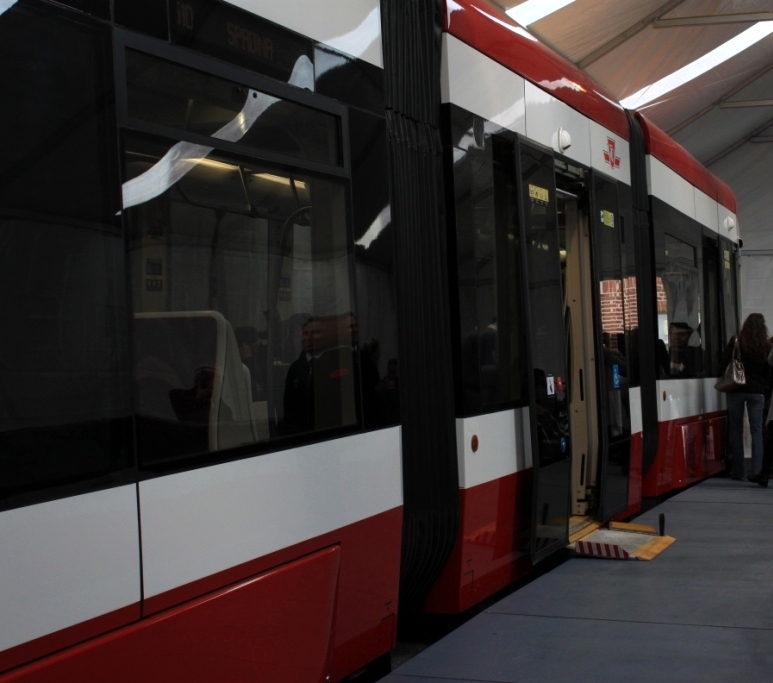
This shows the second doorway of the car (also the second section) looking from the rear. The accessibility ramp is deployed at the high platform level. During the media briefing, we did not see it extended to its full length for pavement level access, but I was told that it is roughly three times longer for that type of situation.
The brick pattern in the window is a reflection from a nearby building. It is not part of the colour scheme.

This is the rear half of the second door panel showing the pushbuttons for opening the door (red) and requesting ramp deployment (blue). All doors on these cars are passenger activated.
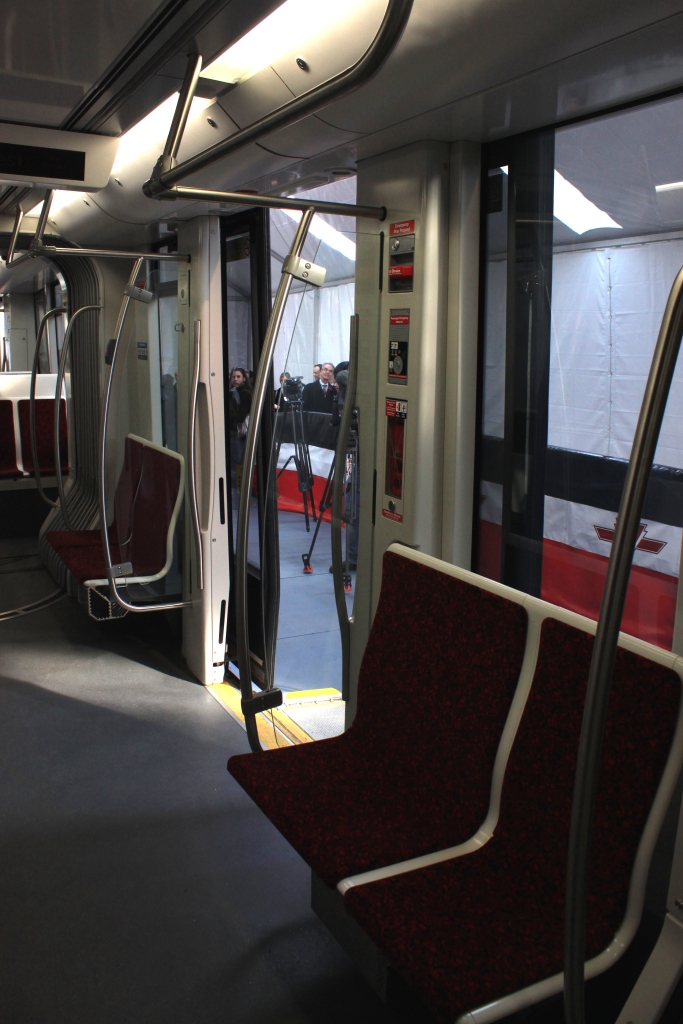
This is a view toward the same set of doors from inside of the car. Note that the door panels are not all of the way open because they were set up manually for the tour.
Also visible here is a sample of the extra wide seat.
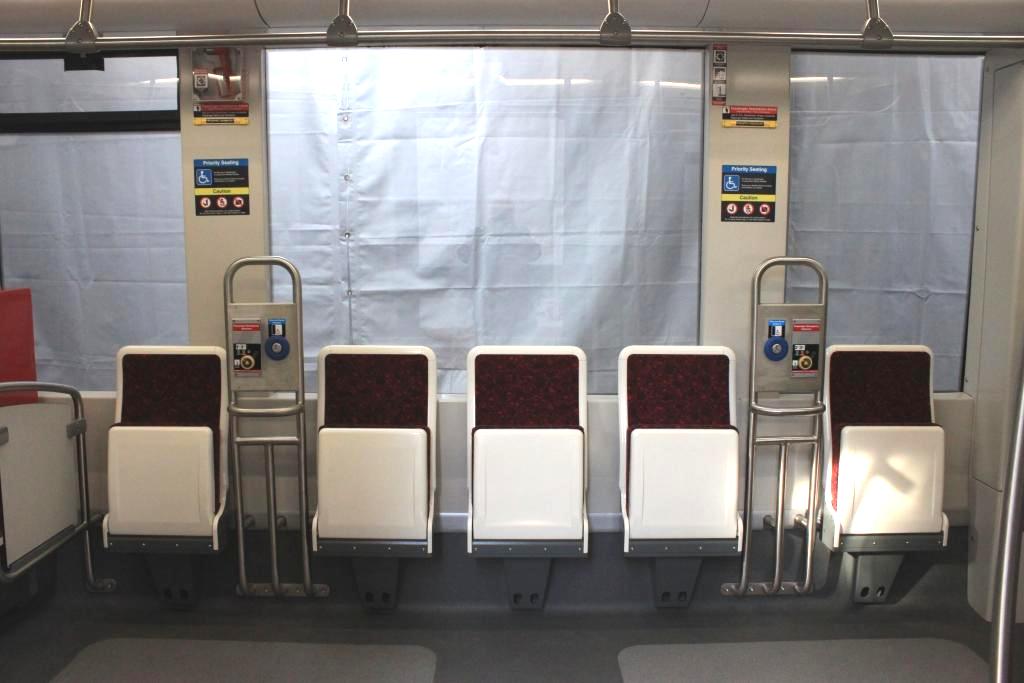
This is the view directly across the car from the second door. There are five flip-up seats in an area that can otherwise be used for wheelchairs and scooters. The lighter patches on the floor mark where spots for these devices and there are stop request buttons on the wall beside each of them.
The red box showing partly in frame (see enlarged version) on the left side is a placeholder for the ticket/Presto machine.
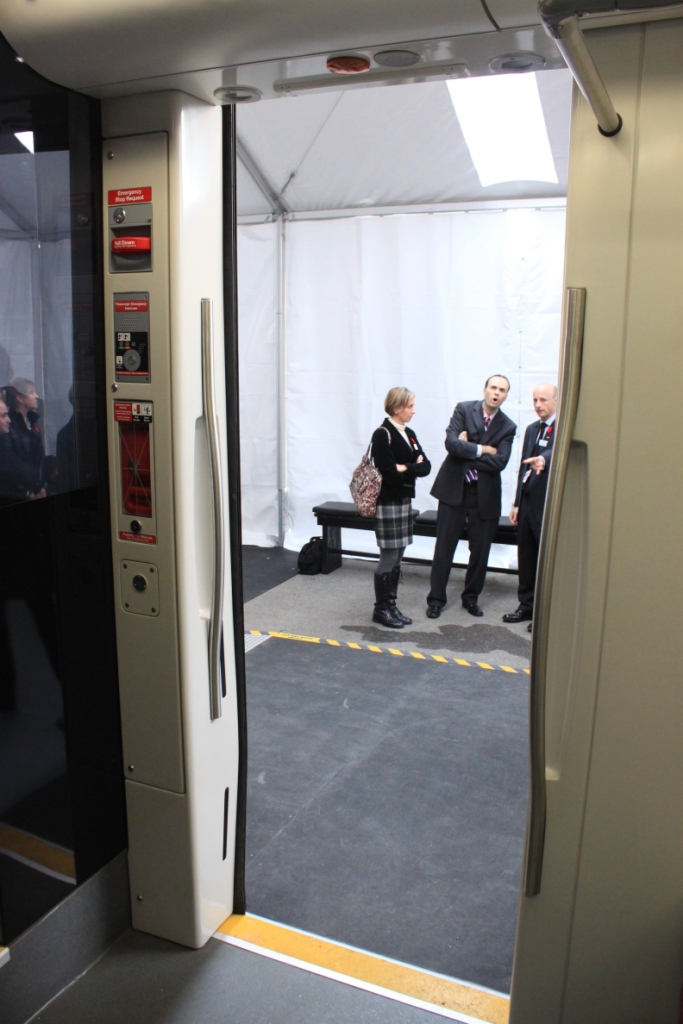
Looking out through the front door which is single width. TTC Chair Karen Stintz is in the background.
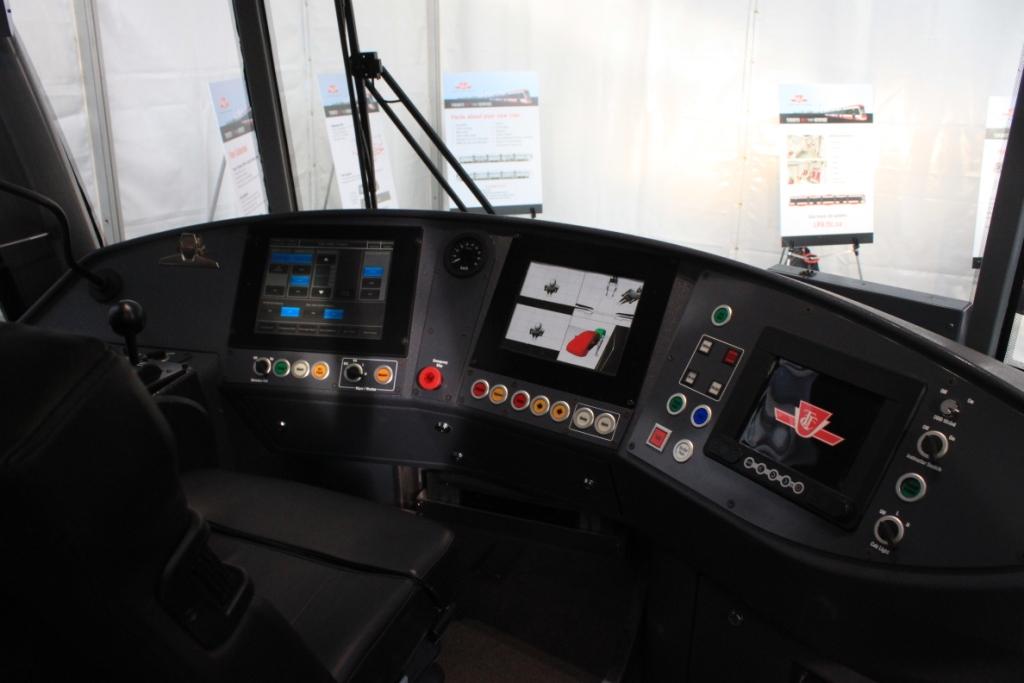
The main part of the operator’s cab. The video display in the middle will contain images from the cameras at each of the four door locations.
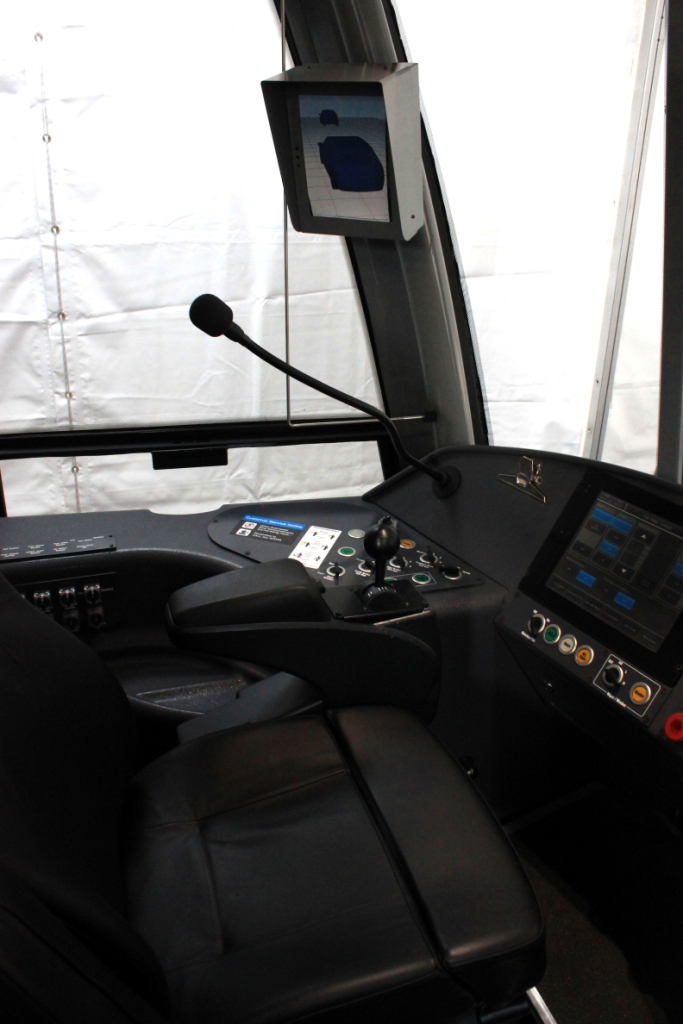
The left side of the operator’s cab showing the control handle for the car.

A poster explaining how fare collection will work. Both a generic ticket vending machine and Presto are shown.
The text in the poster says that the new scheme requires a system-wide conversion to time based transfers. This appears to set the stage for new transfer rules on the TTC.
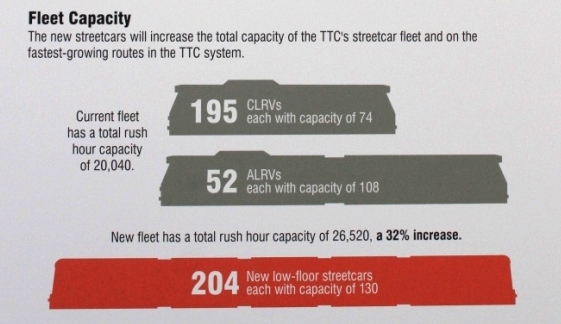
A poster comparing vehicle capacity. The values shown are Service Planning averages, not the crush capacity of the vehicles. Also, the size of the new fleet is still shown as 204 despite budget moves to reduce or defer part of the order.

This map shows the deployment plan for streetcars on each route, and it is much different from the scheme laid out in last year’s budget papers. Bathurst, Harbourfront and Spadina are first up in 2014 with Queen following in 2015. This will allow the ALRVs to be retired in roughly 2016.
 Steve Munro
Moaz Ahmad said, “Melbourne’s older streetcars have stop signs built into the doors”
Melbourne’s newer trams have plug doors, they have yellow lights that flash alternately when the doors open. A change in the law now prevents any vehicles from moving beyond the rear of a tram when the lights are flashing (think of a school bus, only with yellow lights), unless there is a platform/island for passengers. We really ought to adopt the no passing when lights are flashing law.
Our law leaves too much room for accidents. Section 166(1) of the Highway Traffic Act states,
While it is best if one waits until the doors have closed, the law permits vehicles from passing once there is the belief that no one else is boarding or leaving. Given the frequency of “oh, this is my stop” people I see, it is amazing that more don’t get hit by cars.
LikeLike
The tram in this picture is 40 meters long. The original deployment was 30m trams but demand was so heavy that additional 10 meter sections had to be ordered from Alstom. That said, it’s easy to generate demand when you have dedicated lanes for light rail, side of the street running and so forth.
Steve: Not to mention no fear of having a street dominated by transit service.
LikeLike
Maybe it would be harder for operators to soak?
Steve: It’s easy to soak. Just leave the terminal early and run every amber light until you catch up with the next car. The size of the vehicle does not matter. Until intermediate point dispatching was added to the subway, even subway operators soaked by doing very short station stops in the hope of getting to a terminal early enough for a long layover.
LikeLike
Oh – my – my -when I read about increased weight per axle and total length of LFLRV barely fitting between switches, my heart stopped. The same problems have hit several cities in fmr. COMECON post-WWII,when old pre-WWII were fully amortized or no spare parts were available and almost full streetcar production was shifted to Czechoslovakia.CS bought PCC licence from USA in 1935 and got it delivered in early 1950s. New PCC-based vehicles had much greater weight per axle of delivered vehicles – about 3000 kgs (if not more) per axle ,which were built in bogies, while pre-war vehicles had per axle load about 500 kgs (if not less) and no bogies.When municipalities had to add extra cost of “widening” curves or shifting switches for concurrent traffic, they rather folded their operation,converted to buses and blamed the decision on good relationship with USSR, which was supposed to deliver crude oil for ever.
Concerning conversion to pans – does TTC know, who their peers are or who did convert from poles to pans in past 60 years or so? It may be easier and somewhat cheaper for TTC, if they would share experience with others.
Steve: I believe (but will check with the TTC) that the critical number is the unsprung weight per axle. A lot has to do with how the system of vehicle suspension and track construction is able to absorb forces and damp vibration. A big problem with the CLRVs was that they originally had stiff wheels, ran on a trackbed that vibrated badly, and ran on track that was not properly welded. The system could not have been better designed to destroy the roadbed if they had tried.
LikeLike
Every seat section that sticks out has poles that you can grab onto, similar to the T1’s. It encourages people to stand to the side so that others can walk through the train. There are also poles near all the doors. I’ve been on Rockets that were crush loaded and have never witnessed anybody losing their balance. It’s amazing how many people think there are no poles simply because centre poles have been eliminated. The T1’s had a similar setup and they were introduced years ago.
I’d respectfully suggest you wait to ride one before passing judgement, the Toronto Rockets are very nice to look at and ride. You can tell by the smile on people’s faces when they board one for the first time, they’re very impressive.
You should be able to get one soon, There are 5 in service now (6th coming soon) and they seem to be in service at all hours these days. I was coming home from work late last week and manged to snag one at St. George at about 1:15am
LikeLike
I’m assuming that the image shows the pantograph located half-way from the front of the vehicle. That means that the distance between the front wheel and the contact face of the current collector (trolley shoe for CLRV’s, pantograph for LFLRV) will finally be roughly the same for all streetcars, provided the ALRV’s are all retired by then.
After the ALRV’s retire, can the TTC revert back to the original track switching system, where the switch is triggered by a contactor in the overhead wire? … and provided that all wires are pantograph-friendly, of course!
Steve: No, because the way that the old contactors worked is not pan-friendly. Also, we need updated reliable switch electronics long before the last of the ALRVs is retired.
LikeLike
Love the new look for the LRVs! It will be interesting to find out how they’ll fit in the Spadina and Union station loops.
Three quick questions/points:
1. The TTC is putting TVMs on the vehicles. Does this include Presto card readers? If not, why not? If so, why not just put the Presto Card reader and change the fare system in one shot… Saves time and money.
Steve: The intent is that whatever goes on the new cars is able to handle Presto and whatever other fare media might be in use by that time. The entire fare system cannot be converted in the short time before new cars will be in service, and a transitional arrangement is essential to making this work.
2. I noticed that Bombardier has new technology where the LRVs draw power from underneath the tracks as opposed from overhead wires (I believe its called MiTrac or Primove). Would the TTC (and/or the City of Toronto) elect to upgrade to this technology in the future or even consider it an option for Transit City (if and when it gets back on track)?
Steve: This technology is not intended to replace overhead power supply throughout the world of LRT operations. It is intended for specific locations where there are objections to overhead for architectural/heritage reasons.
3. Anyone who rides the streetcar system as it is now knows that sometimes it can be a hassle, especially during rush hour. Would the following suggestions for the system improve service levels with the new LRVs?
– 501 Queen: loop at Kingston rd. permanently, converting the loop into a streetcar/bus loop; replace streetcar service on Kingston Rd with the 22 Coxwell bus, and replace service east on Queen at Kingston with either the 64 Main St. bus, looping at Kingston Rd. or a new bus coming out of Victoria Park Station (13 Neville Park was used during track maintenance a few years ago.. that could be an option)
Steve: The problem here would be that if Woodbine was the terminal, many cars would never get that far. Moreover, riders bound for points east would be forced to transfer. We could nibble away at lots of routes like this whether they are streetcar or bus lines, and in the process wind up with even more services that antagonize riders.
– 502 Downtowner/503 Kingston Rd/508 Lake Shore: removed from service to eliminate redundant service.
Steve: You would still need to add service to 501/504 to make up for the capacity cut by dropping the other routes.
– 504 King: no real changes (unless the city wants to mull the idea of making King st. a transit only road between Bathurst and Parliament)
– 505 Dundas: same as 504
– 506 Carlton/College: not much you can do with this route
– 509 Harbourfront: nothing, unless they’re gonna build east of Bay St.
– 510 Spadina: No more looping at King St! Loop at Queen’s Quay and Union Station only
Steve: Councillor Vaughan asked for this change, but the TTC really doesn’t want to do it. There are many problems with the King Street looping including the amount of construction that has screwed up traffic in the neighbourhood, the absence of transit priority for 510 cars turning west to north, and traffic queueing problems between Charlotte and Spadina (which are also affected by the lack of a priority signal). A possible change would be to shift the loop to Peter Street, but this would put Spadina cars on a street where they could not take any layover.
– 511 Bathurst: Service to St. Clair Station during rush hour; 7 Bathurst bus running out of St. Clair (could be a permanent thing)
Steve: This has been suggested many times. The point here is that riders of the Bathurst bus want to go to Bloor Street, not to St. Clair West Station. Even when a branch of the route ran into St. Clair West, hardly anyone used it. You would be creating an artificial transfer between services including the added delay of getting in and out of the station at St. Clair. Also, running regular streetcar service into Bathurst Station from the north would not work on the tight existing southbound entry track (especially for ALRVs and LFLRVs). Bathurst Station would have to be substantially revised so that northbound and southbound streetcar services had sufficient queueing and loading space.
– 512 St. Clair: they already made the line an exclusive ROW for the streetcar… only thing left to do is extend it west to Jane (if vitally necessary)
LikeLike
Did anybody know about the Combino Supra streetcar by Siemens used in Budapest? Wow!!! It’s 54 m long (181 feet)! That’s what we should have had in contention way back in 2007 when we were in the design and public input stage. Or may be have Bombardier stretch out a dozen or so of their Flexity sets, just as we did with the CLRV to ALRV in the 1980s. Great for ferrying Caribana crowds, and Pan-Am crowds, and 501 rush hour service.
David
LikeLike
Bloor Danforth used to run PCC trains just over 90 feet long and the Witt trains were over 100. I believe that motorists will learn to cope, or hit a parked car. I hope that they use the system of flashing lights that go off at the rear of the car and at every door when the vehicle stops for on street loading. I have seen this elsewhere and it really gets your attention..
LikeLike
@David Seto:
A very significant number of loops won’t hold 54m-long cars.
Gotta watch out for those annoying little details people typically never think about but are critical to the system.
LikeLike
I am pleasantly surprised that this contract has not been cancelled. I remember over the summer there was talk by Ford and company to cancel the streetcar contract and use the money for his Sheppard subway pipe-dream.
LikeLike
Joel M wrote:
I have, and where people had the same issue on older cars — in front of the doors at the end of each car. It’s like watching 8 or so people holding a pizza box above them — short people need not apply.
That, and there are a number of unidentified but significant pinch/safety hazards in the bendy alcove areas between cars.
LikeLike
Rick, I hope you are right, and that the LFLRV contract with Bombardier has not been cancelled – but since Rob Ford IS the fox in charge of the chicken coop, prudence strongly suggests that we not count our streetcar chickens until they are hatched!
Something tells me this particular fox is salivating over other uses for those 200 eggs! Like Scrambled Subway Omelette, Ford-style?
LikeLike
Thanks Steve for posting, and Stephen Lam for sharing the info and graphics.
Page 3 of the slideshow says:
I am a little confused as to why it would be a good idea to have the motor supported by suspension. Wouldn’t this inevitably allow the motor and gear boxes to shake relative to the axles and wheels?
Steve: The motors are connected to the wheels via a flexible drive train so that they can move relative to each other.
LikeLike
@david seto I have ridden on the combinos in Budapest many times and they are the most comfortable ride you will ever have and the most spacious inside. However they were too big for the curves (which are not all that tight) and derailed almost every time. Other than that I was jealous, I would love to have them here.
LikeLike
I would wonder what it would look like to have a long LRV running nose-tail around a loop.
I’ve seen this one great series of photos of a 3-segment trolley bus in Denmark doing a 360 turn – but it would be really interesting to see a 6-segment LRV doing that.
Cheers, Moaz
LikeLike
Does anyone know why they have apparently chosen to go with facing seats? These HORRIBLE configurations have started appearing in Vancouver buses and I’m wondering what on Earth the justification could be for them.
Two immediate problems they present:
(1) They are TERRIBLY spaced for anyone over approx. 5’9″–try having two people this height or taller facing one another–I don’t want to knock knees with strangers. Or friends, for that matter. At least if seat depth is too shallow on traditionally-oriented seats for people of a certain height, the only thing they are pressed up against is a seat back, not another passenger’s legs.
(2) I don’t want to be facing strangers that I’m that close to. And I’m pretty sure no one else does either.
Steve: The facing seats are only on the podia over the places where the trucks intrude into the passenger space. It’s not practical to make both sets forward facing because the podium is only long enough for one shared access area between the two pairs of seats.
LikeLike
All of the streetcars from the PCC on have had triple braking 1: Dynamic, using the motors as brakes, 2: Disk brakes to augment the dynamic brake, and 3: Track brakes for additional emergency braking (A magnet that clamps onto the rails). Do you know if the new LRVs also have track brakes or some equivalent? If not this could be quite a safety issue if a streetcar encounters a slippery rail (such as rails covered with leaves).
Steve: Although it’s not shown in the drawings, I suspect that track brakes are included. I will check with the TTC on this. (There are no trucks under the mockup.)
LikeLike
Barring any last minute rigmarole, when will construction of these vehicles in Thunder Bay actually start?
Steve: It must be soon as the TTC expects to see a prototype sometime in the spring of 2012 and have three of them on the property by the summer.
LikeLike
Well, the “Do not pass open doors” decals look decent… but what would REALLY make a difference, would be pop-out stop signs, like those found on school buses. Have them on a 36″ pole, and when the doors open, the sign pops out. Drivers are more likely to ‘pay attention’ to that, than a simple $2 sticker on the back of the street car. (This is, of course, from personal experience, where I’ve had to wait for vehicles to pass the open doors, before walking to the curb.)
LikeLike
I know it’s been mentioned a couple of times, but haven’t seen it addressed. If they’re rolling the new cars out on Spadina and Harbourfront first:
1. Will the new vehicles fit into the current Union loop?
2. How are they planning on handling on/off-load in this already fairly tight space?
Thanks!
K.
Steve: Physically, they will fit. The challenge will be having enough room for them on the platforms. The TTC is aware of this, but has not yet come up with a consolidated plan for this type of situation (there are others).
LikeLike
According to the deployment plan map, the Carlton car has been renamed “506 College”.
Certainly “College” is a more accurate route name than “Carlton”. Is this renaming planned, wishful thinking, sloppiness, or are there twits at the TTC who don’t know what their own routes are named? (If anyone knows the history of the Carlton car — and how it got its name — please chime in).
I’m puzzled the 506 will be the last route on which new cars will be deployed — in 2018. This line is currently severely under-serviced, with multiple points of local demand and over-stuffed cars. It would benefit from improved service and capacity ASAP.
Also, it’s surprising passenger offboard TVM deployment is based on 2008 passenger boardings/stop data. The TTC doesn’t seem interested in collecting the data necessary to plan and manage service. And how many TVMs will be installed at stops with 500, 2K or 8K boardings/day?
Steve: I think that “506 College” is just sloppiness. Regardless of which line is the last to be converted, the moment that CLRVs start to be freed up by conversion to the new cars, there will be more of the old vehicles available to beef up service on routes that come later in the plan. As for the stop data, I think for this purpose all they need is an order of magnitude, and the change in demand since 2008 isn’t going to have a huge influence on identifying which are the most-used stops in the system.
LikeLike
Steve
Thank you for following up with the questions about the axles and the weight of the LFLRVs – and thanks to Stephen Lam for the information.
I’m just wondering, point #3 in this article http://www.thegridto.com/city/local-news/six-cool-things-about-the-city%E2%80%99s-new-streetcars/ Six cool things about the city’s new streetcars says that the LFLRVs can reach a top speed of 70km/h (and that Karen Stintz was highlighting this).
Correct me if I’m wrong, but the CLRVs and PCCs could reach similar speeds, couldn’t they? I remember reading that the CLRV could top 100km/h, meaning it would be quite comfortable racing past cars on the highway.
Steve: The CLRVs were designed with the mistaken idea that they would be used on high speed suburban lines with speeds over 60 mph, but operation at this speed must be enabled by switching the cars into “high rate”. When they were in Boston on trial, they were limited to 50mph (80 kph). The highest speed on the Toronto subway system rarely touches this speed both for safety considerations (track dynamics) and because there is no point accelerating to such a high speed when stations are close together.
Well, speed doesn’t matter that much for an urban “streetcar” uses. I would be interested to see how fast the LFLRV’s can go when connected into trains and running under Eglinton Ave.
Cheers, Moaz
LikeLike
A new Union Station terminus for Spadina/Harbourfront Streetcars by 2014? Not a chance in heaven.
The bright side is that mammoth-sized vehicles will miraculously squeeze themselves through closet-sized stations, which I think is cool to watch.
LikeLike
Steve, has there been any discussion of extending 511 Bathurst-St Clair when the fleet is Flexity-only? Will the new cars have the power to take the hill/rescue disabled cars?
Steve: No, the 511 will stay at Bloor. As I discussed in a response to another comment, the question of taking the line to St. Clair has been investigated a few times and the most important problem is that St. Clair is not a natural place to split the route based on actual riding patterns. Also the arrangement of the loops at St. Clair West and at Bathurst Station are very poor for the addition of a service north of Bloor on Bathurst. As for hills, that requirement is part of the spec. One of those Toronto peculiarities.
LikeLike
I am actually somewhat impressed with the changes to the front-end design since the earlier renderings and overall the paint scheme flows along structural elements in a flattering manner. I still wish they’d put in a large centre-headlight. It kinda looks like a blend on the CLRV and PCC profiles. (Now if they’d just demo one of them in maroon and cream…)
Steve: You can thank the design review panel for changes to the paint scheme, specifically the continuity of the striping along the side, the change in the treatment of the front and rear schemes so that they are distinguished from each other, and the shade of red. It is not as dark as the old PCC/Witt maroon, but is supposed to be darked than the cherry colour used for CLRVs. As for a maroon and cream scheme, we looked at that, and it didn’t suit the car.
What remains to be seen is the smoothness and quietness of their performance. Videos I’ve viewed of similar Bombardier products suggest I shouldn’t be very concerned. I’m still not convinced though that hunting and sway in the front section will be reduced enough from what I’ve experienced in LRVs of similar sectional design. I’m also concerned about the door cycle time being excessive (a plague in the current new bus fleet) and the potential for a very irritating and loud closing warning tone.
I am quite pleased that you were able to get detailed technical documentation from Mr. Lam. It does put some of my concerns to rest. I really wish they had released more of this information and earlier. They seem to assume we don’t need or want to know it or couldn’t understand it. I’d rather read more of it. I really feel like they’ve left me in the dark about this vehicle throughout the development process. Using vague examples from other Bombardier products along the way has left me poorly informed and short of confidence in the whole process.
One last thing — Do you know if the capacity figures cited take into account the planned reduction in vehicle count (number of concurrent runs) per route on some routes? How does this relate to current or future ridership figures and service expansion? I’d rather not see another mathematical foul-up like with the new subway fleet.
Steve: What is not yet clear in TTC capital plans is whether the car order has been downsized or whether they have simply pushed part of the order beyond the 10-year window in their budgets. Service Planning obviously still thinks they will be getting 204 cars. They don’t need all of them to implement service improvements, and the political situation may well be different in the future.
LikeLike
For maximum exposure, would not having this mock-up displayed at Dundas Square a better locale than Hillcrest?
It would have been nice if Bombardier/TTC had, minimally, supplemented the shuttle buses from Bathurst/St. Clair W. stations with PCCs from St. Clair W. to Hillcrest on Sunday.
Steve: The mock-up is a bit longer than the Minneapolis half-car that Bombardier had at Dundas Square, and putting it at Hillcrest simplifies shipping and setup, not to mention avoiding conflicts with whatever may be booked for the square over a longer period.
LikeLike
Out of curiosity Steve, is the mockup just a mockup or actually an incomplete prototype?
Steve: There are almost none of the control systems you would find in a real car beyond equipment in the cab and the doors, and no trucks. The intent is mainly to validate the look of the vehicle and passenger circulation. A few things are not yet in their final state such as a decision on whether to add frames for advertising.
LikeLike
Now that you’ve seen the mock-up, is there any more information on how conspicuous the open doors will be to passing traffic? From the photos, there doesn’t seem to be anything readily apparent.
Steve: There will be an illuminated stripe on the door edge. However, this isn’t installed on the mockup, and we can’t get a sense of how it will work.
LikeLike
Since there is a switch on the dash to the left of the controller handle that says “Track Brake Enable Disable”, I would assume that they will have a track brake. One of the engineers told me that they do have two on each truck and that the first and fifth axles have sanders. There is also a “snow plow mounted under the car in front of the first axle to direct snow off to the side. The wheels are 64 cm diameter.
The fire, police and ambulance will apparently have an emergency key to open the drivers cabin in case he/she becomes disabled. There were a number of operators there and they all loved the cab, especially the part where they could lock out the public. They believe a number of bus operators will apply for these cars, at least until the novelty wears off.
One of the TTC types said something about passengers being able to pay a fare at the first door if they get on with a ticket or token, at least for the first while.
Another unrelated point is the fact that the TTC only laid the part of Long Branch Loop from the trailing point switch of the passing track to the loading point of the platform in concrete. The rest of the loop is still buried in dirt, though it appears that the dirt has been redone. The track has a rubber pad on either side of it to the level of the rail head. Any idea what is going on?
Steve: I’m not sure whether this project ran aground for some reason, and was then hastily tidied up to allow streetcars to return. The situation may be clearer if the rest of the loop shows up on the list of future track projects (although it may simply be treated as a carry-over.
LikeLike
I have a couple questions about the pantograph conversion in the future. Will trolley poles still be able to used on the wires after pantograph conversion or will the wires be “pantograph exclusive”. If it’s the case that the wires can use either technology, would the TTC keep the trolley poles on the new streetcars just in case if there was an issue with the pantographs when they are first installed?
Steve: Some overhead has already been converted to a form that can be used by either pantographs or poles and that will allow trolley-pole equipped cars to run on pan-friendly wire. For the LFLRVs, an important issue with the pans is that the cars can draw more power from the wire because there is a larger area of contact than with a trolley pole and shoe. One vehicle that is the equivalent of two CLRVs is being powered through one contact source, and it needs to be bigger than what’s available today with poles.
LikeLike
Why aren’t the LFLRV prototypes allowed to serve passengers when they’re here, while the ALRV prototypes ran revenue service in 1983?
LikeLike
1. I noticed a dearth of stop-request controls in the passenger compartment. Each cell of the LFLRV seemed to only have two (plus the one on the door). On a crush-loaded streetcar, the current string system would seem to be the simplest solution to ensure a stop request makes it to the driver in time to stop.
2. In speaking with the engineers, they explained the system for indicating a stop to motorists in the right curb lane (the flashing lights on the inside rear of the LFLRV door that are only visible when the door is open – the LED strip was there, but not functional). Given the advertised use of all-door loading, as a passenger approaches the LFLRV to board, the door may not be open. This could be a safety hazard, as that passenger will be walking out into traffic with no indication from to motorists that the door will be opening.
Steve: This is an excellent point. The warning should flash whenever the door is activated for possible opening. I will chat with the TTC folks about this. It raises an interesting problem about the wording of the section in the Highway Traffic Act and how a motorist is supposed to know that a car is actively taking on passengers. When they get off it will be obvious, but not when they walk toward a closed door.
LikeLike
@Nick L
Staff told me that the prototypes are under construction as we speak. They also told me that 1/3 of the $1.2 billion has been spent so far.
I’m impressed as to how low the step of the accessible entrance was. The variation in floor-level was obvious, but not uncomfortable.
I couldn’t help but overhear staff saying “The Transit City people should be coming down soon”.
LikeLike
Why aren’t they having all the doors open every time the streetcar comes to a designated stop? Skytrain in Vancouver initially had by-demand door opening and it was quickly abandoned. One would imagine with the expected traffic on streetcars and the switch to all-door boarding, it would just be easier (and safer, apparently) to open all doors at all stops.
There were DEFINITELY far too few stop-request buttons. I don’t mind not having pull-cords but if you’re not including them, you need to make sure there is a similar prevalent alternative.
LikeLike
@Joey Connick:
The reason given is that those big doors will let the elements in, and with cold winters and air conditioning in the summer, that would be undesirable. The Vancouver Skytrain has the benefit of covered stations, where that would be impractical on the streetcar network.
LikeLike
“Why aren’t they having all the doors open every time the streetcar comes to a designated stop?”
This is Canada. Not a good idea. In fact, one of my complaints with modern bus door designs is that they stay open much longer than is necessary for passengers to use them to get off the bus—they just sit there for several seconds after the passenger is gone, letting in cold air (and incidentally making it easier for people to board illegally at the rear entrance).
LikeLike
@Jacob Louy
My question regarding whether the mock-up was a prototype or not was due to the fact that it is essentially a LFLRV without the components listed by Steve. So I was just curious if once the display is done, they would take it north and finish it with any modifications needed.
Some thoughts on the new Flexity:
1) One of the people there mentioned 2013 for the delivery of the prototypes. Was that a mistake or did I miss a production delay announcement?
Steve: Prototypes in 2012, production cars in (late) 2013. Look at the dates on the rollout map which show three routes converting in 2014.
2a) Just how important are the backs of the “family seats”? Everyone there quickly realized that people will be using them as seats with a foot rest during off peak times and that means that winter is not going to be kind to them. I was wondering if it would be possible to replace them with three seats along the window.
Steve: Side facing seats would be a problem because there is no way to make the podium narrower — the truck is underneath it.
2b) that seat next to the door at the front is going to become a tripping hazard the second someone stretches their legs out while sitting in it. I felt it was best to get rid of it.
3) I like the security strip, but more effort should be made to ensure that the half asleep morning commuter doesn’t confuse it for a stop request strip since the pull chord is being removed. It’s probably something as simple as using an alternating red-yellow colour scheme rather than solid yellow.
4) Definitely needs more stop request buttons. I was surprised that there were none within easy reach of someone standing between sections.
Steve: Agreed. On a crowded car, people need to have easy access to a stop request button without physically reaching the doorway.
5) Any news on the fare machines the TTC is considering to install beyond Presto, Steve? I’m just curious if the TTC is going to use them to shift towards a paper ticket system similar to what GO transit uses.
Steve: No info on this, only that the TTC knows it needs some sort of transitional system, and Presto will not completely replace all other fare formats.
6) I get the feeling that the LED strip in the doors is not going to be enough to tell drivers that people are getting off/on. To that end, a swing out stop sign like those on a school bus at the end might be an idea worth considering.
Steve: I don’t think a swing out sign is what is needed. Rather, there needs to be something brightly lit at all of the door locations but independent of the door leaves so that there is a “doors may be open” warning. I believe that there are already internal discussions about the inadequacy of the design shown on the mockup.
LikeLike
I was told by staff at the mock-up that the decal at the back is actually going to be illuminated in red lighting and will flash when doors are enabled. That’s a pretty strong signal for those cars that haven’t passed the streetcar’s rear window. Those that have, of course, may still leave something to be desired, but by the time the doors have opened, those cars will probably have passed the full length of the LRV anyway.
Steve: There really needs to be a strong signal along the length of the car so that both passengers and motorists see the same indication that says “pedestrians have right of way now”.
LikeLike
I can somewhat understand the “let the weather in” argument although, as someone else pointed out much earlier in this thread, that means that passengers boarding from the street may be stuck in the street longer than is safe in some cases. It also introduces delays in boarding and alighting that could be eliminated.
The “boarding illegally at the rear entrance” argument is completely irrelevant as they’ll be switching to all-door boarding.
LikeLike