
Updated November 10 at 4:45 pm: Photos of the mockup have been added to this article.

This shows the mockup (actually three sections of the five-section vehicle) including street level (front door) and island level (at the second door with a ramp deployed) comparisons for boarding heights.
For more photos, scroll down to the bottom of the article.
See also coverage on the Torontoist, Urban Toronto and blogto websites.
Updated November 9 at 5:20 pm: In response to questions that have come up in this thread and previous articles about the new cars, I have added information at the end regarding the issues of weight-per-axle and the Toronto requirement that the cars negotiate single-point track switches.
The TTC will display a mockup of the new streetcar fleet for public viewing.
TTC Hillcrest Yard
November 12 to 15, 2011
10:00 am to 7:00 pm
Additional information about this event and the new cars is on the TTC’s LRV Page.
39 years ago, the TTC decided to retain its streetcar system, and this will be the second generation of new streetcars. Toronto joins the rest of the world with a modern car based on designs used in other major cities.
They’ve been a long time coming, and design changes have added almost a year to the process that TTC and LRT advocates expected when the order with Bombardier was approved. When I have details of the delivery schedule, I will update this post.

For additional hi-res views of the new cars, visit the “Meet Your New Ride” page. Something that’s immediately obvious is a family resemblance to the interior of the new Toronto Rocket subway cars.
Two observations about the TTC’s website:
- Comments about the improvement of capacity on routes and the approach to scheduling service are now out of sync with statements in the TTC’s budget papers. Originally, the TTC was committed to improving capacity on streetcar routes and keeping wait times reasonably short. Today, this position is no longer as definite because running service above a full standard load is transit gravy.
- The new cars will operate, according to the TTC, on new routes for the eastern waterfront. Considering the foot-dragging on this project, the cost escalation and the low priority given to waterfront transit generally, it’s hard to say whether these routes will ever actually be built.
Updates regarding technical issues with the cars follow the break below.
I exchanged emails with the TTC’s Stephen Lam, Chief Engineer, Rail Vehicle Engineering on some the technical subjects readers have raised about the new cars. The sections below are based on his responses.
Comparing weight-per-axle of LVLRVs with other cars
Yes, the weight-per-axle is greater on the new cars than those we now operate. The new cars, like the ALRVs, have three two-axle trucks, but these carry longer, heavier cars.
The axle load is higher on the new low floor cars than that on the ALRV because it is a longer car with higher capacity, air-conditioned, more auxiliary equipment, with structure and metal still built for 30-year life, but on the same number of axles. The axle loads on the CLRV and ALRV are almost identical because the ALRV is approximately 1.5 times longer than the CLRV, with 1.5 times more axles to carry the additional 50% weight.
What really matters, however, is the “unsprung load”, the portion of the total load that is not supported through some form of resilient suspension.
Vibration that could cause track and equipment degradation, however, is more caused by the mass below the suspension system – in other words, the weight on the wheel-axle set, or what is known as “unsprung” mass.
The new low floor vehicle still employs three layers of suspension – super-resilient wheels with soft rubber blocks between the wheel tyre and the axle; a rubber primary suspension system; and a coil spring secondary suspension system that supports the carbody.
More importantly, the “un-sprung” mass on wheel axle set of the new vehicle is lower than that on the current fleet of vehicles by approximately 10%.
Vibration and noise
Vibration problems with the roadbed arise from a number of sources, and this was described in detail in a research paper prepared in response to early problems with the CLRV fleet. The original “Bochum” wheels on those cars have a rubber layer to damp vibrations, but it is a completely different configuration from what existed on the PCC fleet and a similar arrangement with the super-resilient “SAB” wheels now used.
On the Bochum wheel, the axle hub is separated from the steel tire (the ring of metal that actually runs on the track) by a rubber ring. This ring is placed in compression by the force of the wheel on the track, and so the wheel is stiff in that direction. This aids in transmission of vibration to the trackbed. The concrete slab acted as a resonator.
When these wheels were introduced, Toronto was building non-resilient track with rails laid directly in concrete. By contrast, older tracks sat in asphalt or paving setts and the roadway would not vibrate.
The SAB (and PCC) wheels also have rubber between the hub and the tire, but in a vertical sandwich. On the PCC wheel, it is a single piece of rubber on each side while on the SAB wheel there are 16 separate “hockey pucks” (8 on each side of a wheel) providing a similar, but greater effect than the PCC design.
This puts the rubber in shear vertically, the direction the wheel bears on the track. It also changes the vibrating frequency to one that is high enough that solid pavement cannot resonate. Moreover, for many years the TTC has been building track that is mechanically isolated from the slab with a rubber sleeve so that any vibration from the wheels is damped out.
The new LFLRVs have skirts that cover much of the truck and block the transmission of noise from the wheels into the air.
Single-point switches
Unlike the switches found on many LRT systems, the TTC’s streetcar network is built in the North American standard layout using single-point switches. This means that there is a movable blade only on the “inside” rail of a curve. By contrast, railways and the subway use double-point switches where both rails have a movable blade.
A single-point switch is cheaper to build and maintain, especially for street trackage, because there is no need to link the two blades so that they move as one unit. That’s why it was so common on streetcar systems. When a streetcar enters a switch that is in the curved or “open” position, the wheel on the inside of the curve (the right side of the car on a right turn) is pulled into the turn, and through the axle this directs the wheel on the outside into the correct track.
When the CLRVs operated with Bochum wheels, this arrangement caused derailments because the Bochum wheel, with its rubber ring, is not stiff horizontally. Rather than turning into a curve, the wheel would deform. Because the inner wheel was not pulling its mate on the other side of the car into the curve, the outer wheel would follow the straight track.
The SAB wheel is stiff horizontally and this pushes the inner wheel into the curve as desired with a corresponding move in the outer wheel.
One concern the TTC had with low floor car designs that used split axles (a separate half-axle for the wheel on each side of the car) is that there was no mechanism to transfer the force between inner and outer wheels at switches.
Truck design also affects how well a car will follow track on a curve, but that is independent of the type of switch used. The specification for the new cars improves on the CLRV truck in this regard.
Stephen Lam provided a set of illustrations of the design illustrating some of the points discussed here. Page 2 shows the design used for the Bochum wheel (left) and for the super-resilient wheel. Pages 3 and 4 show details of the suspension system. Page 5 shows the full truck (bogie) and skirting.
Photos of the Mockup added November 10, 2011:
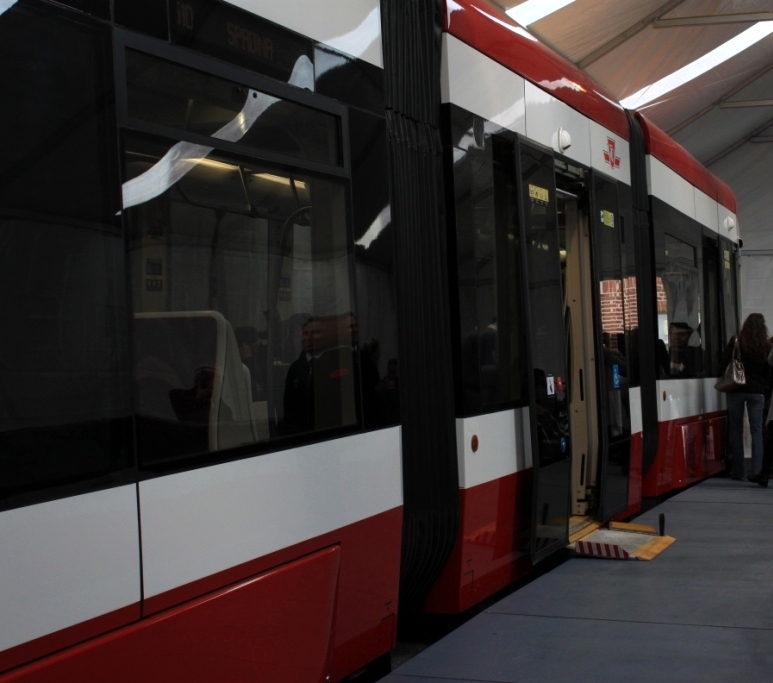
This shows the second doorway of the car (also the second section) looking from the rear. The accessibility ramp is deployed at the high platform level. During the media briefing, we did not see it extended to its full length for pavement level access, but I was told that it is roughly three times longer for that type of situation.
The brick pattern in the window is a reflection from a nearby building. It is not part of the colour scheme.

This is the rear half of the second door panel showing the pushbuttons for opening the door (red) and requesting ramp deployment (blue). All doors on these cars are passenger activated.
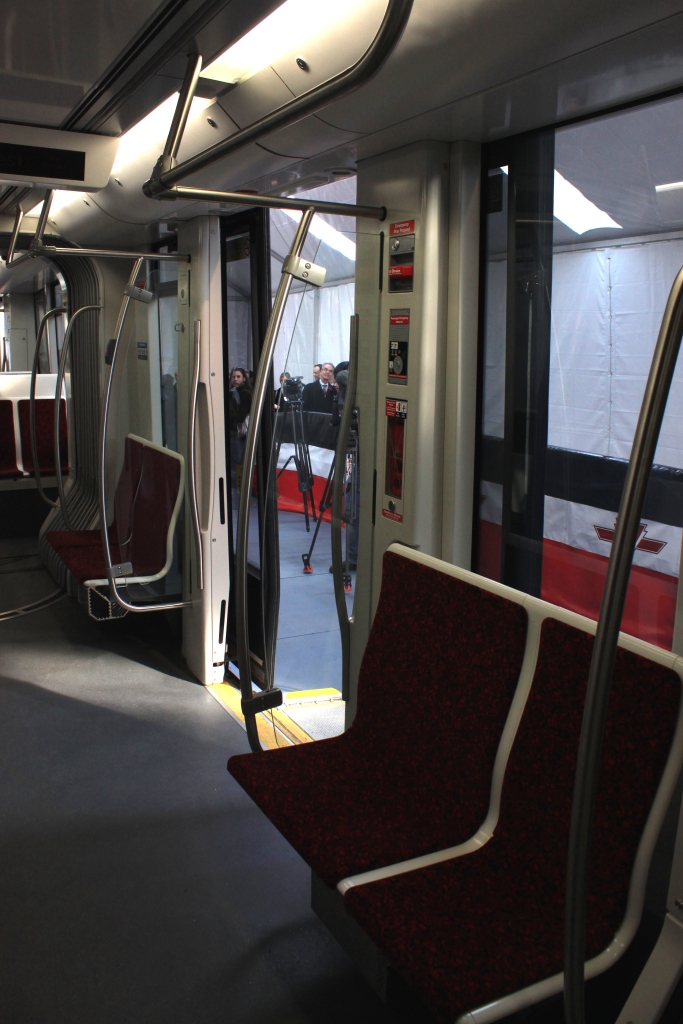
This is a view toward the same set of doors from inside of the car. Note that the door panels are not all of the way open because they were set up manually for the tour.
Also visible here is a sample of the extra wide seat.
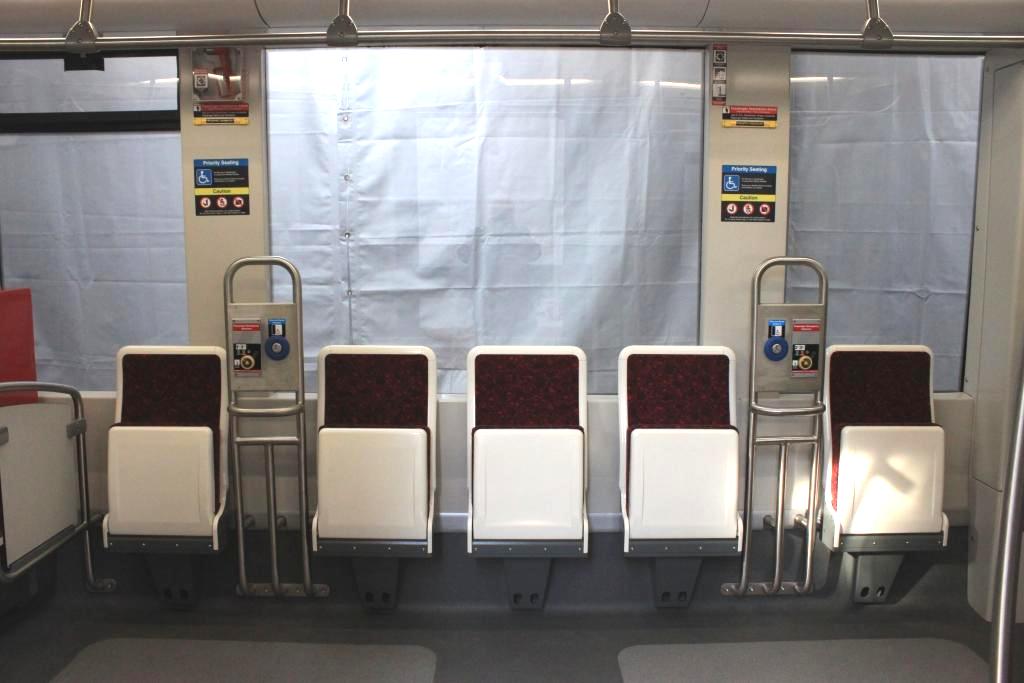
This is the view directly across the car from the second door. There are five flip-up seats in an area that can otherwise be used for wheelchairs and scooters. The lighter patches on the floor mark where spots for these devices and there are stop request buttons on the wall beside each of them.
The red box showing partly in frame (see enlarged version) on the left side is a placeholder for the ticket/Presto machine.
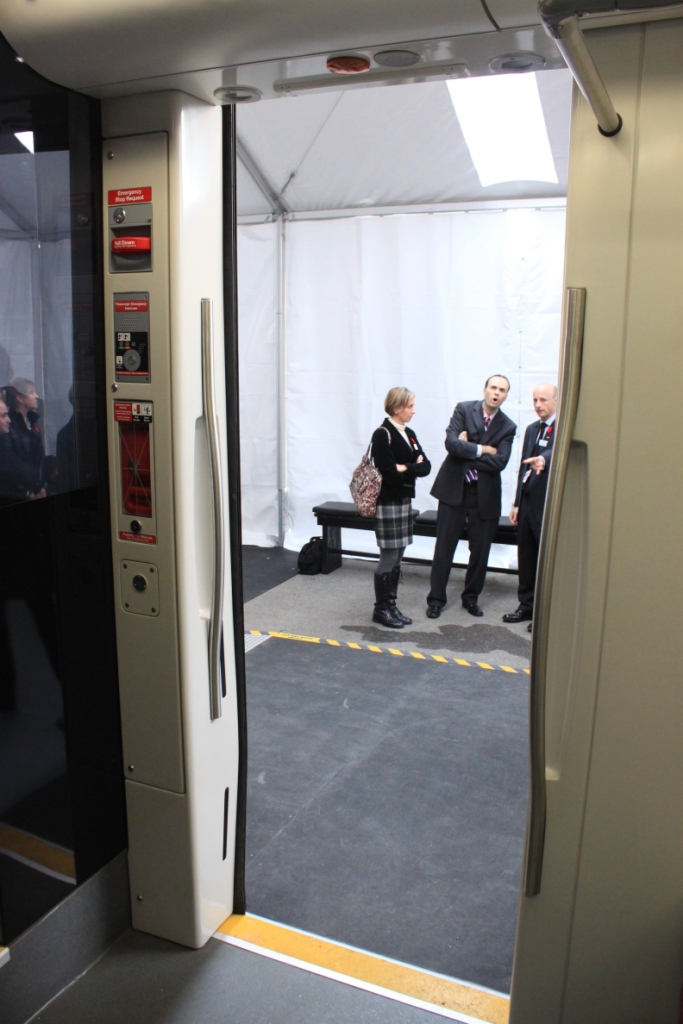
Looking out through the front door which is single width. TTC Chair Karen Stintz is in the background.
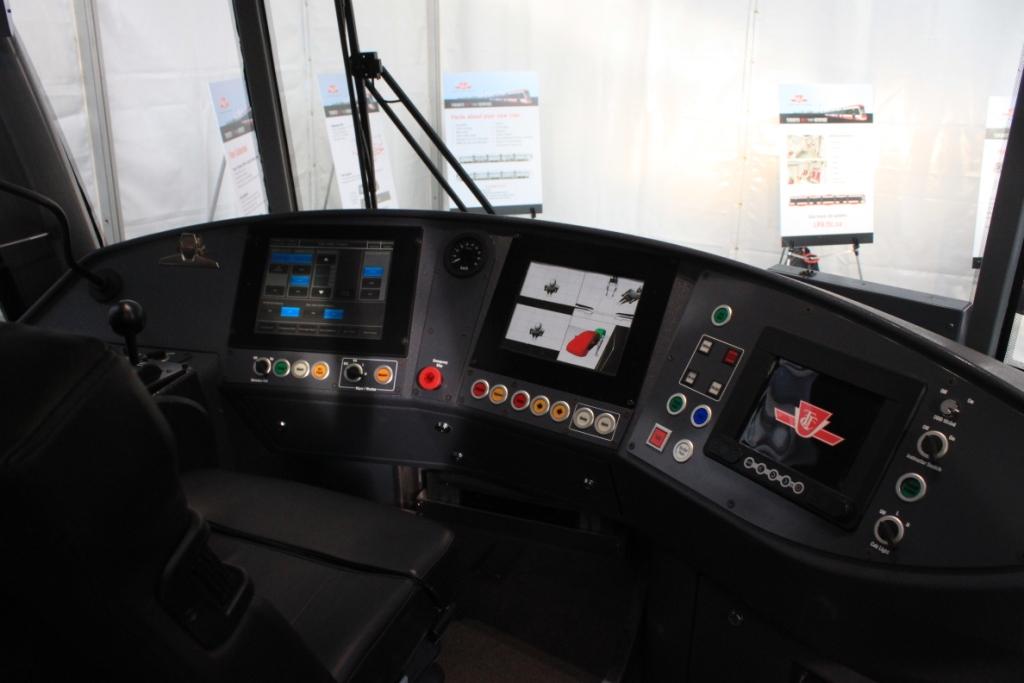
The main part of the operator’s cab. The video display in the middle will contain images from the cameras at each of the four door locations.
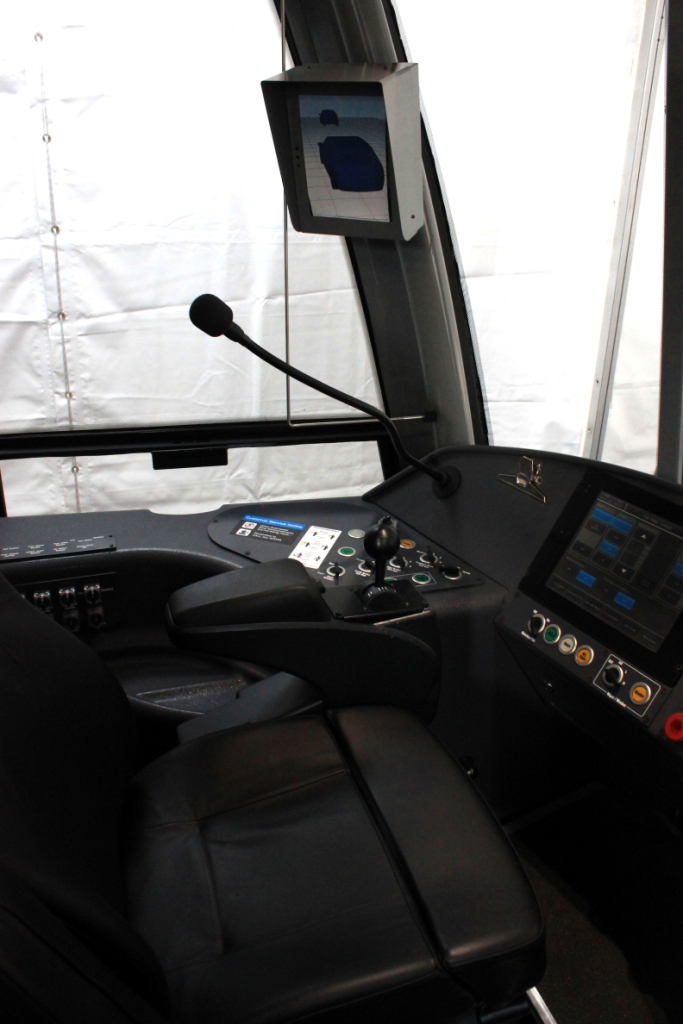
The left side of the operator’s cab showing the control handle for the car.

A poster explaining how fare collection will work. Both a generic ticket vending machine and Presto are shown.
The text in the poster says that the new scheme requires a system-wide conversion to time based transfers. This appears to set the stage for new transfer rules on the TTC.
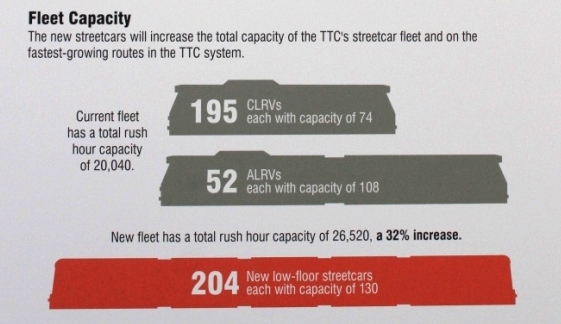
A poster comparing vehicle capacity. The values shown are Service Planning averages, not the crush capacity of the vehicles. Also, the size of the new fleet is still shown as 204 despite budget moves to reduce or defer part of the order.

This map shows the deployment plan for streetcars on each route, and it is much different from the scheme laid out in last year’s budget papers. Bathurst, Harbourfront and Spadina are first up in 2014 with Queen following in 2015. This will allow the ALRVs to be retired in roughly 2016.
 Steve Munro
I am somewhat confused. All “photos” or animations show new LFLRVs with the collection poles,while there is a current project at TTC , that will convert the network to pantographs and the LFLRVs will be delivered with pantographs. So – what is the truth? Collection poles retained or network converted for pantographs and LFLRVs delivered with pants?
Steve: If you look at the drawing on the “Meet Your New Ride” page, it clearly shows a car with both forms of current collection. The intent is to migrate to pans, but until the entire system is converted, all cars must be able to operate either way. Presuming that “LFLRV” routes will be converted to pan-friendly suspension, this would allow regular operation with pantographs. However, the moment we get into diversions, life gets interesting. If too much of the system stays with “old” overhead, operators will probably leave the poles up to save farting around every time Transit Control sends them on an excursion.
I hope to see an updated schedule for the conversion project when the TTC publishes the detailed format of its 2012 capital budget. The one they had for 2011 didn’t line up with the planned rollout of the new cars to various routes.
LikeLike
In the interest of generating discussions amongst commentators about the new LFLRV’s, I have reposted my old comments to this blog post.
I’m worried that having ticket machines on-board the LFLRV’s themselves would take away standee space. I would have thought that it would simpler to have people purchase tickets at the streetcar stop on the sidewalk, and save precious space on the vehicle.
Even if the on-board ticket machines are small, I’d imagine it to be difficult, especially during peak periods, for single-journey passengers make their way across the crowds to access the ticket machines. Even more of an inconvenience of single-journey passengers are in wheel-chairs.
The only advantage I can think of about having ticket machines on vehicles would be the number of machines actually required, provided that there are more stops than vehicles.
1) How did this idea come about? Are there any other streetcar systems that have ticket vending machines on board the vehicles themselves?
2) Would the CLRV’s have card-readers and ticket machines installed, and would the CLRV handle all-door loading? I initially assumed that the rollout plan was designed to avoid multi-fleet operation on each line (where each line is either exclusively LFLRV or CLRV, but never both), to avoid the need for CLRV retrofitting, but by 2017, 27 CLRV’s would still be in service somewhere in the system.
Steve: Yes, on board ticketing is common on other bus and LRT systems. As far as I know, CLRVs will continue to operate as pay as you enter cars. One of the things the TTC hopes to accomplish in the near future is a review of its fare system. Ostensibly this is to get rid of annoyances, but it’s part of a broader review to look at how surface fares will work in the new environment. Don’t forget that even after all of the CLRVs are gone, there will still be an entire bus network operating more or less as it does today. The fare system has to make sense for all type of vehicles.
LikeLike
Hi Steve
I am really looking forward to seeing the mock up of the cars. My concern here is that I won’t see the cars themselves because of Ford. Is there anything that the Fords can do at this stage to stop the process, or is this so far along that it is safe?
Steve: In the discussion about sale of city assets to fund capital purchases, the budget chief, Mike Del Grande, mentioned that the streetcar order was too far along to cancel. I suspect that there has been pressure from Queen’s Park on that score as well.
LikeLike
Is this the same prototype that has been on display in Hillcrest Yard for a while? Steve, I can send you some pictures of it made a year ago if needed.
Steve: No. The one at Hillcrest for the past year was put together with cardboard and scotch tape just to get the general layout right. This one was actually built with real parts. I would be embarrassed to show that first mockup to the public who wouldn’t really understand its purpose but would dump all over what it looked like.
LikeLike
Based on traditional nomenclature systems, are these cars “3 rooms, 2 baths”? (lvly vu)
LikeLike
Looks more to me like two rooms, three baths.
LikeLike
I say ‘two rooms, three baths’ based on the length of the sections rather than whether or not they’re mounted on a truck or bogie.
Here’s an interesting Hungarian tram website.
– if you scroll down the page a short distance, you’ll see the classic “two rooms and a bath” streetcars in Boston, Massachusetts, USA where, in the first decade of the 20th century, the Boston Elevated Railway Company paired older two- and four-axle streetcars with a central ‘bath’ section to extend their useful lives and accommodate rapidly growing ridership.
They were also known locally as “snake cars.”
These streetcars were, I believe, the first to be given the room-and-a-bath name. The overall concept was so successful that, beginning around 1915, the Boston El ordered several hundred “center-entrance” cars which were the outgrowth of this design, and were themselves quite unique in a number of respects.
LikeLike
Also, I thought the new LFLRV’s were supposed to be lighter per axle than the existing streetcars. Not that I have doubts that the current infrastructure can support the LFLRV’s.
According to the lrv.ttc.ca website, LFLRV’s weigh 48,200kg on 6 axles, hence 8,033kg/axle
Applying the same logic with data from transit.toronto.on.ca, CLRV’s and ALRV’s weigh 5,671kg/axle and 6,124kg/axle, respectively.
LikeLike
Interesting to note yesterdays Then and Now feature from over at UT. Possibly the only pantograph compatible hanger within earshot of Russell? By TTC reasoning I s’pose it doesn’t matter since Queen is supposed to be the last route to see full LFLRV operation–the Downtowner is a myth anyway.
LikeLike
Jacob Louy asked, “Are there any other streetcar systems that have ticket vending machines on board the vehicles themselves?”
Melbourne has on-board TVMs on their trams. Also, for those who use pre-purchased tickets or their version of Presto, one has to validate when boarding and terminals are needed for this. To see what these look like, take a look at this page and scroll down to where the route map is.
LikeLike
Steve wrote, “In the discussion about sale of city assets to fund capital purchases, the budget chief, Mike Del Grande, mentioned that the streetcar order was too far along to cancel.”
I have heard it specifically mentioned in some news reports over the past few weeks that the “capital purchases” that need funding include the new streetcar maintenance facility. That is probably the best confirmation one could get, short of mayor RoDo (Rob/Doug) actually saying it outright.
LikeLike
There are many times more stops than vehicles in service. Let’s take a few examples:
Carlton:
Vehicles in service in AM Peak: 32
Stops in one direction (less Sunday stops): 63 (final station omitted – applies to opposite direction)
So, there would be almost 4 times as many TVMs if you placed them at stops instead of on board the vehicles.
Harbourfront:
Vehicles in service in PM peak (higher than AM peak): 8
Stops in one direction: 12 (final station omitted, as above)
So, similar story, there would be 3 times as many TVMs if you placed them at stops instead of on board the vehicles.
I haven’t checked, but I imagine the same pattern would apply to most other routes as well, except for the Downtowner, Kingston Rd, and Lake Shore routes since they mostly duplicate other routes.
Even with spares factored in, it is no contest; cheaper to put them on the vehicles.
Steve: The plan is to have them on the street at major stops where there would be a lot of passengers and the demand for the onboard machine would be too high. For the minor stops, riders can use the one on the vehicle. It’s worth noting also that pass use is very high in the part of town served by the streetcar routes.
LikeLike
@Karl,
Yes. I’ve learned that there are 800 streetcar stops throughout the entire system.
LikeLike
I like the look of the new TTC Streetcars. They really remind me of the rapid Streetcars in Budapest which are very nice trains.
As a quick FYI, out here on the West Coast, Seattle’s South Lake Union Streetcar does have an onboard TVM and that will apparently be the standard for the new streetcar routes that are planned for Seattle. Of course, Seattle’s tiny little line doesn’t carry a fraction of the passengers that travel on the average TTC bus, but it’s the only North American example I know of.
LikeLike
Actually it’s not hard to say if any of the waterfront lines will ever get built. They won’t. Not as long as Ford or any other anti-streetcar person is in charge at City Hall, that’s for damn sure.
LikeLike
The Portland Streetcar, and the Seattle Streetcar have on-board TVM’s. The ridership is much lower than the our system of course, but there are systems with on-board TVMs. One concern I have is the time it would take to buy a ticket. Using the Viva machine’s I notice it takes at least a minute to buy a ticket. Considering the streetcar TVM will have a much higher usage than the Viva Machines, that might to be something the TTC looks at.
LikeLike
It is important to remember that most — the vast majority — of the passengers will have a Presto Card that will only need a quick tap — if not at first, shortly after implementation. If at the moment over half of the passengers have a MetroPass and we assume that all of them convert, then the starting point is a minority of riders. For those riders the Card would offer the convenience of easy entry and the discount associated with a prepaid (rather than a CASH) fare while still allowing the purchase of one ride at a time. The outlay necessary to load up a card will be little different than the outlay needed to buy tickets or tokens in advance. Only the occasional rider should be purchasing a fare on the car — about the same number that we see paying with coins today.
LikeLike
I think the vast majority of current Metro pass users have no clue about Presto, except some vague notion of a green thingie they pass by at certain stations. The porting of users from one to the other will take some explaining.
On another note, the announcement of the new cars mock up seems to mark the end of the beginning in the latest war on the streetcar.
LikeLike
You’re assuming a few things here:
a). You’re assuming Presto will function reliably with at least several hundred-thousand trips in either of the peak periods alone. I’ve heard there are still technical issues not yet ironed out causing unacceptably high failure rates (and the TTC expects very high reliability – rightfully so). I am skeptical these issues will be resolved since this is a made-in-Ontario-reinvention-of-the-wheel, and will never really work properly, kind of like the SRT. Although I don’t expect the rollout to actually happen, in the event that it does, what should the protocol be when the fare validation equipment inevitably fails for whatever reason? I’d hope it is not to take the vehicle out of service (spare ratios would explode).
b) You’re assuming everyone will remember to have their cards loaded by the time they board. Having had experience with similar cards in Japan, I can tell you someone trying to get on without enough left on the card to pay for the trip does happen on a regular basis. That doesn’t apply to passholders in Toronto’s case (passes work differently in Japan, as they’re origin-destination specific), but there’s still a large minority remaining that can screw up the “just a quick tap” momentum and drag out dwell times.
c) Finally, we’re assuming Presto works properly for transfers where a free-body facility like a subway station is not present. I’m told there have been issues on this front. What happens when the system is charging riders another fare when it shouldn’t? Or charges them the wrong fare if they’re entitled to a discount? Presto has yet to clear these hurdles with high enough reliability, and if Presto can’t do this, it won’t be rolled out on the full TTC system.
I would say it’s important to remember that Presto has to perform if it is to be available to all TTC riders. That mark hasn’t been reached yet. Politicians did at least attach that condition to their acceptance of Presto (even though they should never have accepted it in the first place when off-the-shelf technology is available that partially piggyback on existing infrastructure in the finance sector; we’ll see if anything happens this month as the bidder for open payment is still in play until late Nov).
Steve: Metrolinx owes us all a full explanation of the actual capabilities and reliability of the Presto system. Now that they have taken control of that organization and have retired the extraordinarily well-paid former head of the organization, we may get some straight answers. I say “may” because there is probably an “Emperor’s new clothes” phenomenon surrounding that system with a government unwilling to hear bad news.
LikeLike
I’m almost afraid to ask, but is it known if there will be some kind of warning light on the rear of the vehicle to let drivers know that the doors may be opening at a stop?
Steve: There is supposed to be a band of flashing lights at each door. I am waiting to see the mockup to see exactly how this will work.
LikeLike
I’ve been using Presto for quite some time now — no issues at all. I’m pretty sure the TTC will move to a simple time-based transfer system when it rolls out. When I use Presto on Mississauga Transit, it counts two hours from the first tap. When you go over a certain number of trips per month, each additional trip is free, and the “unlimited pass” kicks in. I’ve also tapped at Islington and College stations and it deducts the proper fares when there’s still time left on the Mississauga fare. Never a delay. And GO sets up a default trip, with an override button, so you don’t need to tap off. I think this is way better, and simpler, than an open system with RFID debit or credit cards.
When this rolls out, it will be superior to the Metropass in that the unlimited ride functionality only kicks in if you need it that month.
Steve: However, what should really happen is that “unlimited rides” should mean across the network and there should be a way to get a consolidated system discount regardless of which part of it you are using. However, that would require that Queen’s Park address the whole question of a regional fare system rather than a hodge-podge of local ones.
LikeLike
Michael Greason wrote about Presto, “The outlay necessary to load up a card will be little different than the outlay needed to buy tickets or tokens in advance.”
The minimum online top-up is $10, which is the minimum outlay for tokens at a TTC subway station (token vending machines only sell 4/$10 and 8/$20, and the same amounts can be purchased at the collector booth at some stations). Other transit agencies that use Presto have higher minimums (YRT is 10/$26, going to 10/$28 in the new year), so the $10 minimum with Presto is very convenient.
I don’t know what the minimum top-up purchase is if done in person, but if paying cash, I suspect it may be less than $10. The trouble is, there are very few places at this time where it can be done in person.
At least once monthly passes are implemented with Presto, it will be possible to buy the pass in increments as low as $10 throughout the month instead of all up front.
LikeLike
OgtheDim wrote, “I think the vast majority of current Metro pass users have no clue about Presto, except some vague notion of a green thingie they pass by at certain stations.”
I would agree, give the looks I get when I go up to one of those turnstiles and bump my hip up to it and then proceed through the turnstile without putting in a fare! 😉
LikeLike
I’ve begun using Presto a month ago since I take the occasional GO bus trips into the suburbs and my experience so far has been horrible. The first time I used it on a GO bus, it charged me double fare, and the operator didn’t know what was going on, and couldn’t override it. I had to call the Presto hotline and be put on hold, which is only in operation during weekdays, to get them to take a look at it. After I called, they had to investigate on this issue, which took them a week to get back. Then once they finally realized that there was a mistake on their part, they asked me for my mailing address because “due to privacy reasons”, they couldn’t just credit my card, never mind the fact that my card was already registered to me and my address on their website. Then when I finally got my refund in the mail, it came in the form of a voucher that must be redeemed within 6 months for GO fare media. I tried to go redeem it at the Union Station fare counter, but I wasn’t able to load it up to my Presto card right away because the minimum load on a card is $5 (the fare from Union Station to Square One is $4.20). The website is also pretty terrible, requiring you to enter the 17 digit code each time even after you registered it. Presto has a long way to go before it should be widely accepted.
LikeLike
Steve, how do the doors open — do they slide open like on the SRT, or do they flip open like on the Orion 7s? (Perhaps “flip” is not the right term as it implies speed… slowly rotate?) The mock-ups show a decal on the back of the streetcar that reads “Do Not Pass Open Doors,” but it will be tough to see if the doors are open if they slide parallel to the side of the streetcar, which appears to be the case. The open doors are missed too often even on the CLRVs where they flip out!
Steve: Yes, the doors slide along the cars like the SRT rather than opening out into traffic. As you note, motorists have problems even dealing with doors and the warning light on CLRVs.
LikeLike
Never mind — I had not refreshed my browser and I see the question has now already been asked.
Flashing lights don’t give me much optimism. They have to be both difficult to miss and difficult to misinterpret. For drivers from out-of-town encountering streetcars for the first time, at least the opening doors give a strong cue that people might be getting off a streetcar…
LikeLike
I have to agree with Mimmo Briganti about not having any problems with Presto, so far. I am wondering how well the system will handle the load when a million TTC users come onboard. I am guessing that there cannot be more than 100,000 cards out there now (and I suspect under 50,000).
Still, since most transactions are simply between the card and the terminal (because the balance is on the card), increased load should not slow down most transactions.
Where there is a delay is when a reload occurs. If I go online now and add money to my balance, what I see online will not show the new addition until my card gets that new information and the fact that the card has received it has been uploaded to the back end. The “news” about my reload has to be sent out to all terminals, which they say can take “up to 24 hours.” I haven’t timed it, but I suspect it currently takes somewhat less given the small number of terminals and cards out there. The next time one taps on or does a balance check, the “conversation” between the terminal and the card will tell the card about the reload, if that information is known by that terminal at that time, and the information about the card receiving the update is passed up to the back end. I suspect this upload about the card being updated is immediate as I have checked online within a half hour of the update and it shows the new balance online. By comparison, any usage of the card done in the day is not visible online until the next day, as this seems to only be uploaded at the end of the day.
We decided to get Presto cards when YRT was offering them without the $6 charge. My daughter’s card is set up for student fare (though, the terminals at TTC stations only charge the adult token price). Her oddest trip, in terms of figuring out if she was charged correctly, was from a friend’s home in Ajax to Union Station, using DRT and GO. DRT only accept Presto for ride-to-GO service at this time, which is 60 cents, but her tap on DRT deducted $2.90, which is their adult cash fare. When she tapped on at the GO station, another deduction was made, and when she tapped off at Union, it refunded her something like 62 cents. When this was all added up, she was charged one tenth of a 10-ride student GO fare from Ajax to Union plus 60 cents for the ride-to-GO on DRT – exactly what she should have been charged.
Steve: I don’t think that Presto is beyond the 50k mark in cards issued yet. There is a fundamental difference between systems like Presto that keep their balance on the card and those that simply use whatever object (a credit card, a cell phone) has been registered by a rider as “their” fare medium. If trip histories are maintained at “the back end” of the system, then the entire process of calculating the appropriate charge for system use and billing it to riders is done after the fact. The tradeoff is that a vast amount of travel info must be maintained and digested, although this info may be collected anyhow for the purpose of tracking riders for planning purposes.
Either way, fare systems are really very large, complex IT projects. Like any IT project, if we don’t understand the technology and marry this understanding to expectations of what the system will do and what it will cost, we are in for big problems down the road. Queen’s Park has avoided discussions of regional fare structures and revenue sharing, and Presto has mainly been used to automate fare collection on the existing policies. The issue of cross-border fare payments has been misrepresented as a convenience issue rather than one of double-charging for trips going across boundaries. Changing fare policies to eliminate boundaries and changing technologies to simplify the accounting should go hand-in-hand.
LikeLike
I hope that the LFLRV interior layout can adapt to open-payment systems, should the TTC decide against Presto. Instead of Presto Card readers at the doors, maybe regular credit/debit card readers. Card-less passengers would still pay by cash or token at the Proof-of-payment vending machines.
The problem is how to give every card-swipers their proof-of-payment documents when they swipe without delaying everyone else trying to board.
Steve: Card swipers don’t get a POP document. Fare inspectors would have readers that would allow them to query the status of a card to determine if it had a valid fare registered on it. Note that this does not necessarily mean that someone would swipe on (transferring passengers in a timed fare system would not have to do this).
The technical challenge for Presto is that its model is based on a “conversation” between the card and the reader. If people are using credit cards, Presto cannot store data on those cards, and it must track centrally the fact that a card has “paid” a fare. This also means that a query to check for fare payment must “call home” to talk to the central system. This is a fundamentally different scheme than Presto uses today.
LikeLike
FYI is a clip of the launch of Blackpool’s similar Flexity 2 on 08.09.11.
LikeLike
Steve wrote, “The tradeoff is that a vast amount of travel info must be maintained and digested, although this info may be collected anyhow for the purpose of tracking riders for planning purposes.”
The transactions are uploaded to the back end at the end of the day, but there are other reasons besides planning purposes. The transit tax credit requires a certain amount of use over a four week period and has previously only been available to monthly pass holders, and weekly pass holders who have at least four weeks of consecutive weekly passes. With a system like Presto, if one uses the media to pay for at least 32 trips in a month on a single transit system, they also can receive the tax credit, but the upload of this information is necessary in order to make that happen.
Steve also wrote, “The issue of cross-border fare payments has been misrepresented as a convenience issue rather than one of double-charging for trips going across boundaries. Changing fare policies to eliminate boundaries and changing technologies to simplify the accounting should go hand-in-hand.”
I also agree that there has been misrepresentation about what Presto does for cross-border fares, but I don’t totally agree that changing technology and changing fare policies have to go hand-in-hand.
We should be starting the process of coming up with a fair fare system that encourages the long distance traveler while not leaving the short distance traveler feeling like they are subsidizing the long distance traveler, but a change in technology can proceed with the current policy (save for the TTC’s A-to-Z transfer policy) in order to work out the technical bugs before a new regional fare policy is implemented with the technology. I strongly suspect that trying to move forward hand-in-hand will result in a stalemate that will see us no further ahead a decade from now.
Steve: To be clear, that’s not what I intended to say. We must avoid creating a system that builds in stone the existing fare models and makes no allowance for a migration to some form of cross-border fares and revenue sharing. The implementation of Presto could make possible a more flexible scheme that would not be burdened with manual procedures on board vehicles. I do not want to hear “the computer can’t do it” after we spend hundreds of millions on a home-brew system.
LikeLike
Calvin Henry-Cotnam said:
November 7, 2011 at 12:54 am
“We decided to get Presto cards when YRT was offering them without the $6 charge. ”
I note Presto cards are available for free (i.e. without the $6 issuance fee) if ordered from the Presto web site. The cards are loaded with $10 value, payable via credit card or Interac online.
By ordering your card online you can experience Presto without surcharge.
LikeLike
These things are enormous! 100 feet long! I’m as big a transit proponent as anyone else here, but does this not strike you guys as a bit off?
Imagine one of these parked at Lansdowne and College, and how far into Dundas it would snake.
Can anyone point me to a mixed-traffic implementation of a train of this scale somewhere else? Has it worked?
Steve: Toronto ran two-car trains of PCCs on Bloor Street until 1966, and for a brief period on Queen a few years later. They stopped the practice because the Queen trains were always being split up to short turn one car.
And looking at the satellite view on Google Maps, a 100-foot car will just fit between the trailing and facing switches northbound on Lansdowne. There are other locations such as the platform at Spadina Station that are far more challenging.
LikeLike
The loss of the tax credit for riding 31 rather than 32 times in a 4 week period might lead to some interesting marginal cost implications were TTC to adopt a similar fare structure to GO using Presto. I’ve seen comments on some articles saying “well the tax credit isn’t much” but $16-18 is the credit on an adult pass at present (depending on whether MDP or retail) so we could see situations where people take short trips just to ensure they retain their credit if 28 or 30 rides was more expensive on a net basis than 32.
Steve: If only the TTC’s break even point were 32 fares!
LikeLike
So, after all this time the best they can come up with is a mockup for a portion of a car. Big deal. I was going to go for a look-see but now I think I will pass. Not sure what to make of it judging by the images posted. Let us hope they are not like the current LRV cars which were obsolete the day they hit the street. Should have bought new PCC’s from Europe.
Have not seen interior of new subway train but, I really think it is being oversold as a great advancement just because you can walk through the entire train. I see no poles to hold onto and in a crowded car how will people (especially short and/or older people) prevent being thrown off balance?
LikeLike
You’ve already addressed this comment, Steve, but I wanted to add a few more points as to why on-vehicle ticketing is the best option here.
1. Riders would be pretty angry if they missed their streetcar due to having to wait to use an on-street ticket machine. Personally, I’d just hop on the streetcar and not pay the fare in such a situation, which wouldn’t be the TTC’s preference either.
2. Toronto sidewalks are already narrow and cluttered, with small public ROWs leaving little room for widening, especially in the areas where streetcar service remains. Those also happen to be places where pedestrian traffic is heaviest. While using precious standee space on a vehicle isn’t great, taking up limited sidewalk space for ticket machines would be even worse.
3. Going through all the vehicles in the TTC yard at the end of the day to reload ticketing machines is drastically less time- and labour-intensive (i.e. cheaper) than having someone drive around to each stop on a daily/weekly basis.
4. Keeping ticket machines inside vehicles means they don’t need to be designed to withstand snow/salt, or undergo the added maintenance that demands.
On an unrelated note, is there any news on the TTC’s rollout plans? Will we be seeing these on high-traffic routes or are they going to be confined to Kingston Road until the 2020s?
Steve: There was a rollout plan included in last year’s capital budget books, but it didn’t make sense and appeared to be an arbitrary way to soak up cars as they arrived. We know that the TTC wants to get rid of the ALRVs first, and yet the last route to get Flexitys in the new plan was Queen. I am waiting for the 2012 books to come out to see whether this plan has been revised. This also affects the timing of reconstruction of the overhead power distribution system. Queen makes sense as an early conversion because it is common access trackage to the carhouses.
LikeLike
@Aric Guite:
See for yourself (I love this site, old and outdated as it may be):
Map Toronto
(zoom in and turn on the Arial 2003 imagery – very high res, albeit greyscale). Click on the measuring tape and you’ll see over 30m between the switches on Lansdowne.
Union Loop, if it doesn’t get rebuilt (and it has funding issues right now), will be interesting to see how they manage.
LikeLike
Wouldn’t the pole operation have a lower maximum speed than the pantograph operation? I thought that was one of the drivers of switching to pantograph, to allow faster & more reliable service. If this is the case, the operators would have to switch operation modes according to the line they were on.
Steve: The maximum speed is affected by two issues. At intersections, the constraint is the curve radius and the desire not to derail, and this is more restrictive than any issues with overhead frogs. As for straightaways, the constraint is traffic speed. I can assure you from personal experience on night cars that poles work just fine at any speed we will see from the new cars. Indeed, their design top speed of 70 km/h may well cause night service to be delayed compared with a CLRV or the PCCs before that.
LikeLike
Mark Dowling said, “…so we could see situations where people take short trips just to ensure they retain their [tax] credit…”
Perhaps, but more likely another family member might use that card for the extra trips and top up their card for what they used. Been there, done that. 😉
LikeLike
Jacob Louy said: According to the lrv.ttc.ca website, LFLRV’s weigh 48,200kg on 6 axles, hence 8,033kg/axle
Applying the same logic with data from transit.toronto.on.ca, CLRV’s and ALRV’s weigh 5,671kg/axle and 6,124kg/axle, respectively.
I remember reading that the CLRVs and ALRVs were already putting too much weight per axle and affecting the streets underneath.
If the LFLRVs are an extra 2000kg per axle, what will that do to Toronto streets?
Another challenge will be dealing with passing the streetcars. It’s already hard enough to pass an ALRV – what would be the effect of a series of cars trying to pass an LFLRV – especially one that uses a different system to tell people when the doors are opening.
Cheers, Moaz
By the way, Melbourne’s older streetcars have stop signs built into the doors – so they pop out when the doors fold. You can see the back of the stop sign (the big white circle) in this photo.
The door design is a bit different but it would be interesting to see if some kind of pop-out stop sign would also help people pay attention.
Steve: There are already “Stop” decals on the CLRV/ALRV door panels that are visible when these cars have their doors open. The basic problem seems to be that motorists can’t get it through their heads that people will get off of transit vehicles. Signs won’t do the trick, and the almost complete lack of enforcement (as with so many other traffic bylaws) means that we have a growing problem of idiot drivers. Indeed, we have idiot politicians who might view any attempt to enforce the laws as a “war on the car”.
LikeLike
Regarding the safety of on/offloading passengers at streetcar stops, I’m wishing the TTC would look at the whole network and identify areas where they can remove stops, add passenger islands or do other street-scape modifications to improve streetcar safety and convenience.
There’s many locations where having a 100 ft vehicle with all-door boarding means close stops are even closer, and unnecessary. There’s also many locations where I think sidewalk space can be shaved off to create a passenger island (sidewalk space that is already blocked by transit shelters), the new one at King and Bathurst gives me hope that this is something the TTC is thinking of.
There’s places where bump-outs could be put in as well (such as Howard Park Ave). I think other ideas such as unique pavement markings and signs telling drivers where to stop when a streetcar is stopped would go a long way as well. All this could be implemented as streets go through their regular maintenance cycles, and/or as the new vehicles are introduced on routes.
LikeLike