
Updated October 2 at 11:15 pm:
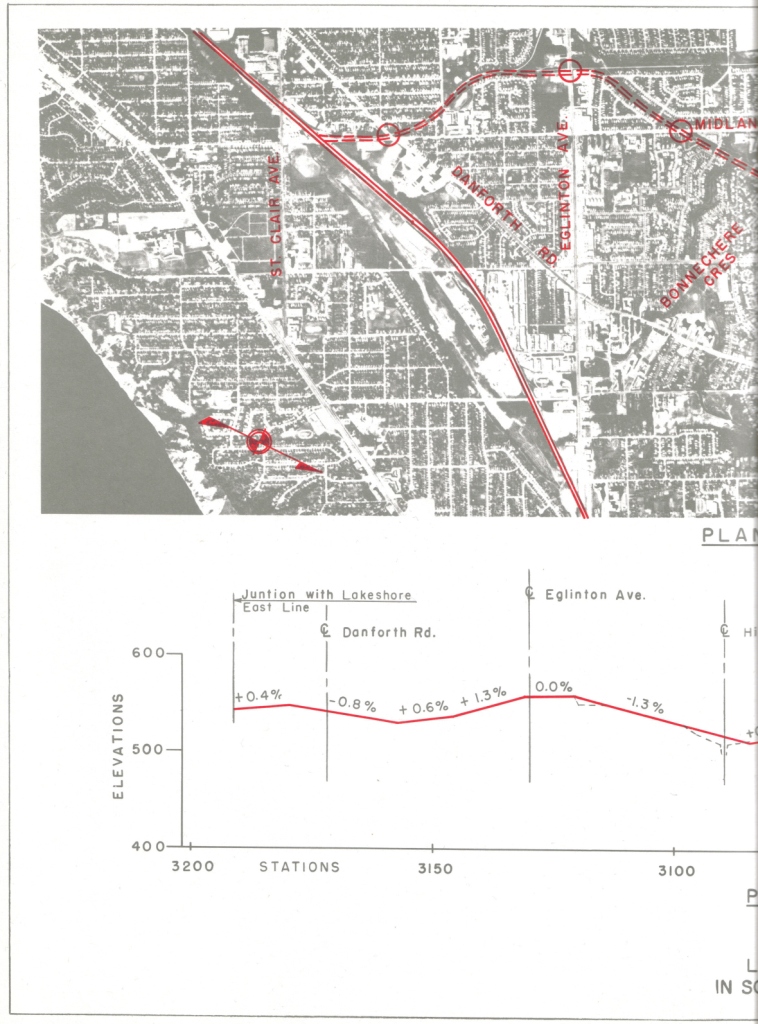
In the comments thread, a question has come up about the originally proposed alignment of the SLRT. This dates back to the Metropolitan Toronto Transportation Plan Review (MTTPR) and a study of alternatives to the Scarborough Expressway. One of these was an LRT line starting at roughly Queen & McCaul running east to the CNR Kingston Sub at Degrassi St., then northeast via the CN to Morningside Avenue. A branch would run north from Scarborough Junction following mainly existing and abandoned rail corridors to the Scarborough Town Centre.
That branch eventually became the SRT, but was moved to follow the Uxbridge Subdivision because the old right-of-way used in the first proposal was very narrow. As you will see from the maps, this is not the very wide Hydro corridor that crosses the SRT line, but a much tighter route.
To orient yourself, the Uxbridge Subdivision runs just below the top edge of these maps which have north to the right.
Updated September 30 at 4:50 pm:
Item SC 28.30, which requests the TTC and Metrolinx to report in November 2009 on an LRT implementation for the SRT, was passed today by Council.
Item SC28.20 was ruled out of order and withdrawn.
Updated September 30 at 12:45 pm:
This morning, in discussion of another Transit City matter on the Council Agenda, Councillor Thompson asked TTC Chief General Manager Gary Webster about the status of the Scarborough project. Among other things, Webster replied that:
- TTC now feels that LRT is the appropriate technology for the route and is working with Metrolinx to define the technology and scope for the Transit City projects generally.
- The funding announced by Queen’s Park is not sufficient to carry the SRT north from Sheppard to Malvern.
The debate will continue this afternoon, but I suspect the items listed in my original post below will not be dealt with until tomorrow given their place on the agenda.
Original post:
Toronto Council’s agenda today, September 30, includes items of interest regarding the Scarborough RT (SRT) line.
Item SC28.30, initiated on a motion by Councillor Michael Thompson, amended by Councillor Brian Ashton, (both former members of the Toronto Transit Commission), reads:
Scarborough Community Council recommends that:
1. City Council request the Toronto Transit Commission and Metrolinx to report back in November 2009 on a process to implement LRT Technology to match and work with Transit City, on the extension of the Scarborough Rapid Transit line, and request the conversion of the existing line between Kennedy and McCowan stations from its current I.C.T.S. Technology to LRT technology, matching the extension, consistent with Transit City.
Decision Advice and Other Information
The Scarborough Community Council requested Scarborough Planning and Transportation staff to report to the Scarborough Community Council, at its meeting on October 13, 2009, on the status of the Transit City as it impacts the Scarborough District including the status of Environmental Assessment studies relative to current networks.
In a related item, SC28.20:
Scarborough Community Council recommends that:
1. City Council request Metrolinx and the TTC to report back to the Scarborough Community Council by April 2010 on Scarborough Community Council’s position that the Sheppard East LRT will terminate at the Toronto Zoo.
2. City Council request Metrolinx and the TTC to reaffirm the commitment to a transit line extending to the Scarborough Town Centre.
The historic irony of this proposal is, of course, that the SRT was originally planned as an LRT line, but at the request of Scarborough Council, under considerable lobbying effort from Queen’s Park, was redesigned as an ICTS line.
These motions, collectively, would see an extended “RT” integrated in Scarborough’s Transit City LRT network and would provide for both east-west and north-south service as well as interlining to connect the Scarborough Town Centre with the Sheppard line. This could allow service to operate from STC to the Zoo (as per the proposed extension) and/or the University of Toronto Scarborough Campus (UTSC).
I hope that Council formally embraces this position. Throughout the Scarborough RT extension EA process, almost all of the proposals shown to the community were heavily ICTS oriented and there was no discussion of the alternative implementations possible if the line were LRT. Notable examples are:
- The absence of a track connection between the Sheppard LRT and the extended RT. If the technologies differ, of course such a connection would not exist. However, if an option for LRT were truly being considered, the junction at Sheppard would have included an alternative design with a connection.
- The underground section for the ICTS route north of Sheppard could possibly be shortened for LRT depending on how the approach to Malvern Centre is handled.
- The design for Malvern Centre station assumes an ICTS line on an elevated structure. However, there are already proposals to extend the route further north, something that would be much more easily (and cheaply) achieved with an at-grade LRT.
- The proposed yard for the extended SRT line could be replaced by consolidation into those that will be built for other parts of the LRT network.
None of this is a surprise to TTC staff who have talked, usually privately, about their preference for an all-LRT network in Scarborough. With Council’s approval, this discussion can come into the open.
 Steve Munro

If they go for LRT, it could work. The new LRT Vehicles will be 90 feet long IIRC, which means two of them should be enough to replace a 4 car SRT train.
A connection between this LRT “SRT” at Sheppard would only work if it was pointing east. IE there is little sense IMHO to pull an eastbound LRT train off Sheppard, turn it 180, and run it back west. Catching a westbound LRT train off Sheppard, however, makes more sense. With that, you don’t even need an extension into Malvern, since the Morningside line will have a track running up Nielson. Depending on ridership, there is even a possibility of building track on Ellesmere to connect to the U of T Scarborough.
Steve: The Scarborough-Malvern LRT, which connects into the east end of the Sheppard line, goes directly to UTSC.
LikeLike
Steve,
I’m glad to see there is now support for converting the SRT to an LRT line as originally intended. It’s also good to see the Scarborough community council has moved on from its initial insistance on extenstion of the Bloor-Danforth line as a replacement. The challenge will be to sell to the local community the lengthened down time that an upgrade to LRT would take. I live not far from the Kennedy station and that area is in great need of improvements. Time will only tell.
Phil
LikeLike
Steve, are there any indications how this will be received? You say that there’s been behind-the-scenes talk by TTC staff about preferring LRT, and obviously there’s at least some support at Scarborough Community Council. If Toronto City Council approves this, do you think it will have any sway at Metrolinx and with the Province, or will Metrolinx try to force ICTS?
For that matter, do you have any feel for the support this might receive at Council?
Steve: Please see the update I added to this item recently. The talk is no longer behind the scenes with TTC’s CGM stating at Council that their preference is now for LRT. I suspect, given the motion from Scaborough Council, City Council will have no trouble supporting this change. If Metrolinx were fighting it seriously, the proposal would never have gotten this far.
LikeLike
Although converting the SRT to LRT does seem logical, is it not a bit late in the game to be considering this now? I thought the community consultation meetings were all completed and that RT technology was chosen as the go-forward option. If we have to start again, and hold more community meetings to discuss and review LRT conversion, and who knows what else, will there be enought time given how slooowly things are usually done in this city? I guess I’m saying that despite this potentially good news, I’m worried that we may end up in a situation where the RT is closed for longer that it should be.
I also hope that with LRT, the TTC can maintain the existing levels of service on the McCowan to Kennedy portion. Any dilution of service in this corridor will not go down well with riders. Yes, I know the SRT gets shut down from time to time, but overall, the service is almost as good as our subways, and certainly better than our buses and legacy streetcars.
Steve: The great shame in the recent rounds of public meetings is that LRT was mentioned, if you looked closely enough, but is was never presented on an equal footing and everyone assumed the line would be ICTS. That said, the length of consultation needed for a revised proposal is fairly short, and many issues will be common to either technology. The biggest question, I suspect, will be design and staging of the conversion work for the existing SRT and how long people will have to put up with bus service. Indeed, there may be some justification for restructuring of bus routes to provide more through services to Kennedy rather than forced transfers at STC.
As to future capacity, if you look at the Benefits Case Analysis for various SRT options on the Metrolinx site, you will see that the planned capacity for either ICTS or LRT mode is more than double the service now provided. (Even the ICTS “base case” has better service than we get today.)
LikeLike
It seems that Scarborough community council now believes that a larger LRT network has more potential benefit to residents than an RT+LRT one. Makes sense to me, but I wonder how they are convincing those among their fellow citizens who feel this amounts to a downgrade in technology.
LikeLike
YES! YES! YES!
If we can’t have a subway, then at least let’s avoid having an orphan fleet for another 30 years. LRT is perfect for Malvern. They don’t even need to grade separated it. Run it down Progress and then use the hydro corridor north of Sheppard. Tunnels would only be needed to go under Sheppard (and under the Community Centre) and in the vicinity of the high school and the station (though that could be elevated).
To handle capacity issues, just as the BCA recommended, some trains could be short-turned at McCowan. They could also offer some inter-lined routes. I’d like to see a Sheppard East LRT-SRT from Scarborough Town Centre to the Zoo. That would be off immense value to all those who live east of Markham.
LikeLike
If they had gone with the original Swan Technology, things would have gone swimmingly.
Seriously, though … Any chance this could be derailed and we’re stuck with an upgraded ICTS, if that’s even possible?
Steve: As I said in another reply, I don’t think discussions would have come this far with the TTC now openly saying they prefer LRT if there was serious opposition to this at Queen’s Park. The real issue is money — the further an ICTS line goes, the more expensive it becomes in comparison to an LRT alternative.
LikeLike
Essentially SRT would become the same technology as the underground portion of Eglinton: grade-separated LRT.
The piece of the SRT between Ellesmere and McCowan has an average station spacing of about 830 metres, and an average scheduled velocity of 37.5 km/hr (2.5 km in 4 minutes), while the proposed travel time from Brentcliffe to Keele on Eglinton (9.5 km with average station spacing of 870 m) is 19 minutes (30 km/hr).
This suggests that the travel times for the SRT would increase by 25% if converted from the current technology to LRT. Either that or TTC has grossly overestimated the travel times on the Eglinton LRT.
Steve: It’s not quite as straightforward as you make out just taking station spacings. For your Scarborough example, you have only one actual stop, STC, and the running time will be from departure at McCowan to arrival at Ellesmere. Dwell time at stations is a considerable part of any trip and is the reason people prefer GO trains with their express operation to riding an equivalent distance on the subway.
On Eglinton, the time from Brentcliffe to Keele includes many stations, and the fact that no dwell time is attached to the end points has less effect. Also, yes, I suspect the TTC has been conservative in its times for Eglinton. Better to do this and find you can run the line faster than to oversell the technology and be blamed for misleading people.
LikeLike
I have supported a conversion of the SRT to true LRT, and this is a positive development.
Gary Webster’s statement, “The funding announced by Queen’s Park is not sufficient to carry the SRT north from Sheppard to Malvern,” reflects what I have said in the past. Even on this blog, I have said that the funding announced either takes the upgraded ICTS SRT to Sheppard, or converts the line to LRT and takes it to Malvern.
One other interesting issue that converting the SRT to LRT brings up: track gauge for Transit City. I have been basically on the fence about this in the past, but as I wrote today that there may be a small cut in the conversion cost of the SRT if Transit City were to adopt standard gauge.
Steve: I suspect that the trackbed will be completely rebuilt regardless of which gauge is chosen. The Mark II ICTS cars are wider than the Mark I’s, and the Metrolinx BCA lists track realignment and platform cuts among the requirements for this type of vehicle.
The arguments in your post about using standard gauge on Transit City generally have merit, but that should be argued in its own right. The idea does have problems, however, in that no interoperation of “city” cars over the new network would be possible. I am thinking specifically of the idea of running St. Clair via Jane to the new Eglinton West carhouse.
There are pros and cons everywhere in this, and we shouldn’t focus on any one issue like the SRT conversion which has far more extensive issue than track guage to deal with. It’s a metaphorical tail wagging the dog.
LikeLike
Steve. My example from Ellesmere to McCowan includes 2 intermediate stations (Midland and Scarborough Centre), and 3 segments (Ellesmere-Midland, Midland-Scarborough Centre, Scarborough Centre-McCowan). It includes NO dwell time at the end. It’s scheduled as 4-minutes from departure at Ellesemere to arrival at McCowan. It’s an apples-to-apples comparison (though the one apple is a bit smaller).
The key here, is that the current SRT is significantly faster than the proposed LRT (and doesn’t upgrading to Mark II, and dealing with a couple of track issues suring the upgrade, make it even faster?).
There are 2 concerns here.
1) They may have significantly underestimated the potential operating speed. This may mean that they don’t select the appropriate LRT equipment, and never achieve the potential faster speed (and acceleration).
2) Based on all the public information, they are opening themselves to criticism that changing the SRT to LRT will make for slower journeys.
I don’t necessarily think it’s a bad idea to convert; if they can achieve comparable travel times, the improvement in reliability is worth it!
Steve: Oops, sorry, for some reason I was thinking McCowan to Midland, not Ellesmere. When LRT has been compared to ICTS in the past, the only difference in trip time has been attributed to LRT schemes running partly with grade crossings (the original SLRT would have crossed some or all of Lawrence, Ellesmere, Midland, Brimley and McCowan at grade), and the original Malvern LRT extension similarly was planned to run at grade.
Of course, the LRT would have had more stops too.
LikeLike
Steve. Here’s a radical idea, I’m wondering if it would work
During the reconstruction and conversion of the SRT to an LRT, there will be a need to get people from Kennedy to STC. You could try to bus it (Extend routes like 130, 131, 132, 133, 134) down to Kennedy, or, run shuttle buses, but this would still cause capacity problems. The SRT currently runs packed during rush, and you’d need one shuttle bus every minute in order to make up for the shortfall. Rather than deal with that, how about this:
Think O-Train.
Reconstruct the tracks half at a time. Lets say we start with the southbound track. Take it out of service. Keep the northbound track in service, however. On this track, run two trains of 6 car SRT. Build a passing lane south of Ellesmere station somewhere, and run these two trains as shuttles connecting Kennedy and STC. they’d meet, and pass one another at the siding. While this would not meet 100% of the capacity, it should meet enough of it for the shuttle bus (that’d connect all the intermediate stations) to run within reasonable time frames. Once the southbound track has been converted to LRT use, use it, and the new LRT vehicles (or, our current vehicles for that matter, 4 CLRV’s or 3 ARLV’s per train) to do the same Kennedy to STC shuttle service.
I think that this just might work, and although it could lead to a longer time spent reconstructing the area, it should result in a higher ridership retention rate.
Steve: I can think of a few problems with this that could be hard constraints. First, I will assume that the shuttle service would run completely manually so that htis new operational design and the track layout for the passing siding would not have to be incorporated into the existing signal system. However, some locations require fundamental reconstruction of the whole station at once because of the way they were built. It may not be practical to keep one track in service through these locations. There will also be locations where the centre line of the right-of-way may be moved and the new southbound track might conflict with the old northbound one.
Similarly, the power distribution system will require replacement of existing substations because the TC cars will run on 750 VDC, a completely different arrangement from the existing ICTS cars (or the CLRV/ALRV fleets for that matter). I doubt the TTC could keep both power distribution systems in operation simultaneously.
Definitely there would be severe construction constraints operating with live service (and power rails) right alongside.
LikeLike
My track gauge suggestion comes from the premise that interoperation of “city” cars may not be possible anyways. Besides running St. Clair cars via Jane to the future Eglinton West carhouse, is there any other need for this?
I have heard it suggested in various places that the TC cars will be powered by 750 volts while the “city” cars will continue to operate on 600. My degree in electrical engineering tells me that unless the new “city” cars are built to operate at either (which may very well end up the case), operating them on a 750 volt line will be somewhat problematic.
In addition to this, I suspect that much of the overhead wiring for TC lines will not be compatible with trolley poles, assuming that the new “city” cars will start their life with poles. Any interoperation for a specific purpose, such as the aforementioned St. Clair cars, will require that part of the network be built with compatible overhead.
I don’t believe that gauge selection and the decision to convert the SRT to LRT should be directly tied to each other, but there may be a small connection that may affect cost.
I do have to question why new trackbed would be needed for the existing SRT line. Is there an expected end of life for the concrete there now that is fast approaching? While I believe that ballasted tie construction is better for an LRT line on its own private right of way, that is mainly due to new construction costs. Why not use the exiting concrete trackbed unless it is not expected to last at least another couple of decades?
Steve: I mentioned the St. Clair connection only as an example of what I believe to be marginal considerations that seem to drive some of the debate on this site. There are days I think there is a warehouse full of green tile somewhere, and therefore we should build all new lines with green stations to “save” money. I agree that the idea of St. Clair using Jane to reach Eglinton carhouse is odd especially considering that the Jane route would likely not be in operation for at least a decade.
As for the trackbed, the issue is that the new tracks (for either Mark II ICTS or LRT) might not be in the same place as the existing ones, and some track may need to be shifted or replaced. Whether this allows for retention of the actual fixation points (which determine tha gauge) is an open question. The underlying slab (ie the one that the ties sit on should be easily retained, but it does not affect the gauge.
LikeLike
Maybe sometime in the next couple of decades it will become politically acceptable to convert the Sheppard subway to LRT operation, allowing through operation with the existing Sheppard East LRT. Then, if the LRT connected to Scarborough Town Centre, it would complete the North York Centre to Scarborough Centre connection originally envisaged for the Sheppard line, and lusted after by the anti-SELRT contingent on certain unnamed internet message boards.
After all the route makes sense, even if the selection of subway technology was misguided.
LikeLike
I am concerned about capacity issues on the existing Scarborough RT segment from Kennedy-Scarborough Centre if it is converted to LRT and extended. The increased capacity that an LRT conversion would provide (an increase from 3’30” to about 2’00” peak headways and train length from 4 Mark I cars to 2 30-35m LRT vehicles = about a doubling of capacity) is clearly sufficient if the line is not extended. However, if the line is both extended to Malvern and interlined with the Sheppard LRT, this will significantly increase demand on the Kennedy-STC segment, which I fear will bring that section up to capacity again, and furthermore increase overcrowding on the Bloor-Danforth subway. Any plan to convert the RT to LRT and extend it needs to consider alternatives to the route between Kennedy and STC, in particular improved GO service on the Stouffville line, new GO service on the main CP line and new GO stations in the area with feeder bus service.
LikeLike
Steve,
My councilese isn’t as good as it should be. What does “Item SC28.20 was ruled out of order and withdrawn.” mean?
Can/Will the motion be brought back to council?
Thanks.
Steve: Sorry about that. The actual item under discussion was funding of current Transit City development and design work, not modifications to the network.
In a way, the Scarborough request for a link to STC is redundant if the SRT is converted to LRT as part of an overall network because interlining will be possible.
Requests for new network components should be made as a separate item including funding for studies.
LikeLike
I hope they pick Option 4 of the BCA. It’s far less invasive on the construction side than the above-grade RT they planned to build.
LikeLike
I was thrilled to hear the CGM come out and state point-blank the LRT preference. I’ve heard other senior staff say this earlier, but this is the most authoritative statement to date. Progress!
I’ve been particularly interested in the implications for this section of the line. I’ve tried to look at this closely in 3D, including profile information – however limited its availability – and I think that they may be able to eliminate the tunnel altogether if they can tweak some roads and property accesses. Worth noting is that with this part of the route being devoid of any noteworthy horizontal track curvature, noise is not really an issue (LRT is the invisible vehicle compared to the SRT in terms of noise).
Given performance issues in winter, I think it would be easy to market it as an upgrade rather than a downgrade. The exclusive right-of-way quality between Kennedy and Scarborough Centre will remain in tact regardless.
———-
About track gauge for a moment, I noticed during the council debate today that the topic of subway compatibility for the Eglinton Tunnel came up, by a number of councillors. If Council and the Commission want that compatibility protected for, that would dictate TTC gauge.
LikeLike
Calvin Henry-Cotnam says:
My degree in electrical engineering tells me that unless the new “city” cars are built to operate at either (which may very well end up the case), operating them on a 750 volt line will be somewhat problematic.
—
TTC Passenger says:
It wouldn’t be hard at all to build the cars to run on either since the three phase inverters used for traction etc. operate as a switching regulator (either feeding or as part of a three phase H bridge circuit). The question there to the manufacturers would be what kind of line regulation their propulsion packages offer over an operating range of 600-750 volts. Shouldn’t be a big deal to accommodate that range of voltages, which is why I think that Soberman report on bringing back trolley buses where the 150 volt difference between subway/streetcar and transit city power distribution was used as an excuse to be a bit suspect, since it didn’t include any hard facts and figures from the company that built the equipment for the Vancouver and Philadelphia trolley buses proving that this would indeed be a problem.
Back to the 150 volt spread, I remember seeing some UTDC literature for the CLRVs that specified line voltages from 600 to 750 volts. At the time, it caught my attention because the ends of the nominal range looked like they were intended to accommodate both standards but I don’t know if there’s anybody around that’d have that kind of detailed information about the design of the 600 volt facing equipment on the CLRV cars. I do know that SEPTA’s Kawasaki cars are designed to deal with 750 volt line voltages since they regularly generate 750 volts into the streetcar wire during regenerative braking; above that, a contactor closes to bring a dump resistor on the car’s roof into the circuit, which combined with the chopper control brings the regenerative braking voltage back down so the streetcar wire tops out at about 750v without going too much over.
LikeLike
If this line is converted to LRT AND goes all the way to Malvern Town Center area it isn’t even a debate for me- I would definitely vote to convert it to LRT. The Malvern Town Center area already generates the a good percentage of riders on the present SRT so it makes sense to extend some form of rapid transit as far as that area. Having a station there might even convince some fence sitters to finally get on public transit.
One item that I would like is if the LRT stations would be like how some of Edmonton’s LRT stations are designed. I have two children and strollers so I empathize with people of limited mobility who can’t navigate stairs. One thing about the SRT is that I can roll right from the platform at Scarborough Town Center (that has elevators) and roll right onto the SRT. Hopefully the type of LRT selected is one you don’t have to climb stairs. I can’t do that on a regular streetcar but hopefully I can on the planned LRT network.
The Zoo extension if it happens might be good as well as that station could have a couple of bus routes feeding it as well as a possible Durham Region Transit link. Not only the Zoo but I hope the park land in the area gets developed-an affordable place I could take my children via fast public transit.
LikeLike
Steve, do you reckon the terms of reference for whatever ensuing studies this vote kicks up will constrain the plan to reusing the existing ROW in situ?
You could certainly make a due-dilligence argument that it might be worth it to study and cost out the option of a replacement alignment from Eglinton to STC along Danforth/McCowan. You would potentially get better avenuey-ness points, provide service to a job-intensive site at the hospital, wipe out a bus route, and avoid the problem of service being suspended while the line is under construction. I’m not sold on it as an inherently better option myself, but surely it would be worth it to answer our collective curiosity as to how that option might stack up.
I imagine the big question is how much of the existing ICTS infrastructure will be recyclable and how much money will need to be spent on modifications. If we’re going to have width problems as well as issues with platform height, the costs are going to add up quickly.
Steve: This option was already costed as part of the Metrolinx Benefits Analysis. The total capital cost for the all-LRT version (option 3) Metrolinx cited is $1.4-billion as compared to all ICTS (option 1) at $1.6-billion.
LikeLike
I thought the original reason why they built a ICTS instead of the LRT as plan, was because the province basically said it wouldn’t help fund it if they didn’t chose ICTS over a LRT system in the mid 80’s?
If that’s the case, what going to stop Metrolinx (who seems to favour ICTS/ART) by essentially saying the same thing and repeating history over again?
Steve: Metrolinx could do that (and has been interfering a lot in the TTC’s LRT plans). However, the LRT proposal could not get this far, to the point that the TTC was publicly advocating it, if Metrolinx and/or Queen’s Park had indicated that it would not be accepted.
LikeLike
The problem is not so much the technology, but the downtime (3 years vs. 8 months). Even in an all-LRT world, interlining isn’t going to happen, so that shouldn’t come into the argument at all. Besides, in that area, I don’t even think interlining makes sense.
Given all this, I think the lesser of two evils is to simply keep the ICTS technology. Three years is a very long time to close a rapid transit line — the ridership would just evaporate and probably take years to recover.
Steve: That three-year estimate comes from an era when TTC was very much in “keep ICTS” mode. However, they never published comparative construction schedules. If they really wanted this project to run more quickly, could they?
LikeLike
When they say there is enough funding for LRT but not SRT to Malvern, I assume they mean an LRT line with a different (more at grade/cheaper) alignment than the one last presented? I don’t see much of a difference in cost if that alignment if used for LRT.
Steve: The TTC was not clear on exactly what they meant. I look forward to a detailed report that Council has requested for November.
LikeLike
Any chance the Eglinton line could be integrated with the SRT/LRT, or the Scarboro-Malvern line, making for 2 LRT routes thru Kennedy rather than 3? It would make for a VERY long Eglinton line I know but eliminate transfer hassles on at least one route. Not sure what kind of havoc that would wreak on schedules or headways.
Steve: I think separate lines are much preferable to allow for independent line management and service levels. There will always be a lot of transferring between routes at Kennedy no matter how we configure the routes.
LikeLike
I don’t think it will be hard to sell it. I actually thought they might have a tougher time selling the ART Mk IIs. People in Scarborough, so dislike the idea of orphan technologies after the SRT experience that anything different, here on in, will strike them as second class service. This will be an easy sell outside of the transit enthusiast commnity. It’s even easier if they can plan for interlined service and show that to the public. Imagine the combinations: STC-zoo, STC-Sheppard-Morningside-Kingston-Eglinton Loop (nows that an actual Scarborough RT), Eglinton-STC via Kennedy, etc.
These are all services that Scarborough residents would love to have. If the TTC can start building these than ditching the ART Mk IIs would not be a tough sell at all.
LikeLike
I don’t think that tunnel can or should be eliminated. When it was LRT, it was disruptive enough (particularly between McLevin and Sheppard). And many residents had serious issues with the idea of elevated tracks that tower over their homes and backyards (particularly for privacy reasons). It might be less so as LRT, but the tunnel will still be needed because of the position of the hydro corridor and the presence of the SELRT on Sheppard. I think a short tunnel from just south McLevin to just north of Sheppard is more than adequate and would not be all that expensive. Depending on how the station at Malvern Town Centre is done, a second tunnel may be necessary. Though, maybe elevated is best here. The stations would have to be properly integrated into the Yellow Pages building and the Community Centre.
One huge benefit of switching to LRT that nobody seems to have commented on is the possibility for more stops and reduced station spacing. They didn’t even have a stop at McLevin or Markham in the old plan. The only SRT extension plan was rather useless for Malvern in that regard. If they use at-grade LRT they can also place stops where they make sense like Progress and Bellamy instead of at some mid-block point on a Hydro corridor.
I am really hoping they don’t just stick to the current alignment and go back to the drawing board on this one. I’d to see a re-alignment of McCowan station to allow them to bring the LRT down to grade at Progress (with a branch to the yard from the station as well) and then proceed down Progress at-grade till McLevin. That seems to me about the best solution.
Steve: Running in the Progress road allowance was one of the extension options, but the TTC is dead set against it because of the level of service they expect to run south of Sheppard.
LikeLike
Steve: This option was already costed as part of the Metrolinx Benefits Analysis. The total capital cost for the all-LRT version (option 3) Metrolinx cited is $1.4-billion as compared to all ICTS (option 1) at $1.6-billion.
I thought Option 3 was basically about deploying LRT along the existing corridor and having grade separated LRT for the rest of the way to Malvern. Tom’s suggestion was not considered but is an interesting one: run service down Eglinton and McCowan/Danforth instead of the SRT corridor to maximize the benefits of avenuization, connect to the hospital and avoid service disruptions on the existing SRT. It’s a very good idea….though it might cut down on the speed of the line a bit.
Steve: The projected demand on the SRT is well above what could readonably run on a surface alignment in the middle of a street. Think of those pictures of Yonge Street before the subway opened. Where LRT gives an advantage is at the outer end of the line where demand will be lower, and a surface extension on street makes sense.
LikeLike
I find Webster’s comment “TTC now feels that LRT is the appropriate technology for the route and is working with Metrolinx to define the technology and scope for the Transit City projects generally” very interesting. Do you have any sense how far these discussions are going? Are we talking just about nailing down vehicles specs or is there any move on Metrolinx’s part to reopen any of the TTC EA work to, for example, have a longer grade-separated segment on Eglinton?
Steve: Metrolinx and TTC are desperately trying to keep projects within the allocated funding. Grade separating more of Eglinton makes that harder rather than easier, even though for some at Metrolinx the idea of complete grade separation dies hard. However, once you go that way, the cost goes up, and the station spacings get much wider (not to mention intrusive structures above the street).
LikeLike
Regarding comments from yourself & Tom A-N:
Converting the ICTS-based SRT to an LRT-based Transit City line, is it possible/likely (given it’s existing routing) that mid-point stations could be added between Kennedy & Lawrence (Lord Roberts Woods) or Lawrence and Ellesmere (who knows where)?
Certainly there is little non-local use for them (feeder services would be next-to-impossible), and creating connections (walking, likely) to the potential communities they serve might be more trouble than they’re worth.
Regarding an in-street alignment:
From Kennedy station to Scarborough Centre via Eglinton to Brimley and extended north via McCowan or Bellamy might be a more direct-connection to existing bus and GO bus services.
Steve: The originally proposed LRT line in the 70s had a station at Lord Roberts, but this was dropped in the ICTS implementation. As I mentioned in response to another comment, the projected demand on the SRT is well above that which can reasonably handled by on-street operation, and the line will, therefore, stay on its current routing.
You might be amused to know that the originally proposed route for the LRT was to go diagonally northeast via the Canadian Northern right-of-way, but there was considerable local objection to having streetcars running right behind people’s homes. The route via the Uxbridge Sub and Progress is partly down to a proposal made by me and Robert Wightman as an alternative implementation to avoid this problem.
LikeLike
TC Passenger says:
September 30, 2009 at 7:45 pm
“Calvin Henry-Cotnam says:
“My degree in electrical engineering tells me that unless the new “city” cars are built to operate at either (which may very well end up the case), operating them on a 750 volt line will be somewhat problematic.”
—
TTC Passenger says:
“It wouldn’t be hard at all to build the cars to run on either since the three phase inverters used for traction etc. operate as a switching regulator (either feeding or as part of a three phase H bridge circuit). The question there to the manufacturers would be what kind of line regulation their propulsion packages offer over an operating range of 600-750 volts. Shouldn’t be a big deal to accommodate that range of voltages, which is why I think that Soberman report on bringing back trolley buses where the 150 volt difference between subway/streetcar and transit city power distribution was used as an excuse to be a bit suspect, since it didn’t include any hard facts and figures from the company that built the equipment for the Vancouver and Philadelphia trolley buses proving that this would indeed be a problem.”
Now I say:
Calvin, I will bet that my degree in Electrical Engineering id older than yours (1970) but even I have learned about switching power supplies and how they can operate over a range of voltages. I will bet that all the new equipment will have them for main power and auxiliaries and that they can operate on either voltage. It is not difficult to make overhead that is useable by either pole or pantograph but it does add to the complexity.
At the various meetings that I attended this past year for the various LRT lines, every YOUNG (under 30) TTC engineer that I asked about the SRT all said that it should, and hopefully would, be LRT. I am glad that their argument seems to have won out. Perhaps we will get a new group of engineers and planners who are transit oriented rather than members of the “Subway Construction” group.
LikeLike
We have a lot to lose if ICTS is not used in Toronto any more. Will Bombardier maintain a production facility here in Thunder Bay if no one use this product in North America. If Toronto goes, only New York, Vancouver and Detriot are left. When China orders ICTS vehicles, it will be built there. Once we stop building it here in Ontario, it will never come back.
Steve: I am not going to lose any sleep over this. The technology was rejected even by the showcase system, Vancouver, for the Canada line, and indeed only was used on the original skytrain because of a deal between the Ontario and B.C. governments. It has never won in an open competition in Canada.
When the Ford Windsor and St Thomas engine plant shut down, Ontario lost the ability to produce 4.3L V6 and the 5.3L V8 engines. There are already enough Transit City trams to keep a tram production site active for years at Thunder Bay. This is the question that Ontarians must ask themselves when making this decision. China announced an order for the Zefiro trains yesterday. If we don’t use it here in Canada, it will not be built in Canada.
I question how much money is saved by going to tram technology. Since a tram is heavier, it will require a stronger guideway structure to support it. This cost more money. No matter what technology we choose, we will need to build a guideway when it crosses the 401.
Steve: Vehicle weight is only one of many considerations for the cost and design of infrastructure. The rest of Transit City is going to be LRT, and retaining an orphan technology is simply not a reasonable option. As for all the flagwaving, Bombardier is an international company. The Zefiro trains would never have been built in Canada anyhow as with many other of its products.
LikeLike
When I went to the open house back in June a ttc offical told me that route 1 had been selected as perfered option. If that’s the case it doesn’t really matter the type of technology that is chosen because the route is tethered to a isolated ROW meaning the advantages in which an LRT can bring can’t even be excerised.
Steve: The advantages lie with the outer end of the line, possibly a future northern extension, as well as interlining with the Sheppard East LRT. Also, we save on one carhouse and maintenance facility.
LikeLike
Steve,
Regarding the 3 year shut down time, is it possible to keep the system running by doing conversion in stages? I had an idea previously when people were talking about converting the Sheppard line, but never mentioned it because I thought it would never happen politically.
What I’d propose would be to switch to single line operation at the end of the line, then convert the other side to LRT. As each section is completed, the switching point is moved further back down the track, and transfers take place by crossing to the other platform. Below is an ASCII art rendition of what I’m talking about.
Would something like this work? Are there switchback points on the SRT that would make something like this possible? Or is it just impossibly Brobdingnagian?
Steve: I have deleted the “art” below because it won’t format properly in the comment stream, and in any event this proposal just is not practical.
Right off the top, when someone asks if there are switchback points that would make this possible, it tells me they have violated the most basic requirement for this sort of thing: go and look at it yourself. Indeed, with the entire line above grade, you can do this with Google, but site visits do have their purpose.
There are no intermediate turnback points, and these would have to be installed and moved several times in your proposal. SRT stations are side platform, and you would require the peak demand to transfer from side to side via the underpasses between the platforms. Stairways/escalators (where they exist and work) do not have the capacity needed to handle this volume. Moreover, the transfer would add to the total travel time.
Most importantly, once you lose connectivity to McCowan Yard from the ICTS part of the line, you would have no maintenance facility.
LikeLike
Another interesting inter-line combo I just thought of: Don Mills-Malvern via Sheppard and the hydro corridor. Another very useful route. If subways aren’t going to be extended, I’d like to see more inter-lined routes that help cut back on transfers.
LikeLike
Their was one idea in the old SRT report that impressed me and I hope they keep this idea if they go with LRT. They were going to have the Kennedy SRT platform below grade, at the concourse level of the Kennedy Station. That would have meant that we commuters would only have to go up one level to catch a connecting bus or down one level to catch the subway. The center platform I like at the terminus as well because the TTC could have two RT’s or LRT’s waiting to be loaded up during rush hours.
While I am at it, since they have to redo the tunnel at Ellesmere Station, it might be nice to keep that Station below grade as well with a center platform. The pedestrian tunnel that goes below the train tracks might have to be converted to a pedestrian bridge. While I am dreaming, hopefully the Scarborough Town Center LRT(?) Station gets a center platform as well since more passengers will be heading east and north to Centennial College and Malvern Town Center. The 134 Progress Bus to Centenial College is packed presently, so that shows me a lot of Centenial College Students will use this platform to get to school.
Steve: Yes, the revisions at Kennedy Station will occur with the LRT implementation. Given that the Eglinton LRT also comes through there, and a track connection will be needed (which would not be the case for ICTS on the RT), the layout of a consolidated LRT station may be different than might have happened with ICTS.
As for Ellesmere and STC stations, no I don’t think you will see either of the changes you propose. Both would require major reconstruction, with a complete reconfiguration of STC, and you may recall that we are trying to save money with LRT. Moreover, we want to have the down time for the changeover as short as possible.
LikeLike
I for one would like to see the original station spacing kept on the new SRT line. With stations only at Lawrence and Ellesmere and complete grade separation people will get to see the other end of LRT and what it can do. For an idea of this go to St. Louis and ride their LRT system. It is 41 miles long and has about 40 stations. It is sort of like GO interurban or the once proposed GO ALRT. The trains go like mad and accelerate very quickly. It is too bad they built the system where it was convenient and not where it is necessarily needed. I believe that there are places that would suit this kind of operation. Can you say York Vaughan Spadina extension any one?
LikeLike
Robert Wightman commented on switching power supplies and the likely voltage difference between TC and legacy lines. I am aware of this, and specifically said, ‘unless the new “city” cars are built to operate at either,’ to cover that possibility. There have been other discussions on this site and in other places where there was an implication that voltage difference may contribute to incompatibility.
The point is, it will have to be decided in the near future if there will be any interconnection between the TC and legacy networks. Some factors have a greater implications than others.
LikeLike
Without realizing it, you just confirmed that ICTS is better. When you say that the SRT’s demand cannot be handled by LRT in a semi-exlcusive on-street ROW, then I have to conclude that grade-separated ICTS was the best choice for this route.
Why? If the line had been built “your way” as LRT, it would NOT have been built on an elevated exclusive ROW into the Town Centre. And so, it follows the line would never have reached its current ridership level, because, as you say, we can’t move that many people with LRT on the street through traffic signals.
Let’s face it — LRT is limiting. Here we’ve got a service that looks like a subway, acts like a subway, and were falling over ourselves trying to convert it to something less for the sake of saving a carhouse.
Steve: You’re off base here. The demand I am talking about as a limiting factor is the projected 10K/hour 2031 demand, not the 4K/hour the line carries today.
In Metrolinx’ Scarborough RT BCA, they cite headways around 140 seconds (just under 26 trains/hour) with three-car trains holding about 390 passengers each. This could operate on street in theory, but with a huge impact on other traffic (the level is above that carried by the Bloor-Danforth streetcar). There would also be pedestrian congestion issues at major on-street stations.
At 4k/hour, headways could be wider and/or trains shorter, and the pedestrian effects at stations would be much lower. The TTC’s design load for service planning purposes is 108 on an ALRV, or 216 for a two-car train. For a 4K demand, that gives 18.5 trains/hour, or a two-car train about every 3’15”. (This could equally be a three-car CLRV train with roughly the same results.)
Finally, the SRT, whatever the technology, would never have run “in street”, only with grade crossings.
No, we are not falling over ourselves for the sake of a carhouse. We are taking advantage of the way the line was actually built to provide a trunk STC to Kennedy section that can be fed by multiple outer branches north of the 401 where onstreet operation is quite possible.
LikeLike
I did not mean to sound condescending about your memo and I am sorry, but I don’t think that voltage difference should be a major problem. What I would like to see with the Transit City cars is consideration given to making them 9 ft wide. (I think that is 2.74 m) rather than the current width of about 8.5 ft (2.59 m). Since the current cars are that width the TTC seems to think that all cars have to be that width. They were going to make the CLRV’s the same length as the PCC’s until they were reminded that the big Witts were about 6 ft longer. Since they are going to build a completely new system with cars that will not, cannot, run on the legacy system then make them as wide as possible. Width costs a lot less than length.
It would appear that the politicos will make the Eglinton tunnels large enough to be converted to subway so why not make use of the extra width. It should not be hard to fit it into street reservations, especially if the TTC can forget about centre poles.
LikeLike
“We are taking advantage of the way the line was actually built to provide a trunk STC to Kennedy section that can be fed by multiple outer branches north of the 401 where onstreet operation is quite possible.”
But in order to do this, the TTC will have to manage this trunk section very carefully. If there are two or three or four branches using this trunk line, what happens when they get to Kennedy? Will there be step-back crews for all incoming branches? Or will they build more than two platforms at Kennedy? What about when a train from one branch is late? I have no reason to believe signal priority beyond the 401 will be any better than it is currently on Spadina or St Clair.
Basically, this ties back to my earlier comment, in that I hope they don’t mess up the current service between McCowan and Kennedy, which is fairly reliable, fast, and second only to our subways. I am very nervous about what the service north of the 401 will do to the trunk portion, and this unease extends to the planned operation along Eglinton as well.
LikeLike