TTC Service Changes Effective Sunday, December 21, 2025

The TTC will adjust schedules on December 21 to reflect lower demand over the holiday period.

506/306 Carlton will revert to the normal route between Spadina and Bay following work at McCaul Street. Additional service on the west half of 94 Wellesley will be removed.

306 Carlton night service will be improved from a 20′ to a 15′ headway.

The following routes will get added, unscheduled service using surplus operators:

  • 57 Midland
  • 80 Queensway
  • 89 Weston
  • 123 Sherway
  • 131 Nugget
  • 960 Steeles West Express

Some routes which received unscheduled additions in November will lose it for the holiday period. This will be restored in January.

  • 7 Bathurst
  • 24 Victoria Park
  • 25 Don Mills
  • 29 Dufferin
  • 100 Flemingdon Park
  • 165 Weston Rd North

Service over the period will be adjusted day to day as shown below.

DateService Design
Fri. Dec. 19Regular weekday service
Sat. Dec. 20Regular Saturday service
Sun. Dec. 21Regular Sunday service with minor changes
Mon. Dec. 22 to
Wed. Dec. 24
Adjusted weekday service (school trips removed)
Thu. Dec. 25Holiday service with most routes starting at 8am
Fri. Dec. 26Holiday service with 32 shopping extras between 11am and 10pm
Sat. Dec. 27Regular Saturday service with minor changes
Sun. Dec. 28Regular Sunday service with minor changes
Mon. Dec. 29
Tue. Dec. 30
Adjusted weekday service (school trips removed)
Wed. Dec. 31New Year’s Eve service (see below) (school trips removed)
Thu. Jan. 1Holiday service with most routes starting at 8am
Fri. Jan. 2Adjusted weekday service (school trips removed)
Sat. Jan. 3Regular Saturday service with minor changes
Sun. Jan. 4Regular Sunday service
Mon. Jan. 5Regular weekday service including school trips

New Year’s Eve Service

Service will operate free of charge from 7pm on December 31 to 7am on January 1. Late evening service on most routes will be extended to 3am January 1.

DepartArrive
1 Yonge-University-Spadina
North from Union to Finch2:31 am3:02 am
North from Union to VMC2:27 am3:10 am
South from Finch2:00 am
South from VMC1:50 am
2 Bloor-Danforth
East from Kipling 2:15 am
East from Bloor-Yonge to Kennedy2:40 am3:02 am
West from Kennedy Station2:18 am
West from Bloor-Yonge to Kipling2:39 am3:08 am
4 Sheppard
East from Sheppard-Yonge to Don Mills2:57 am3:05 am
West from Don Mills to Yonge to Sheppard-Yonge3:09 am3:17 am

Contract services on 52 Lawrence West to Westwood and 68 Warden to Major Mackenzie will end at about 3am. 160 Bathurst North, 102 Markham Road and 129 McCowan North will end at their usual times.

Note that the memo detailing these changes was issued before Line 6 Finch opened, and therefore contains no info about that route.

Continue reading

TTC Board Debates Finch L(R)T

At the TTC Board meeting on December 10, 2025, there was an extensive discussion on the poor showing of Line 6 Finch since it opened a few days ago.

Predictably, this was a mix of “give us time to get things working”, disappointment over the bad impression left in riders’ minds, and attempts at hard questions about what went wrong. I say attempts because there were many evasive or just plain misleading replies, coupled with a stifling blanket of Metrolinx confidentiality thrown over the debate.

Yes, thanks to the multi-party agreement between TTC, Metrolinx and others for the Finch project, many aspects of it cannot be discussed in a public session because Metrolinx enforces silence as a condition of their contract. Commissioner Josh Matlow attempted a line of questions early in the meeting, but was shut down on this by Chair Jamaal Myers as the issue would be debated later in camera.

Global News recently reported that the TTC and Metrolinx did not agree on a planned opening date for Line 5 Eglinton. Metrolinx wanted December 28 and the TTC wanted February 8 as there were “still issues to be ironed out”. In the end the TTC prevailed, but the gravity of the meeting was clear from the presence of the Mayor, Premier and Minister of Transportation. This was no ordinary staff gathering. Attempts by Commissioner Matlow to elicit any information about discussions with Metrolinx were shut down by the Chair.

All the same, two motions regarding transit priority were proposed, amended and adopted, and discussion of them revealed details on the Finch and Eglinton projects. They also revealed many errors in understanding by some board members, TTC and City officials. This does not bode well for a frank, well-informed discussion of what might be done to improve Finch and other lines.

Continue reading

Scheduled Travel Speeds on TTC Lines 1, 2 and 6

From the moment Line 6 opened in a magisterial whoosh of grandeur, well, maybe not exactly a whoosh, the issue of its glacial operating speed has fuelled many debates in social media.

One comparison that is always made is between the “LRT” and subway speeds. Yes, the LRT has closer stops, it has to deal with traffic signals, errant motorists and pedestrians, but it gives a new meaning to “glacial”. The downtown streetcar lines are in the same ballpark, and some of them best the brand new “LRT”.

There are many factors at work which I will leave for another day. This post is intended to provide info on the scheduled travel speeds of the two major subway lines and the new 6 Finch West.

The data are taken from the GTFS version of schedules used by trip planning apps. They do not match the actual speeds, but give a sense of what the TTC expects these to be, in general, for trains running “on time”. (The GTFS data includes times and spacing for every stop from which the scheduled speed can be calculated easily.)

In the charts for Lines 1 and 2 (Yonge-University and Bloor-Danforth), data are shown for both the AM and PM peaks. For Line 6 Finch, only one set of data is shown because the TTC has used a generic all-day schedule for the initial service.

The vertical scale is set at 60 km/hr for all charts. The average values for each set of data are at the right end of each chart labelled “Route”.

It is self-evident that subway speeds will be higher for many reasons including stop spacing and the fact that trains both accelerate to and run at higher speeds. However, the LRT speeds are embarrassingly slow. Riding the line even on a trip that makes its scheduled time, the car crawls across the route.

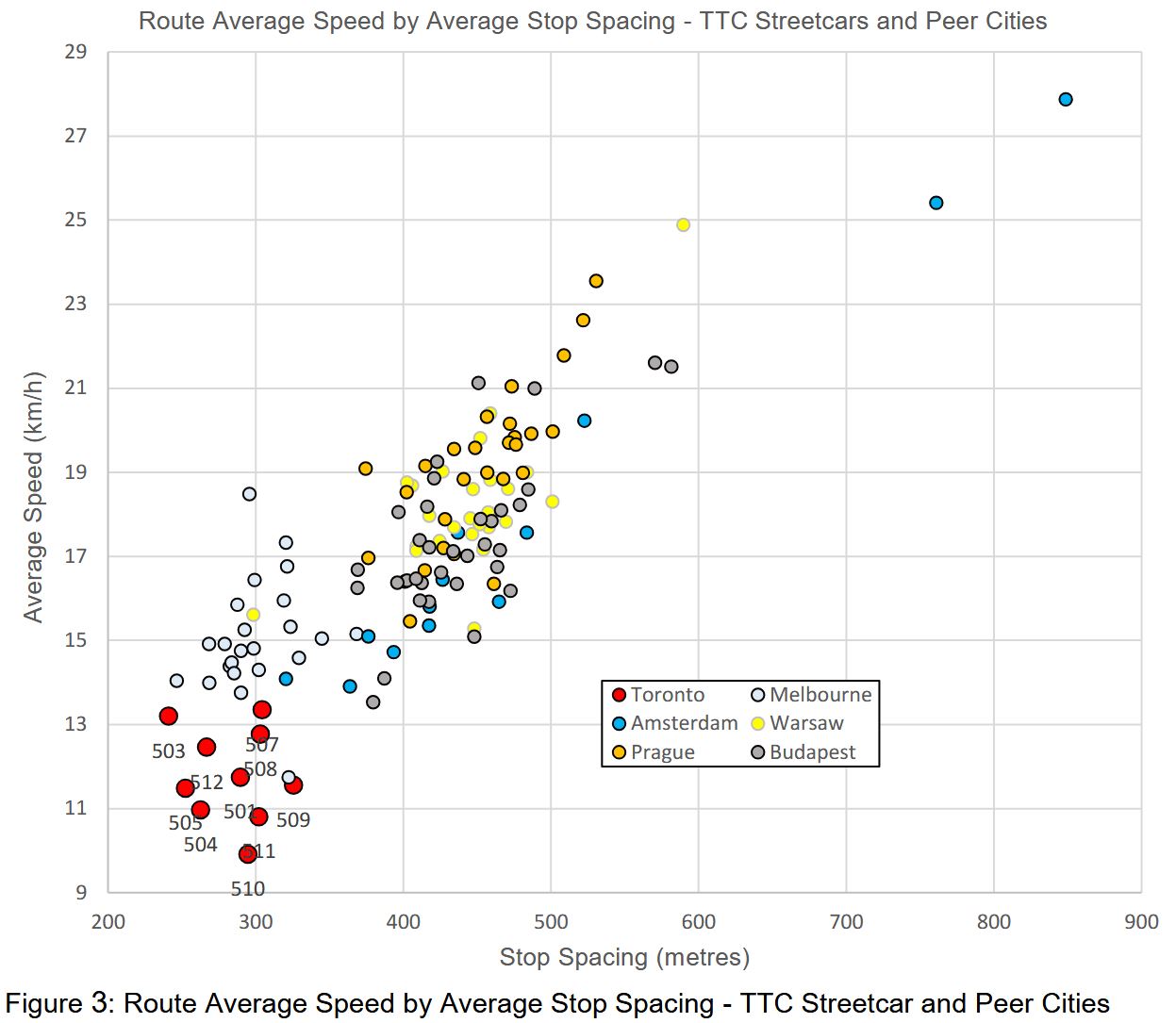
As a matter of comparison, the 512 St. Clair car is only slightly slower than 6 Finch and at times faster. The 507 Long Branch running on Lake Shore Boulevard in Etobicoke is consistently faster than 6 Finch.

TTC Service Summary Update Dec. 7, 2025

With the mid-period update of schedules for opening of the 6 Finch line, TTC has published a revised Scheduled Service Summary. There are only a few changes, and they are listed here for convenience.

6 Finch

Here is the service summary for the new LRT line and the late evening shuttle bus. Note that the shuttle bus is interlined with the 37S Islington short turn service from Humber College to Humberwood Loop, although this is not mentioned in the summary.

Note that the scheduled speed of the bus is much higher than the LRT, and the buses get generous recovery time.

The peak requirement is 15 cars out of the 18 in the fleet.

37 Islington

In the December 7 summary, a 37S Islington short turn service is shown between Humber College and Humberwood Loop, although the effective date of the schedule is supposed to be mid-November. This does not appear in the November 16 version of the summary.

During the late evening, these buses interline with the Finch West shuttle which has an internal route number of 806 even though it operates as “6”.

32 Eglinton West
63/363 Ossington
90 Vaughan
109 Ranee
164 Castlefield

Schedules changed to reflect the renaming of Eglinton West Station as Cedarvale Station. No change in service levels.

Fare Capping Coming to the TTC in 2026

Mayor Chow announced that as part of her 2026 Toronto Budget, fare capping will be introduced on the TTC starting in September 2026.

The cap will be set at 47 rides per calendar month and will apply to all fare classes including adults, seniors and youth. This will bring the senior’s and youth monthly fares down to the same multiple as adults. Chow also proposes that the TTC budget for a 40 ride cap in 2027.

The caps will apply to fares paid by Presto, debit or credit card provided that the same card is used for all rides. This is enabled by changes in Presto’s “back end” system that will keep track of rides used and charge accordingly. Monthly passes will disappear, but frequent riders will get the equivalent benefit without buying a pass up front. This is important for those on tight budgets who do not know what their travel habits will be in advance.

The anticipated cost in 2026 will be $2.9-million less TTC farebox revenue, and a further $0.6-million for the City due to the reduced effective price of their “Fair Pass” for low income riders.

This is a long-overdue change to the fare structure that was first approved in principle by the TTC Board many years ago. Now finally it will be implemented because of the Mayor’s willingness to fund it, and Presto’s ability to support it for all types of payment.

No details of how this scheme will interact with regional fare deals such as 905+416 trips and GO+TTC trips have been announced.

The proposal will first go to the TTC Board’s budget meeting in January, and then through the City’s budget process to Council on February 10, 2026.

Metrolinx Hands Line 5 Crosstown to TTC

Ooops! The initial version of this article used Line 6 in the title. I am too focused on the impending Finch opening!

The Ontario Ministry of Transportation has announced that the Line 5 Crosstown project achieved substantial completion today, December 5. The line is now transferred to the TTC for operation.

No start date has been set, and the TTC will have to conduct its own final pre-service testing just as they did on 6 Finch after the provincial hand-off. A likely date would be mid-February which corresponds to a planned schedule change far enough in the future to accommodate both Line 5 testing and the crewing process for concurrent network changes.

The opening of Line 6 on December 7 is a “mid period” change that is not part of the TTC’s regular cycle, but is likely due to a political desire to complete at least one of the lines in 2025.

According to the Ministry, service on Line 5 will ramp up:

Opening Day

  • Operation from 6am to 11pm
  • Peak service every 4’45”

Six-Month Service

  • Operation from 5:30am to 2:30am
  • Peak service every 3’30”

The TTC has not announced what type of supplementary service will operate during the six-month interim period, nor the service to be provided on a parallel 34 Eglinton bus from Kennedy to Mount Dennis Station in the long term.

Finch Corridor Sunday Morning Timetables

Updated December 4, 2025 at 11:40am

The TTC has issued a press release confirming the times for start of service on December 7:

Line 6 Finch West – Toronto’s newest transit line – will officially open to customers on Sun. Dec. 7. The first westbound train will depart from Norfinch Oakdale Station at 7:33 a.m., while the first eastbound train will leave Jane & Finch Station at 7:47 a.m.

For detailed first train times at each of the 18 new Line 6 stations, customers are encouraged to visit the official TTC schedules page: https://www.ttc.ca/routes-and-schedules.

Before regular service begins, two ceremonial trains will depart from Finch West Station.

Opening day is expected to be busy, and the TTC has organized special activities to mark the occasion. Customers will have the opportunity to collect exclusive Line 6 souvenirs, including special-edition ride guides, vehicle cutouts, and limited-edition commemorative coins and buttons.

[…]

Opening day schedule

On Sun., Dec. 7, the TTC will host a celebratory opening at Finch West Station. The planned opening day schedule is below:

• 7:00 a.m. – Brief remarks from dignitaries.
• 7:20 a.m. — A ceremonial first train will depart Finch West Station. This trip will be reserved for media and invited guests.
• 7:27 a.m. — A second train will depart Finch West Station. Members of the public are welcome to board and join the celebration. This train will be travelling to Driftwood Station and returning to Finch West Station. It will not be picking up customers at other stops.
• 7:33 a.m. — The first in-service train will depart Norfinch Oakdale Station, heading west.

Note that the schedule pages for Line 6 have not been loaded yet, but you can see the early Sunday morning service on the Finch Corridor below, and the full schedule for 6 Finch West in this pdf. The schedules should go live on the TTC’s site when they flip over to the December 7 versions on the weekend.

Original article:

This post contains a consolidated view of schedules for:

  • 6 Finch West LRT
  • 36 Finch West Bus
  • 336 Finch West Night Bus

The period covered is 6 to 9am on Sundays, and these timetables show the transition from the night bus covering the entire route to the split bus/LRT operation east and west of Finch West Station during the daytime.

The information is taken from the GTFS version of the schedules for these routes published on the City’s Open Data site recently. My intent in producing this is that the new schedules will not go live on the TTC site until December 7, and many eager transit aficionados will want to know the times of service at various locations on the route in time to plan to ride early trips.

The TTC’s web page about Line 6 gives a generic start time of 7:30am for the route on Sundays, but actual times vary along the route.

In the timetables below, the LRT trips are in bold italics. Only major stops are shown to save space.

For those unfamiliar with the new line, the carhouse is located between Jane and Norfinch stations, and some trips originate there during the build-up of service.

6 Finch West: Schedules, Travel Times & Speeds

Corrected November 29, 2025 at 2:55pm: An error in the PDF containing the schedule information has been corrected for early Sunday service westbound.

Updated November 29, 2025 at 12:15pm: Charts comparing the scheduled travel times of the 36C Finch West Bus with the planned 6 Finch West LRT have been added.

Correction November 29, 2025 at 7:45am: As some readers have noted in the comments, the times shown at Martin Grove Station eastbound on weekdays were the same as those at Humber College. This was an editing error on my part in copying columns from a larger version of the table. This has been corrected both in the snapshot and in the PDF of the full schedule.

The TTC has published the GTFS version of the schedule for 6 Finch West. This is the electronic timetable used by trip planning apps to understand how the scheduled service is supposed to behave. From these data, it is possible to construct a schedule in a human readable format as well as to calculate travel times and speeds along the line.

The full schedule for weekdays, Saturdays and Sundays is in this PDF. [Corrected Nov. 29 at 2:55pm]

As a guide to reading this, here is the early part of weekday service eastbound.

  • Trip id: The internal trip number assigned by the scheduling system
  • Departure and arrival times: These are shown for selected major stops. Some trips originate eastbound from the maintenance yard, and so they first show up at Jane-Finch.
  • Trip times: The difference between arrival times at Finch West Station and departure times from Humber College Station. Note that they are all 46 minute. This is not typical for TTC routes where the scheduled time varies over the course of the day. This is likely a placeholder value until the TTC finds out what the actual travel times will be.
  • Headways: The interval between cars at a point where all trips are present.

Because there is only one schedule design for a 46 minute trip time all day, the scheduled speeds are the same for all trips. An obvious question is whether the TTC will force cars to hold to this schedule even if it proves excessive thereby delaying riders needlessly. Conversely, if cars operate at whatever speed conditions will allow, there will likely be terminal congestion just as on streetcar routes with excessive scheduled travel and recovery times.

The tables in this file show the spacing between stops, the scheduled time and the speed in kilometres per hour. Speeds vary over the route, and they average 13.53 km/hr. This does not include terminal turnaround time.

There is a particularly slow section at Jane-Finch both ways implying that provision has been made for a delay on every trip. I will inquire of TTC why the slow operation (8.2 to 8.6 km/hr) applies there.

The average speed is slower than the 36 Finch bus during some periods, a rather poor showing for a rail line on its own reserved lane. In a future update, I will include more information about the stop level schedules and speeds for the 36C Finch West Bus. Here is the current scheduled service summary.

Comparative Scheduled Travel Times for 36C Finch West Bus an 6 Finch West LRT

The charts below compare the scheduled travel times between Humber College Bus terminal and Finch West Station with the planned 46-minute trip time of the LRT service. The LRT is faster than the bus notably on weekday and Saturday afternoons, but slower in the early morning and evening periods.

This post will be updated with early operating results and vehicle tracking information once they are available.

Where Is My Streetcar: Fall-Winter 25/26 Edition

With the constant changes in route diversions for various construction projects, water and sewer repairs and overhead reconstruction, the previous Fall 2025 edition was getting cluttered and unwieldy. This version consolidates the current and planned work for late fall and winter 2025-26.

Updated April 30 at 2:45pm

Current and pending diversions:

  • Effective May 3 to May 8:
    • Although regular operation of 506/306 cars through Bay & College resumes on May 3, the diversion via McCaul, Dundas and Parliament will continue between 11pm and 4am to allow completion of overhead maintenance.
  • Effective April 30 to May 3:
    • 504/304 King streetcars will divert between Spadina and Church Streets for track work between 10pm and 4am. Eastbound cars will run via Spadina, Adelaide and Church. Westbound cars will run via Church, Richmond, York, Queen and Spadina.
  • Effective April 27:
    • Normal service along Queen Street between Broadview and Parliament will resume on 501 Queen, and 503 Kingston Road buses will return to King Street from the Don Bridge westward.
    • The split operation of 504 King with streetcars running to Distillery Loop, and a 504D shuttle bus from Parliament to Broadview Station will continue until the schedule change on Sunday, May 3 when streetcars will return to the full route.
  • April 26 to May 3, 2026, 10pm to 4am:
    • 511 Bathurst streetcars will divert north of College to Spadina Station for red lane painting on Bathurst. Buses will run on Bathurst from Bathurst Station to Exhibition Loop.
  • Ongoing:
    • 501 Queen cars divert both ways via Church, Richmond/Adelaide and York.
  • Beginning June:
    • Long Branch Loop will be rebuilt. Streetcar service will be partly or completely replaced by buses from June 7 to October 31. Dates are tentative.
Continue reading

TTC 2026 Budget Preview

The TTC’s Strategic Planning Committee met on November 25 for a presentation outlining major issues in the forthcoming Operating and Capital Budgets. These will be presented at the next meeting of the full Board on December 10.

When the Strategic Planning Committee was first proposed during 2025 budget debates, the idea was that it would have some input to the 2026 cycle through discussions of policy options, financial effects and tradeoffs. However, the committee’s actual formation dragged on for months almost as if there was a “fifth column” working to prevent its ability to function.

The committee will not meet again until March 2026, and hopes to plug into the 2027 budget cycle. This will be complicated by the municipal election and the sense that any policy debate sets the stage for candidate platforms. Still to come from management is an updated Ridership Growth Strategy that necessarily will inform budget plans for 2027 and beyond. It is not yet clear how work on various TTC plans will flow through the Strategic Planning Committee with meaningful input and opportunity to fine-tune proposals.

In that context, management presented an overview of issues facing the TTC going into the 2026 budget debates.

The stage is set with an overview of recent years and the situation in late 2025.

The 2025 budget aimed high anticipating riding growth from a return-to-office commuting trend. This has not materialized uniformly across the system, and it is compounded by a decline in student travel thanks to cuts in the international student visa program and reduced offerings at post-secondary schools.

In the table below, note that the “Operating Budget (Net)” is effectively the budget as seen from the point of view of funders, primarily the City. The gross budget for 2025 is $2.9-billion.

On the Capital side, the TTC spent 87% of allocated budgets as of the third quarter end, and expects to hit 100% or more by year-end. Spend rates through the year are affected by peaking effects from project timing related to weather (construction delays) and major deliveries (new vehicle arrivals), for example.

Although the bump proposed in 2026 spending is relatively large, almost $200-million, 87% of this goes to the extra cost of operating Lines 5 and 6, assuming both are open. Only $25-million goes to current service. Some of that will simply pay the full year cost of operating improvements made in 2025 such as restoration of subway service to near-2019 levels. As we will see later, improvements, such as they might be, will come by reallocation of service between routes, not from net new spending.

For the third year in a row, fares will be frozen. This has a cost, although it is not shown as a budget line item. A 10-cent increase in adult fares, about 3% at current levels, translates to about $30-million annually less the effect of any ridership loss an increase would cause. TTC management has always warned that small annual changes in fare levels are preferable to infrequent large jumps to make up for periods of fare freezes. There is nothing inherently wrong with keeping fares low and service good, but the City must go into that policy with its eyes open as subsidies make a larger part of total revenue, and any service increases bear an increasing effect on non-fare funding.

Debates will continue about changing the fare structure including rebalancing concession rates, introducing schemes to benefit frequent riders such as fare capping. However, any change is unlikely until at least mid-2026 when the TTC rolls out a new version of Presto that will provide more flexibility in tariff design.

This is not to say discussion about fares should halt, and indeed it should already be underway informed by the capabilities and restrictions of Presto. This should be a integral part of any Ridership Growth Strategy debate including the comparative value both in the business sense and as a matter of municipal policy. Why do we provide transit service, what constitutes good, attractive service, and what spending (or avoided revenue increase) would best address the City’s goals?

For 2026, the highlights are:

  • The fare freeze
  • A 2.2% increase in service hours
  • Added funding for a growing fleet of eBuses and streetcars (new vehicles delivered in 2025 will incur full-year maintenance costs in 2026)
  • Lines 5 and 6 operation (the net cost to be offset by a Provincial subsidy)

Of the total operating cost, 93% is “conventional” TTC service and 7% is for Wheel-Trans out of a projected total of $3-billion.

This was achieved while keeping the increase in City funding to $91-million and finding $87-million in budget reductions (some of which are due to accounting changes). We do not know most of the details of budget trimming, nor the foregone possibilities for improvement. Commissioner Saxe queried the lack of Board participation in this process which was to be part of the Strategic Planning Committee’s mandate. We will see in 2026 whether there actually is an open debate.

The revenue/cost ratio for the TTC is now 42%, and that number includes some ancillary revenue beyond the farebox. It is no longer possible to paint TTC as a woefully undersubsidized agency. Riders once paid 60% of costs with another 6% coming from sources such as advertising. Indeed, the City of Toronto will pay more in subsidy in 2026 than the TTC will receive from fares.

Note how small the ancillary revenues are in the table below. Budget debates spend excessive time on how the TTC could be so much better off if only there were more ads, or revenue generating schemes such as shops in stations. This is all very small change compared to overall funding needs, but fixating on minor revenue schemes avoids hard decisions about spending on quality service.

Continue reading