From The Archives: 1984 Streetcar Operations Study

Following up from my long post about the King car, I dug into my archives for the 1984 report by Streetcars for Toronto about streetcar operations.  You can read all the details in the report here.

In a few days, I will post information about the responses between SFTC and TTC that followed.  The upshot of this exercise was that we proved the TTC was doing a lousy job of scheduling and running service, and the TTC did an excellent job of showing how unwilling it was to accept criticism.  The single largest effect from all of our effort was that they made the vehicle numbers on the streetcars (PCCs then) bigger so that the Inspectors (now called Route Supervisors) could see them easily.  I am not making this up.

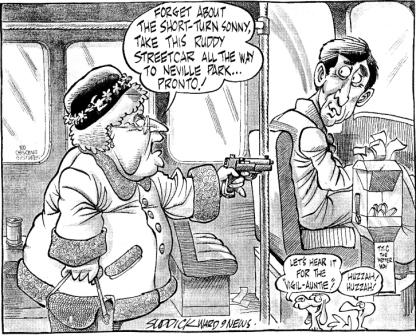
The situation in the Beach raised the locals’ ire enough that the following cartoon appeared in the Ward 9 Community News [apologies if there are any copyright issues here 22 years after the fact].
HijackToNeville

[Ah the simpler days when grannies with guns could be used as a joke.]

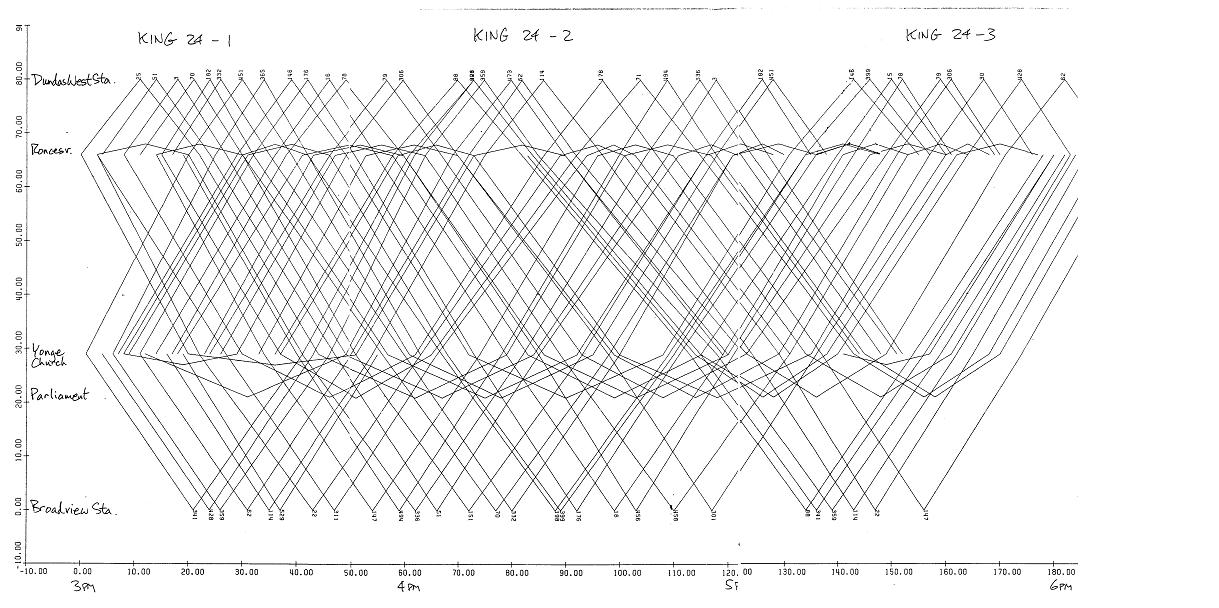
Among the significant features of our report was the use of graphs to show the operation of a route.  The full set is not reproduced here because the salient details are discussed in the text.  However, I have scanned and assembled one graph for the King car’s operation on the afternoon of May 24, 1984.  The graph is linked here.

This image is explained in detail in the text, and it provides as easy way to analyze the operation of an entire route.  The technique is not new, possibly only to the TTC who do not use it.

We had over a dozen people standing on street corners recording car movements to get this data, but the TTC could get it today from the computerized vehicle monitoring system.  Alas, they don’t and it’s a great shame.  That part of the computer system was never developed as a budget saving.

Here’s a challenge for the TTC:  Digest all the data you already have, and provide a website where anyone can look at a graph of any route’s operation for, say, the past month.  This is not rocket science, but it would put to rest claims and counterclaims about what quality of service actually exists on the street.  Will the TTC do this?  Don’t hold your breath.

They will go on telling us that any claims of poor service are figments of our imagination or, alternately, the service really is bad, but only with a reserved lane will your bus show up on time.

I will return to the question of service management and what causes delays in a future post.

Trains on King Street

Today’s Star contains an article by Kevin McGran in which we learn of a scheme to run trains of CLRVs on King Street.  This won’t happen any day soon because the CLRVs haven’t had couplers for years, but they are included in the upcoming CLRV retrofit.

The vital point comes in the article’s second sentence:

The coupling would move more people faster, even though the “headway” — the time between streetcars — during rush hour would increase from two minutes to four, the transit commission says.

This claim of a two minute headway is repeated elsewhere in the article.  Continue reading

Whitelisting and Bouncing Email

From time to time, I get reports of email rejections from the aggressive spam filter on this site.

If you receive a rejection message, the likely reason is that the spam filter thinks your mail is coming from a blacklisted site.  This can even happen to large commercial providers like rogers.com if they happen to host a user who launches a lot of spam.

When this happens, I would like to have a copy of the rejection message so that I can (a) whitelist you and (b) determine whether the rejection was legitimate.  Please cut-and-paste the text of the rejection message into the comment form below and submit it.

Note that these “comments” go into a review bucket for me and I will not make them public.  I will delete them after I have dealt with the whitelisting request.

The original post under this heading follows below. Continue reading

East Waterfront Update

Last night, I dropped by the first Public Forum for the EA now in progress for the Eastern Waterfront transit proposals.  There are three study areas:  East Bayfront covers the area roughly to Parliament Street, West Donlands looks at the slice from Parliament to the River up to King, and the Port Lands covers everything east of the river.  Although there will be separate studies, the work is co-ordinated, and some of the public participation is consolidated to avoid duplication of effort.

At this point, the EA is only at the Terms of Reference stage.  This part can be immensely frustrating because nobody actually designs anything, they only talk about what the ground rules will be when they actually start to work.  If you get these wrong, you may find yourself with a subway where you expected a pleasant streetcar ride, or an expressway where you expected a civilized pedestrian oasis. Continue reading

A Question of Density, Indeed

My thanks to Greg Mckhool for reminding me that I needed to write something about this:

There is a misleading comment in the Dr. Gridlock column of today’s (Apr. 3) Globe and Mail by the TTC’s Tom Middlebrook that needs to be highlighted.

He tries to justify extending the subway to Vaughan’s “field of dreams” by saying that Toronto’s downtown didn’t look like it does today when the Yonge subway was built.  Technically that’s true, but there certainly was a downtown there, and transit ridership along Yonge was substantial. He should know better…

You can find Jeff Gray’s column (Dr. Gridlock) here. Continue reading

Density and Subway Construction

Two recent press items caught my eye:

  • In today’s Globe & Mail, we have an article about residents of Sheppard Avenue who are astounded to find that high density, high rise development is coming to their neighbourhoods.  This development is a direct consequence of the Sheppard Subway line and, indeed, that line’s existence was cited by the Ontario Municipal Board as a reason that the developments should be approved.  Click here.
  • In Thursday’s Metro, Ed Drass reports rather astounding, if sensible, statements attributed to Rick Ducharme, Chief General Manager of the TTC.  Ducharme feels that if the Spadina extension is going to be like Sheppard, without significant, high density development, then it should not be built.  Click here.

Continue reading