What Does Building a Subway Cost?

In the previous item here, I wrote about the Metrolinx study tour including a visit to Madrid. A report reviewing that tour was on yesterday’s Metrolinx Board agenda.

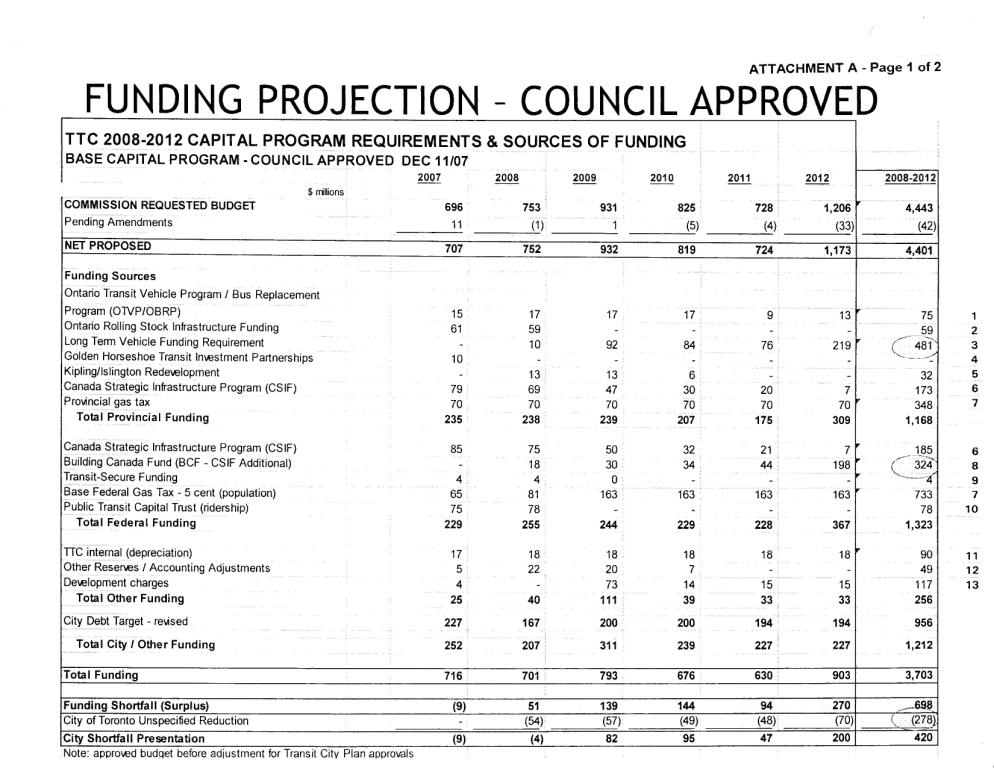
The “Madrid Miracle” is always an issue for discussion. How could a city build so much rapid transit so quickly? Part of the answer lies in the political climate where just getting the work done takes priority over endless political posturing, announcements, jurisdictional wrangling and little action. Part of the answer lies in the money lavished on Madrid by other governments. But part is the much lower cost of building subway tunnels in Madrid compared to other cities thereby making subway expansion much more affordable regardless of who pays for it.

The TTC produced a complementary report examining the differences between Madrid and Toronto to determine just where the cost differences lie. The material that follows is a paraphrase from the TTC’s material with a few of my own observations. Continue reading

Metrolinx Looks to Europe

The January 25th agenda for Metrolinx contains a number of reports well worth reading. Metrolinx has the advantage, for now, that it is a planning agency and doesn’t have to worry about keeping the wheels turning on a large fleet. The focus is on reviewing conditions in the GTA and, to its credit, Metrolinx is not simply rehashing business-as-usual models.

I have not had a chance to read and digest all of these documents in detail, but will post more commentaries as I get the chance.

A long report reviews findings from a study tour in November 2007 to England, Scotland and Madrid. This covers many issues including the evolution of service delivery models in the UK, financing schemes and facility design. Madrid’s experiences get a lot of coverage because that city region has built so much rapid transit so quickly at such a low cost.

I expect that many future studies and directions in Metrolinx will flow from this review of European practices and, no doubt, from the long-overdue recognition that other cities and regions have much to teach the GTA.

Continue reading

Mind the Doors! (Updated)

In today’s Metro, Ed Drass writes about the problem of subway car doors closing before people have a chance to get on and off. (The article is not yet online except in the full PDF version of the paper.)

Updated: This item has been clarified to show that Ed is paraphrasing the TTC’s remarks rather than directly quoting them. My apologies if the earlier version of this piece misrepresented the situation.
Drass paraphrases the TTC as saying:

… the TTC has not changed its policy, but ridership has definitely grown across the system. Train guards are given about 15 seconds at each station, typically opening the doors for shorter periods at quiet stops and longer at busy ones.

When asked why trains wouldn’t take longer at busy stations, the TTC replies:

If you extend it too long you’re going to develop gaps in your service.

Drass notes that the TTC has asked for help with expanding capacity on the subway, but it is unclear from his article whether this is his own comment or a paraphrase from the TTC itself. Such relief, in the form of new trains and signal systems, won’t be here for years and only affects the Yonge line.

Moreover, they won’t address problems with jackrabbit behaviour at stations. Although the TTC worries about keeping the service properly spaced, the signal system (anqituated though it may be) does that today unless, of course, the service is late. Like other TTC systems, it focuses on schedule maintenance, not headways. When trains are late, operators are free to make as brief stops as possible in an attempt to get back on time again.

There is no excuse for ultra-brief station stops, trapping people in trains before they can get off, or catching people in the doors. All have happened to me, and not during the peak of the rush hour when we can blame the problem on rising demand.

Once again, the TTC needs to get its own house in order before blaming those pesky passengers who insist on getting on and off the trains for their problems.

Has The Queen Car Report Been Short-Turned? (Update 3)

Update 3: Here are preliminary comments on the report which is now available (see link below). I have left this as a single item so that the comment thread is kept together.

What is most striking about this report is the sound of multiple authors. One intently defends the status quo, while the other airs various problems at the TTC that have contributed to poor service.

We begin with the usual excuses about running streetcars in mixed traffic “where the TTC has no control over the multitude of factors which delay or obstruct service”. Later on, we hear about the difficulties of running a two-minute streetcar service even though (a) this has not been the case on Queen Street for decades and (b) the only place it does happen in mixed traffic is for the 45-minute eastbound wave on King in the am peak. These excuses are getting quite tiresome as anyone who has read my analyses of vehicle monitoring data for these routes will know.

There are all sorts of blockages, but true stoppage of service is rare. Yes, left turns can be a pain in the butt, but they are there every day, and the schedule can make provision for them. They are a chronic delay, not an unpredictable source of gaps in service.

The TTC’s actions over past years concentrated on on-time performance to the detriment of reliable service frequency, and the TTC acknowledges this. However, management tools (the CIS vehicle monitor) support schedule-based, not headway-based goals. Moreover, on-street route supervisors have no way of seeing the CIS data and must resort to the time-honoured tradition of peering into the fog to see where the next car might be.

CIS, as I have discussed elsewhere, does not yet use GPS technology and often errs in locating vehicles, especially when they are in an unexpected location such as a short turn or diversion. This makes line management more difficult at the precise time when it is so important.

Irregular departure times and the lack of headway management are big problems with off peak service even when there is no congestion or other interfering effects. The report is nearly silent on this issue, and speaks only of changes in route management and in the measures used to assess the quality of service.

We learn that vehicle reliability is not what it might be, and this affects both the number of cars available and the mix of CLRVs and ALRVs on the route. This is the first time the TTC has acknowledged that there are problems maintaining service due to vehicles. If the ALRV fleet is not reliable, why has the schedule not been adjusted to match the characteristics of the available fleet?

The TTC plans to split the route apart in the fall of 2008, and they now allow that service is worse on Lake Shore than it was before the 501/507 amalgamation in 1995. Why has it taken 13 years for the TTC to admit this?

As for workforce problems, we know that there are two issues. First, the number of operators available in December 2006 was not always enough to ensure that all scheduled runs left the carhouse, or at least did so on time. This may have improved in the intervening year and I hope this will be revealed when I get the CIS data for December and January. Oddly, the TTC blames workforce problems on growing demand on the system. That’s a strange tactic considering that service improvements planned for 2007 didn’t actually materialize, and moreover, what did come was mainly on the bus network.

I think that we are finally seeing some of the TTC’s dirty laundry coming out. Yes, running a streetcar system is no picnic, but there are several changes the TTC could implement to improve things. There is a strong culture in the TTC of blaming problems on external factors, but now they acknowledge that some are internal too.

How long has the TTC claimed that service problems are all beyond its control? How long have they advocated nothing less than a fully segregated lane for transit, something that is physically impossible on most streetcar routes?

It’s good to see this shift, but we need co-ordinated changes in operating practices, route management tools and organizational attitude.

I will add to this post later this evening. Continue reading

B.C. Announces Major Support for Transit

The government of British Columbia has announced funding for major expansion of transit especially in the Greater Vancouver area. This was covered in yesterday’s Globe & Mail and the full details are available on the government’s site.

There is a glossy brochure (4MB) with maps and other info.

Looking at all this, I am reminded of Move Ontario and similar announcements. They look great on paper, but there are problems in the details. As with so many plans, this one depends on money from various levels of government. The total is $14-billion, but it comes from:

  • $2.9-billion in existing commitments
  • $4.75-billion in new money from the province
  • $3.1-billion from Ottawa
  • $2.75-billion from Translink (the Vancouver equivalent of Metrolinx)
  • $500-million from local governments

The major components of the announcement are:

  • The Canada Line (now under construction) linking the airport and Richmond to downtown.
  • The UBC (University of British Columbia) Line which will serve the heavy crosstown Broadway corridor and run into the UBC campus where there is already a large bus and trolleybus terminal.
  • The Expo Line (the original SkyTrain) will be extended and will receive additional cars to boost capacity.
  • The Evergreen LRT Line will connect Coquitlam Centre to Lougheed Town Centre SkyTrain station
  • A network of rapid bus routes will provide BRT service primarily in outlying areas.
  • 1,500 new “clean buses” of various technologies will green the fleet.

Like the Canada Line, a good chunk of the UBC Line will likely be underground as an elevated down the middle of Broadway would not do wonders for the character of the street with stations posing a particular problem. Unlike existing SkyTrain routes, the UBC Line runs along a main street rather than through back lanes, industrial districts and railway corridors.

The Evergreen line is the odd-man-out in this plan as the only true LRT line. Support and funding for the line has been slow to come, and I would not be surprised to see it fall victim either to funding constraints or to a change of heart in the interest of standardizing rapid transit technology.

The clean bus plan involves hydrogen, hybrid, electric, natural gas and low emmision diesel options. The announcement is rather vague on the actual mix, and one only learns that these technologies are under consideration in the glossy. The hydrogen bus project is a rather sad reminder of the dreams for Ballard fuel cell technology. The company itself has decided to get out of the vehicle market and concentrate on smaller stationary plants such as emergency power supplies, but dreams of large-scale fuel cell applications die hard.

When the 20 hydrogen buses arrive in 2008, BC claims it will have the largest fleet of such vehicles in the world. At a cost of $89-million, that’s an expensive demonstration.

Notable as part of a rapid transit announcement are plans to improve bus services. This is a welcome change from the capital rich, capacity poor, transit announcements so popular in Toronto for decades.

As for fare collection, BC will move completely to Smart Cards which will include on-the-spot fines for scofflaws.

Probably the saddest part of this announcement is a chart showing the hoped-for market share by transit (page 5 in the brochure). By 2020, Vancouver will move up from 12% to 17%, and then to 22% by 2030. Percentages are lower in other parts of the province. I can’t help wondering what that other 78% of the trips will be, and why they won’t be on transit.

All-in-all, there may be good times for transit planners, builders and riders on the west coast. Tactically, an important role for such announcements (like Transit City) is to have something on the table. Someday, someone may want to get elected, and they may want to spread some money around. We hear that times are tight in Ottawa, but strange things happen in elections.

If there are enough plans from enough cities looking for funding, this may scare off the Feds, but alternately it makes the basis for a truly national transit investment program. We can dream.

A New Look For Roncesvalles

John Bowker of the Roncesvalles Village BIA (Business Improvement Area) passed on a link to information about the TTC’s new design for Roncesvalles Avenue.

At this point, it is unclear whether this will actually be built in 2008 or 2009 (my own guess is 2009), but this gives an idea of what the TTC would like to do with streetcar stops in locations where the incursions into the road are possible.  At all stops from Dundas down to just north of the carhouse at Queen, sidewalks at stops will be widened out to the tracks to provide a step on-and-off configuration.

Various schemes are used to deal with intersections where there are turns either by using farside stops or moving nearside ones back to leave enough room for a right turn bay.

The PDF with the design is very long and narrow — it really belongs on a roll of paper — but the one drawing covers the entire length of the projecvt.

The community appears to be strongly in favour of this scheme, and within a few years we may see a very new transit and pedestrian friendly street.

Trams to the Airport

Today, spacing’s Montreal site includes a report that a tram-train has been proposed as a link to Trudeau International Airport.

Meanwhile in Toronto, the “official” scheme for airport access is still the free-standing “Blue 22” proposal that is mired in Environmental Assessment problems, not to mention its dubious attractiveness to private sector proponents.

The Transit City scheme holds hopes for an LRT access to Toronto Airport, and this could include a connection directly into Terminal One.  This has major implications for airport access from various origins:

  • The Eglinton West LRT connection to the Spadina and Yonge subways, and beyond
  • An Eglinton service extending into Mississauga
  • A connection with the Jane LRT which could also be routed down the Weston corridor to Union Station
  • A connection with the Finch West LRT

This would make Toronto’s airport both a major hub for transit services and provide huge improvements in access to the site from many parts of the GTA, a far superior arrangement to the downtown-oriented Blue 22 scheme.

We are starting to see the benefits of a technology, LRT, that is comparatively easy to implement and doesn’t cost the earth just to go a few kilometres.  How we think about planning transit and how prospective customers view transit services can be transformed over the next decade.

Analysis of Route 29 Dufferin — Part III: Link Times

In the previous post of this series, I looked at headways along the Dufferin route for December 2006.  Now, I will turn to the Link Times, the length of time taken to get from one point on the route to another.

If these times are well behaved, this indicates that the requirement for a bus to cover this particular section is predictable even though it may vary over the course of a day or by day of the week.  Random interruptions occur rarely and the schedule can reliably make assumptions about travel times.

If Link Times are spread out over a wide range of values, particularly for trips at similar times of the day, then something in this area is making travel unpredictable, likely some form of congestion. 

When we are considering the reliability of a service and how it might be improved, areas and times with widely varying link times are a good place to start looking.   Conversely, if link times for a route are generally well-behaved, then variations in headways have some other cause than random interference from traffic. Continue reading

Now It’s Time For Ridership Growth Strategy Two (Updated)

[The original version of this post, up to the point where the update starts, appeared as a guest column on the Op Ed page of the Toronto Sun on January 5, 2008.] 

[Updated January 4, 2008 – see end of post for the changes.] 

Here we are in 2008. We’ve survived threatened cutbacks to service and even have hopes of improvements starting in mid-February with more to come through the year. Mayor Miller’s 100 new buses and Mt. Dennis bus garage will operate, eventually. Plans are afoot for a new streetcar fleet and a huge expansion of rail services via Transit City.

Often, people ask why I’m not satisfied with our plans, and the answer is simple: as an advocate, it’s my job to never be satisfied, to always say “you can do better and we want more”. In that spirit, this thread is intended to ask: what should happen after RGS? What should we aim for next?

In a separate thread’s comments, there’s an important issue about Transit City: we need to establish minimum service levels for major surface routes that are much more like subway standards. Today, we run trains every five minutes everywhere even though there are times that half that service would be adequate for the demand. Why? Because part of the allure of a subway is that you don’t have to wait a long time for it to show up. Moreover, a good chunk of the operating cost relates to the stations and infrastructure, and the trains are a comparatively cheap addition once the line exists.

People on Transit City routes, and even on major surface routes that are not part of Transit City need the same sort of guaranteed service quality.

The TTC hopes to implement two RGS changes later this year. First, service will run on all routes whenever the subway is open. If a route exists, it runs 7 days/week, 19 hours/day. Second, no headway will be worse than 20 minutes anywhere. Both of these will fill out the network and get us back to the idea that transit isn’t just something we run when hordes of people want to use it.

However, a next step might be to designate “A-list” routes, major routes where the maximum headway is no worse than 10 minutes.

With new buses finally coming into play in 2008, we will see reduced crowding during the peak period because the TTC will actually meet their own loading standards. Great stuff, but what happens if we set the loading standard so that there is more room for growth on major routes? What happens if we actually try to encourage people to use the system by making it frequent and if not uncrowded, at least less than jam-packed?

By late 2008, it’s possible the TTC and their political masters will be feeling rather pleased with themselves. Press releases will be issued. Similing faces will appear in front of buses and streetcars everywhere. The job will be done.

No, that’s only for starters.  We need the next round of plans on the table before the year is out.

RGS was first proposed when David Miller was still a Councillor, and it’s taken ages to implement with no end of bureaucratic and political interference, not to mention a fiscal crisis or two. While Miller is still Mayor, it would be nice to see a second round of RGS hit the streets so that Toronto can take on the challenge of making transit a better alternative to driving.

We won’t do it overnight, but we will never do it if we stop after one long-overdue effort.

Update: Today I learned that the TTC is working on a scheme for better bus service.  According to Chair Adam Giambrone:

The TTC is developing a Transit City Bus plan that will likely include max 10 minute service to match subway hours at a grid of streets and new separated bus ROW’s.

Some streetcar lines have service worse than every 10 minutes at times.  This should not just be a plan for the bus system.

Examples include Harbourfront (off season), Queen (west of Humber Loop), and evening service on King, Dundas and Carlton on some days. Some of these will probably qualify as part of the “grid of streets”.

Good news if and when we see this plan on the street, but the service has to actually show up.

Analysis of Route 29 Dufferin — Part II: Headways

In the previous post, I began my analysis of the 29 Dufferin route with a look at service on Christmas Day 2006.  Before turning to other specific days and their events, let’s look at the month overall as seen by the reliability of headways and link times at and between various points on the route.  This post presents the headway data, and in the next installment, you will see the link times.

The picture revealed by these data is not a happy one, although it will not surprise any regular user of the route.  Headways are a mess, especially in the evening.  The oft-cited “flexibility” of buses does not appear to yield service any more reliable than on the King car, and in some cases, the service is worse.  The fundamental problem is that very frequent services are left more or less to their own devices, and less frequent periods on such routes suffer from the effects of laissez-faire management.

Of particular note is the service on Sunday evenings, a period when classic TTC excuses about “traffic congestion” simply are not credible.  Headways are scattered over a range up to 20 minutes even though the schedule says 10. 

Continue reading