More New Streetcars For Toronto (Updated)

Updated on June 15 at 11:30 am:  Thanks to “nfitz” for pointing out that the base prices for both the TTC and Metrolinx cars are available in Bombardier press releases. 

Updated at 11:50 am:  A link to Transit Ottawa’s website has been added.

We gathered at an odd, odd-of-the-way spot — the GO platform at Kennedy Station — a small band of media, government aides and friends of MPPs.  In the background, SRT trains came and went from the upper level of the subway station.

The occasion?  Metrolinx and the Government of Ontario announced Cabinet approval of the extended “Big 5 in 10” project funding and the  purchase of 182 new Light Rail Vehicles for the Transit City network.  The “Big 5” announcement was no surprise — an agency like Metrolinx doesn’t publish a plan like that without knowing approval is certain.  The real news was that Ontario has embraced LRT by actually ordering vehicles.

The irony of the location, a site where we might have seen Toronto’s first LRT line three decades ago, made this event one I just had to attend even if I will have to wait almost a decade to see the new cars rolling out of Kennedy on a rebuilt, extended SRT.

This order builds on the already-approved TTC “legacy” order of 204 LRVs from Bombardier.  That contract included an option for up to 400 additional cars of which 300 were assigned to Metrolinx and the remaining 100 stayed with the TTC.  If Metrolinx wants to bump its order, it has six years to exercise the option for its remaining 118 cars.  This lies well within the timeframe of announcements for another round of LRVs for Toronto or possibly other Ontario systems, but on the timescale of transit planning, is short enough to focus attention on the question “what’s next”.

The new cars (5MB pdf) are slightly longer and wider than the “legacy” LRVs, and the Transit City lines have been designed to match the specs of an “off the shelf” vehicle rather than the more restrictive TTC streetcar system.  A comparison chart shows the major differences between the two new fleets as well as the existing CLRVs and ALRVs.

The contract price is $770-million not including taxes, spare parts and future change orders.  This $4.23-million unit cost compares favourably with the TTC’s $1.2-billion contract for 204 cars (roughly $6-million each), but the actual difference will only be in the range of 5-10% according to Metrolinx CEO Rob Prichard.  Much of the difference lies in the way the TTC and Metrolinx quote pricing and inflation (the TTC’s is an all-in price because as-spent dollars must be quoted in capital budget projections).

The TTC and Metrolinx would do well to present a price reconcilliation so that everyone can make an apples-to-apples comparison.  The last thing we need is a bunch of ill-informed Mayoral candidates presenting the difference as an example of how streetcars are too expensive in Toronto.

Updated June 15:

The base price for each set of vehicles can be found in Bombardier press releasesThe first of the new cars will run on the Sheppard East LRT scheduled to open in 2014.  The remainder of the fleet isn’t needed until 2019/20 when the Finch, Eglinton and (rebuilt/extended) SRT lines are scheduled to open.  This puts much of the order at the back end of the TTC legacy car deliveries running to 2018.  Bombardier and their workers in Thunder Bay are quite happy to see production continuing at their plant.  They have committed to 25% Canadian content, and Bombardier hopes to improve on that figure.

Metrolinx order: 182 cars for $770-million, or $4.23-million each

TTC order: 204 cars for $851-million, or  $4.17-million each

This order sets the technology pattern for other LRT projects in the GTA including Hamilton, Mississauga and Kitchener-Waterloo if any of these progresses beyond the planning stage.  Less clear, however, is the relationship with Ottawa whose LRT scheme recently got back on track with announced 1/3 funding from the federal government.  Siemens was the chosen supplier for the original Ottawa proposal, and will no doubt have a presence in any revival of that scheme.

So begins the long-overdue introduction of LRT to suburban Toronto, although much remains just lines on a plan.  There are the “Phase 2” elements of the four LRT lines, the proposed Sheppard East extension south to University of Toronto Scarborough Campus, the rest of Transit City, and who knows what beyond the 416.  The UTSC extension proposal will be on the Metrolinx Board agenda for its June 29, 2010, meeting, while the remainder awaits the “Investment Strategy” and discussions on how to fund a growing regional network.
Ridership Growth Strategy Revisited

As the term of the Miller Council winds down, I thought it would be interesting to look back at an important document that came from David Miller’s days on the TTC Board.

In the early 2000’s, we were still recovering from the Harris funding and service cuts, and the TTC really needed to move beyond just keeping the lights on and the wheels turning.  The Ridership Growth Strategy was conceived as a way to advocate and advance a menu of low-cost options to make the system more attractive and build ridership.

Far too often, when someone proposed a transit improvement scheme, the idea foundered because:

  • There was never enough money to do anything,
  • We didn’t know how much it would actually cost anyhow, and
  • Competing proposals crowded out the discussion space.

The RGS brought together many proposals so that their costs and potential effects could be compared, and a multi-year implementation could be planned.  Here is a short overview, from my viewpoint, of where things stand.

Much has been done, although there are still holes to be filled.  Looking back from 2010, the RGS is a rather conservative set of proposals, and yet it was considered radical at the time.  Probably the saddest part in rereading RGS is not the table of improvements, but a description of why people ride transit.

3.1 The Importance of Passenger Focus in TTC Service Delivery

The Ridership Growth Strategy focuses on improvements to service quality and speed, and on fare incentives that will be feasible and cost-effective in attracting new riders.  However, the TTC’s operating practices, business culture, and sensitivity to passenger needs — factors that will affect the TTC’s ability to be a serious travel option in Toronto beyond the medium term — must reflect and continually adapt to the needs and expectations of its changing passenger base.

Critical to attracting passengers are efforts to improve the comfort, reliability and convenience of service.  The TTC has made, and continues to make significant efforts to achieve this goal.  A major initiative regarding route management, strict monitoring of service reliability, ongoing, major improvements to terminal operations at a number of stations, improved configurations of buses and streetcars, more comfortable seating on new vehicles, and the commitment to buying only low-floor fully-accessible vehicles are examples of these efforts.  The organisation must continue its work in these areas.

The attractiveness, cleanliness and ambience of subway stations and trains is very important to passengers’ overall travel experience.  The TTC’s recent initiatives regarding station renovations, overall lighting, rebuilding of escalators, recycling of newspapers, enhanced station cleaning, installation of elevators, and acquisition of roomier and brighter “T-1” subway cars are examples of important work in this area.  Again, these initiatives must be continued and strengthened.

Communicating effectively with passengers contributes to their satisfaction with the TTC.   A number of initiatives, all of which will require new funding, have been identified as having the potential to provide significant customer benefits.  These include improved and more effective signage within subway stations and system-wide, continued expansion and improvement of the provision of electronic information through the TTC’s web site, electronic displays of vehicle arrival times within subway stations and on-street at stops, direct marketing of community-specific service information, and automated announcement of stops in the subway system.

Passengers need to know that safety and security are top priority in the TTC system, and a number of initiatives  in this area have contributed to the TTC system being widely regarded as extremely safe.  These include increased presence of security personnel throughoutm the system, introduction of the “request stop” program, more closed-circuit surveillance of station areas, the establishment of “designated waiting areas”, and the installation of platform edge markers.  Again, efforts and resources targeted at increasing system safety and security should be increased in order to meet or exceed passengers’ expectations in this area.

The desire to improve the quality and friendliness of the service which the TTC delivers must continue to be engendered in all employees — management, staff and union.  The Awards of Excellence program, which recognizes employees who have provided truly excellent service according to customer commendations, is a key tool in this drive.  Also critical is the TTC’s ongoing program of employee training and develoment.  These and other initiatives to inculcate an unwavering commitment to satisfying customers must be supported, strengthened and accelerated.

All of these types of ongoing, long-term commitments to improving the overall quality of performance of the TTC must be an integral part of the Ridership Growth Strategy.  [RGS pages 11-12]

This text was written over seven years ago, and we all know that the TTC has a long way to go on many points.  Indeed, they have slipped from “the good old days” in some areas rather than improving.  There are improvements, notably the amount of service.  The TTC’s passenger information systems, including its website, crawl slowly into a reliable and useful state.  However, the “business culture” of the TTC remains inward-looking, often too ready to blame any problem on forces outside of the organization.

In a few months, we will have a report from the Customer Service initiative, and there will many fine words and much back-patting.  Whether we will see anything concrete beyond half-implemented changes — do the easy stuff, but never quite get to the hard parts — remains a matter of conjecture and faith.

Next year, there will be a new crew at City Hall, and with them, no doubt, changes at the TTC including demands for better accountability.  The “business culture” may be in for a shakeup, or like large organizations everywhere, it may bend those who would change it to a safe, corporate outlook.

Upheaval for its own sake is dangerous and destructive, but the TTC needs a wakeup call when so much remains only words from a seven year old strategy.

Wrong Way at Russell (Updated)

In the thread about Ashbridge and Russell Carhouses, there has been the odd mention of cars using the crossovers at Russell Yard.

Until the late 1960s, there were two crossovers at this location.  One still exists on Connaught south of the east gate where the double track merges into single track.  The other was in the “trailer yard” west of the Traffic Office.  The track which now is a westbound bypass track off of Queen used to connect to the eastbound track beside it just behind the Traffic Office.  This was changed so that cars could enter the yard westbound from Queen to couple into MU trains.

One use for the crossovers was that occasionally a car would be spotted in the carhouse facing south.  This was usually done to put the front truck over the wheel truing equipment at the north end of the pits.  This activity stopped with the arrival of the CLRVs.

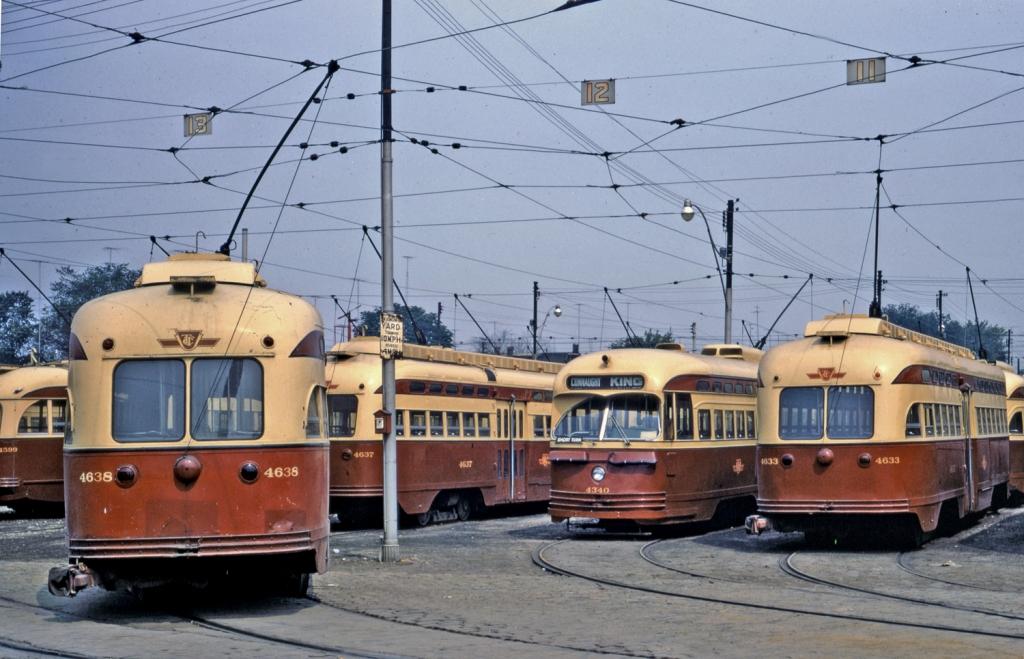
John F. Bromley sent along three photos of cars facing the wrong way at Russell.

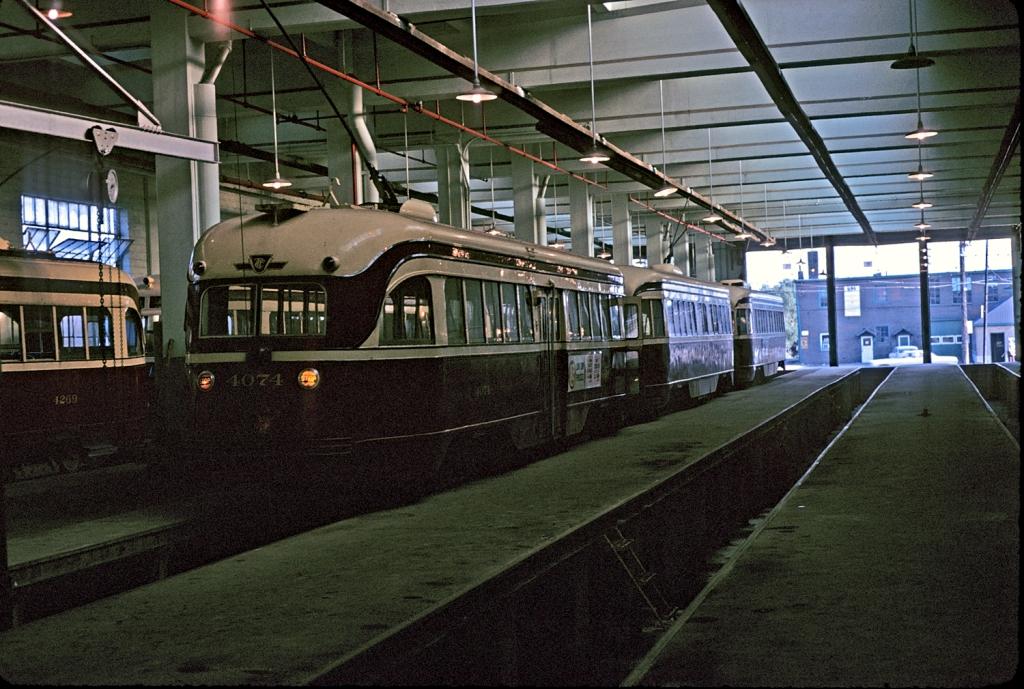
Here is 4074 facing south on Track 2 inside the carhouse, nose-to-nose with another A-1 class car (identifiable by its distinctive trolley shroud) on September 21, 1965.

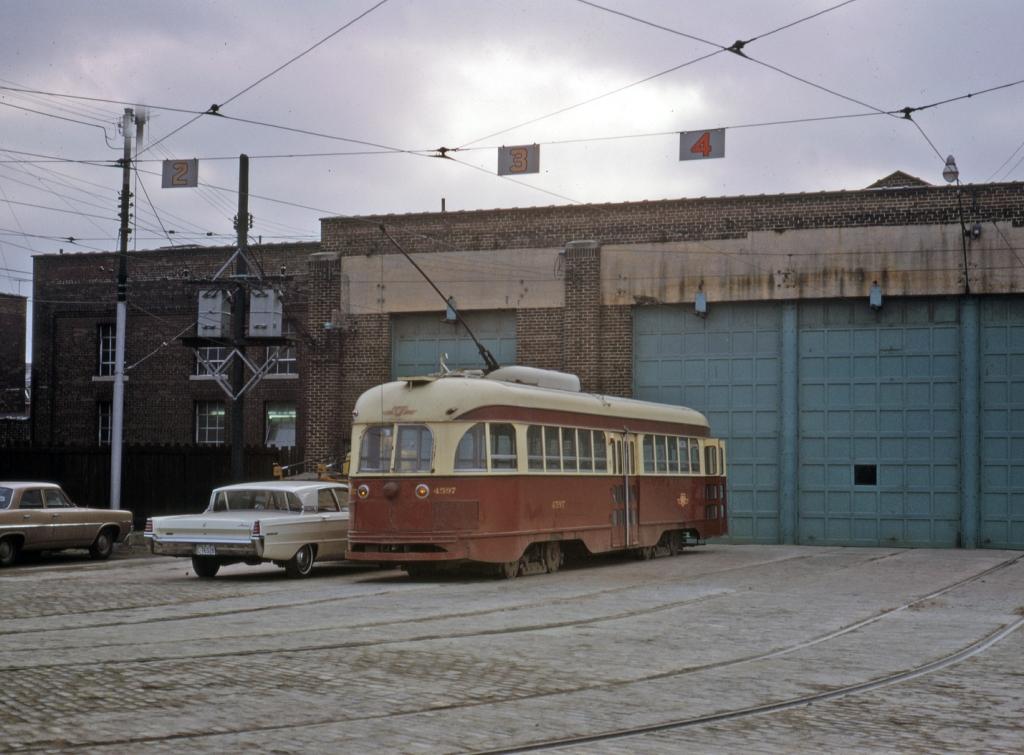
Ex-Cincinnati car 4597 sits outside of the carhouse facing south on Track 2 on December 17, 1966.

Toronto A-6 class car 4340 faces south to Eastern Avenue surrounded by ex-Cleveland 4600’s with ex-Cincinnati 4599 partly in view.  The date is July 26, 1967.

The crossover on Connaught Avenue will be removed later this year when the special work at Russell Yard is replaced.  The TTC has not yet worked out the details of completely replacing the yard while keeping it in service.

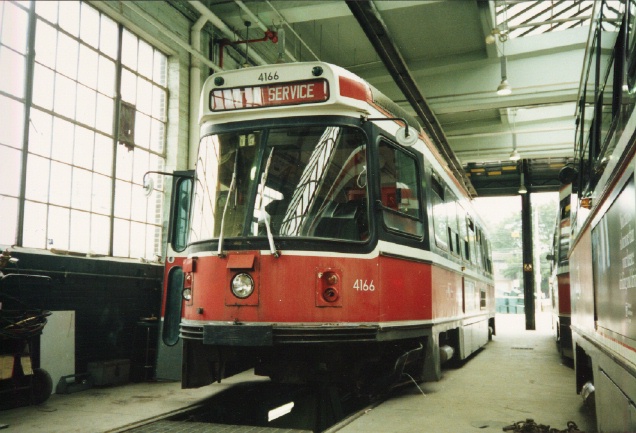
Updated at 5:10pm:  Robert Lubinski sent in this view of 4166 facing south on Track 7 on July 21, 1991.

Bylaw Enforcement is Anti-Transit

I wish that I could put this story down to the silly-season, the pre-election follies that afflict City Hall.

I wish, but I can’t.

Today, we learn in the Star that TTC buses will be forced to comply with the anti-idling bylaw, although there are good reasons for not doing so, as the article describes.

Meanwhile, we learned only two days ago of the many exemptions available to those who flout traffic control bylaws.  These are the “legal” exemptions, not to mention the many other road users who operate as if traffic bylaws don’t apply to them.

Enforcement can be spotty, even when paid duty constables are hired as the TTC did a few years ago to patrol King Street, because everyone knows the tickets will either be cancelled, or will be treated as a business expense.  Meanwhile, the City and the TTC gripe about traffic congestion and its effect on transit service.

Maybe they should both start with a “war on cars” where it matters, on all those cars that block lanes intended for moving traffic.  A fleet of tow trucks will drive the message home that roads do not exist to store cars, they exist to move them.

Once that challenge is in hand, the City can turn to a long-suggested but still not implemented proposal to extend the times designated for rush hour restrictions.

If Toronto has nothing better to do than ticket idling buses, then the City has lost sight of the real problem on our streets.

Service Changes Effective June 20, 2010

Many service changes take effect on June 20, 2010.  Most of these are seasonal route changes and, in some cases, improvements.  Many routes lose peak service, particularly in the AM peak, during the summer because school traffic falls off.

2010.06.20 Service Changes

The 512 St. Clair route is scheduled to return to Gunn’s Loop on June 20, but the actual implementation date has not yet been finalized.  Cars will operate to Lansdowne with geneous layovers pending the opening of the line.

The TTC has published a comparison of running times and headways for the route before and after the implementation of the right-of-way on St. Clair.  Particularly striking is the improvement in running times on Saturdays when St. Clair was the most congested before the reconstruction.  Advocates for transit priority often forget that there are many more hours, and much more traffic, outside of the peak period on some routes.

An operational change effective on June 20 is that AM peak cars running out of service will now operate east to Yonge, then return westbound and go out of service at St. Clair West Station.  This will avoid having cars bound for Roncesvalles Carhouse drop inbound passengers eastbound at Vaughan Road rather than taking them to the subway.

2005-2010 St. Clair Schedule Comparison

For details on individual route branches, please refer to the TTC’s Scheduled Service Summary.

A New Carhouse for TTC Streetcars (Update 4)

Updated June 9, 2010 at 7:40 pm:

Council today voted to support the TTC’s proposal for the Ashbridge Carhouse including an access route via Leslie Street.  This was little surprise given that Councillors are loathe to override staff recommendations unless there is an overwhelming case in favour of an alternative.

The first part of the debate turned on whether the carhouse should be at the Ashbridge site at all.  Despite some uninformed grandstanding by would-be mayor Ford, and handwringing by others over what might have been at the Lever site (Sunlight Park) if only its availability had been known sooner in the process, the Ashbridge site selection was approved.

The second part of the debate focussed on the access route.  The TTC argued strongly against the Knox/Russell option and that position won the day, in part because few champions of this route rose in the debate.

The Transit Project Assessment now enters its formal 90-day phase for comment and then goes to the Minister of the Environment for approval.

Continue reading

Furious George Has A Plan (Update 2)

Updated June 8, 2010 at 11:00 pm:

The Smitherman campaign has posted a backgrounder to his transportation plan which has been updated to reflect the funding of inflation by Queen’s Park.

In a previous update, I noted that there was a bit over $1-billion still unaccounted for.  This is explained in the backgrounder as follows:

Once the provincial government formally approves their contribution escalation the Smitherman construction cost increment is reduced to $3.87­billion, or $5-billion once financed to 2021. [Page 3]

Although this issue has been addressed, the method of paying for transit investments has not been changed.  Smitherman still depends on revenue from gas tax and dividends from City agencies, money that is already spoken for by existing budgets at the TTC and the City.  He also depends on new tax revenue from developments along the routes to be built.  However, those taxes traditionally have been at least partly spent to serve new residents and businesses these developments would bring.

While I applaud Smitherman for at least producing a detailed plan, I still do not agree with elements of it such as the Bloor-Danforth subway extensions or with his financing scheme.  (For the record, at Council today TTC staff responded to a question from Councillor Thompson about a subway extension and explained that any subway extension could not be built along the existing SRT corridor.)

The original content of this post follows the break.

Continue reading

Still Waiting For A Long Branch Car (Updated)

Updated June 3, 2010:

On June 2, the Commission didn’t decide to implement the 507 Dundas West option (described below), but didn’t kill off the idea entirely either.  Some Commissioners balked at the $825k/year pricetag, but the greatest failing was the lack of strong support from the local Councillor who is not a member of the Commission.

I had the sense that individual Commissioners wanted to do what they could to improve service on Lake Shore, but could not figure out a way to do so without out appearing to overrule staff and give in to a local pleading, especially in an election year.

There was a side discussion of the Park Lawn Loop whose installation would extend the 501 Humber service a short distance westward providing better service to some of the Humber Bay condo area, but this project is one of many competing for capital funds in a tight budget.

The motions passed by the Commission were:

Vice-Chair Mihevc:

That the Lakeshore Boulevard Streetcar service matter be referred to staff for consideration during the 2011 budget process.

Commissioner Milczyn:

That TTC staff consult with City Transportation staff on the possibility of constructing a portion of the civil works related to roads, curbs, sidewalks and utilities required for the Parklawn Loop in conjunction with road construction this year, and further authorize the Chair and Vice-Chair to approve any reallocation of funds required for this.

Commissioner Moeser:

The Chief General Manager be authorized within his authority spending level of $100,000.00 to approve any pro-active work considered appropriate for the proposed Park Lawn Loop.

[From draft minutes of the meeting supplied by the General Secretary’s office.]

I spoke to the subject, but nobody from the community appeared probably due to timing constraints and a sense that deputations would be fruitless in the face of TTC staff’s position on the matter.

The original post follows the break.

Continue reading

Sunlight Park Carhouse?

The TTC has a report on its Supplementary Agenda for the June 2 meeting regarding the Unilever property at the foot of Broadview as a possible carhouse site.

During the initial search for new carhouse and maintenance sites, this property was rejected because the then-available acreage was too small.  The situation has now changed, and quite a large block of property is available.  However, the lead time to acquire and clear the site means that a new carhouse and maintenance facility could not be ready in time for the delivery of the Flexity LRV fleet.

All the same, it would be worthwhile investigating this property as a long-term site for a new carhouse replacing Russell and/or Roncesvalles once the high-floor fleet is completely retired.  This would allow redevelopment of two choice pieces of property on Queen Street.

Those familiar with the old Lever Bros. property know it is bordered by Sunlight Park Blvd., a street named after a well-known product.  If this does become a carhouse, that would make a fitting and historical name.

Of course, with that BMW dealership next door, the carhouse would have to feature a large window framing an LRV looking out onto the DVP!