The full set is available in a PDF here. These have been condensed substantially to make browsing easier and to focus on the location, type and duration of delays and incidents.
Many of these delays are short enough that they are not reported to the public via service alerts, but there was a period from December 29-31 when no alerts for Line 6 were issued at all.
A common pattern through the month is that most of the delays are due to infrastructure or equipment failures.
Inoperative or non-responsive switches, especially on snow days.
Emergency braking caused by overspeed conditions. Some of these could be false positives, or could indicate an aggressive enforcement of speeds.
Emergency braking caused by passengers reopening doors. This is a common practice on streetcars, and a design that causes delays through normal passenger behaviour clearly needs a rethink.
Positional problems at stations caused by spin-slide braking which triggers misreporting of vehicle location.
Cold cars.
Many error codes appear on the operator consoles, and these are cleared by “remedial procedures”. There is no discussion of why these happen, and because maintenance is not handled by the TTC, there is no transparency to that part of the operation. An obvious problem is that if normal procedure is to treat error codes as spurious, they lose their meaning and importance.
Failed communications both of hand-held radios and of the control/signalling system.
No equipment available. The Line 6 fleet is 18 cars of which 15 are scheduled for peak service.
Inability to maintain schedule.
Washroom and work breaks for operators. This implies a scheduling problem which is accentuated by perennial delays on the line.
Operational issues with restrictive speeds at intersections and delays due to traffic signals are not logged as delays except for overspeed incidents. The one exception is a log entry from Christmas Day when by mid-evening the entire line was running about 49 minutes late. This is not a heavy traffic day, but the problem illustrates the mismatch between the line’s design and even the padded schedule that was implemented.
Metrolinx has been silent on the question of reliability of components that lie with its P3 partner, Mosaic, or of any work plan to address shortcomings in the vehicles, systems and infrastructure.
City Council supports changes to the traffic signal behaviour to provide aggressive transit priority, and a report on this is due early in the year. Once that comes out, we will see how much of the original design is due to foot-dragging by car-oriented planning in the Transportation Services Department who are responsible for the signals.
A detailed analysis of service such as I have provided for other TTC routes is impossible because there are no tracking data for the Line 6 vehicles. This is a problem even for the TTC who have no way to review the line’s operation, and for trip prediction apps. This is a glaring oversight that should be corrected as soon as possible to improve real-time rider information and to allow retrospective analysis of operations.
The TTC’s 2026 Capital Budget and Plan will be discussed at a Board meeting on January 7 in advance of passing this on to Council for the beginning of the City’s budget cycle on January 8, 2026. There are four reports in the budget package:
There is a lot of detail in the plans, and reading them can leave one mired in a sea of projects and figures. All the same, this plan is as important to the TTC’s future as the Operating Budget which usually gets most of the attention. Key to the Capital Plan is the “State of Good Repair” (SOGR), the need to keep many parts of the system in working order to provide reliable, safe service and to be a foundation for transit growth. Political effort tends to go to single, large projects such as the replacement of the Line 2 subway fleet, but the combined value of less glamourous capital maintenance is considerably larger.
There are two types of maintenance budgets. One lies in the Operating Budget where day-to-day repairs are funded. The Capital Budget funds major overhauls and replacement of infrastructure and vehicles. The capital side can be “spikier” in individual budget lines because some components are totally replaced but infrequently. This leads to uneven funding needs, and the marquee projects can crowd out routine but necessary work.
Another consideration for capital is that some infrastructure has a very long lifespan, but eventually reaches the point where major investment is needed. The subway system was built in stages from the 1950s onward, and as it ages there are new costs just to keep old infrastructure in good repair. For example, the signal system on Line 1 has been replaced and preliminary work for Line 2 is underway. The Line 2 signals are 60 years old, and they will be even older when they are eventually replaced.
Fleet planning for the rail modes, subway and streetcar, has peaks and valleys of procurement because entire sets of cars are replaced in a single order. On the bus fleet, in theory the procurement should be continuous, but even here there are peaks caused by uneven purchasing in past years, occasional special subsidies for purchase of specific vehicles, uneven reliability among various bus types, and an uneven rate at which old vehicles are retired. Quantities can be affected by manufacturing issues as is now the case with eBus procurement.
Funding programs come in two flavours. One is project specific such as the subway car purchase, while the other comes at a fixed annual rate such as gas taxes and the new Federal transit funding program. Capital spending plans have to fit around the rate at which money flows from many different sources. Major expansions such as the Scarborough Subway used to reside in the TTC’s budget, but they are now completely funded and managed by Metrolinx with provincial funding.
The TTC presents its Capital Budget in three versions with different timelines.
A one-year budget for the current year.
A ten-year plan corresponding to the City of Toronto’s financial plans.
A fifteen-year plan showing all projects beyond the ten-year window but with an important difference to the one- and ten-year versions — all projects are included whether they are funded or not showing the gap between the funded 10-year version and actual needs.
Historically, the 10-year plan was trimmed to fit known and expected funding, and everything else went “below the line” (in the sense that it came at the end of the budget). A common trick was to push enough of the planned spending beyond the 10-year window. In spite of routine hand-wringing about TTC finances, the current budget was always magically kept intact and the hard decisions were left to another day. Now with the 15-year plan, those future costs are visible, and even then new items crop up. The “below the line” segment is now twice the size of the funded budget.
The lack of long-term funding is a major issue for Toronto especially considering Council’s desire to substantially increase transit’s share of travel.
Overview
Here are high level views of the one year, ten year and fifteen year plans.
Source: TTC Capital Budget
Although the one year plan for 2026 is about 10 percent of the ten year plan, the spending is uneven with more than half of the total in the first five years. This reflects anticipated funding availability which drops off in the latter half.
Source: TTC Capital Budget
Longer term, over two-thirds of the fifteen-year total is only in the Capital Plan. This does not mean that the TTC would spend the remaining $37-billion in the last five years. This is the “below the line” effect where work that is not yet funded is shown in the long-term plan even though much of that work is needed well before 2036.
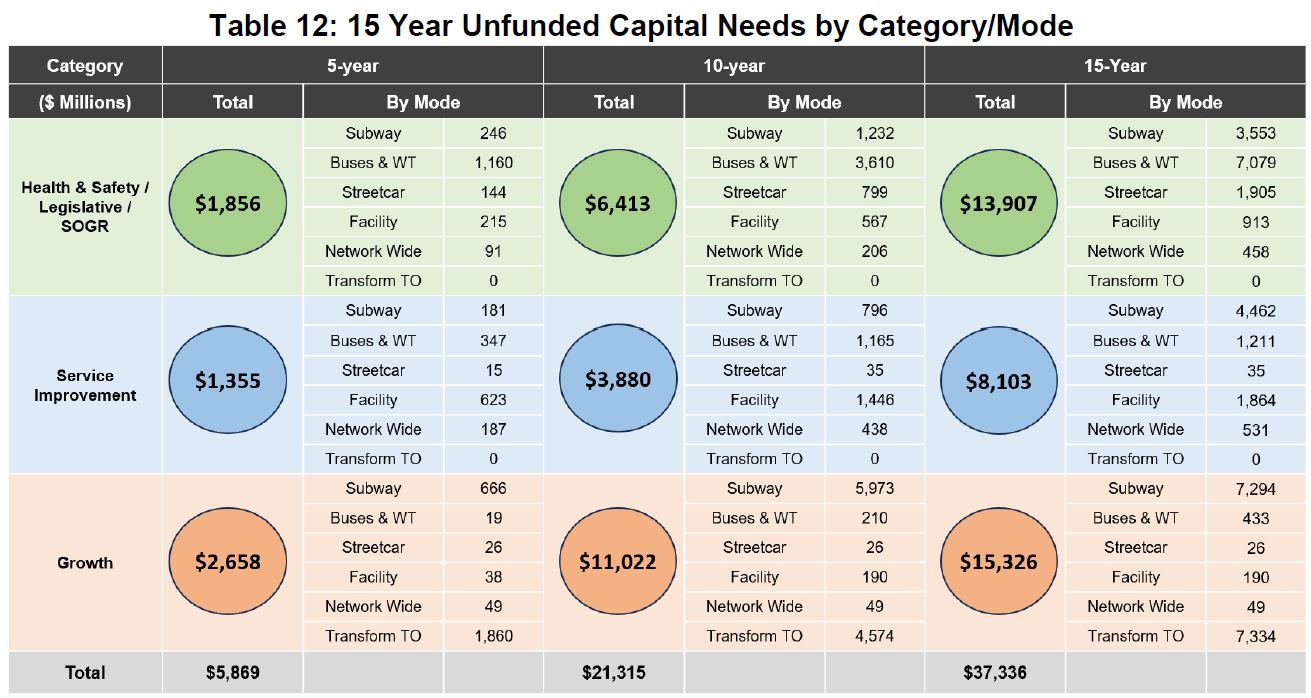
The unfunded projects span every aspect of the TTC. The chart below breaks down the funding gap and shows how it grows from the short to long term. (Note: the values reading across are cumulative.) The $37.3-billion here is the difference between the 10-Year Capital Plan ($16.7-billion) and the full 15-year plan ($54.0-billion). This is not an issue for the indefinite future, but one which faces the City today with a shortfall of over $1-billion annually for the next five years, growing to over $2-billion in a 10-year view and even more in a 15-year view.
Note that TransformTO is included at a projected capital cost of $7.3-billion, over half of which would be spent in the first 10 years. If Toronto is really serious about major investments in system capacity and attracting many more riders, the decision to proceed must occur soon together with the spending commitment. Whether this will attract support from other governments is quite another matter, and there is sure to be a debate about competing priorities for transit funding regardless of its source. This will require a long-term political commitment to growth of the whole network, something notably absent except for subways.
Source: TTC Capital Budget
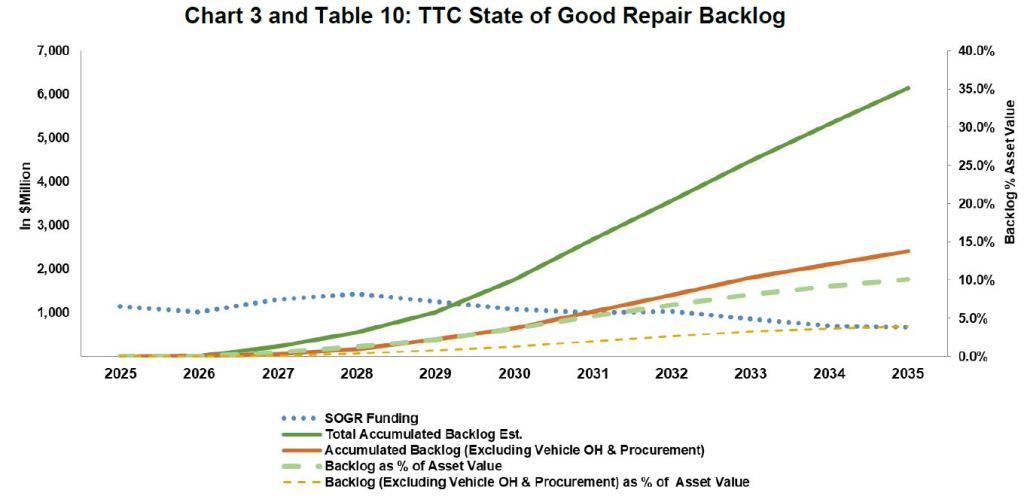
A related issue is the growth of the SOGR backlog as infrastructure and fleets age faster than funding is available to renew them.
Source: TTC Capital Budget
Although the TTC has chipped away at the SOGR backlog in the short term, changes in estimates for later years have worsened the problem. Three sources are cited for the increase.
eBus procurements, which count as SOGR because they replace existing buses, have increased “by $854.8 million as of 2034, and $1.277 billion as of 2035.” eBuses are proving more expensive to buy, and more or them are needed for projected service levels.
Overhaul costs for all modes increase “by $169.1 million as of 2034, and $277.2 million as of 2035”. Some of this is due to changes in fleet plans which push vehicle replacements further into the future requiring more SOGR maintenance on older vehicles, notably subway trains and buses.
Subway track goes up “by $123.0 million as of 2034, and $148.7 million as of 2035.” Thanks to new assessments of track condition, the TTC has recognized a need for accelerated replacement of older track.
This is a perennial problem with capital plans — the scope and/or pricing of future projects rises faster than the provisions built into the plan, and there is year-to-year growth even if nothing is added to the shopping list.
Funding
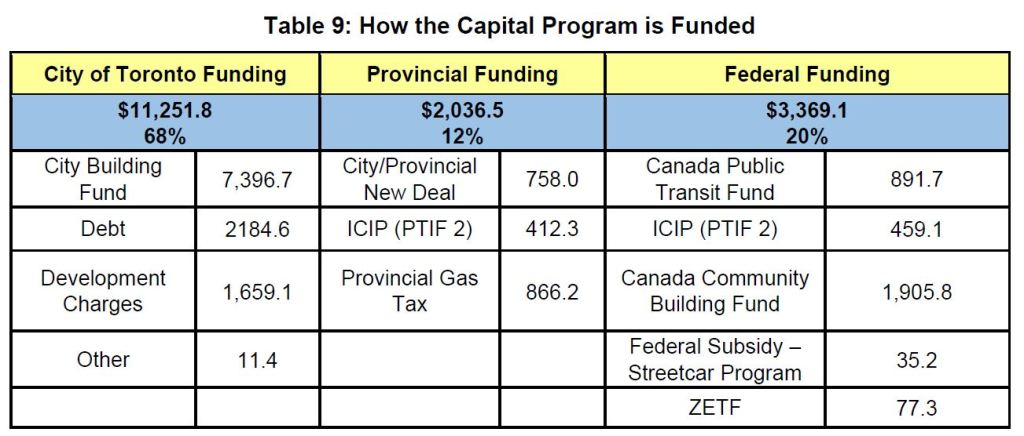
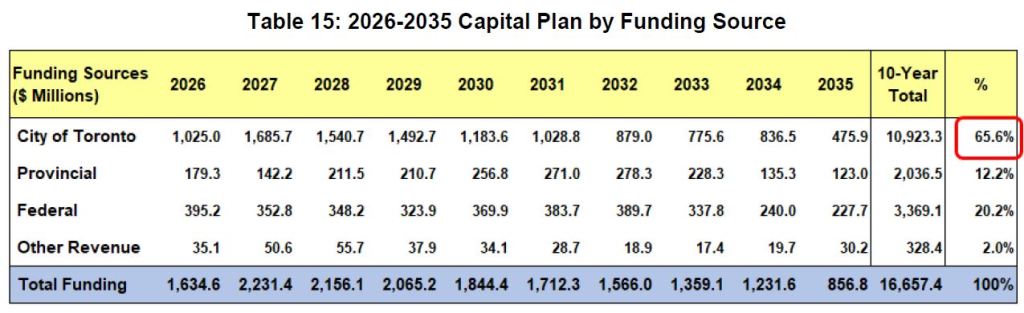
The 10-year plan is funded from various sources as shown in the table below. Some of these are time limited and project-specific. For example, the streetcar funding looks after the tail end of the 60 added car procurement and related changes at Harvey Shops so that it can function, in part, as a carhouse. The Zero Emission Transit Fund only covers current eBus procurement, and it is unclear how much this program will be extended, and what proportion of costs it will cover. Development charges will fall in later years of the plan as the current regime expires and rules for what can be included change. The New Deal with Ontario is also time-limited, although the City and TTC are negotiating an extension.
This only accounts for the funded part of the budget, and much more is required, some of it in the early years.
As things stand, the City carries almost two-thirds of the total cost primarily through debt financed through City Building Fund revenue (essential a property surtax) and by debt supported from general revenue.
From somewhere, the City must find a further $37.3-billion, a number certain to grow, or it must trim some projects from the wish list. The level of support needed from provincial and federal sources is woefully inadequate to address Toronto’s needs. Toronto is not alone with this problem, but it has the biggest funding gap given the size and complexity of the transit system.
Real Estate Investment Plan
A separate report details planning for real estate requirements.
When it was created in 2022, the Real Estate Investment Plan’s goal was to flag the need for property well in advance of actual requirements so that construction would not be delayed. One example of how this happened is the SR busway conversion where a project unforeseen in the plan was delayed awaiting settlement of various property issues.
The REIP highlights needs separately from the main budget, but the report is rather disorganized and is not cross-referenced to the main Capital Plan. Some items are quite small while others such as studies of future use for properties like Hillcrest and the Kipling Yard site are bound up with basic questions of what the TTC will become in future years.
Many parts of the REIP address housing various TTC functions which have grown over the years into an expanding collection of trailers as “temporary space”. The TTC also occupies many leased spaces for offices that have outgrown the Davisville headquarters and other major sites. Talk of a new consolidated Head Office has been heard for years, but nothing concrete emerged. The context now is a wider City plan to consolidate office space. This should primarily affect the Operating Budget both through reduction in rent costs and improved efficiency of co-located staff.
Updated December 30, 2025 at 10:45pm: The description of proposed service changes on the subway has been amended to reflect that the headway changes on Lines 1 and 2 are already in place. They show up as “new” in the 2026 budget because they were not included in 2025.
The Toronto Transit Commission’s Operating and Capital Budgets will be considered by the TTC Board on January 7, 2026, and will go from there to City Council for final approval. This article discusses the Operating Budget, and my next one will deal with the Capital Budget and Plans for 2026-2040.
Through a combination of belt-tightening and accounting magic, some of which cannot be repeated in future years, the TTC manages to freeze fares for a third year, introduce fare capping, retain and improve overall service levels, and stay close to the City’s target of $91-million in added subsidy for the new year. This is roughly equal to the $90.8-million rise in Provincial subsidy for the operation of Lines 5 and 6.
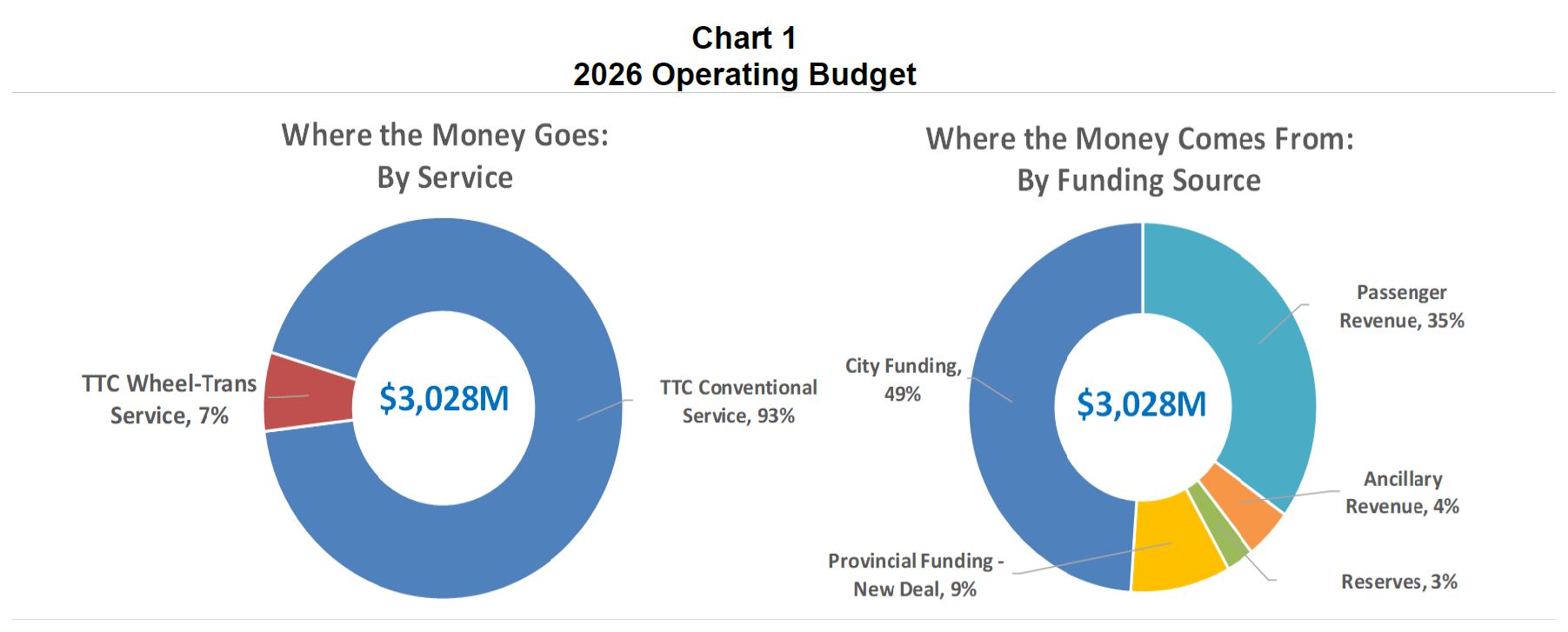
The pie charts below give a high level view of the budget. Note that passenger and ancillary revenues (fares, parking lots, shop rentals, advertising) account for only 39% of the total, and City subsidy is almost half. This is a huge change from the days when the City and Province each paid one sixth of the total, and the lion’s share of the remainder came from fares.
Source: TTC Budget p. 3
Fare Changes
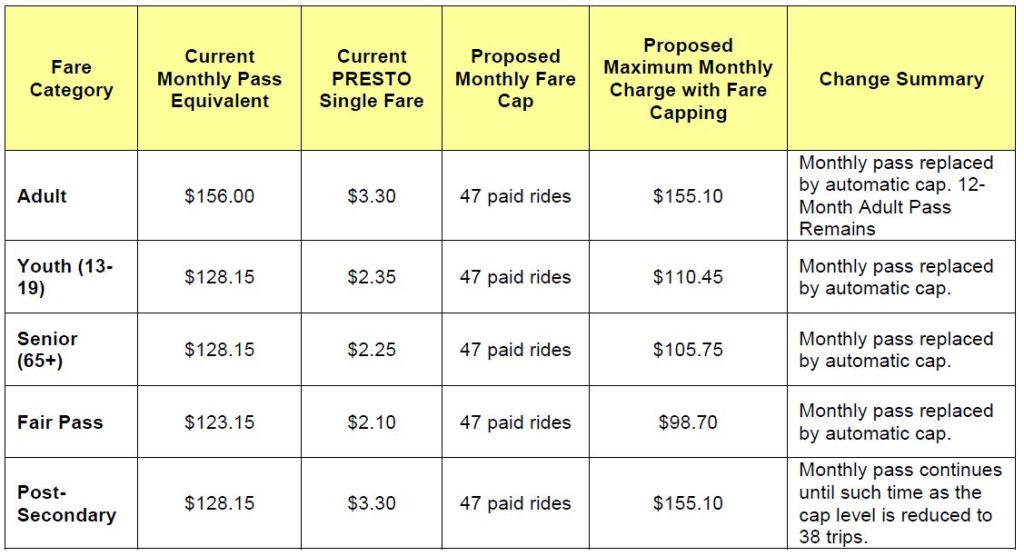
For riders, the biggest news is the fare freeze and capping, to be introduced in September 2026 with a view to further improvement in September 2027. The Adult fare cap is close to the price of a monthly pass, and so riders who already buy passes will see only a small change in their cost. However, the benefit of a capped price will be available to all riders without an upfront payment for a pass.
Youth, Senior and Fair Pass fares will be capped at the same ratio, 47 rides, and this is an improvement over the current higher multiples of 54.5, 57 and 58.6 respectively. Frequent TTC riders in these classes will see reduced costs.
The odd group out here are Post Secondary students whose pass is priced at the same rate as Youth and Seniors, but who pay the full Adult fare if they do not have a pass. This creates a situation where a pass is cheaper than capped single fares. The policy issue here is whether the Post Secondary single fare should be reduced to the Youth level and the monthly pass eliminated.
If the fare cap is reduced to 40 in September 2027 (a decision subject to the 2027 TTC Board and City Council), this will be equivalent to a 15% reduction in the monthly pass cost.
Source: TTC Budget p. 31
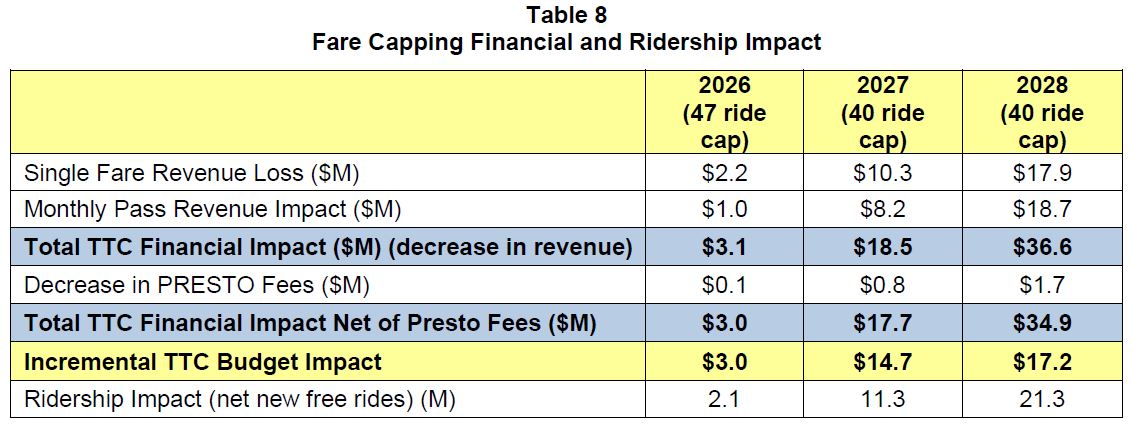
The anticipated cost of fare capping in foregone revenue is $3.1-million in 2026, $18.5-million in 2027 and $36.6-million in 2028 assuming that the 40 fare cap is implemented in September 2027.
Source: TTC Budget p. 22
All of this occurs with the hoped-for greater riding and extending the benefits of fixed transit costs to more riders. However, fare freezes and reductions cannot go on forever without also discussing the TTC’s ability to retain and improve transit service. A large “SALE” sign attracts few customers if the shop window is half-empty.
Service Changes
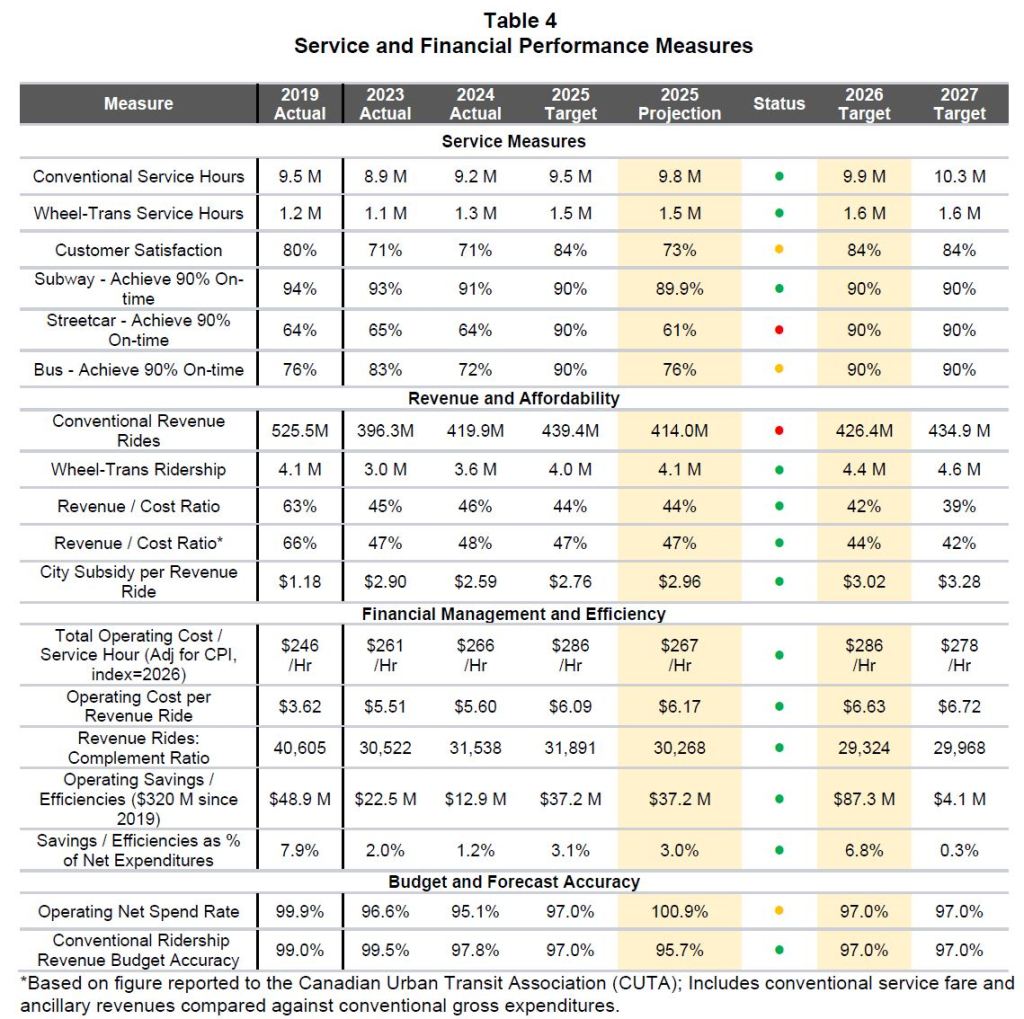
The service budget increases by 2% measured in service hours “to address congestion, adapt to changing travel patterns, deliver world-class service during the FIFA World Cup” with an expected ridership of 426.4-million in 2026 compared to a projected 414.0-million in 2025. Note that this is still lower than the original 2025 projection of 439.4-million. The budget does not explain how much of this increase will show up in more frequent service as opposed to congestion adjustments and the one-time bump for FIFA.
One specific change mentioned in the budget is the restoration of peak service on Lines 1 and 2. For reference, here are the current peak service levels and the levels operated in January 2020. Line 2 is already operating at the 2020 level, and Line 1 would only improve by 6% (measured as trains/hour) in the AM peak. The controlling factors in peak service levels are the signal systems and the fleet sizes which prevent service improvements beyond the 2020 levels.
Updated December 30, 2025 at 10:45pm: The “restoration” of peak subway service appears here because it is a budget-to-budget change even though it was actually implemented in late 2025. This does not represent net new service compared to year-end 2025.
Line
AM Dec 2025
AM Jan 2020
PM Dec 2025
PM Jan 2020
1 Yonge University
2’30”
2’21”
2’30”
2’36”
2 Bloor Danforth
2’20”
2’21”
2’30”
2’31”
Source: TTC Scheduled Service Summaries
Ridership
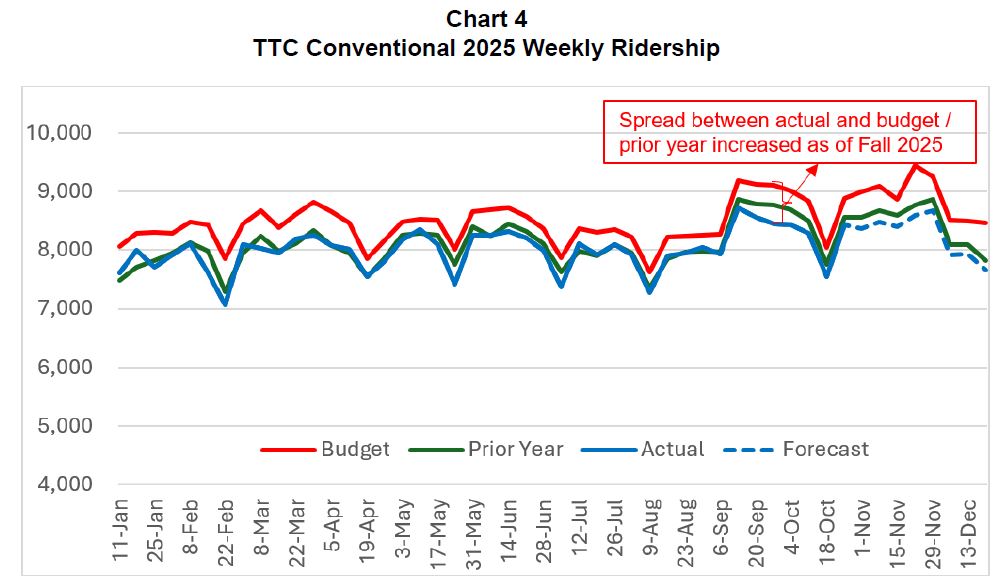
Conventional system ridership has not done well against budget projections in 2025. The budgeted value (top line, red in the chart below) has been consistently above actual counts (blue at the bottom). 2025 numbers closely tracked 2024 values (green) until the Fall when they fell lower. The shortfalls are attributed to a combination of undue optimism about the effect of return-to-work commuting and the loss late in the year of foreign students.
Source: TTC Budget p. 16
Projections for 2026 are less aggressive and, for budget and service planning, the “medium” increase will be used.
Source: TTC Budget p. 14
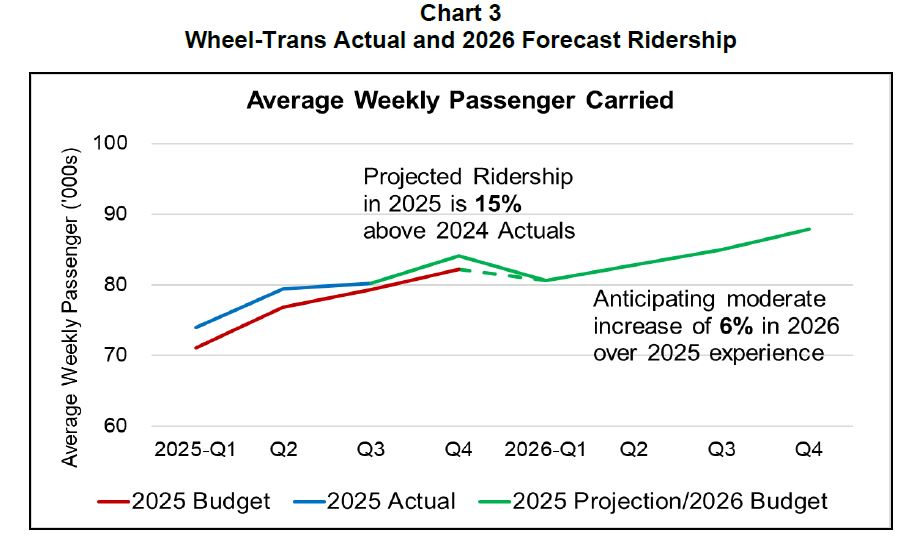
Wheel-Trans demand is strong and more growth is expected there in 2026.
Source: TTC Budget p. 15
The issue of future demand affects both the operating and capital budget planning process, and there have been conflicting indications of where the TTC thinks this is headed. In the short term, they expect little growth, but a recent Major Projects Update claims that current projections will accelerate the need for extra capacity on Lines 1 and 2.
Line 1 – Capacity Enhancement Program:
This program provides for the expansion of Line 1 capacity by achieving headways of up to 100 seconds, enabling the movement of up to 39,600 passengers per hour at peak hours. […] Headways of 100 seconds by 2037 were based on pre-pandemic projections. The updated ridership demand forecasts will require headways to be achieved earlier (2035). Full schedule and scope impacts are currently being evaluated. [p. 23]
Line 2 – Capacity Enhancement Program:
The ridership demand forecasts have been updated and are under review, extending to 2051, and will require the target headways to be achieved earlier than previously planned (135 seconds by 2028, 130 seconds by 2029, 125 seconds by 2030, and 120 seconds by 2037). Full impacts are currently being evaluated and will be outlined in a detailed report to the Board. [pp 20-21]
How this fits with overall system demand, fleet and service needs is not explored in the budget. As the chart below shows, TTC riding has not yet returned to 2019 levels. The “flip side” of that observation is that the pre-pandemic era was noted for overcrowding on many routes and spawned expansion plans such as the Bloor-Yonge project. Toronto should not wait to be back at 2019 and its capacity problems before planning for growth.
Metrics and Targets
The TTC has several metrics to track their operation and associated targets. Notable among these are Customer Satisfaction and On-Time Performance. Although the TTC is working internally on new metrics, these have not yet appeared. A major problem with the concept of “on time” is that it has more meaning for internal purposes than to riders on most routes where service is frequent, but erratic. It is reliability, not the schedule, that matters especially when considerable variation is allowed by TTC standards.
The TTC will make changes to several routes on January 4. Some of this is simply the restoration of service oriented to school traffic, but several routes will see a mixture of adds and cuts to address ridership. The actual change from December to January is only 518 weekly hours, and most improvements are offset by cutbacks.
One new route, 906 Airport-Humber College Express will begin operating.
The detailed service plans for all changes are in a spreadsheet at the end of the article.
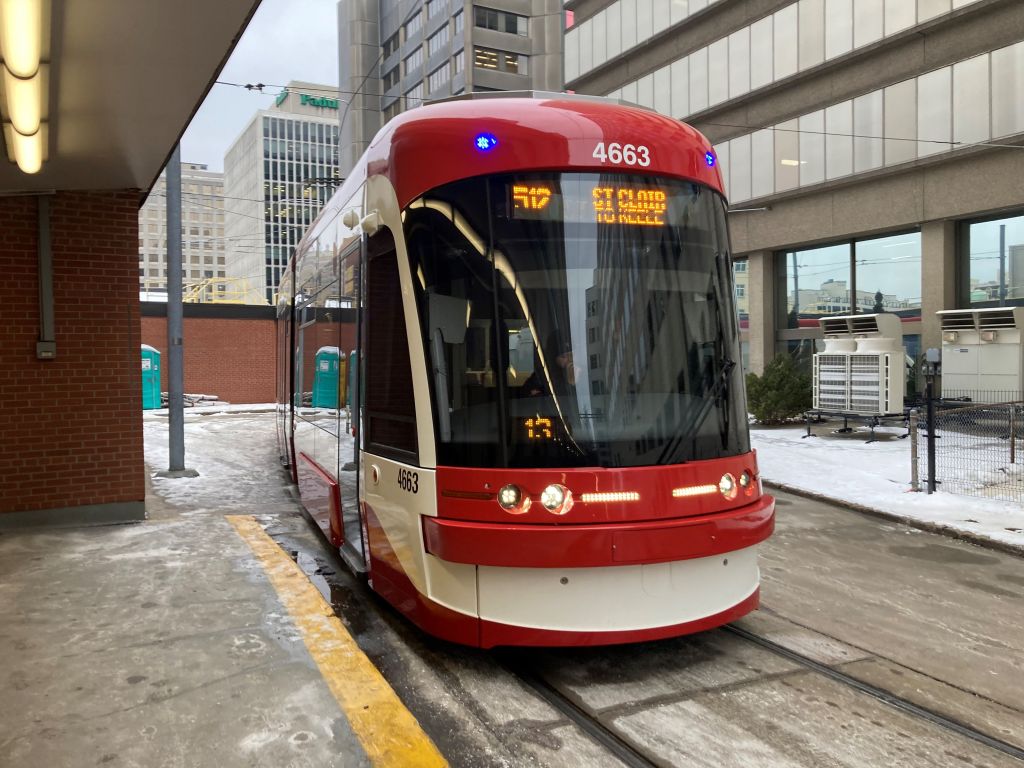
The last of the TTC’s 60-car add-on streetcar order arrived in Toronto recently, and entered service on December 16, 2025. This brings the streetcar fleet to 264 vehicles.
4663 at St. Clair Station Loop, December 16, 2025. Photo by Jeffrey Kay.
With so many streetcars, the real shame is that the service is so poor on many routes through a combination of 10-minute headways and erratic operation, not to mention the effect of never-ending diversions, construction projects and bus replacements.
The TTC began a shift to a 6-minute headway standard with 512 St. Clair earlier in 2025, and this was followed by 505 Dundas and 511 Bathurst in mid-November.
Due to construction at Queen & Broadview, the 503 Kingston Road car is operating with buses, and will continue to do so at least until April 2026. There are moves afoot within the TTC to kill off the all-day operation of the 503 downtown, but one of its biggest challenges comes from irregular service on the 503 itself, and the total absence of headway blending where the 503 joins the 501 Queen car westbound at Kingston Road and Queen. Pairs of 503 buses are a common sight today, and 503/501 pairs were common when streetcars plied both routes.
The TTC simply does not take seriously the effect of unreliable service on ridership.
As we see a move to a new 6-minute standard, the question is just how far the 264-car fleet will stretch. The table below shows all of the streetcar routes with headways and PM peak car requirements. Toronto has not seen every streetcar route active at the same time for a very long time thanks to equipment shortages during the later days of the CLRV fleet, and the omnipresent construction projects that always managed to keep a route running with buses. One might think that the TTC overextended its route closures simply to save on streetcar operations.
In fact, a big shortage lies in operating staff and in budget headroom to field more cars on a scheduled basis.
If all streetcar routes were operating with streetcars today, the TTC would need 172 cars for service. A 20% provision for spares would raise this to 206 leaving a substantial pool of cars on the sidelines.
The right-most column below shows the current peak requirements scaled up for routes that now run on headways above six minutes. For example, getting 501 Queen down from a 9-minute to a 6-minute service would require 14 more cars. The total for an all-streetcar operation would be 215 cars, plus 43 spares for a total of 258, only slightly below the fleet size.
Until we see details of the 2026 budget, we will not know if any more routes will join the 6-minute network in the coming year.
Route
Headway
Peak Cars
Cars Required for 6-Minute Network
501 Queen
9’00”
28
42
503 Kingston Road to York (April 25)
10’00”
12
20
504 King (April 25)
5’00”
27
27
505 Dundas
6’00”
25
25
506 Carlton (Sept 25)
10’00”
19
32
507 Long Branch
10’00”
8
13
508 Lake Shore
Trippers
5
5
509 Harbourfront
9’00”
6
9
510 Spadina
5’00”
14
14
511 Bathurst
6’00”
14
14
512 St. Clair
6’00”
14
14
Total
172
215
The 60 new cars were intended both to handle growth and to provide for the Waterfront East line that is still only a faint hope for better transit there. An update on this project is expected at Council early in the new year, but a projected opening date lies in the 2030s.
The TTC is also short carhouse space. Thanks to the arrival of all 60 cars well before planned work completes to expand storage and maintenance capacity at Russell and Hillcrest. Part of the main shops will be converted as a streetcar barn serving 512 St. Clair and possibly 511 Bathurst. Several Blue Night streetcar routes operate with improved headways simply to reduce overnight storage demands on the carhouses.
The streetcar system always pulls up the rear in reliability stats, and recovery of pre-pandemic demand is not as strong on that part of the network as elsewhere. This is due in part to a shift in travel and work patterns in the area streetcars serve, but one cannot help wondering how much the erratic service deters riders from returning.
An ironic side-effect of a move to 6-minute service is that this makes “on time” an easier target, but with bunching as a daily event. The reason is that TTC vehicles can be up to 5 minute late and still count as “on time”. On a 6 minute headway, this easily leads to pairs of “on time” vehicles every 12 minutes. The real condition of service is hidden by a too-easily attained “target”.
The bus network also has fleet utilization issues, but these are a mixture of scheduled service levels, vehicle reliability, budgeted headroom for growth and the use of “Run As Directed” buses. The “RADs” are a relic of the Leary era that were routinely cited as a catch-all alternative to addressing specific problems. The vehicles were not well-used and their numbers dwindled as the pool of spare operators moved to other duties, notably on Lines 5 and 6. I will turn to the bus fleet in a future article.
For 2026, streetcar routes face many challenges:
Provision of enough budget to allow improved utilization of the streetcar fleet.
Service management that actually brings evenly spaced streetcars on dependable headways.
Addressing the validity of operating practices that hamper streetcar speeds everywhere, rather than just at locations with problems such as badly worn track. This includes sorting out constraints that really do relate to “safety” as opposed to using that as a catch-all excuse for padded schedules.
Addressing track switch controller issues that have plagued the streetcar network for decades.
Providing real transit signal priority for streetcars including at locations where diversions and short turns see streetcars fight through traffic attempting turns with no signal assistance at all.
An end to construction diversions scheduled for longer periods than actually needed to complete road, water, track and overhead repairs or upgrades.
Getting City projects that are supposed to be co-ordinated with streetcar track and overhead repairs to actually start and end when they are planned.
On December 16, Toronto Council debated and approved a motion by Mayor Chow regarding transit priority on 6 Finch West and more generally on the streetcar network.
1. City Council direct the City Manager, working with Metrolinx and the Chief Executive Officer, Toronto Transit Commission, to advance implementation of more aggressive, active transit signal priority at intersections along surface portions of the Line 5 Eglinton and Line 6 Finch West, subject to contractual and legal obligations, and to provide an update on progress in the first quarter of 2026.
2. City Council direct the City Manager, working with the Chief Executive Officer, Toronto Transit Commission, to report back in the first quarter of 2026 with a plan, including costs and staffing requirements, to implement further measures that improve streetcar network speed and reliability, including signal timing adjustments, a more aggressive transit signal priority policy, deploying traffic agents at key intersections to prevent blocked streetcars, and recommendations for removing on-street parking and restricting left turns during high-peak periods on key streetcar routes.
3. City Council direct the City Manager, working with the Chief Executive Officer, Toronto Transit Commission, to report back in the first quarter of 2026 with a plan, including costs and staffing requirements, to expedite transit signal priority activations at intersections on the surface transit network where the required technology is not currently installed.
Later in this article, I will give a synopsis of the questions and statements by various members about this motion, but to begin, here are a few key points.
The debate focused almost exclusively on Finch, although the motion deals with surface transit generally.
Some members spoke of the need to move beyond assigning blame to fixing the problems on Finch. This gracious approach avoids important “lessons learned” about how not to open a major new transit line. These cannot be ignored, nor can recognition of where problems lie among various parties.
From many comments by staff and councillors, it is quite clear that the slow speed of the route was known in advance of opening, indeed had been planned for years before. However, neither Council nor the TTC Board were informed of this.
The glacial operation has been explained away as part of a natural “bedding in” process. However, the slow speed was not foreseen by Metrolinx whose FAQ page for the project still (as of Dec 18, 2025) claims a 33-34 minute trip at an average speed of 20-21 km/hr including stops.
Advance publicity for the opening gave no hint of slow operations, and there is no mention of a frequent, parallel shuttle bus service to supplement the slow LRVs on the TTC’s Line 6 opening page.
The actual speed of cars on the line is well below the claimed limits of 60 km/hr between stops, and 25 km/hr at stops and intersections. Something else limits driving speeds, such as importation of restrictive downtown streetcar practices, but this was never mentioned in the debate. Comments by staff showed that they thought the 60/25 km/hr speeds were typical when in fact actual speeds are much lower. A slow crossing speed at intersections increases the amount of time a transit only phase would take out of traffic signal cycles.
There is a posted 10km/hr limit on the curve at Humber College Station which is likely permanent because the Citadis cars have troubles going around the corners which by downtown streetcar standards are quite generous. This is a design error between the curve radii and the capabilities of the cars that is likely unfixable.
Some members mentioned Seattle as an example of active transit priority where left turning traffic comes second, not first, and cited this as an example of how LRT could operate faster.
There was some confusion between automatic operation and speed limits imposed on manually operated LRVs. Routes that are completely grade separated can be driven automatically, but not a route in the middle of a street where access to the right-of-way cannot be controlled. Comparisons between systems in various cities needs to take the characteristics of each line into account.
On the question of nearside vs farside transit stops, the overwhelming reason for the farside design is to provide space for a nearside left turn lane. Some stops are nearside because of space constraints. In any event, farside stops depend on good signal priority to avoid the “double stop” problem so common in Toronto.
Reliability of the fleet and infrastructure are key responsibilities of the Metrolinx P3 partner, Mosaic. Information about failures is available in the TTC’s internal operating logs for the route, and I summarized these for Dec 7-12 in a recent article. Council was told that the TTC is cataloguing issues to work with Metrolinx and Mosaic, but was not given any details.
Tracking of Line 6 vehicles for service reliability and to flag locations of delay is not yet possible because the TTC does not received a tracking feed comparable to what has long been available on its routes. This also affects trip prediction apps dependent on next vehicle information.
On one hand, the City and TTC claim that until handover of Line 6 by Metrolinx, they could not make changes to the signal programming. However, staff revealed that a move for slower operation dates back at least to 2024, possibly to 2020, and was approved by all parties. Moreover, the handover took place well before opening day, and issues with poor signal priority would have been obvious during the TTC’s acceptance trials.
Thanks to action at the political level, City staff are now working on data collection for intersection operations and possible signal timing changes to place a transit phase ahead of the left turn arrow. However, the length of this phase will be determined by the speed at which LRVs cross, possibly from a standing stop. Any modelling of new timings must be done in the context of achieving the alleged 25 km/hr speed at intersections.
Although there has been talk in the transit community of slow operation on Line 5 testing even in the tunnels, this did not come up in debate. Any speed restrictions there will be completely the responsibility of Metrolinx.
Mayor Chow was quite clear that Line 5 Eglinton should not open until the issues found on Finch are corrected and Line 5 is updated accordingly. She noted that the City has traffic agents who can help, although this is likely more applicable to the downtown streetcar lines. Signal priority will be added on the surface transit network where it is not yet installed. Urgent work for Finch will be done soon with a report back to the TTC and Council in Q1 2026.
Chow also mentioned that the SRT busway will open in September 2026 thanks to a construction speed-up with more shifts and weekend work. This comment reveals that the original work plan for this project prioritized cost over faster completion.
The motion carried on a vote of 22-1 with only Councillor Holyday opposed. Councillors Mantas and Carroll were absent. Councillor Colle declared a conflict of interest (his son is an official at the TTC).
Line 6 Finch West opened for service on Sunday, December 7. Beside the basic issue of glacial train speed are questions of vehicle and infrastructure reliability. This post summarizes the delays that occurred.
This post is far more detailed than I would normally publish, but the information found its way to me, and a clear understanding of what is going on is in the public interest.
Although the TTC takes the blame for rotten operations, their shuttle buses keep service available to riders. The overwhelming cause of delay is with systems provided and maintained by Metrolinx’ P3 partner, Mosaic. It is extremely difficult to believe that these are new conditions that suddenly manifested when passengers actually rode the trains. Equipment reliability should have been proven in the acceptance process. As for switches failing to operate in cold weather, this is not exactly new technology for Toronto, and in any event Metrolinx claimed that the line had already been through cold weather testing before it opened.
A common delay is that a car’s control system will throw a fault code, but no cause was determined and the car continued in service. Some fault codes cause an emergency brake application including an overspeed condition. These happen often enough to suggest that speed restrictions with automatic stops are set far too conservatively.
Some delays arise from misalignment of cars with platforms. This could be either due to operator error, or to braking issues. Doors are not supposed to be opened with a car in the wrong place, but manual emergency mode operation is to be needed to properly reposition a car.
Some problems with maintaining schedule were reported due to operators unfamiliar with the line. This raises the question of training and the amount of experience they received before revenue operations began.
Aside from equipment failures are delays caused by “vehicle not available”. There are 18 cars in the fleet, and peak service requires 15 leaving three spare for maintenance and change offs of cars from service. It is Mosaic’s job to have those cars available. This problem grew as the week went on. Note that service improvements will be possible only by operating cars on a shorter trip time at the speed originally expected of the line. There are no extra cars to add to the service.
It would be fascinating to read and compare the logs from a few weeks before opening during the final acceptance process. How many of these problems were common then, and was the rate of failures considered “acceptable”? We will probably never know thanks to Metrolinx and TTC secrecy.
The express busway linking Kennedy Station to Ellesmere Road along the former Line 3 Scarborough RT corridor will open in late September 2026 rather than in 2027 as originally planned. This was announced jointly by Mayor Chow, TTC Chair Myers and TTC CEO Lali.
The idea of repurposing the SRT corridor was approved well before the premature end of service with a derailment south of Ellesmere Station in July 2023. According to an April 2022 presentation, design work would begin in 2022, and construction to convert the corridor would begin immediately after the RT shutdown scheduled for November 2023, and the busway would open in Q4 2025.
Yes, it should be open already, but delays in funding the project, acquiring property, gaining Metrolinx approval for co-existence of a busway with their rail corridor, among other factors, pushed design completion out to mid-2024, and the target in-service date well into 2027.
A common factor in many delays was a lack of urgency, and the idea that Ontario should pay for this conversion as part of the Scarborough Subway project. Council approved its expected share of funding in February 2024, but time was lost waiting for provincial money that would never arrive. Eventually the City decided to just get on with the work.
The 100% Detailed Design of the Busway was completed in December 2024, along with the final cost estimates, which remain within the approved budget. The contract for the Busway was tendered in February 2025 and is expected to be awarded in Q2 2025 to commence the construction of the Busway.
The contract for the Busway was tendered in February 2025 and closed in April 2025. Delegated authority to award the contract was approved at the May 2025 Board meeting along with a motion to report back to the Board in July 2025 on an acceleration plan.
As the contract was awarded on June 5, 2025, and the first kick-off meeting was held with the Contractor on June 13, 2025, staff are anticipating receiving the Contractor’s baseline schedule in the first week of July. We, therefore, expect to start the discussion with the Contractor on the acceleration plan in July 2025. The Contractor will need time to line up their sub-contractors and suppliers to develop a comprehensive acceleration plan that demonstrates ways and means of achieving the acceleration goal. We anticipate finalizing the acceleration plan by end of the summer and reporting back to the Board in September/October 2025.
The contract for the Busway was tendered in February 2025. The contract for the Busway implementation was awarded in June 2025, and work commenced on July 22, 2025.
[…]
Awaiting an acceleration plan proposal from the contractor. Upon receipt of the proposal, negotiations to finalize the proposed plan will take place immediately over the following two to three weeks. A report will be provided to the Board at the October 2025 meeting.
“The contractor submitted a baseline construction schedule, and an acceleration plan to target an early revenue service is under negotiation.”
In other words, it was possible to get the busway open sooner, but that was not the original scheme nor was an acceleration plan required in the initial tender. No, it was not your imagination that this project could have run faster, it was actually planned to be long. As of a few days ago, a faster schedule was still only a possibility.
Now with political pressure, the Scarborough Bus Corridor project will speed up. However, the basic question is why was this option not on the table from day one especially after the time lost awaiting provincial funding.
The TTC will adjust schedules on December 21 to reflect lower demand over the holiday period.
506/306 Carlton will revert to the normal route between Spadina and Bay following work at McCaul Street. Additional service on the west half of 94 Wellesley will be removed.
306 Carlton night service will be improved from a 20′ to a 15′ headway.
The following routes will get added, unscheduled service using surplus operators:
57 Midland
80 Queensway
89 Weston
123 Sherway
131 Nugget
960 Steeles West Express
Some routes which received unscheduled additions in November will lose it for the holiday period. This will be restored in January.
7 Bathurst
24 Victoria Park
25 Don Mills
29 Dufferin
100 Flemingdon Park
165 Weston Rd North
Service over the period will be adjusted day to day as shown below.
Date
Service Design
Fri. Dec. 19
Regular weekday service
Sat. Dec. 20
Regular Saturday service
Sun. Dec. 21
Regular Sunday service with minor changes
Mon. Dec. 22 to Wed. Dec. 24
Adjusted weekday service (school trips removed)
Thu. Dec. 25
Holiday service with most routes starting at 8am
Fri. Dec. 26
Holiday service with 32 shopping extras between 11am and 10pm
Sat. Dec. 27
Regular Saturday service with minor changes
Sun. Dec. 28
Regular Sunday service with minor changes
Mon. Dec. 29 Tue. Dec. 30
Adjusted weekday service (school trips removed)
Wed. Dec. 31
New Year’s Eve service (see below) (school trips removed)
Thu. Jan. 1
Holiday service with most routes starting at 8am
Fri. Jan. 2
Adjusted weekday service (school trips removed)
Sat. Jan. 3
Regular Saturday service with minor changes
Sun. Jan. 4
Regular Sunday service
Mon. Jan. 5
Regular weekday service including school trips
New Year’s Eve Service
Service will operate free of charge from 7pm on December 31 to 7am on January 1. Late evening service on most routes will be extended to 3am January 1.
Depart
Arrive
1 Yonge-University-Spadina
North from Union to Finch
2:31 am
3:02 am
North from Union to VMC
2:27 am
3:10 am
South from Finch
2:00 am
South from VMC
1:50 am
2 Bloor-Danforth
East from Kipling
2:15 am
East from Bloor-Yonge to Kennedy
2:40 am
3:02 am
West from Kennedy Station
2:18 am
West from Bloor-Yonge to Kipling
2:39 am
3:08 am
4 Sheppard
East from Sheppard-Yonge to Don Mills
2:57 am
3:05 am
West from Don Mills to Yonge to Sheppard-Yonge
3:09 am
3:17 am
Contract services on 52 Lawrence West to Westwood and 68 Warden to Major Mackenzie will end at about 3am. 160 Bathurst North, 102 Markham Road and 129 McCowan North will end at their usual times.
Note that the memo detailing these changes was issued before Line 6 Finch opened, and therefore contains no info about that route.
At the TTC Board meeting on December 10, 2025, there was an extensive discussion on the poor showing of Line 6 Finch since it opened a few days ago.
Predictably, this was a mix of “give us time to get things working”, disappointment over the bad impression left in riders’ minds, and attempts at hard questions about what went wrong. I say attempts because there were many evasive or just plain misleading replies, coupled with a stifling blanket of Metrolinx confidentiality thrown over the debate.
Yes, thanks to the multi-party agreement between TTC, Metrolinx and others for the Finch project, many aspects of it cannot be discussed in a public session because Metrolinx enforces silence as a condition of their contract. Commissioner Josh Matlow attempted a line of questions early in the meeting, but was shut down on this by Chair Jamaal Myers as the issue would be debated later in camera.
Global News recently reported that the TTC and Metrolinx did not agree on a planned opening date for Line 5 Eglinton. Metrolinx wanted December 28 and the TTC wanted February 8 as there were “still issues to be ironed out”. In the end the TTC prevailed, but the gravity of the meeting was clear from the presence of the Mayor, Premier and Minister of Transportation. This was no ordinary staff gathering. Attempts by Commissioner Matlow to elicit any information about discussions with Metrolinx were shut down by the Chair.
All the same, two motions regarding transit priority were proposed, amended and adopted, and discussion of them revealed details on the Finch and Eglinton projects. They also revealed many errors in understanding by some board members, TTC and City officials. This does not bode well for a frank, well-informed discussion of what might be done to improve Finch and other lines.





 Steve Munro