You’re Not Crazy: TTC Service Is Worse

In the political hoopla surrounding the City budget, and the level of support transit will get, we regularly hear claims from the TTC that its service is close to 100% of the pre-pandemic level. Further improvements are planned for 2025.

This story is echoed by Mayor Chow as one of the “good news” pieces about our city.

There is only one small problem: it isn’t true.

The metric behind the claim is “service hours”. This translates directly to the number of operator hours in the service budget. Yes, other factors affect total costs, but operator hours relate fairly well to expenditures and provide a simple, single variable to track over time.

However, the rider experience comprises three very different factors: frequency, reliability and capacity. Infrequent service is not worth the wait, especially for short-hop trips. Service that shows up in bunches, if at all, following an interminable wait compounds the problem. Inadequate capacity tells riders that comfort is not important in spite of a customer first focus.

Over the years, a service hour has provided less real “service” to riders because buses and streetcars take more time to make the same round trip than they did in past years. This was acknowledged by a chart in the TTC’s 2025 budget presentation deck. Slower buses and streetcars arrive less frequently and provide less capacity.

Another metric, vehicle mileage, does not tell the whole story either. The average speed varies quite substantially from route to route, and the relationship between vehicle hours and kilometres is not the same across the system by route, time of day, or day of the week. Average values system wide can differ greatly from those for individual routes and time periods.

The charts in the main part of this article review service levels in January 2025 and January 2019, before the pandemic with data taken from the TTC’s own Scheduled Service Summaries (archived copies are available on this site).

All streetcar routes and the most heavily travelled bus routes are included. The streetcar comparisons also include January 2013 data from the period before new, larger vehicles were introduced.

There is no question that traffic congestion across the entire city is an issue, and this shows up in longer travel times scheduled for these routes. However, a larger component of the increase lies in terminal time that is provided not just for a bio-break for operators, but as padding to attempt better on time performance. (I will turn to OTP and how well the TTC achieves its own goals in a separate article coming soon.)

When Rick Leary was CEO, his stock approach to improved route performance was extra time in schedules, coupled with a “no short turns” edict. The result can be seen in clusters of buses and streetcars at terminals thanks to extra time they do not always require. We can argue about the appropriate amount of terminal time, but there is no question that this factor has grown more than the time actually provided for travel along the route. This translates to extra operator hours that only indirectly provide service to riders to the extent that they might provide less erratic service.

The combined effect of traffic conditions and added terminal time is that capacity actually provided on routes has declined and by a far greater percentage than “getting back to 97% of pre-pandemic service” implies.

On streetcar routes, lower capacity combines with larger, less frequent vehicles to produce wider gaps, and to make any irregularity much more pronounced. We have seen the effect of larger vehicles and longer headways before when the 15m CLRVs were replaced by 23m ALRVs on Queen. The wider headways (arising from a combination of vehicle size and slower operation) succeeded in driving away roughly 1/3 of the demand on 501 Queen at a time when other routes were holding their own. This is a major concern with new streetcars that arrive, even if on time, much less frequently than in the era of shorter cars.

By widening the scheduled gap between streetcars and buses (the “headway”), the TTC has avoided increasing its peak vehicle requirements and staffing.

If the capacity of streetcar routes in peak periods were restored to 2019 levels, the TTC would need 40 more cars in service. On the bus network, considering only the routes analysed here, they would require about 150 more buses. (This will be reduced by the opening of Lines 5 and 6 which will eliminate many buses on routes 32 Eglinton West, 34 Eglinton East and 36 Finch West.) This shows how riders are short-changed by a metric that only looks at vehicle hours, not at how vehicles are used and the capacity they provide.

These increases can be accommodated within the existing fleets. The problem is not vehicle availability, but the budgetary headroom to operate the service.

One can argue that ridership has not fully recovered on all routes, and a return to full capacity would waste resources. What we do not know is how many former and potential riders are lost to the decline in service quality especially when the TTC repeatedly claims it is close to 100% of former service.

Continue reading

TTC Fleet Utilization

From time to time, a discussion arises about the makeup of the TTC’s surface fleet, how it is utilized and the effect on service levels. This article presents details broken down by vehicle type to show variations across the system.

My apologies to readers if this seems a tad nerdish, but any discussion of future service requires an understanding of the fleet’s makeup and how it is used. Any fundamental differences between vehicle types will affect future planning, but equally there are inherent differences in types of routes and schedule designs that have nothing to do with the vehicles.

The charts in this article are based on tracking data accumulated by Darwin O’Connor at TransSee for the months of November and December 2024, less a few days around Christmas when the site was offline.

First, a basic question about how many vehicles were actually active over the two-month period. The chart below shows the daily count of vehicles that were observed in service by the TTC’s tracking system and TransSee during the period.

The peak number of buses (blue) is higher than the peak service requirement shown on the Scheduled Service Summaries for these months. The difference is due both to “Run as Directed” buses which do not show up in the assigned vehicle counts, and to buses that only work for part of the day and are replaced by other vehicles for various reasons.

The situation for streetcars (red) is similar, but with a smaller difference because there are few “RAD” streetcars and most cars stay in service all day, as shown in the detailed stats later in the article. Another important difference for streetcars is that weekend service is close to weekday service in terms of the number of vehicles used.

The bus fleet is in flux as old vehicles are retired and replaced by new deliveries. If anything, this should increase availability by removing the least reliable vehicles from service. The streetcar fleet is growing with deliveries of new cars that will continue through 2025. Service levels for both modes have yet to catch up with fleet size and availability, although some improvements are planned later this year.

The remainder of this article looks at the stats for individual vehicles, grouped by type.

Continue reading

TTC 2025 Budget Meeting Follow-Up

This article includes observations and updates from the January 10, 2025 TTC Board meeting. For background information on the Operating and Capital Budgets, please refer to my previous articles:

The budget report and presentation deck are available on the TTC’s site:

This was the first Board meeting for Deputy Mayor Ausma Malik and Councillor Alejandra Bravo as Commissioners. They replaced Councillors Chris Moise and Stephen Holyday.

There was relatively little debate on the details of the budget with the overall sense being relief that the TTC will be able to make some improvements in service in 2025. However, three Commissioners proposed amendments to the recommendations that foretell a more actively involved Board in setting policy in the coming year.

Normally the Board agendas are released at least a week before meetings in keeping with practice by the City Clerk for Council and Committee agendas. Although it appears, according to Commissioner Matlow, that the budget report was completed a few weeks ago, it was not released until a few days before the meeting when the Mayor and TTC Chair held a press conference to announce the high points. This may serve their post-holiday scheduling, but not the public’s (or other Board members’) ability to digest and comment on the budget in time for the Board meeting.

Motion by Commissioner Matlow

[The Board] Directs the TTC CEO and Director – Commission Services, to publicly release the TTC’s annual budget at least 10 business days prior to its consideration by the Commission.

For many years, the budget has arrived as a fait accompli at the Board with no room for debate about priorities or changes in underlying assumptions about the Board’s goals even when a new Board inherits the philosophy behind an outgoing Board’s budget. The Board has taken a very hands off approach leaving decisions to management with, as we have seen recently, less than ideal results as the priority for tight budgets compromised system integrity.

The motions below are intended to re-establish an active Board as the TTC and City look to establish a stronger role for transit, and to set priorities before budgets lock in past assumptions.

Motion by Commissioner Bravo

[The Board] Establish a Strategic Planning Committee to assist the TTC Board in managing strategic planning and priorities, including through a Ridership Growth Strategy and other existing strategic documents, and direct the Director, Commission Services to report back to the February 24, 2025 TTC Board meeting on a proposed structure and meeting schedule after canvassing Commissioners’ interest in committee membership.

Amend the 2025 Schedule of Meetings to add a Special Meeting of the Board in September 2025 to consider recommendations from the Strategic Planning Committee, receive an update on the 2026 Budget, and discuss budget priorities informing the development of the 2026 TTC Operating Budget; 2026-2035 Capital Budget and Plan and 15-Year Capital Investment Plan and Real Estate Investment Plan Update.

Direct the Director, Commission Services to include a Special Meeting to consider recommendations from the Strategic Planning Committee, receive an update on the next year’s budget, and discuss budget priorities informing the development of the next year’s budgets in future year’s recommended annual schedule of Board and Committee meetings for the Board’s approval, in accordance with Section 20 of the By-law to Govern Board Proceedings.

Chair Myers proposed overlapping goals based on the TTC’s Ridership Growth Strategy. The original RGS from 2003 operated from the premise that management should tell the Board what might be possible as a menu of costed options, rather than precluding discussion on the basis that “we can’t afford it”. The 2018 update was written in the context of rising demand and crowding, and included changes such as the two-hour transfer and GO Transit fare integration. Unsurprisingly, it flagged key factors for both existing and potential new riders: trip duration, wait time, crowding, affordability and reliability. Fare changes can only go so far, and service quality is inherent in four of these five.

The points about hiring strategy are important because past attempts to implement service improvements were hamstrung by “we have no staff”. Establishing priorities well before the budget is finalized can reduce lead times to expand service. (A related change in the 2025 Operating Budget speaks to the need for an improved recruitment process within the TTC.)

Motion by Chair Myers

TTC Staff conduct public consultations and develop a Ridership Growth Strategy 2.0, building upon the Ridership Growth Strategy 2018-2022 and report back to the Board in July 2025;

TTC staff develop a hiring strategy on the basis of the approved Ridership Growth Strategy 2.0 and report back to the Board by October 2025; and

TTC staff use the approved Ridership Growth Strategy 2.0 and associated hiring strategy to inform the 2026 TTC Budget process.

Continue reading

TTC 2025 Capital Budget and Plan – Preliminary Review

This is the second article in my review of the TTC’s 2025 budget package to be discussed by their Board on January 10, 2025. The Operating Budget is covered in the first part.

The Capital Budget and Plan exists in various forms:

  • A one-year budget for the current year.
  • A 10-year plan corresponding to the City’s financial planning horizon. In past years this tended to contain only approved projects for which funding was certain, but now some projects are only funded in early years.
  • A 15-year plan takes a longer view and includes many projects that have not reached the approval stage. The intent is to give the City and other funding partners a heads up on the longer term needs for transit funding.

Separately there is a Real Estate Investment Plan. This was created a few years ago in response to project delays caused by the time needed to acquire property before works could go ahead. In some cases, this gives early warning of items that have not even shown up in the 15-year plan. I will address the Real Estate Plan in the third article in this series.

When the 15-year plan was first unveiled, it shocked City financial staff, Council and the TTC Board with its scale then roughly three times the 10-year plan. Over the years projects would pop up from the TTC with little warning because they did not appear on official lists until they were approved. (Only a few enjoyed special status of “below the line” as placeholders in anticipation that someone would pay for them when the time came.) Now everything was on the table, but with no sense of priorities beyond broad areas such as “state of good repair”

The three budgets/plans have grown substantially over the years, as has the City’s expected share of the cost thanks to Provincial and Federal governments backing away from what once was an assumed one third contribution to whatever the TTC proposed. Today, funding from these governments is a mix of ad-hoc allocations to specific projects and some dedicated yearly funding, albeit nowhere near enough to cover what is proposed.

The charts below show the 1-year, 10-year and 15-year versions of the plan broadly subdivided by category and portfolio (groups of projects generally related to one part of the network such as the subway). Note that the 10-year plan is roughly ten times the cost of the 1-year budget, but the 15-year plan is over three time the 10-year plan. This implies a massive jump in spending, and it is hard to believe that scale of change will occur.

The 2025-2039 plan is up by $5.4 billion over the corresponding 2024-2038 plan, or 11.4%. The unfunded amount is almost the same ($37.0 billion in 2025 vs $35.5 in 2024) because of new money freed up by provincial assumption of major highways from the City.

The main additions are listed below (Budget report at p. 42):

  • An accelerated rate of SOGR for critical infrastructure such as subway pumps, escalators, elevators, and other aging assets (Subway/SOGR) – $0.9 billion
  • An accelerated rate of surface track replacement (Streetcar/SOGR) – $0.5 billion
  • Addition of Net Zero requirements for facilities (Facility/SI) – $1.5 billion
  • Vehicles and infrastructure required for TransformTO service enhancements for streetcars and refined estimate for bus service (TransformTO/Growth) – $1.1 billion
  • Procurement of additional subway cars to support future growth and service maturity (Subway/Growth) – $0.7 billion

There are large projects in the later years of the plan contributing to the high cost beyond year ten. Some of these are described as “aspirational” which is a polite way of saying they are unlikely to materialize. However, the political problem remains that the big number, $53 billion, gets the attention and would-be funders cough on the size. Prioritization is an obvious requirement, but that has political challenges.

Note that these budgets do not include the large provincial projects such as the Eglinton and Finch LRT lines; the Ontario, Scarborough and Yonge North subway lines; nor the GO Transit expansion including the SmartTrack stations Toronto will pay for. Those are in the Metrolinx budget, not TTC.

Continue reading

TTC 2025 Operating Budget – Preliminary Review

The TTC released its 2025 budget package on January 7 including the proposed Operating Budget, the Capital Budget and Plan, and the Real Estate Investment Plan. The TTC Board will discuss this package at its meeting on January 10.

This article is a preliminary review of the Operating Budget. I will turn to other parts of the package in separate articles, and will add follow-up articles after the Board meeting.

Highlights:

  • Fares continue to be frozen at 2023 levels.
  • The total Operating Budget for 2025 is $2.819 billion of which $1.387 billion will be covered by City subsidies. This is broken down as:
    • Conventional system: $2.636 billion with a subsidy of $1.214 billion
    • Wheel-Trans: $182.6 million with a subsidy of $173.2 million
  • Service hours will be increased by 5.8%. There are some specifics in the budget, but more details are to follow.
    • 1.7% increase to account for ridership growth and new services for accessibility pending completion of the Easier Access program.
    • 2.2% increase for off-peak service.
    • 1.9% increase for opening Lines 5 and 6 together with bus network changes (tentatively planned for July and August, respectively, subject to Metrolinx confirmation of dates).
  • Specific service improvements listed in the budget include:
    • Implementation of 6 minute service or better from 7am-7pm, 7 days/week on 505 Dundas, 511 Bathurst and 512 St. Clair.
    • Return to pre-pandemic wait times on subway lines during off-peak periods.
    • Restoration of pre-2023 off-peak crowding standards. Service will be increased starting in April on nine priority routes (not listed).
  • Increase in Wheel-Trans service to handle an expected 4 million more rides in 2025.
  • Increase in capacity to recruit, train and develop the workforce.
  • A pilot program on 10 key routes to reduce bunching and gapping.
  • A pilot program to improve cleanliness in six key subway stations (Scarborough Town Centre, Kennedy, Dundas, Finch, Spadina, Lansdowne).
  • Improved maintenance and asset management for key items such as subway work cars.
  • Beginning an environmental resiliency program.
  • Expanding the fare compliance program to increase revenue.
  • Cost savings of $37.2 million from budget reviews and efficiencies.

These items are discussed in more detail in the main part of the article. Many parts of the budget are presented here only in summary with tables showing financial breakdowns. Readers interested in further details should consult the TTC’s budget report linked above.

Continue reading

Does Toronto Have a Vision For the TTC?

With a new year, and the TTC 2025 Budget coming imminently, where is our transit system headed?

Back in September 2024, as the TTC began to seek a new permanent CEO, Mayor Chow wrote to the TTC Board with her vision for the TTC’s future. The word “imagine” gives a sense of the gap between where the TTC is today, and where it should be.

Imagine a city where a commuter taps their card to enter, paying an affordable fare, and then takes a working escalator or elevator down to the subway platform. The station is clean and well-maintained, the message board is working and tells them their train is on time. People aren’t crowded shoulder to shoulder waiting to get on the train, only to be shoulder to shoulder during their ride. If while they wait they feel unsafe, there’s someone there to help them. And they can rely on high quality public WiFi or cell service to chat with a friend or send that important text to a family member.

Imagine a system with far-reaching, frequent bus service. Where riders aren’t bundled up for 20-30 minutes outdoors, waiting for bunched buses to arrive. Where transfers are easy and reliable. Where there is always room to get on board. Where people can trust their bus to get them to work and home to their families on time.

This is very high-minded stuff any transit advocate could get behind, if only we were confident that the TTC will be willing and able to deliver. This is not simply a matter of small tweaks here and there – a bit of red paint for bus lanes on a few streets – but of the need for system-wide improvement in many areas.

Reduced crowding depends on many factors including:

  • A clear understanding of where and when problems exist today, and the resources needed to correct them.
  • A policy of improving service before crowding is a problem so that transit remains attractive. Degrading standards to fit available budgets only hides problems.
  • A bus and streetcar fleet large enough to operate the necessary service together with drivers and maintenance workers to actually run them.
  • Advocacy for transit priority through lanes and signalling where practical, tempered by a recognition that conditions will never be perfect on every route.
  • Active management of service so that buses and streetcars do not run in packs.

None of this will happen without better funding, and without a fundamental change from a policy of just making do with pennies scraped together each year.

Funding comes in two flavours: operating and capital. Much focus lately is on capital for new trains, signals and buses, but this does not add to service. Replacing old worn-out buses with shiny new ones has little benefit if they sit in the garage.

A Ridership Growth Strategy

For decades, the TTC has not had a true ridership growth strategy thanks to a transit Board who thought its primary role was to keep subsidy requirements, and hence property taxes, down. This began before the pandemic crisis, although that compounded the problem. There is little transit advocacy within the TTC. Yes, there is a Five Year Service Plan, but it is a “steady as she goes” outlook. Only minor changes are projected beyond the opening of a few rapid transit lines.

What might Toronto aim to do with transit? What will this cost? How quickly can we achieve change? Strategic discussions at the TTC could lead to informed advocacy by both politicians and the riding public, but that is not what we get.

Astoundingly, the TTC Board does not have a budget committee. The Board never discusses options and goals, or “what if” scenarios. Board members or Councillors might raise individual issues, but these are not debated in an overall context. If one survives to “approval in principle”, it will be something to think about “next year” if there is room in the budget. In turn, Council does not have a clear picture of what might be possible, or what is impossible, because TTC does not provide information and options.

Whether it is called a “Budget” committee or a “Strategic Planning” committee, the need is clear, although the name will reflect the outlook. “Budget” implies a convention of bean counters looking for ways to limit costs, while “Strategic Planning” could have a forward-looking mandate to explore options. Oddly enough, billion dollar projects appear on the capital plan’s long list with little debate, but there is no comparable mechanism to create a menu of service-related proposals. A list does exist within the Five Year Service Plan, but it gets far less political attention or detailed review.

A further problem lies in prioritization of operating and capital budget needs. With less than one third of the long-term capital plan actually funded, setting priorities has far reaching consequences. The shopping list might be impressive, but what happens if, say, half of that list simply never gets funding? Everyone wants their project on the “must have” list, while nobody is content to sit on the “nice to have some day” list.

Even worse, a recent tendency inherited from Metrolinx views projects in terms of their spin-off effects. For every “X” dollars spent “Y” amount of economic activity and jobs are created. The more expensive the project, the more the spin-off “benefits”. This is Topsy-turvy accounting. Either a project is valuable as part of the transit network in its own right, or not. Spending money on anything will generate economic activity, but the question is do we really need what we are talked into buying?

On the operating side, an obvious effect is on the amount of service. Toronto learned in recent years the cost of maintenance cuts on system reliability and safety. Budget “efficiency” can have a dark side. Strangely, we never hear about the economic benefits of actual transit service, and the effects of improving or cutting it. The analysis is biased toward construction, not operations.

The populist view of transit is that fares are too high, and this attitude is compounded by nagging sense that today’s fare does not buy the same quality of service riders were accustomed to in past years. After the pandemic, we forget that TTC had a severe capacity problem in the past decade that was only “solved” by the disappearance of millions of riders. Toronto should not be aiming to get back to “the good old days”, but should address the chronic shortfall between expectations and funding.

Mayor Chow wrote:

Transit is essential. It has to work, it has to work for people. A safe, reliable and affordable transit system is how we get Toronto moving. It’s how we create a more fair and equitable city, where people can access jobs and have more time with family, no matter where they live. It’s how we help tackle congestion and meet our climate targets. In so many ways, it’s the key to unlocking our city’s full potential.

These high principles run headlong into fundamental issues:

  • The TTC metric of vehicle service hours does not reflect actual service provided to riders because it does not account for slower operation (congestion, added recovery time) and other factors (mode and vehicle changes). Getting back to pre-pandemic hours does not mean providing the same level of service. Riders want to see frequent and reliable service.
  • Recent success with federal funding for new subway trains hides two problems: there are many other much-needed capital projects, and the new funding does nothing to address day-to-day operations and maintenance.
  • Even the subway car funding will not show its full benefit for years. Service growth on both major subway lines will be constrained over the next decade by past deferrals of needed renewal projects.
  • Signal problems exist on both Line 1 (new equipment, used world-wide) and Line 2 (old, must be replaced). Management should clearly explain the sources of problems, and their plans to improve reliability in the short-to-medium term. Signal issues are only one example of the decline in infrastructure and fleet reliability that the TTC must address.
  • New eBuses may give Toronto a greener fleet, but at a substantial cost premium that adds to long-term capital requirements. The main environmental benefit of transit is to get people out of their cars, but without more service, without the money to operate more shiny new buses, service quality will discourage would-be riders.
  • Low fares are politically attractive, but absent other funding, they are a constraint on transit growth. It is ironic that fare freezes are a common political “fix”, but targeted benefits such as the “Fair Pass” program languish because they are “unaffordable”.

Toronto thinks of itself as a “transit city”, but must do more to address service as riders see it.

Continue reading

TTC Requests Proposals for New Line 2 Trains and Signalling

On December 9, 2024, the TTC issued Requests for Proposals for two major contracts affecting the future of Line 2 Bloor-Danforth: one for new trains, and the other for a new signalling system.

Although the documents for these RFPs total over 2,700 pages with detailed specifications for cars and signals, round one of the process is intended to establish the basic capabilities of would-be suppliers to actually handle the contract without getting into the nitty-gritty. Following rounds will get into the technical details and negotiations.

The RFP process for round one closes on January 28, 2025 (trains) and on January 27 (signals). Contract awards will occur in 2026.

Major points:

  • The two projects/contracts are linked because implementation of Automatic Train Control on Line 2 requires a new fleet. ATC installation can run concurrently with new train deliveries, but the benefits of ATC operation are not possible until the existing Line 2 fleet of T-1 trains is replaced.
  • As a separate project, the T-1s will be overhauled to keep them running into the 2030s, although they will be retired as new trains are delivered.
  • The new trains RFP includes provision for additional equipment including trains needed for extensions of Lines 1 and 2, and for improved service on Line 1. The timing of train deliveries for Line 2 could bump into requirements for Line 1 trains thereby delaying the Line 2 cutover to ATC. Additional trains for Line 1 also trigger the need for a new carhouse which is not yet a funded project.
  • Growth in capacity of Lines 1 and 2 beyond 2019 levels could be constrained by the availability of fleet and infrastructure. This has already shown up in the planned completion of the ATC cutover on Line 2 in 2035. This date conflicts with TTC projections of demand growth.
  • Although the RFP for new trains is theoretically open to all bidders, both the provincial and federal governments have made statements about how this will guarantee work for Thunder Bay. Bidders might well ask if any firm but Alstom actually should bother participating. Options within the RFP include future replacement of the Line 1 TR fleet which, based on a 30-year lifespan, would stretch from 2039 to 2047.
  • The Line 2 ATC RFP is also an open bid, and it explicitly states that if a different vendor from Line 1 (Alstom) is chosen there will be Line 1 and 2 trains with different vendors’ ATC gear. The trains will not be able to interoperate between the lines except in manual (“emergency”) mode at restricted speed.
    • Work cars need dual capability and the TTC intends to equip them with gear that can work with either the Line 1 or 2 system. What this might entail both for physical space on the cars, operating procedures and complexity is not discussed.
  • If train frequencies are improved beyond 2019 levels (less than 140 seconds), there will be capacity issues at terminals and turnbacks. The ATC RFP includes a performance requirement for faster turnarounds (as low as a 100 second headway) but it is not clear whether this is possible with existing track geometry.
  • The Scarborough Subway will be built with conventional block signals, and will be retrofitted with ATC in a later, as yet unfunded, project. It is not yet clear whether full service will operate during peak periods on the SSE during peak periods, and the ATC RFP provides for turnback operations in a tail track east of Kennedy Station.
  • Funding for future stages beyond 70 cars (55 for Line 2, plus 15 for the Scarborough and Yonge North extensions) is not guaranteed.
Continue reading

Seasons Greetings For 2024

We’re almost at the end of another year, and I thank all of my readers for visiting and leaving comments that extend the discussions (usually) in a helpful direction.

Here is ex-Kansas City PCC 4759 on a fan trip in February 1976. For much of the trip, the car operated with a Philadelphia roll sign, hence the odd destinations in some shots.

  • At Moore Park Loop in the last winter when what we now call “512 St. Clair” operated east of Yonge Street. This site is now a parkette.
  • At the old and far more attractive Exhibition Loop before it was buried under what is now called the Direct Energy Centre.
  • At McCaul Loop before The Village by the Grange.

“Service” on the 320 Yonge Night Bus

A reader commented in another post that he had a very long wait this morning (Sunday, December 22, 2024) for the 320 Yonge night bus around 6am. I had a look at the tracking data on Darwin O’Connor’s TransSee website to see what was happening. What I found was not pretty, not by a long shot.

320 Yonge is one of many all-night routes that riders depend on for transportation at a difficult time of the day, but the way the TTC operates this and other 3xx routes in the Blue Night network is a testament to how badly riders are treated at off hours.

I plan a detailed review of overnight service in January, but this will give a taste of what is going on.

Here are the tracking charts showing vehicle spacing and crowding on 320 Yonge for the past four Sundays. Each line represents a bus moving north and south from Steeles at the top to Queens Quay at the bottom. The horizontal spacing shows the gap in service, and the thickness of the dot shows the crowding level. The really fat dots show a bus at 90% or more of its maximum load.

Service between 5 and 6am is scheduled to be thin, but sometimes it can totally vanish as it did northbound on December 1st and 15th, and almost completely for over an hour on the 22nd. There are wide gaps at other times on some dates. For example, a wide gap southbound from Steeles at about 2:30am travels south and echoes back and forth on the line until nearly 6am.

Remember the usual tropes to explain poor service such as traffic congestion, bike lanes and the occasional plague of frogs that are cited to explain bad service. Oh yes, we mustn’t forget how streetcars cannot run reliably in mixed traffic, but, oh dear, the last streetcar ran on Yonge Street 70 years ago.

There is only a minor sign of traffic congestion in the period from 2-3am northhbound. This is a common issue and should be provided for in the schedules. Instead, it generally creates clumps of buses than run together to Steeles and back again southbound.

This is down to bad service regulation in the off hours, something already visible for evening and weekend services in many of my previous article. Overnight bus and streetcar routes have the worst reliability in the system, but they are not important enough for the TTC to care about them.

Another factor evident in these charts is that the buses have inadequate recovery time with which to recover from any delays or simply to give operators a break. This is shown by the immediate turnaround of buses at terminals (top and bottom of charts) with very little dwell time (shown by horizontal lines indicating a stopped bus).

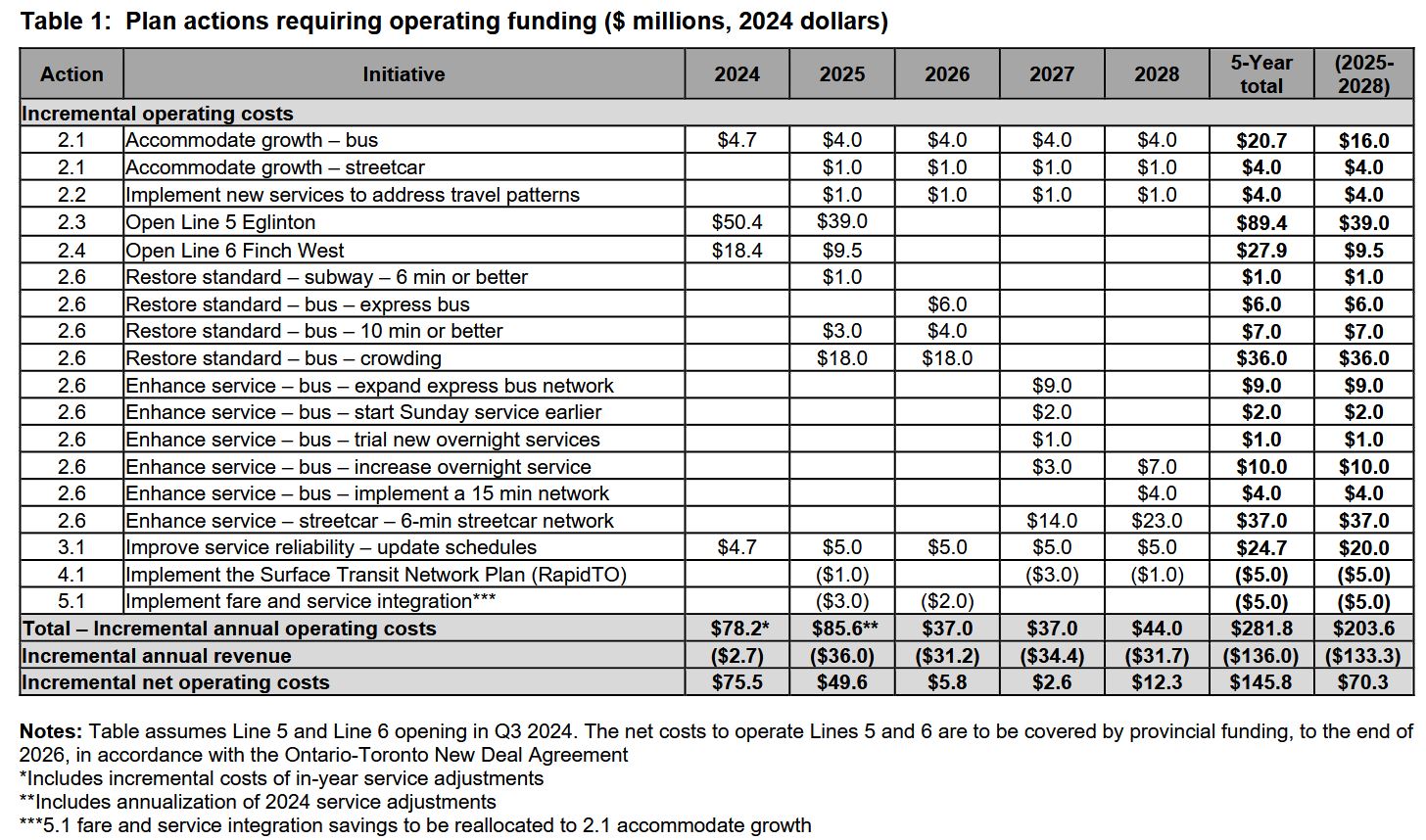
In the Five Year Service Plan, the TTC talks of future Night Service improvements, assuming that they are funded. Here is a table showing possible changes:

Nothing is even proposed for night service improvements until 2027, and based on typical budget cycles, that really means fall 2027, not New Year’s Day.

The problem shown in the tracking charts above is very much one of poor line management, scheduling and wasted resources. It is almost impossible to tell whether, if buses were evenly spaced, any more would actually be needed, except during that 5-6am hour when service is thin on the ground, at best.

The TTC operates under difficult circumstances, but too many problems are “own goals” all the way from service adequacy and management through infrastructure and fleet maintenance.

Biblical plagues are not responsible for poor service, although the TTC would love to have a supernatural excuse. In the new year, we will see what the TTC proposes for 2025 and whether this will really make a difference for riders.

TTC Service Changes Effective Sunday, January 5, 2025 (Updated)

The TTC will change schedules on many of its routes on January 5 in response to various factors including:

  • Restoration of holiday period cuts implemented on December 22
  • Progress in construction projects at Lawrence West and Rosedale Stations, and on Queens Quay
  • Beginning of reconstruction of Warden Station
  • Reallocation of bus bays at Kennedy Station
  • Reallocation of streetcar routes between carhouses to simplify operations
  • Setting a standard night car headway of 20 minutes (this change will complete when 310 Spadina resumes streetcar operation)
  • Implementing alternate surface routes to provide for accessibility where this is not yet available in certain stations

There is no change in subway service for this period.

Possible service improvements for 2025 will not occur until after the TTC’s 2025 budget and subsidy are approved.

Updated January 3, 2025 at 11:30pm: There will be a temporary arrangement with 511 Bathurst cars operating to Union Station and 509 Harbourfront cars operating to Spadina & Adelaide until mid-January. See the map later in this article.

Continue reading