Toronto plans to implement reserved bus lanes on Bathurst Street between Eglinton and Bloor. The project is notionally in support of future service to the FIFA World Cup events in 2026, but there is a good chance that they will permanent. Substantial travel time savings are claimed for this change, but the overall question must be of how service behaves on the route and what the RapidTO red lanes will add.
Part I of this series reviews headway reliability (vehicle spacing) and travel times in April 2025. Part II will review travel times in April 2025, and Part III will look at historical data going back to January 2024.
The scheduled service on 7 Bathurst is not as frequent as on other corridors where reserved lanes have been added. Weekday service has been every 10 minutes operating with articulated buses for the past two years. Weekend service was slightly more frequent, but operated with standard sized buses until September 2024 when it changed to artics and a 10 minute headway at all hours.
Another change in September 2024 was an increase of terminal recovery times, partly offset by a reduction in scheduled travel times, during most weekday periods.
Not shown in the schedule summaries is additional service from November 18, 2024 to March 28, 2025 using spare operators. These trips operated with standard sized buses between roughly 7am and 1pm. The effect of these will show up in Part III of the series.
In the detailed review, it is clear that weekend service on 7 Bathurst is much less reliable than weekdays. In the tables below, note that scheduled travel times are considerably less on weekends than weekday midday and early evening. This is reflected in shorter terminal layovers and many more short turns on weekends.
Updated May 12, 2025 at 3:40pm: The text of the summary explaining the motion has been changed.
A motion before the TTC Board meeting on May 14 seeks to have staff examine ways to make service more reliable:
TTC4.9 – Optimizing Scheduling Efficiency and Enhancing Service Planning Using Technology – by Chair Jamaal Myers, seconded by Commissioner Dianne Saxe
Recommendations
Chair Jamaal Myers, seconded by Commissioner Dianne Saxe, recommends that the TTC Board:
1. Direct TTC staff to conduct an analysis of surface corridor TTC routes where multiple TTC routes operate on the same corridor to optimize scheduling efficiency, improve blended headways and customers wait times and identify opportunities and implications for scheduling and operational adjustments that minimize bunching and gapping and enhance coordination between routes serving the same corridor.
2. Direct TTC staff to explore opportunities to use artificial intelligence (AI) and predictive analytics to enhance our service planning and scheduling and management of gapping and bunching, and report back through the Strategic Planning Committee on best practices and priority actions to be integrated in the 2026 Operating and Capital Budgets.
Summary
Original version: This motion directs staff to review bunching and gapping on all routes where multiple TTC routes use the same corridor to explore how scheduling can be optimized to improve headways and reduce bunching and gapping of vehicles. This motion also directs staff to explore how Al and predictive analytics can be used to enhance service planning and the management of gapping and bunches on all routes and make recommendations for priority actions that could be integrated into the 2026 Operating and Capital budgets.
Revised version: Currently, TTC vehicles are not considered “bunched” for purposes of route planning, if multiple buses are traveling together so long as they are representing different bus routes. This motion directs staff to review bunching and gapping on all routes where multiple TTC routes use the same corridor to explore how scheduling can be optimized to improve headways and reduce bunching and gapping of vehicles. This motion also directs staff to explore how Al and predictive analytics can be used to enhance service planning and the management of gapping and bunching on all routes and make recommendations for priority actions that could be integrated into the 2026 Operating and Capital budgets.
There are several problems with this motion, but a few are key.
The idea of a “scheduled” time simply does not work especially when service is fairly frequent. Riders care about regularity, not that each bus or streetcar is spot on its assigned time. Yes, of course, if the service were “on time”, it might also be regular, but forcing this to occur is counter-productive. The question is how to ensure reliably even spacing between vehicles.
The TTC’s Service Standards and the rules operators are supposed to follow are based on the schedule, but this is not a workable guide to running service under typical conditions found on busy routes. If the TTC really wants evenly spaced service, then this should be the standard the organization aims for.
There will always be some variation between ideal and actual vehicle locations whether this is measured by a schedule or by a target headway spacing. That’s the nature of transit even on a completely protected route like the subway. The goal is to control and minimize this variation before small problems become very large ones.
Many streets are served by a single route with no branches or overlaid service, and headways are not reliable. This problem shows up throughout the day, not just in periods where external forces such as surge loads, traffic congestion and plagues of frogs can be blamed. The TTC should learn how to run “simple” routes reliably, and then we can talk about more complex route structures.
“Artificial Intelligence” does not learn out of thin air, but from a combination of examples and goals. If we train bots on the collected works of Donald Trump, don’t expect Shakespearean verse. So it is with Toronto’s transit. The current system is hardly an example to learn from, and even with input from other cities, the basic question of goals must be answered. If we tell the bot to optimise for general traffic and transit will benefit oh-by-the-way, the bot will quickly say “look at all those cars” and move them as quickly as possible.
I have written many articles reviewing service behaviour on routes, and the problem of irregular service has, if anything, grown worse over the years. In “the old days” there were issues with the adequacy of scheduled travel times combined with growing traffic congestion, and this led to lengthened trips. Even where operators get adequate time for terminal breaks, this does not guarantee reliable service, although it does reduce the need for short turns.
Those short turns are a valid response to service problems. For a time, a simplistic embargo on this service management technique actually worsened bunching because gaps could not be filled by a judicious turnback. Vehicles stayed in bunches.
TTC management, with the tacit approval of the Board if only through their ignorance, produced reports showing that on average the service wasn’t too bad. “TTC’s goal is to have 60% of all trips meet the on-time performance standard.” [Service Standards at p. 15] This is an all-day average and individual periods could vary without affecting the overall metric.
Every rider knows that the “average” service is not what pulls up (or not) to their stop every day.
Quality is measured only from the terminal, and two closely-spaced cars will run nose-to-tail fairly quickly because the first one does all of the work. They will stay together for an entire trip, and possibly the return.
Service standards allow vehicles to be up to five minutes late, but on a frequent route that can mean long gaps are followed by a pair of vehicles. Oddly enough, the standards actual recognize that riders care more about vehicle spacing for frequent services (10 minutes or better) than if buses are on time, and yet the metric routinely used by the TTC is schedule based, not headway based.
This not a scheduling problem, but a policy and management that aim low. It’s easy to get a gold star on an exam where you can be almost correct, and then only 60% of the time.
Traffic congestion, construction delays and special events generating surge loads are predictable to a point, although traffic accidents are not. The question is how the TTC deals with these events. Either all schedules are padded on spec in case of delays, an expensive way to deal with an issue that does not affect most routes at most times, or there has to be a recognition that scheduling alone will not solve the problem.
The TTC will make several changes to service on May 11 primarily for the transition to summer schedules with lower post-secondary school demand, and to restructure service for a major construction project.
For details on the King/Church project and its potential effects on traffic congestion, see King-Church Construction and Traffic Effects. Affected routes are 503/303 Kingston Road, 504/304 King, 508 Lake Shore and 511 Bathurst. For details, see that article.
Updated May 6, 2025 at 3:40 pm: Spreadsheet listing service designs for old and new schedules added.
Updated May 7, 2025 at 8:50 am: Diversion map for Roe Loop summer Saturday closures added.
Updated May 8, 2025 at 7:45 am: Spreadsheet updated with corrected data for 92 Woodbine South.
Updated May 8, 2025 at 11:40 pm: Spreadsheet updated with data for 939 Finch Express.
Updated May 9, 2025 at 3:30 pm: Destination sign changes added for all affected routes.
Permanent Service Changes:
9 Bellamy:
Service improved in the morning, afternoon and early evening on Saturdays, and in he afternoon and early evening on Sundays to reduce crowding.
Service reduced early mornings on Saturday, and on late evenings on Saturday/Sunday.
Service adjusted in late evenings to align with Lakeshore GO trains at Scarborough and Eglinton GO stations.
101 Downsview Park: Trips are added in the peak periods to better align with the GO Barrie service at Downsview Park Station. This has been informally in effect since March 2025.
114 Queens Quay:
Service adjusted in all time periods for reliability and to take advantage of new reserved bus lanes on Queens Quay.
Service officially removed from the Logan, Lake Shore, Carlaw loop with the route extended to Lake Shore Garage. This change has informally been in effect since September 2024.
123 Sherway:
Service improved on weekends to address crowding during most periods.
The current 1:13am trip by the 123B from Long Branch Loop will be changed to 1:17am to better connect with the Lake Shore GO train.
125 Drewry:
Service improved early evenings on weekends, and early morning on Saturday to address crowding.
Saturday “afternoon” service levels will extend from 7:00 to 8:00pm.
134 Progress: Weekday midday and early evening schedules will be adjusted to provide evenly spaced departures from Centennial College Progress Campus by the 134 Progress and 903 Kennedy Station Express services.
165 Weston Road North: The routing of YRT 165 Weston on April 27 will change to operate both ways via Weston Road, and it will no longer run on Old Weston Road. Transfers to TTC’s 165 Weston Road North can be made on Steeles at Weston or at Old Weston northbound, and at Signet Drive southbound.
927 Highway 27 Express:
All service will operate with 40-foot buses due to constraints on the articulated bus fleet. Service will run more frequently in many weekend periods to ensure sufficient capacity.
927A weekday midday school trippers to Humber College will be removed for the summer.
939 Finch Express: All service will operate with articulated buses.
Seasonal changes:
22 Coxwell: Holiday service will extended to the loop at Lake Shore and Northern Dancer Blvds, and will be interlined with 92 Woodbine South. Service on both routes will be adjusted. There is no change to regular weekday or weekend service.
38/938 Highland Creek: Service on the 38B to University of Toronto Scarborough Campus (UTSC) and on the 938 express will be discontinue for the summer. Service on the 38A branch to Rouge Hill GO will be improved during weekday peak and midday periods.
65 Parliament: Service will be reduced weekdays in the early morning, AM and PM peaks.
75 Sherbourne:
Service will be reduced weekdays in the early morning, AM peak, midday and PM peak.
Schedules adjusted to reflect implementation of reserved bus lanes on Queens Quay. Buses will no longer stop westbound on Queens Quay at Richardson.
The north end layover point will be shifted from South Drive at Glen Road to Bloor Street East at Sherbourne Station.
92 Woodbine South: Service improved during all periods.
102 Markham Road:
102A to Progress/Centennial College service removed for the summer.
Some late evening trips will be adjusted to go out of service on Markham Rd at Sheppard Ave E instead of Warden Station and/or Markham Rd at Progress Ave. This change will also improve transfers with the 385 Sheppard East night bus.
124 Sunnybrook and 162 Lawrence-Donway: Saturday service until 3pm will be extended west to Bathurst and Lawrence so that Roe Loop can be closed for a community market.
200 Toronto Zoo: Service from the Toronto Zoo to Rouge Hill GO will resume on weekends from morning to early evening periods. Weekday service will resume with the June schedule change.
201 Bluffer’s Park: Service from Kennedy Station to Scarborough Bluffs Beach will resume on weekends from morning to early evening periods. Weekday service will resume with the June schedule change.
202 Cherry Beach:
Union Station to Cherry Beach service will resume with weekday service from the midday to early evening period (ending at 10:20 pm from Cherry Beach), and weekend service from the morning to late evening period.
Schedules will be adjusted to take advantage of the reserved bus lanes on Queens Quay.
902 Markham Rd Express: Three weekday trips from Warden Station at 7:35, 7:47 and 7:59am will be dropped.
903 Kennedy Stn-STC Express: Some weekday trips on the 903A branch to Centennial College will be cut back as 903B trips to end at STC Station. All weekend trips will operate as 903B ending at STC.
905 Eglinton East Express: Service reduced during all weekday periods.
927 Highway 27 Express: See the service change section above.
Additional service will be provided on some routes due to a temporary surplus of operators. Note that these are separate from the Route 600 RAD (Run as Directed) buses:
20 Cliffside 21 Brimley 37 Islington 38 Highland Creek 44 Kipling South 52 Lawrence West 57 Midland
68 Warden 80 Queensway 86 Scarborough 89 Weston 110 Islington South 111 East Mall 119 Torbarrie
123 Sherway 124 Sunnybrook 131 Nugget 939 Finch Express 944 Kipling South Express 960 Steeles West Express 996 Wilson Express
Operational changes that do not affect service levels:
1 Yonge-University-Spadina: The break/relief point will move from Vaughan Metropolitan Centre Station to Wilson Station. Double step-backs will be scheduled at all times at both Vaughan Metropolitan Centre and Finch Stations in anticipation of increased off-peak service in late 2025.
510 Spadina: Carhouse trips to/from Leslie Barns will operate via Queen Street rather than King Street due to the King/Church construction.
Night bus crews: All night bus crews ending at or after 5:00 a.m. will be adjusted to go into and out of service at their respective divisions instead of on-street.
31 Greenwood: Service to Greenwood Station has not operated for several months due to construction. This will now be reflected in the “official” route description.
72 Pape: This route will be scheduled with electric vehicles in late evenings.
91 Woodbine: The north end layover point will be changed from Valley Woods Road at York Mills Road (west side) to York Mills at Valley Woods (northside).
112 West Mall: This route shifts from Queensway to Mount Dennis division. No schedule change.
365 Parliament Night Bus: The stop westbound on Queens Quay at Richardson will be removed as part of the reserved bus lane implementation.
All routes serving the former Villiers Island in the Port Lands will now include its permanent name Ookwemin Minising in the destination signs.
Several routes will gain new destination signs for garage trips replacing the generic “short turn”.
Tables and maps appear after the “more” break in this article.
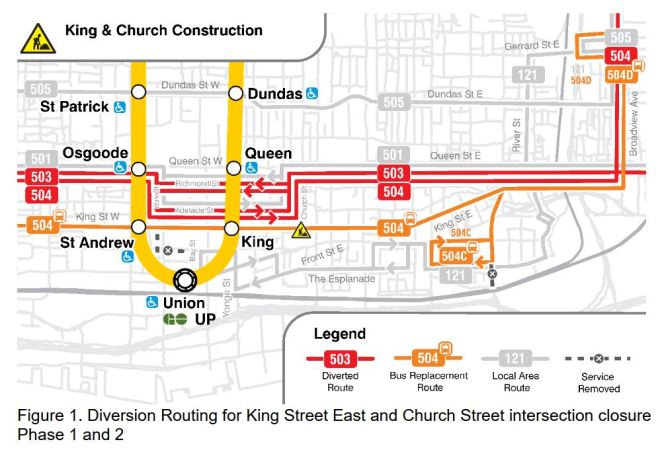
The TTC now has a web page with details of the changes for the first phase of the construction and diversions. This includes a map showing the diversions to west of Bathurst rather than just downtown. I have added this in the body of the article.
May 5, 2025 at 1:40pm:
Information about the 304 King and 303 Kingston Road night services has been added.
May 5, 2025 at 1:55pm:
The TTC has confirmed that overhead upgrades on King Street East and on Sumach/River will be completed before the King/Church track work end, and streetcar service will resume in September.
May 5, 2025 at 4:30pm:
I asked the City if it thought the intersections used by diverting streetcars and buses could handle the volume of traffic. They replied, but didn’t add much. See the end of the article for the exchange.
Major changes are coming to downtown streetcar routes on May 11 with the next schedule change. This will accommodate a combination of water main replacement, track reconstruction and streetcar overhead upgrades mainly at King and Church. Work is expected to require diversions until the October schedule change on Thanksgiving weekend.Streetcar service is expected to return with the September schedule change on Labour Day weekend.
The effects of work an King and Church have been known for some time through the Annual Service Plan and through a City report on the project. (The original report and recommendations were amended at the recent Council meeting to lessen the effect of various proposed lane closures.) Service levels have been published via the electronic version of schedules used by trip planning apps. The information about vehicles/hour at various locations is taken from those schedules.
(As an aside, the TTC website has still not been updated to include the 2025 Service Plan even though it was approved by the Board in January.)
With the concentration of transit service through various intersections, and the added complexity that most vehicles will make turns at these locations, there simply will not be enough capacity even under ideal conditions. It is no secret that “ideal” is a word rarely appropriate for transit operations downtown thanks to the lack of robust traffic management and real transit priority.
In past years, the diversion of services from King Street around the TIFF street fair created problems for transit travel times and reliability, but this lasted for a brief period. The planned diversions for King/Church will last through the summer.
Many of the water mains in the “old” city have been in service for over a century. Other parts of King Street have seen renewal, occasionally on an emergency basis following a break and sink hole.
The special trackwork at the King/Church intersection has been in bad shape for some time, and was overdue for replacement. Previous reconstructions were in 1983 and 2003. Other competing construction projects got in the way, and the track conditions have worsened year by year. There are many patches, and a well-deserved slow order unlike the standing practice even at freshly rebuilt junctions.
This intersection is also old enough that it predates the era of panel track construction where pre-welded sections are trucked in and assembled on site. This replaced the older style of tracks assembled piece-by-piece and often not welded robustly if at all. TTC has not yet been through its entire inventory of “old” track given the 20-30 year cycle depending on the level of service, wear, and disintegration at intersections.
Other work planned for this period of suspended streetcar service is the reconstruction of overhead on King and on the Distillery branch for pantograph-only operation.
Closing King & Church for an extended period concurrently with the Ontario Line construction at Queen & Yonge will add to the traffic snarls downtown. The City talks about using Traffic Agents to manage key intersections, but whether they provide enough people at enough places at enough times remains to be seen.
Routes Diverting off of King Street
Three routes are affected: 504 King, 503 Kingston Road and 508 Lake Shore.
The 504 King service will be broken into three sections:
A 504 streetcar service between Broadview to Dundas West Stations operating via the same route as 501 Queen between the Don Bridge and Spadina.
A 504C bus shuttle from Wolseley Loop south on Bathurst and east on King terminating at Broadview & Gerrard.
A 504D bus shuttle from Wolseley Loop south on Bathurst, east on King and south on Sumach to Front & Cherry. Buses will loop via [to be announced] and will not serve Distillery Loop.
The 503 Kingston Road service will be changed so that its western terminus shifts from York Street to Dufferin Loop. Cars will follow the same route as the 504 King via Queen from the Don Bridge to Spadina, then shift south onto King to follow the pre-diversion 504B route to Dufferin.
508 Lake Shore cars will follow the same route as 504 King.
Night Service Changes
The 304 King night car will operate every 20 minutes over the same route as the daytime 504 service diverting via Queen and Spadina.
A 304D night bus will run every half-hour over the same route as the 504D bus from Wolseley Loop to Broadview & Gerrard.
The 303 Kingston Road night car will operate every 20 minutes over the same diversion route as the 304 King night car, and will operate as it does now to Sunnyside.
The maps below are from the City Report about this project originally published in February. An updated map for the first phase has been added later in the article.
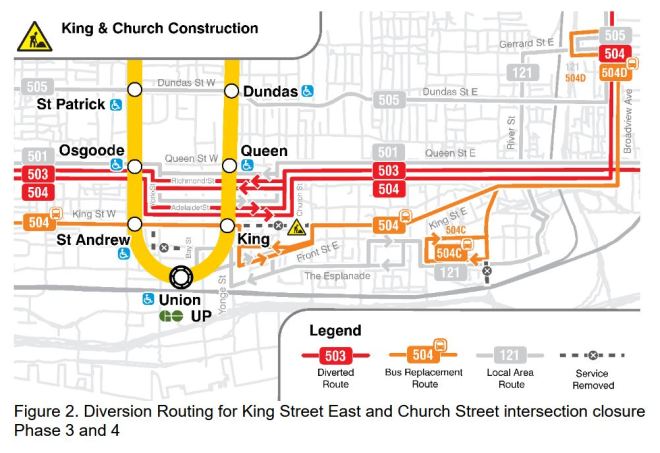
For part of the construction period, King/Church will be impassible even to the replacement bus service and it will divert south to Wellington and Front.
These maps do not tell the whole story because another set of construction diversions will overlap the King/Church changes until the next schedule change in late June.
Although water main work at Bathurst/Fleet/Lakeshore is now complete, track work continues there and on Bathurst Street further north. 511 Bathurst streetcars will continue to divert east via King to Spadina looping via Adelaide and Charlotte. The 511B shuttle bus will be shortened from Wolseley Loop at Queen to an on-street loop via King, Portland and Richmond to Bathurst Street.
509 shuttle buses continue operating between Exhibition Loop and Queens Quay Loop at Spadina. 510 streetcars continue operating to Union Station.
The combined effect of the diversions will be greater than during the total meltdown of King service in 2024 when all cars diverted north via Church to Queen because volumes of other routes (510 Spadina, 511 Bathurst and 501 Queen) will be added to the King services, and more intersections will be affected over a wider area.
Updated May 5, 2025 at 12:50pm:
The TTC’s project webpage has a consolidated map of the diversions for the first phase of the work.
The RFP was issued in December 2024 and was intended to go through several stages including:
Pass/Fail screening: January
Confidential cybersecurity meetings: March to April
Commercial confidential meetings: April to early July
Proposal submission deadline: July 22, 2025
We have just reached the point where early discussions with would-be vendors are to get underway, and actual submissions are three months off.
This means that no details of potential bids such as Canadian content, manufacturing plans or, of course, pricing are known to the TTC.
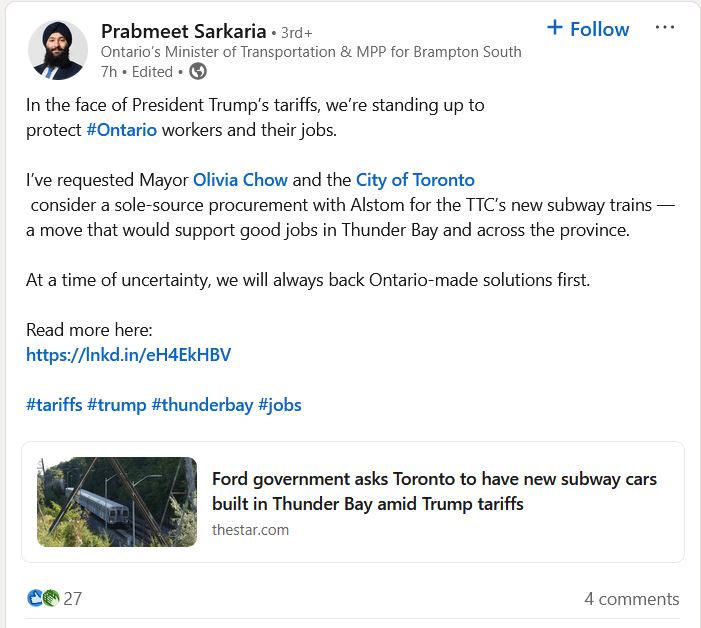
On April 23, 2025 (yesterday as I write this), Ontario’s Minister of Transportation, Prabmeet Singh Sarkaria, wrote to Mayor Chow asking:
I am writing to you about the importance of standing up for Ontario workers as a critical consideration during the procurement of the 55 new subway trains for TTC’s Line 2, which our government is supporting with a $758 million investment.
[…]
I am requesting that the City of Toronto recognize this historic opportunity and consider a sole-source procurement with Alstom, which would support Ontario workers in Thunder Bay and across our province.
Coverage of this appeared in The Star on April 24. In an unusual move for a government so enamoured of media exposure, this was not accompanied by a formal press release or media conference, but by a posting on the Minister’s LinkedIn feed.
Mayor Chow issued the following statement in reply:
Mayor Chow supports Buying Canadian whenever possible. With President Trump attacking Canada’s economy, we need to support local workers, jobs and businesses. We are working in collaboration with the provincial and federal government to deliver public transit for Torontonians and to support Canadian jobs. A Request for Proposal was issued in December. The Mayor speaks regularly with Minister Sarkaria and we will work collaboratively with the province and assess the feasibility of their request.
Past comments at both the Provincial and Federal level have suggested that this contract should automatically go to Alstom’s Thunder Bay plant, and yet the TTC issued an open RFP with all of the cost and complexity that entails. Of course, Trump’s machinations against Canada had not begun in December.
This RFP proposes not just the 55 replacement trains for the current Line 2 fleet, but trains for extensions to Scarborough and Richmond Hill, growth in demand, and eventually replacement of the current Line 1 fleet (all as options). Whoever gets this contract can well lock in decades of work supplying the Toronto subway system.
Sarkaria hints at the possibility that a sole-source contract to Alstom might require some adjustments:
The Ontario government will work with the city and the federal government to ensure the successful delivery of the trains should this decision lead to any changes in the project scope.
With a Federal election in progress, we will not know soon how much more funding might be on the table, but any extra cost would likely come out of Toronto’s allocation of the 10-year Federal funding plan already in place. It could be a stretch to get net new funding.
We have already seen the effect of cost projections on this project which was originally scoped at 62 trains, but was cut back to 55 to stay within the requested funding.
For the record, the Canadian content requirement in the RFP is 25%, and much of this contract could go offshore based on the RFP specs. If we are really going to “buy Canadian”, that number must be higher to the degree possible. (Some components, notably electronics, are not made in Canada.)
Vendors who are already involved in the RFP process will, no doubt, be upset that “the fix was in” for Alstom and resent the waste of their time. What added economic benefits might have come with an alternate vendor we will never know. Any such proposal would have to be weighed against the possible closure of Alstom’s facilities for lack of work.
In anticipation of transit demands for the FIFA games in June 2026 as well as general route reliability, Toronto proposes to install transit-only lanes on Bathurst (Eglinton to Lake Shore) and Dufferin (Eglinton to Lake Shore) Streets. Consultation sessions for these projects will be held through May 2025 both online and in person.
Updated Apr 28, 2025 at 1:40pm: Corrections to the Bathurst Street info have been added thanks to responses from the project team.
Updated May 7, 2025 at 10:10am: Links to the presentation decks and maps have been added for both projects.
Additional details and registration links for the online sessions are on the project web sites linked above.
The consultation sessions will be interesting, especially to see whether the FIFA games will be used to bulldoze transit proposals that might not otherwise be approved.
Implementation is planned for fall 2025 subject to Council approval.
Only overviews of the proposals have been posted at this time, but I will update this article when more details are available. The overviews are summarized beyond the “more” break below.
Anyone living in Toronto will remember the heavy rains of July 2024 and the snows of February 2025. July 15-16 brought 115mm of rain within 24 hours, higher than the 100-year design for storms. From February 8-17, Toronto saw over 60cm of snow accumulation with no melts between storms. This was the highest snow pack in 25 years.
Both of these events revealed shortfalls in both TTC’s and City’s response to extreme weather. They also undermined the credibility of management claims of the transit system’s physical state, and the City’s false claims about snow clearing. The split jurisdiction between TTC and City forces did not help the situation either.
Among the issues raised in the report are:
The (in)adequacy of drainage on City streets to prevent ponding and flooding of underground structures.
The (in)adequacy of TTC drains for streetcar tracks, subway tunnels and stations.
The condition of drainage and pumping systems from inadequate maintenance and deferred replacement of aged equipment.
The integrity of TTC buildings, tunnels and other infrastructure to prevent or limit water penetration.
The actual condition of roads that were supposedly plowed versus reported conditions.
The absence of snow clearing at transit stops.
The creation of windrows both along curbs and between streetcar and adjacent lanes where the curb lane is not used by autos.
The failure to remove accumulated snow on transit routes causing repeated cases of parked cars blocking streetcars, and in some cases, buses.
The TTC’s ability to keep subway open cut areas operational when there is a large accumulation of snow on the tracks and power rails.
The adequacy and timeliness of public information provided to riders about transit operations during emergency conditions.
Many of these are interrelated. For example, if snow were actually cleared to the curb on four-lane roads with streetcars or buses, then autos would park normally rather than obstructing the only other lane available for transit vehicles. If maintenance of drainage and pumping systems (both day-to-day and life-cycle) kept them in working order, then less water would accumulate and potentially block service or render stations unsafe. If passengers could board and alight from transit vehicles with their usual ease, buses and streetcars would not be delayed attempting to serve snowed-in stops.
Among the TTC’s observations is the challenge of operating streetcars and articulated buses in bad weather, particularly snow. How much of this an inherent shortcoming of the vehicles, and how much is the effect of inadequate infrastructure maintenance and snow clearing?
Both from the delay logs and from personal experience, transit vehicles continued to be blocked by parked cars, and stops were blocked by snow, well after the snowfall ended. Some of the snowbanks did not dissipate until they melted. One particularly ironic location was at the southbound stop on Bay at Albert Street, the City Hall stop.
These are not just issues for the once-in-a-blue-moon weather events, but for the general condition and robustness of transit and related city infrastructure.
The report actually contemplates the purchase of spare buses, and possibly a new garage to hold them, to deal with periods when streetcars and articulated buses have operating difficulties. This would present a substantial premium in fleet size, garaging and staffing for these vehicles. One cannot help asking if the same money invested in better service generally would be more productive, combined with more aggressive storm responses when needed.The TTC is silent on the subway (for which bus replacements are completely inadequate even in good weather), and on the extra staff who would have to be available on the off chance of a bad storm.
This ludicrous approach avoids responsibility for making the streets and the transit system as robust as possible in their own right. Elsewhere I have written about the TTC’s bad habit of maintaining a spare ratio for their fleets well above industry targets, and “just buying more buses” would make the problem even worse. It is the kind of response I would expect from a system whose CEO considers crowded buses a mark of success, and months-long slow orders on deteriorated subway track as perfectly normal.
The TTC routinely trots out its list of unfunded capital projects. Critical maintenance such as replacement of pumps for subway tunnels is on that list. This is not a “nice to have”, but essential for safety. However, the problem is not just in capital funding, but under-resourcing of routine maintenance, an operating budget issue. We know the effects this brought to subway and SRT track. What other aspects of the system are waiting to fail?
The capital budget lines related to extreme weather effects total $1.4 billion of which only $360 million is funded in 2025-2034, mainly in the early years. (See TTC Major Projects Update and Funding Shortfalls for details.)
Information on large transit projects and their status is scattered through several reports. Two of these appear on the TTC Board’s April 16, 2025 agenda, but for a broader picture we must look elsewhere. In part this is due to the split responsibility between TTC and the City’s Transit Expansion Office. Also, some details lie in the TTC Capital Budget, 10-year and 15-year plans.
The TTC Capital Budget contains a high level listing of many projects much longer than in the “Major Projects Update”.
There is no surprise that the TTC faces a very large gap between its capital needs and available funding. The City is the primary funder for projects still on the TTC’s books, with smaller contributions from the provincial and federal governments. Expansion projects such as the Ontario Line were taken over completely by the province.
This greatly increases Ontario’s share of transit spending overall, but with the caveat that they build what suits their political climate, and Toronto is left to raise money, such as it can, for anything else. Another recent issue is that originally, Ontario’s projects were to be 100% capital with operating costs borne by the City. This has proved impractical, and Ontario now guarantees an operating subsidy for new Lines 5 and 6, albeit not in perpetuity.
As for the Federal government, it will (assuming the current government remains in power) fund a national transit program over ten years, but the money allocated to Toronto (and every other city) falls well short of their needs. Moreover, the funding is still done on a project basis with cities applying for each project rather than simply getting a block grant. This is different from the provincial and federal gas tax rebates to cities which can spend them as they see fit.
The TTC and City both produce reports tracking major transit projects, but these do not cover the full extent of the funding problem. Many issues with infrastructure condition, for example, are not mentioned in these reports although they are critical to the viability of transit service. In this article, I will review both the formally acknowledged “major projects” as well as the large dollar line items within the Capital Budget that get much less attention.
With Toronto’s Congestion Management Plan in the news, we hear about various ways to improve the movement of cars and, oh, by the way, maybe speed transit vehicles too. Toronto talks a lot about “transit priority” but this more often means giving transit vehicles the leftovers, the spare time that can be shaved at some locations from competing traffic, not absolute priority for transit vehicles.
This shows up particularly where transit vehicles have a dedicated lane, but they must wait patiently while other traffic, typically left turns, gets out of the way. This has the perverse effect of making transit slower particularly when combined with the “double stop” effect of farside stops. At these locations, the nearside space a stop would normally use is occupied by a left turn lane, and traffic in that lane has first claim on a green cycle.
Two routes with this as a near-standard stop configuration are 510 Spadina and 512 St. Clair. The Spadina car only recently returned, and I will leave comparative analysis of bus and streetcar operation there until more data have accumulated. A preliminary look is not complimentary to the streetcars because, unlike them, the buses are able to combine waiting for green signals with loading passengers.
On St. Clair, streetcars returned in Fall 2024. This article reviews tracking data for March 2025. In brief, a common situation along the route is that streetcars spend more time waiting at intersections than they do serving stops once they cross to a farside platform. The traffic signals are not organized to favour streetcar movements, and the configuration with farside stops is counterproductive.
To be fair, one cannot simply throw a red signal in front of cross traffic every time a streetcar appears as this will affect both auto and pedestrian crossings that require a minimum time. When both the St. Clair and Spadina lines were designed, a concern was the frequency of streetcar service and the high probability that there would always be a streetcar demanding priority. However, the larger Flexity cars combined with TTC service cuts makes this claim less valid.
Pre-emptive streetcar signals could be challenging at some locations, but there is the separate issue of timing of the phase for left turning autos. Should it come before or after streetcars are allowed to cross the intersection? Streetcar-only phases are only provided at some locations on Spadina where cars are turning across traffic lanes, but not for through movements. There is a streetcar-only phase at Lansdowne and St. Clair westbound, but otherwise left turning auto traffic always has priority.
A related problem lies in TTC’s glacial streetcar speeds through special work which would require a lengthy transit phase to allow streetcars to clear intersections on Spadina with streetcar junctions. With streetcars crossing on the shared north-south green, this does force motorists to wait for streetcars to get out of their way.
The data on St. Clair show a common pattern: streetcars spend more time waiting to cross intersections than they do serving the farside stops. They may operate in their own lane, but the combination of farside stops and signal design works against transit operations. This has implications for the soon-to-open “LRT” lines on Eglinton and Finch.
If we are not prepared to give transit vehicles true priority over cars, how do we expect to attract more riders to the system and, in theory, reduce overall road demand?
The remainder of this article describes the methodology behind my analysis and shows the behaviour at individual intersections along St. Clair.




 Steve Munro