Today, Ontario announced that it would raise the Canadian content in 55 new Line 2 trains from roughly 25 to 50 percent. The provincial capital subsidy for this purchase will rise from $758-million to $950-million, and the increase will be matched by the federal government who are also funding this purchase. There is no change in the Toronto share.
It is not clear whether the federal contribution is net new money, or merely a reallocation within Toronto’s share of the ten-year transit funding program.
Updated January 16, 2026: According to the federal government announcement, the funding will come from an existing allocation stream and is not net new money.
This project is part of the previously announced 10-year funding commitment under the Baseline stream of the Canada Public Transit Fund (CPTF). Beginning in April 2026, the Toronto Transit Commission will receive up to $1.2 billion in CPTF funding over 10 years from 2026 to 2036.
A related question is which government(s) will be on the hook for the extra CanCon in future transit vehicles including those for the Scarborough and Richmond Hill extensions, and for added capacity to deal with expected growth. Collectively these account for a potential 57 more trains, doubling the size of the eventual order.
What the announcement did not address is a list of questions about the Toronto subway fleet overall:
When will the cars be delivered, and how much work is needed to keep the old Line 2 trains operating in the interim?
When will Metrolinx place the add-on orders to provide trains for the Line 2 Scarborough and Line 1 Richmond Hill extensions?
How will delivery of the add-on trains affect opening dates for the extensions?
Will complete replacement of Line 2 trains be delayed because new trains are needed to provide service on these extensions?
Will the extensions have enough trains to provide full service to the new terminals, or will some trains have to short-turn in peak periods?
How soon does the TTC project it will require more trains to improve capacity on Lines 1 and 2, and how will these be funded?
What is the status of funding and timing for new maintenance facilities on Lines 1 and 2 to hold and service the additional trains?
Will the Automatic Train Control (ATC) technology for Line 2 be the same as the existing system on Line 1, or will the two lines (and their fleets) be limited to use only their “own” trains?
The TTC produces a quarterly report on all its major capital projects with the intent of showing all planned work, but it does not produce a unified chart or timetable showing how everything fits together and where critical links might be in the overall plan. The TTC has a “Strategic Planning Committee”, and this is a complex piece of strategy that badly needs detailed, public review.
Despite the premise of an open, competitive bid among potential carbuilders for new subway trains, various politicians have openly argued that the work should go to the historical provider, the Alstom (formerly Bombardier) plant in Thunder Bay.
On August 15, all three funding governments, Canada, Ontario and Toronto announced that a sole-source contract will be awarded to Alstom Transport Canada. This is intended to support Canadian jobs and an existing manufacturing facility. All bidders have been notified that the former bid process has been cancelled.
To ensure that Alstom delivers state-of-the-art trains at a fair market price, maximizes the creation of Canadian jobs, and benefits Toronto, Alstom must:
• deliver a product that is compliant with the TTC’s original requirements; • maximize Canadian content and create Canadian jobs; • have its pricing subject to an independent third-party market price assessment.
It is expected that negotiations will occur over the next few months with a report back to the TTC Board on the status of negotiations by the end of the year.
The proposed contract would provide 70 new trains
55 trains to replace the existing Line 2 fleet
15 trains for the North Yonge and Scarborough extensions
There is also provision for future train orders that would support expansion of service on both Lines 1 and 2. The 55 trains are sufficient to operate Line 2 at the capacity supported by its existing signal system, but more trains would be needed to exploit the capabilities of CBTC (Computer Based Train Control) which will be installed in coming years. Similarly, the existing Line 1 fleet will support the pre-CBTC service level of 140 seconds (25.7 trains/hour), but more trains are needed to go beyond that level. There is no funding for the additional trains in current budgets, nor for the added maintenance facilities a larger fleet will require.
The award of additional trains to Alstom is dependent on their performance on the 70-train order.
The new release states:
The TTC is working diligently to ensure the aging Line 2 fleet operates safely and reliably until new trains arrive.
Originally, the TTC had planned to replace the Line 2 trains by 2026, but that scheme was shelved by former CEO Rick Leary who claimed the trains could be life-extended to 2040. That solved a budget pressure for funding, including the proposed new maintenance yard at Kipling, but created a potential crisis in subway reliability and fleet availability.
The TTC has more than 55 of the current T-1 stock used on Line 2 due to changes over the years in the scope of automatic train control implementation on Line 1. These would, if all trains were working, have allowed the Scarborough extension to open using the existing fleet, but only barely. The delay in the Scarborough project bought the TTC time to procure new trains.
The challenge now is to keep the T-1 fleet operating reliably until new cars arrive. TTC management reported at a Board meeting earlier this year that some cars are being used as a source of spare parts. There are obvious limits to how far this practice can go, and if carried too far will limit the TTC’s ability to restore full pre-pandemic service on Line 2.
The RFP was issued in December 2024 and was intended to go through several stages including:
Pass/Fail screening: January
Confidential cybersecurity meetings: March to April
Commercial confidential meetings: April to early July
Proposal submission deadline: July 22, 2025
We have just reached the point where early discussions with would-be vendors are to get underway, and actual submissions are three months off.
This means that no details of potential bids such as Canadian content, manufacturing plans or, of course, pricing are known to the TTC.
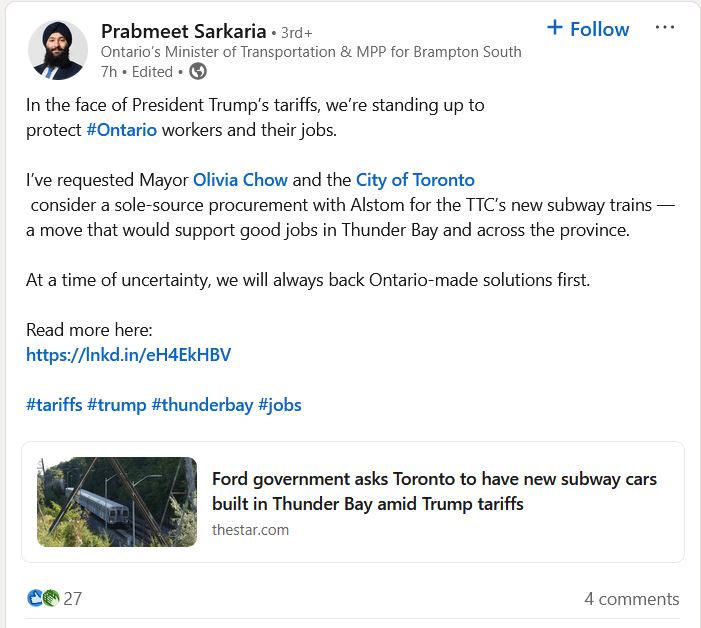
On April 23, 2025 (yesterday as I write this), Ontario’s Minister of Transportation, Prabmeet Singh Sarkaria, wrote to Mayor Chow asking:
I am writing to you about the importance of standing up for Ontario workers as a critical consideration during the procurement of the 55 new subway trains for TTC’s Line 2, which our government is supporting with a $758 million investment.
[…]
I am requesting that the City of Toronto recognize this historic opportunity and consider a sole-source procurement with Alstom, which would support Ontario workers in Thunder Bay and across our province.
Coverage of this appeared in The Star on April 24. In an unusual move for a government so enamoured of media exposure, this was not accompanied by a formal press release or media conference, but by a posting on the Minister’s LinkedIn feed.
Mayor Chow issued the following statement in reply:
Mayor Chow supports Buying Canadian whenever possible. With President Trump attacking Canada’s economy, we need to support local workers, jobs and businesses. We are working in collaboration with the provincial and federal government to deliver public transit for Torontonians and to support Canadian jobs. A Request for Proposal was issued in December. The Mayor speaks regularly with Minister Sarkaria and we will work collaboratively with the province and assess the feasibility of their request.
Past comments at both the Provincial and Federal level have suggested that this contract should automatically go to Alstom’s Thunder Bay plant, and yet the TTC issued an open RFP with all of the cost and complexity that entails. Of course, Trump’s machinations against Canada had not begun in December.
This RFP proposes not just the 55 replacement trains for the current Line 2 fleet, but trains for extensions to Scarborough and Richmond Hill, growth in demand, and eventually replacement of the current Line 1 fleet (all as options). Whoever gets this contract can well lock in decades of work supplying the Toronto subway system.
Sarkaria hints at the possibility that a sole-source contract to Alstom might require some adjustments:
The Ontario government will work with the city and the federal government to ensure the successful delivery of the trains should this decision lead to any changes in the project scope.
With a Federal election in progress, we will not know soon how much more funding might be on the table, but any extra cost would likely come out of Toronto’s allocation of the 10-year Federal funding plan already in place. It could be a stretch to get net new funding.
We have already seen the effect of cost projections on this project which was originally scoped at 62 trains, but was cut back to 55 to stay within the requested funding.
For the record, the Canadian content requirement in the RFP is 25%, and much of this contract could go offshore based on the RFP specs. If we are really going to “buy Canadian”, that number must be higher to the degree possible. (Some components, notably electronics, are not made in Canada.)
Vendors who are already involved in the RFP process will, no doubt, be upset that “the fix was in” for Alstom and resent the waste of their time. What added economic benefits might have come with an alternate vendor we will never know. Any such proposal would have to be weighed against the possible closure of Alstom’s facilities for lack of work.
Updated April 24, 2025 at 11:30 pm: TTC responses to my questions have been added at the end of the article. One questions remains outstanding.
Back in 2018, the City of Toronto bought the lands southwest of Kipling Station formerly known as the CP’s Obico Yard. This land was to be used for a new Maintenance and Storage Facility for Line 2 trains in anticipation of:
Space at Greenwood being reallocated to serve the Downtown Relief Line,
Greenwood’s layout being inappropriate for permanently coupled six-car trains,
The planned increase in the Line 2 fleet to accommodate both extension and increased service.
The existing Line 2 fleet comprised 372 T-1 subway cars dating from 1995-2001, and they will reach the end of their 30-year design life starting this year. The cars are in married pairs that can be easily uncoupled from their trains. Greenwood’s layout is based on short maintenance bays, not on six-car trains. (When Greenwood was designed, operation of four-car trains was common.) Back in 2018, the expected new trains for Line 2 would be similar to the TRs on Line 1 running in permanent six-car sets.
The original plan was to buy 62 New Subway Trains (NSTs) to replace the T-1 fleet. This would give enough trains to operate Line 2 through to Scarborough, albeit likely with a short turn during peak periods at Kennedy Station. The NST order has been scaled back to 55 trains (the number required for the existing Kennedy-Kipling line) with extras to be purchased as part of the Scarborough and Yonge North subway projects.
The NST design has changed to retain the style of the 6-car TRs with open gangways, but the cars will come in married pairs. Each end of the train will have a pair with one cab plus hostler controls on the “blind” end of the pair. The middle pair will have hostler controls at both ends. This will allow the 6-car sets to be broken up for movement of individual pairs in yards and shops. (See: TTC Requests Proposals for New Line 2 Trains and Signalling)
The Ontario Line replaced the Relief Line, and will have its own fleet and MSF at Thorncliffe Park eliminating Greenwood as its home base.
These factors led to a rethink of Greenwood Shops and the need for a new yard west of Kipling Station.
In 2022, the City bought property east of the Western Yard lands at 780 Kipling as a site for their next bus garage, although current plans will not require it immediately. The two properties are adjacent, but are separated by the link between the Metrolinx Lakeshore West corridor to the CPKC Milton line at Kipling Station.
TTC proposes to use this site not just for a garage, but to consolidate other operations that are now in leased space around the city.
The map below shows the two sites. The Milton corridor is at the upper left, and Kipling Station is out of frame at the upper right.
Source: Figure 1 from “MASTER PLAN – STUDY OF KIPLING INDUSTRIAL LANDS” TTC RFP March 2025
There are two RFPs (Requests for Proposals) on the street for consulting services:
The Master Plan for the Kipling Industrial Lands
Consultant services for design of the proposed Western Yard
The Master Plan work entails looking at the various possible uses for the site and how they would be accommodated.
The Western Yard RFP includes two documents from the Line 2 Capacity Enhancement Program as reference information. Both were prepared by HDR and Gannett Fleming.
Greenwood Yard Workflow and Processes Analysis, Final Report, June 13, 2023
Western Yard Concept of Operations & Maintenance Report, Draft, January 24, 2025
The Need For Another Yard
Although it may seem like the distant past, only six years ago the subway system was bulging with passengers, and planning focused on how to accommodate more riders. This led to proposals including new trains, automatic train control and a general increase in capacity of both Lines 1 and 2. The services now operating on Lines 1 and 2 are not yet back to pre-covid levels.
Line 1 Time Period
Trains (Headway) January 2020
Trains (Headway) April 2025
Capacity Difference
AM Peak
65 (2’21”)
56 (2’52”)
-22%
M-F Midday
42 (3’49”)
35 (4’34”)
-20%
PM Peak
65 (2’36”)
54 (2’59”)
-15%
M-F Early Eve
46 (3’30”)
38 (4’11”)
-20%
M-F Late Eve
32 (5′)
26 (6′)
-20%
Sat Afternoon
42 (3’41”)
34 (4’34”)
-24%
Sat Early Eve
30 (5′)
30 (5′)
Nil
Sun Afternoon
35 (4’20”)
34 (4’34”)
-5%
Sun Early Eve
30 (5′)
25 (6′)
-20%
Source: TTC Scheduled Service Summaries. Note that M-F services include trippers and gap trains.
Line 2 Time Period
Trains (Headway) January 2020
Trains (Headway) April 2025
Capacity Difference
AM Peak
46 (2’21”)
42 (2’38”)
-12%
M-F Midday
33 (3’20”)
30 (4’04”)
-22%
PM Peak
43 (2’31”)
34 (3’23”)
-34%
M-F Early Eve
29 (3’42”)
25 (4’52”)
-32%
M-F Late Eve
20 (4’52”)
19 (5’23”)
-11%
Sat Afternoon
26 (4’15”)
26 (4’15”)
Nil
Sat Early Eve
19 (5’30”)
19 (5’30”)
Nil
Sun Afternoon
22 (4’52”)
22 (4’52”)
Nil
Sun Early Eve
20 (4’52”)
19 (5’30”)
-13%
Source: TTC Scheduled Service Summaries. Note that M-F services include trippers and gap trains.
TTC expects to be back to the pre-covid peak service in 2030. Line 2 will require 46 trains plus 7 spares (at TTC’s minimum of 15%) for a total of 53, or 9 spares (at 20%) for a total of 55. Spares include both trains ready for deployment as replacements or extra service (ideally 4), as well as those in maintenance programs.
Service more frequent than 140 seconds will not be possible on Line 2 until it fully converts to automatic train control in the early 2030s. The Scarborough extension’s opening date is currently claimed to be 2030, although whether like so many other projects it will come in late is unknown. Extra trains for that extension, and for ATC conversion will be needed starting in 2030.
Thus far, this article has covered basics and readers might ask about the title’s question – will a western yard ever be built?
The Western Yard design RFP incorporates the Greenwood Yard study which speaks of construction of a new yard originally planned for 2034, but now pushed to 2038 or beyond by the TTC. No reason for this is given. No estimate of construction time, and hence availability of the new facility, is given either.
Can Greenwood handle the transitional state between its current role and various steps on the way to complete delivery of the new trains, not to mention a new yard?
Back in 2018, the transition looked relatively straightforward with a planned new yard to provide capacity. Now this is constrained by several factors even allowing for the DRL/OL fleet shift out of Greenwood. There is no provision in the TTC’s 10 Year Capital Plan for construction of a western yard, only for preliminary work such as design.
The issues go beyond space for train storage. They include capacity for ongoing servicing and maintenance, major overhauls, spare parts storage and workforce scheduling. For many years, the TTC had a surplus of space and maintenance capacity, but as the number of active trains grows concurrently with delivery of new trainsets, much more will be expected from staff and facilities.
This situation arose in part because TTC management opted to defer the new yard with no acknowledgement of its critical role as the system grows. Simultaneously, contracts for new trains and ATC conversion also were pushed out into the future. This delayed capital expense, helped to keep taxes down, and left headroom for other projects.
All of this bumps into assumed go-live dates for the Scarborough extension, automatic train control and headways below 140 seconds. The pandemic pushed many dates for transit’s growth into the future thanks to lost riding. However, if events drive demand up faster than the TTC’s projections, they will not be able to handle the pressure. Considering that the City of Toronto often cites transit growth as an essential part of fighting traffic congestion, the City and TTC plans could be out of whack.
A follow-up on the report re Subway Streetcar Fleet and Infrastructure
The proposed interim wayfinding strategy
An update on fare collection technology
A new procedure for handling complaints about CEO misconduct
I will cover the 2025 Annual Service Plan and the Corporate Plan Update in a separate article.
Location of Reports Changed
Effective with this meeting, the agendas and reports for Board meetings have shifted to the City’s meeting management site which hosts Council and Committee meetings. This will also host documents for Board committees such as Audit & Risk Management. Information for past meetings continues to be available on the TTC’s own site.
In Fall 2024, the CEO’s Report was reorganized with the Key Performance Indicators split off from the main report. There are now separate pages on the TTC site for accessing monthly CEO’s Reports and KPI reports.
On December 9, 2024, the TTC issued Requests for Proposals for two major contracts affecting the future of Line 2 Bloor-Danforth: one for new trains, and the other for a new signalling system.
Although the documents for these RFPs total over 2,700 pages with detailed specifications for cars and signals, round one of the process is intended to establish the basic capabilities of would-be suppliers to actually handle the contract without getting into the nitty-gritty. Following rounds will get into the technical details and negotiations.
The RFP process for round one closes on January 28, 2025 (trains) and on January 27 (signals). Contract awards will occur in 2026.
Major points:
The two projects/contracts are linked because implementation of Automatic Train Control on Line 2 requires a new fleet. ATC installation can run concurrently with new train deliveries, but the benefits of ATC operation are not possible until the existing Line 2 fleet of T-1 trains is replaced.
As a separate project, the T-1s will be overhauled to keep them running into the 2030s, although they will be retired as new trains are delivered.
The new trains RFP includes provision for additional equipment including trains needed for extensions of Lines 1 and 2, and for improved service on Line 1. The timing of train deliveries for Line 2 could bump into requirements for Line 1 trains thereby delaying the Line 2 cutover to ATC. Additional trains for Line 1 also trigger the need for a new carhouse which is not yet a funded project.
Growth in capacity of Lines 1 and 2 beyond 2019 levels could be constrained by the availability of fleet and infrastructure. This has already shown up in the planned completion of the ATC cutover on Line 2 in 2035. This date conflicts with TTC projections of demand growth.
Although the RFP for new trains is theoretically open to all bidders, both the provincial and federal governments have made statements about how this will guarantee work for Thunder Bay. Bidders might well ask if any firm but Alstom actually should bother participating. Options within the RFP include future replacement of the Line 1 TR fleet which, based on a 30-year lifespan, would stretch from 2039 to 2047.
The Line 2 ATC RFP is also an open bid, and it explicitly states that if a different vendor from Line 1 (Alstom) is chosen there will be Line 1 and 2 trains with different vendors’ ATC gear. The trains will not be able to interoperate between the lines except in manual (“emergency”) mode at restricted speed.
Work cars need dual capability and the TTC intends to equip them with gear that can work with either the Line 1 or 2 system. What this might entail both for physical space on the cars, operating procedures and complexity is not discussed.
If train frequencies are improved beyond 2019 levels (less than 140 seconds), there will be capacity issues at terminals and turnbacks. The ATC RFP includes a performance requirement for faster turnarounds (as low as a 100 second headway) but it is not clear whether this is possible with existing track geometry.
The Scarborough Subway will be built with conventional block signals, and will be retrofitted with ATC in a later, as yet unfunded, project. It is not yet clear whether full service will operate during peak periods on the SSE during peak periods, and the ATC RFP provides for turnback operations in a tail track east of Kennedy Station.
Funding for future stages beyond 70 cars (55 for Line 2, plus 15 for the Scarborough and Yonge North extensions) is not guaranteed.
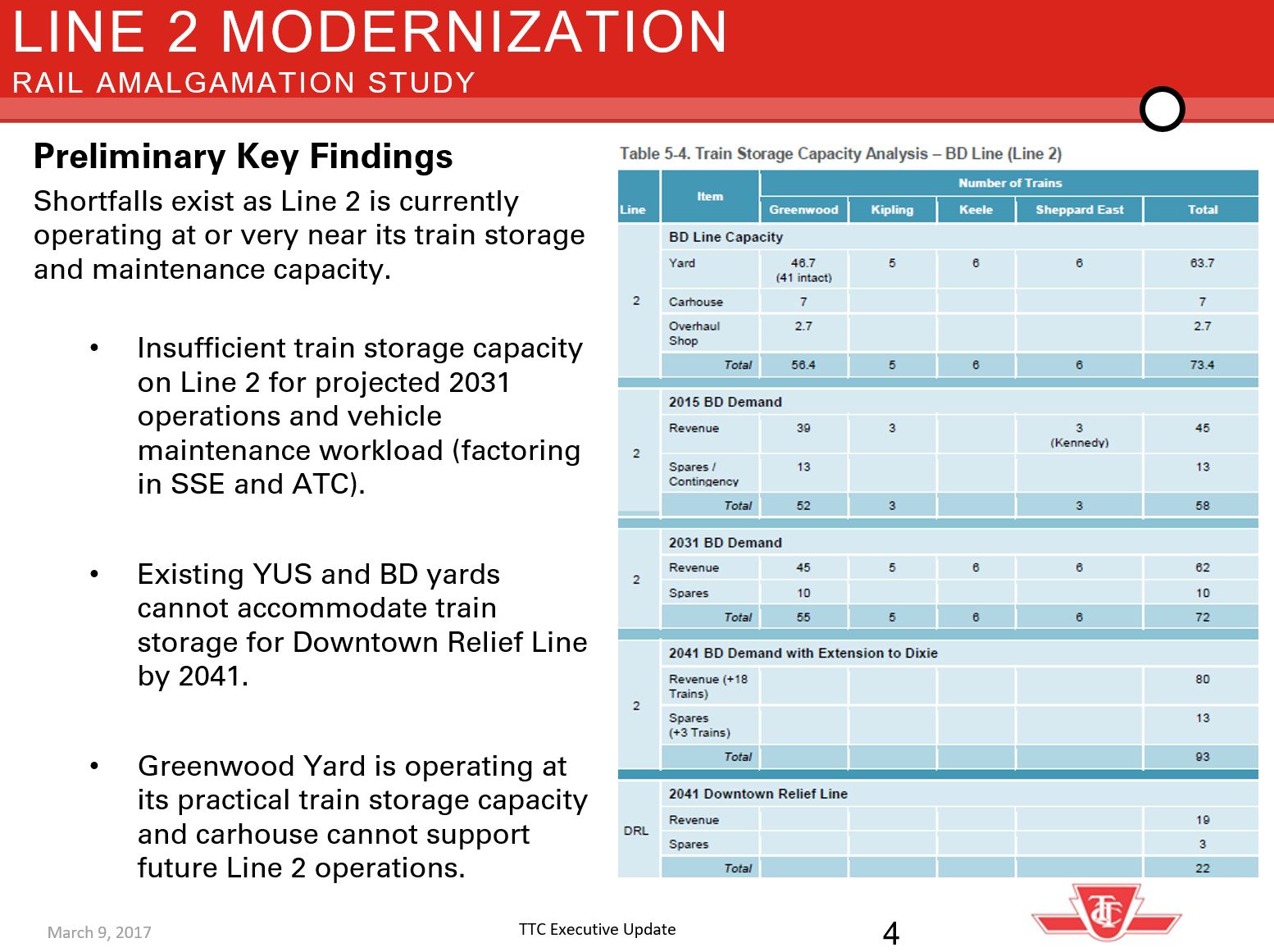
Back in 2017, there was a proposed renewal program for Line 2 that covered many aspects including fleet planning, extensions, future demand growth, signalling and maintenance yard requirements.
Most regular transit followers in Toronto will scratch their heads and ask “what renewal program”. The problem was that it was too rich for political blood at the time and most of it was ditched after CEO Andy Byford was replaced by Rick Leary.
A fundamental premise of the plan was that all of its components would be handled through one master schedule and common overall project management. The TTC had learned from experience on Line 1 that a piecemeal approach was fraught with conflicting timetables and specifications, not to mention the danger that each piece had to be funded separately with little appreciation for the big picture.
A Rail Amalgamation Study was conducted for the TTC by HDR and Gannett Fleming starting in 2015, and it was expected to finish in 2017. The intent was to review the line’s needs based on various future scenarios. For maintenance and storage facilities, it would consider:
The use of 2-car sets rather than the 6-car TR train configuration.
Possible line extensions
Expansion of the work car fleet to support expanding infrastructure
Implementation of ATC (Automatic Train Control) signalling
A preliminary report from the study showed that capacity would be a major problem. Note that in the context of this study, the Ontario Line did not yet exist, and the intent was that Greenwood Yard would host the Downtown Relief Line trains. Even without the DRL, Greenwood would not be able to handle expected growth in demand on Line 2.
The remainder of this article shows the details of the resulting plan, notably proposals for a new Line 2 fleet and expansion of the work car fleet that might have been set in motion had this scheme not been sidelined.
The TTC had a consolidated plan for Line 2 (and for the DRL), but this fell victim to budget cuts, the idea that we could “make do” rebuilding old trains and signal systems, and then the Provincial intervention with Metrolinx showing how they “knew better” how to plan and build rapid transit lines. We all know how that worked out.
After this agenda was published, the Federal Government announced its one third support for the purchase of 55 new Line 2 subway trains. See the Major Projects Update below for more details.
Also on the agenda is the quarterly financial report. I will review it in more detail in another article, but it includes material relevant to the Line 2 project
The modernization report updates the status of various projects, notably the proposed purchase of replacement trains for the T1 fleet on Line 2. Related projects include installation of Automatic Train Control, upgrades to Greenwood Yard, and various infrastructure changes to support future service increase.
Recent months have seen much hand-wringing over the timing of a subway car purchase and the state of both the aging T1 fleet and the 1960s-era signal system. The newfound urgency at TTC is due, in part, due to deferral of an entire package of Line 2 upgrades in past years.
A comprehensive plan was presented to TTC management’s Executive Committee in March 2017, but it sat on the shelf. [Note: This plan is not available online.] The plan included many components including a new fleet with a delivery window of 2026-2030, and conversion of Line 2 signalling to Automatic Train Control. Trains, signals and other infrastructure continue to age, costs rise, and the first of the replacement trains is not expected until 2030.
With later delivery of new trains, the existing T1s require another five-year overhaul cycle for continued service. This adds an estimated $163 million to overall costs which are already up due to inflation.
Thanks to the delay when the TTC and City were constraining the capital budget, the need for a Line 2 modernization was not “rediscovered” until 2023.
Toronto is now in the difficult position of having a huge appetite for transit capital, but with funding sources inadequate and uncertain beyond the immediate future. Assuming that each level of government will pony up one third of any project is a foolhardy basis for planning, and hard decisions will be needed about which projects can go ahead.
At a time when Toronto claims it wants to shift urban travel from cars to transit, the level of investment we will likely see will at best preserve existing operations and infrastructure.


 Steve Munro