A Transit Platform For Toronto

Two months from now, on June 26, Toronto will elect a new Mayor thanks to John Tory’s unexpected departure. There will be at least fifty candidates on the ballot, although most of them will garner only a handful of votes.

I am not one of them, and have no ambitions to high office. That said, I certainly have hopes that our new Mayor will have a strong pro-transit agenda and will actually care about the City rather than brown-nosing their way to small favours from Queen’s Park.

For those who are interested, here is the campaign-sized version of my advice and platform were I running:

  • Service is key. Run as much as possible, everywhere, and run it well.
  • Build budgets based on what you want to see, not on what you think you can afford. Just getting by is not a recipe for recovery and growth. If the money doesn’t come, then look to “Plan B” but aim for “Plan A”.
  • Fares are a central part of our transit system, but the question is who should pay and how much. Strive for simplicity. Give discounts where they are truly needed. Make the transit system worth riding so that small, regular increases are acceptable.
  • Focus on ease of use among transit systems in the GTA, but do not equate “integration” with amalgamated governance.
  • Transit property: parking or housing?
  • Foster a culture of advocacy in management and on the TTC Board.
  • Beware of lines on maps. A “my map vs your map” debate focuses all effort on a handful of corridors while the rest of the network rots.
  • Plan for achievements in your current term and make sure they actually happen. Longer term is important, but the transit ship is sinking. You are running for office in 2023. Vague promises for the 2030s are cold comfort to voters who have heard it all before.

That’s more than will fit comfortably on a leaflet, but, hey, I am the blogger who writes long form articles about transit. As a commentator, my biggest worry lies with those who say “TL,DR”. In the following sections I will expand on the bullets above. Thanks for reading.

How much would all this cost? In many cases the answer depends on the scale and speed of implementation. Although I have a sense of at least order of magnitude costs, I am not going to be foolish enough to put specific dollar figures here. For too long, City policy has started with a budget rather than a philosophy, an aspiration to be great, and settled for just good enough. We almost certainly cannot afford everything today, but we need to know what tomorrow we strive for.

If the 2003 Ridership Growth Strategy taught us anything, it was that we should first talk about aspirations, about what the transit system might be, rather than precluding debate with the classic “we can’t afford it” response. It’s amazing what monies can be found once information is out in the open. We commit tens of billions to construction, but are terrified, at least politically, by far lower costs to improve transit for everybody today.

I have deliberately omitted a discussion of security and related social services here. These are not just transit issues, but part of a city-wide, society-wide problem that will not be solved with a simple show of force. Recent trends both in public opinion and official responses at the City and TTC show an emphasis on providing support for those who need it: the homeless and the mentally unwell. This should continue and expand.

An inevitable question is who will I endorse? That will come later in the campaign as candidates flesh out their programs. Some make their beds with the provincial Tories. As enemies of the city, collaborators, they deserve only contempt. For others, we are in promising early days.

Continue reading
Osgoode Hall Garden and University Park

Over past months, the Ontario Line’s effect on trees in various locations around Toronto has become something of a cause célèbre. Osgoode Hall was, in a way, the “poster child” for this because of its location and the historic buildings at Queen & University. However, this was far from the only affected location with tree felling on a massive scale elsewhere including Moss Park, Riverside, and now planned for the Don Valley at the Leaside Bridge and the crossing of Walmsley Brook north of Thorncliffe Park.

A common refrain from citizens along the Ontario Line and other corridors is that Metrolinx does not deal in good faith, but rather presents its positions as unchangeable and pressing. They look only for acquiescence so that “consultation” can be claimed for the record. There is no public record of these consultations, and no community is aware of what might be told to others except by information sharing among them.

I have written about the garden at Osgoode Hall before, most recently in a review of the report prepared for the City of Toronto by Parsons looking at various alternative configurations.

On February 23, 2023, Toronto and East York Community Council established a subcommittee composed of Councillors from Wards 10 Spadina-Fort York, 13 Toronto Centre and 14 Toronto-Danforth and “directed the Executive Director Transit Expansion Division to report to the first meeting in March 2023 regarding the current status of the Ontario Line, pedestrian and traffic management plans, and opportunities for City and resident involvement moving forward”.

That meeting will occur on March 22, 2023. The only report on the agenda is from the Executive Director, and a great deal of it is a rehash of information from earlier reports along with a claim that Metrolinx is engaging with communities along the corridor. The actual degree of consultation is a matter for some debate, and one cannot wonder whether the ED is parroting the official line from Metrolinx, hardly an appropriate tactic for a senior City official. I will address that report in more detail after the meeting, but turn here to a proposal for the new entrance to Osgoode Station.

Continue reading

Richard F. Glaze Film Digitization Project Phase 2

Normally, I would not post a fundraiser on this site, but this one is very special.

James Bow of Transit Toronto has launched a fundraiser for the second phase of digitizing a trove of 16mm film from the estate of Richard F. Glaze.

James writes:

We’ve raised enough that we’re definitely going to digitize the three remaining train-related 400-foot reels in the collection. These date from the late 1950s and offer around 9 minutes of footage from the last days of streetcar operation in Montreal, 2 minutes of footage from the last days of streetcar operation in Ottawa, footage from the last days of Rochester’s streetcar subway, and CN steam locomotive 6218 (I think that’s the number; I don’t have the canister at hand at the moment). On top of this, I’ll be able to digitize another 12 100-foot reels from Toronto and Ontario in the 1970s (some interesting Ontario Northlander footage is available).

That still leaves 68 100-foot reels. The good news is, since these cost about $150 per reel to digitize, and I can probably get these scanned over time. However, every $150 we raise between now and the end of the month puts another reel on the pile, so hopefully we can make a good push of this.

Any contribution is worthwhile, big or small, via the gofundme page for this project.

Toronto’s Board of Trade Contemplates Transportation

Prologue: When I started to write this story, John Tory was still Mayor of Toronto and the dynamics of City-Province relations assumed he was in charge. The context for these discussions was soon to change.

The Toronto Region Board of Trade holds a yearly “transportation summit”, and on February 8, 2023, this focused on the Greater Toronto Area’s transit, plans for the future, and the aftermath of the covid pandemic.

The TRBoT is no wild-eyed radical institution. The regional economy and businesses are at the heart of causes it advocates.

Both in the introductory remarks and in comments by speakers sprinkled through the day, the economic effect of traffic congestion was a mantra. This sets the framework for the importance of both transit and road projects, depending on who is speaking. The latest factoid describing Toronto’s problems is that we have the third worst congestion in North America and the seventh worst in the world.

CBC: Toronto ranks 3rd most congested city in North America. Here are the city’s worst traffic spots

A problem with this hand-wringing is that there is little acknowledgement that some particularly bad locations are related to major infrastructure projects such as the Gardiner Expressway rebuild and various rapid transit lines. Moreover, goods movement has severe problems in areas that historically have poor transit and show little chance of seeing any in the near future. No single project will solve the problem of many-to-many trips patterns that now depend almost totally on roads and private vehicles.

Continue reading

Goodbye, Mr. Tory

John Tory is no longer Mayor of Toronto. That astounding news landed on Friday evening, February 10, to the complete surprise of Toronto’s political scene. You can read the details in the Star, who broke the story, and other online sources.

The great irony here is that Tory was felled by that most garden variety political pecadillo, an affair with a staffer half his age. Meanwhile, up the road at Queen’s Park, Premier Doug Ford barrels through blatant conflicts of interest and corruption charges untouched, so far.

My topic is not to comment on either of these, but to look at Tory’s departure in the context of Toronto’s transit service and the TTC’s future.

Although Deputy Mayor Jennifer McKelvie will take over the office pro tem, we will not have a real Mayor until, at least, an election likely in May (based on legal requirements of the City of Toronto Act). This means a caretaker government at a time when a clear vision (whatever it might be) is needed for the City’s future. No individual Councillor has the Mayor’s influence to advance programs and lobby other governments for support. Each Councillor has their own shopping list, their own political links and favours, that do not necessarily align with Council as a whole, or at least those who have been the power brokers in Tory’s immediate circle.

Any project hoping for the Mayor’s support – the Eglinton East LRT extension, Waterfront transit, green buses, Osgoode Plaza, and many more – have lost the heft the Mayor’s office might have brought.

One “legacy” of the Tory years, SmartTrack, should face a quick death if only to release the substantial capital from the “City Building Fund” it represents. However, that is not easily done because there are commitments by the City to fund new GO Transit stations under the SmartTrack banner, and some of these are already nodes for major new developments. Which of them should survive deserves a thorough review. As for Metrolinx, they no longer have to maintain the fiction that there is a distinct service brand.

On the bright side, Tory’s deal-with-the-devil – Metrolinx propped up his pipedream in exchange for uncritical support – should be dead and buried.

SmartTrack was a distraction that warped planning and funding allocations for far too long. The website extolling its benefits in travel time savings for a 22-station line is still active long after that campaign scheme turned to dust.

Over at the TTC, the crisis lies in a lack of advocacy for significantly better transit. This touches many issues including a high-handed CEO rumoured to be a Tory favourite, and a lacklustre Board where much institutional memory was lost with the post-election turnover. Their job has been to keep the lights on, and to preside over budget cuts that could hogtie transit’s ability to regain lost ridership. Red paint on a few lanes in the city, assuming they could even get Council’s approval, will not attract more riders if the service is undependable and crowded, even if slightly faster. Buses have to show up to carry riders.

I often use the metaphor of a store window in talking about transit’s attractiveness. The grandest marketing campaign – “BIG SALE” signs plastered over the building – cannot make up for a lackluster collection of mouldy products and empty shelves. Too much of our transit planning and political capital goes to the razzle-dazzle.

This brings me to the question of who will replace John Tory as Mayor. I can easily name people who might have been good candidates three years out running to replace a finally-retired Tory, but everyone’s political plans rested on those three years to develop a city-wide presence and articulate a plan for what a new Mayor would bring. That luxury is gone, and quite bluntly “more of the same” is not an inspiring thought.

The interregnum will strengthen the Province vis-a-vis Toronto because Council is unlikely to speak with one voice, nor is there anyone to go hammer-and-tongs to Queen’s Park demanding a better deal for the City. Some other big city Mayor will have to take up the banner of increased federal funding and revenue tools.

The relationship between Toronto and other governments should be an important part of any Mayoral platform. Sadly, I expect that some candidates would be more than happy to fall even deeper into the “embrace” of the thugs at Queen’s Park and its agencies like Metrolinx. Toronto needs its own clear voice.

A new Mayor will have to deal with the long-standing suburb-downtown split in answering the question: what should our city be? There is no single answer to that, and anyone who tries a one-size-fits-all response will just make the problem worse. Transit is only one of many portfolios, and its political support varies across the city and beyond into the Toronto region. Even the basic question of “what should transit do” has no simple answer, especially as its role in serving downtown commuters shrank with the shift to work-from-home.

Toronto has grave financial challenges, but the larger problem will be to keep the City together rather than splitting into rival groups with unyielding demands for “their” City vision.

Osgoode Station Entrance Review

Metrolinx plans along several of its corridors have provoked community opposition and proposed alternative schemes, but Metrolinx has been quite intransigent about “just getting things built”, the mantra of the Ford government at Queen’s Park. Opposition is not merely steamrolled, but is painted as anti-transit, out of touch, and nimbyist in preventing the wider population from enjoying the benefit of new transit lines.

This does not endear Metrolinx to many groups (and they stretch well into the 905, not just central Toronto), but Metrolinx does not care. For them, it’s all about managing the message. Most communities just roll over and give in to an unstoppable force trying to make the best of a bad situation. “Consultation” amounts to picking the colour of the tiles for a bathroom reno, and hoping that the contractor actually installs the ones you selected.

Several sites along GO corridors and the Ontario Line have been subject to tree clearing either to open construction sites, or to remove trees that will conflict with electrification infrastructure. A small grove at Osgoode Hall, although far from the largest area Metrolinx has cleared, received much publicity because of its location. The northeast corner of Queen and University is a park beside one of Toronto’s oldest buildings, a green space complementing the square at City Hall just to the east and a more recent arrival, Campbell House, to the west.

Although the park was owned by the Law Society of Ontario, the portion Metrolinx requires was expropriated for the Ontario Line. The community around Osgoode Hall (a mix of the legal profession, the local BIA, residents and heritage advocates) convinced Toronto Council to undertake a review of Metrolinx plans in comparison with alternative designs that would preserve the treed parkland.

This report was produced by a consulting firm, Parsons, and was posted on the City’s website on February 4. It exists in two formats:

An interim injunction, in force until February 10, paused the felling of trees at Osgoode Hall for a time. Other locations have not been as lucky, nor have they had groups like the Law Society capable of taking on Metrolinx.

An important distinction for this site is that it also contains a heritage building, and there are concerns for potential damage Osgoode Hall might suffer from the overall construction plans. However, the injunction itself only applies to the trees, and it is not clear whether the wider issue of construction effects will form part of the broader argument when the application is heard.

Among the legal issues will be whether a heritage site with mixed ownership (the Law Society, Metrolinx and Ontario) can be treated as “indivisible” for the purpose of heritage preservation so that one owner, the LSO, can prevent changes on property of another owner, Metrolinx. There is also the question of whether Metrolinx can even be bound by an injunction as it is one of many agencies that are exempt from many provincial regulations.

In Brief

  • An interim injunction pauses work until February 10, with possible extension, pending further review.
  • The Parsons report commissioned by the City was published at the last moment, and was seized upon by Metrolinx to justify commencement of work on the same day as the injunction hearing.
  • Parsons concurs that the Metrolinx proposal is the best of those analyzed, but suggests that an alternative using the Campbell House site should be studied in more detail.
  • The Campbell House option would effectively displace the house from its location, and it is doubtful that it could return in as harmonious a setting as it has today.
  • Parsons does not afford the same treatment to the Osgoode Plaza proposal even though this is the major contender among the alternatives.
  • The City’s inaction on the proposed Osgoode Plaza is an (almost) missed opportunity to make the new station and the intersection into a major site downtown. If this is to be pursued, prompt action by the City is needed so that Metrolinx could adjust their construction plans accordingly.

If City Council, and most importantly Mayor Tory, are serious about an alternative to the Metrolinx plans for Osgoode Station, they should proceed as quickly as possible to endorse the Osgoode Plaza scheme and work with Metrolinx to adjust construction plans for Osgoode Station on the basis of road space on University Avenue that the plaza will free up.

In the presentation accompanying the report, the Osgoode Plaza option is shown first, and it is dismissed for various reasons notably the absence of detailed studies because the City has not yet embraced the proposed reconfiguration of University Avenue. Rather than recommending that the potential of this scheme be examined in greater detail, Parsons rejects it. This effectively prejudices the report to endorse the Metrolinx scheme as the only viable option, with a faint hope alternative that is worse than the original.

Continue reading

Seventeen

Here we are again at this blog’s anniversary. Looking back over the past year, let alone ahead to the next one, I regret that I am not in an up-beat, optimistic mood.

A year ago, I wrote:

In Ontario, there is hope that opposition will coalesce to drive the Premier and his band of incompetent fools from office. Whether we will get a new band of fools remains to be seen, but a Toronto, an Ontario in which nobody named “Ford” has any power is long overdue. Simplistic, populist slogans and dogma are no replacement for competent, dare I say, inspiring government.

This year I really do want to look forward, even with some misgivings on the social and political landscape.

The NDP and Liberal opposition did not manage to seize power, and won’t even have a shot at this until 2026. Meanwhile, we are stuck with Doug Ford and his gang of rogues who will sell off the province to their pals. Between rhetoric for the cameras, and legislation working against any interest that does not contribute to his party, Ford’s reign brings fresh disasters at every turn.

If there were a credible alternate view at the municipal level, I might hope at least for some balance, an alternate voice, but Mayor Tory continues to focus on doing whatever he can to cheapen Toronto. Some effects are not immediately visible, but they are cumulative. The City’s ability to be great, to inspire citizens to hope for more, drifts further and further out of reach.

Both “leaders” share a common problem: their egos and their dislike of criticism or opposition. They are right and everyone else is wrong, part of a rabble opposition who can be dismissed, if need be by legislative fiat.

On the transit front, their respective agencies echo this stance. Metrolinx and the TTC are run by CEOs who want things their way, and who answer, if that is the word, to boards utterly unwilling to challenge their rule (or under marching orders to shut up and vote the right way).

Without question, three years of the pandemic have stretched every agency thin. The lights stay on, flickering, only by infusion of special subsidies that already wane and could disappear within one fiscal year. That environment gave management a chance to take more power from their boards who, especially at the TTC, had many other problems as Councillors. That power will not likely be clawed back and delegated authority will be the “new normal”.

Continue reading

So You Want To Be A TTC Commissioner (2023 Edition)

Our brand new City Council meets this week. After the requisite speechifying and back-patting typical of the inaugural gathering, they will get into the business of appointing members of various Committees and Boards, including the one that runs the Toronto Transit Commission.

There are two sets of Board members: Councillors and citizens, a.k.a. civilians who (in theory) are not politicians. Only the first group will be appointed at this meeting, and the citizen members will come up for review in the new year once the City goes through the motions of soliciting applications.

The choice of a TTC Chair is up to Council, although it’s hard to believe that a nod from the Mayor, even without any new powers, would be ignored.

On the past Board, the Council members were: Jaye Robinson (chair), Brad Bradford, Shelley Carroll, Cynthia Lai, Jennifer McKelvie and Denzil Minnan-Wong. Of these, Councillor Lai died just before the election, and Minnan-Wong chose not to run. The Chair’s job should go to someone with experience and a strong commitment both to transit and to making something of the position, not just being a seat warmer.

Oddly enough, none of the existing Councillor/Commissioners has asked to be reappointed. This could lead to turnover (good, maybe) but also the loss of institutional memory at the Board level. That works to management’s advantage, but an organization as large as the TTC needs experience at the top for policy and oversight, not just ribbon cutting.

The new Board, to be confirmed by Council today, will have Councillor Burnside as Chair, with Councillors Mantas, Holyday, Moise and Ainslie as members. The citizen positions will be filled separately in the new year, and current members remain in office until that occurs. I cannot say that I am enthusiastic abouy Burnside as Chair, and do not expect much advocacy from that quarter beyond a knife aimed at the budget, and hence the quality of transit service.

The new Board will face very, very serious problems affecting transit’s future in Toronto. As pandemic-era financial supports wind down, the TTC will simply not be able to afford to operate service without new revenues through fares or subsidies. Moreover, their capital plans vastly exceed available resources.

Since 2020, the struggle has been to just get past the crisis, but the TTC faced a bleak outlook even before the pandemic. I have no crystal ball or magical insights, but offer this article as advice to the new Board.

Continue reading

Fifty Years of Transit Advocacy

Over five decades, I’ve had a hand in many of the issues described here, but I didn’t want this piece to give the impression of a one-man band. Many people contributed along the way including other activists, media, politicians, and professional staff within various agencies and consultants. My thanks to them all for being part of this journey.

Updated October 17 at 12:25 pm: Corrected opening date of Spadina streetcar (oops!)

When I was very young, I liked streetcars. A lot. Trains were OK, but streetcars were the genuine article. My Dad and I would go for rides around Toronto on most weekends exploring where all the lines went. Through him I got to know the world beyond Mount Pleasant and Eglinton and the loop where my local streetcar line ended.

I’m willing to bet that a lot of “transit advocates” and their equivalents in subways, buses and the mainline railways got their start that way. As such, I’m proud to be called a “railfan”, but not the pejorative term “trolley jolley” concocted by the anti-streetcar elements of the transit industry.

Roll forward to 1971. Toronto was a hotbed of citizen activism with the big focus of the Spadina Expressway, a road that would tear through downtown and provide the justification for even more destruction including the Crosstown, Scarborough and 400 South Expressways, not to mention conversion of local streets like Dundas and Front to serve as arterials through the core. This was an era when fighting City Hall was very much part of the body politic, and this was the context for my entry into transit activism.

The TTC planned to dismantle the streetcar system line-by-line up to 1980 when, yes, the Queen Subway would take over the heavy lifting of getting people into the business district and the streetcars would disappear.

TTC held on to its streetcars longer than most cities by buying up used vehicles as others disposed of them, often under the influence of a cabal of bus-gasoline-tire companies more than happy to finance the conversion. Streetcars came to Toronto from Cincinnati, Cleveland, Louisville (almost brand new, those), Birmingham and Kansas City. But the policy of streetcar abandonment had been in place for years, and the early 70s were to see the first lines go – St. Clair, Earlscourt and Rogers Road.

What would replace them? Trolleybuses. With the opening of the Yonge Subway north to York Mills Station, the TTC no longer needed a very frequent trolleybus service between Glen Echo Loop and Eglinton Station, itself a remnant of the Yonge streetcars that disappeared with the original subway in 1954.

Although this might have been the beginning of the end, the TTC made a crucial mistake: the level of service they planned for St. Clair was sized to the available trolleybus fleet, not to the existing capacity of the streetcar lines. In that era the peak service between Yonge and Oakwood ran every 60 seconds, and this was not a trivial route for service cuts.

The summer of 1972 saw the birth of the Streetcars for Toronto Committee under the leadership of Professor Andy Biemiller with political support from Aldermen (as they were then called) Paul Pickett and William Kilbourn. Later, Mayor David Crombie’s office lent support.

By October, the Committee was issuing press releases, making deputations and gaining political support from City Council. On November 7, 1972, the TTC board voted to reverse management’s position and to retain most of the streetcar system. The only exception would be the Rogers Road car that operated outside of the old City in York (a remnant of York Township Railways), and later the service on Mount Pleasant (a victim of bridge reconstruction at the Belt Line Railway).

This was not just a fight to save one car line, but for streetcars as the backbone of the old City of Toronto’s transit network, and as a basis for expansion into the suburbs, something the TTC had planned in the late 1960s.

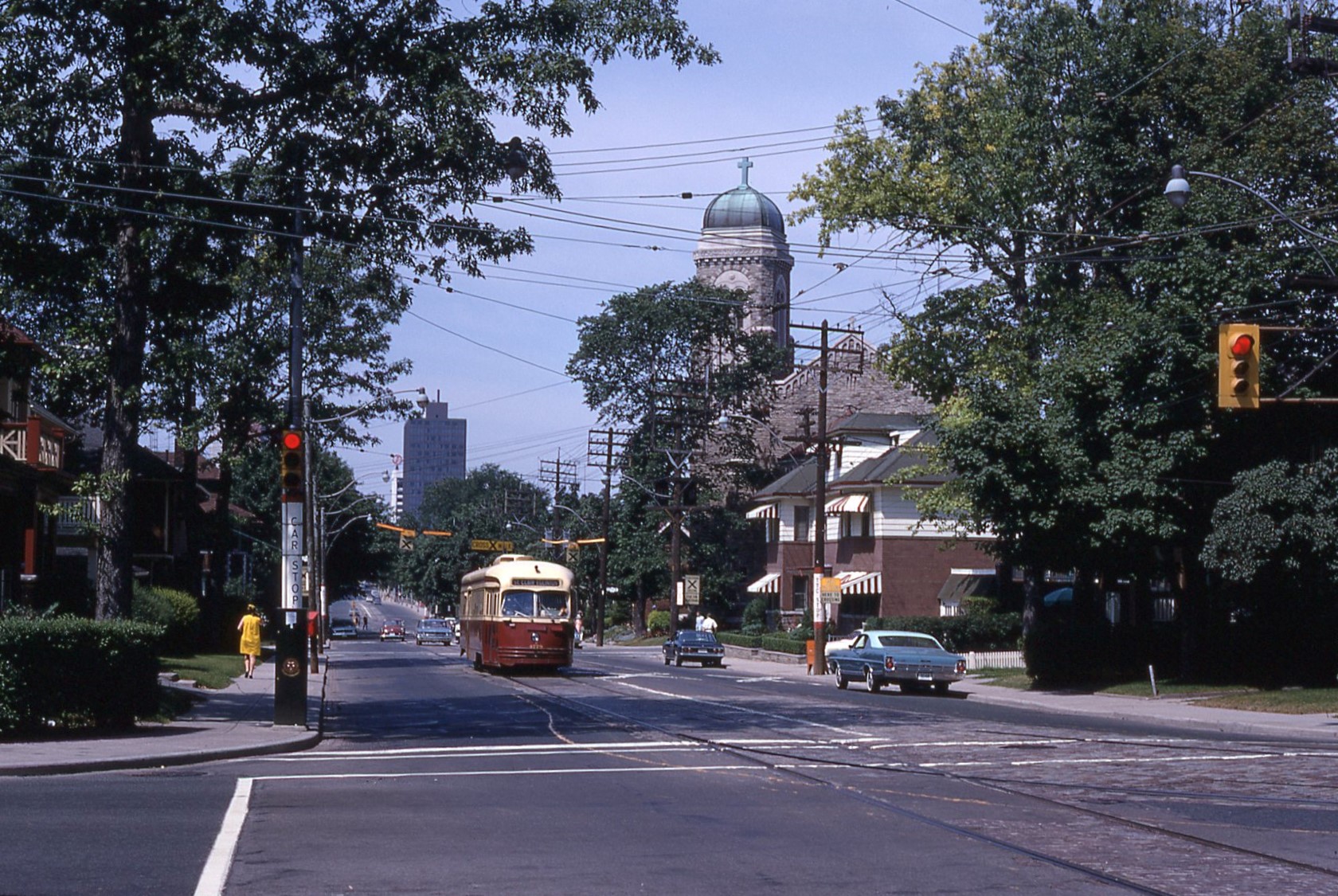
Ex Kansas City PCC 4779, the last in the fleet, eastbound on St. Clair at Mt. Pleasant. July 21, 1968 (Steve Munro photo)

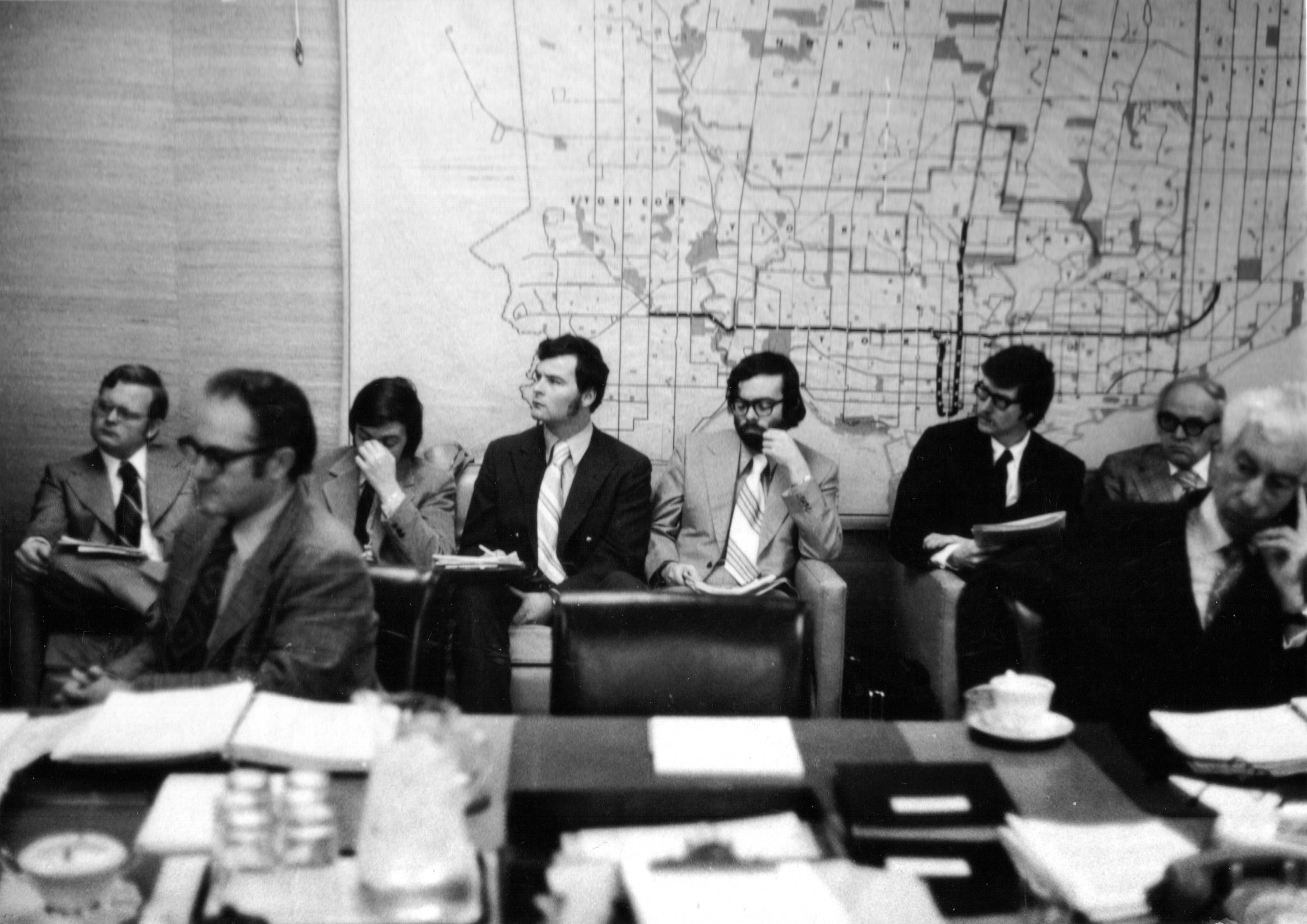
Here are some of the Streetcars for Toronto Committee members at the TTC Board meeting.

From the left along the wall: the late Mike Filey and John Bromley, Chris Prentice, Steve Munro, Professor Andrew Biemiller and Alderman William Kilbourn. In the foreground at the table are Commissioner Gordon Hurlburt and Pat Paterson, General Manager of Engineering.

Not shown: Howard Levine, Robert Wightman, Ros Bobak.

Photo by Ros Bobak

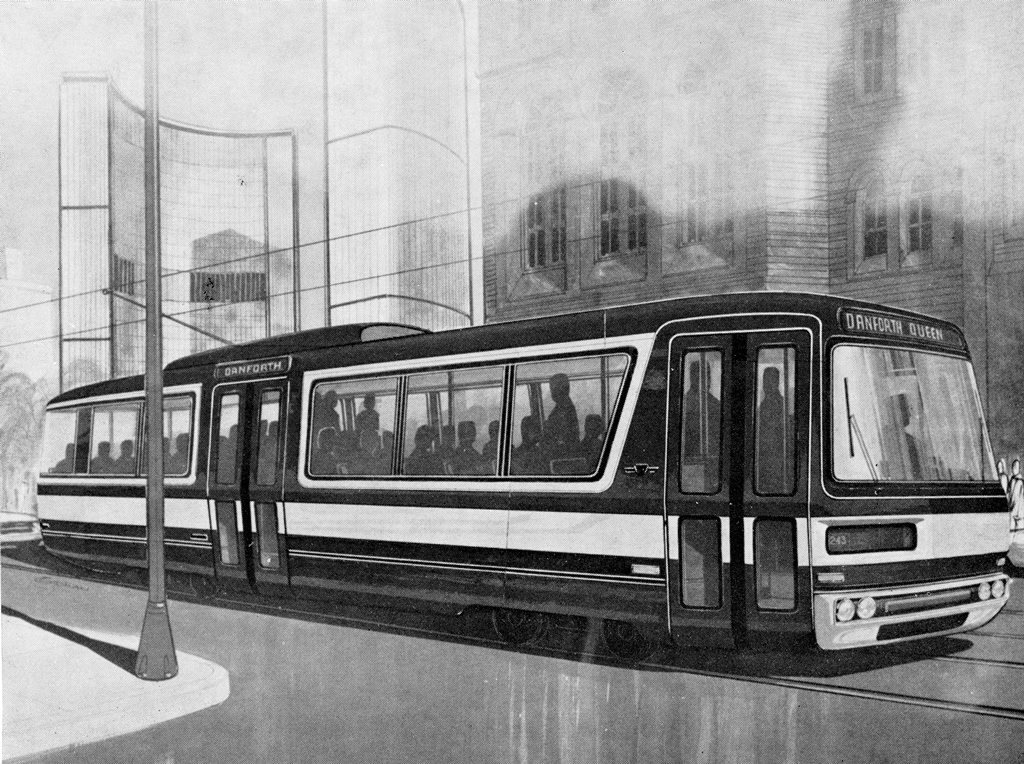
In those days, the estimated cost of a new streetcar was quite low, and the TTC had already been working with Hawker-Siddeley (then proprietors of the Thunder Bay plant now owned by Alstom) on a design for an updated streetcar. These would be used both on exiting streetcar routes, pending the Queen subway, and on suburban lines to what is now Scarborough Town Centre, across the Finch hydro corridor, southwest through Etobicoke and even with a branch to the airport.

Photo: Hawker-Siddeley/TTC

But Queen’s Park had other ideas, and in the same month, November 1972, Premier Bill Davis announced his scheme for a network of maglev trains that would criss-cross the city and make subways obsolete. The premise was that subways were too expensive, and buses were limited in speed and capacity. The “missing link” would be “GO Urban”.

Continue reading