Updated January 29, 2025 at 7:35am: I have just received a note from the TTC stating that the historic fleet will return to Toronto following completion of reconstruction at Hillcrest. Good news, eventually.
From time to time, readers ask when or if the TTC will retrofit its historic streetcar fleet with pantographs so that cars can operate on the new pan-only overhead. That question is now answered with the move of these cars to the streetcar museum at Rockwood, the Halton County Radial Railway.
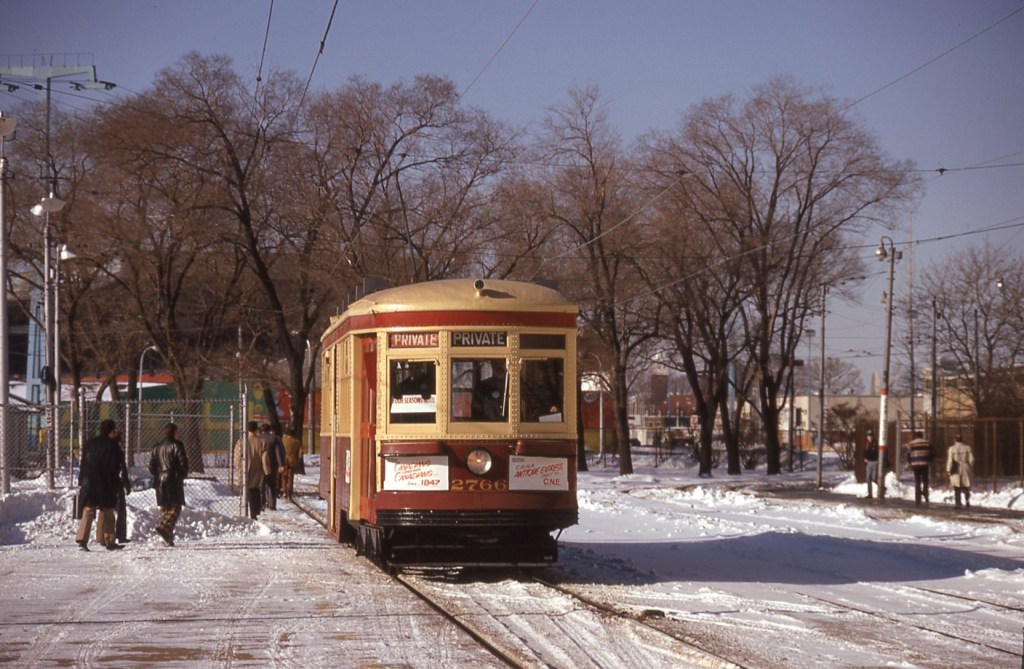
Peter Witt 2766 and PCC 4500 are already at the museum as of January 28. 4549 will move on January 29, and the CLRVs will move on February 3 & 4.
Here is car 4549 sitting at Hillcrest ready to leave.
We’re almost at the end of another year, and I thank all of my readers for visiting and leaving comments that extend the discussions (usually) in a helpful direction.
Here is ex-Kansas City PCC 4759 on a fan trip in February 1976. For much of the trip, the car operated with a Philadelphia roll sign, hence the odd destinations in some shots.
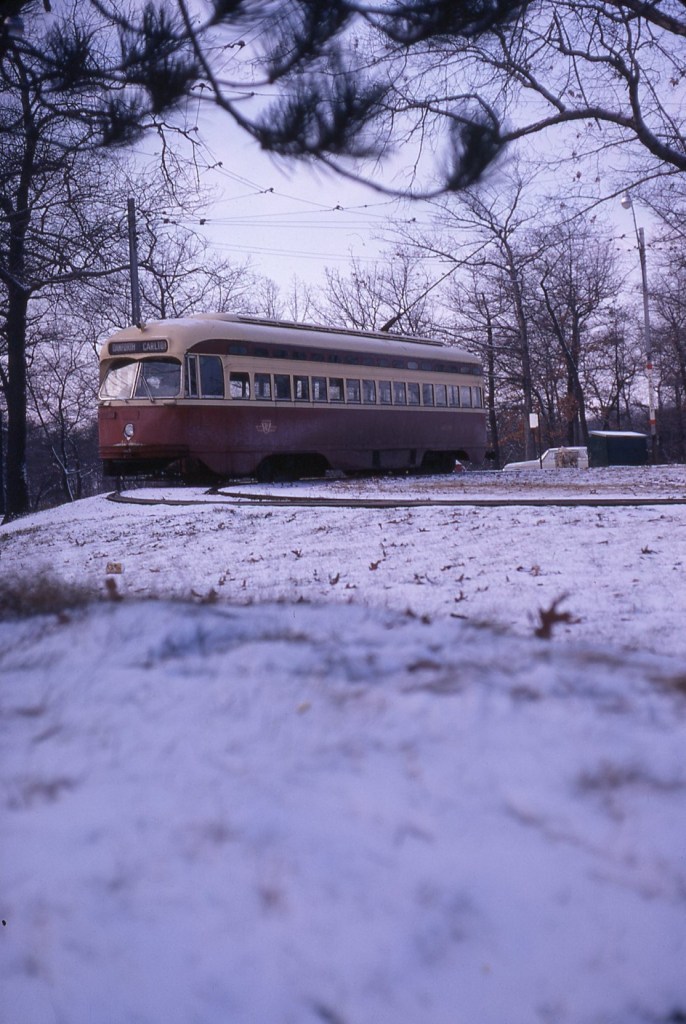
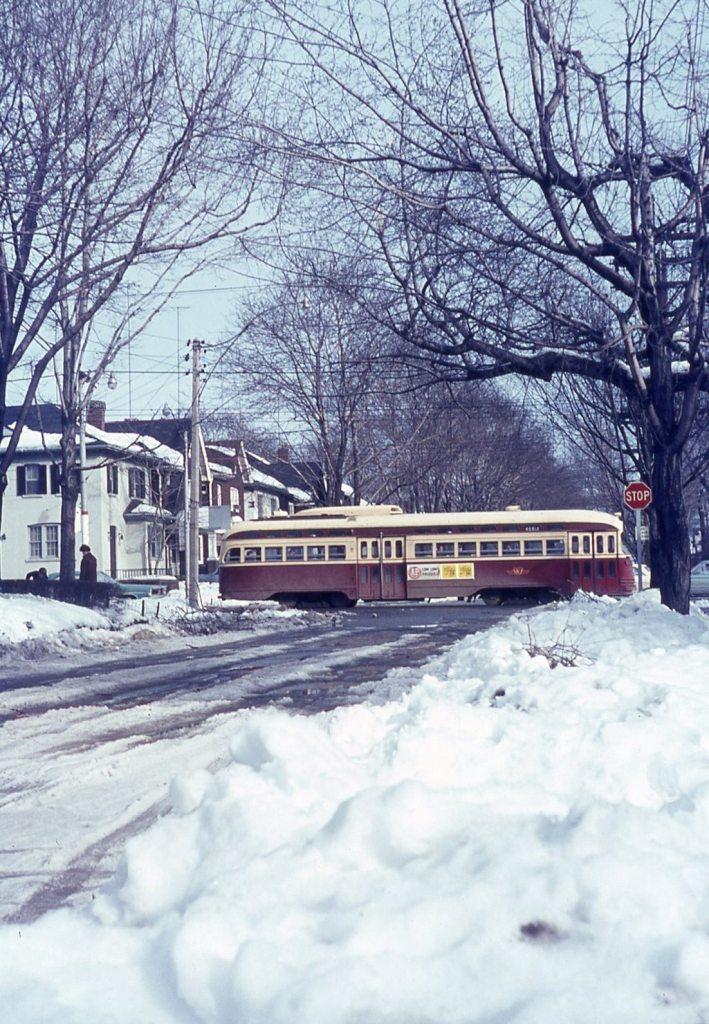
At Moore Park Loop in the last winter when what we now call “512 St. Clair” operated east of Yonge Street. This site is now a parkette.
At the old and far more attractive Exhibition Loop before it was buried under what is now called the Direct Energy Centre.
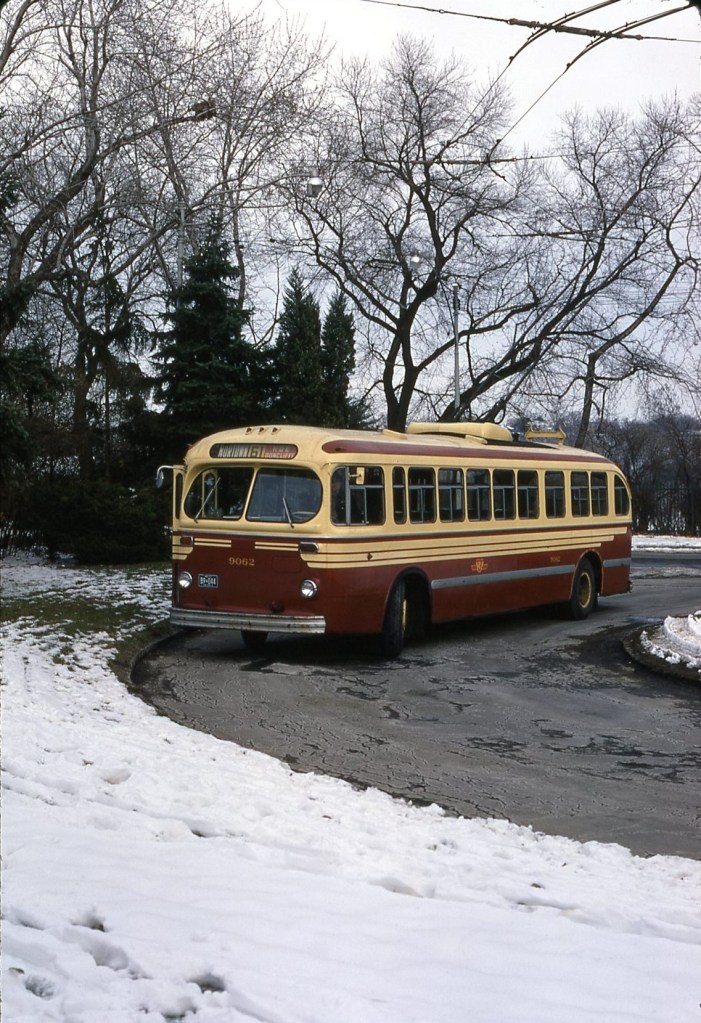
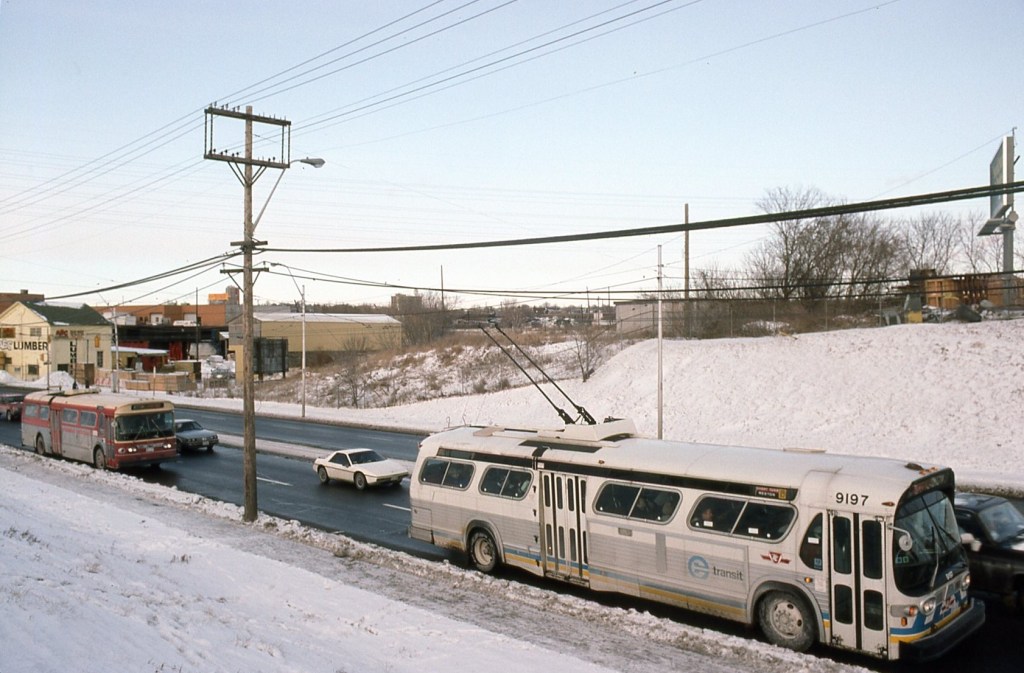
Back in 1987-88, I photographed the Bay trolleybus a lot. The route was threatened for a time by a proposed one-way pairing with Yonge Street, and the south end of the route went out of service for construction of the Harbourfront line.
Looking at these photos 36 years later, two things are quite striking: the changes all along the route where the canyon of newer buildings had not yet materialized, but also the frequency of service. Getting shots with two or three buses at a time was easy, far different from today when the service is infrequent with the “best” being a 14-minute PM peak headway, and 20-30 minutes at other times. This route saw a vicious downward cycle of riding loss and service cuts, and now is simply not worth waiting for.
The route’s conversion to trolleybus was an offshoot of the 1972 decision to retain streetcars. The surplus TBs from 97 Yonge, released when the subway extension to York Mills opened, were originally intended for the St. Clair streetcar route, although the proposed service level would have been worse than the streetcars to be replaced. The Streetcars for Toronto advocacy group (which I chaired for a time) pushed for deployment of the surplus TBs on Bay given its frequent service and downtown location well placed to use the existing power distribution infrastructure. (A less obvious motive was to eliminate a potential threat to any other streetcar lines with the TBs looking for a home.)
The galleries below run from south to north along the route with photos from Fall 1987 and Spring-Summer 1988. Photos of 9200, the first production bus of the “new” TBs, are from a fan excursion.
Mount Pleasant & Davisville 1967.12.234696 High Park Loop 1967.12.294673 Humber Loop 1967.12.294550 Mt. Pleasant & Heath 1968.014362 Mt. Pleasant Loop 1972.02.204362 Bingham Loop 1972.02.209062 Doncliffe Loop 1971.12.059062 Otter Loop 1971.12.05Weston Rd. N of St. Clair 1992.01West of Warden Stn. 1972.03.26Exhibition Loop 1974.02.11
With the shutdown of Queen Street for Ontario Line construction between Victoria and Bay, we will not see streetcars there for many years. The last cars will run just before midnight on April 30, 2023.
Until early 2024, the absence will be over a longer stretch from Broadview to McCaul until new diversion track via York and Adelaide is finished. In turn, that depends on relocating nine utility vaults under the new Adelaide trackage.
It is possible that the TTC will revise the diversion pattern once the Don Bridge reopens to streetcars later in 2023 (it will close for maintenance on May 7), but nothing has been decided yet.
Here are photos of various generations of streetcars on the central section of Queen as a memento while we await their return.
Note that this is a large gallery, and it will take a while to load after you first click on a photo.
Normally, I would not post a fundraiser on this site, but this one is very special.
James Bow of Transit Toronto has launched a fundraiser for the second phase of digitizing a trove of 16mm film from the estate of Richard F. Glaze.
James writes:
We’ve raised enough that we’re definitely going to digitize the three remaining train-related 400-foot reels in the collection. These date from the late 1950s and offer around 9 minutes of footage from the last days of streetcar operation in Montreal, 2 minutes of footage from the last days of streetcar operation in Ottawa, footage from the last days of Rochester’s streetcar subway, and CN steam locomotive 6218 (I think that’s the number; I don’t have the canister at hand at the moment). On top of this, I’ll be able to digitize another 12 100-foot reels from Toronto and Ontario in the 1970s (some interesting Ontario Northlander footage is available).
That still leaves 68 100-foot reels. The good news is, since these cost about $150 per reel to digitize, and I can probably get these scanned over time. However, every $150 we raise between now and the end of the month puts another reel on the pile, so hopefully we can make a good push of this.
Any contribution is worthwhile, big or small, via the gofundme page for this project.
Over five decades, I’ve had a hand in many of the issues described here, but I didn’t want this piece to give the impression of a one-man band. Many people contributed along the way including other activists, media, politicians, and professional staff within various agencies and consultants. My thanks to them all for being part of this journey.
Updated October 17 at 12:25 pm: Corrected opening date of Spadina streetcar (oops!)
When I was very young, I liked streetcars. A lot. Trains were OK, but streetcars were the genuine article. My Dad and I would go for rides around Toronto on most weekends exploring where all the lines went. Through him I got to know the world beyond Mount Pleasant and Eglinton and the loop where my local streetcar line ended.
I’m willing to bet that a lot of “transit advocates” and their equivalents in subways, buses and the mainline railways got their start that way. As such, I’m proud to be called a “railfan”, but not the pejorative term “trolley jolley” concocted by the anti-streetcar elements of the transit industry.
Roll forward to 1971. Toronto was a hotbed of citizen activism with the big focus of the Spadina Expressway, a road that would tear through downtown and provide the justification for even more destruction including the Crosstown, Scarborough and 400 South Expressways, not to mention conversion of local streets like Dundas and Front to serve as arterials through the core. This was an era when fighting City Hall was very much part of the body politic, and this was the context for my entry into transit activism.
The TTC planned to dismantle the streetcar system line-by-line up to 1980 when, yes, the Queen Subway would take over the heavy lifting of getting people into the business district and the streetcars would disappear.
TTC held on to its streetcars longer than most cities by buying up used vehicles as others disposed of them, often under the influence of a cabal of bus-gasoline-tire companies more than happy to finance the conversion. Streetcars came to Toronto from Cincinnati, Cleveland, Louisville (almost brand new, those), Birmingham and Kansas City. But the policy of streetcar abandonment had been in place for years, and the early 70s were to see the first lines go – St. Clair, Earlscourt and Rogers Road.
What would replace them? Trolleybuses. With the opening of the Yonge Subway north to York Mills Station, the TTC no longer needed a very frequent trolleybus service between Glen Echo Loop and Eglinton Station, itself a remnant of the Yonge streetcars that disappeared with the original subway in 1954.
Although this might have been the beginning of the end, the TTC made a crucial mistake: the level of service they planned for St. Clair was sized to the available trolleybus fleet, not to the existing capacity of the streetcar lines. In that era the peak service between Yonge and Oakwood ran every 60 seconds, and this was not a trivial route for service cuts.
The summer of 1972 saw the birth of the Streetcars for Toronto Committee under the leadership of Professor Andy Biemiller with political support from Aldermen (as they were then called) Paul Pickett and William Kilbourn. Later, Mayor David Crombie’s office lent support.
By October, the Committee was issuing press releases, making deputations and gaining political support from City Council. On November 7, 1972, the TTC board voted to reverse management’s position and to retain most of the streetcar system. The only exception would be the Rogers Road car that operated outside of the old City in York (a remnant of York Township Railways), and later the service on Mount Pleasant (a victim of bridge reconstruction at the Belt Line Railway).
This was not just a fight to save one car line, but for streetcars as the backbone of the old City of Toronto’s transit network, and as a basis for expansion into the suburbs, something the TTC had planned in the late 1960s.
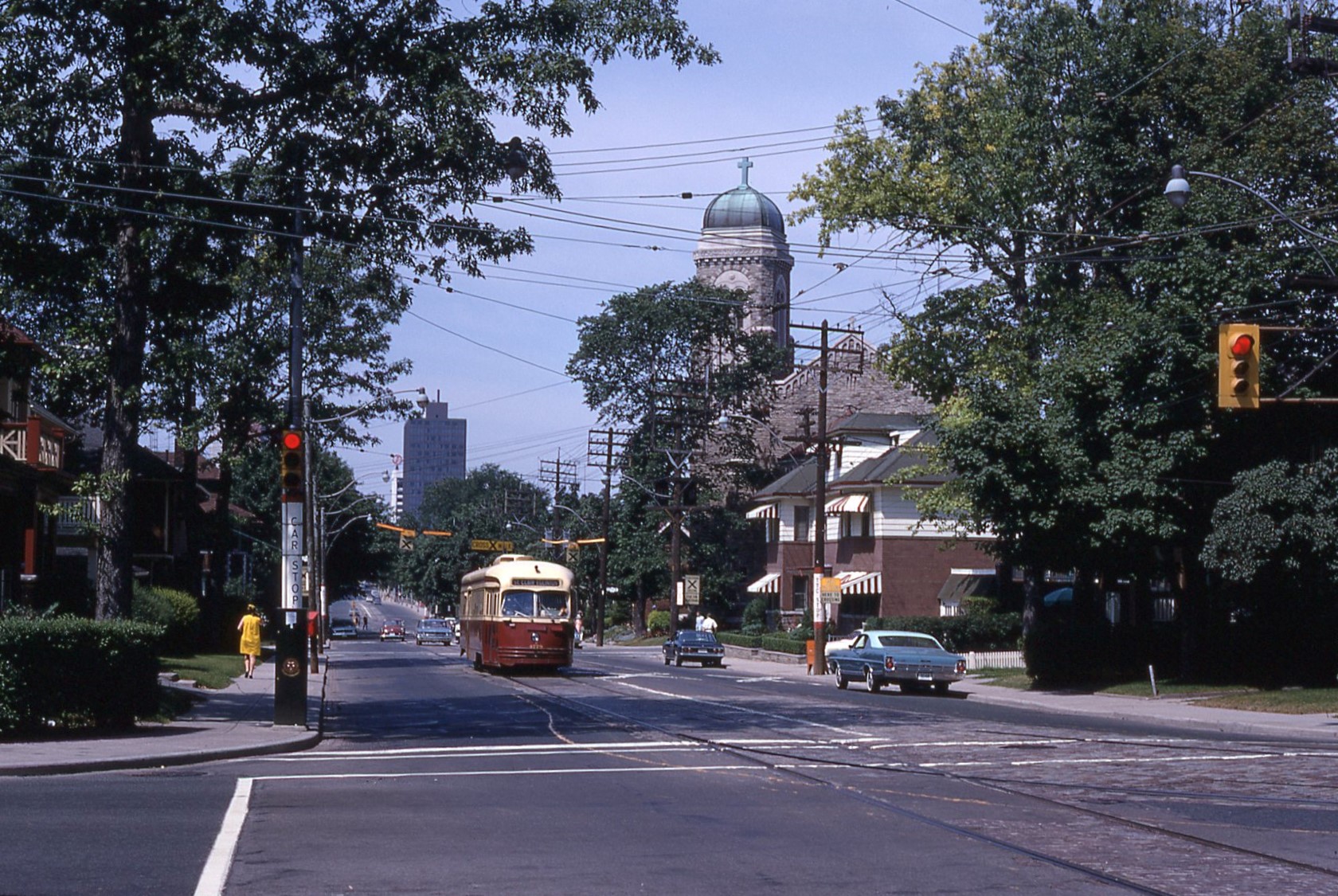
Ex Kansas City PCC 4779, the last in the fleet, eastbound on St. Clair at Mt. Pleasant. July 21, 1968 (Steve Munro photo)
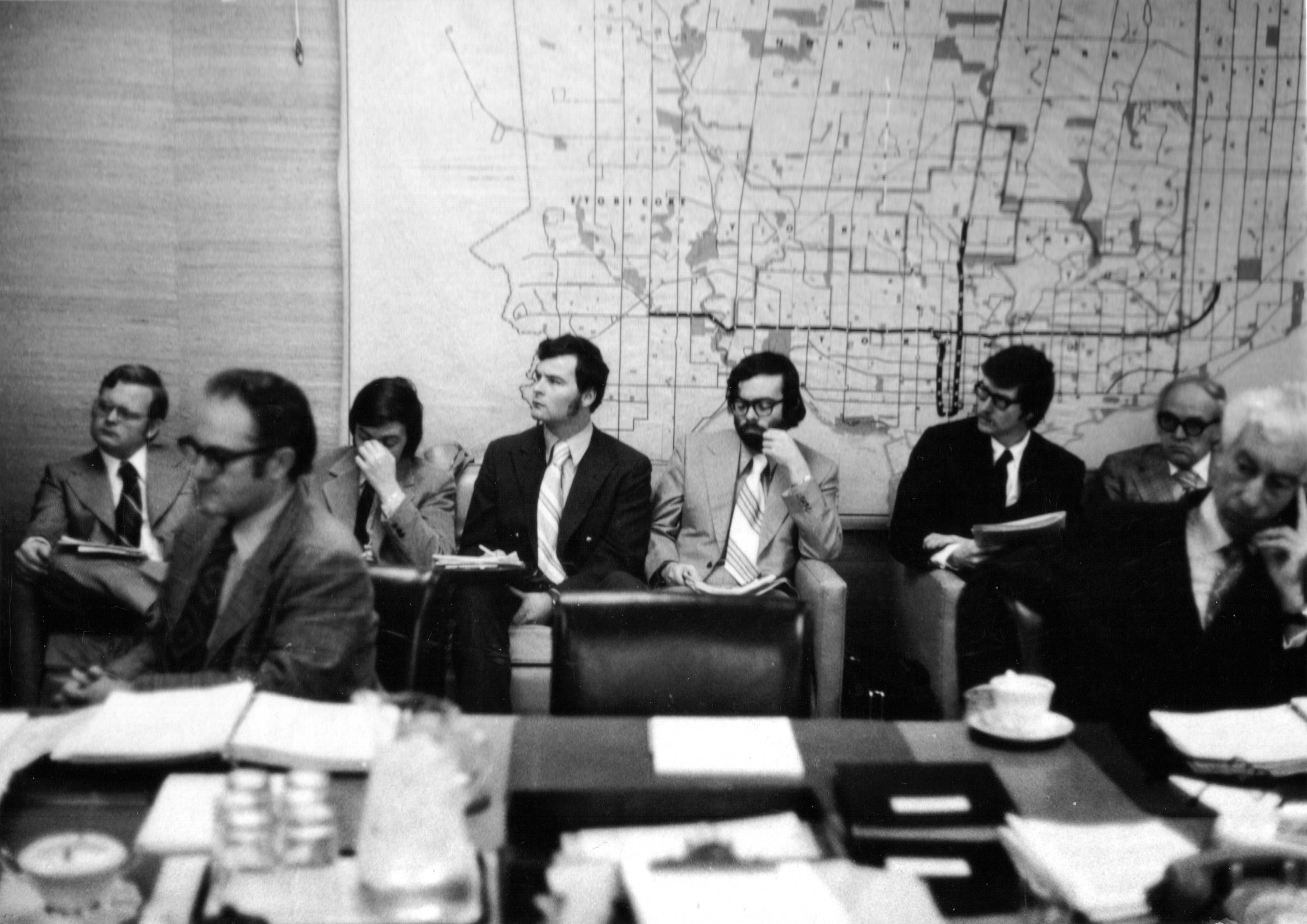
Here are some of the Streetcars for Toronto Committee members at the TTC Board meeting.
From the left along the wall: the late Mike Filey and John Bromley, Chris Prentice, Steve Munro, Professor Andrew Biemiller and Alderman William Kilbourn. In the foreground at the table are Commissioner Gordon Hurlburt and Pat Paterson, General Manager of Engineering.
Not shown: Howard Levine, Robert Wightman, Ros Bobak.
Photo by Ros Bobak
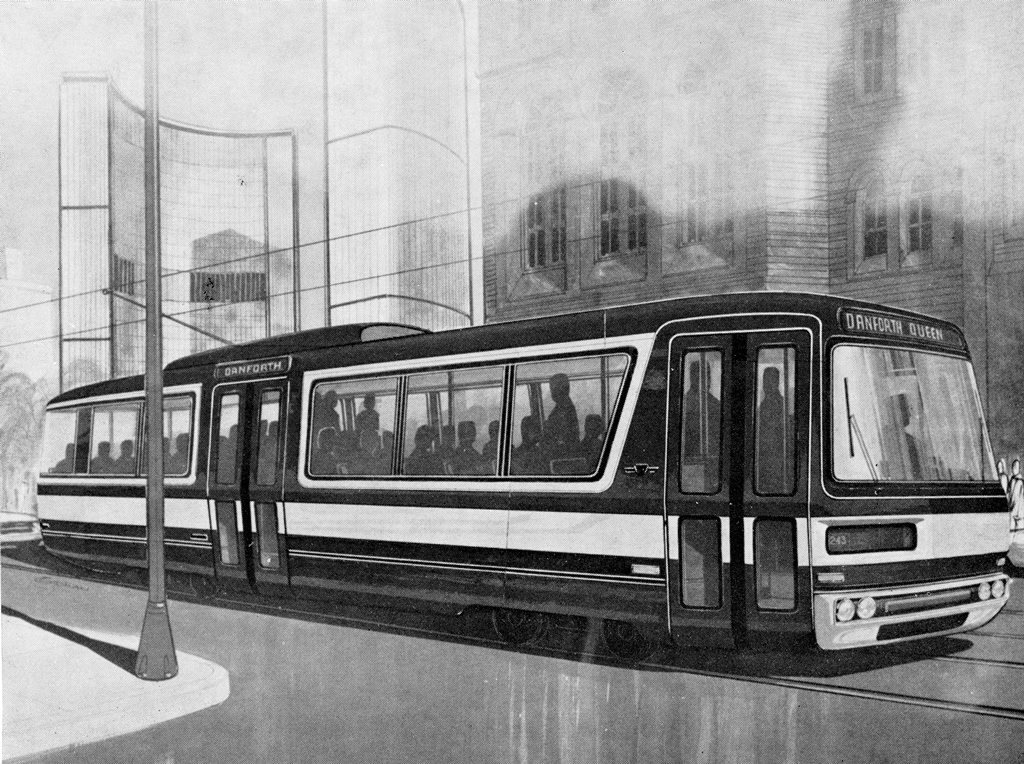
In those days, the estimated cost of a new streetcar was quite low, and the TTC had already been working with Hawker-Siddeley (then proprietors of the Thunder Bay plant now owned by Alstom) on a design for an updated streetcar. These would be used both on exiting streetcar routes, pending the Queen subway, and on suburban lines to what is now Scarborough Town Centre, across the Finch hydro corridor, southwest through Etobicoke and even with a branch to the airport.
Photo: Hawker-Siddeley/TTC
But Queen’s Park had other ideas, and in the same month, November 1972, Premier Bill Davis announced his scheme for a network of maglev trains that would criss-cross the city and make subways obsolete. The premise was that subways were too expensive, and buses were limited in speed and capacity. The “missing link” would be “GO Urban”.
On Saturday, May 28, 2022, between 10am and 5pm, the TTC will open the lower level of Bay Station as part of Toronto’s Doors Open event.
May 28, 2022: Updated with photos from the event.
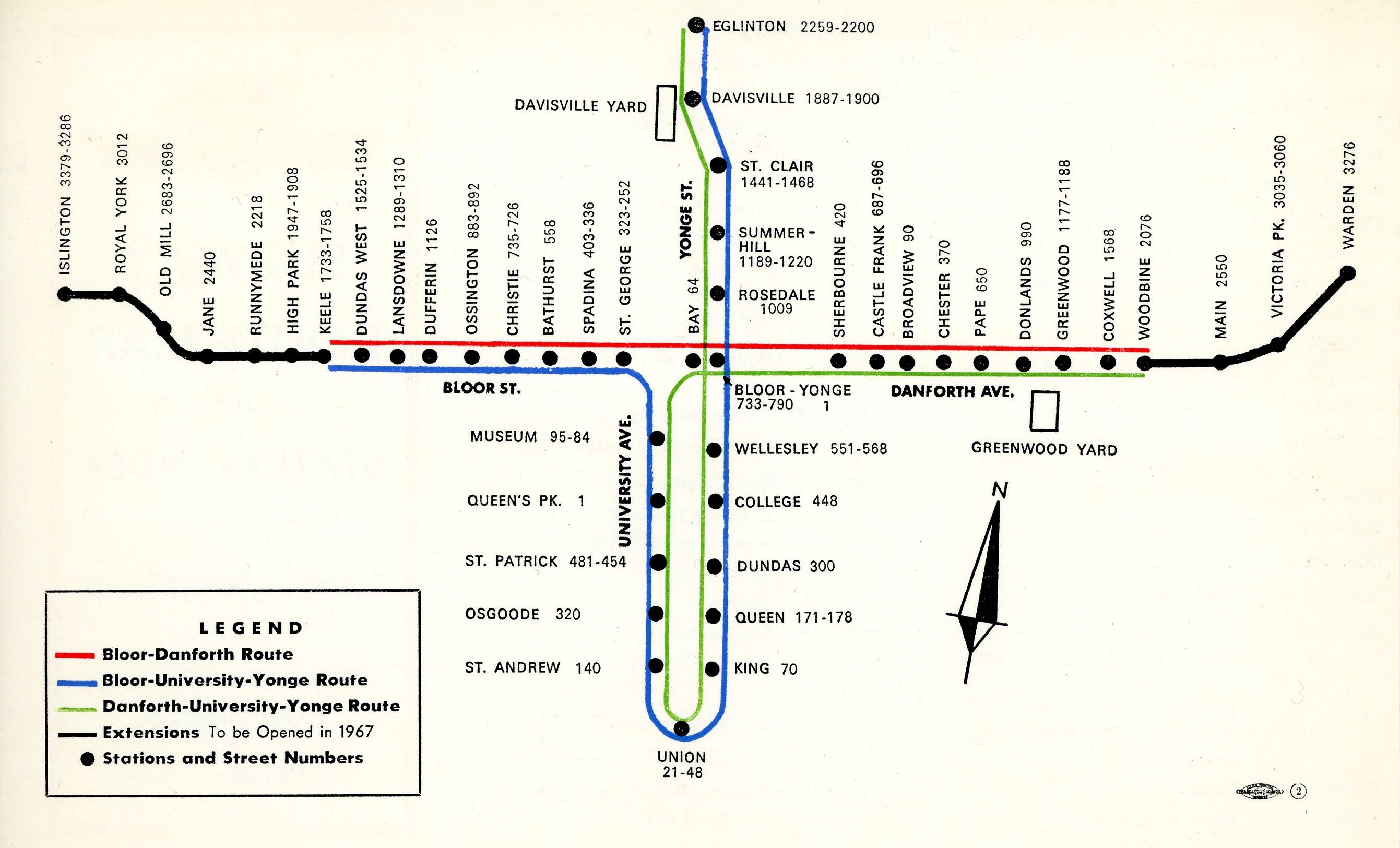
Bay Station is an inverted version of St. George Station with the Bloor line on the upper level (the currently active station) and the University line on the lower level. Tracks connect to Lower Bay from the junctions north of Museum Station and at the west end of Yonge Station. These are regularly used for equipment moves between the two lines as well as by work trains.
This station has rarely been seen by the train-riding public except for a few construction-related subway diversions. It operated in revenue service for the first six months of the Bloor-Danforth subway during the trial of an integrated service on the Yonge-University and Bloor-Danforth lines. When that ended in September 1966, the station took on various uses including storage, training, testing of platform treatments for wayfinding, and movie shoots.
During the event, trains will be parked on the platforms, and there will be displays from the TTC’s centennial book A Century of Moving Toronto.
Access is only by stairway.
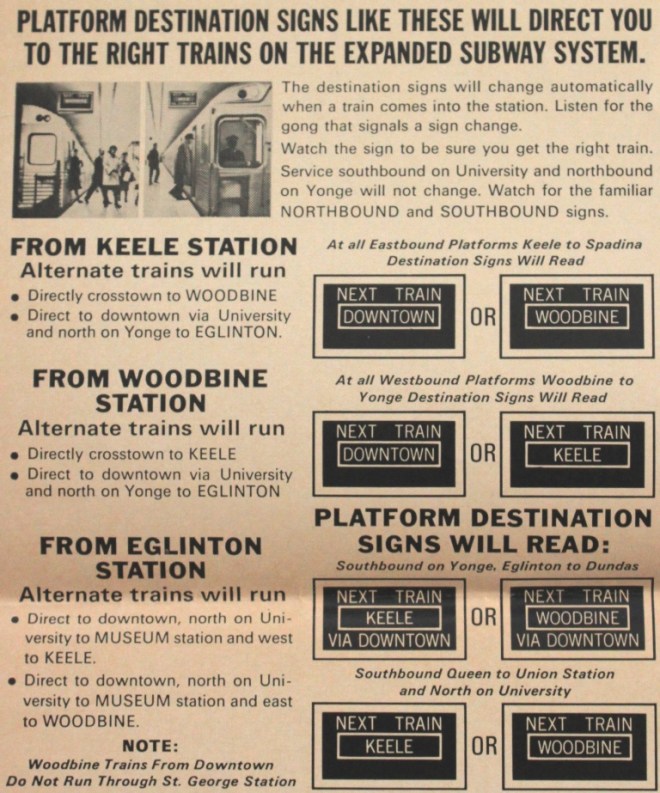
Route Map for Integrated Subway Service 1966
Here is a selection of photos from the event.
Lower Bay Station is taller than most because of the alignment of the tunnel which connects to the University line north of Museum by going under the north-to-west track into St. George Station.
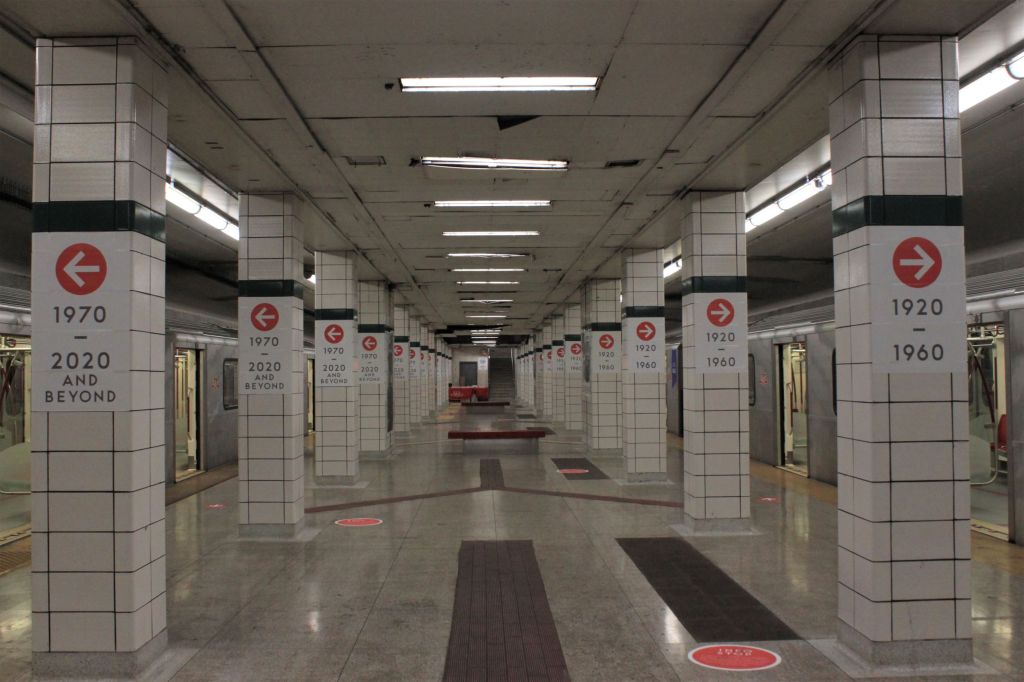
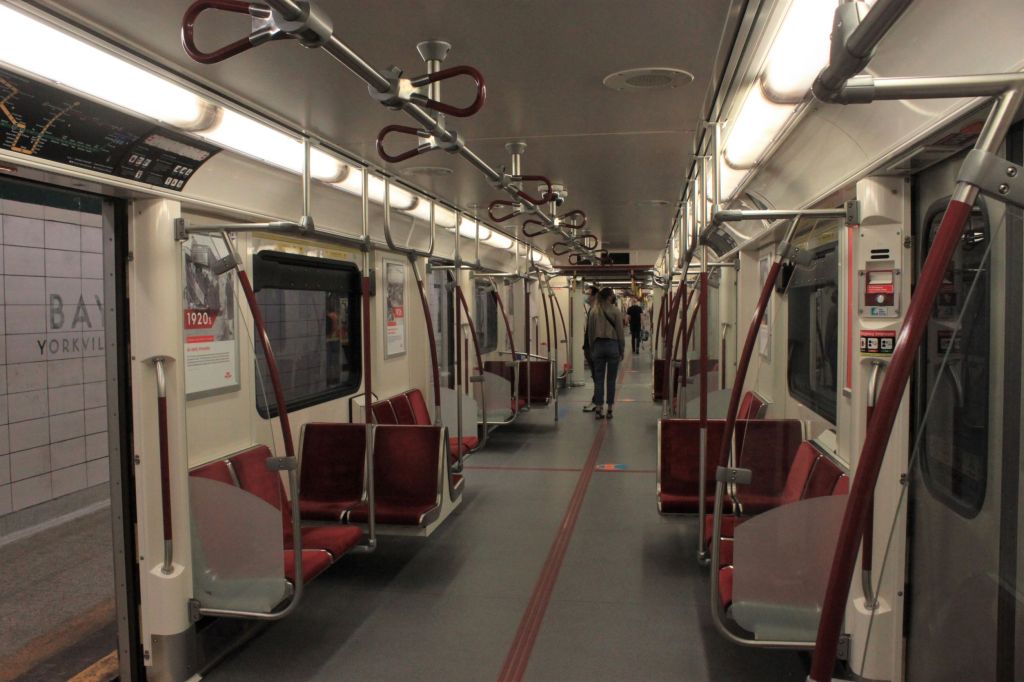
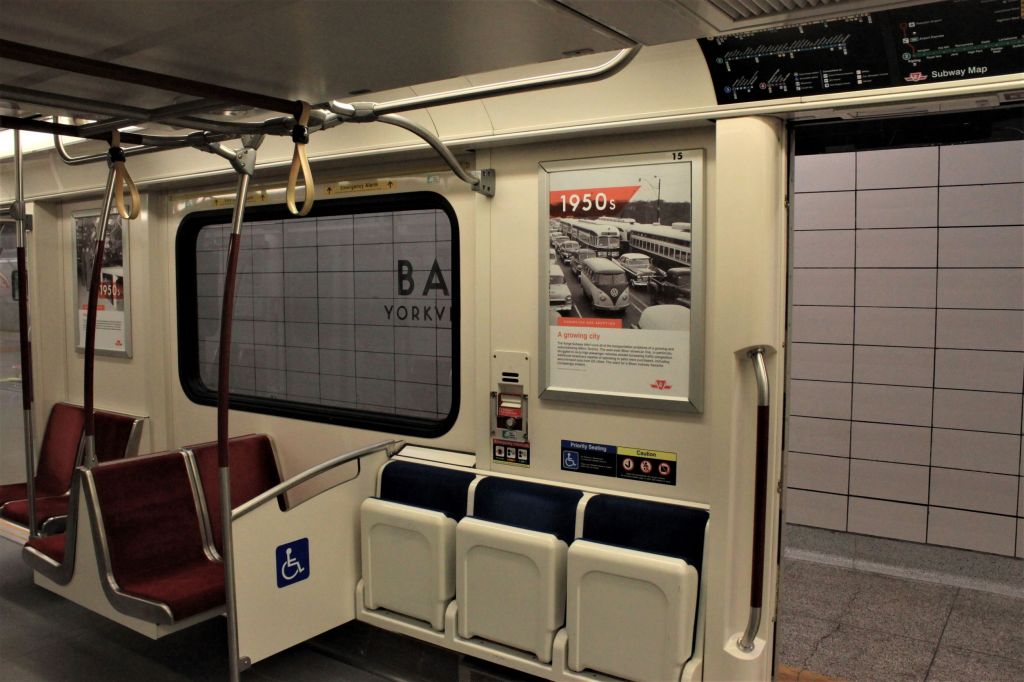
Two trains were set up with photos arranged by decade. The display is adapted from the book TTC100 which is available in hardcover or digital version from the TTCShop.
The streetcar system is a lot smaller than it was in 1949 before any of the subway was built. Streetcar trains with Peter Witt cars served Yonge, and trains of PCCs operated on Bloor-Danforth. Many other parallel routes funnelled riders into downtown.
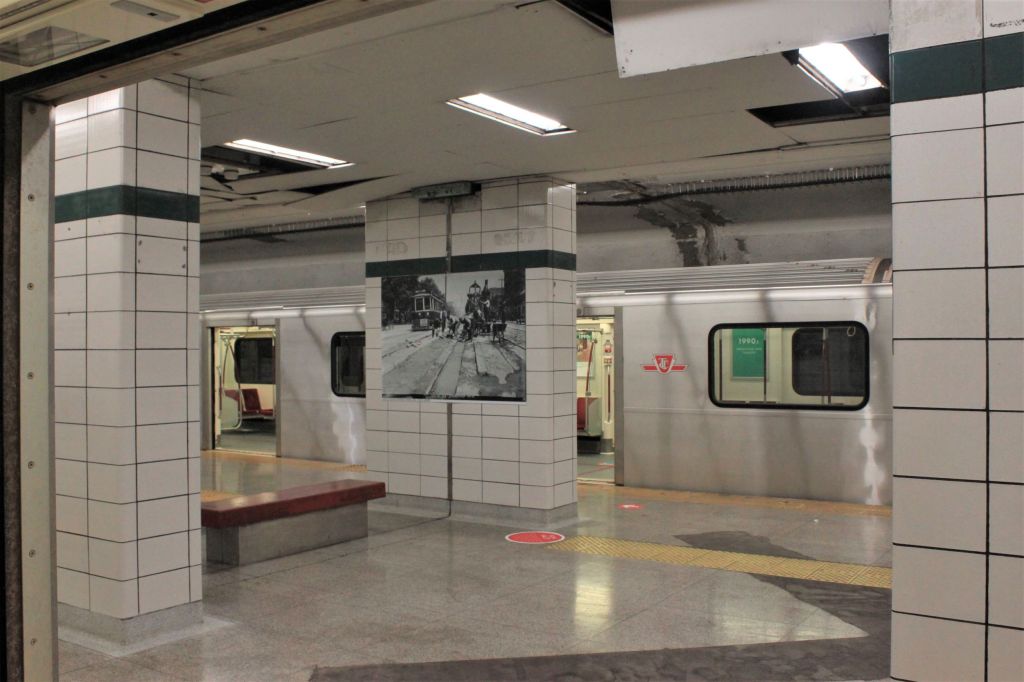
Lower Bay is a bit worse for wear, not having seen revenue service (at least with stopping trains) since 1966. It has been used, among other things, to test various floor treatments for wayfinding.
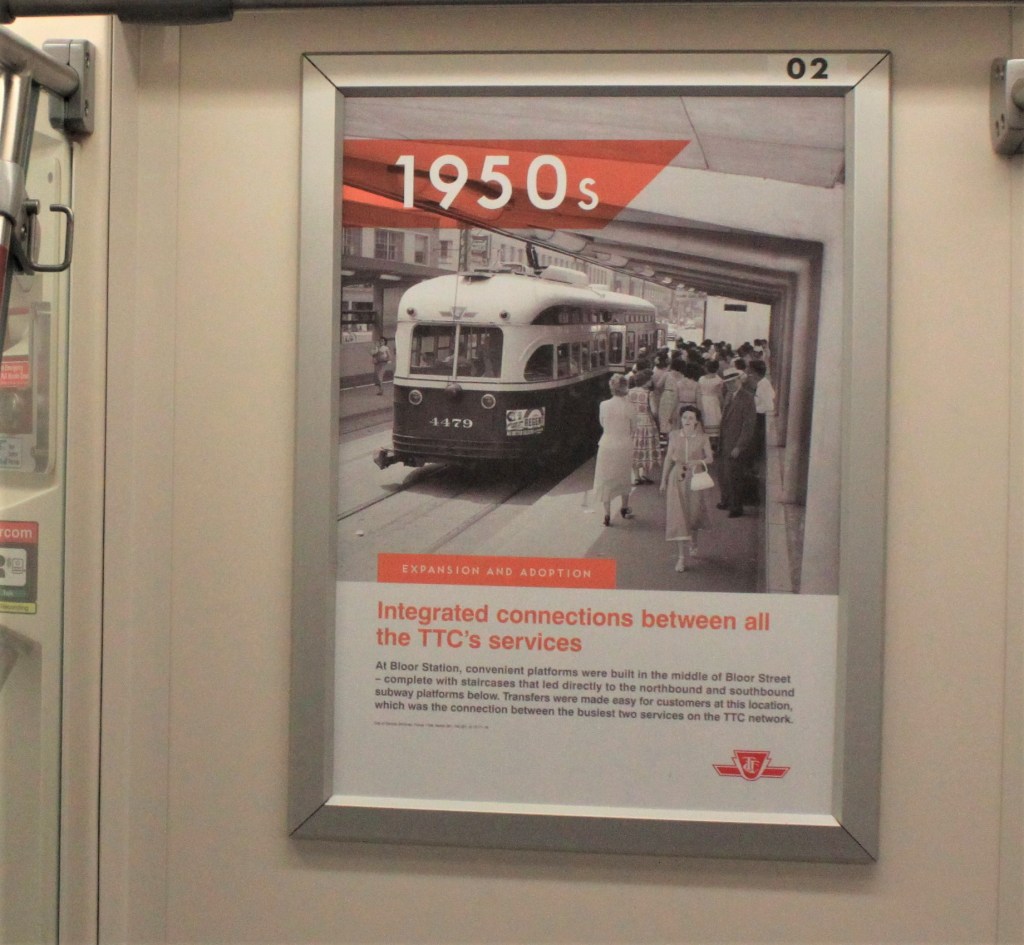
Once the Yonge Subway opened in 1954, the major interchange was at Bloor-Yonge with a protected unloading and loading platform in the middle of Bloor Street leading directly to the Bloor Station platforms below. This area will see major reconstruction in coming years as Yonge Station and the link with Bloor Station are expanded to provide a separate eastbound platform for Line 2.
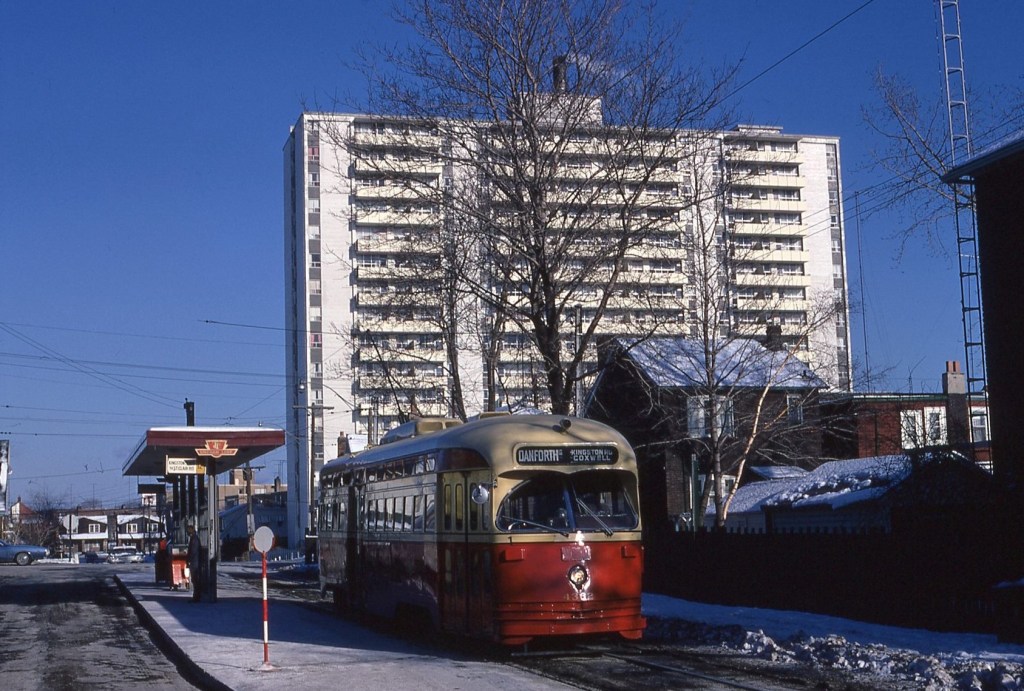
Streetcar traffic to the east end was quite intensive with the combined service Bloor and Danforth trains operating close to once a minute between Bedford Loop (now St. George Station) and Coxwell. The view looks northwest on the Prince Edward Viaduct with the trees of Rosedale in the background.
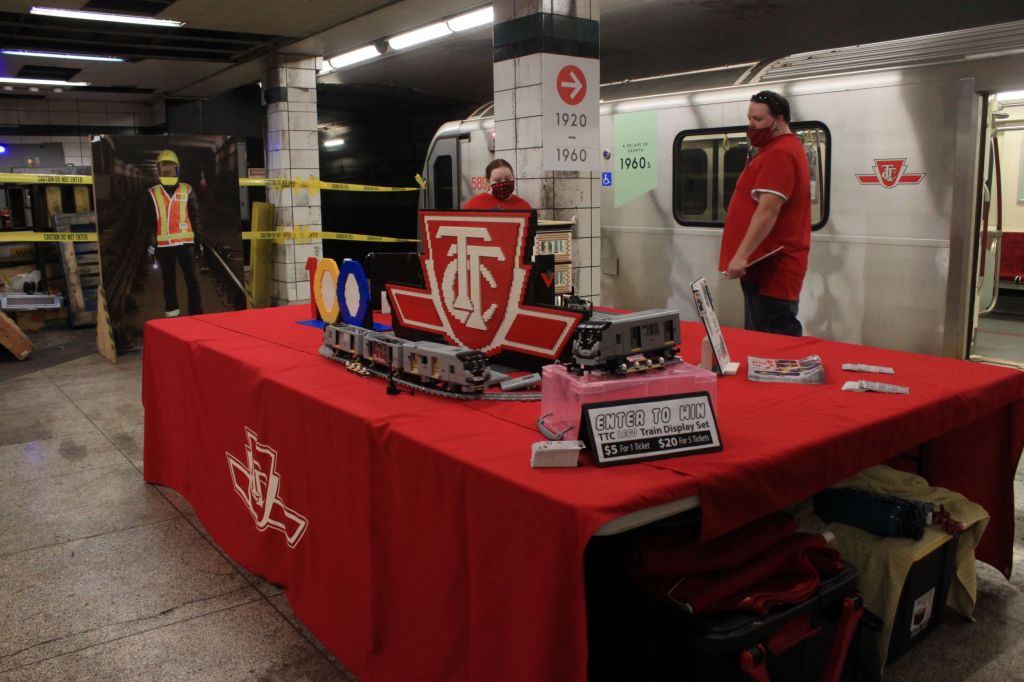
At the east end of Lower Bay, there is a TTC Lego subway train set up which some lucky soul will win in a draw.
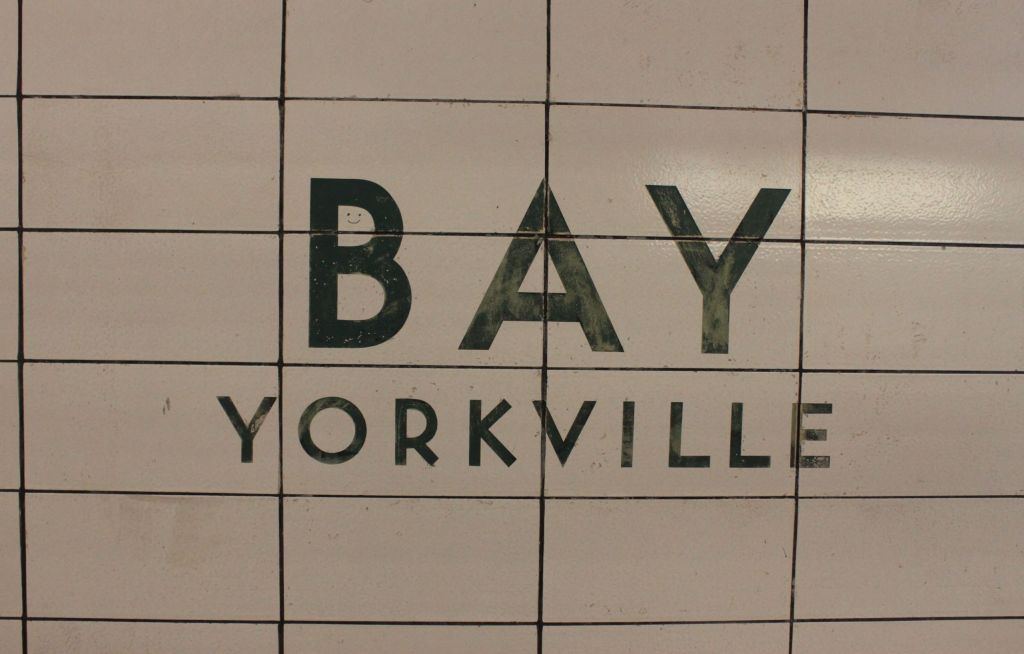
Finally, the station name is “BAY Yorkville”. This is a testimonial to the days when Yorkville was a disreputable neighbourhood full of coffee houses, people with long hair, and smokeables you can now find on any street corner. The station’s original name was to be “Yorkville” after the former town, but this was changed. This is not the only original BD station to get a different name when it was built: “Vincent” became “Dundas West”, and “Willowvale” became “Christie”.
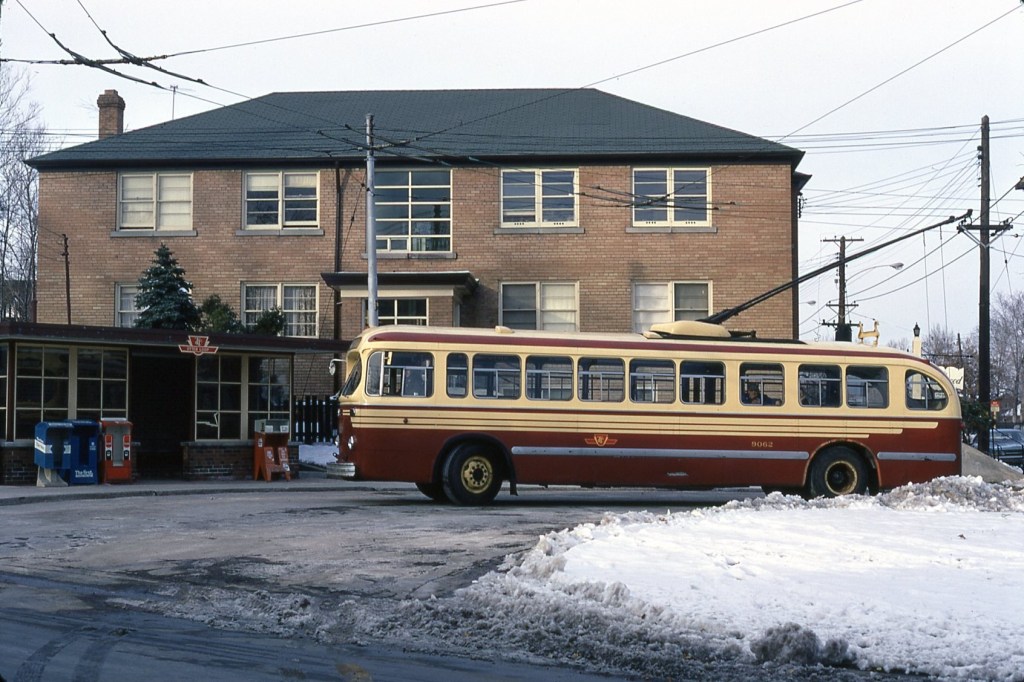
In spite of the TTC’s self-congratulatory publicity about its largest-in-North-America electric fleet, elecric buses have been around a long time and in greater numbers in the form of trolley coaches.
Toronto had a very small fleet in the 1920s, but the mode came into its own in the 1940s when the TTC replaced streetcars on some routes with trolley coaches to retire aging rail equipment. These vehicles served Toronto for two decades, and in the late 1960s, the TTC experimented with reconditioned electrical gear in a new bus body.
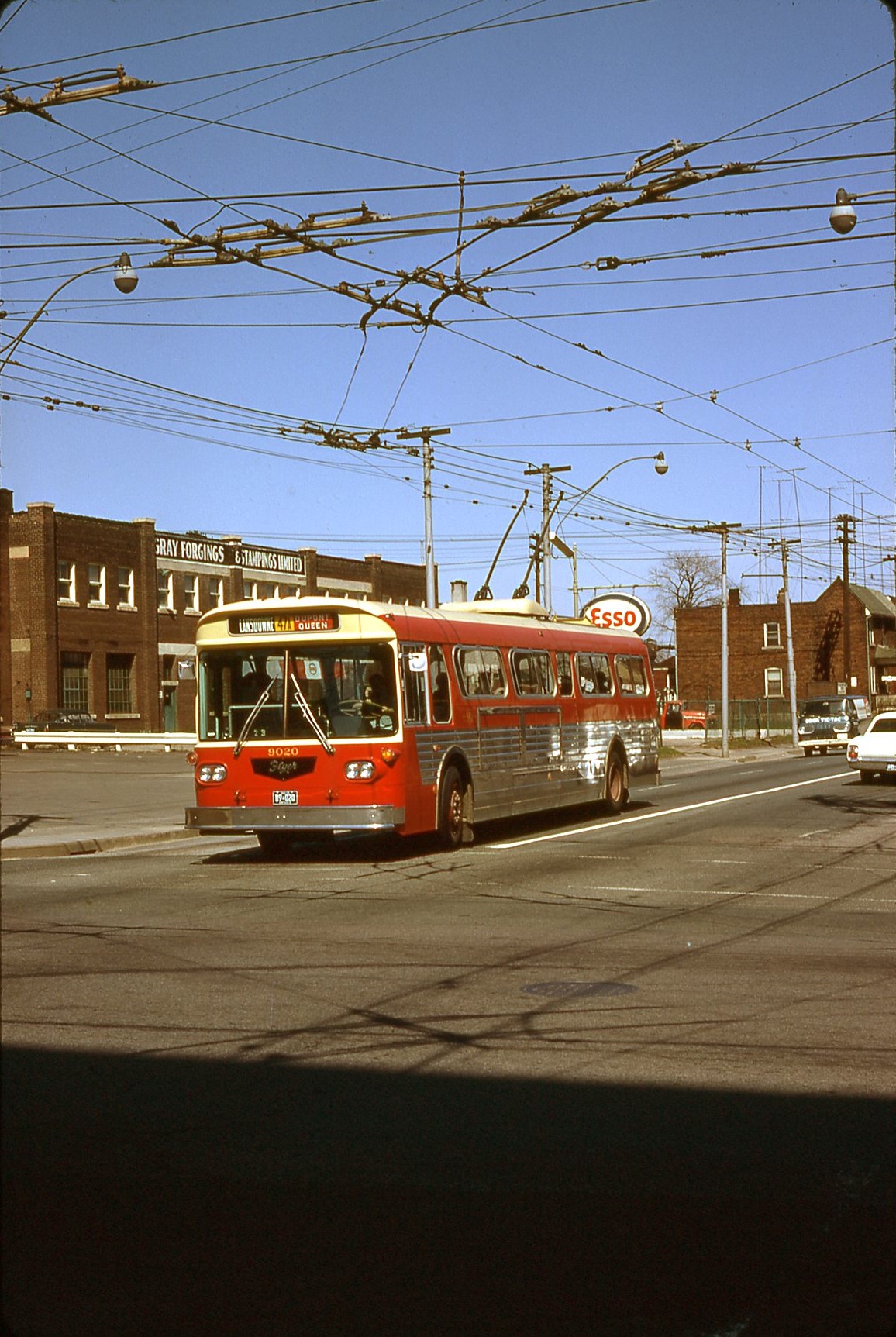
Western Flyer (as it then was) 9020 was the result, with the fleet number taken from the coach whose equipment was recycled. During its experimental period, a group of transit enthusiasts (we were not yet respectable enough to be called “advocates” or any haughtier term) took the prototype out for a spin on the network of routes based at Lansdowne Garage.
The robust nature of 1940s electrical gear allowed it to be reused in new buses, and the “new” fleet ran for over two decades. Using old electrics saved on the cost of new buses, but brought the downside that the buses had no off-wire capability.
Now, with batteries and a mixture of charging schemes, the electric bus has been rediscovered. In a few cities like Vancouver, it was never forgotten.
The TTC could still have a trolley coach network, probably much bigger than the one it dumped in 1992 for the then-latest “green” fad: “clean” natural gas buses that did not last ten years.
Lansdowne GarageSB on Beresford at LincolnEB on Lincoln at RunnymedeJane StationSB on Keele at HillsviewAvon LoopChurch St, Weston, WBChurch & Weston RoadWeston Rd at St. John’s Loop SBRunnymede LoopMount Royal N of Davenport SBLanark W of Oakwood WBOakwood S of Eglinton SBOssington SB at NorthumberlandWB on King W of CrawfordWB on Prince Arthur W of BedfordWB on Dupont at Lansdowne






 Steve Munro