TTC Historic Fleet Moves to Streetcar Museum

Updated January 29, 2025 at 7:35am: I have just received a note from the TTC stating that the historic fleet will return to Toronto following completion of reconstruction at Hillcrest. Good news, eventually.

From time to time, readers ask when or if the TTC will retrofit its historic streetcar fleet with pantographs so that cars can operate on the new pan-only overhead. That question is now answered with the move of these cars to the streetcar museum at Rockwood, the Halton County Radial Railway.

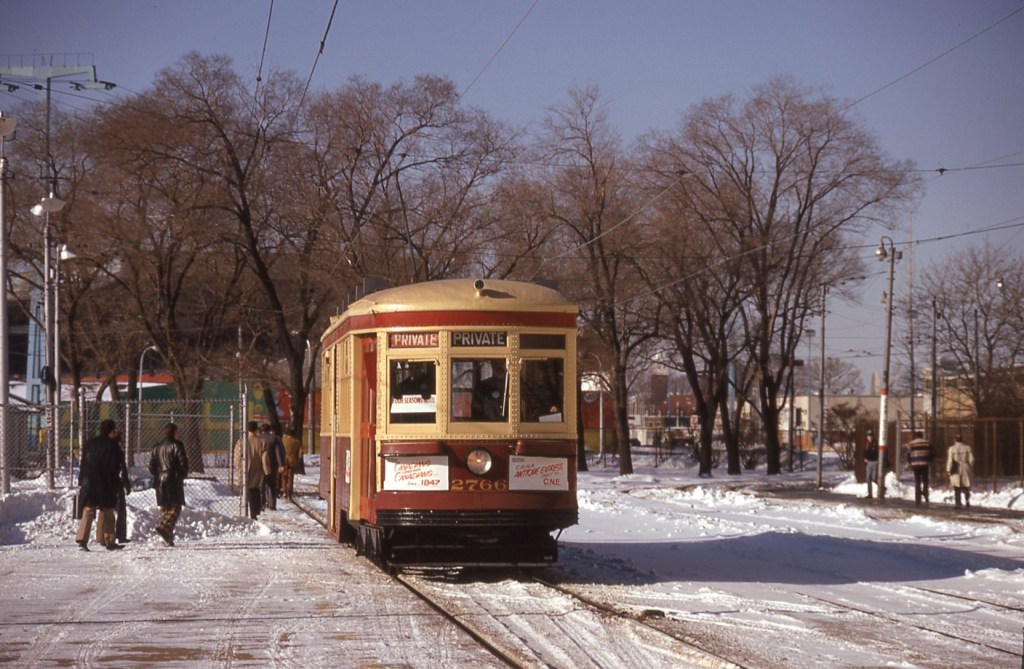
Peter Witt 2766 and PCC 4500 are already at the museum as of January 28. 4549 will move on January 29, and the CLRVs will move on February 3 & 4.

Here is car 4549 sitting at Hillcrest ready to leave.

Photo by an anonymous reader
Continue reading

Seasons Greetings For 2024

We’re almost at the end of another year, and I thank all of my readers for visiting and leaving comments that extend the discussions (usually) in a helpful direction.

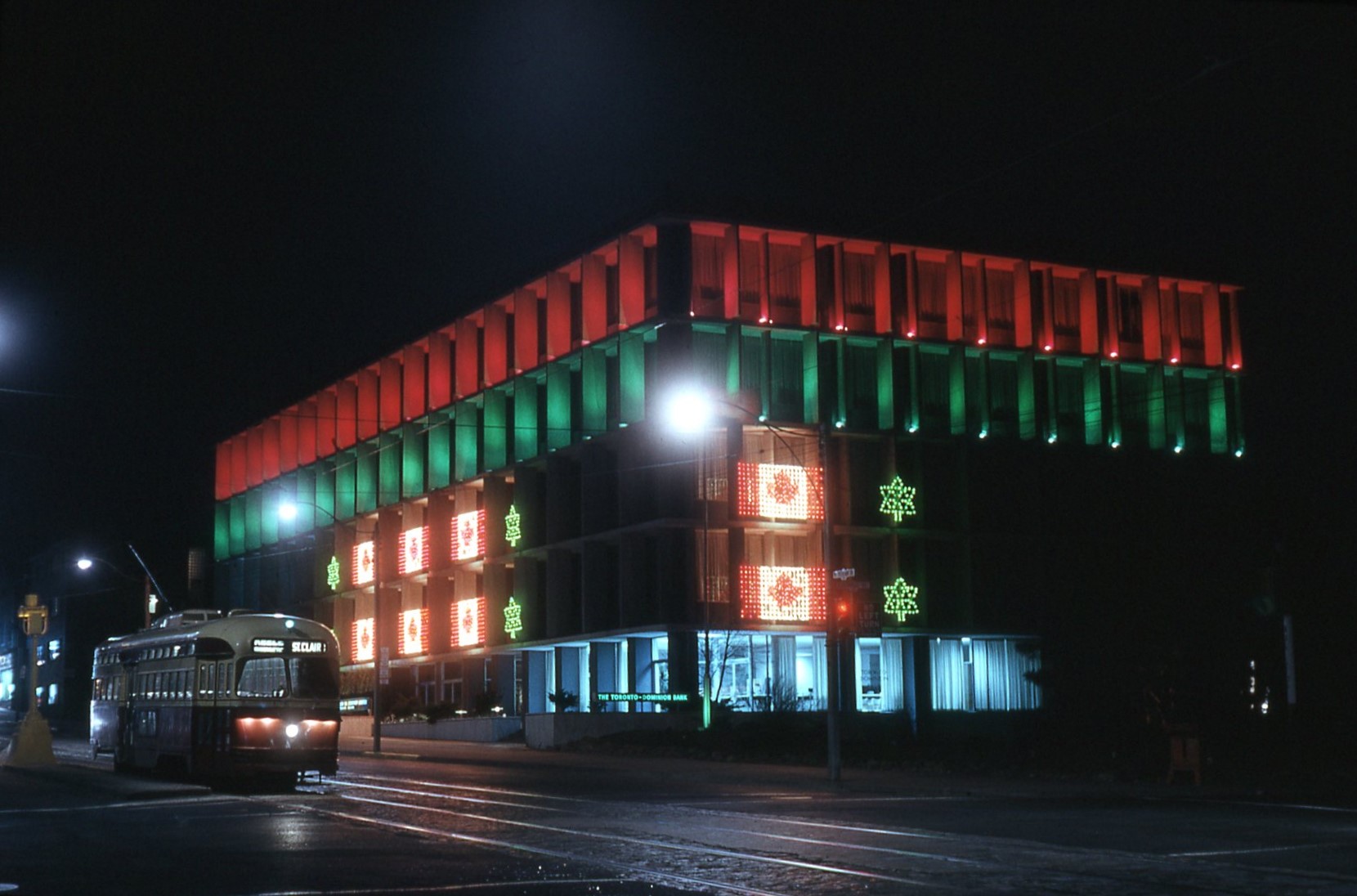
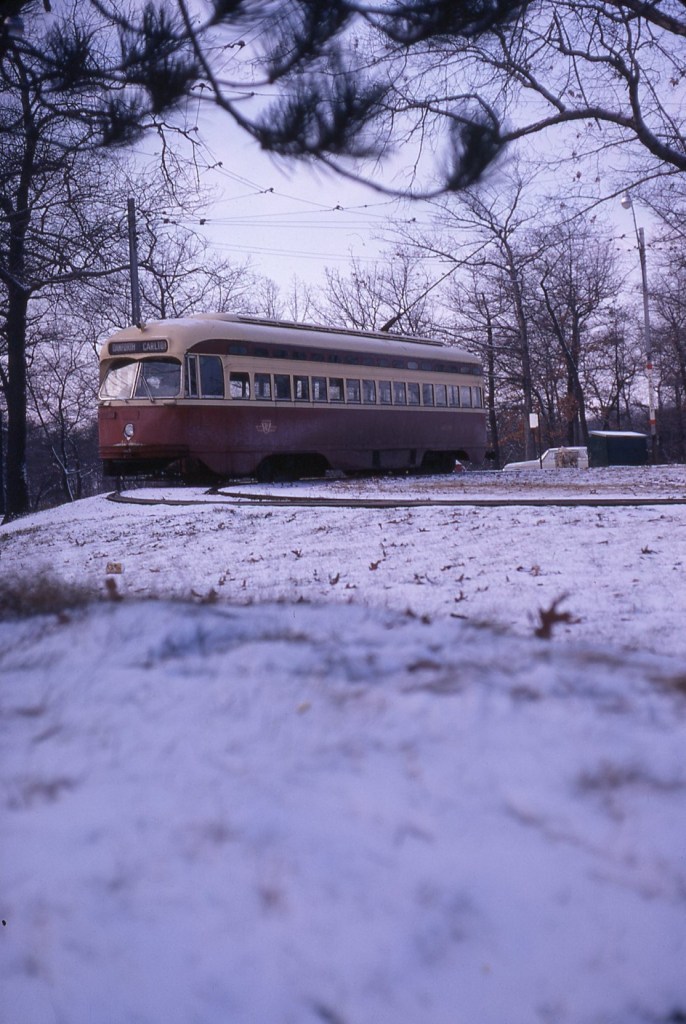
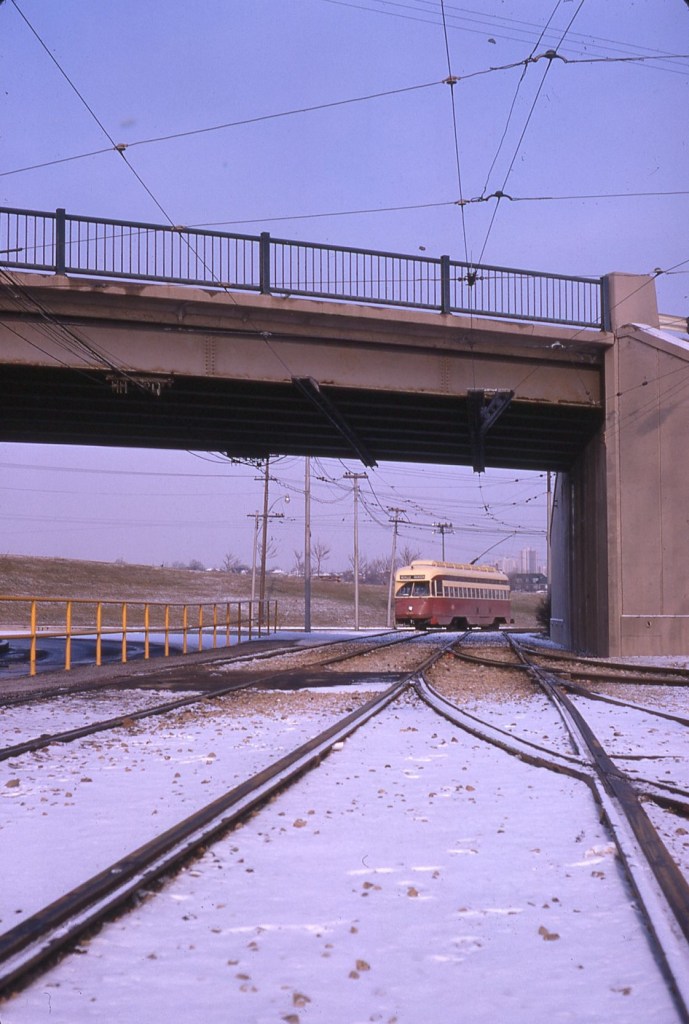
Here is ex-Kansas City PCC 4759 on a fan trip in February 1976. For much of the trip, the car operated with a Philadelphia roll sign, hence the odd destinations in some shots.

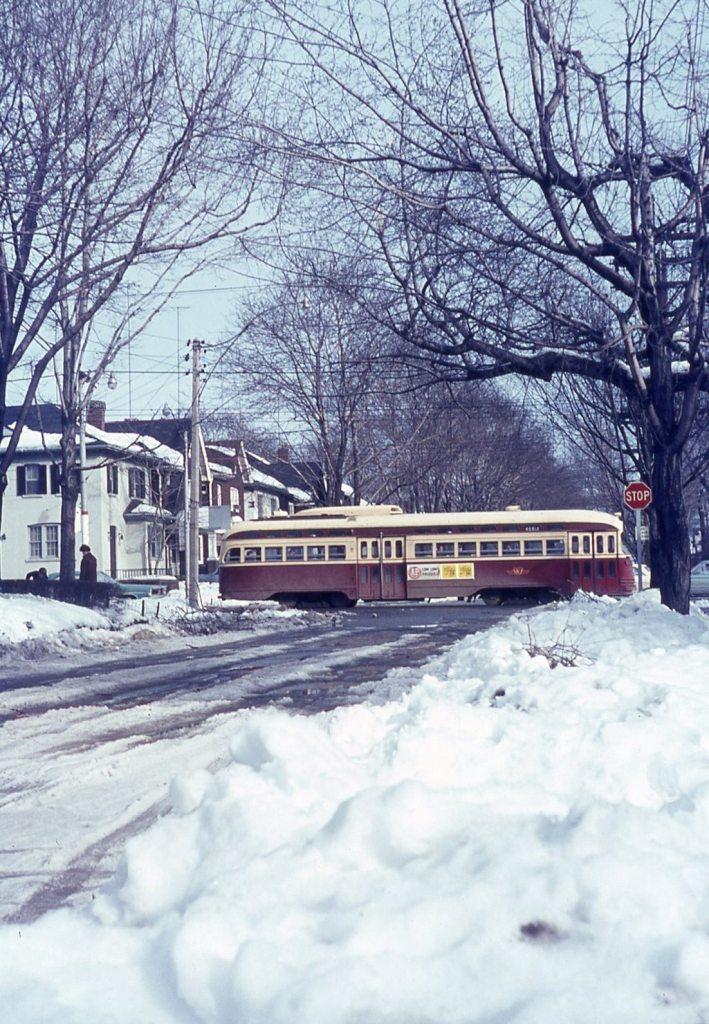
  • At Moore Park Loop in the last winter when what we now call “512 St. Clair” operated east of Yonge Street. This site is now a parkette.
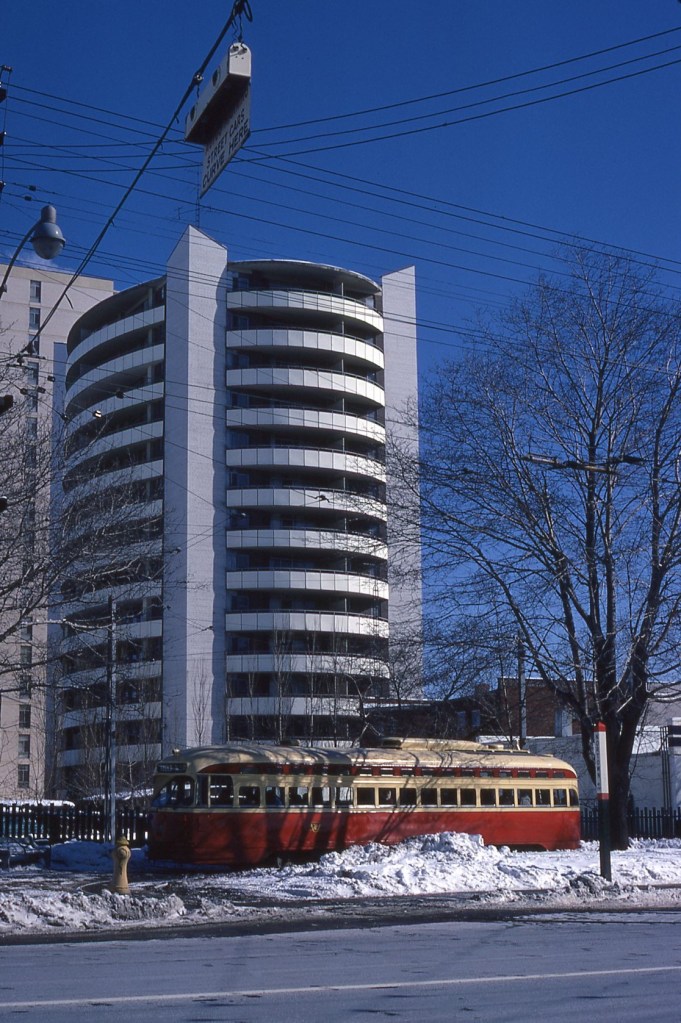
  • At the old and far more attractive Exhibition Loop before it was buried under what is now called the Direct Energy Centre.
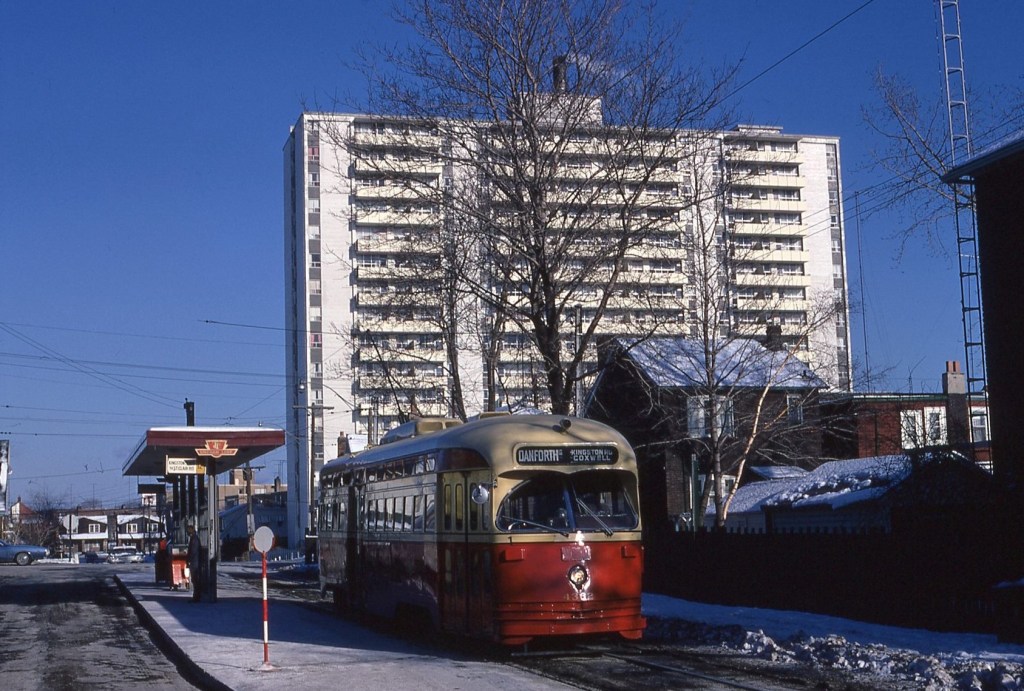
  • At McCaul Loop before The Village by the Grange.

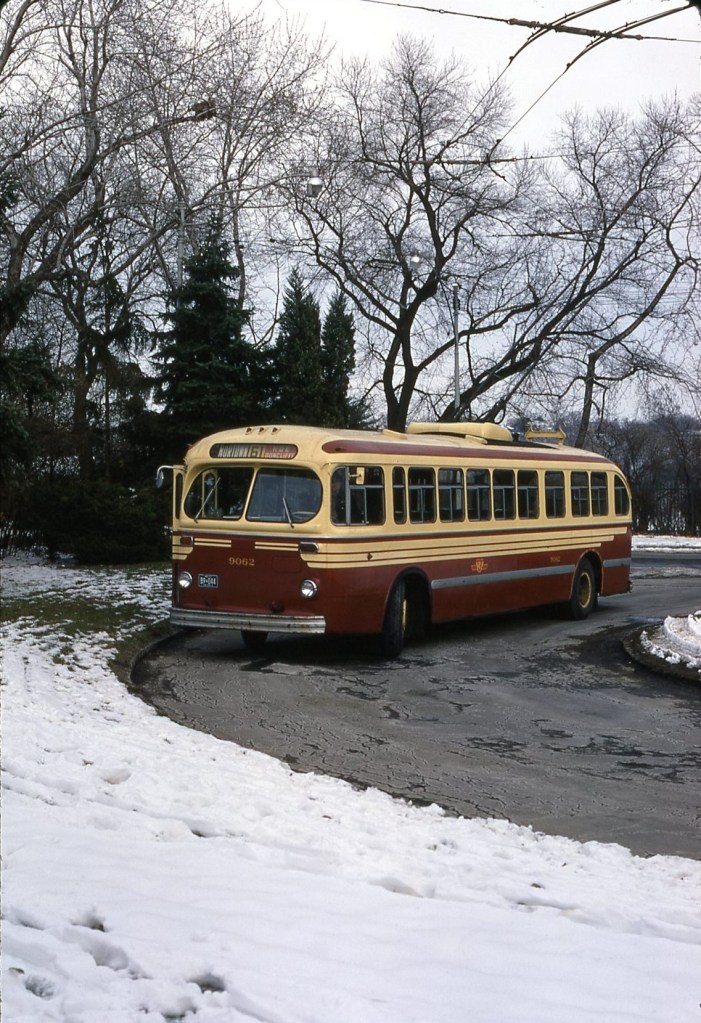
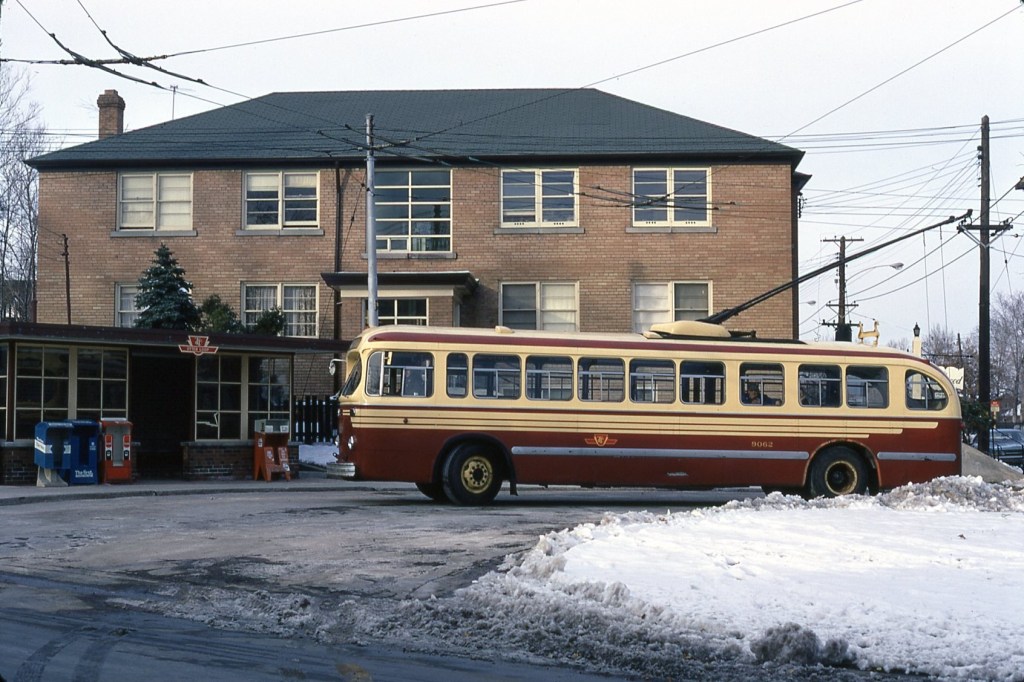
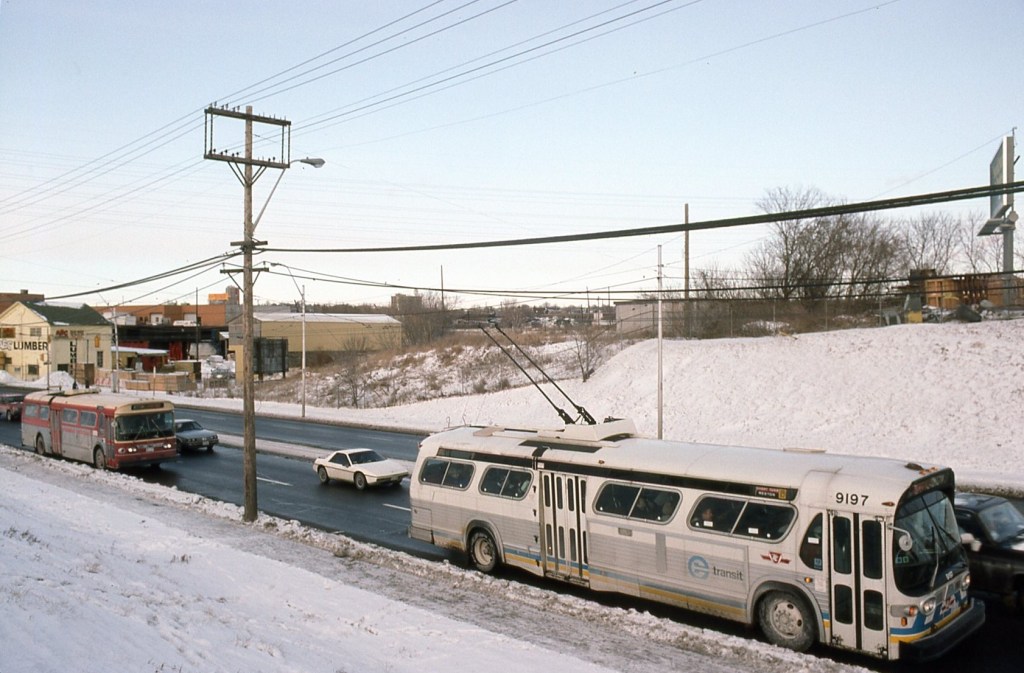
The Bay Trolleybus in 1988

Back in 1987-88, I photographed the Bay trolleybus a lot. The route was threatened for a time by a proposed one-way pairing with Yonge Street, and the south end of the route went out of service for construction of the Harbourfront line.

Looking at these photos 36 years later, two things are quite striking: the changes all along the route where the canyon of newer buildings had not yet materialized, but also the frequency of service. Getting shots with two or three buses at a time was easy, far different from today when the service is infrequent with the “best” being a 14-minute PM peak headway, and 20-30 minutes at other times. This route saw a vicious downward cycle of riding loss and service cuts, and now is simply not worth waiting for.

For a history of the route, see the Transit Toronto site.

The route’s conversion to trolleybus was an offshoot of the 1972 decision to retain streetcars. The surplus TBs from 97 Yonge, released when the subway extension to York Mills opened, were originally intended for the St. Clair streetcar route, although the proposed service level would have been worse than the streetcars to be replaced. The Streetcars for Toronto advocacy group (which I chaired for a time) pushed for deployment of the surplus TBs on Bay given its frequent service and downtown location well placed to use the existing power distribution infrastructure. (A less obvious motive was to eliminate a potential threat to any other streetcar lines with the TBs looking for a home.)

The galleries below run from south to north along the route with photos from Fall 1987 and Spring-Summer 1988. Photos of 9200, the first production bus of the “new” TBs, are from a fan excursion.

Continue reading

A Short Holiday Gallery

Toronto Considers Congestion Management, Again

At its meeting on October 25, 2023, Toronto’s Infrastructure and Environment Committee will consider a report titled Congestion Management Plan 2023-2026. With a familiar refrain, the report begins:

The City is facing an unprecedented amount of construction road closures creating congestion issues for motorists, cyclists and pedestrians and surface street transit. There has also been a significant demand for special events in the City post-pandemic with the needs for road closures and more comprehensive traffic management strategies to minimize the impacts. This situation emphasizes the demand for better coordination of access to the right-of-way and the need for improved traffic management overall to help mitigate the impacts of congestion while maintaining safety for all road users.

[Congestion Management Plan 2023-26 at p. 1]

It goes on to talk about “refocusing” on four key areas:

  • Leveraging Technology to Better Coordinate Construction on City Streets and expanding the Construction Hub program
  • Establishing a dedicated traffic management team that will work with stakeholders such as Toronto Police Services, Toronto Parking Authority, TTC, Metrolinx GO, the Office of Emergency Management and City Councillors to improve traffic management planning efforts around major events while also coordinating with ongoing construction
  • Providing increased traffic management support for surface street transit for both TTC and Metrolinx GO to help mitigate the impacts of construction related route diversions
  • Investigating Intelligent Transportation Systems (ITS), including Artificial Intelligence (AI) and Internet-of-Things (IoT) technology to better optimize traffic signal operations to help all modes move more efficiently and safely with less delay around the City.
[Congestion Management Plan 2023-26 at pp 1-2]

This appears modestly promising but for the fact we have heard many proposals before and, if anything, congestion becomes worse. If this is a “refocus”, one might ask what the City has been doing for the decade since the first Congestion Management Plan was adopted in 2013. In turn, that goes back to an October 2011 motion by Councillor Josh Matlow asking for “a report on the cost and feasibility of implementing a Synchronized Traffic Signal System”.

Looking back at years of reports, there is a common theme that changes are possible at the small scale with improvements of up to 10% in traffic flow at specific times and locations. However, these are one time effects in the sense that the improvement, once achieved, cannot repeated to cope with traffic growth.

Moreover, there is a finite capacity in the road system, and the major political challenge is to apportion this capacity among competing demands. Motor traffic, as the dominant use, inevitably must give up part of its share to give better service and space to others. This was a fundamental choice needed in the King Street Transit Priority Pilot scheme, and even there, the assumption was that some traffic could shift from King to parallel corridors.

[Full disclosure: I was a paid consultant on a project in 2014-15 to review the major east-west streetcar lines with a view to modifying traffic and parking rules to improve transit operations in the peak and shoulder-peak periods.]

Although Transit Priority is one topic in the report, there is no mention of the RapidTO program which appears to be stalled after the initial implementation in Scarborough on Eglinton-Kingston-Morningside. I am not counting the red lanes for the 903 Scarborough Express bus replacing the SRT as they came from a force majeure situation and would not otherwise have been implemented. Any of the RapidTO proposals will involve substantial change in allocation of road capacity, and they have not been well received in some quarters.

A related question is whether dedicated lanes can be justified in areas where TTC service is not as frequent as it once was on King Street, especially on a fully dedicated 7×24 basis.

In March 2020, the Covid lockdowns made a lot of traffic vanish, although as reported both here and elsewhere, traffic is now above pre-pandemic levels. This is particularly true in the suburbs where there are proportionately more jobs that are not suited to work-from-home arrangements, and where transit’s share of the travel market is hampered by service levels, route structure and trip distances.

The pandemic also triggered a move to accelerate construction projects both as a job creation program and to take advantage of the lower effect on traffic possible at the time. However, construction does not appear to have diminished, but the normal traffic level is back.

The basic problem of finite road capacity is made much more complex by the removal of significant chunks of that capacity for rapid transit construction, utility repairs, streetcar track maintenance (downtown), road and bridge maintenance, and curb lane occupancy permits for building construction. All of this might be “co-ordinated”, but the sheer number of affected locations and the duration of temporary capacity removal means that the road system is rarely at an optimal condition.

This also hampers schemes to reallocate capacity permanently for transit, cycling and pedestrians.

The current report includes only two recommendations:

  • the reconfiguration and expansion of zones served by “construction hubs” which are supposed to provide co-ordination between all projects by various parties in different sections of the city, and
  • expansion of the Traffic Agent Program (aka “Traffic Wardens”) by use of police officers and special constables.

Any other effects would come from continuation of work already approved or in progress, notably from the “Smart Signals” project which is already underway, but which is not yet fully funded.

Notable by its complete absence in this report is the recognition that some congestion cannot be easily “fixed”, and that active intervention in allocating road capacity will be necessary in the worst cases. That is dangerous political territory, especially in a City that has lived through both the Ford and Tory eras where transit did not rank first.

Moreover, there is a danger that a focus on “congestion” will reinforce the TTC’s typical behaviour of assigning all blame for poor service on external factors when their own scheduling and line management practices make a substantial contribution.

In the remainder of this article, I will review various aspects of the City’s plan and actions to date. This is mostly in the same order as sections of the report, with some consolidation to group related items.

Continue reading

Metro Morning June 27/23

On June 27, I was one of several guests on CBC’s Metro Morning doing “where do we go from here” pieces about newly elected Olivia Chow’s challenges as Mayor of Toronto.

The item was not posted on the show’s website, and so here for those who missed it is my own recording.

Why I Voted For Olivia Chow

Yes, dear readers, I have cast my ballot. My yellow envelope with a mail in ballot is safely in the hands of Toronto’s elections office.

Full disclosure: I have advised, pro bono, on some transit policy proposals for both Josh Matlow and Olivia Chow, but have not determined which were eventually adopted, if any.

My vote went to Olivia Chow for several reasons.

First, thanks to the absence of ranked ballots, I cannot pick candidates secure in knowing that if they don’t attract enough votes, my choice will go to someone else to my political liking. This time out, the job is to ensure Toronto stands up to Doug Ford’s gang at Queen’s Park and rejects the Tory cabal on City Council. I only get one vote, and it goes to Olivia.

If there were ranked ballots, I would have picked Josh Matlow first because he has been in the trenches for years, has a detailed platform and shows he can stand up to the Tory crowd. Sometimes over the top, yes, and he has a reputation for “not playing well with others”. I will take that any day over the back room dealing of Tory and any in his camp who yearn for the job.

Ana Bailão presents herself as a centrist, but her campaign started off with the prince of darkness himself, Nick Kouvalis, a long-time associate of the Fords, and a pack of development industry supporters. When on Council, she supported Tory’s fiscal program, and I have no faith in a miraculous conversion.

Mitzie Hunter has a full platform, but not, as I have written in a platform review, one that is as “fully costed” as she would have us believe. Some revenue sources she touts are already spoken for, including for transit, and to present the money as if it’s just looking for a home is, as they say in parliamentary circles, misleading.

She also flip-flopped in the past on support for Transit City in order to ride the subway bandwagon to a seat at Queen’s Park. Her embrace of the “Scarborough deserves” trope might have some foundation, given how voters there have been played for support by pols for over a decade, but as Mayor of all the city, there is a need to see other districts that deserve attention too.

Brad Bradford I know from his days on the TTC Board, and we would speak regularly about coming items on the agenda. But he rarely delivered advocacy and settled into accepting the management line, something that desperately needs to be changed at that organization. It is not the Board’s function to direct day-to-day decisions, but the Board should set policy and demand accountability.

As a candidate, Bradford has embraced the safety issue and speaks as someone right of Tory, not as someone I could imagine being even moderately right of centre. He also embraces the strong mayor powers to get things done. That path is both undemocratic and an opportunity for very bad, unchecked decisions.

Mark Saunders is Doug Ford’s candidate, and on that basis alone, cannot be trusted. Moreover, he is known both for substantially dismantling the machinery of police traffic enforcement, for his blind eye on a major serial killer case that wrecked his credibility with the gay community, and for a paid advisory role to Ford on the Ontario Place privatization. He is unworthy of consideration.

Returning to Olivia Chow, I believe that criticism of her detailed platform as rather thin is valid, but I am willing to believe there is room for improvement. A major problem with the past decade and more at Council is that policy debates begin with the tax increase (or lack of it), rather than with determining what we actually need and what has top priority. Departments and agencies were given budget targets, and they generally do not present a “Plan B” for what might be done with more money.

That brings at best “business as usual” plans, or trimming in the name of “efficiency” often without revealing the actual effect of budget cuts. The sham of the 2023 TTC budget process was disgusting. Details of service changes that were already designed in January were withheld from the TTC Board and Council until long after any alternate policy might have been adopted. We might not be able to afford all of the service we want, but we should know what is really on the chopping block, and what the cost of alternatives might be.

Simply having an open, frank discussion will put council and citizens in a much better position both to know what is possible, and to defend calls for better funding and new revenue streams. That is a path I hope Chow will follow, and with Matlow as a trusted ally on Council.

Promises, Promises: 2023 Edition

The Toronto Mayoral By-Election is just under a month away, and candidates pump out announcements daily, often with a transit spin. In this article I will look at the transit-related issues they are trying to address (or in some cases avoid).

All of this takes place in a strange world where the availability of money to pay for anything is suspect. Is a promise is even credible let alone affordable? Many of the platforms overlap, and so I will take related issues in groups rather than enumerating and critiquing each candidate’s platform.

A month ago, I wrote about what a transit platform should look like:

That sets out my philosophy of what I seek in a candidate, and the short version appears below. If you want the long version, click on the link above.

  • Service is key. Run as much as possible, everywhere, and run it well.
  • Build budgets based on what you want to see, not on what you think you can afford. Just getting by is not a recipe for recovery and growth. If the money doesn’t come, then look to “Plan B” but aim for “Plan A”.
  • Fares are a central part of our transit system, but the question is who should pay and how much. Strive for simplicity. Give discounts where they are truly needed. Make the transit system worth riding so that small, regular increases are acceptable.
  • Focus on ease of use among transit systems in the GTA, but do not equate “integration” with amalgamated governance.
  • Transit property: parking or housing?
  • Foster a culture of advocacy in management and on the TTC Board.
  • Beware of lines on maps. A “my map vs your map” debate focuses all effort on a handful of corridors while the rest of the network rots.
  • Plan for achievements in your current term and make sure they actually happen. Longer term is important, but the transit ship is sinking. You are running for office in 2023. Vague promises for the 2030s are cold comfort to voters who have heard it all before.

Full disclosure: I have always maintained an “open door” to anyone who wants to talk transit, and in this round I have been approached by both the Matlow and Chow campaigns for information and advice, as well as some media outlets. This I provided pro bono and without any “leakage” of who asked me what. No other candidates asked. How much of my input shows up in platforms is quite another matter. We shall see as the campaign unfolds.

Continue reading

Au Revoir to Queen Street

With the shutdown of Queen Street for Ontario Line construction between Victoria and Bay, we will not see streetcars there for many years. The last cars will run just before midnight on April 30, 2023.

Until early 2024, the absence will be over a longer stretch from Broadview to McCaul until new diversion track via York and Adelaide is finished. In turn, that depends on relocating nine utility vaults under the new Adelaide trackage.

It is possible that the TTC will revise the diversion pattern once the Don Bridge reopens to streetcars later in 2023 (it will close for maintenance on May 7), but nothing has been decided yet.

Here are photos of various generations of streetcars on the central section of Queen as a memento while we await their return.

Note that this is a large gallery, and it will take a while to load after you first click on a photo.

Continue reading