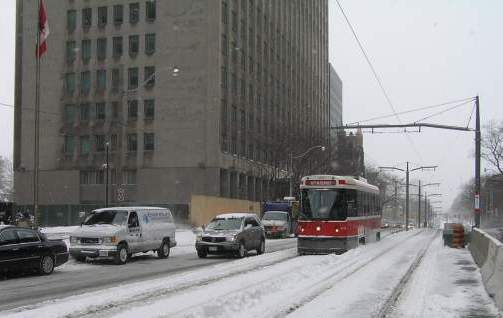
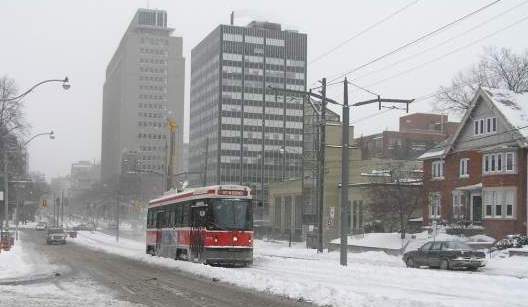
Jane’s Walk 2: My Home Streetcar Lines — Mt. Pleasant & St. Clair

Back in the days when goodly chunks of “the suburbs” were still farms, I grew up in North Toronto near Mt. Pleasant and Eglinton.  This neighbourhood dates from the building boom of the 1920s, although our house was older, 1906, the third one built in our block.  The old farmhouse up the road was replaced by two monster homes a few years ago, and now ours is number 2 in seniority.

When I was young, I spent a lot of time down at Mt. Pleasant Loop watching the streetcars.  This was a typical old style TTC loop with trees and benches, a house to the north and a BA gas station to the south right on the corner.  All of that’s gone now, and the loop is simply a hole in the front of seniors’ building where, infrequently, one can find a Mt. Pleasant bus.

The other corners held Ted’s Restaurant (gone — replaced like other stores around it with an ugly midrise office block), Eglinton Public School (replaced by a new building that turns its back on the intersection with a dead wall where once there was a playground), and the Bank of Commerce (now a Second Cup, but at least the original building).

Tracks ran west on Eglinton to Yonge, but these were never used for revenue service.  These had been installed in 1930 to allow operation of the St. Clair line from Eglinton Carhouse, but this never happened.  The junction at Mt. Pleasant came out in 1959, but the track to Yonge, buried under pavement, remained years longer until Eglinton was repaved. Continue reading

Streetcar Track Construction Update

The TTC agenda for April 18 includes a report recommending award of a three-year contract for “rubber encapsulation” for special trackwork.  This technique, technically called “elastomeric isolation”, extends the mechanical isolation of track from regular tangent rails to the intersections where there is much more vibration and potential for roadbed damage.

The TTC pioneered this design for special work installation with three test sites:  King & Queen (Don Bridge), Main Station Loop, and finally a large-scale project at King & Dufferin.  The impending work on St. Clair at Robina and at Oakwood, as well as intersections along the Dundas line will all be encapsulated.

Other design changes are in the works according to the TTC’s Jim Teeple:

Not only have we been evaluating the polymer used for the isolation, we have also been reviewing fastener and tie technologies as well. Our primary objectives are: life-cycle (including future vehicle fleets) , in-street construction timelines (panalisation to minimise disruption), reduced preventative maintenance, ongoing maintenance costs, capital costs, in roughly that order.

The St. Clair project this year will see Hydro working between Vaughan Road and Westmount Avenue (one block east of Dufferin Street) to underground its services, while the TTC rebuilds the streetcar right-of-way from Westmount to Caledonia (where Hydro services are already underground).  St. Clair West Station Loop will also be rebuilt this summer, and the work will include repair of expansion joints in the station structure.

The remainder of the line’s reconstruction (Vaughan to Westmount, Caledonia to Gunn’s Loop) will take place in 2008.  There is no word on the proposed extension westward, but this is included as part of the Transit City scheme.

In a previous post about the overall plans for special work replacement, I raised the question of why some intersections on Spadina were listed even though they are comparatively new.  It turns out that budget estimates are done based on formulas including service intensity and the time projected for special work to deteriorate to the point of needing replacement.  The Spadina intersections were built long before the move to mechanically isolate the track and this, combined with the extremely frequent service, will bring them up for replacement sooner rather than later.  However, the actual timing of the project will be based on actual conditions on site, not simply on a formula.  The TTC’s track construction plans change every year, and we may see the Spadina intersections move further out if they remain in better condition than expected.

St. Clair Update – Almost, But Not Quite

I wandered up to St. Clair West Station today to check out the current signage situation.  On the bus/streetcar platform level, I found a forest of signs pointing me to the eastbound bus stop inside of the station.  Hurrah!  Hurrah!  An indoor connection.  I was amazed at how few people got on with me, but all was soon revealed.

The bus took a circuitous route to get itself eastbound on St. Clair:  Leave by the west ramp (the east one is still closed for construction), south on Bathurst, northwest on Vaughan, east on St. Clair (bypassing the hordes waiting at the eastbound stop at least some of whom probably wanted to go to Yonge Street), and thence to the south entrance to the station.  That’s where the big crowd of eastbound passengers was waiting.

Didn’t they see all the signs?

Well, no, they didn’t.  People getting off a train come up to the mezzanine where there are NO signs telling them that the bus is back inside the station, and they trudge out to the south entrance as they have for months.

Maybe when they finally get the east ramp open, someone will think to put up signs telling people NOT to go out the south exit because the next bus along will be the night bus.

Meanwhile, the beginnings of overhead construction are underway.  How they will get the work done by February 18th in this weather I do not know.  But the real kicker is that the overhead hangers are incompatible with pantograph power collection.  At least on Spadina we got modern overhead, but on our new, premier example of LRT, we get overhead that would be at home in the 1920s.

Maybe we could save the expense and just run horsecars.

StClairOverhead

Photo courtesy of Harold McMann.

My Little Jaunt to Forest Hill

This evening, I attended a concert at Grace Church in Forest Hill.  Because I was coming from Mt. Pleasant and Eglinton, the logical way to get there was to go to St. Clair Station, take the 512 bus, and then walk north on Russell Hill.  My experience shows that the TTC still doesn’t get it. 

I arrived at the Pleasant Boulevard loop in time to see the 7:25 South Leaside trip sitting on the platform.  No St. Clair bus.  After a 10 minute wait, one arrived, but it parked down at the far end of the loop for a crew change.  About 5 minutes later, a second bus arrived and parked behind the first one.  It was now 7:40 and I was in danger of missing my concert.

I walked out to St. Clair and Yonge (if I got really lucky, the first bus might make it to the stop by the time I got there), and found that a third bus was coming east on St. Clair.  This means that 3 of the 4 buses on the route (on a 7 minute headway no less) were at one end of the line.

I took a cab.

The TTC is fond of telling us how it will build ridership for new rapid transit lines by running really good surface routes in anticipation.  The 190 Rocket from Don Mills Station to STC is a good example, and ridership is building up on this route (although to nowhere near subway levels). 

The service on St. Clair is a disgrace that bears absolutely no relationship with the schedule.  This is not the first time I have found packs of buses and seen long layovers at St. Clair Station.  Please don’t tell me about traffic congestion.  There was none.  If anything, the TTC is driving riders away from St. Clair, a line that is to be the shining example of what we can do with LRT.

Memo to both the TTC and the ATU:  Better service means more riders.  “Better” includes properly managed, well-spaced, predictable service.  More riders means more justfication for expanding the system, and more work for union members.

Also, someone might like to take down the timetable for the Christie bus as well as the handwritten sign telling people that both the Christie and Vaughan buses will take them along St Clair.  They don’t run to St. Clair Station any more.

Always A Car In Sight

That, believe it or not, used to be the TTC’s slogan years ago when transit service was a far more important part of the life of Toronto than it is today.  Three love affairs have brought us to where we are now:

  • The automobile
  • The subway which moves huge numbers of people provided they’re going where one was built
  • Tax cuts and changes in public spending priorities

From time to time, people ask me both about how service has declined and about the practical limits on streetcar service.  I am not going to pretend that the answer to our problems is to build streetcar lines running in mixed traffic everywhere.  For one thing, there’s a lot more of that “mixed traffic” than there used to be.  But it’s interesting to see what streetcars were doing even well into the “modern” automotive era. Continue reading

Service For January 2007

January 2007 does not bring much in service changes beyond the return of streetcars to St. Clair west of the Spadina Subway.  Buses will continue to run east to Yonge Street until, it is hoped, the middle of February.

The RT will continue to operate with buses on Sundays to allow testing of the new RT signal system.  As a regular user of this line, I am looking forward to it actually working on those cold mid-winter days (which surely will be here eventually) when the old system regularly froze up.

There are several minor changes in running times and a few added trips here and there, but nothing major in improved service.  Current expectations are that we won’t see anything significant until the fall when sufficient operators, buses, and budget headroom will, in theory, be available.

Meanwhile, the list of services that should be improved or operated, but are not due to funding and other constraints, continues to grow. Continue reading

Howard Levine Writes About St. Clair

Howard Levine, a former member of City Council and one of the founding members of Streetcars for Toronto back in 1972, writes in today’s National Post about the St. Clair project.  Howard and I sit on opposite sides of the St. Clair fence these days — I still believe in the scheme and wish it were done better, while he sees it as irredeemably flawed.  I share his despair that what we fought for in 1972 took so long to achieve and was such a botched piece of design and community relations. Continue reading

St. Clair Update

Christopher Hume has a column in today’s Star about the St. Clair line (Click here) where he discusses the gap between theory and practice in major urban design/construction projects.

This morning, CBC’s Metro Morning had a discussion about the impact on businesses with the owner of the Retro Cafe (at Vaughan and St. Clair) and David Crichton, the city’s manager for design and construction.  With luck this may show up later today as a podcast on the CBC site here.  It may have been early in the day, but Crichton continued the city’s unhappy stance of saying “it’s too bad, but we have to rebuild the street” while ignoring that the design and the construction phasing have considerable impacts. Continue reading

How Joe Mihevc Got Conned On St. Clair [Updated]

[I received a very long response to this item via email which contains enough information that I believe it is worth having alongside the original post here.  I have added it below.]

Back in the dark ages when we had public participation meetings on St. Clair, there was a huge amount of concern about intersection design and curb cuts.  The folks along St. Clair were deeply suspicious, and rightly so.  As I have often written, the road engineers cannot be trusted with anything and need to be wrestled to the ground for the slightest design improvements.

Then, finally, construction started.  I had talked to Councillor Mihevc several times about the need to corral the engineers, and met with him and Jim Teeple, the TTC’s project manager, in the cafe over Loblaw’s one day.  I was assured that Joe had his eyes open and was working hard to minimize the intrusions of the project.

That was when the project stopped at the east ramp into St. Clair West Station.

Then something odd happened.  In the interest of speeding up construction, the work for 2006 was extended west to Vaughan Road.  What we now see is the same ridiculous curb cuts that were in the original TTC plans, and which many had assumed we would be able to fix as part of the detailed design for the section from Bathurst west.

It didn’t happen.  The road folks got their widenings, the community got ridiculously narrow sidewalks, and Joe has turned into an apologist for this outrage.

Now we have to go into detailed design for the next section actually believing that we have a chance to get proper treatment for pedestrians and businesses along the street.

The TTC and Council must insist that roads be designed for people and neighbourhoods, not just for cars. Continue reading