Metrolinx work at Queen and Degrassi Streets will require a street closure and diversion of transit service during installation of a new bridge deck for the Lake Shore East GO corridor. As part of the Ontario Line work, the GO corridor will be raised to the now-standard elevation above roads it crosses. This work has been underway at various locations northward from Eastern Avenue along the corridor.
The Metrolinx work will begin on the evening of Friday, September 27 at 9pm, but the TTC will remove its streetcar overhead and power supply beginning on Thursday, September 26 at 9pm.
The Metrolinx work will end on the morning of Monday, September 30 at 5am, but streetcar service will not resume until Wednesday, October 2 at 4am to allow for reinstallation of streetcar overhead. A benefit of the new, higher bridge is that problems with passing trucks tearing down the overhead should cease.
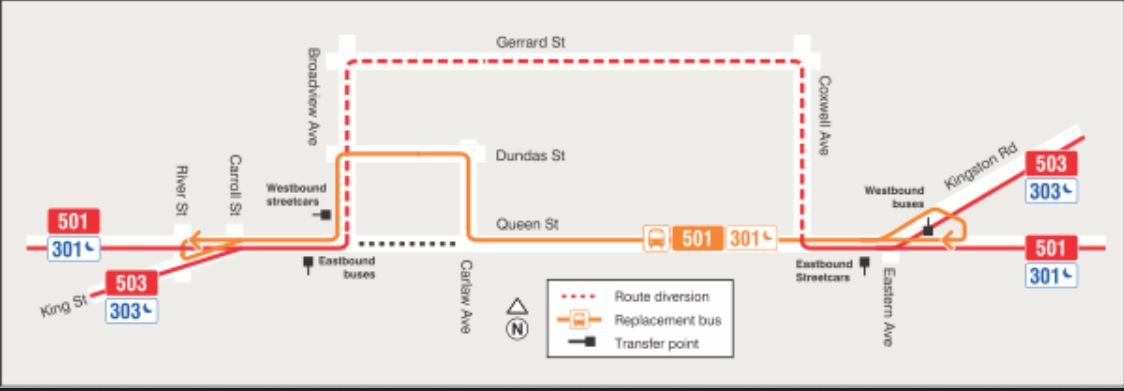
TTC will run a shuttle bus service between River Street and Kingston Road, diverting both ways via Broadview, Dundas and Carlaw around the construction area.
This will affect the daytime and overnight services on 501/301 Queen and 503/303 Kingston Road.
TTC map:
Metrolinx map:
The TTC and Metrolinx notices for this work contain slightly different information. I have confirmed the dates shown above with TTC Media Relations.
The City/TTC project to rebuild utilities, track and the roadway on King Street between Dufferin and Shaw Streets has completed earlier than originally planned. The roadway is now open, and TTC will be restoring power to allow testing of its new tracks and overhead.
Streetcar service between Shaw and Roncesvalles on King will resume with the October schedule change on October 6. Affected routes will resume their normal destinations:
501 Queen will operate to Humber Loop.
504B King will operate to Dufferin Loop.
63 Ossington will resume its Liberty Village loop via Atlantic Avenue and King Street. (Although there was a proposal to change this route to use Dufferin Loop as a western terminus in the Service Plan, this is not being implemented.)
This project originally included the reconstruction of the King/Dufferin intersection, but this was deferred to 2025 as part of a planned water main and track replacement project from Dufferin Street west to Close Avenue.
According to the TOInview map of planned construction work, other water main and track projects affecting King Street in 2025 include:
The Church Street intersection
Shaw to Bathurst
Updated September 18, 2024 at 3:40 pm:
The 63 Ossington bus will revert to using Atlantic Avenue, and then King west to Roncesvalles on Monday, September 16 until October 5. From October 6 onward, the Ossington bus will loop east on King to Shaw, its original pre-construction route and streetcars will serve King Street.
Once again the Toronto International Film Festival will disrupt streetcar service downtown. This year, the effect is more severe because of already existing diversions and construction projects.
The TTC’s announcement of diversions is on their News page and on their Updates page in separate postings. The information differs between the two. There is also an announcement in their Service Advisories.
Updated September 5 at 1:20pm:
A map of the 504B service from Distillery to Woodbine Loop has been added to the Service Advisory. This advisory has been updated, but is still incomplete.
The table comparing the three notices has been modified to reflect recent revisions.
Updated September 5 at 7:50am:
The correct layout of King east diversions appears to be on the map in the Updates page which is included below. There are two services operating:
504A between Broadview Station and King & York via Church and Wellington.
504B between Woodbine Loop and Distillery Loop.
Updated September 4 at 10:00pm:
The three announcements are inconsistent, and the “Update” page for 504 King service in the east end does not make sense.
The TTC is setting a new record here for inconsistent public information. Here is a comparison of the claimed services.
Route
News Item
Update
Service Advisory
East of University
503 Kingston Rd
Turns back from York.
Turns back from York.
Turns back from York.
504A King
Turns back from York. No mention of Distillery District service.
See below. Original version was correct, but this was updated to a nonsensical routing.
Turns back from York. Broadview Station reroute not mentioned.
504B King
Broadview Stn to Distillery
Broadview Stn to Distillery
Turn back from York. No special routing mentioned originally, but a map showing the Distillery to Woodbine Loop service has been added.
303 Kingston Road
Not mentioned.
Turns back from York.
Not mentioned originally. Updated to show turnback from York.
304 King
Turns back from York.
Streetcar not mentioned, only shuttle bus.
Turns back from York.
508 Lake Shore
Turns back from York. (Nonsensical)
No service.
Not mentioned.
West of University
504A King/Dundas West
Turns back from Spadina.
Turns back from Spadina.
Turns back from Spadina
504B King/Humber
Turns back from Spadina.
Turns back from Spadina.
Turns back from Spadina.
304 King
Turns back from Spadina.
Streetcar not mentioned, only shuttle bus.
Turns back from Spadina.
303 Kingston Road
Not mentioned.
Not mentioned.
Not mentioned originally. Update implies there is no service west of York.
508 Lake Shore
Turns back from Spadina.
Turns back from Spadina.
Turns back from Spadina.
Diversion periods
Sept 5-8 Sept 9-10 (3:30-9:30pm)
Sept 5-8
Sept 5-8 Sept 9-10 (3:30-9:30pm)
Map
Downtown area only.
Full map but 504 east services do not match text.
Downtown area only.
“Update” notice for 504 east end services:
Original (retrieved from archive.org):
504A King streetcars in the east end of the city will operate between Broadview Station and King and Church streets. Streetcars will then turn south on Church Street, west on Wellington Street, and north on York Street and east on King Street towards Broadview Station.
504B King streetcars in the east end of the city will operate between Broadview Station and Distillery Loop.
Revised version (from ttc.ca):
504A King streetcars in the east end of the city will operate between Broadview Station and Kingston Road and Queen Street East (Woodbine Loop). Streetcars will then turn south on Church Street, west on Wellington Street, and north on York Street and east on King Street towards Broadview Station.
504B King streetcars in the east end of the city will operate between Broadview Station and Distillery Loop.
This is different from the map which showed the 504A running from Broadview Station while the the 504B runs between Woodbine Loop and Distillery Loop. This turned out to be the service actually operated.
From 5am Thursday, September 5 to 5am Monday, September 9:
Service will be broken at University Avenue into east and west halves of routes.
The map below was added to the Service Advisory on the morning of September 5.
The descriptions below have been updated to reflect actual operations on the morning of September 5.
In the east:
503 Kingston Road cars will operate from Bingham Loop to York via Church and Wellington, a cutback from their current terminal at Spadina (Charlotte Loop).
504A King cars will operate from Broadview Station to York via Church and Wellington.
504B King cars will operate from Woodbine Loop to Distillery Loop.
508 Lake Shore cars will not operate east of Spadina.
304 King and 303 Kingston Road night cars will turn back from the east at York.
In the west:
504A King cars will operate between Dundas West Station and Spadina (Charlotte Loop).
504B King cars will operate between Humber loop and Spadina.
508 Lake Shore cars will operate between Long Branch and Spadina.
304 King night cars will operate between Dundas West Station and Spadina.
There is no mention of any 303 service west of York Street.
Shuttle buses:
Replacement bus service will operate between Jarvis and Portland bypassing the TIFF area via University, Richmond (WB) / Adelaide (EB) and Spadina.
303 Kingston Road Night Car
There was no mention in the announcement of the 303 Kingston Road night car in the original TTC notices. It appears that the 303 is running only between Bingham Loop and York Street similar to the 503 daytime service.
I have asked the TTC for clarifications, but they remain silent on the topic.
Monday and Tuesday September 9-10
“Red carpet events” on King Street will require diversions between 3:30 and 9:30pm.
Wednesday to Saturday September 11-24
“Red carpet events” will occur, but are not expected to require diversions. Some service delays are likely.
What About Adelaide/Richmond?
Thanks to the glacial pace of construction on the Ontario Line diversion, an alternate route for streetcar service eastbound via Adelaide around TIFF is not available. Next year we are likely to see Richmond/Adelaide diversions rather than split routes.
Transit Signal Non-Priority
There is no mention in the announcement of signal adjustments, notably eastbound at King & Spadina and westbound at King & Church to support the greatly increased volume of streetcar left turns the 2024 diversions will require. Similarly, there has never been any transit priority for left turns westbound at King & Sumach to support a Broadview Station / Distillery Loop service. A major problem with past TIFF diversions has been queues at turning locations on diversion routes.
This is an example of how the City compounds the traffic issues caused by events such as TIFF with an absence of pro-transit signalling. We have millions to study red lanes and paint streets, but well-known routine diversions must fend for themselves.
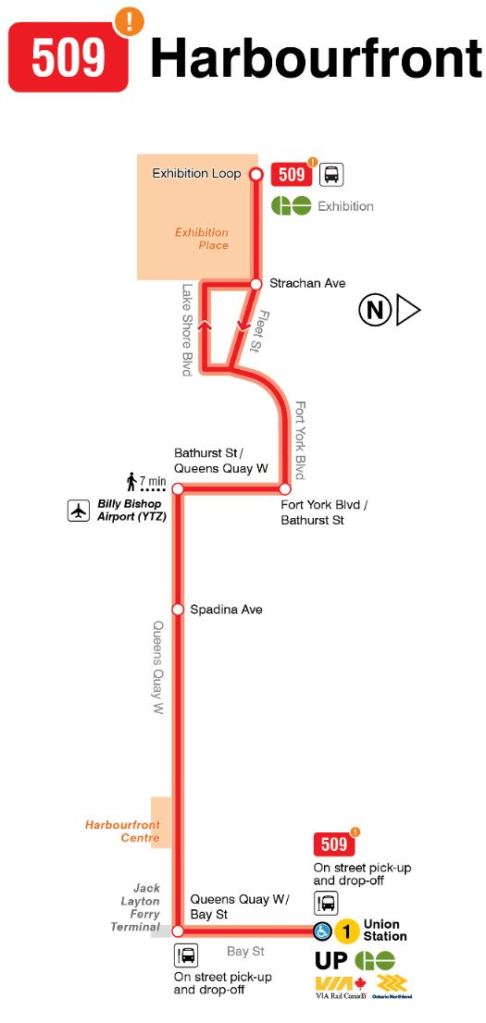
The TTC has announced that streetcar service will be suspended, in part, over the 509 Harbourfront and part of 511 Bathurst at various times between Tuesday, September 3 and January 2025. This will allow the reconstruction and upgrading of the overhead system between Union Station and Exhibition Loop to be fully pantograph-compliant.
Information is posted in three separate items on the TTC site with the first being the most extensive.
In a previous article, I reviewed travel times for the bus and streetcar operations on 510 Spadina Avenue at the north and south ends of the route where severe traffic congestion made bus operation extremely difficult. The north end problem resolved itself first with a diversion, then at least partly with completion of construction on Bloor Street, but the south end required a reserved bus lane to bypass the traffic queue for the Gardiner Expressway on ramp.
With all the attention on these areas, a separate factor is often overlooked in comparing the services: when and where there is little or no congestion, the buses are faster than the streetcars in spite of the “transit priority” treatment with dedicated lanes. The problem lies in a combination of different stopping patterns, traffic signals that do not favour streetcars, and operational practices requiring streetcars to creep through intersections.
This is the daily experience of regular riders on Spadina, and it is a “dirty little secret” that factors conspire to undermine the quality and speed of streetcar service. This is both a City and TTC problem because responsibility for road design and streetcar operations rest with the two organizations.
Updated August 11 at 2:20 pm: Charts have been added at the end comparing streetcar travel times over the central portion of the Spadina route in September 2014 and May 2024. The differences reflect both loading times, acceleration and operating practices of the former CLRVs compared to the current Flexitys,
In a previous article, I reviewed the transition from streetcar to bus operation on 510 Spadina in mid-June. Since then, the route saw other changes:
Beginning on July 8, TTC suspended service south from Front Street between 3 and 7pm on weekdays due to congestion and very extended travel times on the southbound approach to the Gardiner Expressway. See 510 Spadina Bus Modified Diversion Tracking.
On July 29, implementation of a reserved bus and cycling lane began south from Richmond to Lake Shore. See Reserved Bus Lanes for Spadina?
The reserved lane has greatly reduced delays at the south end of the route, albeit at the expense of road capacity.
This article presents travel times over various segments of Spadina from Bloor Street to Queens Quay during July 2024 to show the effect of the changing route configuration.
A key factor evident in the tracking data is that congestion occurs outside of the peak periods, and not necessarily in the same way each day. It can be tempting to cherry pick the afternoon peak as a worst case target, but that does not solve all problems. The extent of congestion also varies, and transit priority must be on a sufficient scale to deal with the bad days, not simply to improve conditions a bit over a short distance.
What is quite clear is that the City and TTC reaction to congestion problems gave the impression of surprise rather than preparedness, and that weeks of delays for riders could have been avoided or at least reduced in severity at both ends of the route.
The July 17 Board meeting was extraordinarily long thanks to three in camera items, plus extended discussions of the CEO’s Report and of use of buses as homeless shelters during the winter.
The confidential session dealt with:
A collective bargaining update for two small groups of customer service and operations supervisor employees.
An update on advice from External Counsel. On a recorded vote, this was adopted with all Board members except Councillor Saxe in favour. As of the publication of this article (July 28), there have been no leaks about the subject of this report.
An update on the fare modernization program including the status of the Presto contract. The report was also discussed briefly in the public session later in the meeting.
The public meeting included:
The July 16 storm, flooding and hardening of infrastructure against climate change.
New subway trains and federal funding announced earlier the same day (July 17).
Prioritization of State of Good Repair projects. This item received scant attention although the report contains much interesting background on capital plans.
Safety on the TTC.
Use of shelter buses.
Transit network expansion update.
Fare Compliance Action Plan: See the updated version of my previous article on this report which includes the debate at the Board meeting.
Not discussed was the issue of hydraulic fluid leaks from subway work cars of which one quarter are still out of service. A report is supposed to be coming to the Board soon. It is not clear how much this situation is affecting the TTC’s ability to stay on top of track maintenance issues and the growing list of slow orders for track that cannot be safely operated at full speed.
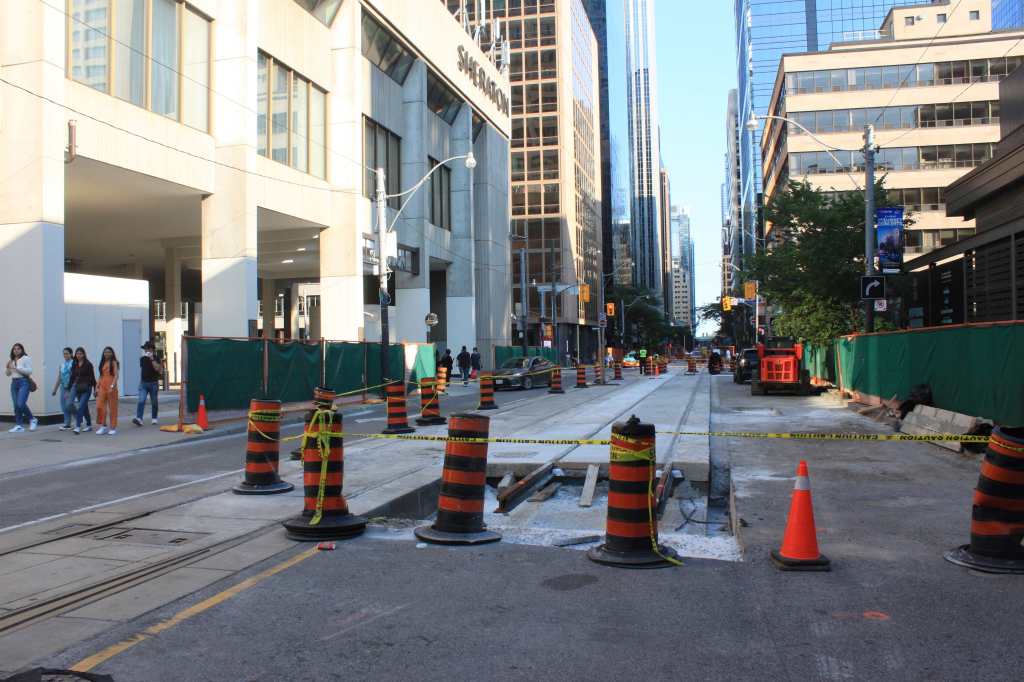
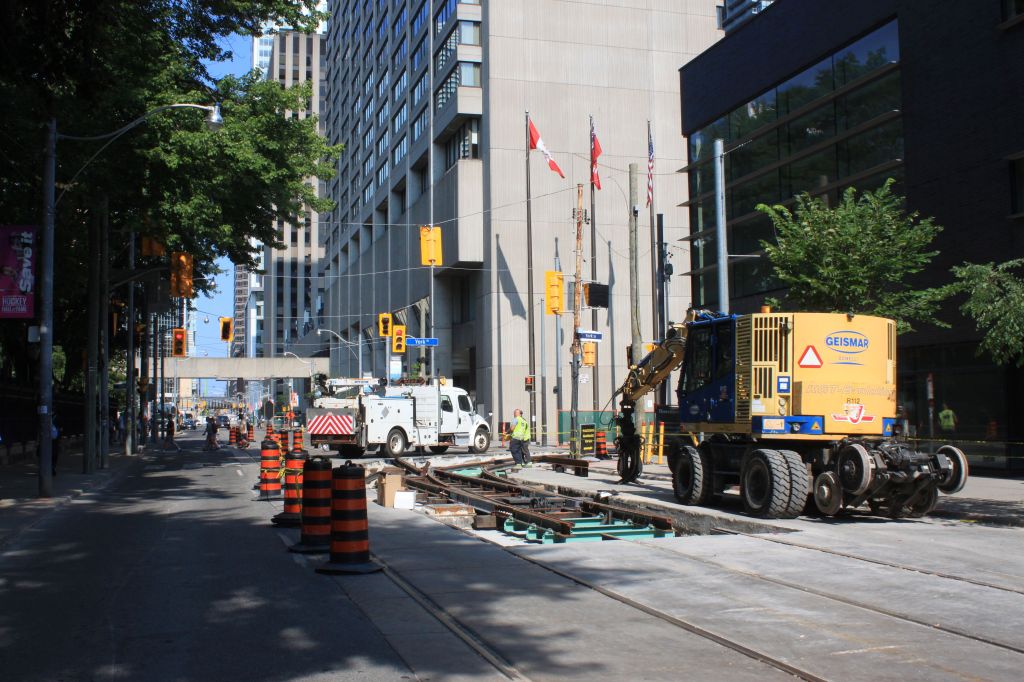
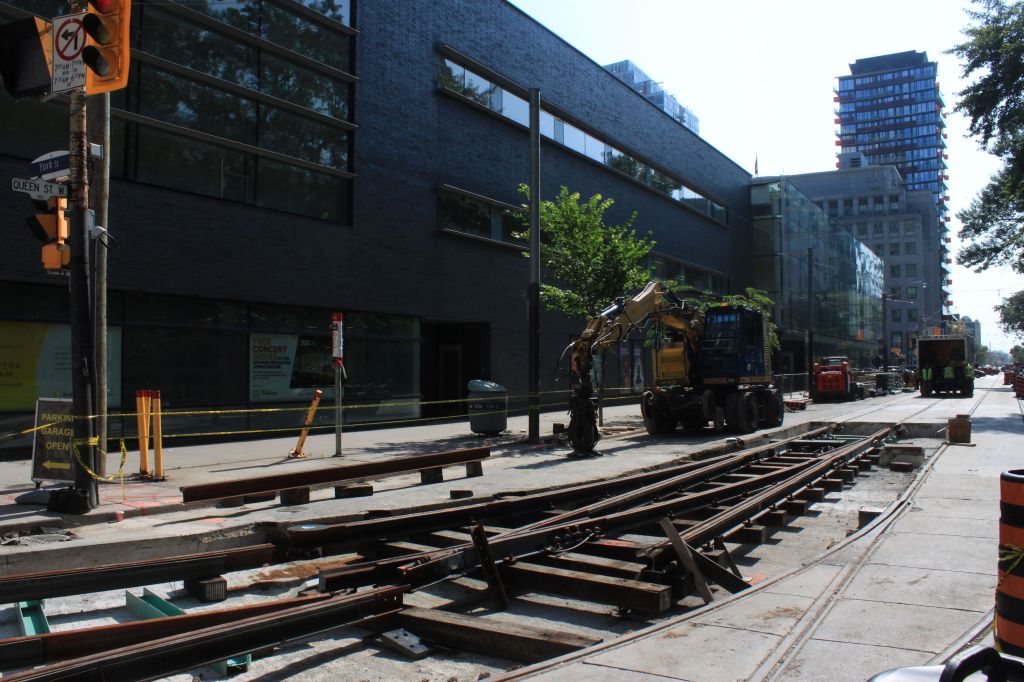
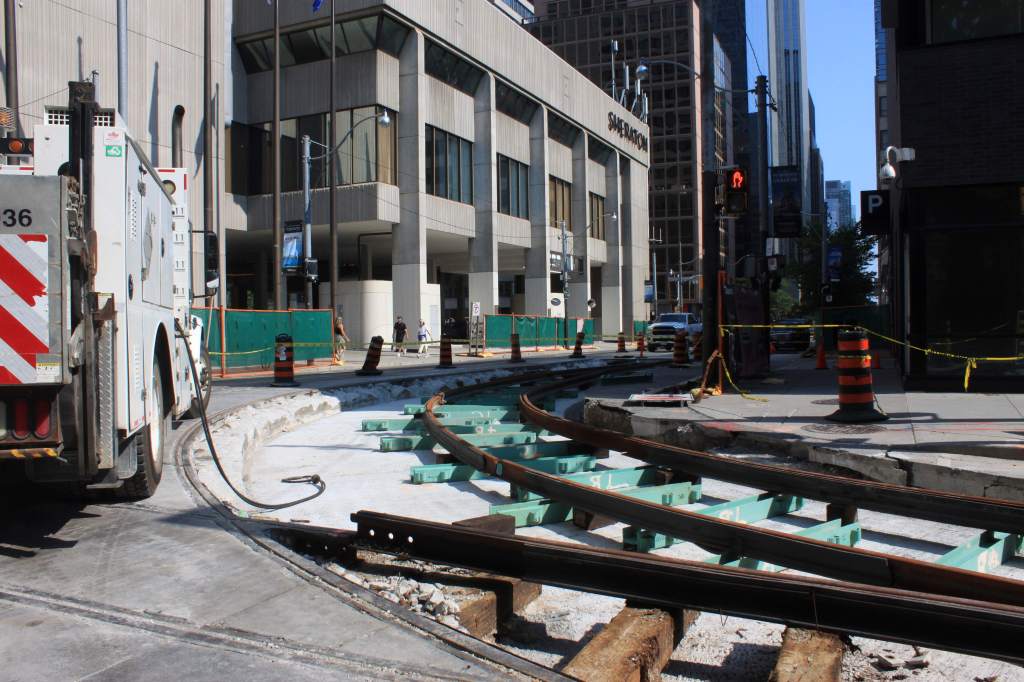
At long last, the new curve for a 501 Queen eastbound diversion via York Street south to Adelaide is being installed. Of course the entire diversion should have been operational before Metrolinx shut down Queen Street for the Ontario Line, but such careful planning is not what we expect from the agencies involved.
Indeed, the City took over the trackwork on Adelaide Street as part of other works in progress because Metrolinx was dragging its feet. Why they didn’t take the full project up to Queen & York is a mystery. With luck, the west and east ends of 501 Queen will be reunited before year-end 2024, but I am not making any bets.
Road and utility works for this project are contracted by the City and Metrolinx. Track installation is by the TTC.
Three weeks ago, on Sunday, July 7, the new switch was sitting at Queen and University ready for installation, but work on excavation and a new track foundation took some days afterward to begin.
Looking E on Queen to YorkLooking W on Queen to UniversityLooking S on York to Richmond
Here is the state of installation as of Sunday, July 28.
Looking E to York on QueenLooking W on Queen at YorkLooking S on York from Queen
For many, many years, there has been talk of expansion of the streetcar system into the eastern waterfront. The “Waterfront East LRT” would branch off of the Bay Street tunnel at Queens Quay and running east initially to Villiers Island and eventually link with a southern extension of Broadview via the new GO/Ontario Line station at East Harbour.
Anyone waiting for this service will age considerably before it opens at the now tentative date of 2036. This was supposed to be a “Transit First” neighbourhood, but the history mocks all the fine talk of “Transit Oriented Communities” we hear today. Meanwhile, any attempt to actually use transit to reach this area is, putting it mildly, challenging. A collection of overlapping bus routes with infrequent and irregular service fight their way through chronic traffic congestion.
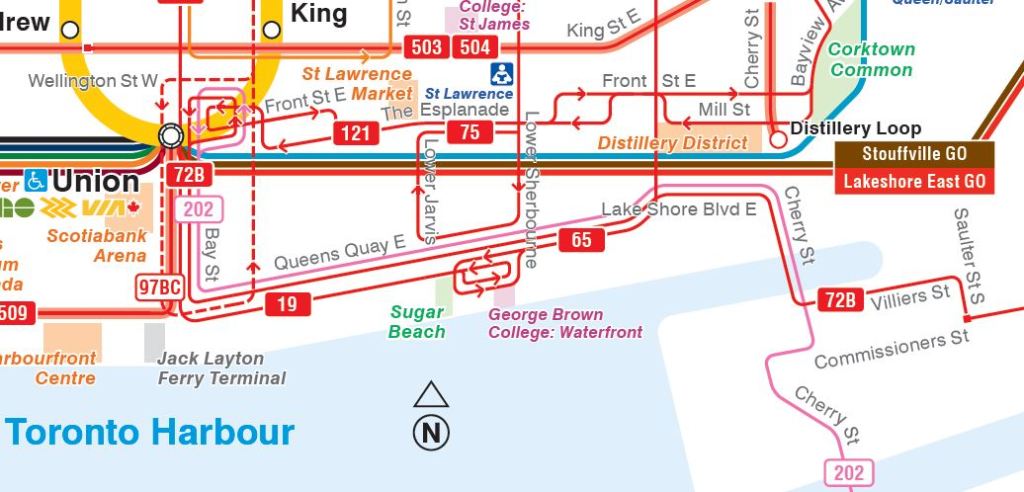
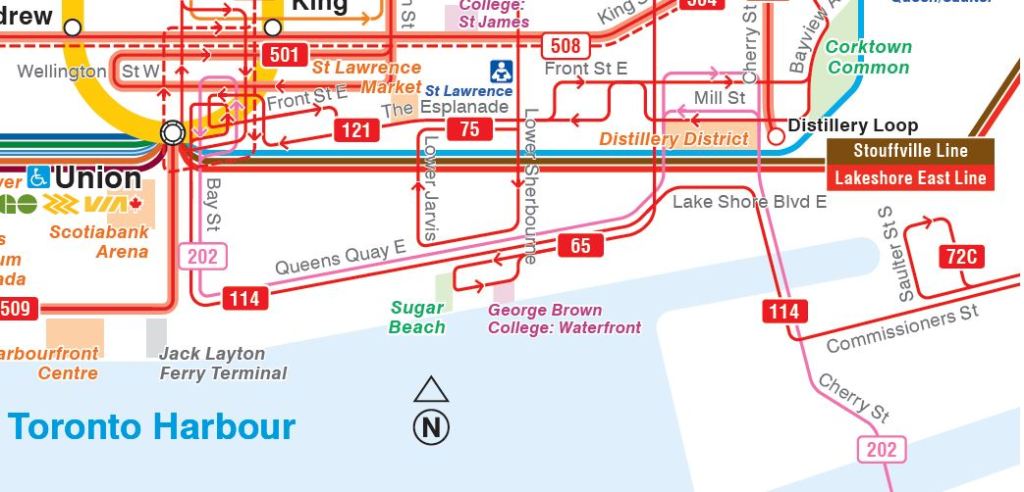
The route structure changed on May 12, 2024 as shown in the TTC maps below from 2023 and June 2024.
2023June 2024
19 Bay
2023: From the central business district south on Bay and east on Queens Quay to loop at George Brown College near Sherbourne Street.
May 2024: Route shortened to loop via east on King, south on Yonge, west on Front and north on Bay.
72 Pape
2023:
72A service from Pape Station to Eastern.
72B service to Union Station from Pape via Commissioners, Cherry, Lake Shore, Queens Quay and Bay. The route changed from time to time as the area was rebuilt to create Villiers Island.
72C service from Pape Station to Commissioners Street peak periods only.
May 2024:
72A service to Eastern peak periods only.
72B replaced by 114 Queens Quay East.
72C extended west from Pape to Saulter Street and operated as the all day route.
114 Queens Quay East
May 2024: New route from Union Station to Carlaw replacing the south end of 19 Bay and the west end of 72 Pape.
Two routes were not changed:
65 Parliament:
From Castle Frank Station south via Parliament and west on Queens Quay to George Brown College.
75 Sherbourne:
From Sherbourne Station south via Sherbourne and west on Queens Quay to Jarvis returning north via Jarvis and The Esplanade.
There is also the seasonal 202 Cherry from Union Station to Cherry Beach. Like the 72 Pape bus, its route has changed from time to time due to construction in the Villiers Island area.
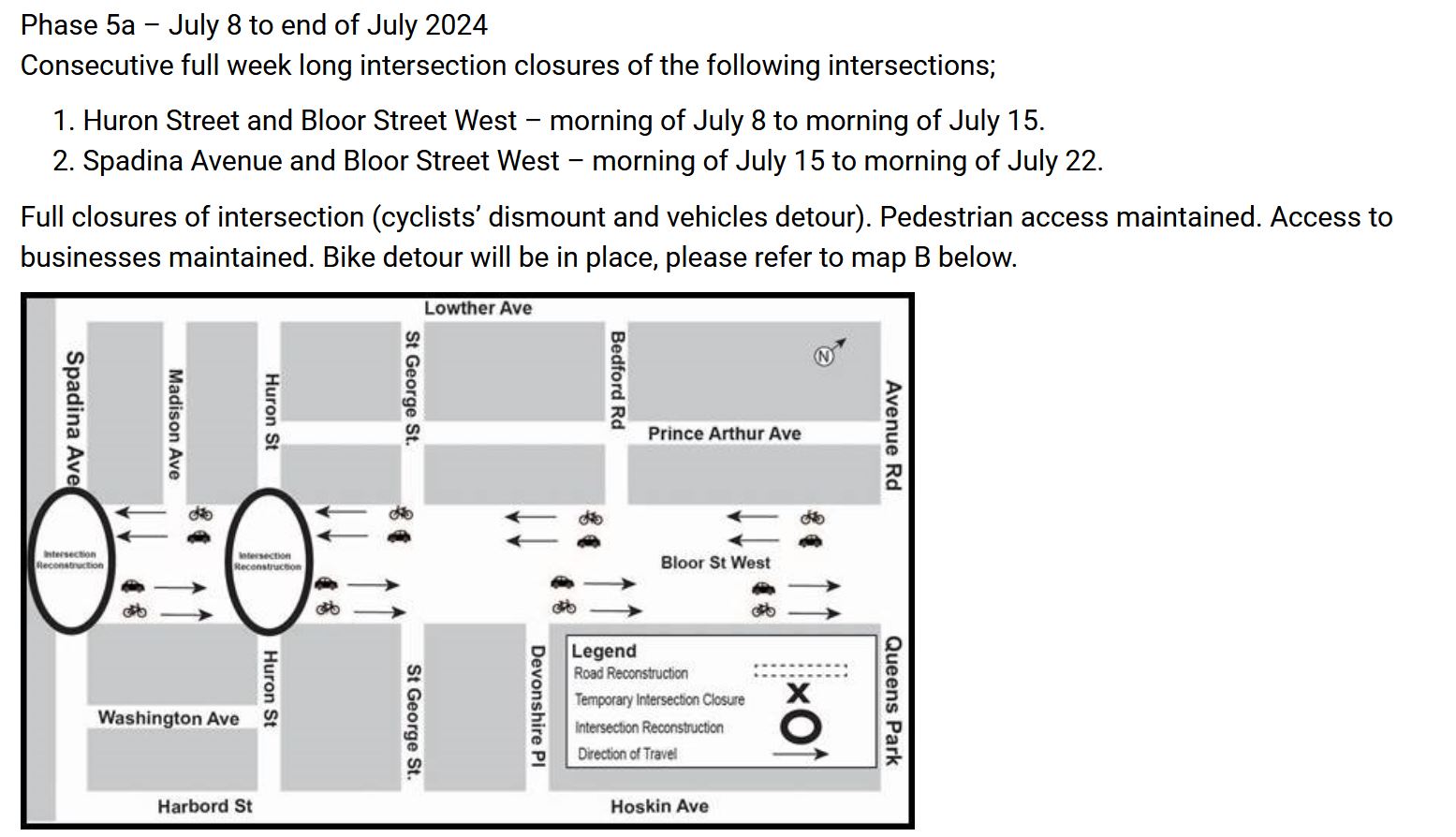
The City of Toronto will be closing the intersection of Spadina and Bloor to all traffic from 5am Monday, July 15 to 5am Monday, July 22 for complete reconstruction. This is the west end of a project that has been working its way along Bloor Street for months.
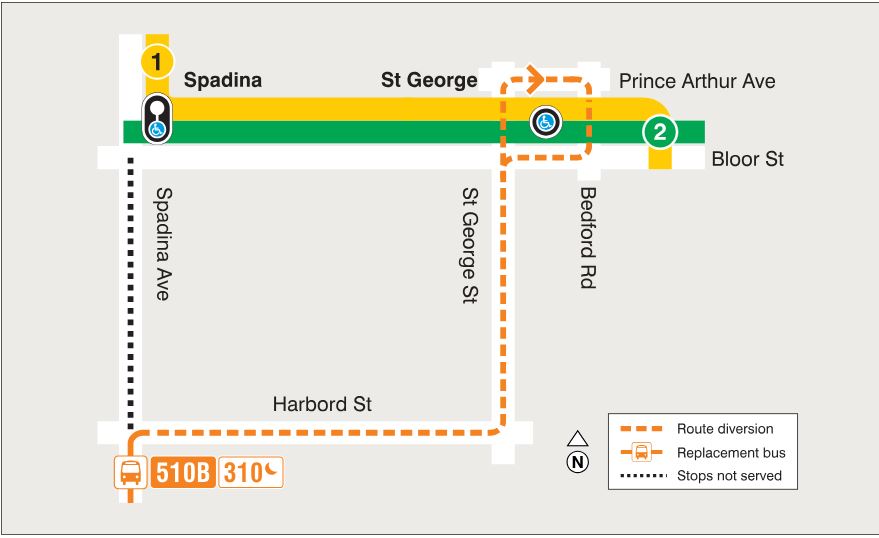
TTC bus service will divert to St. George Station. Whether this will alleviate the bus congestion at the north end of the route remains to be seen.
Because this is a non-standard route, transit prediction apps will not work for locations off of Spadina, and southbound predictions will only work for stops and buses that are south of Harbord.



 Steve Munro