Honestly, I didn’t think they would get it done in time given the weather, but today saw the first cars (4171 and 4176) make test trips on the St. Clair line to Yonge Street.
Many thanks to Harold R. McMann for the photos.
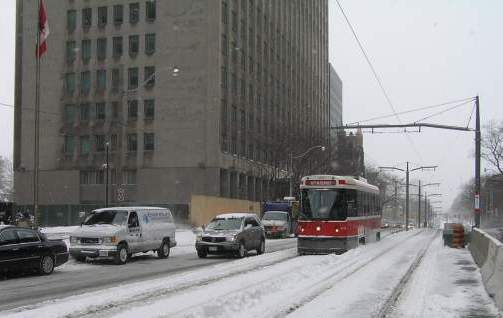


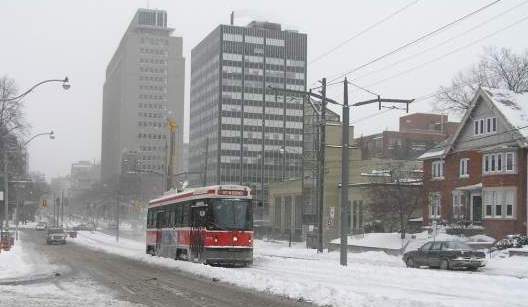

Honestly, I didn’t think they would get it done in time given the weather, but today saw the first cars (4171 and 4176) make test trips on the St. Clair line to Yonge Street.
Many thanks to Harold R. McMann for the photos.
Mark Dowling sent in the following note in response to the item on Park Lawn Loop:
Where do you stand on a Queensway ROW west of Humber Loop? I know ridership on 80 is dismal but so is the service. The street is wide and to my mind screams for LRVs or Citadis 302s bombing along between Roncesvalles and Sherway at 2x bus stop lengths with all the toys – next-car displays, signal priority and the like – giving a real “subway-like” service as opposed to the joke our Mayor cracked in relation to St Clair.
The residential developments at Sherway and along the Queensway would, I believe, generate a decent ridership if decent service was offered. Who knows, it might even pull in some park and ride traffic from the Gardiner?
Steve: First off, The Queensway as far as Kipling is an “Avenue” in the Official Plan, and it is also shown as a Transit Priority corridor all the way to Brown’s Line (as is Lake Shore). You would never know this from the sort of service offered in that part of the world or the total absence of planning for improvements as part of the TTC’s LRT studies.
Southern Etobicoke has a huge amount of redevelopable land — old industrial property, strip malls, parking lots — and there are also big possibilities up at the Six Points. However, if we keep pumping out the message that this part of the world won’t be developed soon, if ever, from our own Planning Department, transit will continue to ignore this part of the world as well.
To answer your question, yes, an LRT service along The Queensway would be a great addition to the network, assuming redevelopment to support it.
What effect this would have on the Gardiner is another matter. I think that the car traffic comes from further afield in the 905, and the benefit of new transit services will be to allow growth in population without overwhelming the road system. However, we must have the will to “invest” in the future of this part of the city just as we hope to do in the eastern waterfront.
This post is extremely long and most of it will be in the “more” section. I received a copy of a letter addressed to Mike Olivier from David Nagler, the public consultation co-ordinator for the Western Waterfront LRT project. The discussion is all about “why Park Lawn and not somewhere else” with a few other bits thrown in for spice. My own comments are sprinkled through the post.
I have edited this slightly to eliminate duplicate information. Continue reading
The following comments came in response to my post about travels on St. Clair. It’s big enough and has enough material to warrant its own thread, so here it is:
This week has been an interesting one. My morning commute is from Brown’s Line/Lakeshore to Queen/Spadina. One seat ride on 501 is nice when the cars are running on schedule….
I’m getting a depressing kind of entertainment checking the time ahead/behind when boarding (and leaving if the car isn’t too crowded).
This week, it seems that 501 operators are not trying very hard to keep to schedule.
Tuesday: I go out to catch the regular 8:40 AM eastbound from Long Branch. It’s signed as run 08/18, and there was one operator who was on this for a couple of board periods who was very good about leaving the loop consistently and arriving at Queen and Spadina no later than 9:35. On Tuesday, it was a different operator, who arrived at the loop after the scheduled departure time. She then took her backpack and vanished in the TTC building at the north-west corner of the loop. Two other 501 ALRVs showed up while she was in there. Three ALRVs stacked around the loop is a pretty unusual sight! When she finally came out and pulled up to the loop, CIS was reporting -16 (which was about right); at Queen and Spadina it was still around -15.
Wednesday: after 9AM, waiting for a eastbound 501 streetcar at the 39/40th Streets stop. And waiting. A streetcar finally goes past westbound, and does not reappear eastbound for at least ten minutes. This means it laid over for at least five minutes. This is run 17; CIS is saying -20 as I board and of course it stops at every stop because people have been waiting for close to half an hour for a streetcar. At Palmerston and Queen he turns on the four-way flashers and goes off to Starbucks for a coffee. I think it was -19 at Queen and Spadina.
Today: same operator on the same run 17 goes past westbound; this time it returns eastbound in about five minutes. CIS is saying -9 when I board. There’s another ALRV on his tail westbound (run 02); and it stays on his tail eastbound. We don’t move very quickly across Queen Street (slow bicyclists are keeping up or passing us). The car is too crowded for me to check the CIS when I leave but I figure we were probably an additional few minutes behind, for a -14 or -15. Run 02, which was right behind him westbound at Brown’s Line, is right behind him eastbound at Spadina. As I leave the streetcar, run 17’s rollsigns are being changed to 501 KINGSTON RD & QUEEN.
Now I have been on other 501 runs where the operator is on schedule, or catching up to schedule. I know it can be done. I ’ve been on other runs where we’re behind, and there’s no effort on the part of the operator to pick things up. Combine the two, and you get huge gaps and multiple TTC vehicles showing up at the same time.
Steve: Just think! The TTC wants to put an LRT service out to the western waterfront. This shows the sort of marvellous job they are doing of running attractive service now to build ridership.
Once again, I have to ask two questions of both the TTC and the ATU: Why is it that situations where service runs at the whim of the operator are becoming more and more common, and what is the TTC going to do about it? Do they even know or care?
There are a lot of wonderful operators out there, and it only takes a minority of bad apples to create havoc for riders and for other operators stuck in the mess. This has nothing to do with the TTC’s favourite complaint, operation in mixed traffic, and everything to do with an abdication of the need to properly manage the service.
I wandered up to St. Clair West Station today to check out the current signage situation. On the bus/streetcar platform level, I found a forest of signs pointing me to the eastbound bus stop inside of the station. Hurrah! Hurrah! An indoor connection. I was amazed at how few people got on with me, but all was soon revealed.
The bus took a circuitous route to get itself eastbound on St. Clair: Leave by the west ramp (the east one is still closed for construction), south on Bathurst, northwest on Vaughan, east on St. Clair (bypassing the hordes waiting at the eastbound stop at least some of whom probably wanted to go to Yonge Street), and thence to the south entrance to the station. That’s where the big crowd of eastbound passengers was waiting.
Didn’t they see all the signs?
Well, no, they didn’t. People getting off a train come up to the mezzanine where there are NO signs telling them that the bus is back inside the station, and they trudge out to the south entrance as they have for months.
Maybe when they finally get the east ramp open, someone will think to put up signs telling people NOT to go out the south exit because the next bus along will be the night bus.
Meanwhile, the beginnings of overhead construction are underway. How they will get the work done by February 18th in this weather I do not know. But the real kicker is that the overhead hangers are incompatible with pantograph power collection. At least on Spadina we got modern overhead, but on our new, premier example of LRT, we get overhead that would be at home in the 1920s.
Maybe we could save the expense and just run horsecars.

Photo courtesy of Harold McMann.
This evening, I attended a concert at Grace Church in Forest Hill. Because I was coming from Mt. Pleasant and Eglinton, the logical way to get there was to go to St. Clair Station, take the 512 bus, and then walk north on Russell Hill. My experience shows that the TTC still doesn’t get it.
I arrived at the Pleasant Boulevard loop in time to see the 7:25 South Leaside trip sitting on the platform. No St. Clair bus. After a 10 minute wait, one arrived, but it parked down at the far end of the loop for a crew change. About 5 minutes later, a second bus arrived and parked behind the first one. It was now 7:40 and I was in danger of missing my concert.
I walked out to St. Clair and Yonge (if I got really lucky, the first bus might make it to the stop by the time I got there), and found that a third bus was coming east on St. Clair. This means that 3 of the 4 buses on the route (on a 7 minute headway no less) were at one end of the line.
I took a cab.
The TTC is fond of telling us how it will build ridership for new rapid transit lines by running really good surface routes in anticipation. The 190 Rocket from Don Mills Station to STC is a good example, and ridership is building up on this route (although to nowhere near subway levels).
The service on St. Clair is a disgrace that bears absolutely no relationship with the schedule. This is not the first time I have found packs of buses and seen long layovers at St. Clair Station. Please don’t tell me about traffic congestion. There was none. If anything, the TTC is driving riders away from St. Clair, a line that is to be the shining example of what we can do with LRT.
Memo to both the TTC and the ATU: Better service means more riders. “Better” includes properly managed, well-spaced, predictable service. More riders means more justfication for expanding the system, and more work for union members.
Also, someone might like to take down the timetable for the Christie bus as well as the handwritten sign telling people that both the Christie and Vaughan buses will take them along St Clair. They don’t run to St. Clair Station any more.
That, believe it or not, used to be the TTC’s slogan years ago when transit service was a far more important part of the life of Toronto than it is today. Three love affairs have brought us to where we are now:
From time to time, people ask me both about how service has declined and about the practical limits on streetcar service. I am not going to pretend that the answer to our problems is to build streetcar lines running in mixed traffic everywhere. For one thing, there’s a lot more of that “mixed traffic” than there used to be. But it’s interesting to see what streetcars were doing even well into the “modern” automotive era. Continue reading
January 2007 does not bring much in service changes beyond the return of streetcars to St. Clair west of the Spadina Subway. Buses will continue to run east to Yonge Street until, it is hoped, the middle of February.
The RT will continue to operate with buses on Sundays to allow testing of the new RT signal system. As a regular user of this line, I am looking forward to it actually working on those cold mid-winter days (which surely will be here eventually) when the old system regularly froze up.
There are several minor changes in running times and a few added trips here and there, but nothing major in improved service. Current expectations are that we won’t see anything significant until the fall when sufficient operators, buses, and budget headroom will, in theory, be available.
Meanwhile, the list of services that should be improved or operated, but are not due to funding and other constraints, continues to grow. Continue reading
Howard Levine, a former member of City Council and one of the founding members of Streetcars for Toronto back in 1972, writes in today’s National Post about the St. Clair project. Howard and I sit on opposite sides of the St. Clair fence these days — I still believe in the scheme and wish it were done better, while he sees it as irredeemably flawed. I share his despair that what we fought for in 1972 took so long to achieve and was such a botched piece of design and community relations. Continue reading
Christopher Hume has a column in today’s Star about the St. Clair line (Click here) where he discusses the gap between theory and practice in major urban design/construction projects.
This morning, CBC’s Metro Morning had a discussion about the impact on businesses with the owner of the Retro Cafe (at Vaughan and St. Clair) and David Crichton, the city’s manager for design and construction. With luck this may show up later today as a podcast on the CBC site here. It may have been early in the day, but Crichton continued the city’s unhappy stance of saying “it’s too bad, but we have to rebuild the street” while ignoring that the design and the construction phasing have considerable impacts. Continue reading
 Steve Munro