Catch The Spadina Bus While You Can

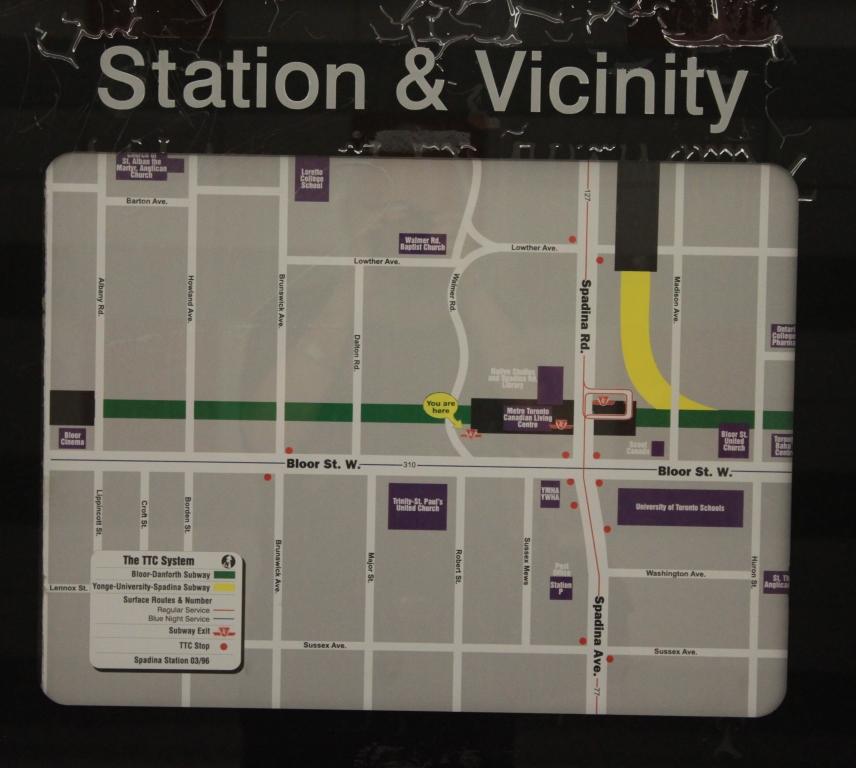
Some time ago, I wrote about the haphazard way in which station vicinity maps were replaced (never mind their content).  There are a few spots in the system that time forgot, and, while it lasts, I thought to bring you a map from before July 1997 when the 510 Spadina car began operation.

This is one of the older style of maps, back when the TTC actually put connecting surface routes on them.  If you look closely, you will see that Spadina south of Bloor is served by route 77.  The date on the map is “03/96”.

The “You Are Here” pointer gives away the location — the Walmer Road exit from Spadina Station.  This was built as part of the reconfiguration of Spadina Station to accommodate the LRT line.  Oddly enough, the route map right beside it is recent enough to include the Spadina car.

Another version of this legacy map at the bottom of the stairs from the west side of Spadina has been replaced with the new version.

Elsewhere in Spadina Station, a poster still advertises the August subway diversions for construction at St. George.

Smart Card Wars (Part III) (Update 1)

Update 1:  July 28, 2010 at 4:00 pm: Comments and clarifications by Ernie Wallace at Presto have been added to this article.

On July 26, I visited the folks at Presto and talked with Ernie Wallace, Executive Project Director, about the system and its plans.  Subsequently, I did some digging of my own, primarily on the Ontario government website.  The information below is organized to keep topics and the logical flow intact rather than to represent the sequence of the conversation.

Continue reading

Service Changes Effective June 20, 2010

Many service changes take effect on June 20, 2010.  Most of these are seasonal route changes and, in some cases, improvements.  Many routes lose peak service, particularly in the AM peak, during the summer because school traffic falls off.

2010.06.20 Service Changes

The 512 St. Clair route is scheduled to return to Gunn’s Loop on June 20, but the actual implementation date has not yet been finalized.  Cars will operate to Lansdowne with geneous layovers pending the opening of the line.

The TTC has published a comparison of running times and headways for the route before and after the implementation of the right-of-way on St. Clair.  Particularly striking is the improvement in running times on Saturdays when St. Clair was the most congested before the reconstruction.  Advocates for transit priority often forget that there are many more hours, and much more traffic, outside of the peak period on some routes.

An operational change effective on June 20 is that AM peak cars running out of service will now operate east to Yonge, then return westbound and go out of service at St. Clair West Station.  This will avoid having cars bound for Roncesvalles Carhouse drop inbound passengers eastbound at Vaughan Road rather than taking them to the subway.

2005-2010 St. Clair Schedule Comparison

For details on individual route branches, please refer to the TTC’s Scheduled Service Summary.

Still Waiting For A Long Branch Car (Updated)

Updated June 3, 2010:

On June 2, the Commission didn’t decide to implement the 507 Dundas West option (described below), but didn’t kill off the idea entirely either.  Some Commissioners balked at the $825k/year pricetag, but the greatest failing was the lack of strong support from the local Councillor who is not a member of the Commission.

I had the sense that individual Commissioners wanted to do what they could to improve service on Lake Shore, but could not figure out a way to do so without out appearing to overrule staff and give in to a local pleading, especially in an election year.

There was a side discussion of the Park Lawn Loop whose installation would extend the 501 Humber service a short distance westward providing better service to some of the Humber Bay condo area, but this project is one of many competing for capital funds in a tight budget.

The motions passed by the Commission were:

Vice-Chair Mihevc:

That the Lakeshore Boulevard Streetcar service matter be referred to staff for consideration during the 2011 budget process.

Commissioner Milczyn:

That TTC staff consult with City Transportation staff on the possibility of constructing a portion of the civil works related to roads, curbs, sidewalks and utilities required for the Parklawn Loop in conjunction with road construction this year, and further authorize the Chair and Vice-Chair to approve any reallocation of funds required for this.

Commissioner Moeser:

The Chief General Manager be authorized within his authority spending level of $100,000.00 to approve any pro-active work considered appropriate for the proposed Park Lawn Loop.

[From draft minutes of the meeting supplied by the General Secretary’s office.]

I spoke to the subject, but nobody from the community appeared probably due to timing constraints and a sense that deputations would be fruitless in the face of TTC staff’s position on the matter.

The original post follows the break.

Continue reading

How Many Cars Reach Long Branch? (Update 4)

Updated May 7, 2010 at 12:10 am:  On May 6, the TTC directed staff to report back to the June Commission meeting with further analysis of the Dundas West option for the Long Branch service.  With luck, this will give staff a chance to moderate their position and show real tradeoffs between the pros and cons of this proposal.

Updated May 6, 2010 at noon:  My presentation to the TTC is linked here for convenience.

Updated May 5, 2010 at 09:50 am:  By popular demand, charts sho wing the distribution of headways by length of hadway, time of day and date have been added. 

Updated May 4, 2010 at 12:45 pm:  Charts have been added showing the proportion of service reaching various locations on the route by date and time of day.

Updated May 3, 2010 at 11:30 am:  Comments and charts showing the headways on Lake Shore have been added.

As a follow-up to the question of splitting the Queen car back into separate routes with a dedicated service on Lake Shore Boulevard West, I crunched through the vehicle monitoring data for that route for October and November 2009.  These data were obtained to allow an analysis of the Dufferin/Broadview split operation, but I have been pre-occupied with other things and have not published any comments yet on what seemed to be a dead issue.

The analysis here looks at only one aspect of the route, the service on the west end of the 501 Queen line.

Continue reading

The Queen Car is Fine as it Is, Thank You (Updated)

The TTC agenda for May 6 includes a report on the proposed restructuring of route 501 Queen in two optional ways:

  • Return to the old setup with a separate 507 Long Branch service west of Humber Loop, or
  • Operate a 507 service to Dundas West Station overlapping 501 Queen service between Humber and Roncesvalles.

Needless to say, TTC staff recommend against any changes.

The Humber option never made sense because:

  • The connection at Humber Loop is in an isolated location where passengers do not feel secure, especially at off hours, and
  • Short turns of 501 Queen cars at Sunnyside leave a gap in the route and cause highly unpredictable travel times for passengers trying to transfer between the 501 and 507 in either direction.

Since the construction of much new development on The Queensway, the provision of reliable service is more important than ever.

The Dundas West option is designed to address several problems, none of which are addressed by the TTC report:

  • Move the transfer point east from Humber Loop to Roncesvalles.
  • Provide additional service on The Queensway that is not affected by short-turns further east.
  • Provide additional service on Roncesvalles to partly compensate for the frequent short-turning of 504 King cars (once that route returns to its normal configuration).

The TTC report lists many favourable aspects of the 507 Dundas West option:

  • The restored 507 route would operate with CLRVs freeing up five ALRVs for use on the 504 King route.  This is the equivalent of adding 2.5 CLRVs worth of capacity to the 504 in the peak period, but no value is attached to this by the TTC.
  • Service would be improved between Humber and Roncesvalles, and between Queen and Bloor on Ronces.  This is stated relative to the scheduled service, but a good deal of this service never actually reaches the terminals especially when there are disruptions downtown.  Nearly 10,000 trips per day would benefit from these improvements.
  • A small number of trips between Lake Shore Blvd. and the Bloor/Dundas area would have one less transfer.
  • The TTC does not mention the benefit of reliable service on Lake Shore, the value this would have in reduced wait times for riders there, and increased riding that could result.

On the down side, the TTC claims:

  • About 2,500 trips per day that travel from points east of Roncesvalles to west of Humber Loop would be inconvenienced by this arrangement, an that about 300 rides per day would be lost due to this change.  When I first proposed the 507 Dundas West service, the scheme included improved service on the 508 specifically to preserve through trip options.  This was not included in the scheme the TTC reviewed.
  • There would be little benefit for the Neville-Humber service because the west end of the line is not a source of congestion and service disruption.  This is exactly the reason for splitting off the 507 service so that it can benefit from the relatively trouble-free environment.  Also, with the 501 service having shorter trips, operators would not be faced with interminable runs across the city before they get a break. 
  • The TTC claims that sharing the platform at Dundas West between the 504 and 507 services could cause delays similar to what happened when the Dundas and King routes shared a common track.  I beg to differ.  First, the 507 service is less frequent, and there is a runaround track available if a 507 is so early arriving at Dundas West that it would hold a King car from leaving.

After all of this, the report concludes that “overall, the change would make service better for customers”.

However, the TTC rejects the scheme because it is estimated to have a marginal cost of about $825k annually.  As mentioned above, they give no credit for the value of the additional capacity provided on the King line by reassignment of equipment nor for the ridership effect of more reliable service.  Indeed, the only ridership change the TTC cites is the potential loss of 300 rides per day from the loss of a transfer-free trip through Humber Loop.

In discussing the route’s history, the TTC states that the amalgamation in 1995 was intended to eliminate the transfer at Humber.  What they omit is that this change was made primarily to reduce operating costs.  The decline in service quality west of Humber has long been a complaint from the community, and it is a direct result of the restructuring coupled with general service cutbacks on streetcar routes through the 1990s.

The report includes a chart showing ridership declines on the route, and the TTC argues that the fall occurred before the routes were amalgamated due to declining employment.  The TTC neglects to mention a large cut in service on the Long Branch car in the early 1990s that drove away riding even before the route’s amalgamation with the Queen car.

An important note about the Long Branch route, something evident in a previous TTC report on the subject and to anyone who rides the line, is that there is considerable local demand that never gets east of Humber Loop.  Service that is managed (and short turned) on the basis of somewhat empty vehicles at Roncesvalles will short-change riders who don’t board until west of Humber.  This is particularly so during off-peak periods.

The TTC report is self-serving with selective analysis intended to put their preferred option, do nothing, in the best possible light.

At a minimum, the TTC needs to carry out a trial operation of the 507 Dundas West option following restorarion of streetcar service on Roncesvalles late in 2010.  This trial needs to run long enough to allow meaningful analysis.  A related service change should be improvement of the 508 Lake Shore route to provide more through peak period trips to and from downtown via King Street.

No Priority for Transit Priority Report

In June 2005, I appeared at the TTC meeting and spoke about problems with transit signal priority on the Spadina-Harbourfront line.  At that time, then Vice-Chair Olivia Chow request a report from TTC and City staff addressing, among other things, the issues I had raised.

This report has appeared on the list of outstanding Commission requests ever since.  It was supposed to be on the March agenda, but was nowhere to be seen.  Now, we learn it will be on the September 30, 2010 agenda.

With the amount of flak the TTC and City have taken about the design of LRT lines and signal operations particularly, one might think this issue was of some interest and priority.

Place your bets now on whether we see anything by September 30, and enjoy your ride on our “priority” transit routes.