Service Analysis of 7 Bathurst Part II: Travel Times in April 2025

Updated May 14, 2025 at 6pm: A section is added at the end of the article showing the time spent at both the Steeles and Bathurst Station terminals.

In Part I of this series, I reviewed headway reliability on 7 Bathurst during April 2025. This article turns to travel times along the route, an important issue relative to claims made for the potential benefit of reserved bus lanes.

See also:

In Part III I will review historic data back to January 2024 to see how, if at all, conditions have evolved over the past 16 months.

Continue reading

King/Church Diversion Observations May 12, 2025

Today was the first weekday of the King/Church construction diversions. I watch things evolve via NextBus through the morning peak, and then visited King/Spadina during the PM peak. A caveat: Mondays are light traffic days. There was no Gardiner backlog at all on Spadina. Later in the week will likely be more challenging.

During the AM peak, the service on 504 King and 503 Kingston Road did not load properly, and many vehicles were clumped together. This took quite a while to unscramble, and there were big service gaps. The 504 buses also ran in packs and huddled together at Wolseley Loop, at one point six of them representing about 20 minutes worth of service at the scheduled headway. The peak period did not encounter queueing frequently at points where streetcars turn because of many wide service gaps. When a bunch of cars arrived, they queued one by one awaiting their turn, but then the intersections would open up again even though in theory there should always have been transit service waiting.

In the PM peak at King/Spadina, the major sources of traffic were pedestrians, cyclists and transit in that order. I observed that the traffic signal cycle time was 110 seconds (1’50”). This means that there are 32.7 opportunities (3600/110) per hour for a turn to/from Spadina. The nature of the intersection is that only one streetcar can make the turn per cycle.

The combined scheduled service trying to make the EtoN turn per hour at King & Spadina in the PM peak is 23 streetcars.

RouteHeadwayCars/Hour
503 Kingston Road8′7.5
504 King Car10′6.0
508 Lake Shore20′3.0
511 Bathurst Car9′6.5
Total23

Stir in 12 510 Spadinas straight through northbound on a 5′ headway. When there is a 510 (or any other car) serving the farside NB stop it blocks any car waiting to turn off of King. In a 45 minute visit, I saw this happen four times, and one car missed two turning opportunities because of closely-spaced Spadina cars blocking the stop.

Depending on arrival times and bunching, more vehicles can queue up here than there are cycles to accommodate them. This was under probably the best general traffic conditions we will see.

There were traffic wardens, but they left just before 5pm. The biggest problem was pedestrians blocking turning streetcars which do not have a protected turn phase EB on King. There is a WB advanced green because autos are forced to turn off King here, but there is no advanced green for eastbound streetcars.

The large volume of riders transferring from eastbound streetcars to buses adds to the already substantial pedestrian volumes at this intersection.

The Traffic Wardens did not reliably ensure that streetcars got “first dibs” on turning, and after they left, pedestrian interference became worse.

I boarded a 504 King eastbound at about 5:10. There was congested traffic over the route across to Church especially on Adelaide and it took over 15 minutes to get from York to Church. Some people complain about space “wasted” by bike lanes, but it was the left turn lane that was almost always empty. Some traffic used it to scoot around stopped streetcars!

The severe congestion can be seen in the TransSee maps of service for 504 King and 503 Kingston Road below. The tracking lines for the diversion area are almost horizontal for an extended period. Note that the problem is mainly eastbound (lines reading bottom to top).

I rode a King car east from Spadina and it took a very long time to emerge from the diversion. The car went from 6 minutes early at King on Spadina to 11 minutes late at Queen and Church. Note the length of time spent approaching King and Spadina inching along the street about one carlength at a time. Other locations where the car crept along are also clear in the tracking data.

Tracking data for car 4634. Source TransSee.ca.

Among the problems enroute were:

  • Congestion on Queen thanks to stopped vehicles and construction in the curb lanes.
  • Autos infilling Adelaide Street eastbound leaving no room for a streetcar to merge from York Street onto Adelaide. We were eventually rescued by a Traffic Warden.
  • Extremely slow progress across Adelaide thanks to a traffic backlog from Church Street.
  • Extremely slow progress on Church Street thanks to a traffic backlog from Queen Street. My car actually fouled the Church/Adelaide intersection as it was unable to complete the EtoN turn in more than one traffic signal cycle.

Ridership on the car was very light and most people got off when the car turned off King onto Spadina. They transferred to the King shuttle buses which were running irregularly and often bunched. These buses were also trapped in the traffic queue eastbound to Spadina of streetcars waiting to turn. (In the chart below, the size of the dot represents the degree of crowding on the vehicle.

Tracking data for 504C and 504D shuttle buses May 12, 2025, 4pm to 7pm. From TransSee.ca.

For those who want to watch the wandering streetcars and buses on NextBus, here is a link. This will open a combined display of routes 501, 503, 504, 510 and 511. The map can be scaled to zoom in to the area of interest. Displays of operating charts on transsee.ca are free for TTC streetcar routes.

Over coming days I will keep an eye on service performance over the diversion, and once a few weeks’ data have accumulated will delve into the details.

Service Analysis of 7 Bathurst Part I: Headways in April 2025

Toronto plans to implement reserved bus lanes on Bathurst Street between Eglinton and Bloor. The project is notionally in support of future service to the FIFA World Cup events in 2026, but there is a good chance that they will permanent. Substantial travel time savings are claimed for this change, but the overall question must be of how service behaves on the route and what the RapidTO red lanes will add.

Part I of this series reviews headway reliability (vehicle spacing) and travel times in April 2025. Part II will review travel times in April 2025, and Part III will look at historical data going back to January 2024.

The scheduled service on 7 Bathurst is not as frequent as on other corridors where reserved lanes have been added. Weekday service has been every 10 minutes operating with articulated buses for the past two years. Weekend service was slightly more frequent, but operated with standard sized buses until September 2024 when it changed to artics and a 10 minute headway at all hours.

Another change in September 2024 was an increase of terminal recovery times, partly offset by a reduction in scheduled travel times, during most weekday periods.

Not shown in the schedule summaries is additional service from November 18, 2024 to March 28, 2025 using spare operators. These trips operated with standard sized buses between roughly 7am and 1pm. The effect of these will show up in Part III of the series.

In the detailed review, it is clear that weekend service on 7 Bathurst is much less reliable than weekdays. In the tables below, note that scheduled travel times are considerably less on weekends than weekday midday and early evening. This is reflected in shorter terminal layovers and many more short turns on weekends.

Continue reading

King-Church Construction and Traffic Effects

Updated May 5, 2025 at 12:50pm:

The TTC now has a web page with details of the changes for the first phase of the construction and diversions. This includes a map showing the diversions to west of Bathurst rather than just downtown. I have added this in the body of the article.

May 5, 2025 at 1:40pm:

Information about the 304 King and 303 Kingston Road night services has been added.

May 5, 2025 at 1:55pm:

The TTC has confirmed that overhead upgrades on King Street East and on Sumach/River will be completed before the King/Church track work end, and streetcar service will resume in September.

May 5, 2025 at 4:30pm:

I asked the City if it thought the intersections used by diverting streetcars and buses could handle the volume of traffic. They replied, but didn’t add much. See the end of the article for the exchange.

Major changes are coming to downtown streetcar routes on May 11 with the next schedule change. This will accommodate a combination of water main replacement, track reconstruction and streetcar overhead upgrades mainly at King and Church. Work is expected to require diversions until the October schedule change on Thanksgiving weekend. Streetcar service is expected to return with the September schedule change on Labour Day weekend.

The effects of work an King and Church have been known for some time through the Annual Service Plan and through a City report on the project. (The original report and recommendations were amended at the recent Council meeting to lessen the effect of various proposed lane closures.) Service levels have been published via the electronic version of schedules used by trip planning apps. The information about vehicles/hour at various locations is taken from those schedules.

(As an aside, the TTC website has still not been updated to include the 2025 Service Plan even though it was approved by the Board in January.)

With the concentration of transit service through various intersections, and the added complexity that most vehicles will make turns at these locations, there simply will not be enough capacity even under ideal conditions. It is no secret that “ideal” is a word rarely appropriate for transit operations downtown thanks to the lack of robust traffic management and real transit priority.

In past years, the diversion of services from King Street around the TIFF street fair created problems for transit travel times and reliability, but this lasted for a brief period. The planned diversions for King/Church will last through the summer.

Many of the water mains in the “old” city have been in service for over a century. Other parts of King Street have seen renewal, occasionally on an emergency basis following a break and sink hole.

The special trackwork at the King/Church intersection has been in bad shape for some time, and was overdue for replacement. Previous reconstructions were in 1983 and 2003. Other competing construction projects got in the way, and the track conditions have worsened year by year. There are many patches, and a well-deserved slow order unlike the standing practice even at freshly rebuilt junctions.

This intersection is also old enough that it predates the era of panel track construction where pre-welded sections are trucked in and assembled on site. This replaced the older style of tracks assembled piece-by-piece and often not welded robustly if at all. TTC has not yet been through its entire inventory of “old” track given the 20-30 year cycle depending on the level of service, wear, and disintegration at intersections.

Other work planned for this period of suspended streetcar service is the reconstruction of overhead on King and on the Distillery branch for pantograph-only operation.

Closing King & Church for an extended period concurrently with the Ontario Line construction at Queen & Yonge will add to the traffic snarls downtown. The City talks about using Traffic Agents to manage key intersections, but whether they provide enough people at enough places at enough times remains to be seen.

Routes Diverting off of King Street

Three routes are affected: 504 King, 503 Kingston Road and 508 Lake Shore.

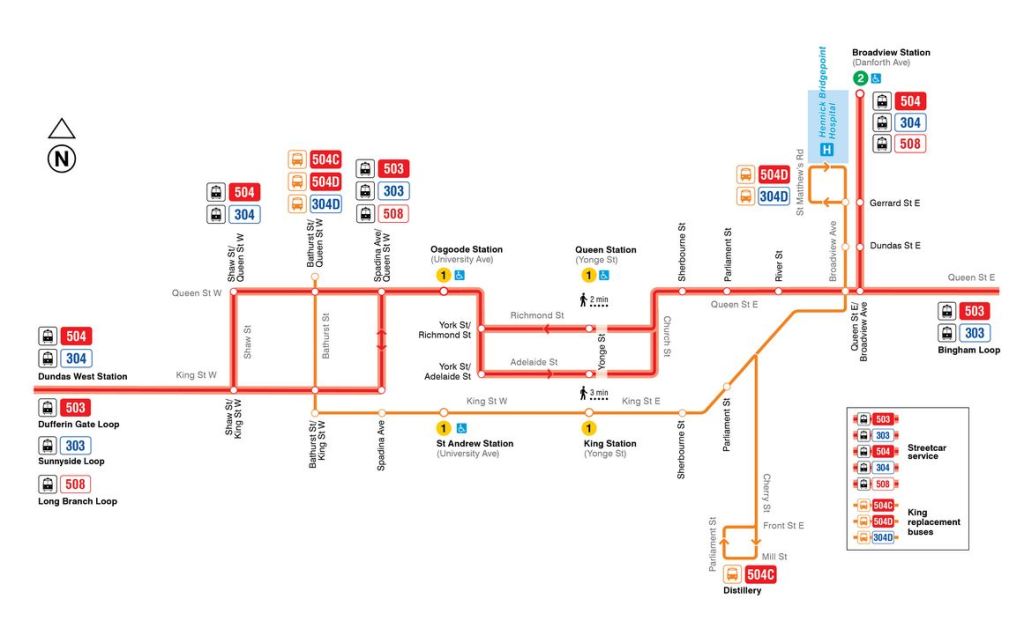
The 504 King service will be broken into three sections:

  • A 504 streetcar service between Broadview to Dundas West Stations operating via the same route as 501 Queen between the Don Bridge and Spadina.
  • A 504C bus shuttle from Wolseley Loop south on Bathurst and east on King terminating at Broadview & Gerrard.
  • A 504D bus shuttle from Wolseley Loop south on Bathurst, east on King and south on Sumach to Front & Cherry. Buses will loop via [to be announced] and will not serve Distillery Loop.

The 503 Kingston Road service will be changed so that its western terminus shifts from York Street to Dufferin Loop. Cars will follow the same route as the 504 King via Queen from the Don Bridge to Spadina, then shift south onto King to follow the pre-diversion 504B route to Dufferin.

508 Lake Shore cars will follow the same route as 504 King.

Night Service Changes

  • The 304 King night car will operate every 20 minutes over the same route as the daytime 504 service diverting via Queen and Spadina.
  • A 304D night bus will run every half-hour over the same route as the 504D bus from Wolseley Loop to Broadview & Gerrard.
  • The 303 Kingston Road night car will operate every 20 minutes over the same diversion route as the 304 King night car, and will operate as it does now to Sunnyside.

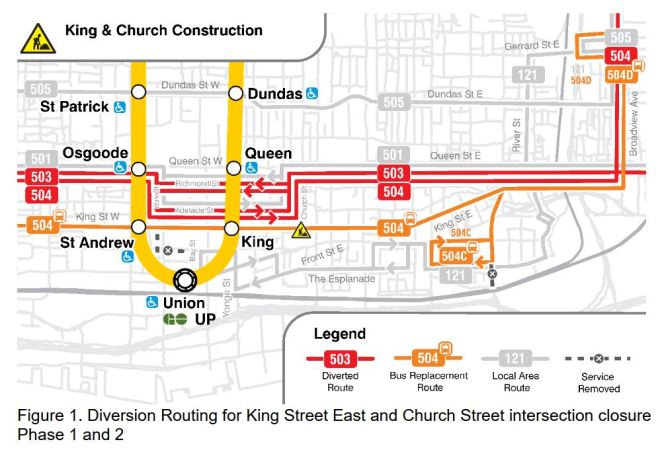
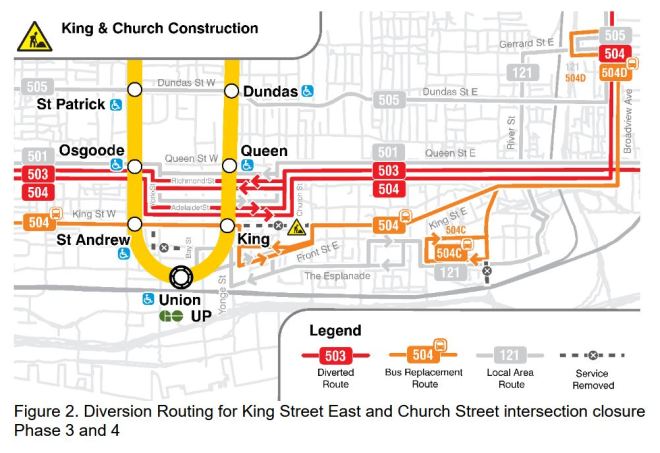
The maps below are from the City Report about this project originally published in February. An updated map for the first phase has been added later in the article.

Source: City Report at p. 5

For part of the construction period, King/Church will be impassible even to the replacement bus service and it will divert south to Wellington and Front.

Source: City Report at p. 5

These maps do not tell the whole story because another set of construction diversions will overlap the King/Church changes until the next schedule change in late June.

Although water main work at Bathurst/Fleet/Lakeshore is now complete, track work continues there and on Bathurst Street further north. 511 Bathurst streetcars will continue to divert east via King to Spadina looping via Adelaide and Charlotte. The 511B shuttle bus will be shortened from Wolseley Loop at Queen to an on-street loop via King, Portland and Richmond to Bathurst Street.

509 shuttle buses continue operating between Exhibition Loop and Queens Quay Loop at Spadina. 510 streetcars continue operating to Union Station.

The combined effect of the diversions will be greater than during the total meltdown of King service in 2024 when all cars diverted north via Church to Queen because volumes of other routes (510 Spadina, 511 Bathurst and 501 Queen) will be added to the King services, and more intersections will be affected over a wider area.

Updated May 5, 2025 at 12:50pm:

The TTC’s project webpage has a consolidated map of the diversions for the first phase of the work.

Continue reading

RapidTO Dufferin and Bathurst Streets: Public Consultation May 2025

In anticipation of transit demands for the FIFA games in June 2026 as well as general route reliability, Toronto proposes to install transit-only lanes on Bathurst (Eglinton to Lake Shore) and Dufferin (Eglinton to Lake Shore) Streets. Consultation sessions for these projects will be held through May 2025 both online and in person.

Updated Apr 28, 2025 at 1:40pm: Corrections to the Bathurst Street info have been added thanks to responses from the project team.

Updated May 7, 2025 at 10:10am: Links to the presentation decks and maps have been added for both projects.

Bathurst Street

  • Virtual public meeting on May 12 from 6:30 to 8:30pm
  • Drop-in events at
    • Harbord Collegiate on May 10 from 11am to 3pm
    • Humewood Community School on May 14 from 4:30 to 8:30pm
  • Consultation materials:

Dufferin Street

  • Virtual public meeting on May 13 from 6:30 to 8:30pm
  • Drop in events at
    • Stella Maris Catholic School on May 15 from 4:30 to 8:30pm
    • St. Mary Catholic Academy on May 20 from 4:30 to 8:30pm
  • Consultation materials:

Additional details and registration links for the online sessions are on the project web sites linked above.

The consultation sessions will be interesting, especially to see whether the FIFA games will be used to bulldoze transit proposals that might not otherwise be approved.

Implementation is planned for fall 2025 subject to Council approval.

Only overviews of the proposals have been posted at this time, but I will update this article when more details are available. The overviews are summarized beyond the “more” break below.

Continue reading

512 St. Clair Traffic Signal Delays

With Toronto’s Congestion Management Plan in the news, we hear about various ways to improve the movement of cars and, oh, by the way, maybe speed transit vehicles too. Toronto talks a lot about “transit priority” but this more often means giving transit vehicles the leftovers, the spare time that can be shaved at some locations from competing traffic, not absolute priority for transit vehicles.

This shows up particularly where transit vehicles have a dedicated lane, but they must wait patiently while other traffic, typically left turns, gets out of the way. This has the perverse effect of making transit slower particularly when combined with the “double stop” effect of farside stops. At these locations, the nearside space a stop would normally use is occupied by a left turn lane, and traffic in that lane has first claim on a green cycle.

Two routes with this as a near-standard stop configuration are 510 Spadina and 512 St. Clair. The Spadina car only recently returned, and I will leave comparative analysis of bus and streetcar operation there until more data have accumulated. A preliminary look is not complimentary to the streetcars because, unlike them, the buses are able to combine waiting for green signals with loading passengers.

On St. Clair, streetcars returned in Fall 2024. This article reviews tracking data for March 2025. In brief, a common situation along the route is that streetcars spend more time waiting at intersections than they do serving stops once they cross to a farside platform. The traffic signals are not organized to favour streetcar movements, and the configuration with farside stops is counterproductive.

To be fair, one cannot simply throw a red signal in front of cross traffic every time a streetcar appears as this will affect both auto and pedestrian crossings that require a minimum time. When both the St. Clair and Spadina lines were designed, a concern was the frequency of streetcar service and the high probability that there would always be a streetcar demanding priority. However, the larger Flexity cars combined with TTC service cuts makes this claim less valid.

Pre-emptive streetcar signals could be challenging at some locations, but there is the separate issue of timing of the phase for left turning autos. Should it come before or after streetcars are allowed to cross the intersection? Streetcar-only phases are only provided at some locations on Spadina where cars are turning across traffic lanes, but not for through movements. There is a streetcar-only phase at Lansdowne and St. Clair westbound, but otherwise left turning auto traffic always has priority.

A related problem lies in TTC’s glacial streetcar speeds through special work which would require a lengthy transit phase to allow streetcars to clear intersections on Spadina with streetcar junctions. With streetcars crossing on the shared north-south green, this does force motorists to wait for streetcars to get out of their way.

The data on St. Clair show a common pattern: streetcars spend more time waiting to cross intersections than they do serving the farside stops. They may operate in their own lane, but the combination of farside stops and signal design works against transit operations. This has implications for the soon-to-open “LRT” lines on Eglinton and Finch.

If we are not prepared to give transit vehicles true priority over cars, how do we expect to attract more riders to the system and, in theory, reduce overall road demand?

The remainder of this article describes the methodology behind my analysis and shows the behaviour at individual intersections along St. Clair.

Continue reading

Service Analysis of 512 St. Clair: January-February 2025

This article reviews the behaviour of service on 512 St. Clair during the first two months of 2025. This period was marked by an intense snow storm in mid-February that left many transit routes in disarray thanks to poor snow clearing.

Updated Mar. 21, 2025 at 10:30pm: The service chart for February 12, 2025, the first of the two major snow storms, has been added to this article.

Updated Mar. 22, 2025 at 1:00pm: Detailed charts of headways and travel times for February 12, 2025, have been added showing the consistency of travel times along the route even though headway quality deteriorated through the evening due to bunching.

The typical problem on four-lane roads was that snow was not removed to the curb causing parked cars to foul the streetcar tracks. Despite streetcar lines being “Snow Routes”, the signs were little more than decorations. The oft threatened but rarely practiced removal of cars for proper clearing did not occur, and some snow/ice banks remained until they eventually melted. Delays for blocked service occurred repeatedly well after the storms.

Another common problem was the absence of breaks in windrows (ploughed snow banks) at stops that lasted weeks after the snowfall. A few special cases had problems that were not addressed:

  • Where a street had permanent curb lane installations such as bump-outs for loading zones at stops, a windrow would be ploughed separating the streetcar lane from the waiting area making entry and exit from cars difficult, dangerous and in some cases impossible.
  • Where a bike lane occupied the curb lane, there would be a windrow between the streetcar and bike lanes blocking transit access.

While the City is officially responsible for snow clearing, the TTC was noticeably silent on a critical issue of operational reliability and passenger safety. They talk a good line about “safety”, but here, in a real crunch, the TTC did nothing beyond pleading by press release with motorists to not block the tracks.

The 512 St. Clair cars run in reserved lanes on a wider-than-usual Toronto street, and snow clearing was much less of an issue for them. Looking over the two-month period, we can see the benefit of a clear, protected right-of-way when many other routes were snarled or inoperative thanks to parked cars.

St. Clair is a relatively short route running between Yonge Street (St. Clair Station) and Keele Street (Gunn’s Loop). It loops through St. Clair West Station underground. In theory, this should provide four points — the two termini and the midpoint at St. Clair West both ways — where service could be regulated easily. Actual headway data show highly erratic service even during the pre-snow period.

By contrast, travel times along the route were consistent, with only small variations thanks to the storm, indicating that the snow was not a major problem. Of course, with a reserved lane, the TTC’s favourite chestnut about “congestion” could not be blamed for headway problems.

The charts in this article show both the travel times and headways (spacing between vehicles) for 512 St. Clair in January and February 2025, as well as detailed charts for specific days.

Continue reading

King/Church Construction Diversions and Transit Priority Plans

From May until early Fall, the TTC and City of Toronto will rebuild an aging water main and track at the intersection of King & Church Streets. A report before Toronto & East York Community Council on February 20, 2025, details plans for service diversions and transit priority measures.

There are two general plans for this project: the first is for phases when the intersection remains open for east-west traffic, and the second for the period when it will be closed. Note that the planned diversions are not the same as in the recent Annual Service Plan. Significant changes are the provision of service to the Distillery District replacing the 504A streetcar with the 504C bus, and the extension of 503 Kingston Road west to Dufferin Loop as opposed to the originally planned McCaul Loop.

Service along Queen Street between River and Spadina will substantially increase with the routes normally on King diverted to the north. Buses will operate as a streetcar replacement.

Traffic restrictions such as parking and turning permissions will change to provide more capacity for transit. Although the report cites the use of traffic wardens and changes to signal timings, it is silent on provisions for the much increased volume of streetcar turns at intersections where no priority signals exist today. (I await feedback from the City on exactly what they propose.)

The entire stretch of Queen Street as well as the Richmond/Adelaide diversion will not be used for CaféTO installations to conserve road space.

As part of this plan, a reserved lane will be created for streetcars eastbound approaching Broadview on Queen, and left turns by other traffic will be banned there.

Restrictions will be in effect from May 11 to October 14, 2025, although the City project is planned to run until August. Streetcar service could return in September, but this will depend on TTC plans for overhead reconstruction on King Street East and on the Sumach/Cherry branch to the Distillery District.

Details of routes and planned changes to traffic regulations follow in the full version of this article.

Continue reading

Headway Reliability on 504 King: January 2025 Update

This article is a companion to Travel Times on 504 King: Update to January 2025 published here recently.

This is a long article with increasing levels of detail toward the end. Feel free to bail out, or come back later.

Although problems with severe congestion delaying transit downtown were somewhat reduced by the addition of Traffic Wardens by the City of Toronto in 2024, reliability issues continue to affect service along the King route. The situation illustrates a few of the service design and management challenges for this type of route, and shows how simply reducing congestion will not necessarily provide regular service.

504 King is unusual in having four terminals: Dundas West Station and Dufferin Loop in the west, Broadview Station and Distillery Loop in the east. The TTC only measures service reliability at terminals, but the overlapping 504A and 504B services must blend together to provide the advertised quality.

The 504 shares with other streetcar routes a much wider headway than existed before the pandemic. This is due primarily to the change in vehicle size, and only partly to riding levels. With less frequent service, regular spacing is more important because scheduled gaps between vehicles are already wide, and can get much wider. This is compounded by overlapping services on the 504A (Distillery to Dundas West) and 504B (Broadview to Dufferin). Nothing in the service design or line management ensures that these blend evenly, and the design provides very frequent service only on paper.

The table below compares headways on routes that operated with the shorter CLRV streetcars in January 2019 versus the new Flexitys in January 2025.

Route and PeriodJanuary 2019January 2025
501 Queen to Humber
AM Peak4’15”10’00”
Midday4’45”9’00”
PM Peak4’50”8’30”
Early Evening4’30”10’00”
506 Carlton
AM Peak5’10”10’00”
Midday5’20”10’00”
PM Peak5’40”10’00”
Early Evening7’10”10’00”

The next table compares headways on routes that were already running Flexitys in 2019. (The Distillery District was originally served by 514 Cherry which ran from Distillery Loop to Dufferin Loop. In October 2018, the service design changed to the 504A/B configuration we have today.) 504 King service is less frequent than in 2019, and even less frequent than in November 2017 when the transit mall was implemented and the line was running with the smaller CLRVs.

512 St. Clair saw a substantial drop in service in May 2023 when headways increased from roughly 6 to 8 minutes. Not long after, the route then went through a long, painful period of bus operation during multiple, overlapping TTC and City projects. TTC plans to restore 6 minute or better service in late 2025. (Yes, you are reading that table correctly: peak service now is about half what it was in 2019.

Route and PeriodJanuary 2019January 2025
504 King
AM Peak5’15” on each branch 8’00” on each branch
Midday7’00” on each branch10’00” on each branch
PM Peak6’00” on each branch10’00” on each branch
Early Evening6’30” on each branch10’00” on each branch
512 St. Clair
AM Peak3’45”8’00”
Midday4’45”8’00”
PM Peak4’10”8’00”
Early Evening6’45”8’00”

Other routes were operating with buses in 2019 or 2025, and they are omitted here although their streetcar service is also less frequent now than it once was.

Although the service capacity in the case of 501 Queen and 506 Carlton is roughly the same allowing for the difference in vehicle size, the situation on 504 King and 512 St. Clair shows a marked reduction of capacity. This is an example of how the TTC is most definitely not back to 100% of pre-covid service, no matter how many media events make that claim.

With a wider scheduled headway, gaps will be wider too if either a vehicle is missing (e.g. a short turn) or vehicles are bunched together. When the scheduled service was frequent, some bunching was inevitable because vehicles were already close together. A management style that worked tolerably for frequent service does not work when fewer, more widely-spaced cars serve a route.

In this article, I will review performance of the 504 King route in January 2025, and show comparative data from earlier periods.

Continue reading

Travel Times on 504 King: Update to January 2025

Updated February 7, 2025 at 8:00pm: It occurred to me that although charts here are produced with maximum Y-values of an hour, or even 90 minutes, that this shows the peak times while compressing the visual range of the area where averages change over time. I have added a second set of charts for 2016-2025 with the maximum Y of 30 minutes to give the area where averages move between 15 and 25 minutes more “elbow room” and to make the evolution of values easier for readers to see. These have been added at the end of the “Implementing the Transit Mall” section.

In previous articles, I have posted charts showing the changes in travel times on the central portion of the 504 King route between Jarvis to Bathurst. This is the area covered by the supposed transit mall, although the degree to which streetcars actually have priority has varied over time for various reasons.

This article will review how travel times have evolved in recent years, as well as looking back to pre-pandemic and pre-transit mall eras. Full chart sets are available via links to PDFs for those who are interested.

Beyond that central section lies the conventional “streetcar” portion of the route west through Bathurst/Niagara, Liberty Village and Parkdale. To the east is the northern reaches of the St. Lawrence and Distillery districts. Do these deserve the same level of priority treatment? What would be the benefit if any? I will turn to those areas later in the article.

For those familiar with similar analyses on this site, I have retained the format of charting the 50th percentile (median) and 85th percentile values. These show both the general trend over time as well as the degree by which trips can vary from the median affecting reliability both in the priority area and on the broader route.

Significant events include the implementation of transit priority in November 2016, the covid lockdown in March 2020, and the effect of enforcement (or lack of it) on the ability of streetcars to move briskly through the priority area. Also important to note is that the effects differ by time and direction, and that congestion interferes with transit not just during the classic peak periods.

The important history lesson on King Street is that transit priority can improve travel times, but more importantly can improve reliability leading to more predictable trips and vehicle spacing over a route even beyond the bounds of the priority scheme’s area. Moreover, the benefits are easily lost through lack of enforcement and external events that significantly change demand on the road network.

Continue reading