Cherry Street Track Construction (Update 3)

Updated September 17, 2013 at 4:25pm:

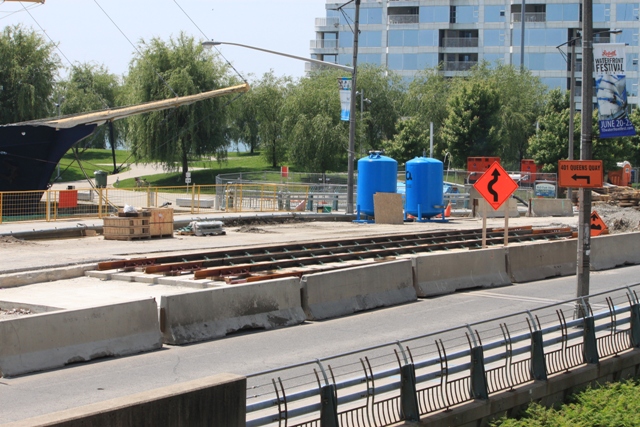
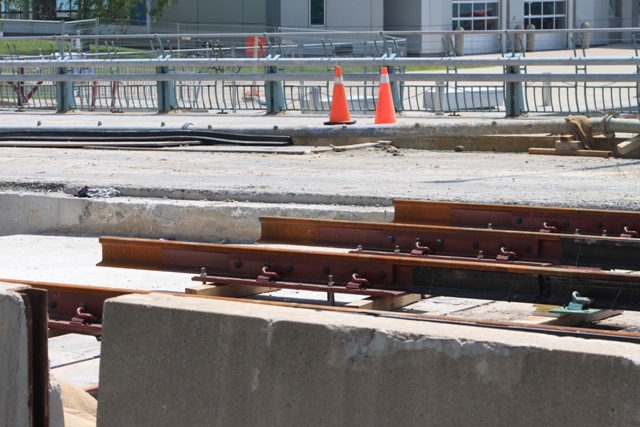
According to earlier plans I had heard through Waterfront Toronto, Cherry Street Loop was not to be completed until after the Pan Am Games because the site is part of a parking lot for buses.  Contrary to this story, the loop is under construction, albeit surrounded by a parking lot.

IMG_4450w

The now-inactive Cherry Street tower that once controlled the eastern approach to Union Station sits at the south end of the loop.  In the left background, behind the trees, is the GO Don Yard.

The terrible irony about this, our possibly newest streetcar line, is that it won’t actually see service until Spring 2016, and the proposed extension under the railway to connect with a Queens Quay East line isn’t even in the current list of projects awaiting funding.

Continue reading

Waterfront Transit Update July 2013

Many projects affect the development of Toronto’s waterfront and transit services.  It is easy to lose track of how everything fits together, and this is an attempt to put updates for the various parts in one place.

For an overall map of the waterfront, go to Waterfront Toronto’s site and click on “View Map”.

Construction progress photos can be found on pages for individual projects, and a good overview is available in the minutes of the Waterfront Toronto Board meetings under the CEO Reports and Construction Updates.   (Scroll down to the bottom of the linked page, click on “View Details” for a meeting, and select the report you wish to view from the pop-up menu.)

Waterfront Toronto will hold a public meeting on Wednesday, July 24 from 6:00 to 9:00pm at the Toronto Fire Academy, 895 Eastern Ave (at Knox) with updates on the Don Mouth Naturalization and Port Lands Flood Protection, and the Lower Don Lands Master Plan.

Continue reading

Development Charges and Transit Expansion

The City of Toronto Executive Committee will discuss the matter of a new Development Charges Bylaw at its meeting on July 3, 2013.  This is a statutory requirement as the current bylaw expires in April 2014, and it must be replaced in order for the city to continue collecting these charges.

Already press reports show a real estate industry apoplectic at the possibility that these charges will double.  With all the concern over a possible softening of the market for new units, the last thing they want is yet more cost added to the purchase price.  However, what we are seeing is a combined effect of the rising population and the exhaustion of surplus capacity in existing infrastructure, notably transit and water.  Much of the new development is concentrated in the central city in former industrial areas that do not possess the infrastructure needed to support their coming new populations.

(Chief Planner Jennifer Keesmaat observed at the “Feeling Congested” session earlier this week, about 70,000 people will call places like Liberty Village and the waterfront neighbourhoods their new home over the coming decade.)

There is bound to be lively debate, especially from the “no new taxes” brigade on Council, but the simple fact is that the city cannot have new development without some way to pay for the supporting infrastructure and services.  In this article, I will talk only about the transit component which is the single largest piece of the new DCs rising about 150% from the previous level for residential development.  (DCs overall will go up 86% because other categories have lower increases.)

Continue reading

Feeling Congested Part 2: Setting Priorities

The City of Toronto’s Planning Department is consulting with the public for the development of an updated Official Plan.  The plan’s transportation component falls under the rubric of “Feeling Congested” with a website devoted mainly to transit issues.  In the first round of meetings, the focus was on “what is important”, what goals should the new plan try to achieve.  In the second round, the topic is the prioritization of goals and how these might drive out different choices in a future network.

This parallels work that Metrolinx is doing on their Big Move plan, but it includes additional options for study that are city initiatives such as transit to serve the waterfront.

A survey now in progress (until June 30) seeks feedback on the evaluation criteria for transit projects, and also for the goals of the cycling plans.  Some of this makes more sense if one first reads the toolkit, but even then the presentation will leave skeptics unhappy because there is no link to the detailed study explaining how the proposed criteria have been measured for each of proposals.  (A summary chart on page 14 does not include the subcategories within each of the eight criteria that generated the total scores .)

Even with this background, an exercise asking whether the methodology is sound seems to be an odd way to survey public attitudes without a stronger discussion of the implications for a preferred network.  This is rather like discussing the colour of a magician’s hat rather than the effect this might have on the rabbit he pulls out of it (or if there’s even a rabbit at all).

Continue reading

Waterfront West Update (Revised June 15, 2013)

Updated June 15, 2013 at 4:20 pm:

The shortest streetcar line in the world exists, albeit without service, as the first piece of new surface track appeared on the 509 Harbourfront route at the Peter Street slip.

IMG_3828w

On June 11, the eight expansion joints for the future bridge crossing were set more or less in place on the new bridge deck.

IMG_3830w

By June 13, the tangent rails had been added, although the expansion joints at the west end of the bridge (below) …

IMG_3834rw

… had not yet been attached.

Note that, like subway track, the rails are mounted directly on the bridge deck, not on ties.  This approach is needed because the bridge design does not include the depth needed for the layer of ties normally found in TTC streetcar track.

IMG_3833w

The view below shows a close up of a test section of track built just west of the corner of Bay and Queens Quay.  The use of the rubber sleeve to mechanically isolate the track  is quite clear.  Under the plastic covers (with duct tape on them) are Pandrol clips holding the track to steel plates in the slab below.  The slab containing the track is separate from the base slab so that only excavation of the top layer is needed for track replacement.

IMG_3776w

The original Harbourfront track did not have the rubber layer and was quite noisy because the whole trackbed vibrated as cars passed.  This is one of the last pieces of mainline “thunder track” to be replaced on the TTC network, a process begun 20 years ago.

Continue reading

TTC Meeting May 24, 2013 (Update 3)

The agenda for the TTC meeting on May 24 contains a few items of interest, but also a troubling sign that matters of public interest are being debated behind closed doors.

Items included in this preview:

Updated May 23 at 12:10 am:

Links to the TTC construction pages for the York Street, Ossington Avenue and Kingston Road reconstruction projects have been added.

A reference to a statement about the New Streetcar Implementation Plan attributed to Andy Byford at the April Commission meeting has been corrected to reflect that it was made by Chris Upfold, Chief Customer Officer, who was standing in for Byford at that meeting.  TTC’s Brad Ross has confirmed that this plan will be presented in the public session of the June Commission meeting.

Updated May 23 at 9:15 pm:

The Kingston Road construction project info has been updated to reflect the early replacement of streetcars by buses effective June 3.

Updated May 25 at 1:30 pm:

This article has been updated to reflect events at the Commission meeting.

Continue reading

A Chat With Minister Murray

Glen Murray has only been sitting in his new office as Minister of Transportation and Minister of Infrastructure for Ontario for about 2½ weeks, but already his comments in the mainstream media (Globe Star) and on Twitter (@Glen4ONT) show that business as usual will not be the style of his office.  We chatted for about 45 minutes earlier today.

I began by asking about the change of his Twitter handle from the suffix “TC” (for his riding’s name, Toronto Centre) to “ONT” and his recent comments about transportation in northern Ontario.  Murray’s focus there is on economic development, and the need for transportation facilities to support investment, especially in mining.  On the question of passenger services, it was a bit harder to nail down the Minister’s position.

Murray is a big fan of High Speed Rail, and feels that the Windsor-Quebec corridor needs that sort of investment as an important first step, followed by improved rail and bus feeder services.  Yes, but what does this do for the north?  Murray sees the need for a spine rail service linking Toronto to the north with bus routes feeding into that spine, but neither details nor any sense of timing emerged.

Two important dollar figures, however, came out.  First, in southern Ontario, current spending on the 400-series highways is about $2.4-billion annually, and there is an argument to be made for upping spending on transit.  Second, mining now brings in about $1-billion annually, and the industry’s primary complaint is the lack of infrastructure, not their tax burden, according to Murray.

Continue reading

Waterfront East Update: February 2013 (Updated)

The Waterfront Toronto Board met on February 6, 2013, and received a presentation on the transit options under consideration for Queens Quay east from Bay to Parliament.

Updated February 7, 2013 at 1:20 pm:  The presentation materials from the February 6, 2013 Board Meeting are now available online.

Background

When a transit line to the eastern waterfront was first proposed, the cost estimate was considerably lower than today.  Waterfront Toronto has only $90-million left in the account for this project because some of the originally intended funds have been redirected to the Queens Quay West project now underway.

Coming into 2012, the project estimate had grown to $335m broken down as:

  • $112m for changes to the Union Station loop
  • $156 for the tunnel on Queens Quay from Bay east to Freeland
  • $66m for the surface portion from Freeland to Parliament

This number is now felt to be low because, somehow, the TTC has acquired a new “mandate” to relocate all utilities under its rights-of-way and this will push up the cost of the surface segment.  (As an aside, I cannot help wondering how much of this is gold-bricking by utilities who seek to renew/replace their existing plant at the transit project’s expense.)

Because Waterfront Toronto does not have full funding available for this project, they are looking for an interim solution that would improve transit in the area for the next 5-15 years.  The criteria fall into four groups:

  • quality and capacity,
  • ability to be implemnted,
  • costs and benefits, and
  • operations and neighbourhood impacts including traffic.

The options under study are not screened out just because they exceed $90m as it could be worth finding additional funds for a better solution.  Broadly speaking, the options fall in three groups: under $90m, about $150m and about $250m.

“Operational” evaluation will include consideration for effects on both the Ferry Docks and on the proposed new bus terminal (tentatively planned by Metrolinx as part of a development northeast of Bay & Lake Shore).

Continue reading

Queen’s Quay Track Construction (Updated November 15, 2012)

Updated November 15, 2012 at 7:00am:

Demolition of the trackbed has progressed eastward to Rees Street.

With the eastbound road lanes now closed, passengers looking for the replacement bus service have a considerable challenge as there is no signage anywhere at the former eastbound stops indicating that buses are now operating on Lakeshore and Harbour.

Continue reading