A Frustrating Update on Transit Expansion Plans

The TTC Board received an update from City and TTC staff on the status of major transit expansion plans in Toronto at its meeting of September 28. The presentation was largely delivered by Deputy City Manager John Livey with backup from Mitch Stambler, TTC’s Head of Service Planning. Also at the table, but notable for her silence, was the Toronto’s Chief Planner Jennifer Keesmaat. A contingent from Metrolinx, another agency studying transit expansion, was in the public gallery, but they did not participate in the presentation or discussion.

This session was a prologue for a report coming to Toronto’s Executive Committee on October 20, 2015, but a great deal of detail remains to be fleshed out. This proved frustrating for the Board members on two counts. First, the lack of detail prevented the TTC from making informed comment on the plans, and second, the process itself has largely bypassed the TTC Board and concentrated work at the City and Metrolinx.

To some extent, the TTC has itself to blame for this situation. During the Ford/Stintz era, meaningful policy debates at the TTC were rare, and the TTC ceded responsibility for large scale planning to the City of Toronto under Keesmaat’s department. At the political level, staying informed about issues is a comparatively new desire by Board members (not to mention some members of City Council) when the issues are more complex than a dumbed-down subways-subways-subways mantra. They have a lot of catching up to do.

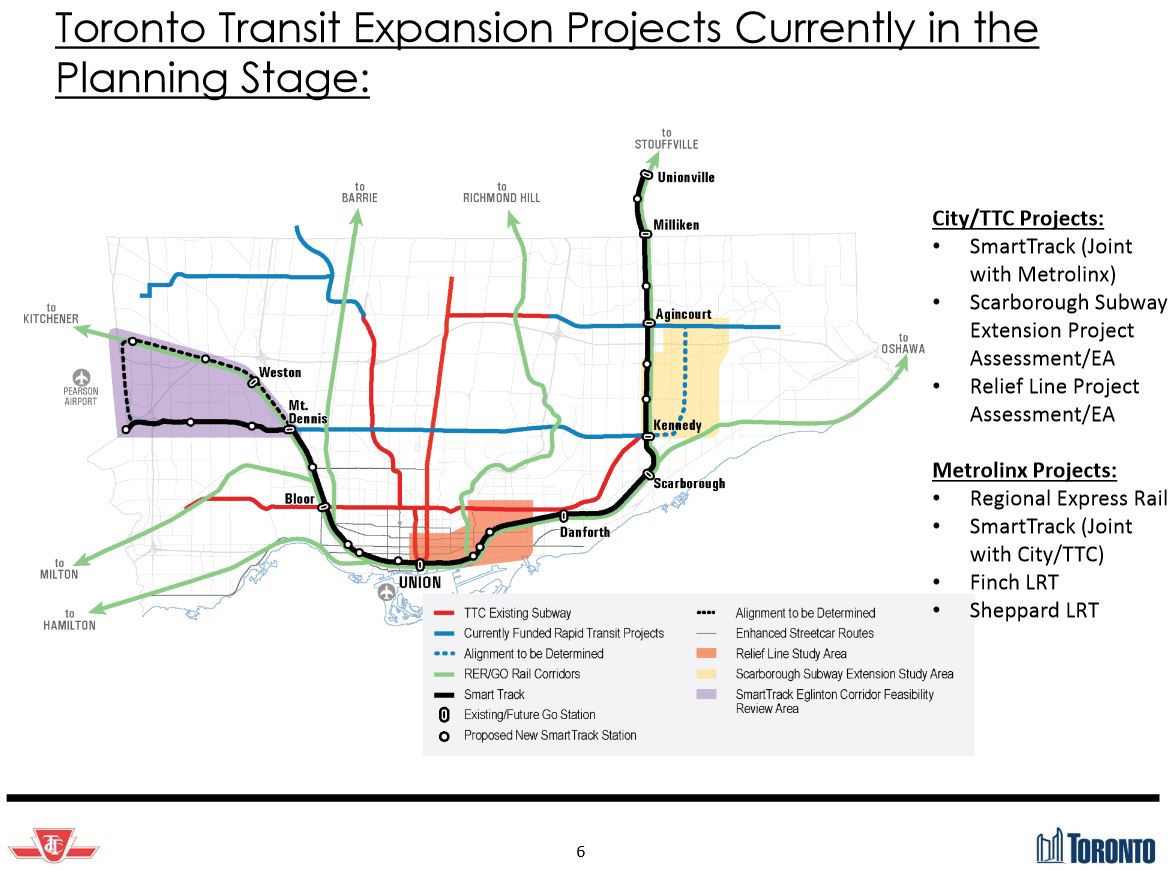
Detailed reports on four major projects will come before the TTC and Council over coming months, and these will inundate members with not only a great deal of information but force some hard decisions about just which projects, and at what scale, the City should pursue. These are:

  • The Relief Line
  • The Scarborough Subway Extension
  • Waterfront transit
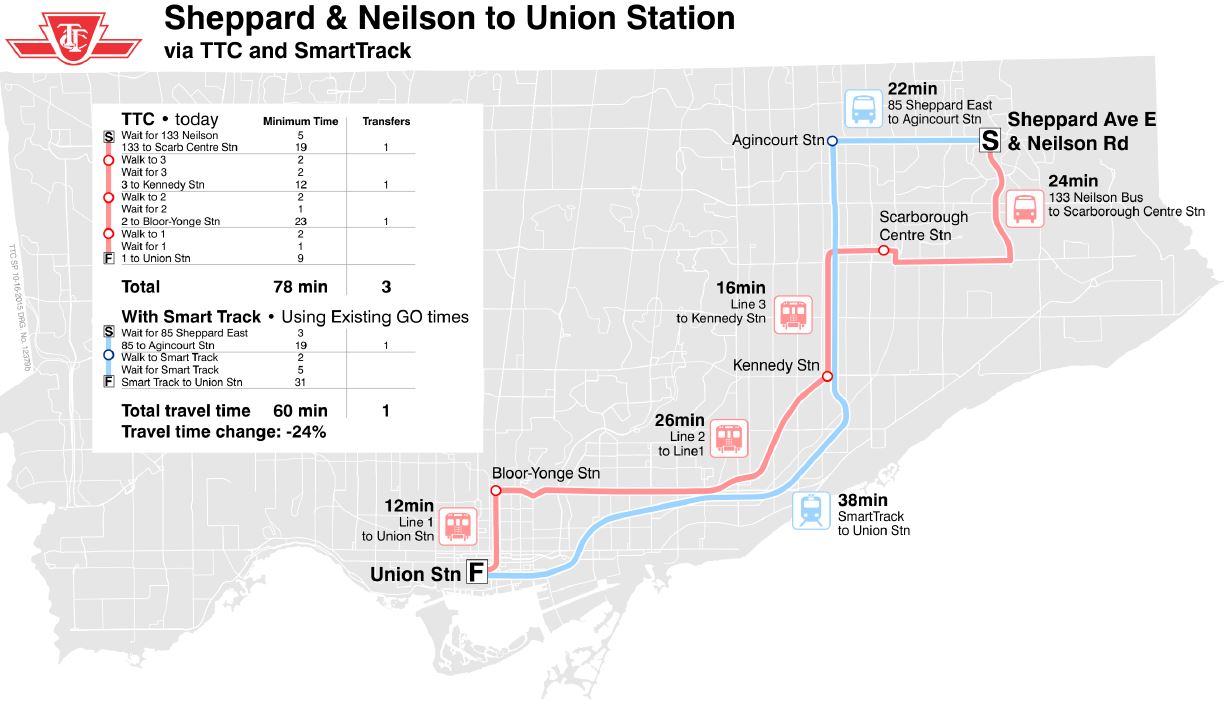
  • GO/RER, SmartTrack and TTC service integration

ExpansionPlanMap_6

The situation is complicated by parallel work at Metrolinx, an agency with very different goals from the TTC and the City, and by the inevitable political wrangling over the relative importance of projects. Whether any reports coming forward from staff will be trusted, especially in an environment where Councillors and the Mayor routinely dismiss “expert” advice that does not suit their biases, remains to be seen. Equally difficult will be the question of whether the reports are spun, in advance, to suit specific outcomes rather than presenting “just the facts”.

One difficulty already lurking in the wings is the question of demand modelling. The University of Toronto together with City Planning is developing a new model for GTHA travel. This is much more ambitious than current models in that it covers the entire region and models travel over the entire day, rather than focussing on AM peak flows. The model also allows for route and mode choice by incorporating considerations of fares and line capacity (crowding). At this point, the model is still being calibrated and validated, a process that uses known historical data (from the 2011 Transportation Tomorrow Survey) to confirm whether the model generates flows that accurately mimic what actually happened. (The TTS is conducted every five years by UofT on behalf of municipal and provincial agencies, and the next set of data will reflect demands in 2016.)

Draft results for the new projects and network will not be available until October 2015, and a report on details will not come to Council until the first quarter of 2016. One suspicion is inevitable given this delay: is the “calibration” intended to produce a desired outcome? That’s a tricky question both because it speaks to the independence of the process and also to the way in which the model is used. For example, a model may well reproduce past behaviour perfectly, but that’s a known target and the context for it (then-existing transit, road and land use configurations) are a matter of record.

Future modelling depends not only on the nuts and bolts of the model itself, but of the assumptions put into its configuration. A well-known example of flawed modelling was for the Sheppard Subway in which unduly rosy assumptions about job numbers and locations gave the subway a projected demand well above what it actually achieved. The further one goes into the future, the cloudier the view becomes, and the presumed distribution of population and employment can involve political as well as basic economic dimensions. If, for example, the concentration of jobs in the core area and the polarization of high and low income housing concentrations continues, this has profound effects on future demand. Moreover, such concentration may not suit politicians who view their own turf as the rightful place for future growth.

Continue reading

The Evolution of Service on Queens Quay

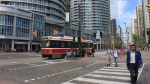
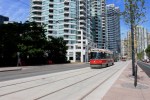
The new, improved transit right-of-way on Queens Quay has been in operation for a few months, and it has had its share, and then some, of problems. These included confused motorists, pedestrians and cyclists who could not figure out the new lane arrangement and signals, more than a few autos stuck in the tunnel entrance at Bay Street, and a streetcar collision thanks to an open switch at the Spadina/Queens Quay Loop.

When the design for the new road was still on the drawing boards, a red flag went up for transit watchers with the number of traffic signals, some fairly closely spaced. The “old” Queens Quay’s signals had their problems, and just to get a semblance of “priority” the detectors for approaching streetcars were moved further and further away from the signals in the hope that they would be able to cycle to a transit green before the streetcar actually arrived.

The streetcars returned, but the signals were, at first, on a standard program with no provision for detecting transit vehicles, although this changed in mid-June with the installation of the new, permanent traffic controllers.

Has there been an improvement? This article reviews current and past operations of the 509 Harbourfront and 510 Spadina cars running on Queens Quay.

Continue reading

TTC Board Meeting July 29, 2015 (Updated August 3, 2015)

The TTC Board will meet on July 29, 2015, and various items of interest are on the agenda. These include:

  • The monthly CEO’s Report (Updated August 2, 2015)
  • A presentation by Toronto’s Chief Planner Jennifer Keesmaat (Updated August 3, 2015)
  • Faregates for PRESTO implementation
  • Purchase of new buses and implications for service growth (Updated August 1, 2015)
  • Improved service standards for off peak service on “frequent” routes
  • Proposed split operation of 504 King during TIFF opening weekend (Updated August 2, 2015)
  • An update on Leslie Barns
  • Excluding Bombardier from eligibility for future contracts (Deferred to September Board meeting)
  • Council requests related to Lake Shore West streetcar service (Referred to TTC Budget Committee)

Continue reading

Queens Quay West Reopens As A Grand Boulevard

After nearly three years of construction, Queens Quay West saw its official re-opening today. After all of the digging, the dust, the new utilities and track, the constantly shifting road lanes, and the construction barricades always somewhere, in the way, the street is now almost complete. A few odds and ends remain for cleanup in the fall, but you need to know what these are to even spot them along the way.

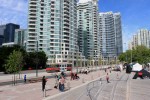
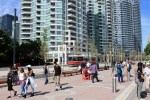
Toronto now has a new type of street – one with generous space for pedestrians, a wide separated pair of cycling lanes, a transit right-of-way and a two-lane road for cars. No longer a speedway (it’s amazing what years of construction can do to “evaporate” traffic), but a space shared among everyone. In these early days, some motorists are confused about where their lanes actually are, especially when turning onto Queens Quay from the north-south streets. Pedestrians have not yet quite figured out where to stand at intersections, and cyclists are getting used to their own sets of traffic signals. But with luck it will all work out.

The street itself is a cut above the usual for Toronto with patterns throughout granite pavers covering not just the public sidewalk but most of the private lands between that narrow strip and surrounding buildings.

Politicians who attended were suitably impressed, although the usual amount of back-patting (“look what my government did”) was inevitable, especially from the federal representative, Finance Minister Joe Oliver. The challenge is to get the same pols on board for the Queens Quay East project now that everyone can see just what the “new Queens Quay” is all about, and to have a more generous attitude to the value of good street design rather than minimalist utilitarianism, beyond the criticism of the most arduous opponents of “fat” in public projects.

One notable transit improvement is that the “transit priority” signals actually work, although I’ve been told there remains a tiny amount of tweaking to be done. For its part, the TTC has still not fixed the switches at Queens Quay & Spadina so that they operate automatically, and they are paying someone to do point duty there. The line has been open for months, but never let it be said that the TTC rushed into anything.

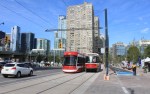
Here is a gallery of photos from the first day with all of the barricades down.

The Gardiner, SmartTrack and the Scarborough Subway

Three major projects face approvals at Toronto Council and Queen’s Park in coming months.

  • Should we replace the Gardiner Expressway with an at-grade boulevard between Jarvis and the Don River?
  • Should “SmartTrack”, John Tory’s signature campaign plank, form a U-shaped line from Markham to Pearson Airport providing both regional and local service in parallel with GO Transit?
  • Should the Bloor-Danforth subway be extended through Scarborough in place of the once-proposed LRT network, via which route and at what cost?

None of these is a simple problem, and they are linked by a combination of forces: polarized political views of what Toronto’s future transportation network should look like, very substantial present and future capital and operating costs, and competing claims of transportation planning models regarding the behaviour of a new network.

On the political front, Mayor Tory is playing for a trifecta against considerable odds. Winning on all three would cement his influence at Council, but it is far from clear that he will win on any of them. Council is split on the expressway options, SmartTrack has already sprouted an alternative western alignment, and the Scarborough Subway fights for its life with alternative route proposals and the threat of demand canibalized by the Mayor’s own SmartTrack plans.

Continue reading

Queens Quay Two Way Traffic Begins

On Monday, June 1, the transition to the “new” two-way operation of Queens Quay started with conversion of the traffic signals at Bay Street to their new configuration. This work will progress westward with one intersection a day until June 10.

The new traffic controllers are supposed to have much more sophisticated transit priority provisions than are used elsewhere in Toronto, and their ability to speed up operations on the streetcar right-of-way will be interesting to watch. I have already requested vehicle tracking data for May 2015 as “before” information, and the June 2015 data, when it comes, will show the degree to which the new signals actually perform as claimed.

(Existing signals have no transit priority at all. They merely cycle through a standard program which does more to hinder transit vehicles than to help them.)

Work on the overall Queens Quay project is nearing completion in many areas, although visitors may be forgiven for doubting this given the ever-present and shifting construction barriers. The weekly construction notice gives details of the work as it progresses.

The Gardiner East Conundrum: Saving Time Is Not The Only Issue

Toronto’s Public Works and Infrastructure Committee (PWIC) will consider an updated report on the Gardiner East reconstruction options at a special meeting on May 13, 2015 where this will be the only item on the agenda. (Note that additional detailed reports are linked at the bottom the main report.)

There has been much discussion of the alternative designs for the expressway section between Jarvis Street and the Don River and, broadly speaking, there are two factions in the debate.

  • For one, the primary issues are to maintain speed and capacity of the road system, and to avoid gridlock.
  • For the other, the primary issue is the redevelopment of the waterfront, and the release of lands from the shadow of the expressway structure.

Both camps seek to encourage economic growth in Toronto, but by different means and with different underlying assumptions.

A further issue, largely absent from the Gardiner debate, is the role and comparative benefits of various transit projects ranging from GO/RER/SmartTrack at the regional level, down to subway options including the Scarborough Subway Extension and the Downtown Relief Line, and local transit including the Waterfront East LRT line and a proposed Broadview Extension south across Lake Shore to Commissioners Street including a Broadview streetcar.

Continue reading

City of Toronto Budget Amendments 2015 (Updated)

At its meeting of March 11 and 12, 2015, City Council passed a few budget amendments affecting the Toronto Transit Commission. Some of these reflect a sense that the TTC has not been “minding the store” quite as well as it claims, and a little belt tightening is good for any organization. Others address specific concerns that, quite frankly, should have been on the TTC’s agenda before now, but were buried under the rapid transit debates.

The motions address the following topics:

  • Additional Streetcars
  • Automatic Train Control
  • Waterfront West Transit
  • TTC Staffing and Project Management

Updated March 13, 2015 at 1:50 pm with further information about proposed staffing reductions.

Continue reading

TTC 2015-2024 Capital Budget: System Expansion Projects

The TTC’s Capital Budget generates much debate over a few items, but there are many, many projects at the detailed level. Understanding those details puts the debate over transit spending, operations and expansion in a better context. This and following articles will look under the covers of the Capital Budget. I will start with the expansion projects because these have seen so much debate, but will turn to the more mundane parts of the budget that keep the wheels turning.

The projects discussed here include:

  • The Toronto York Spadina Subway Extension (TYSSE) to Vaughan Metropolitan Centre
  • The Scarborough Subway Extension (SSE)
  • Various Waterfront proposals

Neither the Downtown Relief Line (DRL) nor the Yonge extension north to Richmond Hill is included because these are not yet official projects.

Continue reading

The Not So Speedy 509 Harbourfront Car

Streetcar service resumed on 509 Harbourfront on Sunday, October 12, after an absence of over two years. The Queens Quay reconstruction project started at the end of July, 2012, and was supposed to be complete in the spring of 2013. For many reasons, things didn’t quite work out that way (this has been discussed in other posts and I won’t repeat the chronology here).

Although the line re-opened for streetcar service, the operating speed was, putting it mildly, glacial thanks to a whole new set of traffic signals that gave a new meaning to the antithesis of “transit priority”. Even with relatively little demand for road traffic on Queens Quay, the vast majority of time was devoted to moving the few cars that showed up now and then, while the streetcars waited for occasional, and very brief, green windows, even at locations where the “traffic green” and “transit green” would not have produced conflicting movements. Despite over two years to plan how the signals might operate in the interim configuration for this stage of the project, the arrangement had all the earmarks of a last minute scheme with a one-size-fits-all approach to programming intersections.

This arrangement lasted until late in the first week of operation, but there is still no co-ordination between transit and signals, and there are now many more places where streetcars can be held waiting for their chance to proceed. Even with the fixes, streetcar service is slower than the bus route it replaced (which did not have to deal with anywhere near as many signals) and slower than the streetcar service operated before the reconstruction.

The TTC, City and Waterfront Toronto face an acid test in their combined commitment to transit as the primary mode of access to the waterfront — if they cannot manage at least to equal the performance of the streetcar route before construction started, what is the future for surface transit in general?

Because the final arrangement won’t be in place until Queens Quay reverts to two-way traffic in the spring of 2015, we will not know just how “intelligent” the traffic signals will be about transit. The worst outcome would be to open the finished street with a disastrous arrangement for traffic control.

In this article, I will review actual running times for 509 Harbourfront in October 2014 with both the bus replacement service and the return to streetcars, and will compare this to data from February 2010.

Continue reading