
Transit City December 2009 Update (Part 3) (Revised)

Revised December 29 at 12:15 am:  The section on the Finch LRT has been moved to the end and expanded to clarify an alternate proposal for the underground connection between the Yonge subway and the LRT station.

In the two previous articles in this series on the Eglinton and other LRT lines, I mentioned that the TTC would receive an update at its December 16 meeting on the status of the projects.  Seasonal festivities and other matters have diverted my attention, and I’ve been remiss in not reporting on the news, such as it is.

The discussion was intriguing as much for its political as its technical content.  Two factors, related to some extent, will force decisions that, to date, have been avoided about priorities and about the mechanism of project delivery.

  • With the award of the 2015 Pan Am Games to the GTA, there is a desire to have everything up and ready to go with time to spare before the event itself.  This affects both the SRT and the proposed Scarborough-Malvern LRT.
  • Although Queen’s Park, through Infrastructure Ontario, is enamoured of “alternative procurement” (code for private sector development of public infrastructure), actually launching a project on such a basis is now acknowledged to add about one year to the delivery time.  This affects both the SRT and the Finch West LRT which were to be delivered in this manner.

Under the original project schedule, the SRT would still be under reconstruction as an LRT line when the Games took place in 2015.  If this is to be avoided, the start date for the project must be advanced to 2011 or delayed until after the games.  The latter option is dubious considering that the SRT is, technically speaking, on its last legs and keeping it running reliably into the Games period may be challenging.  TTC staff will report on these issue in January, and another round of public meetings is expected in the same timeframe.

Of course, staff will also finally have to produce a design that shows an LRT conversion, rather than an ICTS-centric scheme.  They will have to modify the connection at Sheppard both as an interim terminal (the northern section to Malvern is not yet funded), and to provide a track connection to the Sheppard LRT so that Scarborough LRT trains can use Sheppard carhouse.

The Kennedy Station redesign is also affected by the LRT conversion as the SRT will no longer be a separate entity from the Eglinton LRT lines.

When the Games were announced, there was much talk of accelerating construction of the Scarborough Malvern LRT running east from Kennedy via Eglinton, then north via Kingston Road and Morningside to UofT’s Scarborough Campus (UTSC).  What has not been examined in detail, probably because people still think of the “SRT” as an “ICTS” line, is the early construction of the northern 2km of the Malvern line from UTSC north to Sheppard.

I suspect that the running time from Kennedy to UTSC via Eglinton, or via a temporarily extended SRT via Sheppard could be comparable, and for a short-term operation would make much more sense.  The UTSC site could be served by trains on the S(L)RT from Kennedy and by trains on the Sheppard LRT from Don Mills giving good access not just for people using the BD subway to reach Kennedy.  Longer term, this option would provide service to UTSC long before the planned date for the Scarborough-Malvern line.

Metrolinx is considering this option, but the TTC and City are plumping for funding of the full Malvern LRT line.

The “alternative financing procurement” (AFP) issue arises because the contract with the private developer imposes an extra layer of complexity, preparation and management that does not for a project delivered in the “traditional” manner by the inhouse TTC project.  Any private arrangement must have a defined product along with a mechanism to ensure compliance, and design must reach a detailed enough stage that a bidder can make a concrete proposal.  This pushes back the start date for any project using alternative procurement by about a year.

In the case of the SRT, it would likely not be possible to make the target date for completion, according to preliminary comments at the TTC meeting, if the new line was to be up and running by the winter of 2014/15, well in advance of the Games.

In the case of the Finch West line, the delayed start triggers a political problem because there is so much focus on Scarborough.  Why should Downsview and Rexdale have to wait behind reordered priorities that could complete the Scarborough LRT network all in the name of serving the Games?

For all of Transit City, the TTC will deliver the projects on Metrolinx’ behalf, but we don’t yet know how the next layer down will work for the AFP projects.  However, regardless of how the new lines are built, the TTC will operate and mainten them.
Continue reading

Transit City Update December 2009 (Part 1)

On December 16, the TTC will receive an update on the status of the Transit City projects.  This post is a brief synopsis along with my own comments on the progress, or lack thereof, on this plan.

This is a long post, and I have placed the break here for those who don’t want to read the whole article.  The Eglinton LRT is covered here including comments on the December 2009 version of the design presented at recent open houses.  I will deal with the remaining lines in Part 2. Continue reading

Eglinton LRT Project Open Houses (Updated)

Starting tonight, there will be a series of open houses for the Eglinton project.

Updated:  The display panels are now available online.

All Open Houses will be held from 6:30pm to 9:00pm.

  • November 23:  York Memorial Collegiate (cafeteria), 2690 Eglinton Avenue West
  • November 24:  Etobicoke Olympium (2nd floor Lounge), 590 Rathburn Road
  • November 25:  Northern Secondary School (cafeteria), 851 Mount Pleasant Road
  • November 26:  Richview Collegiate (cafeteria), 1738 Islington Avenue
  • December 2:  CNIB Conference Centre, 1929 Bayview Avenue
  • December 8:  Don Montgomery Community Centre, 2467 Eglinton Avenue East
  • December 10:  Beth Shalom Synagogue, 1445 Eglinton Avenue West


Please use this thread for comments on the latest proposals, preferably after you have seen them.

Metrolinx “Big 5” Update (November 2009)

Today’s Metrolinx Board Meeting was notable both for the update, in public session, of the project status for five major lines as well as for supplementary information that came out in a press scrum after the public session.

Five projects now have funding and are at various stages in their approval/construction process.

Continue reading

Eglinton LRT Update (Revised)

At its meeting on November 17, the TTC will consider a report on the Eglinton LRT Transit Project Assessment.  A few items have caught my eye already:

  • Another round of public meetings starting from November 23 to December 10 will present the final version of the design.
  • The scheme for handling left turns has been modified from that shown in the original plan.
  • Construction is proposed for three stages, but service will not reach the airport until 2020.  The section west from Eglinton West Station to Commerce Blvd. would open in 2016, the east section to Kennedy in 2018, and the airport link in 2020.  Promoters of the Pan Am Games might have questions about that timetable.
  • The Silver Dart alignment to the airport remains the preferred option, and the line will not serve the hotel strip on Dixon Road.
  • The station formerly located at Brentcliffe is now at Laird.

Revised November 13, 10:15 am:

The process for handling Commission approval of the Transit Project Assessment is rather odd because only the Executive Summary is available at this time.  Full details of the proposal have not been provided, and yet the Commission is being asked to sign off on the TPA.

This begs the question of how the TTC can “approve” an assessment when the document is not before them and may not yet exist in final form. Continue reading

Transit Improvements for Pan Am Games? Dream On.

Toronto will host the 2015 Pan-Am Games thanks to an overwhelming vote in favour of Toronto’s bid on November 6.  No sooner was the announcement out, but we started to hear what a boon this would be for transit pending in Toronto.

Let’s take a serious look at what will actually happen.

Don Lands

The Athletes’ Village will be built in the West Don Lands with the intention that it be converted to assisted housing after the games.  This will no doubt spur construction of the Cherry Street branch off of the King route so that residents will have transit once the games complete.

However, there are no competition venues in this part of Toronto, and no reason to build new infrastructure to serve them.  We will get the Waterfront East leg, but like the Cheery Street branch, this project was already on the books and, I believe, funded by Waterfront Toronto.

The missing piece is the connection under the rail corridor where the existing Cherry Street underpass must be twinned to provide enough room for the LRT, the road lanes, cycling and pedestrians.  This underpass is shown as a “secure” area in the Bid Book, and there is no sign of the second span on the map.

Also missing from the Bid Book is any description of the as-yet unfunded reconfiguration of the mouth of the Don River and associated street changes in the neighbourhood.  These are vital to knitting together various parts of the new community, but they are nowhere to be found in the Bid Book, nor is there any need to build them as part of the games infrastructure.

Scarborough-Malvern LRT

The Scarborough Campus of UofT will gain a new aquatics centre to host some events, but attendees will likely arrive from many parts of the GTA of which only some would be served by the LRT line.  One might even argue for service via the north end of this route (south from the Sheppard LRT).

George Smitherman, Minister of Infrastructure and possible mayoral candidate for Toronto, has already said that Toronto shouldn’t be too hasty to look for spending on this type of improvement.

The Airport

The Air-Rail link will be in place by 2015.  The Bid Book says it will.  What the Bid Book does not say is that this will be a premium fare service that is not integrated with the local transit system, nor that its capacity will be limited by the size and frequency of trains for which the route is designed.

Meanwhile, the TTC should be pushing to get the western part of the Eglinton LRT completed for 2015, at least from the Airport to Eglinton West Station.  Is this asking too much, or will the TTC bumble along and stay with the current plan for the Eglinton line and a 2016 “phase one” opening?

Everything Else

The games generally take place well outside of Toronto.  The logistics of placing the Athletes’ Village so far away from the venues only makes sense because it is right beside the Gardiner and DVP, and these can be closed or restricted to provide bus shuttles as needed for participants, press and poo-bahs from the games organization.  New public transit infrastructure, beyond what is already in the pipeline, will have little to do with it.

Streetcars on the Waterfront (1968)

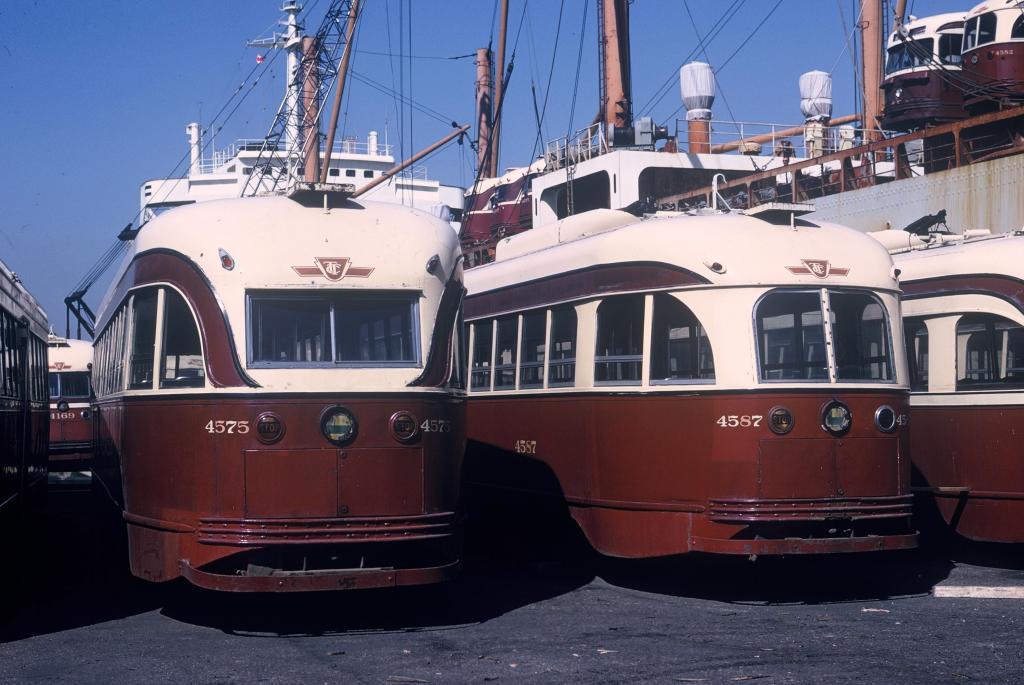
With all the discussion of waterfront transit, many people may forget (or never have seen) a previous visit of streetcars to the water’s edge.  Back in 1968, the TTC sold many of the PCC cars retired after the Bloor-Danforth Subway opened, and a batch of these went to Egypt.  On July 20, 1968, a much younger version of your faithful scribe was there along with many others to record the event.

All photos here were taken by me and I reserve copyright in them.

E010C

Sitting on the dock, here are two ex-Cincinnati PCCs including TTC 4575, a 1939-built  demonstration car for Cincinnati.  This car had many oddities including windows, marker lights and some interior features as befits a one-of vehicle.

Cars were loaded from both sides of the ship, the Mare Tranquillo.

Here, 4217 joins its mate 4222 on deck. A short turn destination right to the end!

A group of cars begins their sea voyage from a lighter. The railfans have obviously been busy with destination and route combinations that were already obsolete when these photos were taken. Parliament and Harbord vanished with the opening of the BD subway in 1966, and Dupont was a casualty of the University line in 1963.

A quartet of cars sits on deck seen from the dock.

The view from the bridge.

Looking out from the bridge to the Toronto Islands.

4007, one of Toronto’s first PCCs, meets the Island Ferry for the last time.

Rethinking the Waterfront West LRT

The TTC’s 2010-2019 Capital Budget contains a project description for the WWLRT that throws the whole project into serious doubt.  Metrolinx funding has been deferred to 2022, and the schedule for the project now looks like this:

  • 2022 Construction starts; Park Lawn Loop is built
  • 2026 Service begins from Exhibition Loop to Dufferin
  • 2028 Service begins from Dufferin to Park Lawn
  • 2029 Service begins from Park Lawn to Long Branch

Most of the Lake Shore community residents who have attended EA meetings to discuss the design and effect on their neighbourhoods will have to wait two decades to see the project implemented.  Whatever happened to Toronto’s “Transit First” model for the waterfront?  Must we wait for the complete condoization of Lake Shore before anything happens with transit service?  How relevant will 2009 studies be if the project isn’t actually in operation until 2029?

This project has been gerrymandered throughout its history to suit whatever pet project (pro or con transit) happened to be on the front pages, and the idea that the line might actually have some useful transit function often appeared secondary.  Indeed, the original 1990 study describes a line that is unrecognizable in today’s plans which have been updated by amendment without any formal public participation or any sense of overall direction for the project. Continue reading