Waterfront West Update (Revised June 15, 2013)

Updated June 15, 2013 at 4:20 pm:

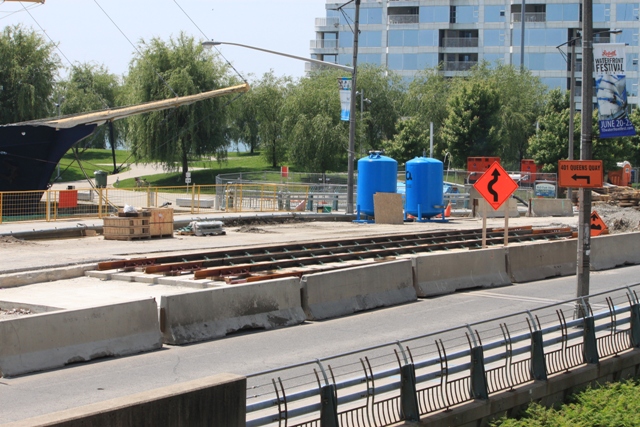
The shortest streetcar line in the world exists, albeit without service, as the first piece of new surface track appeared on the 509 Harbourfront route at the Peter Street slip.

IMG_3828w

On June 11, the eight expansion joints for the future bridge crossing were set more or less in place on the new bridge deck.

IMG_3830w

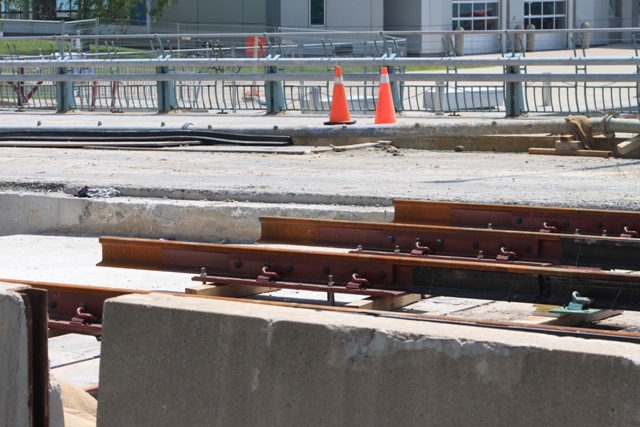
By June 13, the tangent rails had been added, although the expansion joints at the west end of the bridge (below) …

IMG_3834rw

… had not yet been attached.

Note that, like subway track, the rails are mounted directly on the bridge deck, not on ties.  This approach is needed because the bridge design does not include the depth needed for the layer of ties normally found in TTC streetcar track.

IMG_3833w

The view below shows a close up of a test section of track built just west of the corner of Bay and Queens Quay.  The use of the rubber sleeve to mechanically isolate the track  is quite clear.  Under the plastic covers (with duct tape on them) are Pandrol clips holding the track to steel plates in the slab below.  The slab containing the track is separate from the base slab so that only excavation of the top layer is needed for track replacement.

IMG_3776w

The original Harbourfront track did not have the rubber layer and was quite noisy because the whole trackbed vibrated as cars passed.  This is one of the last pieces of mainline “thunder track” to be replaced on the TTC network, a process begun 20 years ago.

Continue reading

TTC Meeting May 24, 2013 (Update 3)

The agenda for the TTC meeting on May 24 contains a few items of interest, but also a troubling sign that matters of public interest are being debated behind closed doors.

Items included in this preview:

Updated May 23 at 12:10 am:

Links to the TTC construction pages for the York Street, Ossington Avenue and Kingston Road reconstruction projects have been added.

A reference to a statement about the New Streetcar Implementation Plan attributed to Andy Byford at the April Commission meeting has been corrected to reflect that it was made by Chris Upfold, Chief Customer Officer, who was standing in for Byford at that meeting.  TTC’s Brad Ross has confirmed that this plan will be presented in the public session of the June Commission meeting.

Updated May 23 at 9:15 pm:

The Kingston Road construction project info has been updated to reflect the early replacement of streetcars by buses effective June 3.

Updated May 25 at 1:30 pm:

This article has been updated to reflect events at the Commission meeting.

Continue reading

A Chat With Minister Murray

Glen Murray has only been sitting in his new office as Minister of Transportation and Minister of Infrastructure for Ontario for about 2½ weeks, but already his comments in the mainstream media (Globe Star) and on Twitter (@Glen4ONT) show that business as usual will not be the style of his office.  We chatted for about 45 minutes earlier today.

I began by asking about the change of his Twitter handle from the suffix “TC” (for his riding’s name, Toronto Centre) to “ONT” and his recent comments about transportation in northern Ontario.  Murray’s focus there is on economic development, and the need for transportation facilities to support investment, especially in mining.  On the question of passenger services, it was a bit harder to nail down the Minister’s position.

Murray is a big fan of High Speed Rail, and feels that the Windsor-Quebec corridor needs that sort of investment as an important first step, followed by improved rail and bus feeder services.  Yes, but what does this do for the north?  Murray sees the need for a spine rail service linking Toronto to the north with bus routes feeding into that spine, but neither details nor any sense of timing emerged.

Two important dollar figures, however, came out.  First, in southern Ontario, current spending on the 400-series highways is about $2.4-billion annually, and there is an argument to be made for upping spending on transit.  Second, mining now brings in about $1-billion annually, and the industry’s primary complaint is the lack of infrastructure, not their tax burden, according to Murray.

Continue reading

Waterfront East Update: February 2013 (Updated)

The Waterfront Toronto Board met on February 6, 2013, and received a presentation on the transit options under consideration for Queens Quay east from Bay to Parliament.

Updated February 7, 2013 at 1:20 pm:  The presentation materials from the February 6, 2013 Board Meeting are now available online.

Background

When a transit line to the eastern waterfront was first proposed, the cost estimate was considerably lower than today.  Waterfront Toronto has only $90-million left in the account for this project because some of the originally intended funds have been redirected to the Queens Quay West project now underway.

Coming into 2012, the project estimate had grown to $335m broken down as:

  • $112m for changes to the Union Station loop
  • $156 for the tunnel on Queens Quay from Bay east to Freeland
  • $66m for the surface portion from Freeland to Parliament

This number is now felt to be low because, somehow, the TTC has acquired a new “mandate” to relocate all utilities under its rights-of-way and this will push up the cost of the surface segment.  (As an aside, I cannot help wondering how much of this is gold-bricking by utilities who seek to renew/replace their existing plant at the transit project’s expense.)

Because Waterfront Toronto does not have full funding available for this project, they are looking for an interim solution that would improve transit in the area for the next 5-15 years.  The criteria fall into four groups:

  • quality and capacity,
  • ability to be implemnted,
  • costs and benefits, and
  • operations and neighbourhood impacts including traffic.

The options under study are not screened out just because they exceed $90m as it could be worth finding additional funds for a better solution.  Broadly speaking, the options fall in three groups: under $90m, about $150m and about $250m.

“Operational” evaluation will include consideration for effects on both the Ferry Docks and on the proposed new bus terminal (tentatively planned by Metrolinx as part of a development northeast of Bay & Lake Shore).

Continue reading

Queen’s Quay Track Construction (Updated November 15, 2012)

Updated November 15, 2012 at 7:00am:

Demolition of the trackbed has progressed eastward to Rees Street.

With the eastbound road lanes now closed, passengers looking for the replacement bus service have a considerable challenge as there is no signage anywhere at the former eastbound stops indicating that buses are now operating on Lakeshore and Harbour.

Continue reading

TTC Madness: A Subway for Everyone

Today’s meeting of the transit commission was expected to be a modest affair with approval of the Downtown Relief Line study’s recommendations, and a few other housekeeping items.  What happened was a complete upending of the transit expansion policies we thought were put in place by the Karen Stintz coup d’état that bounced Rob Ford’s crew off of the TTC board back in the spring.  Stintz herself didn’t even have the nerve to stand up to the runaway proposals from her fellow members preferring to keep peace, for now at least.

To make sense of this debacle, I have to recount some of the earlier events.

The main act was a presentation by TTC staff of the DRL Study, and it contained few surprises relative to coverage we have already seen in the press and on this blog.  One comment caused attentive ears to prick up, namely that spending $1-billion expanding Bloor-Yonge station might be less cost-effective than providing additional capacity with a new line.  Would that the TTC would look at all components of its subway plans that way (a topic for another article), but it’s a refreshing point of view.

The study and presentation make explicit reference to potential shortfalls in GO Transit capacity as part of the problem.  Although these will no doubt annoy Metrolinx (is there a TTC meeting that doesn’t anger Metrolinx?), that agency’s basic problem is that long-term secrecy about what it might actually build forces assumptions to be made.  That said, nothing prevented the TTC from modelling improved service on the GO northern corridors just to see what this would do to demand flows on a “what if” basis.  After all, the whole DRL study is a “what if” exercise.

Councillor Parker asked about Main Station as an alternative DRL/Danforth subway connection.  Staff’s position is that there are advantages to a north-south connection further west that would potentially serve Thorncliffe and Flemingdon Parks, and line up with the Don Mills corridor.  (I will address DRL options in a separate article.)  There were humourous remarks about how staff were trying to buy Parker off with a subway to his ward.

Parker moved that the Danforth to Eglinton section of the DRL be included in the next phase of the study, but the motion fell short of actually committing to this segment as a top priority.

Councillor Milczyn asked about eliminating parking on King or Queen Streets.  Staff replied that this would be important for improved surface transit, and the idea would be part of a separate Downtown Traffic Operations Study now underway by the City, but that this would not avoid the need for a DRL.

Milczyn also asked about a Lakeshore West LRT and seemed to be mixing the proposal that was one option in the DRL study (an LRT or subway line in the rail corridor) with the Waterfront West LRT (that would run on Lakeshore Blvd.).

Councillor Colle asked about capacity on the Bloor-Danforth line east of Yonge, and staff replied that with the DRL, this would not be an issue.  However, that remark misses the fact that the Danforth subway regularly passes up riders today east of Pape, the point where capacity would be freed up.  More service will be needed on the BD line even with the DRL in place.

Colle went on to ask whether extending the BD line to Scarborough Town Centre would affect the DRL’s alignment by shifting the logical point for “relief” further east.  Staff replied that the demand model already has the extra ridership that the replaced and extended SRT will bring to Kennedy Station built into projected Danforth subway demand.

Councillor De Baeremaeker observed than an overall city plan needs to include subways, LRT and buses, that the DRL is a “good subway”, and that the problems of inadequate GO service and fare structure forcing riders onto the TTC need to be addressed.  We will hear more from De Baeremaeker later.

The staff recommendations with a few minor amendments were passed, and the meeting turned to other matters including a presentation on Transit Oriented Development.  This was something of a Trojan Horse brought in by Build Toronto.  An L.A. based consultant who has done a lot of work on redevelopments around station sites talked about the importance of putting good development (including attractive amenities) around transit stations.  This is the classic transit model which looks nice, but ignores the degree of neighbourhood upheaval that the level of development implies.  When you have a greenfield site, or your client is a totalitarian government, pesky problems with local activists and zoning are rarely encountered.

The moral was that if we are going to build many new stations, we should ensure that development occurs around them.  On the Spadina Extension, this is easier said than done at some sites, and development plans are already in place at others.  On the Eglinton line, many stations are in existing low density areas, and there would be a challenge on threecounts having them all upzoned for development at the scale shown in the presentation.  First, the locals would get a tad upset, and public meetings featuring a liberal assortment of pitchforks, torches and rotten tomatoes would be on order.  Second, developers have to believe that these sites are a market for development.  Third, the transit line’s role in the network must be strong enough relative to other nearby facilities (notably highways) that the new development would actually feed the transit stations.  See Sheppard Avenue for a counterexample.

The main discussion turned on the issue of taxation and the L.A. experience with Measure “R” passed in 2008, and Measure “J” expected to pass in the upcoming elections.  “R” levied a 30-year, 0.5% sales tax on Los Angeles County to generate dedicated funds for transit.  “J” extends this for a further 30 years.  This funding will be used to underwrite debt that will be undertaken during the early period (the next 10 years or so) to build out many new transit facilities.

Unlike Metrolinx, whose Investment Strategy seems to be discussed on a pay-as-you-play basis, L.A. appears ready to take on long term debt with matching long-term funding.  This is not unlike buying a house — you buy and live in the entire house at one go rather than adding a room at a time for 30 years.

By this time, the Commission clearly had a taste for spending money.  The DRL was not enough, and the suburban councillors needed to jump in with their projects.

The opportunity came unexpectedly by way of a public presentation by Alan Yule who often deputes at TTC meetings.  He proposed that the Scarborough RT/LRT conversion could be shortened as follows:

  • Since most of the traffic is between STC and Kennedy, all other stations would be closed, and SRT service would run express between the two points.
  • The intermediate stations would be boarded off (much like what is now happening at the Union Station 2nd platform project) while their reconstruction for LRT proceeded behind the walls.
  • Eventually, the work would have to turn to the right-of-way itself, and the line would close, but presumably for a shorter period.

I won’t go into details, but believe that the really time-consuming parts of the project would not be affected by this scheme, notably the underground work north of Ellesmere and the changes at Kennedy Station.  Alan does good, entertaining presentations.  The Commission thanked him for his work, and then the wheels came off the debate.

Councillor De Baeremaeker (he of the we need all modes in the network comment above) moved that staff report on the merits of a subway extension from Kennedy to Sheppard & McCowan.  De Baeremaeker’s position, following on from the One City Plan that briefly surfaced in June 2012, is that the difference in construction cost for a subway is only $500m greater than the cost of the LRT project, and this makes the subway option a great deal.  What he misses is that the comparator subway estimate is only for a line to STC, not to Sheppard.

That extra 3.6 km will cost roughly $1b and push the delta for the subway/LRT comparison much further apart.

Correction: The extra 1.7km will cost $700-million more than the LRT project according to a 2010 estimate. Moreover, the LRT runs further going east to Sheppard and Progress where extension to Malvern is possible.

(The question of comparative costs was discussed back in December 2010 in this article.)

De Baeremaeker should know this already, but it suits his role as the Superman of Scarborough transit to continue the charade that we can have a subway replacement for LRT at only a modest additional cost.  He also does not address the much higher operating cost of a subway line, especially given that it would be on a new, underground alignment, not at grade as the RT/LRT would be.

TTC CEO Andy Byford stayed clear of this debate, but recently in an interview on CBC he expressed guarded support for extending the Danforth subway.  This sends a mixed signal to the politicians and suggests that staff are not firm in their support of the LRT network.

Oddly enough, the staff position on the DRL continues to paint this as something for the medium to long term, at least 15 years away, with the option of adding capacity elsewhere in the interim.  This provides a window into which other subway construction projects might try to slip, an idea clearly on de Baeremaeker’s mind.

Not to be outdone, Councillor Milczyn asked that staff also report on looping this extended subway west from Sheppard & McCowan to Don Mills Station.  This is the Sheppard East subway, but reborn at least entirely on Sheppard itself rather than going through an industrial district to STC.  Such a line would obviously replace the Sheppard LRT.

Need I remind Commissioners of a phrase we heard a lot back during the subway/LRT debates:  Council’s will is supreme.  Council has voted, with not a little blood on the floor, for an LRT network which the province is supporting (to the degree that is possible in the current political climate).  Indeed, the Commission voted today to give CEO Andy Byford the authority to sign the operating agreement form the four-line LRT network.

Metrolinx’ hands are not completely clean in this on a few counts.  Most importantly, as recently as two days ago (Oct. 22), a representative presented an LRT project overview at a public meeting that includes a five-year shutdown for the SRT rebuilding.  However, Metrolinx own VP of Rapid Transit Implementation, Jack Collins, has said that during the contracting stage, Metrolinx hopes to get proposals from bidders that will be under 3 years, maybe only 2.5.  However, such a change has not been blessed by a Ministerial statement, and so we still hear “5” which scares the hell out of Scarborough transit users.  Toronto is ill-served by Metrolinx’ lack of accurate details in its public statements, of which this is only one example.

As if all this isn’t bad enough, the Commission has asked for these analyses to be available for its January 2013 meeting even though staff will be pre-occupied with major work on the 2013 budget for the next few months.  The date may slip, but what is clearly going on is that somebody wants information for use in a coming provincial election campaign.

What we see here is a Commission that claims to understand the limits of spending, that claims it should focus on subways where they are really needed, but which insists on revisiting LRT proposals over and over in the hope that they can be upgraded.  Saying “no” is very hard for a politician to do, especially when constituents have been convinced that LRT is a distant second class option.

The Star reports Councillor Parker’s reaction to the vote:

TTC commissioner John Parker, who was out of the room praising the decision on a downtown relief line, confronted his commission colleagues afterwards, telling them that voting in favour of subway studies was “a stupid, stupid, irresponsible thing.”

“Irresponsible” does not begin to describe my feeling about this vote, one which proved that the current Commission, given half a chance, will be just as irresponsible about the subway/LRT debate as the Ford-friendly crew they replaced.  It is not enough to say that we are getting more information for a better debate.  We have had this debate, and only people with a distaste for the hard truths about subway costs can pretend that this option is viable.

TTC Rediscovers the Downtown Relief Line (Update 4)

Update 4 October 21, 2012 at 8:30 pm:

It’s intriguing to look back at coverage of the DRL the last time this was a major issue.  Mike Filey passed along a clipping from the Star from December 2, 1982 that makes interesting reading.  My comments are at the end in Postscript 2.

Update 3 October 20, 2012 at 3:20 pm:

A postscript has been added discussing the various demand simulations as a group rather than individually.  Charts of total demand southbound from Bloor Station as well as pedestrian activity at Bloor-Yonge are provided to consolidate information from several exhibits in the background paper.

Update 2 October 19, 2012 at 11:00 am:

This article has been reformatted to merge additional information from the background study as well as illustrations into the text.

At its meeting on October 24, 2012, the TTC will consider a report on the Downtown Rapid Transit Expansion Study.  The full background paper is also available on the TTC’s website.

A study by the City of Toronto and TTC, including consultations with Metrolinx, concludes that transit demand to the core by 2031 will grow at a rate that exceeds the capacity of all of the current and planned transit facilities.  Ridership will be 51% higher than today.  The residential population south of College from Bathurst to Parliament will grow by 83%, and employment by 28%.

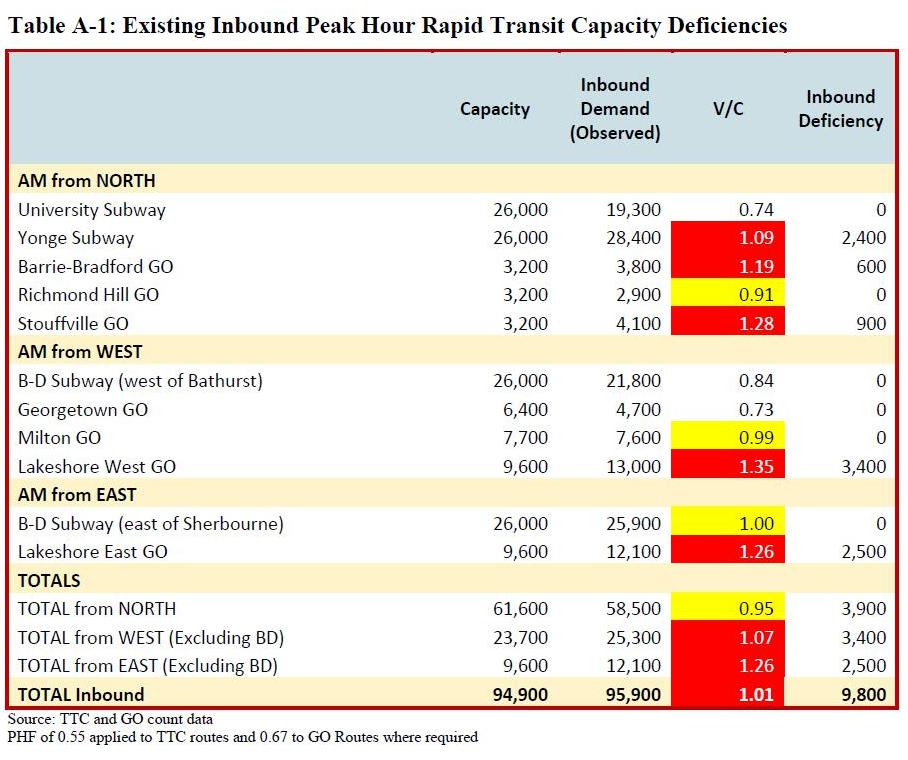
Capacity is an issue today as Table A-1 in the background paper shows.  Several corridors into downtown are already operating over their design capacity.  This is particularly the case on GO where the target is to have few standees, and there is more room for additional passengers in the design capacity than on the TTC subway services.

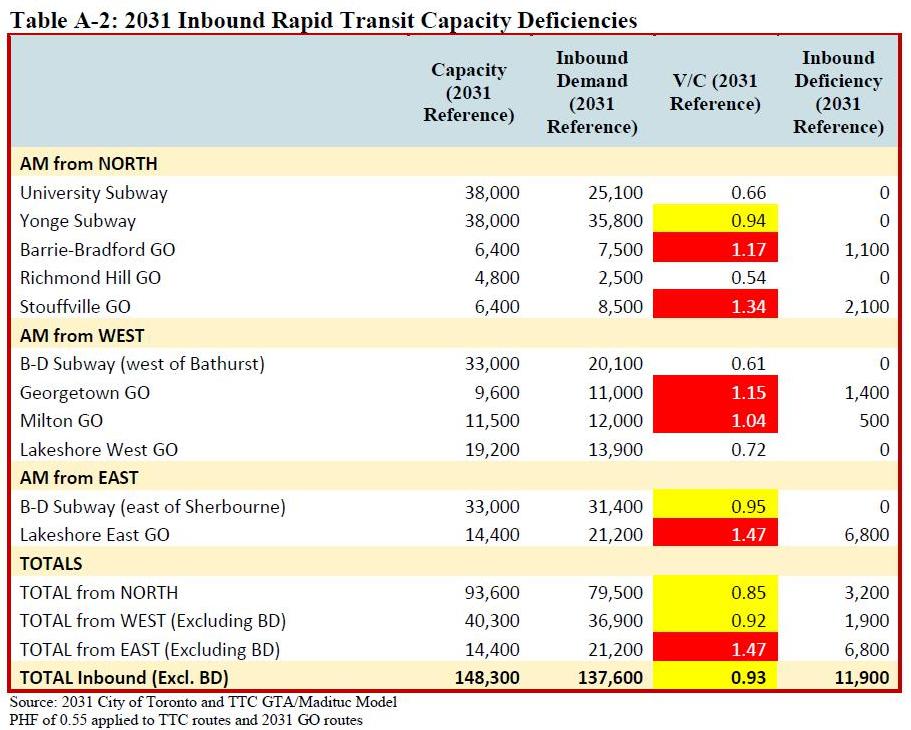
Table A-2 shows the projections for 2031.  All of the shortfalls are on GO, but the TTC lines are close to saturation.  This presumes a considerable increase in the capacity of various lines.  For example, the YUS goes from a design capacity of 26,000 to 38,000 passengers per hour (pphpd), an increase of 46% which may not actually be achievable.  Similarly, the BD line goes to 33,000 pphpd, an increase of 27%.

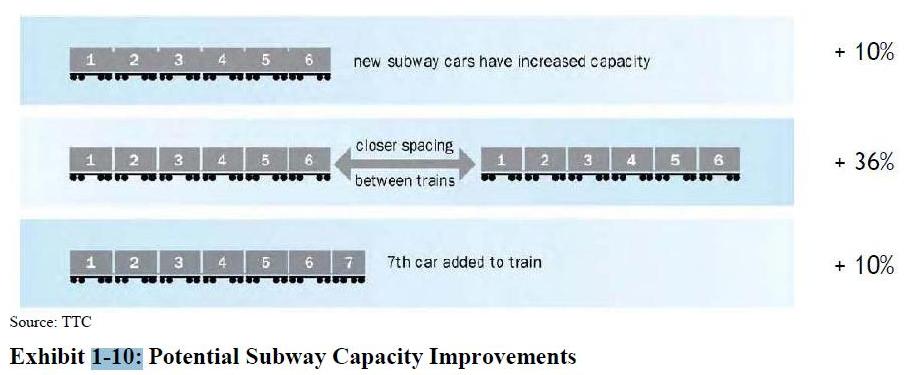
Exhibit 1-10 shows the components of projected capacity increase including 36% from running trains closer together.  As discussed at some length on this site previously, the constraints on headways arise at terminal stations.  A 36% increase in trains/hour implies a headway of about 100 seconds as compared with 140 today.  This cannot be achieved with existing terminal track geometry, not to mention the leisurely crew practices at terminals.

On the GO lines, the projected capacity on Lakeshore West doubles, and smaller increases are seen on other routes.  It is worth noting that the projected capacity of the north-south corridors to Stouffville, Richmond Hill and Barrie are nowhere near the level of service implied by The Big Move, probably because these lines are not targets for early electrification.  This contributes to the capacity shortfall in the northern sector.  Recommendation 1 of the study includes encouragement that Metrolinx review the possibility of increased capacity in those three corridors.

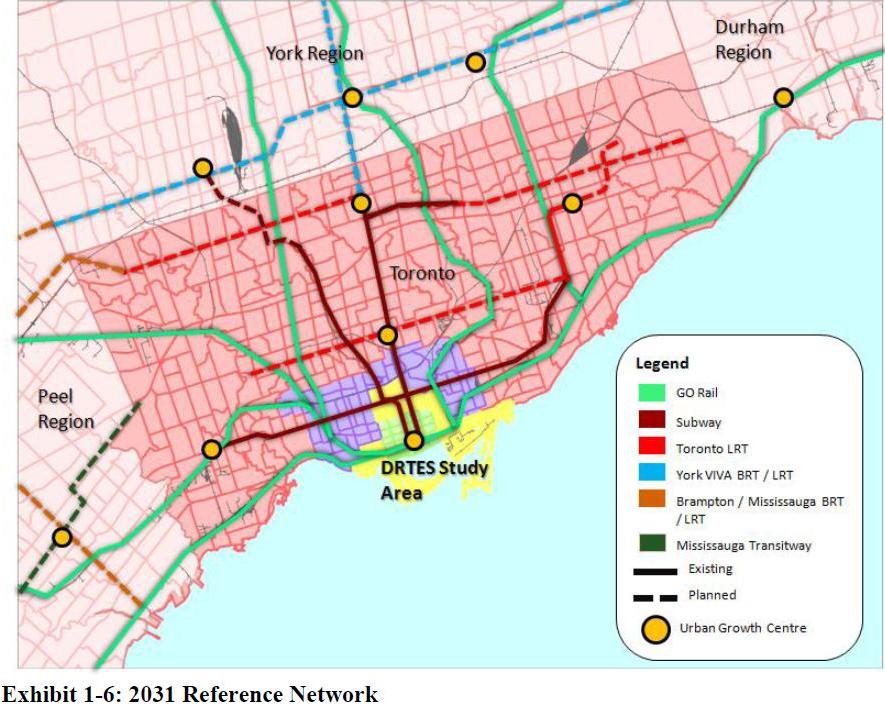
The full list of lines included in the modelled network can be found in the background study at section 1.2.1.

Continue reading

Metrolinx Dumps TTC as LRT Partner (Maybe)

Updated October 4, 2012 at 9:20 am:

Mr reaction to the announcement yesterday that TTC would remain as “operator” of the LRT lines is on the Torontoist website.

Although the TTC sees this as a “good news” story, I am less impressed because Toronto is still very much the junior partner.  We get to drive the trains, and that’s about all.  With all maintenance remaining in the hands of Metrolinx private partner, whoever that will eventually be, this is a big step in outsourcing transit operations.

Updated October 1, 2012 at 10:00 pm:

The Toronto Star reports that discussions continue between Metrolinx, the City of Toronto and the TTC regarding the possible operation of the planned LRT lines by the TTC rather than a private contractor.

Exactly how much “operation” would entail is not mentioned, although the TTC is known to be concerned about responsibility for safety-sensitive systems such as vehicle, signal and track maintenance.

A related issue is the amount of detail that must be worked out before a master contract is let by Infrastructure Ontario.  If the private work ends when operation begins (with possible exceptions such as building and station maintenance), then this is a much simpler contract to draft than one that would require all of the details of future operations to be bundled with a design and construction contract.

Whether Queen’s Park and Metrolinx are aware of or care about the delay inherent in needing to specify so much detail so far in advance for a single contract remains to be seen.

September 21, 2012

My thoughts on recent announcements that Metrolinx would completely take over the LRT projects formerly part of Transit City are in an article on the Torontoist website.


Waterfront East LRT: Will This Ship Ever Sail? (Updated)

Updated September 4, 2012:

The full set of Waterfront Toronto reports and the City Manager’s recommendations arising from them are now available in the Executive Committee Agenda for September 10.

I will not attempt to summarize all of the material in these, but a few critical points deserve mention.

  • Although the revitalization of the mouth of the Don River is a central theme in this entire project, and illustrations showing the effect abound in the reports and publicity, in fact this work has been relegated beyond the 30-year timeframe of the financial projections.  The river mouth changes are in “phase 4” which is beyond the 30-year line.
  • Similarly, transit improvements to the area beyond the level of bus service, possibly but not necessarily as BRT with dedicated rights-of-way, are pushed off to phase 3 and beyond.  Transit is now described as “demand led” rather than the “transit first” policy around which much of the East Bayfront and Port Lands were being planned.
  • The connection to Cherry Street under the rail corridor is not even costed in the report and lies off in the vague future.

The fundamental problem for Waterfront Toronto and for the City is that the economics of a self-financing project simply do not work.  In the City Manager’s report, some shuffling of components allows the scheme to show a “profit” in the short term, the first decade, by the expedient of delaying or dropping expenditures to future years.

The City Manager’s Report shows the evolution of the costing model.  The first cut (page 4) used conservative assumptions and produced a net cost of $189.2m for the first 30 years.  This was reworked (page 5) with more generous assumptions to achieve a positive cash flow in the first decade, and a reduced net cost of $118m over 30 years.  Note that the tables are clearly titled “phases 1 and 2” and therefore omit costs associated with the river mouth and with the upgrade of transit services to LRT.

As someone who has been involved in many of the public discussions of these plans, I am deeply disappointed on three counts:

  • The shift of “phase 3” beyond the 30-year line was not made clear by Waterfront Toronto in its recent public meetings.  This verges on dishonesty from an organization previously well-known for plain dealing with the public.
  • The idea that Toronto would pre-build a good network of transit lines into the waterfront districts has been abandoned, and we are back to the standard TTC approach of running a bus, now and then, once a few people start to complain about service.
  • The myth that private sector development will somehow relieve the City (or other levels of government) from funding the Port Lands revitalization is exposed for what it is.  If Toronto wants to reinvigorate this huge tract of land, it will have to invest money in the process.  This issue — how to actually pay for the waterfront and what staging strategies could be taken — is completely absent.  Council is asked to approve the proposed scheme without knowing what alternatives might be available or what financing strategies would be needed to achieve them.

Building new neighbourhoods of this scale requires major investment in infrastructure and in the operating cost of providing services.  If Toronto is not prepared to pay these costs, then the Port Lands will sit empty for a long time.  Someone may propose they be rescued with a special project such as an Olympic Games or a World’s Fair.  That’s wishful thinking, and simply playing the slots at a race track may prove a better investment.  We cannot make the future of the waterfront dependent on the world’s desire to let us put on a big party.

The original article from August 12 follows the break …

Continue reading