TTC Madness: A Subway for Everyone

Today’s meeting of the transit commission was expected to be a modest affair with approval of the Downtown Relief Line study’s recommendations, and a few other housekeeping items.  What happened was a complete upending of the transit expansion policies we thought were put in place by the Karen Stintz coup d’état that bounced Rob Ford’s crew off of the TTC board back in the spring.  Stintz herself didn’t even have the nerve to stand up to the runaway proposals from her fellow members preferring to keep peace, for now at least.

To make sense of this debacle, I have to recount some of the earlier events.

The main act was a presentation by TTC staff of the DRL Study, and it contained few surprises relative to coverage we have already seen in the press and on this blog.  One comment caused attentive ears to prick up, namely that spending $1-billion expanding Bloor-Yonge station might be less cost-effective than providing additional capacity with a new line.  Would that the TTC would look at all components of its subway plans that way (a topic for another article), but it’s a refreshing point of view.

The study and presentation make explicit reference to potential shortfalls in GO Transit capacity as part of the problem.  Although these will no doubt annoy Metrolinx (is there a TTC meeting that doesn’t anger Metrolinx?), that agency’s basic problem is that long-term secrecy about what it might actually build forces assumptions to be made.  That said, nothing prevented the TTC from modelling improved service on the GO northern corridors just to see what this would do to demand flows on a “what if” basis.  After all, the whole DRL study is a “what if” exercise.

Councillor Parker asked about Main Station as an alternative DRL/Danforth subway connection.  Staff’s position is that there are advantages to a north-south connection further west that would potentially serve Thorncliffe and Flemingdon Parks, and line up with the Don Mills corridor.  (I will address DRL options in a separate article.)  There were humourous remarks about how staff were trying to buy Parker off with a subway to his ward.

Parker moved that the Danforth to Eglinton section of the DRL be included in the next phase of the study, but the motion fell short of actually committing to this segment as a top priority.

Councillor Milczyn asked about eliminating parking on King or Queen Streets.  Staff replied that this would be important for improved surface transit, and the idea would be part of a separate Downtown Traffic Operations Study now underway by the City, but that this would not avoid the need for a DRL.

Milczyn also asked about a Lakeshore West LRT and seemed to be mixing the proposal that was one option in the DRL study (an LRT or subway line in the rail corridor) with the Waterfront West LRT (that would run on Lakeshore Blvd.).

Councillor Colle asked about capacity on the Bloor-Danforth line east of Yonge, and staff replied that with the DRL, this would not be an issue.  However, that remark misses the fact that the Danforth subway regularly passes up riders today east of Pape, the point where capacity would be freed up.  More service will be needed on the BD line even with the DRL in place.

Colle went on to ask whether extending the BD line to Scarborough Town Centre would affect the DRL’s alignment by shifting the logical point for “relief” further east.  Staff replied that the demand model already has the extra ridership that the replaced and extended SRT will bring to Kennedy Station built into projected Danforth subway demand.

Councillor De Baeremaeker observed than an overall city plan needs to include subways, LRT and buses, that the DRL is a “good subway”, and that the problems of inadequate GO service and fare structure forcing riders onto the TTC need to be addressed.  We will hear more from De Baeremaeker later.

The staff recommendations with a few minor amendments were passed, and the meeting turned to other matters including a presentation on Transit Oriented Development.  This was something of a Trojan Horse brought in by Build Toronto.  An L.A. based consultant who has done a lot of work on redevelopments around station sites talked about the importance of putting good development (including attractive amenities) around transit stations.  This is the classic transit model which looks nice, but ignores the degree of neighbourhood upheaval that the level of development implies.  When you have a greenfield site, or your client is a totalitarian government, pesky problems with local activists and zoning are rarely encountered.

The moral was that if we are going to build many new stations, we should ensure that development occurs around them.  On the Spadina Extension, this is easier said than done at some sites, and development plans are already in place at others.  On the Eglinton line, many stations are in existing low density areas, and there would be a challenge on threecounts having them all upzoned for development at the scale shown in the presentation.  First, the locals would get a tad upset, and public meetings featuring a liberal assortment of pitchforks, torches and rotten tomatoes would be on order.  Second, developers have to believe that these sites are a market for development.  Third, the transit line’s role in the network must be strong enough relative to other nearby facilities (notably highways) that the new development would actually feed the transit stations.  See Sheppard Avenue for a counterexample.

The main discussion turned on the issue of taxation and the L.A. experience with Measure “R” passed in 2008, and Measure “J” expected to pass in the upcoming elections.  “R” levied a 30-year, 0.5% sales tax on Los Angeles County to generate dedicated funds for transit.  “J” extends this for a further 30 years.  This funding will be used to underwrite debt that will be undertaken during the early period (the next 10 years or so) to build out many new transit facilities.

Unlike Metrolinx, whose Investment Strategy seems to be discussed on a pay-as-you-play basis, L.A. appears ready to take on long term debt with matching long-term funding.  This is not unlike buying a house — you buy and live in the entire house at one go rather than adding a room at a time for 30 years.

By this time, the Commission clearly had a taste for spending money.  The DRL was not enough, and the suburban councillors needed to jump in with their projects.

The opportunity came unexpectedly by way of a public presentation by Alan Yule who often deputes at TTC meetings.  He proposed that the Scarborough RT/LRT conversion could be shortened as follows:

  • Since most of the traffic is between STC and Kennedy, all other stations would be closed, and SRT service would run express between the two points.
  • The intermediate stations would be boarded off (much like what is now happening at the Union Station 2nd platform project) while their reconstruction for LRT proceeded behind the walls.
  • Eventually, the work would have to turn to the right-of-way itself, and the line would close, but presumably for a shorter period.

I won’t go into details, but believe that the really time-consuming parts of the project would not be affected by this scheme, notably the underground work north of Ellesmere and the changes at Kennedy Station.  Alan does good, entertaining presentations.  The Commission thanked him for his work, and then the wheels came off the debate.

Councillor De Baeremaeker (he of the we need all modes in the network comment above) moved that staff report on the merits of a subway extension from Kennedy to Sheppard & McCowan.  De Baeremaeker’s position, following on from the One City Plan that briefly surfaced in June 2012, is that the difference in construction cost for a subway is only $500m greater than the cost of the LRT project, and this makes the subway option a great deal.  What he misses is that the comparator subway estimate is only for a line to STC, not to Sheppard.

That extra 3.6 km will cost roughly $1b and push the delta for the subway/LRT comparison much further apart.

Correction: The extra 1.7km will cost $700-million more than the LRT project according to a 2010 estimate. Moreover, the LRT runs further going east to Sheppard and Progress where extension to Malvern is possible.

(The question of comparative costs was discussed back in December 2010 in this article.)

De Baeremaeker should know this already, but it suits his role as the Superman of Scarborough transit to continue the charade that we can have a subway replacement for LRT at only a modest additional cost.  He also does not address the much higher operating cost of a subway line, especially given that it would be on a new, underground alignment, not at grade as the RT/LRT would be.

TTC CEO Andy Byford stayed clear of this debate, but recently in an interview on CBC he expressed guarded support for extending the Danforth subway.  This sends a mixed signal to the politicians and suggests that staff are not firm in their support of the LRT network.

Oddly enough, the staff position on the DRL continues to paint this as something for the medium to long term, at least 15 years away, with the option of adding capacity elsewhere in the interim.  This provides a window into which other subway construction projects might try to slip, an idea clearly on de Baeremaeker’s mind.

Not to be outdone, Councillor Milczyn asked that staff also report on looping this extended subway west from Sheppard & McCowan to Don Mills Station.  This is the Sheppard East subway, but reborn at least entirely on Sheppard itself rather than going through an industrial district to STC.  Such a line would obviously replace the Sheppard LRT.

Need I remind Commissioners of a phrase we heard a lot back during the subway/LRT debates:  Council’s will is supreme.  Council has voted, with not a little blood on the floor, for an LRT network which the province is supporting (to the degree that is possible in the current political climate).  Indeed, the Commission voted today to give CEO Andy Byford the authority to sign the operating agreement form the four-line LRT network.

Metrolinx’ hands are not completely clean in this on a few counts.  Most importantly, as recently as two days ago (Oct. 22), a representative presented an LRT project overview at a public meeting that includes a five-year shutdown for the SRT rebuilding.  However, Metrolinx own VP of Rapid Transit Implementation, Jack Collins, has said that during the contracting stage, Metrolinx hopes to get proposals from bidders that will be under 3 years, maybe only 2.5.  However, such a change has not been blessed by a Ministerial statement, and so we still hear “5” which scares the hell out of Scarborough transit users.  Toronto is ill-served by Metrolinx’ lack of accurate details in its public statements, of which this is only one example.

As if all this isn’t bad enough, the Commission has asked for these analyses to be available for its January 2013 meeting even though staff will be pre-occupied with major work on the 2013 budget for the next few months.  The date may slip, but what is clearly going on is that somebody wants information for use in a coming provincial election campaign.

What we see here is a Commission that claims to understand the limits of spending, that claims it should focus on subways where they are really needed, but which insists on revisiting LRT proposals over and over in the hope that they can be upgraded.  Saying “no” is very hard for a politician to do, especially when constituents have been convinced that LRT is a distant second class option.

The Star reports Councillor Parker’s reaction to the vote:

TTC commissioner John Parker, who was out of the room praising the decision on a downtown relief line, confronted his commission colleagues afterwards, telling them that voting in favour of subway studies was “a stupid, stupid, irresponsible thing.”

“Irresponsible” does not begin to describe my feeling about this vote, one which proved that the current Commission, given half a chance, will be just as irresponsible about the subway/LRT debate as the Ford-friendly crew they replaced.  It is not enough to say that we are getting more information for a better debate.  We have had this debate, and only people with a distaste for the hard truths about subway costs can pretend that this option is viable.
TTC Rediscovers the Downtown Relief Line (Update 4)

Update 4 October 21, 2012 at 8:30 pm:

It’s intriguing to look back at coverage of the DRL the last time this was a major issue.  Mike Filey passed along a clipping from the Star from December 2, 1982 that makes interesting reading.  My comments are at the end in Postscript 2.

Update 3 October 20, 2012 at 3:20 pm:

A postscript has been added discussing the various demand simulations as a group rather than individually.  Charts of total demand southbound from Bloor Station as well as pedestrian activity at Bloor-Yonge are provided to consolidate information from several exhibits in the background paper.

Update 2 October 19, 2012 at 11:00 am:

This article has been reformatted to merge additional information from the background study as well as illustrations into the text.

At its meeting on October 24, 2012, the TTC will consider a report on the Downtown Rapid Transit Expansion Study.  The full background paper is also available on the TTC’s website.

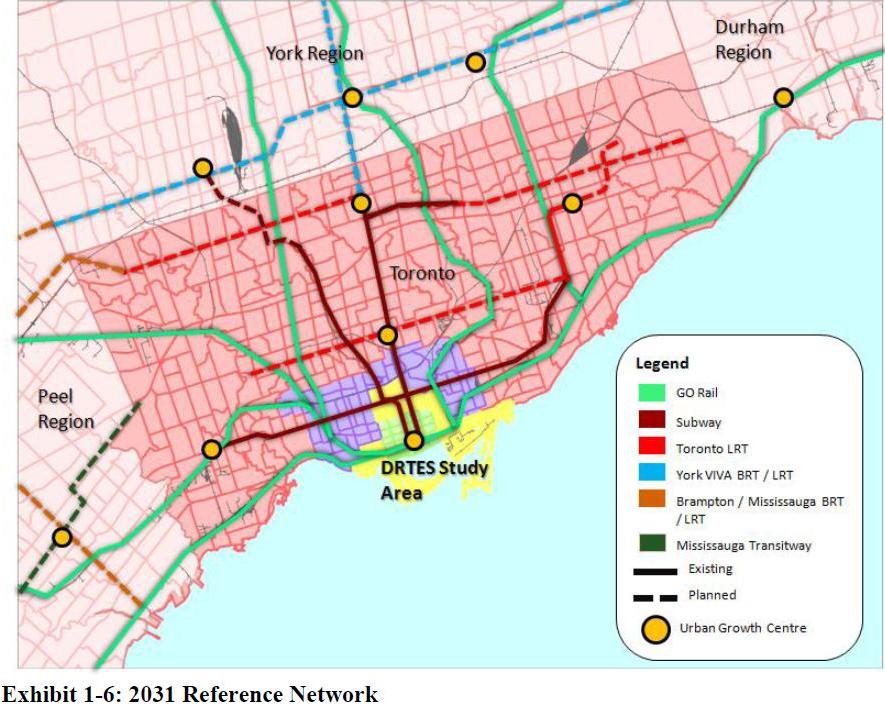
A study by the City of Toronto and TTC, including consultations with Metrolinx, concludes that transit demand to the core by 2031 will grow at a rate that exceeds the capacity of all of the current and planned transit facilities.  Ridership will be 51% higher than today.  The residential population south of College from Bathurst to Parliament will grow by 83%, and employment by 28%.

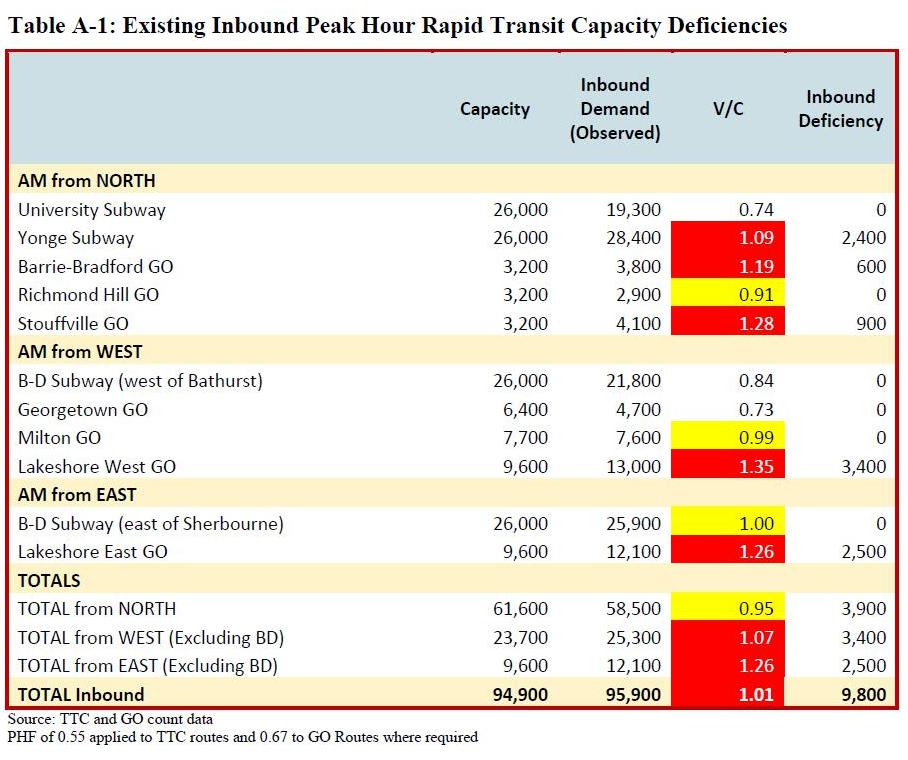
Capacity is an issue today as Table A-1 in the background paper shows.  Several corridors into downtown are already operating over their design capacity.  This is particularly the case on GO where the target is to have few standees, and there is more room for additional passengers in the design capacity than on the TTC subway services.

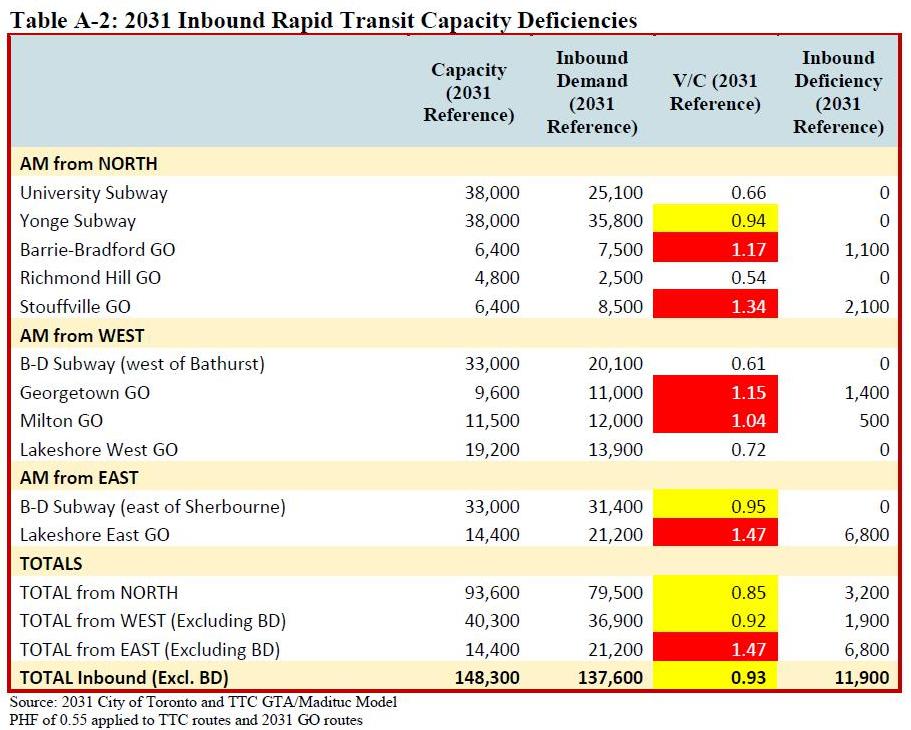
Table A-2 shows the projections for 2031.  All of the shortfalls are on GO, but the TTC lines are close to saturation.  This presumes a considerable increase in the capacity of various lines.  For example, the YUS goes from a design capacity of 26,000 to 38,000 passengers per hour (pphpd), an increase of 46% which may not actually be achievable.  Similarly, the BD line goes to 33,000 pphpd, an increase of 27%.

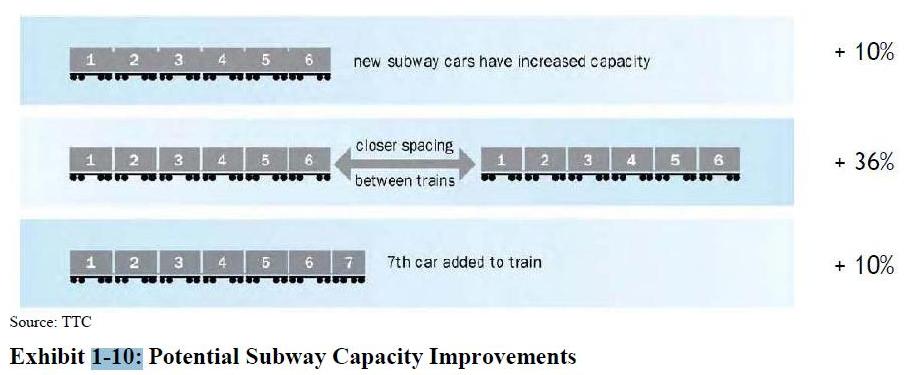
Exhibit 1-10 shows the components of projected capacity increase including 36% from running trains closer together.  As discussed at some length on this site previously, the constraints on headways arise at terminal stations.  A 36% increase in trains/hour implies a headway of about 100 seconds as compared with 140 today.  This cannot be achieved with existing terminal track geometry, not to mention the leisurely crew practices at terminals.

On the GO lines, the projected capacity on Lakeshore West doubles, and smaller increases are seen on other routes.  It is worth noting that the projected capacity of the north-south corridors to Stouffville, Richmond Hill and Barrie are nowhere near the level of service implied by The Big Move, probably because these lines are not targets for early electrification.  This contributes to the capacity shortfall in the northern sector.  Recommendation 1 of the study includes encouragement that Metrolinx review the possibility of increased capacity in those three corridors.

The full list of lines included in the modelled network can be found in the background study at section 1.2.1.

Continue reading

Metrolinx Dumps TTC as LRT Partner (Maybe)

Updated October 4, 2012 at 9:20 am:

Mr reaction to the announcement yesterday that TTC would remain as “operator” of the LRT lines is on the Torontoist website.

Although the TTC sees this as a “good news” story, I am less impressed because Toronto is still very much the junior partner.  We get to drive the trains, and that’s about all.  With all maintenance remaining in the hands of Metrolinx private partner, whoever that will eventually be, this is a big step in outsourcing transit operations.

Updated October 1, 2012 at 10:00 pm:

The Toronto Star reports that discussions continue between Metrolinx, the City of Toronto and the TTC regarding the possible operation of the planned LRT lines by the TTC rather than a private contractor.

Exactly how much “operation” would entail is not mentioned, although the TTC is known to be concerned about responsibility for safety-sensitive systems such as vehicle, signal and track maintenance.

A related issue is the amount of detail that must be worked out before a master contract is let by Infrastructure Ontario.  If the private work ends when operation begins (with possible exceptions such as building and station maintenance), then this is a much simpler contract to draft than one that would require all of the details of future operations to be bundled with a design and construction contract.

Whether Queen’s Park and Metrolinx are aware of or care about the delay inherent in needing to specify so much detail so far in advance for a single contract remains to be seen.

September 21, 2012

My thoughts on recent announcements that Metrolinx would completely take over the LRT projects formerly part of Transit City are in an article on the Torontoist website.


Waterfront East LRT: Will This Ship Ever Sail? (Updated)

Updated September 4, 2012:

The full set of Waterfront Toronto reports and the City Manager’s recommendations arising from them are now available in the Executive Committee Agenda for September 10.

I will not attempt to summarize all of the material in these, but a few critical points deserve mention.

  • Although the revitalization of the mouth of the Don River is a central theme in this entire project, and illustrations showing the effect abound in the reports and publicity, in fact this work has been relegated beyond the 30-year timeframe of the financial projections.  The river mouth changes are in “phase 4” which is beyond the 30-year line.
  • Similarly, transit improvements to the area beyond the level of bus service, possibly but not necessarily as BRT with dedicated rights-of-way, are pushed off to phase 3 and beyond.  Transit is now described as “demand led” rather than the “transit first” policy around which much of the East Bayfront and Port Lands were being planned.
  • The connection to Cherry Street under the rail corridor is not even costed in the report and lies off in the vague future.

The fundamental problem for Waterfront Toronto and for the City is that the economics of a self-financing project simply do not work.  In the City Manager’s report, some shuffling of components allows the scheme to show a “profit” in the short term, the first decade, by the expedient of delaying or dropping expenditures to future years.

The City Manager’s Report shows the evolution of the costing model.  The first cut (page 4) used conservative assumptions and produced a net cost of $189.2m for the first 30 years.  This was reworked (page 5) with more generous assumptions to achieve a positive cash flow in the first decade, and a reduced net cost of $118m over 30 years.  Note that the tables are clearly titled “phases 1 and 2” and therefore omit costs associated with the river mouth and with the upgrade of transit services to LRT.

As someone who has been involved in many of the public discussions of these plans, I am deeply disappointed on three counts:

  • The shift of “phase 3” beyond the 30-year line was not made clear by Waterfront Toronto in its recent public meetings.  This verges on dishonesty from an organization previously well-known for plain dealing with the public.
  • The idea that Toronto would pre-build a good network of transit lines into the waterfront districts has been abandoned, and we are back to the standard TTC approach of running a bus, now and then, once a few people start to complain about service.
  • The myth that private sector development will somehow relieve the City (or other levels of government) from funding the Port Lands revitalization is exposed for what it is.  If Toronto wants to reinvigorate this huge tract of land, it will have to invest money in the process.  This issue — how to actually pay for the waterfront and what staging strategies could be taken — is completely absent.  Council is asked to approve the proposed scheme without knowing what alternatives might be available or what financing strategies would be needed to achieve them.

Building new neighbourhoods of this scale requires major investment in infrastructure and in the operating cost of providing services.  If Toronto is not prepared to pay these costs, then the Port Lands will sit empty for a long time.  Someone may propose they be rescued with a special project such as an Olympic Games or a World’s Fair.  That’s wishful thinking, and simply playing the slots at a race track may prove a better investment.  We cannot make the future of the waterfront dependent on the world’s desire to let us put on a big party.

The original article from August 12 follows the break …

Continue reading

Service Changes Effective September 2, 2012 (Updated)

September 2012 will bring the restoration of “winter” service levels on routes across the system as well as many service improvements.  Most of these occur in the off-peak period thanks to constraints on the size of the fleet and of the operator workforce.

The bus fleet is constrained in the peak period by the many construction projects now underway.  These require either bus/streetcar substitutions, or additional vehicles on bus routes to deal with congestion.  Some of these will end as the fall progresses.

Updated August 26, 2012:

A fare policy experiment will begin on the 38 Highland Creek bus on September 1 and will run through until April 27, 2013.  Riders with GO fare media will be allowed to ride free between Rouge Hill GO Station and University of Toronto Scarborough Campus.

Summer Services

Seasonal services will end after Labour Day on the following routes:

  • 101 Downsview Park weekday service
  • 29 Dufferin to Princes Gates (the limited service that would remain will not operate to the CNE due to a construction diversion)
  • 30 Lambton service to High Park
  • 72B Pape service to Cherry Beach weekday daytimes and weekend evenings
  • 86 Scarborough to the Zoo (extended hours weekday evenings, weekend route extension)
  • 85 Sheppard East to the Zoo (extended hours weekends)

Rapid Transit Changes

The Yonge-University-Spadina subway will see improved midday service, and the transition between the AM peak and midday will be smoothed.

Running times on the Scarborough RT will be extended and headways will be widened.  This change is intended “to better reflect actual operation”.  How it will affect the SRT’s ability to actually operate all of its scheduled service (the target now is to operate at least 80% of planned trips) is a matter for conjecture.

Waterfront Changes

Service on 511 Bathurst will be cut from the summer levels, but will remain above the normal winter schedules to compensate for the construction on Queen’s Quay and on Spadina.

Service on the 509 Harbourfront bus will be cut slightly from summer levels.  However, all 509 buses will now operate to Exhibition and this will recover the time now wasted by many of them laying over in Spadina Loop.  Service west of Spadina will be greatly improved.

The 6 Bay bus will be restructured to provide somewhat improved service to the eastern waterfront and the new George Brown College campus.  In August, the Dundas branch of the route was extended south to Queen’s Quay.  Beginning in September, a new 6C Union to Queen’s Quay service will be added.

The combined service south of Front will see considerable improvement:

  • AM peak from 6’30” to 2’27”
  • Weekday midday from 12’00” to 6’40”
  • PM peak from 10’20” to 3’20”
  • Weekend afternoons from 15’00” to 7’30”

The 75 Sherbourne bus will also see improved service for the George Brown campus:

  • AM peak from 9’00” to 7’30”
  • Weekday midday from 12’00” to 9’00”
  • PM Peak from 10’00” to 8’30”
  • Saturday afternoon from 20’00” to 11’00”

Construction Route Changes

Dufferin street trackage will be rebuilt north from Dufferin Loop to Queen (skipping over the intersection at King) beginning in September.  The 29D Princes Gates service will divert to operate southbound via the “old” Dufferin routing of Peel and Gladstone to Queen, then east to Shaw, south to King, west to Mowat, south to Liberty, east to Fraser and north to King.  The northbound buses will follow the route via Shaw and Gladstone back to the regular route.

The temporary service arrangements for the routes operating on Queen Street will remain in effect with streetcars diverting between Broadview and Coxwell via Gerrard.

2012.09.02 Service Changes

How Can Transit Serve a Revived Ontario Place?

Today a Ministerial Advisory Committee headed by former Ontario PC leader John Tory released its analysis and recommendations for the future of Ontario Place.

For those readers who are not familiar with Toronto, Ontario Place is a park opened in 1971 with then-futuristic architecture on the shore of Lake Ontario west of downtown Toronto and immediately south of the Canadian National Exhibition grounds (now known as Exhibition Place).  Over the years, its attractiveness faded and much of the site was recently closed pending a review of its future.

Access to the site has always been a problem because the transit loops are at the north side of Exhibition Place over 600m from the entrance bridge to Ontario Place, provided that events within Exhibition Place itself do not block off a straight route south.  The recent Indy car races and the annual CNE itself are two good examples.

Forty years ago, the Ontario Government toyed with a magnetic levitation train under development by Krauss Maffei.  A trial installation of a one-way loop around the grounds was proposed, but all that was ever built was a few foundation slabs and pylons for the elevated guideway.  This project ran out of steam when the German government, a partner with KM, withdrew its funding.  Technical problems also arose, and a simplified version of the technology appeared roughly a decade later as the Scarborough RT replacing the originally proposed LRT line in that corridor.

Many years later, the Waterfront West LRT proposal included a route turning south (and underground) from current point of entry to Exhibition place, under Princes Boulevard (the main east west street in the park), and emerging into the land now occupied by the Ontario Place parking lot.  This scheme was strongly opposed by Ontario Place management who preferred to cater to motorists coming to their site rather than transit riders.

Within Transit City, there is also a Waterfront West LRT.  Its alignment through Exhibition place included various options differing mainly in whether the route followed the north or south side of the park.  Because the WWLRT was seen as an “express” route to southern Etobicoke (a dubious claim at the best of times), a southern route was seen as taking passengers “out of their way”.  Sadly, there has been no recent examination of transit to Exhibition Place as opposed to through it.

The Advisory Panel’s report includes a short section on transit to Ontario Place on pages 45 to 47.  This includes:

ONTARIO PLACE IS UNDERSERVED BY PUBLIC TRANSIT.  TTC streetcars and the GO Train do not go to Ontario Place. Streetcars go as far as Exhibition Place, and the commuter GO Train service provides access at the GO Exhibition station that is adjacent to the streetcar loop. The only mode of public transportation that goes directly to Ontario Place is the Dufferin Street bus — but this is only in the summer season.

Well, no, the Dufferin bus does not GO to Ontario Place per se, only to a loop along Princes Blvd provided that it is physically possible to operate buses on this route.  This service is infrequent presuming that it is not short-turned.  (Some of the Dufferin buses did run south to Ontario place in 2011, but this operation was dropped for 2012 because Ontario Place closed.)

The Advisory Panel recommends that parking for Ontario Place be provided in either a parking structure (under of above ground) or by Exhibition Place which has a vast amount of parking most of the year long.

Among the options proposed by the Panel are:

WE SEE A NUMBER OF OPTIONS TO IMPROVE THE ACCESS REQUIRED to generate the crowds Ontario Place needs to attract:

First extend Dufferin Street further south to provide direct bus access to the area and extend the streetcar loop from Exhibition Place.

Second, create more north south pedestrian and cycling paths.

Finally, bicycle storage and rental locations must grow — to encourage riders to bring their own bicycles, and to link to the growing network of bicycle rentals.

Notable by its absence is any mention of the implications improved north-south access through Exhibition Place will have for events that now take over the entire park.

This brings us to a recommendation:

RECOMMENDATION 18

Working with the PRIVATE SECTOR and PROVINCIAL and MUNICIPAL PARTNERS, Ontario Place should explore NEW PUBLIC TRANSIT OPPORTUNITIES to better access the western lakeshore area. [Caps are in the original text]

It is unclear what exactly is meant by a private sector role in “new public transit opportunities”.  The fundamental point in any transit scheme is that only with very high, sustained demand is there any hope for profitability and hence attractiveness of any scheme to the private sector.

Possibly Queen’s Park hopes to recycle the bits of infrastructure dating back to the Mag-Lev scheme, or hopes for someone to propose a monorail loop around the grounds as an alternative to extending the streetcar/LRT trackage.  This would impose a needless transfer for riders trying to reach any development on the south side of Exhibition Place.

Finally, Metrolinx has its own scheme to bring the “Don Mills / Downtown Relief Line” west from a proposed GO terminal at Bathurst Street into Exhibition Place.  If that’s a goal, and it will happen quickly (not very likely), then this will compete with other proposals that would be termed “short term”.

As with the eastern waterfront, planning for transit to the western waterfront has been a slipshod affair between the TTC, the City, Waterfront Toronto and Metrolinx.  If we are serious about redeveloping Ontario Place and the lands along Lake Shore Blvd., we must include good transit as an essential part of any plan.

Updated July 28:  The Globe & Mail weighs in with an article (the print version includes a large map).

The Fate of OneCity (Updated)

Several postmortems have appeared on blogs about the supposed death of OneCity and what might follow:

Updated July 19, 2012 at 7:00 am:

Updated July 16, 2012 at 11:15am:

My own take on OneCity’s fate together with the original article detailing proposals for dealing with transit planning follow the break.

Continue reading

OneCity Plan Reviewed

The OneCity plan has much to recommend it even though in the details it is far from perfect.

The funding scheme requires Queen’s Park to modify the handling of assessment value changes, and they are already cool to this scheme.  Why OneCity proponents could not simply and honestly say “we need a 1.9% tax hike every year for the next four years” (not unlike the ongoing 9% increases to pay for Toronto Water infrastructure upgrades) is baffling.  A discussion about transit is needlessly diverted into debates about arcane ways of implementing a tax increase without quite calling it what it is.

On the bright side, Toronto may leave behind the technology wars and the posturing of one neighbourhood against another to get their own projects built.  Talking about transit as a city-wide good is essential to break the logjam of decades where parochialism ruled.  Couple this with a revenue stream that could actually be depended on, and the plan has a fighting chance.  Ah, there’s the rub — actually finding funding at some level of government to pay for all of this.

Rob Ford’s subway plan depended on the supposed generosity of Metrolinx to redirect committed funding to the Ford Plan (complete with some faulty arithmetic).  Similarly, the OneCity plan depends for its first big project on money already earmarked by Metrolinx to the Scarborough RT to LRT conversion.  If this goes ahead, we would have a new subway funded roughly 80% by Queen’s Park and 20% by Toronto.  Not a bad deal, but not an arrangement we are likely to see for any other line.

On the eastern waterfront, there is already $90m on the table from Waterfront Toronto (itself funded by three levels of government), and OneCity proposes to spend another @200m or so to top up this project.  Whether all $200m would be City money, or would have to wait for other partners to buy in is unclear.

Toronto must make some hard decisions about a “Plan B” if the Ottawa refuses to play while the Tories remain in power.  Even if we saw an NDP (or an NDP/Liberal) government, I wouldn’t hold my breath for money flowing to Toronto (and other Canadian cities) overnight.  A federal presence is a long term strategy, and spending plans in Toronto must be framed with that in mind.

Sitting on our hands waiting for Premier McGuinty or would-be PM Mulcair to engineer two rainbows complete with pots of gold landing in Nathan Phillips Square would be a dead wrong strategy.  Bang the drum all we might for a “one cent solution” or a “National Transit Strategy”, Toronto needs to get on with debating our transit needs whether funding is already in place or not.  Knowing what we need and want makes for a much stronger argument to pull in funding partners.

In some cases, Toronto may be best to go it alone on some of the smaller projects, or be prepared to fund at a higher level than 1/3.  If transit is important, it should not be held hostage by waiting for a funding partner who will never show up.

The briefing package for OneCity is available online.

My comments on the political aspects of OneCity are over at the Torontoist site.

To start the ball rolling on the technical review of the OneCity network, here are my thoughts on each of the proposals in the network. Throughout the discussions that will inevitably follow, it is vital that politicians, advocates, gurus of all flavours not become wedded to the fine details. Many of these lines won’t be built for decades, if ever, and we can discuss the pros and cons without becoming mired in conversations about the colour of station tiles.

Continue reading

“One City” To Serve Them All

Updated June 27 at 5:20pm:  I have written a political analysis of today’s announcement for the Torontoist website that will probably go live tomorrow morning.  A line-by-line review of the plan will go up here later the same day.

TTC Chair Karen Stintz and Vice-Chair Glen De Baeremaeker will formally announce a new plan called “One City” on June 27 at 10:30.

The plan already has coverage on the Star and Globe websites.  Maps:  Globe Star

I will comment in more detail after their press conference, but two points leap off the page at me:

  • The proposed funding scheme for the $30-billion plan presumes 1/3 shares from each of the Provincial and Federal governments.  This money is extremely unlikely to show up, especially Ottawa’s share.  From Queen’s Park, some of the funding is from presumed “commitments” to current projects such as the Scarborough RT/LRT conversion which would be replaced by a subway extension.  The rest is uncertain.
  • The “plan” is little more than a compendium of every scheme for transit within the 416 that has been floated recently in various quarters (including this blog).  What is notable is the fact that glitches in some of the existing ideas (notably the fact that the Waterfront East line ends at Parliament) are not addressed.  The whole package definitely needs some fine tuning lest it fall victim to the dreaded problem of all maps — once you draw them, it’s almost impossible to change them.

For those who keep an eye on political evolution, the brand “One City” surfaced in April 2012 in a speech made by Karen Stintz at the Economic Club of Canada.  This idea of a new, unifying transit brand appears to have been cooking for some time.

TTC v. Metrolinx (Again): Who’s In Charge Here? (Update 2)

Updated June 8, 2012 at 11:00am:  My comments about the Commission’s action appear in an article on the Torontoist website.

Updated June 1, 2012 at 9:15am:  The motions passed at the TTC meeting of May 30 have been added at the end of this article.  The Commission took a much more conciliatory view of their relationship with Metrolinx than the staff report.  I will be writing about this situation in a separate article.

The original May 29 article follows below.

The Supplementary Agenda for the May 30, 2012 TTC meeting includes a report “LRT Projects in Toronto — Project Delivery”.

This report deals with the proposed transfer of responsibility for the Transit City LRT projects on Eglinton, Sheppard, Finch and the SRT replacement from the TTC to Metrolinx and Infrastructure Ontario.

As TTC reports go, this one is rather oddly worded in that it:

  • asks the Commission to “note” a number of factors,
  • requests that provincial agencies respond to various issues,
  • sets an October 31, 2012 deadline for the transfer of project control, and
  • proposes that the TTC’s own staff now dedicated to the LRT projects be redeployed internally.

In effect, the TTC is taking their ball and going home rather than play with the guys from down the block.  This suggests a strained relationship between agencies notwithstanding the soothing words we hear so often, and a sense that a fed up TTC is telling Queen’s Park to get lost.

From a purely political and administrative point of view, Queen’s Park holds all the cards because they are paying almost the entire cost (with a small Ottawa contribution to Sheppard) for these projects.  It’s their money, and they get to say how it will be spent.  Whether it will be spent wisely, and how the projects might fare with the TTC on the sidelines, these are questions that won’t be answered for years until we see the results.

Continue reading