Metrolinx Hands Line 5 Crosstown to TTC

Ooops! The initial version of this article used Line 6 in the title. I am too focused on the impending Finch opening!

The Ontario Ministry of Transportation has announced that the Line 5 Crosstown project achieved substantial completion today, December 5. The line is now transferred to the TTC for operation.

No start date has been set, and the TTC will have to conduct its own final pre-service testing just as they did on 6 Finch after the provincial hand-off. A likely date would be mid-February which corresponds to a planned schedule change far enough in the future to accommodate both Line 5 testing and the crewing process for concurrent network changes.

The opening of Line 6 on December 7 is a “mid period” change that is not part of the TTC’s regular cycle, but is likely due to a political desire to complete at least one of the lines in 2025.

According to the Ministry, service on Line 5 will ramp up:

Opening Day

  • Operation from 6am to 11pm
  • Peak service every 4’45”

Six-Month Service

  • Operation from 5:30am to 2:30am
  • Peak service every 3’30”

The TTC has not announced what type of supplementary service will operate during the six-month interim period, nor the service to be provided on a parallel 34 Eglinton bus from Kennedy to Mount Dennis Station in the long term.

Ontario Announces Testing Complete for Finch West LRT

The 30-day Revenue Service Demonstration for the Finch West LRT is complete, and the TTC will take full operational control of the line no later than Monday, November 3, 2025 according to an announcement by the Ontario Ministry of Transportation. A date for revenue service will be decided by the TTC.

The next planned schedule changes for the TTC are on Sunday, November 17, and Sunday, December 22, 2025. Implementation of any changes for November 17 are already well underway internally, and it would be a stretch to see route 6 Finch enter revenue service that soon unless the TTC had already made provision for this. Service change details for November 17 are not yet public, but should start to emerge both from internal sources and from the posting of new online schedule data used by trip planning apps in early November.

The announcement notes that the Eglinton Crosstown line is currently going through its own demonstration period, but the status of that testing has likely been affected by a collision in the Mount Dennis yard as reported by the Toronto Star.

Also announced are:

  • November 16, 2025: Opening of Mount Dennis GO/UP Station as well as the passageway under Eglinton Avenue at Eglinton West station to reduce pedestrian crossings at the surface.
  • The Crosstown stations at Mount Dennis and Eglinton West will not open until revenue service begins on the line, and at that time Eglinton West will make the long-planned name change to “Cedarvale”.

The Ministry touts various changes made based on experience with the Crosstown project that were applied to the Finch project and others:

  • Using simpler, proven signal and power systems from other LRT projects to reduce design complexity and technical risk, making delivery, testing and commissioning smoother.
  • Working collaboratively with building partners to identify critical funding for testing and commissioning and ensuring claims and legal barriers do not impact this process.
  • Onboarding the maintenance provider earlier in the process to ensure the fleet and line are ready for service sooner.

It is not clear what “other LRT projects” might have more complex signal and power systems, but Eglinton is unique in the amount of underground running where trains will be under automatic operation. Problems with premature brake wear on the Flexity LRVs used on Eglinton were traced to incompatibility between the automatic train control system and the braking system on the cars causing them to brake too strongly. This has been corrected, but considering the years the line has been under construction and testing, it is amazing that this problem was only recently found and dealt with.

The points about working collaboratively with “partners” building the line and bringing a maintenance provider “onboard” earlier speak to basic flaws in project design and contract management. A passing reference to the Eglinton line “which began construction under the previous government in 2011” tries to fob off responsibility for issues with Metrolinx that the Ford government had years to correct.

This article will be updated as more information becomes available.

Ontario’s 2025 Budget and Transit

Ontario unveiled its 2025 budget on May 15. Although it speaks of “Approximately $61 billion over 10 years for public transit”, by far the lion’s share of this spending is for projects already underway in the construction and design stages.

All of this is for capital expansion and renewal, and nothing has been announced for day-to-day improvement of transit service.

GO Transit

The budget cites:

  • The Hamilton-Niagara through service connection at West Harbour Station which is already in service.
  • The proposed Bowmanville extension which has been announced before, but is only barely underway at the “early works” stage. This extension has physical alignment issues.
  • GO 2.0 includes “delivering all-day, two-way service to Kitchener and Milton, building new GO stations across the region and advancing planning to unlock potential new rail corridors through midtown Toronto, Etobicoke, York Region and Bolton.” There are no dates attached, and some of these have been on maps for a very long time. Notable by its absence is any mention of electrification.
  • A total of $850 million to refurbish GO Transit rail coaches at the Thunder Bay Alstom the North Bay ONR facility. This work is already announced. The cars may receive convenience upgrades such as “charging plug ports, cup holders and improved Wi-Fi”, but the long-term retention of these cars indicates that the operating model for GO electrification, if and when it occurs, will have a large component of locomotive-hauled trains rather than electric multiple units.

Subways

Subway projects in the budget are:

  • Ontario Line (under construction).
  • Eglinton-Crosstown Western Extension (under construction).
  • Yonge North to Richmond Hill (procurement underway).
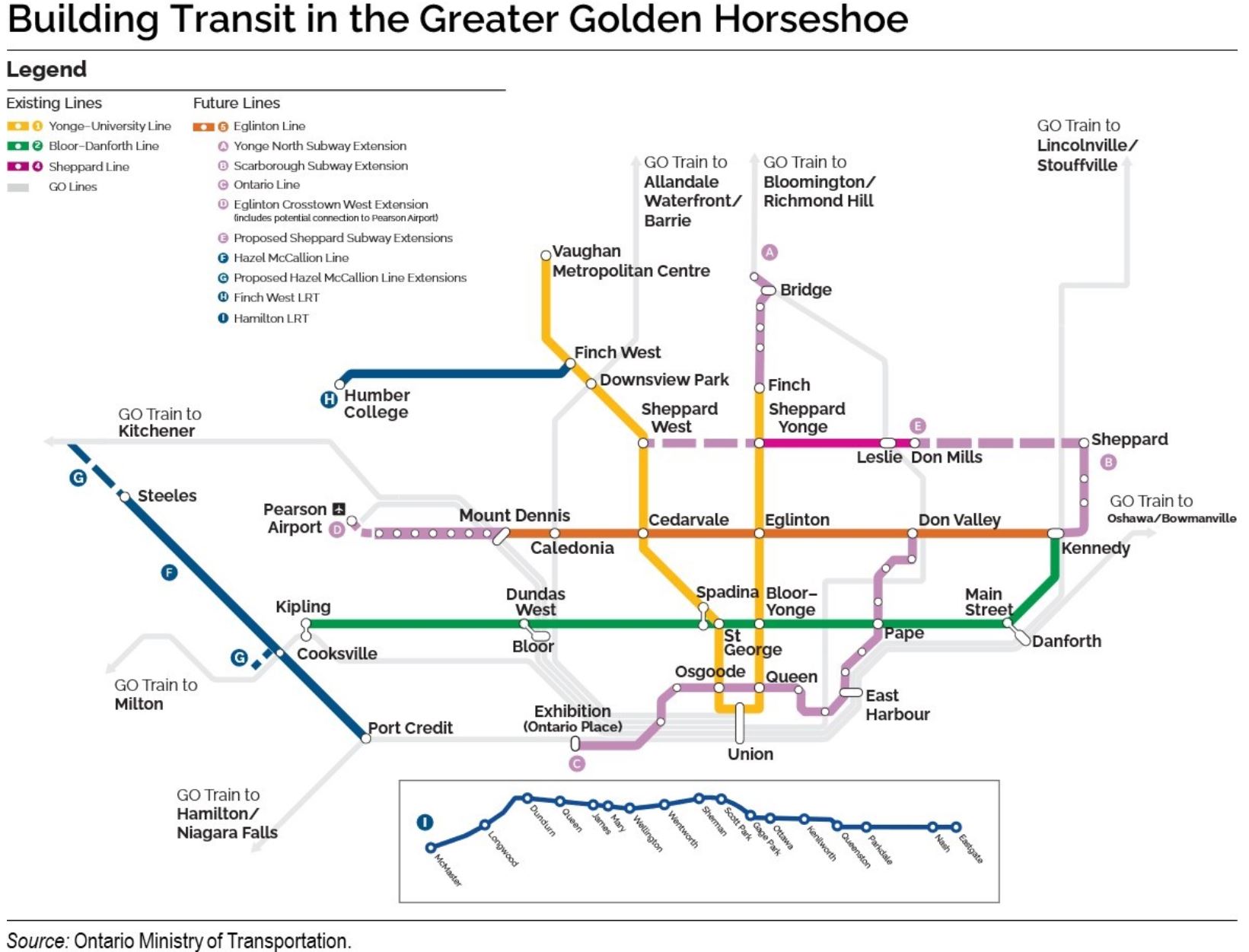
  • Sheppard Subway Extension (planning, consultation and business case preparation underway). Notable in the map below is the absence of a line east of McCowan where there is a conflict with the City’s Eglinton East LRT project and with maintenance yard property requirements.
  • New subway cars for Line 2. Provincial funding for these trains has been in place for some time. What is not yet funded are trains for service expansion beyond pre-covid 2019 levels. Trains for the Yonge North and Scarborough extensions are included in those projects. The TTC is in the Request for Proposals process for new trains, but this has been skewed by provincial statements that the work should go to Alstom’s Thunder Bay plant.

Yes, they seem to have forgotten the Scarborough Subway Extension (now under construction) in the text although it is included in the map below..

East Harbour Transit Hub

The hub at East Harbour Station, near the point where the Lakeshore East GO line crosses the Don River, will eventually serve GO Transit, the Ontario Line, and the local streetcar/LRT system via the Broadview Avenue Extension and a link west via Commissioners Street.

A substantial portion of this project is funded by the City of Toronto as a remnant of John Tory’s “SmartTrack” plan.

Light Rail Projects

  • Hamilton LRT: This is in early states with procurement underway for Civil Works and Utilities.
  • Hazel McCallion (Mississauga) LRT: Construction is well underway for the initial phase of this project, and the Province is studying whether the extension into downtown Brampton should be tunneled.
  • Ottawa LRT: The Province is studying a potential upload of the Ottawa LRT “to help reduce costs for Ottawa taxpayers”. What implications this might have for future network operation and expansion is not clear.
  • Eglinton Crosstown and Finch West LRTs: “Major construction for both projects is now complete. Metrolinx continues to focus on safety and operational readiness testing, as the projects advance toward revenue service.” There is still no commitment to opening dates, and we are getting close to the three-month lead-time required for a go/no-go decision for an early fall 2025 start of service. Meanwhile, TTC has begun the process to update subway train announcements and maps to reflect the new lines.’
  • There is no mention of the Eglinton East or Waterfront East projects. In a recent letter, Mayor Chow asked the Federal government to contribute 1/3 to these schemes, but there is no indication of support in the Provincial budget.

A Sign Of Life on Line 5 Eglinton

The TTC work signup is now in progress for the schedule period starting March 30.

It includes a signup for the Eglinton LRT for non-revenue simulation training.

Now if only we could get Metrolinx to give a clear indication of an opening date. They did once claim that there would be a three-month pre-opening period. We will see just how long “three months” is.

June 1/25 the Earliest Date for Eglinton/Finch says TTC Chair (Updated)

At the TTC Board meeting on December 3, Chair Jamaal Myers proposed a motion to extend the validity of legacy fares (tickets, tokens, day passes) to June 1, 2025 for the “conventional” system, and to December 31, 2025 for WheelTrans. This was adopted by the Board.

After the meeting, in a press interview, Myers was asked “Why June 1”?

He answered that June 1 was the earliest possible opening date for Line 5 Eglinton Crosstown and Line 6 Finch. Those lines have no fare collection support for the old fare media.

This puts Metrolinx in a bind: either they announce an earlier date, something they have been loathe to do for months, or they acknowledge that we will not ride these trains until late Spring, maybe. If Doug Ford holds an election as expected, there will be no ribbon cutting for him to tout his great works.

Updated Dec. 4/24 at 6:10pm: In today’s Star, Myers qualified his statement:

TTC chair Jamaal Myers told the Star on Wednesday that the TTC is preparing to operate the Eglinton Crosstown and Finch West LRTs using an internal target date of early June next year — though he was careful to note that he does not speak for Metrolinx, the provincial agency in charge of constructing both beleaguered light-rail lines.

Myer added that the June target date was set separate from Metrolinx’s construction timeline, and was solely for the TTC’s internal preparations to take over operations once the LRT is ready.

He said TTC staff are using June 1 as a target date to train the LRT drivers and it includes a 30-day “revenue service demonstration,” which will see trains run along the full track of the LRT. The internal target dates were partly created for financial planning purposes and are not specific to the LRT.

TTC Transit Network Expansion: February 2023 Update

At its meeting on February 28, the TTC Board will receive a report summarizing the status of most of the rapid transit plans in Toronto. This article condenses the TTC report and reorders some sections to group related items together.

Dominant among many projects are, of course, the “big four” provincial projects: Ontario Line, Scarborough Subway, Yonge North Subway, and Eglinton West LRT extension.

Project Status Overview

The effect of major projects elbowing everything else aside is clear in the table below. Some projects do not have in service dates because they are not funded, and the timing of that (when and if it occurs) will determine when various lines can open.

Not shown in this table are several major projects that pop up from time to time:

  • Bloor-Yonge Station Expansion
  • Waterfront West LRT from Dufferin to The Queensway
  • Bloor West subway extension
  • New Line 2 fleet and yard at Kipling (Obico yard property)
  • Sheppard East subway extension
  • Platform Edge Doors

Of these, only the Bloor-Yonge project has funding, and some are only a glimmer in various politicians’ eyes.

Continue reading

TTC 2023 Operating Budget

This article is a deeper dive into the budget for 2023 following up from my first cut on the subject yesterday (January 4).

See:

Updated January 6, 2023 at 2:10pm: Of all the tables included in this article, I realized that I had not included the full budgets showing functional breakdowns, as opposed to individual line items. These have been added at the end.

The annual budget cycle is always a challenge because the document comes to the TTC Board at the last minute before it must be passed and forwarded to Council. This year, the situation was complicated by the election (normally we would see the budget reports in December, not January), and by the new “strong mayor” system in which the Mayor effectively dictates the budget by setting the City’s proposed subsidy ceiling. We have many new Board members most of whom have no experience with TTC budgets, and who will not know “which rocks to look under”.

Even worse, the Mayor’s press conference announcing the budget made no mention of planned service cuts coming in Spring 2023 and gave the impression that this “core service” was defended. That can, at best, be called “misdirection” in the hope that nobody would notice what was happening and focus on the “good news”.

Here, in much more detail than I had time for in the first article, is the budget information distilled from the TTC’s 55-page report.

Key points (the TL/DR version):

  • The City will give the TTC $53 million more in subsidy in 2023 than 2022. This is pitched as being in support of more security, safety and cleanliness on the system, although the cost of those changes is less than 10% of that amount.
  • The same argument is advanced for proceeds from a fare increase (10 cents on single fares for adults and youth/students) projected at roughly $16 million.
  • The effect is that new funding is advertised for a politically unassailable purpose even though it will mainly pay for other aspects of TTC operations.
  • The year-over-year increase in City subsidy is lower than in some past years and should not be seen as a generous windfall. This is in part possible because of underspending in 2022 which leaves headroom for 2023 without as much additional City money as would otherwise be required.
  • The cost of beginning operations on Lines 5 and 6 will eat up over $40 million in 2023 and even more in 2024. At the same time, the TTC proposes service cuts elsewhere that will save about $46 million nominally in the name of matching service to demand. What is actually happening is that most of the network is paying for two new rapid transit lines through service cuts.
  • Crowding standards for off-peak service will be substantially changed to permit more riders on buses, streetcars and subway trains. On buses, the off-peak standard will be only slightly less than the peak standard. Combined with chronic unreliability of service, this will lead to more full buses and will discourage riding during the period when recovery to pre-pandemic levels is strong.
  • Headway maxima will be raised so that rapid transit service could operate as infrequently as every 10 minutes during periods of light demand. For buses and streetcars, there is no guarantee that the existing Ten Minute Network will be preserved.
  • The changes to Service Standards (crowding and maximum headways) are not explicitly listed in the report’s recommendations and would be missed by someone only browsing early pages, a not unusual situation for TTC Board members and Councillors.
  • The TTC has not published any details of planned service changes even though, for April 2023 implementation, they are certainly in the early stages of planning. The TTC and Council were clearly expected to approve the changes sight-unseen, possibly without even realizing they were buried in the budget. TTC management must be forced to reveal the details of what they plan.
  • The budget provides for additional operators who will be used to fill open crews to reduce or eliminate the incidence of service gaps caused by missing buses and streetcars. This is a change and improvement from using “run as directed” vehicles to the extent that operators are available to drive them.
  • Even this austerity service is possible only with additional subsidy of $336 million which the City/TTC will seek from the provincial and federal governments.
  • Ridership recovery is stronger on weekends, and among concession fare groups (seniors, youth, students). This type of riding is less affected by work-from-home.
  • Projections for future budgets in 2024 and 2025 include no provision for additional service beyond that which will be operated in 2023.
  • The TTC claims it will pursue a ridership recovery program, but its budgetary plans suggest that service will remain below 2022 levels for 2023 through 2025. This, coupled with chronic service reliability problems, is not a recipe for winning back riders.
Continue reading

Tracking Metrolinx Project Costs

The Province of Ontario is not exactly transparent when it comes to reconciliation of announced project costs and actual spending, let along the changes that might occur along the way. A project, or group of projects, might be announced with a value in then-current dollars, and without necessarily including all future contract costs. There are various reasons behind this approach including:

  • The government does not want to tip its hand on the amount of money “on the table” to prospective bidders who might tailor their bid to the perceived level of funding.
  • Some contracts include future operating and maintenance costs as well as capital costs. In some case the announced cost does not include the O&M component, only the estimated capital portion.
  • Provincial projects are typically quoted in then-current dollars with future inflation to be added as it occurs, at least to the point where there is a contract in place which includes that provision.

This approach hides the likely as-spent costs and makes provincially run projects appear cheaper, at least in the short run.

This is fundamentally different from the way the City of Toronto tracks projects and how TTC requirements are reported. Specifically:

  • City project cost estimates include inflation to completion because this is factored into future funding requirements.
  • City projects do not bundle future operating costs with capital, but report them separately.

Note that cost estimates shown in the Infrastructure Ontario market reports do not necessarily match values shown by Metrolinx because IO shows these values on a different basis. Future operating and financing costs are no longer included in IO estimates so that a project’s value reflects only design and construction costs, a value that gives potential construction bidders a general size of the project’s scope.

Infrastructure Ontario notes on the November 2022 Market Update that we have modified the methodology used to calculate the estimated costs as presented on the chart. In May 2022, and for Market Updates prior to that, we used the Estimated Total Capital Costs. For the latest update, and going forward, the costs listed only include Design and Construction costs.

These changes were adopted after feedback from our construction industry partners found that including only design and construction costs provided them with a better sense of the scope of the project and would assist in determining if they wished to participate in the bidding process.

Email from Ian McConachie, Infrastructure Ontario, Manager, Media Relations & Communications, November 24, 2022.

This can be confusing with “bundled” projects such as the Ontario Line RSSOM contract which includes both provision/construction of vehicles and infrastructure, as well as future O&M costs. This is probably the reason, or a good chunk of it, for the very large increase in the RSSOM contract value between the initial estimate cited by IO and the contract award. However, the way these contracts are handled generally makes it impossible to know how much of the change is simply due to inflation in materials and labour costs, and how much is due to underestimates or scope changes.

Continue reading

Eglinton Crosstown Delayed (Again)

In what must be the most anti-climactic news on the planet, Phil Verster, Metrolinx President and CEO, has announced that the Eglinton Crosstown Line 5 will not open as planned. I will let Metrolinx speak for themselves.

Statement regarding the Eglinton Crosstown LRT

Sept. 23, 2022

Today, Metrolinx President & CEO Phil Verster issued the following statement:

We had expected the Eglinton Crosstown LRT to be fully built, thoroughly tested, and in service this fall in accordance with our project agreement with Crosslinx Transit Solutions, the construction consortium responsible for building the project.

Unfortunately, while progress has been made, Crosslinx Transit Solutions have fallen behind schedule, are unable to finalize construction and testing, and therefore the system will not be operational on this timeline.

We know construction has been difficult for commuters, communities, and businesses along the Eglinton corridor. We are doing everything to hold Crosslinx Transit Solutions accountable and to redouble efforts to meet their commitments and complete the work quickly so we can welcome riders onto a complete, tested, and fully operational Eglinton Crosstown LRT as soon as possible.

Source: Metrolinx Blog

Anyone who has followed the construction project, to the degree it is visible at street level, would have trouble believing the line would be ready in 2022. Only a week ago, the project’s Twitter account announced that they had just finished structural steel at Eglinton Station. This is nowhere near the same as putting the last touch of paint on a building.

The TTC budgeted for a first quarter 2023 startup with training in advance, but that date sounds iffy considering Verster made no mention of a handover date from the builder, let along commissioning and opening the line.

If only Metrolinx were less secretive, less inclined to give us only “good news”, there would be more trust in their breathless announcements for all projects, not just Eglinton.

The key question, however, is not “when will it open”, but “how long has Metrolinx known”.

TTC Board Meeting: July 14, 2022

The TTC Board held its last scheduled meeting of the current term on July 14. Barring an emergency requiring a special meeting, the next regular meeting will follow reconstitution of the Board after the municipal election in the Fall.

Some items on the agenda have already been covered in previous articles:

This article covers:

  • The CEO’s Report
  • Outsourcing of non-revenue automotive vehicle and equipment maintenance
  • Automatic Train Control for Line 1 Yonge-University
  • Five and ten year service plans
  • Transit network expansion update

I will review the Green Bus program update in a separate article.

CEO’s Report

The CEO’s Report contains many charts purporting to show the operation of the system. Unfortunately some of these hide as much as they tell by giving a simplistic view of the system.

I have already written about the wide discrepancy between actual short turning of vehicles and the reported number. A distortion this major calls into question the accuracy and honesty of other metrics in the report.

In a future article, I will turn to the appropriateness of various metrics, but here are some key areas:

  • Averages do not represent conditions riders experience. Data that are consolidated across hours, days, locations and routes hide the prevalence of disruptions. Service that is fairly good on average can be terrible for riders who try to use it at the wrong time.
  • Values for some metrics are reported with capped charts that show only that a target is met, but not by how much it was exceeded. This gives no indication of the room to improve the target value, nor of the variation that could make a higher target difficult to achieve consistently.
  • Reliability is shown only for vehicles that actually operate in service, but there is no measure of actual fleet utilization and the headroom for service growth using available buses, streetcars and subway trains.

In discussion of the report, Commissioner Carroll noted that the TTC still has a problem with on time performance for streetcars. CEO Rick Leary replied that there is an On Time Performance team who are looking at details including recognition that there are three types of routes: those that run well, those affected by construction and those with other problems.

Carroll replied that people are quick to complain about King Street and wondering why they are still waiting for the 504. The TTC says that construction is the reason, but do they have a strategy to deal with bunching and communicate with riders. Management replied that they have strategies for keeping riders informed during planned diversions, but for unplanned emergencies there are service alerts. Changes are coming and service should improve.

This discussion was frustrating to hear because, first off, the central part of 504 King between Dufferin and Parliament is not affected by construction. Only the outer ends in Parkdale/Roncesvalles and on Broadview have (or had until recently) bus shuttles. As for keeping riders informed, irregular service plagues all routes in the system as I have documented in articles here many times. The problem is line management, or the absence of it.

On another topic, Carroll noted that the TTC seems to have a lower standard for the condition of stations than it does for vehicles, or at least tracks the latter at more detail. Leary replied that a summer blitz using student workers will scrub down all stations to bring the system back to a better quality for riders returning in the Fall.

Continue reading