6 Finch West Delay Logs December 2025

The full set of delay logs for 6 Finch West found their way to me recently. The first six days were published in a previous article:

The full set is available in a PDF here. These have been condensed substantially to make browsing easier and to focus on the location, type and duration of delays and incidents.

Many of these delays are short enough that they are not reported to the public via service alerts, but there was a period from December 29-31 when no alerts for Line 6 were issued at all.

A common pattern through the month is that most of the delays are due to infrastructure or equipment failures.

  • Inoperative or non-responsive switches, especially on snow days.
  • Emergency braking caused by overspeed conditions. Some of these could be false positives, or could indicate an aggressive enforcement of speeds.
  • Emergency braking caused by passengers reopening doors. This is a common practice on streetcars, and a design that causes delays through normal passenger behaviour clearly needs a rethink.
  • Positional problems at stations caused by spin-slide braking which triggers misreporting of vehicle location.
  • Cold cars.
  • Many error codes appear on the operator consoles, and these are cleared by “remedial procedures”. There is no discussion of why these happen, and because maintenance is not handled by the TTC, there is no transparency to that part of the operation. An obvious problem is that if normal procedure is to treat error codes as spurious, they lose their meaning and importance.
  • Failed communications both of hand-held radios and of the control/signalling system.
  • No equipment available. The Line 6 fleet is 18 cars of which 15 are scheduled for peak service.
  • Inability to maintain schedule.
  • Washroom and work breaks for operators. This implies a scheduling problem which is accentuated by perennial delays on the line.

Operational issues with restrictive speeds at intersections and delays due to traffic signals are not logged as delays except for overspeed incidents. The one exception is a log entry from Christmas Day when by mid-evening the entire line was running about 49 minutes late. This is not a heavy traffic day, but the problem illustrates the mismatch between the line’s design and even the padded schedule that was implemented.

Metrolinx has been silent on the question of reliability of components that lie with its P3 partner, Mosaic, or of any work plan to address shortcomings in the vehicles, systems and infrastructure.

City Council supports changes to the traffic signal behaviour to provide aggressive transit priority, and a report on this is due early in the year. Once that comes out, we will see how much of the original design is due to foot-dragging by car-oriented planning in the Transportation Services Department who are responsible for the signals.

A detailed analysis of service such as I have provided for other TTC routes is impossible because there are no tracking data for the Line 6 vehicles. This is a problem even for the TTC who have no way to review the line’s operation, and for trip prediction apps. This is a glaring oversight that should be corrected as soon as possible to improve real-time rider information and to allow retrospective analysis of operations.
Toronto Council Debates Transit Priority

On December 16, Toronto Council debated and approved a motion by Mayor Chow regarding transit priority on 6 Finch West and more generally on the streetcar network.

1. City Council direct the City Manager, working with Metrolinx and the Chief Executive Officer, Toronto Transit Commission, to advance implementation of more aggressive, active transit signal priority at intersections along surface portions of the Line 5 Eglinton and Line 6 Finch West, subject to contractual and legal obligations, and to provide an update on progress in the first quarter of 2026. 

2. City Council direct the City Manager, working with the Chief Executive Officer, Toronto Transit Commission, to report back in the first quarter of 2026 with a plan, including costs and staffing requirements, to implement further measures that improve streetcar network speed and reliability, including signal timing adjustments, a more aggressive transit signal priority policy, deploying traffic agents at key intersections to prevent blocked streetcars, and recommendations for removing on-street parking and restricting left turns during high-peak periods on key streetcar routes. 

3. City Council direct the City Manager, working with the Chief Executive Officer, Toronto Transit Commission, to report back in the first quarter of 2026 with a plan, including costs and staffing requirements, to expedite transit signal priority activations at intersections on the surface transit network where the required technology is not currently installed.

Later in this article, I will give a synopsis of the questions and statements by various members about this motion, but to begin, here are a few key points.

  • The debate focused almost exclusively on Finch, although the motion deals with surface transit generally.
  • Some members spoke of the need to move beyond assigning blame to fixing the problems on Finch. This gracious approach avoids important “lessons learned” about how not to open a major new transit line. These cannot be ignored, nor can recognition of where problems lie among various parties.
  • From many comments by staff and councillors, it is quite clear that the slow speed of the route was known in advance of opening, indeed had been planned for years before. However, neither Council nor the TTC Board were informed of this.
  • The glacial operation has been explained away as part of a natural “bedding in” process. However, the slow speed was not foreseen by Metrolinx whose FAQ page for the project still (as of Dec 18, 2025) claims a 33-34 minute trip at an average speed of 20-21 km/hr including stops.
  • Advance publicity for the opening gave no hint of slow operations, and there is no mention of a frequent, parallel shuttle bus service to supplement the slow LRVs on the TTC’s Line 6 opening page.
  • The actual speed of cars on the line is well below the claimed limits of 60 km/hr between stops, and 25 km/hr at stops and intersections. Something else limits driving speeds, such as importation of restrictive downtown streetcar practices, but this was never mentioned in the debate. Comments by staff showed that they thought the 60/25 km/hr speeds were typical when in fact actual speeds are much lower. A slow crossing speed at intersections increases the amount of time a transit only phase would take out of traffic signal cycles.
  • There is a posted 10km/hr limit on the curve at Humber College Station which is likely permanent because the Citadis cars have troubles going around the corners which by downtown streetcar standards are quite generous. This is a design error between the curve radii and the capabilities of the cars that is likely unfixable.
  • Some members mentioned Seattle as an example of active transit priority where left turning traffic comes second, not first, and cited this as an example of how LRT could operate faster.
  • There was some confusion between automatic operation and speed limits imposed on manually operated LRVs. Routes that are completely grade separated can be driven automatically, but not a route in the middle of a street where access to the right-of-way cannot be controlled. Comparisons between systems in various cities needs to take the characteristics of each line into account.
  • On the question of nearside vs farside transit stops, the overwhelming reason for the farside design is to provide space for a nearside left turn lane. Some stops are nearside because of space constraints. In any event, farside stops depend on good signal priority to avoid the “double stop” problem so common in Toronto.
  • Reliability of the fleet and infrastructure are key responsibilities of the Metrolinx P3 partner, Mosaic. Information about failures is available in the TTC’s internal operating logs for the route, and I summarized these for Dec 7-12 in a recent article. Council was told that the TTC is cataloguing issues to work with Metrolinx and Mosaic, but was not given any details.
  • Tracking of Line 6 vehicles for service reliability and to flag locations of delay is not yet possible because the TTC does not received a tracking feed comparable to what has long been available on its routes. This also affects trip prediction apps dependent on next vehicle information.
  • On one hand, the City and TTC claim that until handover of Line 6 by Metrolinx, they could not make changes to the signal programming. However, staff revealed that a move for slower operation dates back at least to 2024, possibly to 2020, and was approved by all parties. Moreover, the handover took place well before opening day, and issues with poor signal priority would have been obvious during the TTC’s acceptance trials.
  • Thanks to action at the political level, City staff are now working on data collection for intersection operations and possible signal timing changes to place a transit phase ahead of the left turn arrow. However, the length of this phase will be determined by the speed at which LRVs cross, possibly from a standing stop. Any modelling of new timings must be done in the context of achieving the alleged 25 km/hr speed at intersections.
  • Although there has been talk in the transit community of slow operation on Line 5 testing even in the tunnels, this did not come up in debate. Any speed restrictions there will be completely the responsibility of Metrolinx.

Mayor Chow was quite clear that Line 5 Eglinton should not open until the issues found on Finch are corrected and Line 5 is updated accordingly. She noted that the City has traffic agents who can help, although this is likely more applicable to the downtown streetcar lines. Signal priority will be added on the surface transit network where it is not yet installed. Urgent work for Finch will be done soon with a report back to the TTC and Council in Q1 2026.

Chow also mentioned that the SRT busway will open in September 2026 thanks to a construction speed-up with more shifts and weekend work. This comment reveals that the original work plan for this project prioritized cost over faster completion.

The motion carried on a vote of 22-1 with only Councillor Holyday opposed. Councillors Mantas and Carroll were absent. Councillor Colle declared a conflict of interest (his son is an official at the TTC).

Continue reading

6 Finch West: Six Days of Delays

Line 6 Finch West opened for service on Sunday, December 7. Beside the basic issue of glacial train speed are questions of vehicle and infrastructure reliability. This post summarizes the delays that occurred.

This post is far more detailed than I would normally publish, but the information found its way to me, and a clear understanding of what is going on is in the public interest.

Although the TTC takes the blame for rotten operations, their shuttle buses keep service available to riders. The overwhelming cause of delay is with systems provided and maintained by Metrolinx’ P3 partner, Mosaic. It is extremely difficult to believe that these are new conditions that suddenly manifested when passengers actually rode the trains. Equipment reliability should have been proven in the acceptance process. As for switches failing to operate in cold weather, this is not exactly new technology for Toronto, and in any event Metrolinx claimed that the line had already been through cold weather testing before it opened.

A common delay is that a car’s control system will throw a fault code, but no cause was determined and the car continued in service. Some fault codes cause an emergency brake application including an overspeed condition. These happen often enough to suggest that speed restrictions with automatic stops are set far too conservatively.

Some delays arise from misalignment of cars with platforms. This could be either due to operator error, or to braking issues. Doors are not supposed to be opened with a car in the wrong place, but manual emergency mode operation is to be needed to properly reposition a car.

Some problems with maintaining schedule were reported due to operators unfamiliar with the line. This raises the question of training and the amount of experience they received before revenue operations began.

Aside from equipment failures are delays caused by “vehicle not available”. There are 18 cars in the fleet, and peak service requires 15 leaving three spare for maintenance and change offs of cars from service. It is Mosaic’s job to have those cars available. This problem grew as the week went on. Note that service improvements will be possible only by operating cars on a shorter trip time at the speed originally expected of the line. There are no extra cars to add to the service.

It would be fascinating to read and compare the logs from a few weeks before opening during the final acceptance process. How many of these problems were common then, and was the rate of failures considered “acceptable”? We will probably never know thanks to Metrolinx and TTC secrecy.

Continue reading

TTC Board Debates Finch L(R)T

At the TTC Board meeting on December 10, 2025, there was an extensive discussion on the poor showing of Line 6 Finch since it opened a few days ago.

Predictably, this was a mix of “give us time to get things working”, disappointment over the bad impression left in riders’ minds, and attempts at hard questions about what went wrong. I say attempts because there were many evasive or just plain misleading replies, coupled with a stifling blanket of Metrolinx confidentiality thrown over the debate.

Yes, thanks to the multi-party agreement between TTC, Metrolinx and others for the Finch project, many aspects of it cannot be discussed in a public session because Metrolinx enforces silence as a condition of their contract. Commissioner Josh Matlow attempted a line of questions early in the meeting, but was shut down on this by Chair Jamaal Myers as the issue would be debated later in camera.

Global News recently reported that the TTC and Metrolinx did not agree on a planned opening date for Line 5 Eglinton. Metrolinx wanted December 28 and the TTC wanted February 8 as there were “still issues to be ironed out”. In the end the TTC prevailed, but the gravity of the meeting was clear from the presence of the Mayor, Premier and Minister of Transportation. This was no ordinary staff gathering. Attempts by Commissioner Matlow to elicit any information about discussions with Metrolinx were shut down by the Chair.

All the same, two motions regarding transit priority were proposed, amended and adopted, and discussion of them revealed details on the Finch and Eglinton projects. They also revealed many errors in understanding by some board members, TTC and City officials. This does not bode well for a frank, well-informed discussion of what might be done to improve Finch and other lines.

Continue reading

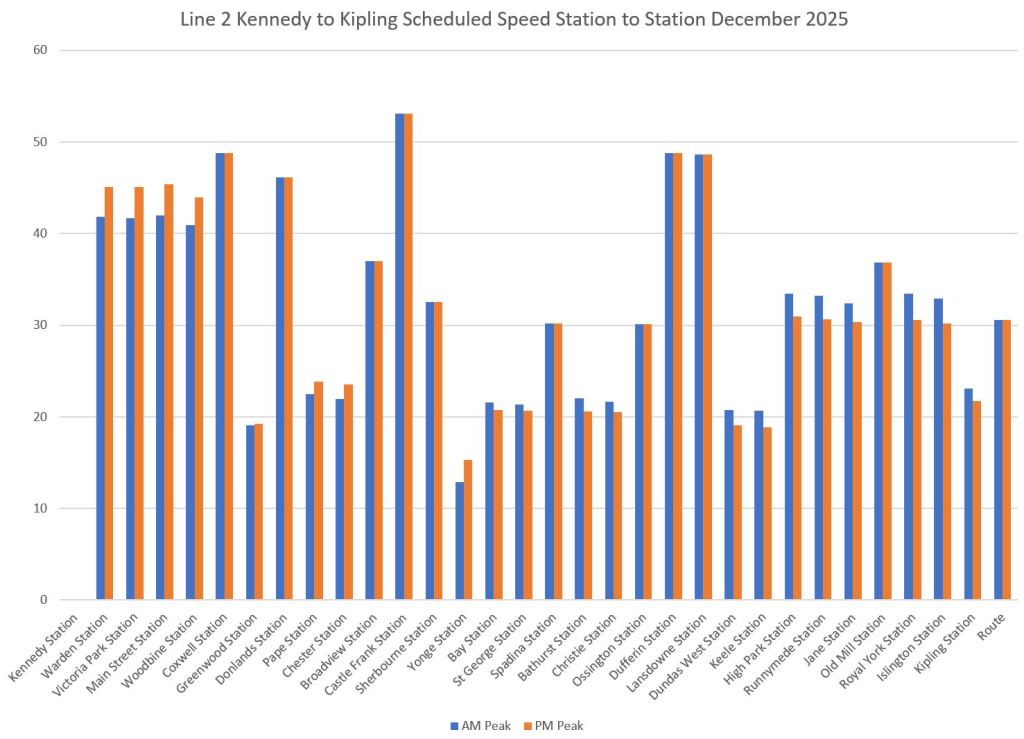
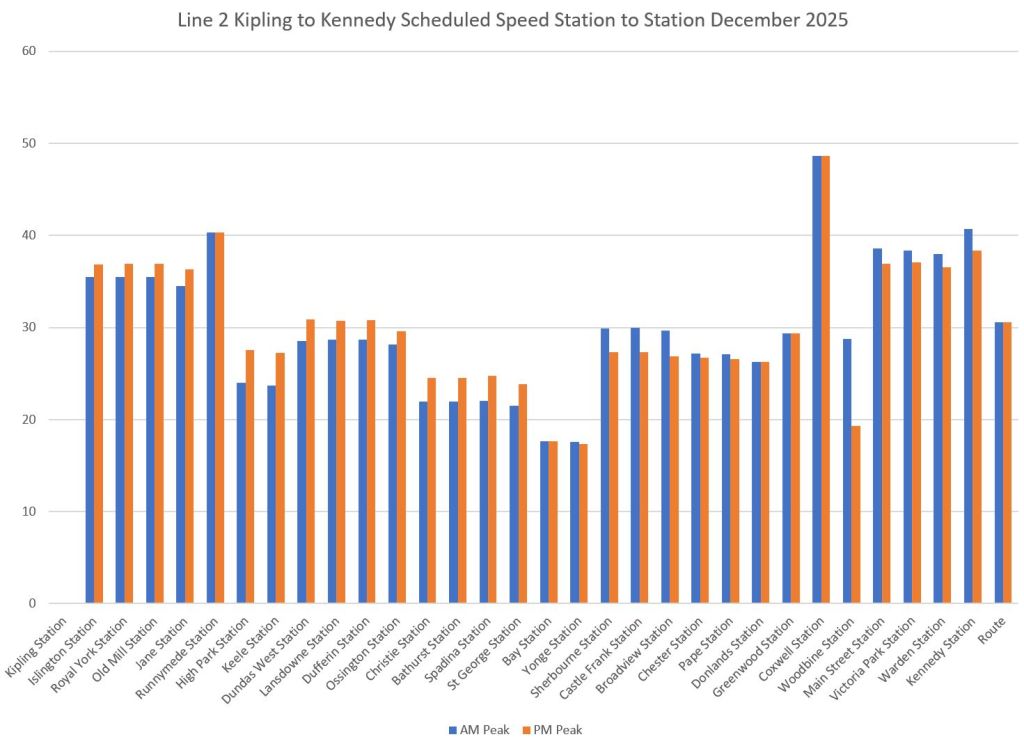
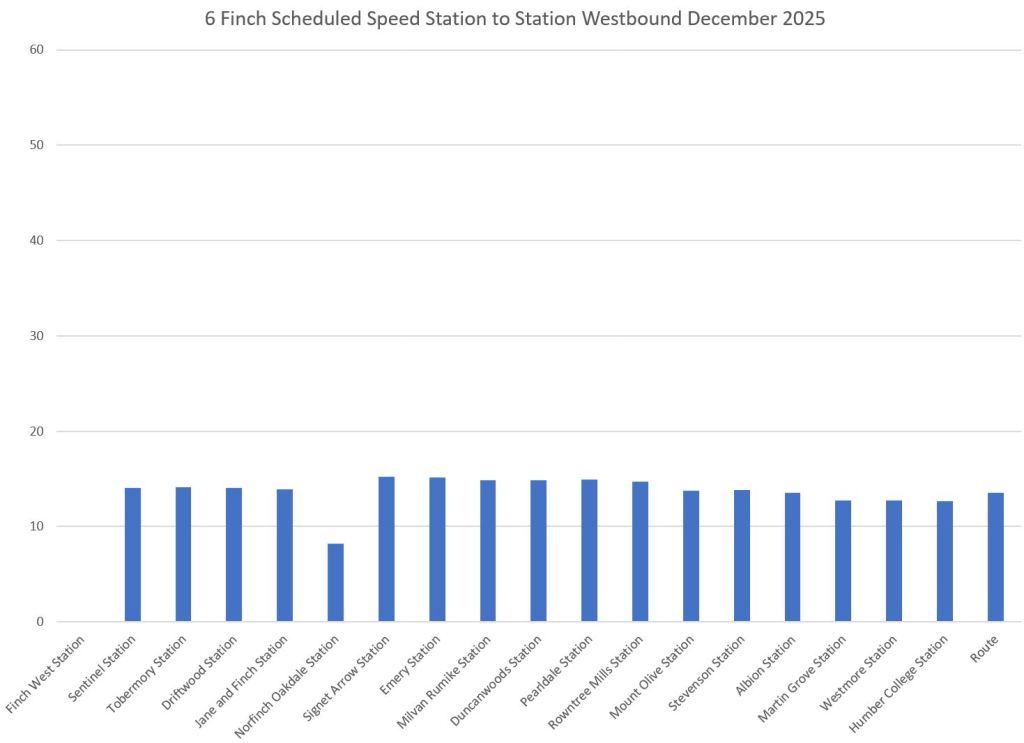
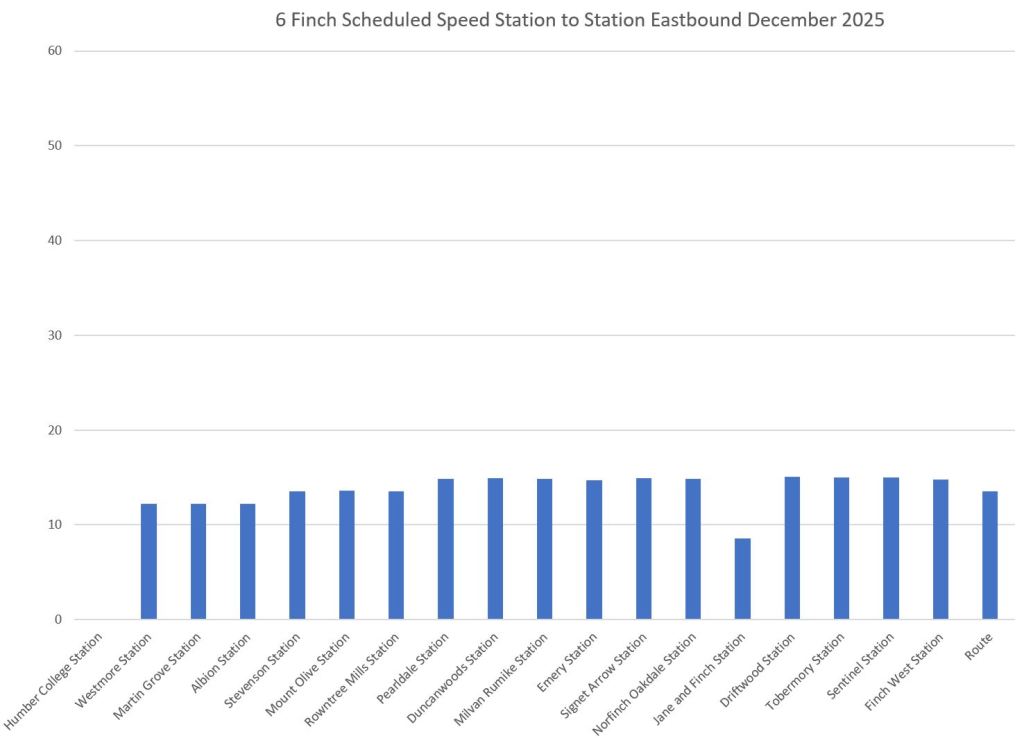
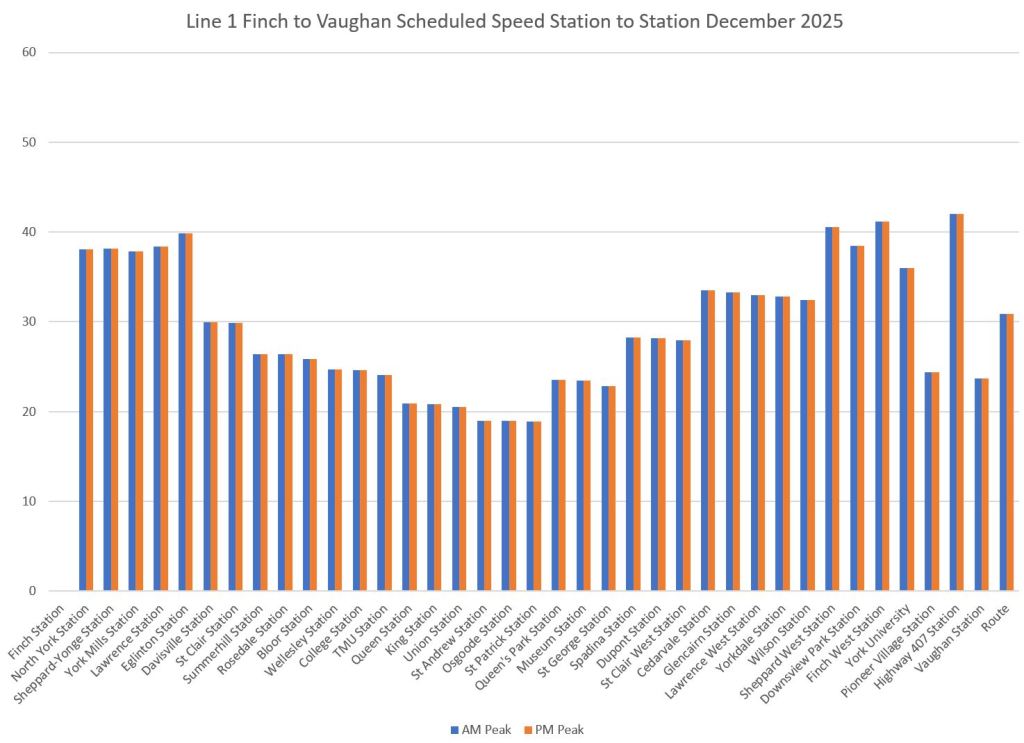
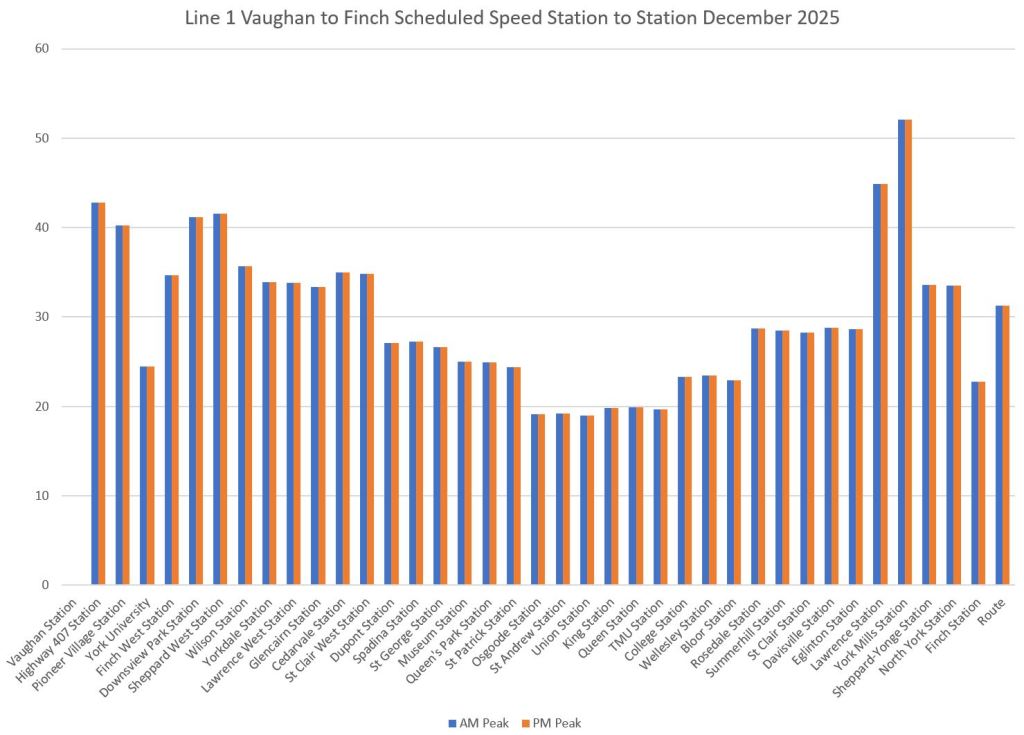
Scheduled Travel Speeds on TTC Lines 1, 2 and 6

From the moment Line 6 opened in a magisterial whoosh of grandeur, well, maybe not exactly a whoosh, the issue of its glacial operating speed has fuelled many debates in social media.

One comparison that is always made is between the “LRT” and subway speeds. Yes, the LRT has closer stops, it has to deal with traffic signals, errant motorists and pedestrians, but it gives a new meaning to “glacial”. The downtown streetcar lines are in the same ballpark, and some of them best the brand new “LRT”.

There are many factors at work which I will leave for another day. This post is intended to provide info on the scheduled travel speeds of the two major subway lines and the new 6 Finch West.

The data are taken from the GTFS version of schedules used by trip planning apps. They do not match the actual speeds, but give a sense of what the TTC expects these to be, in general, for trains running “on time”. (The GTFS data includes times and spacing for every stop from which the scheduled speed can be calculated easily.)

In the charts for Lines 1 and 2 (Yonge-University and Bloor-Danforth), data are shown for both the AM and PM peaks. For Line 6 Finch, only one set of data is shown because the TTC has used a generic all-day schedule for the initial service.

The vertical scale is set at 60 km/hr for all charts. The average values for each set of data are at the right end of each chart labelled “Route”.

It is self-evident that subway speeds will be higher for many reasons including stop spacing and the fact that trains both accelerate to and run at higher speeds. However, the LRT speeds are embarrassingly slow. Riding the line even on a trip that makes its scheduled time, the car crawls across the route.

As a matter of comparison, the 512 St. Clair car is only slightly slower than 6 Finch and at times faster. The 507 Long Branch running on Lake Shore Boulevard in Etobicoke is consistently faster than 6 Finch.

TTC Service Summary Update Dec. 7, 2025

With the mid-period update of schedules for opening of the 6 Finch line, TTC has published a revised Scheduled Service Summary. There are only a few changes, and they are listed here for convenience.

6 Finch

Here is the service summary for the new LRT line and the late evening shuttle bus. Note that the shuttle bus is interlined with the 37S Islington short turn service from Humber College to Humberwood Loop, although this is not mentioned in the summary.

Note that the scheduled speed of the bus is much higher than the LRT, and the buses get generous recovery time.

The peak requirement is 15 cars out of the 18 in the fleet.

37 Islington

In the December 7 summary, a 37S Islington short turn service is shown between Humber College and Humberwood Loop, although the effective date of the schedule is supposed to be mid-November. This does not appear in the November 16 version of the summary.

During the late evening, these buses interline with the Finch West shuttle which has an internal route number of 806 even though it operates as “6”.

32 Eglinton West
63/363 Ossington
90 Vaughan
109 Ranee
164 Castlefield

Schedules changed to reflect the renaming of Eglinton West Station as Cedarvale Station. No change in service levels.

Finch Corridor Sunday Morning Timetables

Updated December 4, 2025 at 11:40am

The TTC has issued a press release confirming the times for start of service on December 7:

Line 6 Finch West – Toronto’s newest transit line – will officially open to customers on Sun. Dec. 7. The first westbound train will depart from Norfinch Oakdale Station at 7:33 a.m., while the first eastbound train will leave Jane & Finch Station at 7:47 a.m.

For detailed first train times at each of the 18 new Line 6 stations, customers are encouraged to visit the official TTC schedules page: https://www.ttc.ca/routes-and-schedules.

Before regular service begins, two ceremonial trains will depart from Finch West Station.

Opening day is expected to be busy, and the TTC has organized special activities to mark the occasion. Customers will have the opportunity to collect exclusive Line 6 souvenirs, including special-edition ride guides, vehicle cutouts, and limited-edition commemorative coins and buttons.

[…]

Opening day schedule

On Sun., Dec. 7, the TTC will host a celebratory opening at Finch West Station. The planned opening day schedule is below:

• 7:00 a.m. – Brief remarks from dignitaries.
• 7:20 a.m. — A ceremonial first train will depart Finch West Station. This trip will be reserved for media and invited guests.
• 7:27 a.m. — A second train will depart Finch West Station. Members of the public are welcome to board and join the celebration. This train will be travelling to Driftwood Station and returning to Finch West Station. It will not be picking up customers at other stops.
• 7:33 a.m. — The first in-service train will depart Norfinch Oakdale Station, heading west.

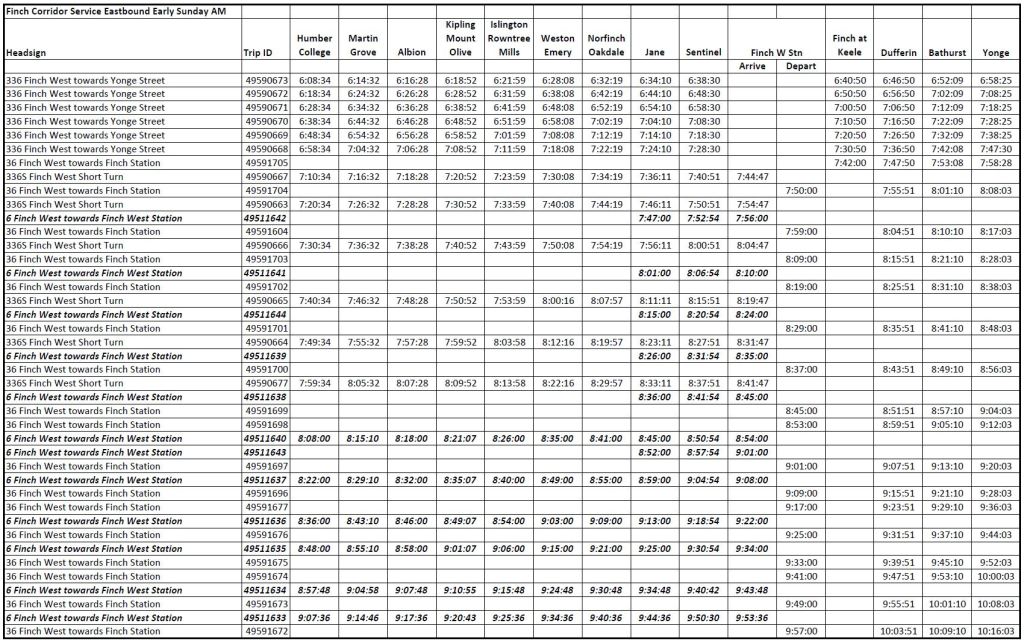
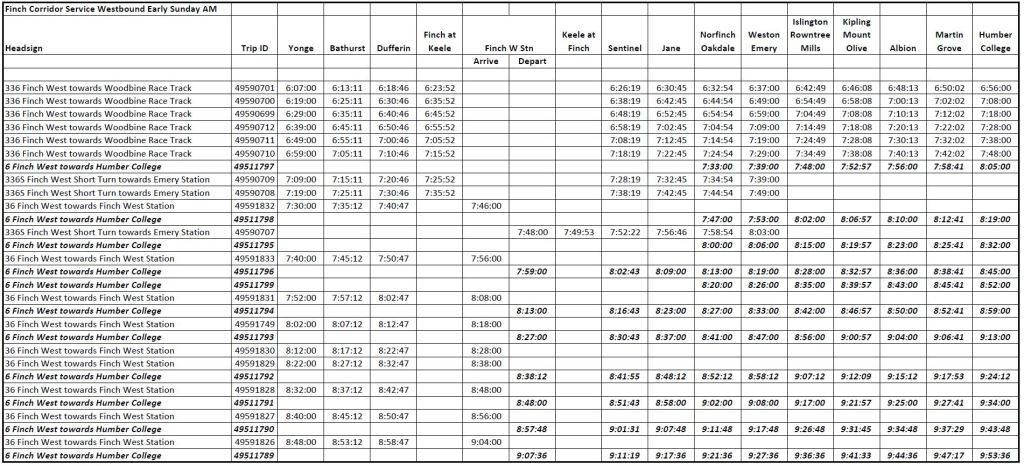
Note that the schedule pages for Line 6 have not been loaded yet, but you can see the early Sunday morning service on the Finch Corridor below, and the full schedule for 6 Finch West in this pdf. The schedules should go live on the TTC’s site when they flip over to the December 7 versions on the weekend.

Original article:

This post contains a consolidated view of schedules for:

  • 6 Finch West LRT
  • 36 Finch West Bus
  • 336 Finch West Night Bus

The period covered is 6 to 9am on Sundays, and these timetables show the transition from the night bus covering the entire route to the split bus/LRT operation east and west of Finch West Station during the daytime.

The information is taken from the GTFS version of the schedules for these routes published on the City’s Open Data site recently. My intent in producing this is that the new schedules will not go live on the TTC site until December 7, and many eager transit aficionados will want to know the times of service at various locations on the route in time to plan to ride early trips.

The TTC’s web page about Line 6 gives a generic start time of 7:30am for the route on Sundays, but actual times vary along the route.

In the timetables below, the LRT trips are in bold italics. Only major stops are shown to save space.

For those unfamiliar with the new line, the carhouse is located between Jane and Norfinch stations, and some trips originate there during the build-up of service.

6 Finch West: Schedules, Travel Times & Speeds

Corrected November 29, 2025 at 2:55pm: An error in the PDF containing the schedule information has been corrected for early Sunday service westbound.

Updated November 29, 2025 at 12:15pm: Charts comparing the scheduled travel times of the 36C Finch West Bus with the planned 6 Finch West LRT have been added.

Correction November 29, 2025 at 7:45am: As some readers have noted in the comments, the times shown at Martin Grove Station eastbound on weekdays were the same as those at Humber College. This was an editing error on my part in copying columns from a larger version of the table. This has been corrected both in the snapshot and in the PDF of the full schedule.

The TTC has published the GTFS version of the schedule for 6 Finch West. This is the electronic timetable used by trip planning apps to understand how the scheduled service is supposed to behave. From these data, it is possible to construct a schedule in a human readable format as well as to calculate travel times and speeds along the line.

The full schedule for weekdays, Saturdays and Sundays is in this PDF. [Corrected Nov. 29 at 2:55pm]

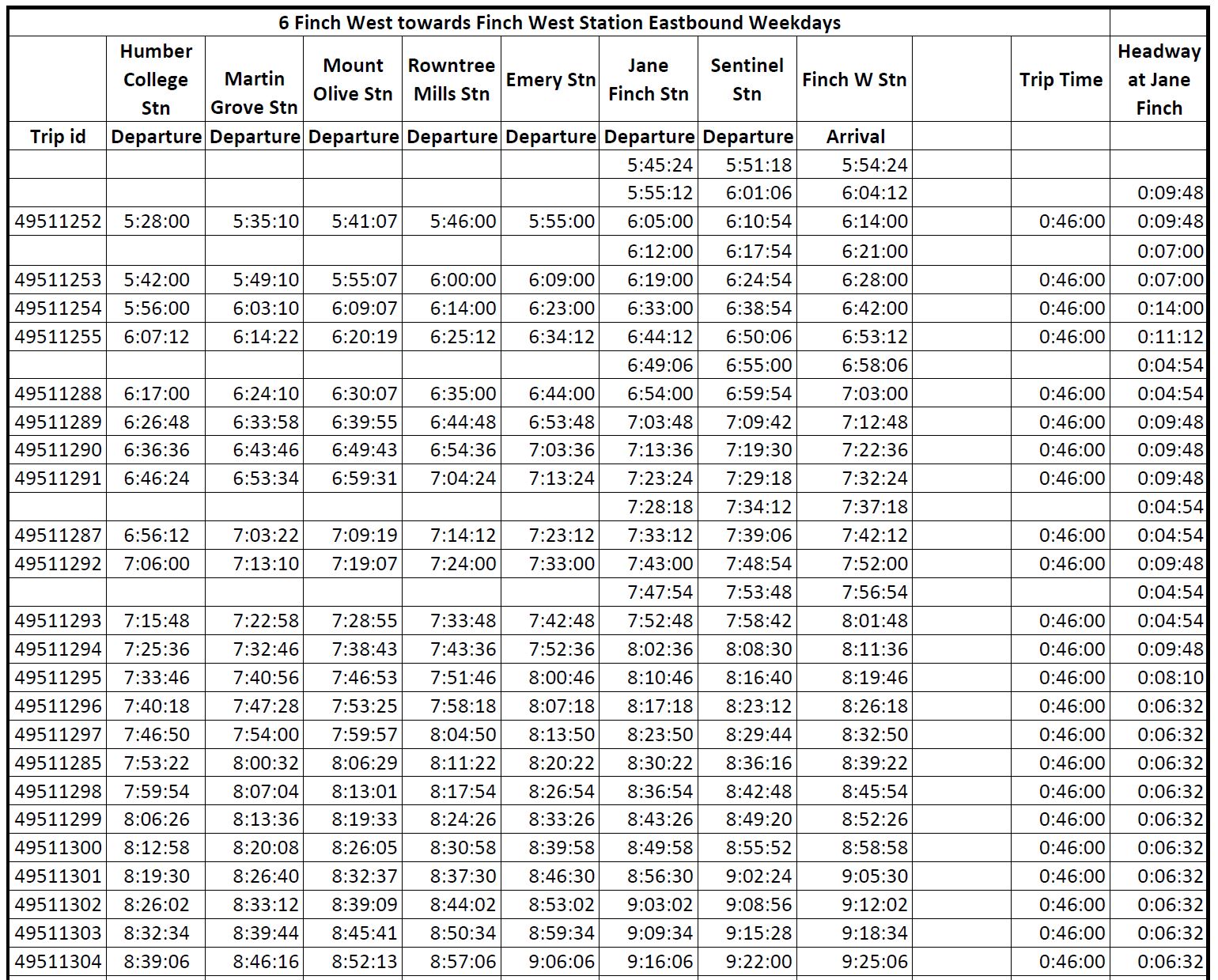
As a guide to reading this, here is the early part of weekday service eastbound.

  • Trip id: The internal trip number assigned by the scheduling system
  • Departure and arrival times: These are shown for selected major stops. Some trips originate eastbound from the maintenance yard, and so they first show up at Jane-Finch.
  • Trip times: The difference between arrival times at Finch West Station and departure times from Humber College Station. Note that they are all 46 minute. This is not typical for TTC routes where the scheduled time varies over the course of the day. This is likely a placeholder value until the TTC finds out what the actual travel times will be.
  • Headways: The interval between cars at a point where all trips are present.

Because there is only one schedule design for a 46 minute trip time all day, the scheduled speeds are the same for all trips. An obvious question is whether the TTC will force cars to hold to this schedule even if it proves excessive thereby delaying riders needlessly. Conversely, if cars operate at whatever speed conditions will allow, there will likely be terminal congestion just as on streetcar routes with excessive scheduled travel and recovery times.

The tables in this file show the spacing between stops, the scheduled time and the speed in kilometres per hour. Speeds vary over the route, and they average 13.53 km/hr. This does not include terminal turnaround time.

There is a particularly slow section at Jane-Finch both ways implying that provision has been made for a delay on every trip. I will inquire of TTC why the slow operation (8.2 to 8.6 km/hr) applies there.

The average speed is slower than the 36 Finch bus during some periods, a rather poor showing for a rail line on its own reserved lane. In a future update, I will include more information about the stop level schedules and speeds for the 36C Finch West Bus. Here is the current scheduled service summary.

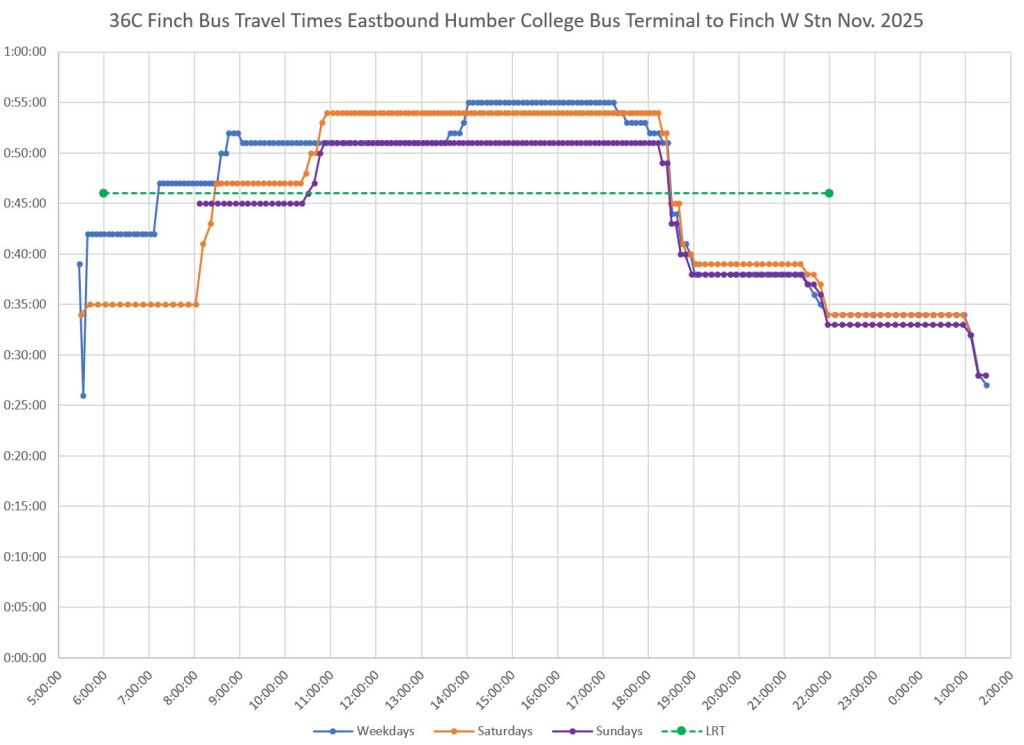
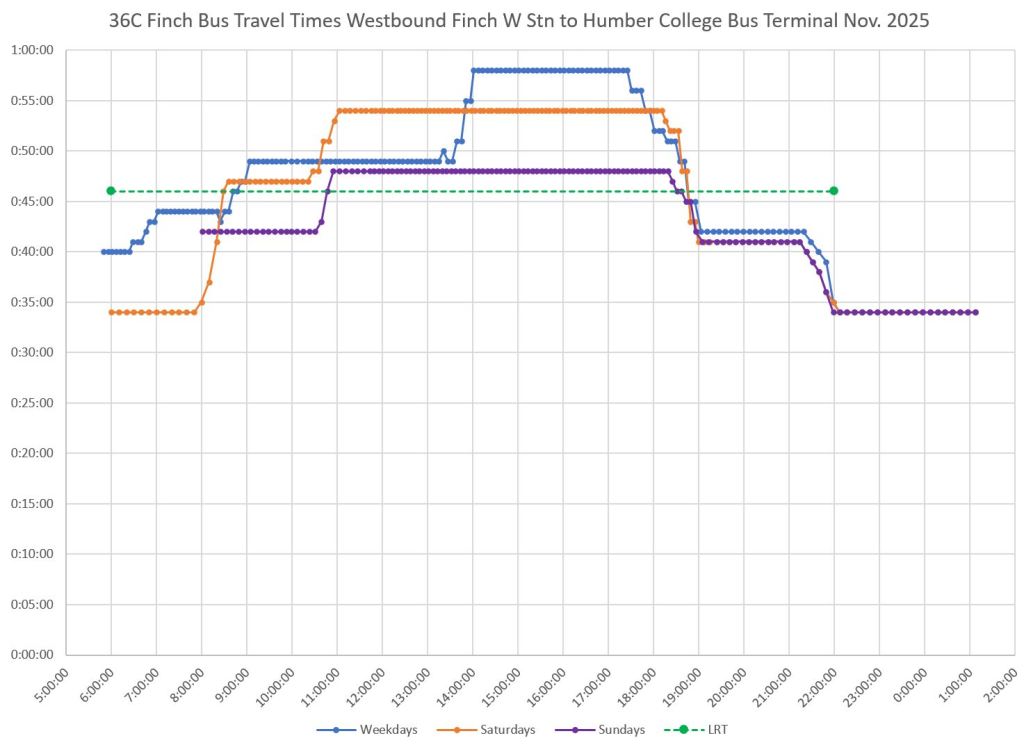
Comparative Scheduled Travel Times for 36C Finch West Bus an 6 Finch West LRT

The charts below compare the scheduled travel times between Humber College Bus terminal and Finch West Station with the planned 46-minute trip time of the LRT service. The LRT is faster than the bus notably on weekday and Saturday afternoons, but slower in the early morning and evening periods.

This post will be updated with early operating results and vehicle tracking information once they are available.

Line 6 Finch: December 7, 2025 (Updated)

Updated November 24, 2025 at 3:30pm:

The TTC has confirmed that Line 6 Finch West will open on December 7, 2025.

See:

The initial service is described as a “soft opening”:

Following the recommendations of the Ottawa LRT public inquiry, Line 6 Finch West will operate under “soft opening” conditions with trains running from 6 a.m. to 10 p.m. until Spring 2026. The temporary early closing will provide the line’s maintainers, Mosaic Transit Group, with an extended maintenance window, allowing staff to become more familiar with the line and monitor it for any issues while in full revenue service.

The service level of 15 trains on a 6’30” headway implies a round trip time of 97’30”.

Fifteen fully accessible trains will operate during weekday morning and afternoon rush hours, with service every six and a half minutes. At all other times, including weekends, trains will arrive approximately every 10 to 12 minutes. [TTC media release]

By comparison, the 36C Finch West bus has an AM peak round trip time from Finch West Station to Humberwood Loop of 116 minutes, and a PM peak RTT of 138 minutes. These times include recovery time at terminals. The peak period scheduled time between Humberwood Loop and Humber College Station for buses is 8 minutes, and so for comparative purposes, 16 minutes should be deducted from the bus running times to compare with the LRT. TTC has not yet published off-peak travel times or train counts.

This adjustment reduces the AM peak round trip time for the 36C bus to 100 minutes and the PM peak time to 122 minutes, as against 97.5 minutes for the LRT. The greater saving comes when the exclusive lanes on Finch give an advantage over bus speeds, although one might have hoped for better in the AM peak. The wider headway (interval) between trains will add waiting time, and it remains to be seen if the TTC can avoid its usual bunching and gaps that plague every major route in the city.

36 Finch West bus service design effective November 16, 2025:

As more information emerges, I will update this post.

Continue reading

Ontario Announces Testing Complete for Finch West LRT

The 30-day Revenue Service Demonstration for the Finch West LRT is complete, and the TTC will take full operational control of the line no later than Monday, November 3, 2025 according to an announcement by the Ontario Ministry of Transportation. A date for revenue service will be decided by the TTC.

The next planned schedule changes for the TTC are on Sunday, November 17, and Sunday, December 22, 2025. Implementation of any changes for November 17 are already well underway internally, and it would be a stretch to see route 6 Finch enter revenue service that soon unless the TTC had already made provision for this. Service change details for November 17 are not yet public, but should start to emerge both from internal sources and from the posting of new online schedule data used by trip planning apps in early November.

The announcement notes that the Eglinton Crosstown line is currently going through its own demonstration period, but the status of that testing has likely been affected by a collision in the Mount Dennis yard as reported by the Toronto Star.

Also announced are:

  • November 16, 2025: Opening of Mount Dennis GO/UP Station as well as the passageway under Eglinton Avenue at Eglinton West station to reduce pedestrian crossings at the surface.
  • The Crosstown stations at Mount Dennis and Eglinton West will not open until revenue service begins on the line, and at that time Eglinton West will make the long-planned name change to “Cedarvale”.

The Ministry touts various changes made based on experience with the Crosstown project that were applied to the Finch project and others:

  • Using simpler, proven signal and power systems from other LRT projects to reduce design complexity and technical risk, making delivery, testing and commissioning smoother.
  • Working collaboratively with building partners to identify critical funding for testing and commissioning and ensuring claims and legal barriers do not impact this process.
  • Onboarding the maintenance provider earlier in the process to ensure the fleet and line are ready for service sooner.

It is not clear what “other LRT projects” might have more complex signal and power systems, but Eglinton is unique in the amount of underground running where trains will be under automatic operation. Problems with premature brake wear on the Flexity LRVs used on Eglinton were traced to incompatibility between the automatic train control system and the braking system on the cars causing them to brake too strongly. This has been corrected, but considering the years the line has been under construction and testing, it is amazing that this problem was only recently found and dealt with.

The points about working collaboratively with “partners” building the line and bringing a maintenance provider “onboard” earlier speak to basic flaws in project design and contract management. A passing reference to the Eglinton line “which began construction under the previous government in 2011” tries to fob off responsibility for issues with Metrolinx that the Ford government had years to correct.

This article will be updated as more information becomes available.