Still Waiting For A Long Branch Car (Updated)

Updated June 3, 2010:

On June 2, the Commission didn’t decide to implement the 507 Dundas West option (described below), but didn’t kill off the idea entirely either.  Some Commissioners balked at the $825k/year pricetag, but the greatest failing was the lack of strong support from the local Councillor who is not a member of the Commission.

I had the sense that individual Commissioners wanted to do what they could to improve service on Lake Shore, but could not figure out a way to do so without out appearing to overrule staff and give in to a local pleading, especially in an election year.

There was a side discussion of the Park Lawn Loop whose installation would extend the 501 Humber service a short distance westward providing better service to some of the Humber Bay condo area, but this project is one of many competing for capital funds in a tight budget.

The motions passed by the Commission were:

Vice-Chair Mihevc:

That the Lakeshore Boulevard Streetcar service matter be referred to staff for consideration during the 2011 budget process.

Commissioner Milczyn:

That TTC staff consult with City Transportation staff on the possibility of constructing a portion of the civil works related to roads, curbs, sidewalks and utilities required for the Parklawn Loop in conjunction with road construction this year, and further authorize the Chair and Vice-Chair to approve any reallocation of funds required for this.

Commissioner Moeser:

The Chief General Manager be authorized within his authority spending level of $100,000.00 to approve any pro-active work considered appropriate for the proposed Park Lawn Loop.

[From draft minutes of the meeting supplied by the General Secretary’s office.]

I spoke to the subject, but nobody from the community appeared probably due to timing constraints and a sense that deputations would be fruitless in the face of TTC staff’s position on the matter.

The original post follows the break.

Continue reading

The Queen Car is Fine as it Is, Thank You (Updated)

The TTC agenda for May 6 includes a report on the proposed restructuring of route 501 Queen in two optional ways:

  • Return to the old setup with a separate 507 Long Branch service west of Humber Loop, or
  • Operate a 507 service to Dundas West Station overlapping 501 Queen service between Humber and Roncesvalles.

Needless to say, TTC staff recommend against any changes.

The Humber option never made sense because:

  • The connection at Humber Loop is in an isolated location where passengers do not feel secure, especially at off hours, and
  • Short turns of 501 Queen cars at Sunnyside leave a gap in the route and cause highly unpredictable travel times for passengers trying to transfer between the 501 and 507 in either direction.

Since the construction of much new development on The Queensway, the provision of reliable service is more important than ever.

The Dundas West option is designed to address several problems, none of which are addressed by the TTC report:

  • Move the transfer point east from Humber Loop to Roncesvalles.
  • Provide additional service on The Queensway that is not affected by short-turns further east.
  • Provide additional service on Roncesvalles to partly compensate for the frequent short-turning of 504 King cars (once that route returns to its normal configuration).

The TTC report lists many favourable aspects of the 507 Dundas West option:

  • The restored 507 route would operate with CLRVs freeing up five ALRVs for use on the 504 King route.  This is the equivalent of adding 2.5 CLRVs worth of capacity to the 504 in the peak period, but no value is attached to this by the TTC.
  • Service would be improved between Humber and Roncesvalles, and between Queen and Bloor on Ronces.  This is stated relative to the scheduled service, but a good deal of this service never actually reaches the terminals especially when there are disruptions downtown.  Nearly 10,000 trips per day would benefit from these improvements.
  • A small number of trips between Lake Shore Blvd. and the Bloor/Dundas area would have one less transfer.
  • The TTC does not mention the benefit of reliable service on Lake Shore, the value this would have in reduced wait times for riders there, and increased riding that could result.

On the down side, the TTC claims:

  • About 2,500 trips per day that travel from points east of Roncesvalles to west of Humber Loop would be inconvenienced by this arrangement, an that about 300 rides per day would be lost due to this change.  When I first proposed the 507 Dundas West service, the scheme included improved service on the 508 specifically to preserve through trip options.  This was not included in the scheme the TTC reviewed.
  • There would be little benefit for the Neville-Humber service because the west end of the line is not a source of congestion and service disruption.  This is exactly the reason for splitting off the 507 service so that it can benefit from the relatively trouble-free environment.  Also, with the 501 service having shorter trips, operators would not be faced with interminable runs across the city before they get a break. 
  • The TTC claims that sharing the platform at Dundas West between the 504 and 507 services could cause delays similar to what happened when the Dundas and King routes shared a common track.  I beg to differ.  First, the 507 service is less frequent, and there is a runaround track available if a 507 is so early arriving at Dundas West that it would hold a King car from leaving.

After all of this, the report concludes that “overall, the change would make service better for customers”.

However, the TTC rejects the scheme because it is estimated to have a marginal cost of about $825k annually.  As mentioned above, they give no credit for the value of the additional capacity provided on the King line by reassignment of equipment nor for the ridership effect of more reliable service.  Indeed, the only ridership change the TTC cites is the potential loss of 300 rides per day from the loss of a transfer-free trip through Humber Loop.

In discussing the route’s history, the TTC states that the amalgamation in 1995 was intended to eliminate the transfer at Humber.  What they omit is that this change was made primarily to reduce operating costs.  The decline in service quality west of Humber has long been a complaint from the community, and it is a direct result of the restructuring coupled with general service cutbacks on streetcar routes through the 1990s.

The report includes a chart showing ridership declines on the route, and the TTC argues that the fall occurred before the routes were amalgamated due to declining employment.  The TTC neglects to mention a large cut in service on the Long Branch car in the early 1990s that drove away riding even before the route’s amalgamation with the Queen car.

An important note about the Long Branch route, something evident in a previous TTC report on the subject and to anyone who rides the line, is that there is considerable local demand that never gets east of Humber Loop.  Service that is managed (and short turned) on the basis of somewhat empty vehicles at Roncesvalles will short-change riders who don’t board until west of Humber.  This is particularly so during off-peak periods.

The TTC report is self-serving with selective analysis intended to put their preferred option, do nothing, in the best possible light.

At a minimum, the TTC needs to carry out a trial operation of the 507 Dundas West option following restorarion of streetcar service on Roncesvalles late in 2010.  This trial needs to run long enough to allow meaningful analysis.  A related service change should be improvement of the 508 Lake Shore route to provide more through peak period trips to and from downtown via King Street.

No Priority for Transit Priority Report

In June 2005, I appeared at the TTC meeting and spoke about problems with transit signal priority on the Spadina-Harbourfront line.  At that time, then Vice-Chair Olivia Chow request a report from TTC and City staff addressing, among other things, the issues I had raised.

This report has appeared on the list of outstanding Commission requests ever since.  It was supposed to be on the March agenda, but was nowhere to be seen.  Now, we learn it will be on the September 30, 2010 agenda.

With the amount of flak the TTC and City have taken about the design of LRT lines and signal operations particularly, one might think this issue was of some interest and priority.

Place your bets now on whether we see anything by September 30, and enjoy your ride on our “priority” transit routes.

NextBus, er NextStreetcar, Comes To Broadview

This morning, the TTC held a press conference at Broadview Station to launch the rollout of next vehicle information on the streetcar network.

This was something of a non-event given that all we had to look at was one small text display on the platform for the 505 Dundas car and two of the familiar video screens showing expected arrival times for 504 King and 505 Dundas inside Broadview Station.  Oh yes, I mustn’t forget to mention that the display out on the shelter is solar powered.  It will be intriguing to see how well it works next winter.

The announcement neglected to mention that you can obtain the same info online.

Go to www.nextbus.com.  Depending on the behaviour of the browser you are using, you will be taken directly to your most recent selection if you have been to NextBus before.  Otherwise, you will have to navigate to the TTC for your first time in by selecting “Ontario” and then “Toronto”.

It’s a good idea to bookmark at least one lookup (preferably one you want to use regularly) to save on the navigation if your browser won’t “remember” where you have been.

While I was at Broadview, I noticed that the information on the display did not match what was actually happening with the cars.  This was sorted out by a conversation with the NextBus folks.  What they are displaying is a predicted arrival time as this is what people want to know at regular stops.  Terminals are a bit odd in that vehicles arrive and then tend to sit for a while.  They will show up briefly as “Due” and then the display will drop them and show the time for the following vehicle.

This could be confusing especially to someone looking at the video screen inside the station where it is not immediately obvious, especially to a rider unfamiliar with the station, that a vehicle is actually at the platform.  (Indeed a bus may not actually be at the platform but hiding somewhere for a break.)  This information needs to be added, and will be especially valuable in large terminals where displays and vehicle bays may be quite some distance apart.  If someone is waiting for the “next” bus and it has already “arrived”, and will depart (according to the schedule) in five minutes, people need to know this.

Meanwhile in other Broadview Station news:

A display panel about the size of a TTC route map was installed beside the route map last fall.  It is still empty.

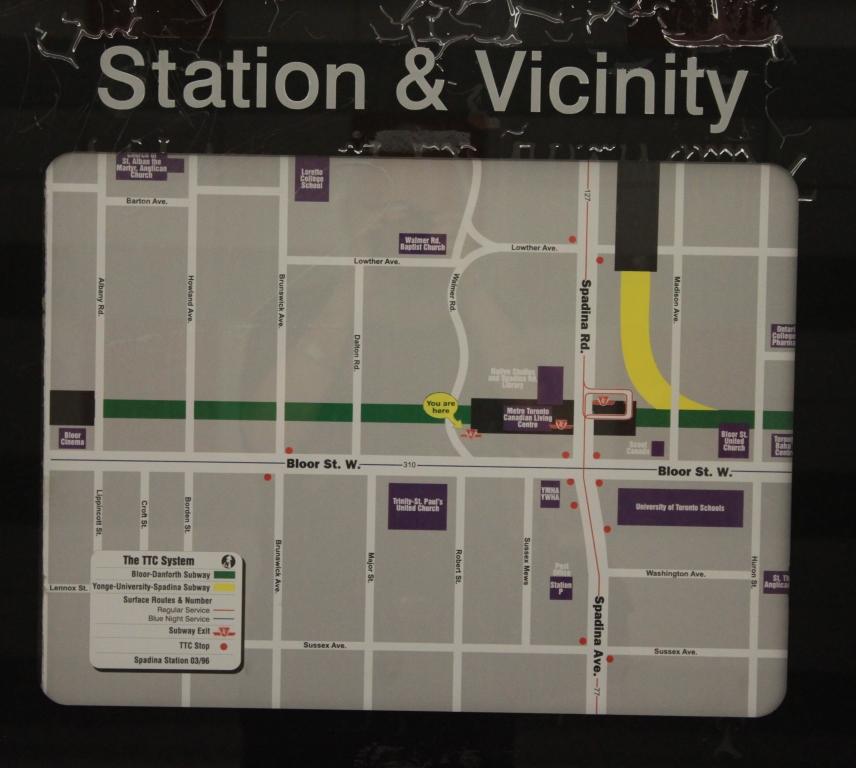
The Station Vicinity map here (and everywhere else on the system, except where ancient ones were never removed) is still missing in action.  These were to have been replaced last  fall after the debacle of the many inaccurate maps posted by the TTC.  Maybe the Customer Service Panel will fix this.

Finally, it’s almost May, and there is no sign of any work of the long-closed second entrance to the station.  There is a sign on the barricade saying it will re-open in May 2010, but this has been discretely modified, possibly in the interest of clarity.

NextBus Maps Vanish: Is TTC Embarrassed by Crappy Service?

Those who have been following the on again, off again appearance of NextBus information on the TTC have noticed that the route maps are no longer visible, only the next vehicle predicitions for stops.

Apparently, the maps showing the locations of the cars were just too embarrassing for TTC management as they show how erratic the service is even on lines with their own rights-of-way and supposedly good service.

This is an odd development considering that a rollout of NextBus to all streetcar lines was expected soon, and the maps are an integral part of the product.  Most of the streetcar routes appeared for a few days, and even were announced by the Mayor, but they were pulled back from public view.

At some point, TTC operations has to learn who they are working for.  We hear a lot about customer service these days, but perish the thought we actually find out how bad things really are.

If there is anyone at TTC with a reasonable explanation of why we should not see these maps, I want to hear it.

TTC E-Initiatives Update (Revision 2)

Revised April 6 at 7:00 am:  A short section has been added about Google Maps.

Revised April 5 at 10:00 pm:  A section has been added at the end covering those e-initiatives which were not included in the discussion at the TTC.

On March 24, 2010, the Transit Commission received an update from staff on the status of various initiatives broadly relating to the use of information technology.  These include:

Internet Trip Planner (ITP)
Next Vehicle Arrival System (NVAS)
Customer Service Disruption Notification (CSDN)
Narrowcasting
Next Train Arrival System (NTAS)

This article gives a summary of that presentation and a few of my own comments on these and other related matters.

Continue reading

Analysis of 512 St. Clair for Jan-Feb 2010 (Part 1: Headways)

In the previous series of four articles about the St. Clair car, I review operations in January 2010.  Quite noticeable within the data for January was a change in line management style in the last week of the month with a more regular pattern of short turns and generally more reliable service.

On February 14, the TTC implemented new schedules with longer running times in an attempt to overcome problems with the original versions.  Headway reliability on weekdays improved slightly, although the largest change had already come with the new line management scheme.  On weekends, although the worst of the bunching and gapping was reduced, there continued to be wide variation in vehicle spacing suggesting that the level of management necessary to ensure reliable service was not present.

I have now received February 2010 data for the St. Clair route, and this series of articles will review what it shows about the effect of the new schedules on various aspects of the operation.  Here I will review headways at key points, and in future articles I will look at link times, general line management and intersection delays.

Continue reading

Service Changes Effective May 9, 2010

Construction diversions on several routes will begin or continue in May.

504 King and 508 Lake Shore: 

King cars will continue turning back at Roncesvalles and Queen, but will reach there via Shaw and Queen Streets.  Watermain construction which last year caused Roncesvalles to be torn up last year moves to King between Ronces and Jameson.

The 504 shuttle bus will be rerouted and extended to run between Shaw and Dundas West Station bothways via Roncesvalles looping via Strachan, Douro and Shaw.

No date has been set yet for resumption of streetcar service on Roncesvalles, but this is expected to be in the late fall.  The diversion via Queen and Shaw is expected to last to the end of August 2010.

502 Downtowner and 503 Kingston Road Tripper

The reconstruction of Bingham Loop, deferred from 2009, will occur this summer.  Buses will replace streetcars over both routes until mid-August.

Replacement bus services will loop via Victoria Park, Meadow and Blantyre to Kingston Road.  The peak service on both routes will be improved from 7’30” to 6’00”, but offpeak service on the 502 will remain at 20′.

22 Coxwell and 70 O’Connor

Reconstruction of the bus loop at Coxwell station requires the removal of all bus service.  Routes 22 and 70 will interline, and all of the “O’Connor” service will run through to Queen or to Victoria Park depending on the time of day.

Existing interlines between the O’Connor, Gerrard and McCowan routes will be discontinued during this period.

72 Pape

Construction at Pape Station requires that the Pape bus be rerouted to loop at Donlands Station.  Passengers transferring to this route from the subway at Pape will do so using on street stops.  This diversion will last until the end of 2010.

The seasonal extension to Cherry Beach will operate during the evenings Monday to Friday, and all day on weekends and holidays.  This will run until Labour Day.

512 St. Clair

The mixed streetcar and bus operation on St. Clair is expected to last until the latter part of June 2010 at which point the TTC hopes to restore streetcar service to Gunn’s Loop.

509 Harbourfront and 510 Spadina

The seasonal fare collection scheme on Queen’s Quay will be in effect until Labour Day.  No fares will be collected eastbound on Queen’s Quay between Bathurst and Union Station on weekends after 3 pm, and there will be collectors stationed in the tunnel linking the Union Station Loop to the subway.

One PCC car will operate on the Harbourfront route on Sundays until September 5, 2010 between 1130 and 1930.  This will run as an extra, and will be subject to availability of both a car and an operator.

Seasonal Route Extensions

  • 72 Pape to Cherry Beach (see above)
  • 28 Davisville to the Brick Works
  • 29 Dufferin to Ontario Place (service south of Dufferin Loop will be split between the 29B Ontario Place and 29D Princes Gate branches)
  • 86 Scarborough to the Zoo
  • 85 Sheppard East to the Zoo
  • 510 Spadina King short turn extended to Queen’s Quay on weekends
  • 165 Weston Road North to Wonderland

Other Route Changes

  • 25 Don Mills service north of Steeles removed (York Region request)
  • 29 Dufferin trial service in Exhibition Place rerouted to operate via Manitoba Drive, Canada Drive, Princes’ Blvd., Nunavut Rd., and Nova Scotia Ave to Manitoba Drive.
  • 224 Victoria Park North service extended to Elgin Mills (York Region request)
  • 96B Wilson route changed via Claireville Drive
  • 96C Wilson service removed from Thistledown Blvd. early mornings and late evenings

Service Level Changes

Many route have new schedules starting on May 9 primarily for seasonal changes in demand.  The details are in a spreadsheet linked below.

2010.05 Service Changes

Transit 102: What is “Good Service”? (Updated)

Updated March 23 at 11:20 pm:  After this article was published, one commenter noted that the cleanliness and attractiveness of the system is another vital aspect of “good service”.  In my article, I had concentrated literally on “service”, not on the physical condition of vehicles and stations.  However, I do agree that a run-down, dirty system does not inspire confidence, and the TTC is looking decidedly shabby.

Tess Kalinowski has an article in the Star on the issue of station condition on the south end of Yonge Street where the BIA is doing a running audit to track progress on fixes.  The TTC has its own internal monitoring, and loves to trumpet improvements as a good news story, but the truth is that there is backlog of repairs that gets longer by the day.  This topic is worth a post in its own right, but I wanted to add the link to the Star’s article here as it fits right in with the comment.

In all the talk about who should run the TTC, or whether transit should even be provided by the public sector, one important question is rarely answered. What sort of transit service do we as a city want? What is “good” service?

“Good” is a relative term depending on your viewpoint. If your job is wrestling with municipal or provincial budgets, your outlook will be to restrain growth in costs and to limit expectations of service quality. This runs head on into schemes to redirect growth in travel from autos to transit. More passengers almost always mean more subsidies over and above any inflationary growth.

If you are a transit rider (or thinking of becoming one), you don’t want service that is barely acceptable. You want service that retains your loyalty and that you would recommend to others. Riding should grow because transit attracts customers, not as the “least worst” of options.

There are three essentials in transit service: reliability, frequency and connectivity.

Continue reading