The Travails of Cherry Street

A recent meeting of the Corktown Residents’ and Business Association included a discussion of problems with the new 514 Cherry service. As reported by thebuletin.ca

… a resident of the King/Sumach area … commented that the screech of the streetcars turning at King and Sumach was so loud as to prevent sleep. Apparently the issue has been ongoing since the inauguration of the 514 (Distillery Loop–Dufferin) line on June 19.

The issue—which took the meeting somewhat by surprise—was amplified by other attendees, who also noted that there were substantial problems with streetlight timings at the Cherry/Front and Cherry/Eastern intersections, as well as with poorly-delineated turning lane stripes which have led to vehicles accidentally getting onto the streetcar right-of-way and then being unable to get off. (There have been earlier, similar incidents with the slightly older right-of-way at Queen’s Quay.)

Deputy Mayor and area councillor Pam McConnell’s office was aware of the issues and noted that streetcar service was now suspended (replaced with shuttle buses) between 10 p.m. and 7 a.m. A public meeting was subsequently scheduled with the councillor’s office and the TTC.

Problems at King & Sumach have continued since the 514 opened for service including:

  • dewirements causing overhead to be pulled down
  • derailments
  • traffic signals that do more to delay transit service than “prioritize” it (this is also a problem further south on Cherry)

When the TTC began rerouting the 514 service late in the evening, the alleged purpose was “railgrinding” and this is still reflected in the URL for the service notice which is called “514_railgrinding.jsp”. The activities underway at the intersection were clearly aimed at the derailment problems by altering the rail profile on the curves.

There is a long-standing slow order for east-west operation on King that has nothing to do with this, but is no doubt related to a few cases of overhead failure.

Meanwhile, the traffic signals here and at other locations on Cherry appear to be on a fixed cycle that has no relationship to whether transit vehicles are present. So much for “transit priority”.

On the subject of wheel squeal, the TTC’s official line is that the new streetcars are supposed to be self-lubricating, and that this would be triggered by GPS information. That’s a good line, but it does not fit with actual conditions.

  • There is a wheel greaser on the southbound approach to Distillery Loop.
  • The GPS-based automatic greasing has not yet been turned on for the new cars. (Anyone with contrary information is welcome to correct me in the comments.)
  • Most of the service on 514 Cherry is provided by CLRVs that do not have automatic greasers.

I have outstanding requests for further information on these issues to both the TTC and to City Transportation, and will update this post as and when they reply.

SmartTrack’s Next Steps

After a day-long debate, Toronto Council has approved continuing along the path set by Mayor John Tory to study and possibly to build the transit lines branded as “SmartTrack”. Although this proposal is now much different from the scheme that was Tory’s campaign centrepiece, the idea of SmartTrack continues to receive broad support among Councillors.

The debate covered a lot of ground with two related threads: how would Toronto actually pay for SmartTrack, and how much of the larger transit network many hope to see will actually be built.

Council has yet to consider a long-term financing strategy and possible “revenue tools” (new taxes in plain English) to deal with the combined capital and operating budget demands of the would-be network. Although there was much talk of the lost decades of underinvestment in transit, Council has yet to show that it really is ready to spend Toronto dollars (as opposed to  money from any other source) at the level that will be needed. City staff will present a report on financing options in a few weeks, and the reaction to this will be telling.

What Did Council Approve?

Below is a consolidation of the staff recommendations and amendments adopted by Council arranged to keep related issues together. For full information, please refer to the detailed record of the item.

Note that in all cases where approvals relate to “SmartTrack” this includes both the six new GO stations and the Eglinton West LRT extension unless otherwise noted.

Process:

  • (1) Adopt the “Summary Term Sheet and Stage Gate Process” which includes details of the many parts of the proposed agreements and (2) authorize the City Manager to negotiate and execute agreements with the province to implement this.
  • (3) Request staff to report at Stage Gate 5 for final approval of full funding for SmartTrack. A report on more definitive costing and the financing funding strategy has been requested for an earlier step in this process. See (18) below.
  • (4) Approve the confidential staff recommendation regarding settlement of the Georgetown corridor funding issue. See also recommendation 15.

Technical and Planning:

  • (5) Proceed with planning and design for the six SmartTrack GO stations, report back to Council, and launch the Transit Project Assessment Process (TPAP). This was amended by two further requests that the work include improvement of:
    • the placement and access points of the Liberty Village Smart Track Station to maximize connectivity, and
    • pedestrian connections to the existing Exhibition Place Station for both Liberty Village and Exhibition Place.
  • (6) Confirmation of city support for transit supportive land use plans for areas around the SmartTrack and GO RER stations. Amendments related to this included:
    • Amending the development strategy for public lands at stations, including air rights, to create ongoing operating revenue streams from development resulting from that strategy.
    • Directing the Chief Planner to report in January 2017 with options to develop a comprehensive plan for managing development and growth related to transit expansion.
    • Confirming that the Official Plan as well as other plans, bylaws and policies, are not changed by this decision on this item. The intent of this is to forestall any claim for additional density by would-be developers in advance of the passing of updated plans for area affected by transit projects.
  • (7) Proceed with planning and analysis of the Eglinton West LRT extension up to Stage Gate 3 including finalization of stops and grade separations, provide a scope for this project up to the Renforth Gateway, and provide a class 4/5 estimate of the project’s cost, and conduct the TPAP. Note that this is a more restrictive approval seeking more detail than in the case of the ST/GO stations in (5) above.
  • (8) Request a financial contribution from Mississauga and Pearson Airport to the outside-416 portion of the Eglinton West extension.
  • (9) Ensure that the proposed new station design at St. Clair and Keele includes improved road operations and is co-ordinated with the St. Clair West Transportation Master Plan. A significant part of this would be the widening of the underpass east of Keele Street to remove the existing choke point.
  • (10) Request Metrolinx to consider grade separations at Progress and at Danforth on the Stouffville corridor, with the proviso that any option closing existing roads would not be considered. This was amended at Council to add requests for grade separations at Passmore, McNicoll, Huntingwood and Havendale.

At Council, there was an attempt to have items (7) and (8) deferred until after the Waterfront Transit Reset report is considered by Council in 2Q17, effectively putting both of the proposed Etobicoke LRT proposals on the same approval timeframe. The deferral motions did not pass.

Finance:

  • (13) Approve $71m for preliminary planning and design on SmartTrack (the 6 new stations plus the Eglinton West LRT)
  • (14) Include $2b in net capital requirements for SmartTrack (stations plus LRT) in the city’s 10 year capital projections.
  • (15) Approve $95m for settlement of the Georgetown South issue with the province.
  • (16) Approve $62m for Toronto’s share of 5 grade separation projects.
  • (17) Approve $60m for GO capital expansion (2 stations at Bloor/Lansdowne and at Spadina on the Barrie corridor). This was amended to ask that staff work with Metrolinx on including the study and design of the Railpath along the Barrie line between Bloor and Dundas West.
  • (18) Request staff to develop the financing and funding strategy, and report back when a class 3 cost estimate is available for a definitive Council commitment to the SmartTrack project.

Two additional amendments ask for:

  • strong TTC in developing procurement options, and
  • negotiations with the province for resumption of operating subsidies.

Commitment to the full cost of the new stations and the Eglinton West LRT will not occur until much more detailed cost estimates come back to Council over the next year (or possibly more). In the event that Council opts not to proceed with any component for which Metrolinx has spent money on development prior to the point of final approval, Council will be responsible to reimburse Metrolinx for its costs.

With respect to the additional grade separation studies requested for the Stouffville line, it is unclear how work on this would be funded, although one might expect Metrolinx to respond with a request for some up-front payment and guaranteed participation in funding if any of these goes ahead.

The Status of Other Major Transit Proposals and Projects

Planning and building any part of SmartTrack should be seen in the wider context of other transit needs and schemes, let alone wider demands on the city’s operating and capital budgets.

  • The Spadina Subway extension to Vaughan (TYSSE) is scheduled to open at the end of 2017, although startup costs will affect the TTC’s operating budget before any passengers are carried. For 2018, the current estimate of the annual operating cost to Toronto is $30 million including whatever marginal fare revenue the extension will bring in. This line’s capital was covered roughly one third by each level of government, with about 60% of the municipal share falling to Toronto based on the proportion of the route within its boundaries.
  • The Scarborough Subway from Kennedy Station to Scarborough Town Centre remains the subject of much debate. Although its capital cost is already covered by money from all three levels of government, the proportions are unequal, and any increase to the overall Scarborough transit scheme will be on the city’s tab. The extension will be part of the TTC’s operation along with the net new operating cost, an unknown amount at this time. A critical issue will be whether the cost estimate overall will hold or increase before final project approval, and how this will affect what actually gets built.
  • The Eglinton Crosstown LRT is now under construction by Metrolinx between Kennedy Station and Mount Dennis (at Weston Road) with a planned 2021 opening, subject to issues about vehicle delivery. This project’s capital cost is funded totally by Ontario, but operating costs will be billed back to Toronto at an anticipated annual net amount of about $40 million in then-current dollars.
  • The Eglinton East LRT extension from Kennedy Station to University of Toronto Scarborough College is part of the Scarborough package approved with much fanfare earlier in 2016. The capital cost is part of the same “pot” as the Scarborough Subway extension, but how much will actually be available after that extension’s scope and price are firmed up remains to be seen. This will be an early test for Council. Does it really believe in a “network”, are councillors willing to accept the extra cost as part of building our city, or is the argument still dominated by an outlook claiming that tax restraint must take precedence. An updated Scarborough report is expected in coming months.
  • The Eglinton West LRT extension from Mount Dennis to the Renforth Gateway (at the western city boundary) and then north to Pearson Airport is part of the SmartTrack package. Funding for the line is still uncertain because city plans depend on contributions from Ottawa (likely as part of the Liberal’s infrastructure program), from Mississauga and the airport authority (GTAA) for the portion outside of Toronto. This extension is now the more expensive portion of “SmartTrack”, and ironically appears to survive mainly because of that branding despite opposition from some Etobicoke councillors.
  • Like the central part of the Crosstown, the two extensions would be operated at the city’s expense even though the lines would be owned by Metrolinx.
  • The Metrolinx GO RER program is provincially funded, although the matter of the municipal contribution to GO’s capital remains a sore point between Queen’s Park and the GTHA. Toronto will pay for six new stations as part of SmartTrack and will also contribute to two stations on the Barrie corridor (Bloor/Lansdowne and Spadina). GO RER’s net operating costs will all be a provincial responsibility, and the amount of service that will actually operate depends on future subsidy levels for Metrolinx. Similarly, the full build-out of RER fleets, electrification and service levels will depend on future provincial budget decisions.
  • The Relief Line remains under study thanks to a provincial infusion of $150 million, and both city and TTC staff emphasize that it is a necessary part of Toronto’s future network. While some relief to Yonge line crowding will come from GO RER and the new SmartTrack stations, this will only blunt but not stop the growth in subway demand. A big problem, as readers have discussed here at length, is the project’s scope and the perception that it is intended for a comparatively small part of the system’s ridership, downtowners. The further north the eastern RL branch goes beyond Danforth (to Eglinton or even to Sheppard), the more it performs a service for the city as a whole, but this benefit is routinely underplayed relative to the cost of a new north-south subway. Major capital spending for the Relief Line would not begin until the mid 2020s, but this will still compete with other city priorities.
  • Waterfront LRT to the west is popular with councillors from southern Etobicoke and has begun to overshadow the shorter eastern LRT line in debates. Both parts of a future waterfront network are under review with the “Reset” study now in progress that has only progressed to the point of developing a moderately long list of options. The strategy appears to be to keep this list as open as possible as long as possible so that political fights over the details are held off at least until there is a better understanding of what will work and what the options might cost. Like the RL, waterfront transit has suffered from being perceived as a “downtown” project despite the scale of development it will have to serve.
  • The Finch West LRT is still on the books, and Metrolinx hopes to begin work in this in 2017. There remains some opposition to the line, and it will be a test of the Wynne government’s resolve to see whether actual work is pushed back beyond the 2018 election.
  • The Sheppard East LRT is also still on the books, although it is no secret that many politicians at City Hall and Queen’s Park would love to see this sacrificed for a Sheppard Subway extension. The LRT would be a provincial project with some federal money. There has not yet been any cost sharing commitment to a subway replacement from any government in part because the cost is unknown. It will almost certainly be greater than the LRT line, and like the extension north from Kennedy, will serve a considerably smaller part of Scarborough than the LRT would have. Any decision on this point is likely to fall to the next provincial government, although it will likely be part of the electioneering to reinforce the “subway champion” brand by all parties if this scheme gains traction at Council.
  • The Richmond Hill extension of the Yonge Subway is a project long-sought by York Region, but the idea is tangled up with network relief from GO RER, the Relief Line and other capacity improvements still pending for the existing subway. Some of these, such as added operating cost for more trains on Line 1 YUS, and capital cost for station capacity impeovements, will fall to Toronto. Whether any of the funding pools now thought to be available for transit projects generally will still be available by the time a decision on Richmond Hill faces council, indeed whether this decision will even be in Toronto Council’s hands, are questions for a future beyond any of the existing governments.
  • Not to be forgotten for its demand on city funding is the surface transit system including the bus and streetcar network. While billions in new projects preoccupy debates, a long-standing problem faces Toronto with population growth, much of it “downtown”, that has not been matched by additional transit. Indeed, transit service today is little changed from twenty years ago largely because the TTC streetcar fleet sits roughly at late 1990s levels, and traffic congestion has been responsible for service cuts to stretch the available fleet. Current operating budget plans at the TTC foresee a major shortfall in 2017 that appears unlikely to be addressed by a supposedly pro-transit council and mayor, and this will almost certainly continue into the 2018 election year. On the capital side, the TTC requires an additional batch of streetcars beyond the 204 now on order from Bombardier. Both the financing and supply of this fleet expansion are on shaky ground. As for the bus fleet, TTC management seems more preoccupied with simply replacing its existing fleet of hybrid buses with diesels rather than actually expanding the level of bus service to Toronto.

In this context, the SmartTrack decision is only a small part, and Council has yet to be presented with a comprehensive view of the effect building a real transit network, rather than a few lines, will have on its budget and future financing requirements.


The SmartTrack Shell Game With TIF

Ever since Mayor Tory’s election campaign, we have been told that SmartTrack is a something-for-nothing project that would bring vastly improved transit service to Toronto at little or new added cost to taxpayers. This would occur through the hocus-pocus of Tax Increment Financing TIF).

For those new to the subject, the premise here is that building a new transit line causes property values to rise and new development that would not occur in the absence of the transit investment. That generates new tax revenue that could be used to pay off the construction debt. However, the city’s staff, who are bending over backwards to make Tory’s transit plans workable, do not see TIF as coming close to paying for Toronto’s share of SmartTrack.

See also:

The election premise was that SmartTrack would be built at a cost of $8 billion, would provide a total of 22 stations and frequent service over a route from Markham to the Airport Corporate Centre (south of Pearson Airport). This would be shared equally by all three levels of government making Toronto’s share about $2.7 billion, if one believes the premise of the campaign.

The situation has changed over the past two years. The Eglinton branch of SmartTrack as a railway operation was never a good idea, and it has reverted to the original LRT proposal from Transit City. Tory takes advantage of the more closely-spaced stops on the LRT to bolster his SmartTrack station count. In fact there would be more new LRT stations than SmartTrack/GO stations as the plan now stands.

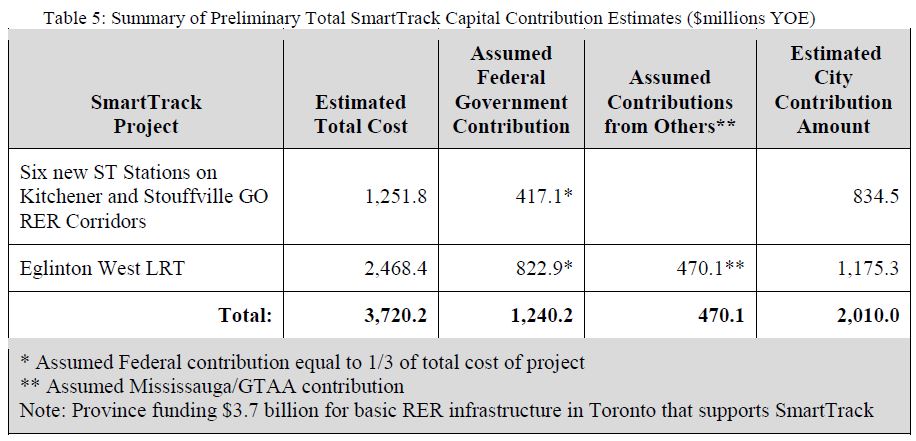
GO Transit’s Regional Express Rail (RER) program will see widespread infrastructure and service improvements beyond which SmartTrack will only add six new stations. The projected cost of “SmartTrack” has gone down, but the City’s share remains above $2 billion. (The values below do not include cost of financing and risk transfer under Ontario’s procurement system that could bump these numbers by 20%.)

smarttrackprelimcosts201611

[Source: Transit Network Plan Update and Financial Strategy, p. 11.]

City staff argue that the benefits available from “value uplift” of existing properties will be low, and they have not included this in their calculations. From new development, the added tax revenue would be $857.1 million over the life of the financing scheme, and to be conservative, staff recommend that only half of this be presumed for SmartTrack financing.

This calculation does not address how the services new commercial or residential development will require would be financed if some or all of their new tax revenues were dedicated to SmartTrack.

The chart below shows the considerable spread between TIF and Development Charges (DCs) revenues and the actual requirements for SmartTrack financing, including the LRT line on Eglinton from Mount Dennis to Renforth.

smarttracktaxrequirement201611

[Source: Transit Network Plan Update and Financial Strategy, p. 12]

The two percent tax increase would be applied to residential property with only a .67% increase for commercial property. This arises from the City’s policy of rebalancing residential and commercial tax rates, a process that will complete in 2020. Given the timing of borrowing for SmartTrack, one must ask whether the balancing policy should apply in this case, and whether it is time for the commercial sector to pay its full share of taxes that will be collected almost entirely beyond the date when the balancing program completes. (Note that “commercial” includes rental apartment buildings.)

The estimates for TIF and DC revenue arise from projections in a report, Commercial & Multi-Residential Forecasts for the Review of SmartTrack, by Strategic Regional Research Alliance (SRRA) that was commissioned by Council to examine the question in detail. (The SRRA report begins at page 8 of the document.)

To put this in context, SRRA was co-founded by Iain Dobson who was an advisor to Tory’s election campaign. In May 2014, just as the SmartTrack campaign started, he was appointed to the Metrolinx Board during Glen Murray’s final days as Minister of Transportation. The consulting contract was awarded by Council on a sole source basis.

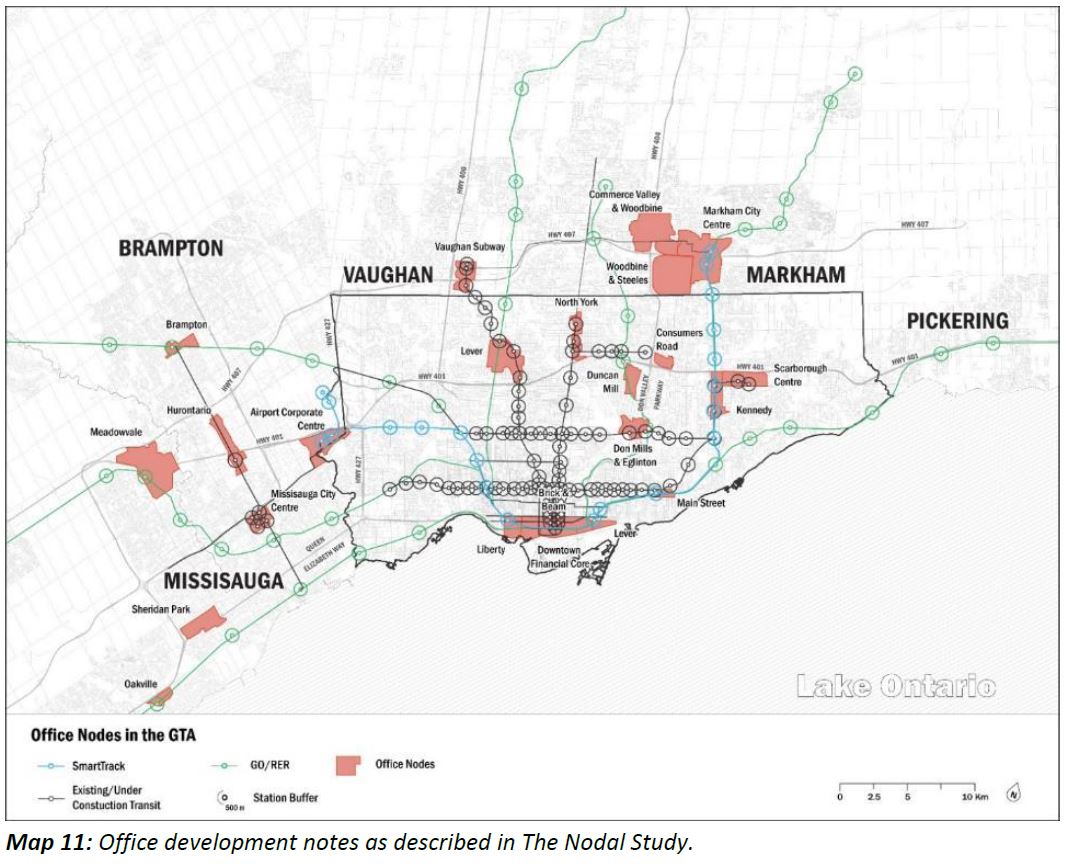
When SmartTrack was proposed, the intent was to improve access to areas of potential development. The following map shows these areas and their relationship to the SmartTrack corridor.

smarttracksrraofficenodemap

[Source: SRRA study at p. 21. “Nodes” is misspelled in the map title, and the Downsview node is mistakenly labelled “Lever”. How this might reflect on the care taken on the report I leave to the reader’s judgement.]

Several of the nodes lie outside of Toronto or far from the SmartTrack corridor (blue line and circles). These will either not produce new tax revenue within the 416 or they are too far from ST to benefit from its construction.

A vital question, then, is whether the amount of development contemplated in the January 2016 SRRA report and resulting tax revenues will actually flow to the city. SRRA’s analysis begins with a map of the “TIF Zones”, the areas around stations where tax increases could be expected.

smarttracksrratifzonesmap

Many of the stations are existing or planned GO stops that will see added service without any SmartTrack investment, and ST adds nothing to them (Milliken, Agincourt, Kennedy, Main, Union, Bloor, Mount Dennis). The map also shows a station at Spadina that will not be part of the upgrades planned for the ST corridor.

Although many zones are shown, most of them will not be affected by SmartTrack as it is now proposed, merely the addition of six stations to the GO Transit map: Finch East, Lawrence East, Gerrard, East Harbour (Lever), Liberty Village and St. Clair.

Although the SRRA report discusses the methodology for analysis of the effect of SmartTrack in the TIF zones, it does not provide a dollar value for the actual tax increments this would produce, nor a description of how this might be calculated. Numbers cited in the City report imply that a more detailed breakdown exists for the SRRA data, but that it has not been published.

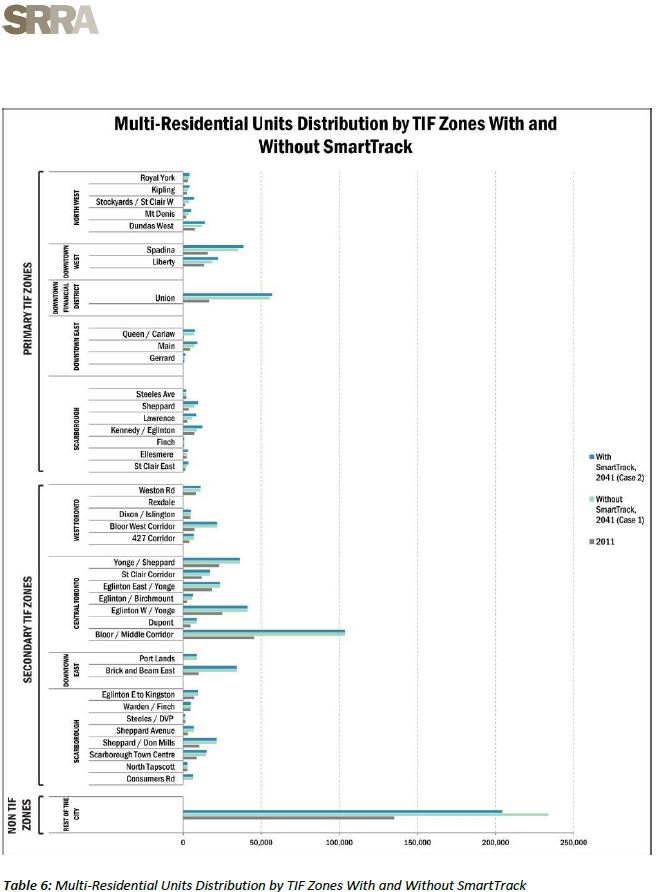
An important component of the stimulus attributed to SmartTrack is the construction of additional residential units because ST would make jobs in the outlying centres (notably Markham and the airport) easier to reach and thereby allow reverse commuting. However, there is no “ST service” per se, only the provision of stops where riders might board GO RER trains running less frequently than original claims for ST itself.

Projections for employment and residential growth are shown in charts.

smarttrackofficeemployment201601

The core area remains the primary location for employment growth, although the projection with SmartTrack diverts some of this to other areas, notably the Queen/Carlaw area (i.e. the Lever site) and Liberty Village. The latter is a bit of a stretch because the station would be located at the northeast end of the district while commercial development, such as there may be, will be toward the southwest.

An important distinction here is that in the “secondary zones” (those along transit corridors other than ST) and in the non-TIF part of the city, the projected employment with ST is generally lower than if ST exists. In other words, potential development that might hold these employees shifts into areas where it contributes to projected TIF revenue.

A similar situation applies with residential units.

smarttrackresidentialunits201601

The city adjusts for this numerically in their backgrounder on City Funding and Financing Strategy.

smarttrackofficespacegrowth201611

smarttrackresidentialcondogrowth201611

What is not clear, however, is which of the TIF zones are included for this analysis, in particular those which are at existing GO stops, nor whether the effect of ST’s having no marginal service beyond that provided by GO RER has been take into account. If all zones were included, has the potential revenue due only to SmartTrack been overstated?

A similar problem exists for the calculation of Development Charges because the formula for these, set by provincial law, makes them applicable only to the benefits provided by the expenses undertaken by the City, not to improvements others such as GO might provide nor to improvements existing transit riders might obtain from the new stations/services. This considerably limits the scope for recapture of costs through DCs. (In Scarborough there was was a successful appeal by developers that reduced DCs attributable to the Scarborough Subway. This was based on a higher estimate used for new riders in the DC calculation, and hence the proportion of riders from new development, than in a later estimate.)

There is a more general problem with DCs in that they affect every new building in the city, not just those along the transit corridors. Developers who do not benefit from the projects these charges help to finance are not enthusiastic about building yet more costs into the base borne by would-be purchasers.

Questions for the City

All of this raises many questions about the validity of the calculated TIF revenues available to finance the SmartTrack scheme. I have sent queries about this to City staff, and await a reply. This article will be updated when more information is available.

Council will debate the SmartTrack reports at its meeting beginning on November 8, 2016. Here, in brief, are my questions.

  • The staff presentation to Council expresses commercial growth in thousands of square feet while SRRA uses employment. These can be converted to each other with a ratio, but what number has been used? How do the City numbers relate to the SRRA values?
  • The bar graphs in SRRA’s report do not include actual values making direct calculations such as selective inclusion or exclusion of TIF zones difficult. What are the numbers?
  • Which TIF zones were used for the calculations in the City presentation? Only the six the City is paying for, or zones at all “SmartTrack” stations even though many of these are GO RER locations to which ST will not add any service?
  • What adjustments in projections have occurred between the original SRRA estimates and those used in current City estimates?
  • As with TIF, have DCs been calculated only based on the six added “City” stations, or for all of the ST/RER locations?
  • TIF revenue is projected to grow uniformly and across all included zones. Is this a realistic assumption, how much growth is projected in each zone, and when is this expected to occur?
  • If the SmartTrack tax were implemented at the same rate across all property classes, at what level would the tax be set?


Toronto Transit Plan Punted From Executive Committee

On October 26, 2016, Toronto’s Executive Committee was supposed to receive a report dealing with a wide range of transit issues.

… the City Manager will be providing a report to Executive Committee with recommendations on the Transit Network Plan, including information on cost-sharing discussions with the Province of Ontario on a range of transit projects, as directed by City Council in July 2016 (EX16.1). This report will also include an update on the planning and technical analysis for SmartTrack, Relief Line, and Scarborough Transit. Additional time is required to ensure proper consultation and coordination with relevant stakeholders including the Toronto Transit Commission, Province of Ontario and Metrolinx. [Placeholder item in the agenda]

This report is not yet available as discussions with Queen’s Park are ongoing. A deadline facing Council is that Metrolinx wants a commitment to specifics of SmartTrack work that will be bundled with the RER construction contracts that will go to tender early in 2017.

Given the time constraints, it is possible that the report will go directly to Council at its November 8 meeting. In theory, materials for the Council Meeting should be posted in advance, and for November 8, the usual deadline is only days away. Whether the materials are actually available in advance remains to be seen. This would put a major debate before Council with almost no advance briefing or public debate.

SmartTrack is not the only time constrained project as an updated transit plan and cost estimate for the Scarborough projects, not to mention a financing scheme for the entire package, needs to be dealt with so that work can begin. Any spending commitments will also affect the City’s budget which will be formally unveiled at the start of December.

As material becomes available, I will provide updates and commentary.


TTC Service Changes Effective Sunday, November 20, 2016

There are comparatively few service changes pending for the November-December 2016 schedules as it’s late in the year, and the TTC’s main concern is to constrain costs in anticipation of a revenue shortfall for 2016.

2016.11.20_Service_Changes

Construction Projects

Various diversions will end with this schedule period or shortly thereafter:

  • Construction at St. Clair and St. Clair West Stations will be complete allowing:
    • resumption of streetcar service over the full 512 St. Clair route,
    • operation through the bus loop by 74 Mt. Pleasant and 88 South Leaside, and
    • the interline between 126 Christie and 33 Forest Hill will be broken, and these routes will once again access St. Clair West Station Loop.
  • Construction at Neville Loop will be complete allowing resumption of 501/301 Queen streetcar service to the east end of the line.
  • Water main construction on Queen is expected to end by November 30 at which point the Queen car will return to its normal routing between Spadina and Shaw.

The list of routes affected by the Eglinton Crosstown project continues to grow, and additional running time will be provided on 7 Bathurst, 11 Bayview, 29 Dufferin, 33 Forest Hill, 56 Leaside and 90 Vaughan (the peak period 90B branch to Eglinton West Station will not operate). Generally speaking, these routes will not get added vehicles, but the headways will be stretched to accommodate congestion. The November 2016 changes only affect weekday schedules, but weekend changes will occur in the future.

Streetcar Shortage / Exhibition Loop

The continued shortage of streetcars will trigger the following arrangement for service to Exhibition Loop:

  • 511 Bathurst will be operated with buses, and these will run through to the Exhibition grounds replacing the existing 509 shuttle service. Streetcars will return in early 2017 when vehicles will become available from bus substitutions elsewhere (notably the west end of 501 Queen) and from delivery of additional new cars.
  • 509 Harbourfront cars will turn back at Fleet Loop until construction at Exhibition Loop completes in mid-December.

Trimming Service

Various routes and periods will see small changes to frequency of service to free up resources and reduce costs. The projected changes in loading on the affected routes remain within the Service Standards.

Routes 121 Front-Esplanade and 514 Cherry will be modified so that their hours of service match the standard 6 am to 1 am pattern (8 am on Sundays).

Christmas Period Schedules

The Christmas period for 2016-17 will be three weeks long because the holidays land on a weekend. Reduced service will operate through to the second weekend in January 2017 because schools will be closed for the first week of the year.

The TTC anticipates free transit service on New Year’s Eve, but has not yet announced a sponsor.

City Manager to Council: Put Up or Shut Up

On October 17, Peter Wallace, appeared at the University of Toronto’s Munk School to present the fifth annual City Manager’s Address under the title “What We Do Is What We Fund”. The presentation deck and the webcast are available online.

With the formal Budget Launch for 2017 about a month away, it would be nice to think the City Manager would actually be as blunt as the title of my article rather than the more diplomatic title of his address. I doubt we will see this, however, as Wallace knows who pays his salary. He was quite open in saying that proposing actions that Council will not accept is not a wise move.

As befits the academic setting, these events are very collegial affairs and one could draw an intricate web linking the attendees, their professional backgrounds and employers to each other. Somewhere far away is the brawl of Council with truculent, ill-informed members more intent on self-promotion than city building.

To nobody’s surprise, the basic message is, as it has been for years, that the city has aspirations beyond its means, and that hard decisions are required on the scope of spending plans and the revenues needed to support them. Wallace described the City as someone who reads the news about health effects of tobacco, but figures that “it hasn’t killed me yet” is an excuse to remain a heavy smoker. In another analogy, he likened the City’s forward planning to driving down a dark road using only the parking lights.

Amusing though these lines might be, the real question is whether Wallace will, like his predecessor, collude with the Mayor and the budget hawks to paper over fiscal problems, or put the issues squarely before Council. In his 2015 address, shortly after being appointed as City Manager, Wallace took the strong position that policy decisions are the role of Council, not of the bureaucracy. He would put the options before the politicians, but they had to choose. This sounds good in theory, but it depends on which options are even offered for debate and the degree to which their benefits or shortcomings are actually explained.

In the transit context familiar to readers here, the TTC rarely produces an “aspirational budget”, one that says “here is what we could do, and here are the resources we need” because it is far too embarrassing to its political masters to confront what might have been with their own short-sighted penny-pinching. TTC budgets are all about fitting within a constrained financial envelope of limited subsidy and fare increases.

On the wider level of the City, Council actually manages to pass many motions saying what it would like to do, but far fewer actually paying for these programs. Some Councillors have found to their chagrin that saying “we want” is not the same as “you will provide” as a direction to City management. If the money isn’t there, “we want” simply adds to the wish list that may or may not be addressed.

Wallace began by cataloguing the many great things about Toronto, its high international ranking as a place to live and conduct business, and the many initiatives that combine to support this.

imfg_3_progress

This collection looks almost progressive, but it suffers from a mismatch between expectations and funding. The Poverty Reduction Strategy together with the TCHC improvements are critical parts of keeping Toronto a great place for those who do not share in its flagrant wealth, but both of them are underfunded. SmartTrack still gets a special mention even though it is only part of a much broader requirement for transit growth. This shows that the Mayor’s signature program continues its outsized role in ongoing transit debates. A “conversation about fiscal sustainability” sounds like a cozy tea party but for Council’s rejection of all methods by which this might be achieved.

The stats for Toronto are impressive [p. 2]:

  • The city of Toronto is home to 2.8 million people and nearly 90,000 businesses
  • Canada’s largest city and the fourth largest urban area in North America
  • 8.2% of Canada’s workforce
  • Toronto’s gross domestic product (GDP) accounted for 26% of Ontario’s GDP and 9.5% of Canada’s output in 2014.

But the expectations are also high:

  • Residents and businesses expect and value the services provided by the City
  • Increased demand for public investment to offset congestion, carbon, and threats to poverty

The problem is that neither residents nor businesses actually want to pay for these services or investments, and the commonly heard cry is that taxes are “too high”. In fact, the business community has a good deal thanks to the provincially mandated reduction in the level of taxation relative to residential (owner occupied) properties. For several years, and continuing until 2020 or so, commercial taxes will rise at 1/3 of the rate of residential, and so the cost increases are disproportionately shouldered by residential taxpayers. They, of course, loathe the idea of paying more, let alone at a rate greater than inflation, and so that total tax take for the City actually rises below inflationary rates. This is further complicated by the fact that property tax is only about one third of total revenues, and other streams may be constrained by market conditions or by the penury of funding governments.

Wallace observed that if Toronto’s taxes had actually increased at the inflationary rate since amalgamation (1998), a good deal of the current fiscal problem would not exist. However, three zero-increase years under Mel Lastman and one under Rob Ford, combined with below-inflation increases in other years have left Toronto’s tax base about 20% below where it would have been otherwise.

“Revenue must be part of the solution” is a key point in Wallace’s presentation, and yet it is precisely the revenue issue which challenges Council and runs headlong into the “gravy train” rhetoric which claims that the problems lie with excessive spending. Debates are hostage to this premise.

Austerity has been part of Toronto budgets for years, but there is limit to what can be squeezed out of the budget after many years of retrenchment. Wallace emphasizes that “Savings and efficiencies are critical, but insufficient” and moreover that we “Cannot rely on narrative regarding future revenue sources or operating funding from other governments”. [p. 6]

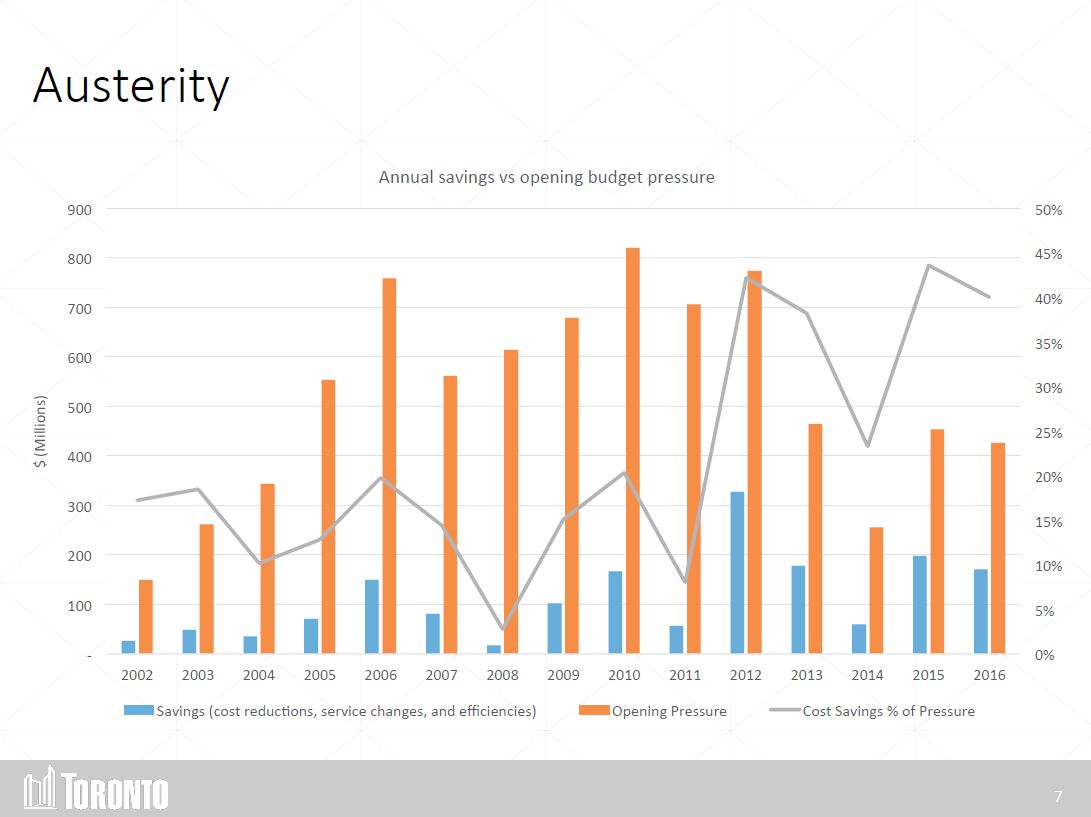
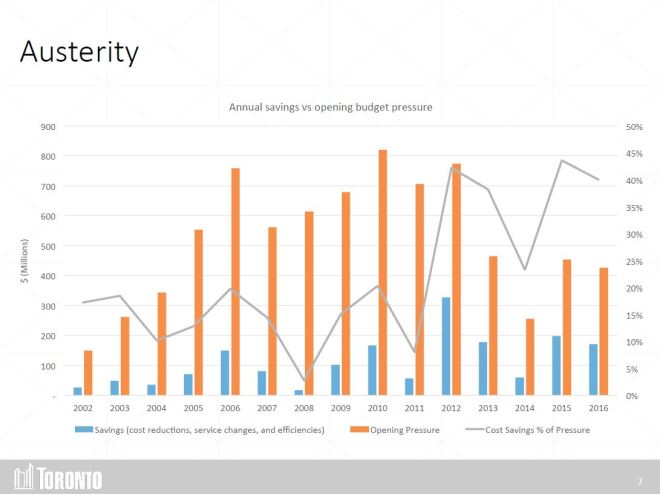
The City is quite proud of its ability to wrestle down “opening pressures” on annual budgets to a level where the required tax increase can support demands for more operating dollars, and the following chart is intended to demonstrate how effective this has been over the years.
imfg_7_austerity

This chart purports to show how well the City has achieved “efficiencies” to rein in year-over-year rises in costs. The amber columns show the “opening” values which represent the projected growth in expenses net of any known changes in revenue, but before any tax increases. The blue columns show the “savings” achieved during the budget process.

This can be misleading in a few ways:

  • There is no distinction between pressures arising from inflation, growth in services provided, and one time effects such as the transfer of a cost between the provincial and municipal level. Therefore, the relative importance of these factors is hidden.
  • Budgets are always compared on a budget-to-budget basis, not budget-to-actual. As I have already written, many “savings” the TTC hopes to achieve in 2017 are actually due to variations between budgeted and actual costs in 2016, some of which have nothing to do with actual “management”. The TTC always “saves” money on diesel fuel, but this occurs because the budgeted price is almost always higher than what they actually pay, and the “saving” is reported year after year as if it were an achievement.
  • A decision to raise fares or fees is not a tax measure, but it reduces the pressure on property taxes. The degree to which such measures contribute to the “savings” is not broken out.
  • Some “savings” are simply accounting tricks to shift costs into other years, notably the City’s approach to provincial termination of social service equalization payments. The City effectively borrowed money from itself pushing the actual need to pay for this transfer into future years, and that bill is now due.

This chart would be much more informative if the major components were broken out so that the contribution of each factor would be evident.

The “opening pressures” for 2017 and 2018 are substantial: $607 million and $438 million respectively. Buried in these numbers is the net additional cost of operating the Spadina subway extension (TYSSE), a new cost which until recently has received little public debate.

The City has many potential sources of revenue, but tapping any of them requires a political acknowledgement that more money is actually needed. Many Councillors, and to a great extent Mayor Tory, simply cannot get past this.

imfg_8_revenue

From the list above, many items have not been implemented although Toronto has the legal authority to do so. There is the parking levy (a space-based surcharge on land used for parking) and the specialty taxes allowed by the City of Toronto Act (COTA). The personal vehicle tax was implemented, briefly, but dropped under the Ford regime. A report on the many options will come forward as part of the budget process.

Wallace noted that the increase in user fees has outstripped the growth rate for property taxes, and that TTC riders have contributed more to the City’s revenue growth than the property tax over recent years. A fast growth in fees and rates has also taken place, notably in water rates, and soon to come for solid waste, so that these services are not cross-subsidized by other revenue streams, and so that their capital requirements can be funded directly by those consuming these services.

Four points set a crucial context for the debate, and especially the degree to which decisions on finding new revenue must take place:

  • Ontario has no financial capacity to increase funding, and uploads of City costs to the province are “reaching maturity” (a polite way of saying that little more will happen).
  • Land transfer tax (a substantial portion of City property tax revenue) depends on the continued level of activity and prices in the real estate market.
  • Prior operating budget deferrals must be addressed.
  • Asking for more money from Queen’s Park and Ottawa will not produce more funding.

Mayor Tory has said that he recognizes the need to find new revenues, but is less forthcoming about just how this would be done. There is a planned 0.5% property tax increase dedicated to financing transit projects, but this is a drop in the bucket beside actual needs. Asset sales such as Toronto Hydro bring one-time revenue and forego current income.

At the TTC, there have been some savings from outsourcing and from a move to one person crews on subway trains, but these are small relative to the overall budget, and they are one-time reductions that cannot be reproduced each year to deal with the demand for more service and the basic inflationary increases in costs.

The Capital Budget received less attention from Wallace, although it is key to many of the projects Torontonians have been tempted by as Council and the Mayor pursue new road and transit spending, parks and other social improvements. The problem is that the City’s ability to finance projects is much lower than the cost all of them would entail if they proceeded. This is illustrated by the “iceberg chart” which is now a familiar part of City budget presentations.

imfg_12_iceberg

This chart does not include some of the recently announced schemes such as the Rail Deck and Don River Parks, and it is unclear whether it includes the required City contribution to Metrolinx expansion, notably the cost of additional SmartTrack-related infrastructure. New and updated costs for many transit projects will come to Executive Committee on October 26 in an as-yet unpublished report.

For all that the City Manager is frank about the need to address Toronto’s fiscal problems, there is no sense that Council and the Mayor will embrace substantial change particularly in the run-up to the 2018 election cycle. Photo ops will continue and (despite global warming) that iceberg will grow. How Mayor Tory and his supporters plan to square great city dreams with their own budgetary rhetoric is a mystery.

Presto’s Problems Multiply

From the Toronto Star:

Presto’s rollout on the TTC is over budget and fraught with problems. This is not new to anyone who has been following the project, or at least following it to the degree that the agencies involved provide reliable information.

As of March 31, however, the agency had spent $276.7 million deploying Presto on the TTC, according to numbers provided by Metrolinx. That’s almost $22 million higher than the agency’s 2012 estimate of $255 million.

The $276.6-million figure doesn’t reflect work that has yet to be completed or was finished after March 31; those jobs include completing Presto deployment at all subway stations, installing additional self-serve reload machines and fare vending devices across the network, and rolling out fare card readers on all 1,900 TTC buses and 500 Wheel-Trans vehicles.

Also unaccounted for are the future cost of upgrading the Presto system — which currently enables riders to pay their fare with a tap of a prepaid card — to allow for direct payment using credit or debit cards, and the cost of migrating TTC passes onto Presto. [From Ben Spurr’s article]

Metrolinx attempts to offload their problems on the TTC. Reliability problems were first blamed on unusual power supply issues on the older streetcars, but then the issue turned out to be far worse on the bus fleet. Presto’s primary implementation to date is on buses, and this is hardly a new environment for the fare card machines.

Now the cost increases are blamed on scope creep in the TTC contract including the fit-out of the old streetcar fleet and the installation of new fare gates in subway stations.

Meanwhile, complications for riders are legion as Ed Keenan describes: difficulty in obtaining and loading money on fare cards, inconsistent rules for their use, overcharges (and undercharges) for transit rides, and a complete lack of benefits compared to the existing system.

Metrolinx loves to deflect criticism to others, but is slow to accept the blame for shorcomings of its own system’s design.

At the outset, Presto as it existed was a more primitive system designed for a simpler environment: GO trains and buses, with riders who mostly took predictable commuting trips to and from Union Station. As its role expanded to other systems, the shortcomings became obvious to the point that the “Next Generation” Presto was developed for Ottawa. Even then, it had major implementation problems.

The GTA fare structure has long been biased against trips to and in Toronto. Unlike the 905 systems, there is no “co-fare” between the TTC and connecting systems notably GO Transit, and GO’s fares within the 416 compound this problem by charging substantially more to travel shorter distances.

Presto has been touted as the basis for “regional fare integration”, but this has different meanings to different people. At its simplest, Presto would be one card that could “talk” to any fare machine and charge the appropriate “local” fare, little more than standardizing the “currency” of fare transactions without any other changes. On a more aggressive level, fares would be “integrated” so that the cross-border penalty would be reduced or eliminated. It is self-evident that getting rid of fare penalties will cost somebody money in the form of higher fares overall, or increased subsidy. However, Queen’s Park wants a “revenue neutral” scheme so that added subsidies are not required.

Metrolinx has wrestled with new fare structure concepts for a few years, and push-back on their original proposals has delayed the production of a final recommendation. Behind the scenes, the always-preferred option was “fare by distance”, a concept familiar to GO, although not actually implemented “fairly” across its network. This brings very substantial operational problems because the fare system must “know” both the origin and destination of each trip requiring “tap on” and “tap off” for each leg of the journey. This evolved into a scheme to make “rapid transit” a distance-based premium fare zone, a scheme that preserves GO’s rail premium, but destroys the “integrated” nature of the subway within Toronto’s system.

The effect might be to lower fares for cross-border trips (a small minority of all GTA travel) and improve the attractiveness of GO+TTC rides, but at a higher cost to TTC users for whom the subway is an integral part of most travel.

Metrolinx also neglected to determine whether LRT and BRT lines would be “rapid transit” because none of them existed in the data used for their study. Such is the quality of forward thinking at our provincial agency.

In this context, a decision by the TTC on the fare structure to be implemented has been almost impossible, although the TTC must be faulted for keeping a real discussion of the options and limitations under wraps for so long. The TTC missed a chance to market the new fare system with more convenient fares and refuses to address a simplified fare structure, notably time-based transfer validity. That decision immensely complicates the fare calculation requirements for Presto in determining where a “new” trip starts and a second fare should be charged.

For its part, the TTC opted to enlarge its fare gate upgrades from a limited scale needed to bring Presto and accessibility to all entrances, to a full-scale replacement across the system. And, oh yes, with the capability to require “tap out” for all passengers (ignoring that a huge volume of passengers transfer to and from surface routes without using a turnstile). In effect, TTC management enabled by stealth a fare structure that has not been debated or approved by the TTC Board (at least publicly) or by City Council.

The TTC also decided to accelerate the Presto implementation by a year so that it would be fully operational at the end of 2016. This would serve two purposes. On one hand, Metrolinx could brag that the Toronto rollout was “complete” and trumpet huge additional usage (along with the service fees) by Presto. On the other, the TTC could move ahead with its redeployment of station staff who would no longer be selling fare media. Things have not quite worked out as planned, and it is likely that we will not see substantial conversion to Presto until the end of 2017.

Presto itself has design limitations, not least the fact that so much of the fare calculation occurs between the card readers at stations and on vehicles and the card itself, rather than in a back-end system. This is responsible for the oddity that updates to Presto accounts do not actually arrive at the card when they are made online, but only later when all devices in the system learn of the changes through periodic updates. “Open payment” support for credit cards is coming, but until the tracking and calculation of fare discounts is done by a central system, credit cards will only support the equivalent of a cash fare, not the discount schemes available to Presto cardholders. That is not a truly “open” system.

We’re not supposed to talk about any of this because everything Metrolinx and its masters at Queen’s Park do is perfect, Ontario is a transit Nirvana for transit policy going back decades. If we were honest, we would be discussing the alternatives, including technical limitations and funding requirements, but instead the only important work is the manufacture of ever more photo ops.

Try harder.

Does Toronto Owe Metrolinx Half a Billion? (2)

Two weeks ago, I wrote about the receivable on Metrolinx’ books for supposed “municipal contributions” that have not been paid, but instead have been funded temporarily by Queen’s Park. This has been going on for roughly a decade and the bills are piling up, now over a billion dollars.

I posed a series of questions to the Minister of Transportation’s Press Secretary, and received a friendly, sunny, but utterly uninformative reply.

Firstly thank you for your e-mail and questions – it is nice to e-meet you! I saw your blog piece from earlier this week and the Qs you submitted to Patrick re: the existing framework for municipal contributions to GO Transit growth and expansion capital costs, potential future municipal contributions to major transit initiatives in the region and the Province’s Dedicated Gas Tax Program.

There are two Regulations under the Metrolinx Act, 2006, which are intended to assist the Regions of Durham, Halton, Peel and York, and the Cities of Toronto and Hamilton, to collect development charges (DCs) to help offset their respective contributions to GO Transit growth and expansion capital costs:

1) O. Reg. 528/06, which sets an expiry date for GO Transit DC by-laws; and
2) O. Reg. 446/04, which prescribes the allocation of the expected municipal share of the GO Transit growth and expansion capital costs amongst the municipalities.

The municipal contributions to GO Transit growth framework were put in place to establish a fair and balanced approach to support GO capital expansion in communities across the region. All municipalities in the Greater Toronto and Hamilton Area benefit from an effective GO Transit network, and the Province remains committed to working with all of our partners to expand and deliver this network. Given the transformational $13.5 billion investment that the Province is making to strengthen the GO network through the 10-year GO Regional Express Rail initiative under the Moving Ontario Forward plan, we recognize that this commitment to working together with all of our partners to build and optimize an integrated, regional transit network is even more critical.

As you note in your email, the two Regulations permit GO Transit DC by-laws to help the municipalities offset their expected contributions – per the allocation formula set out in O. Reg. 446/04 – to Metrolinx for their share of GO Transit growth and expansion capital costs. The contributions made by municipalities are not directly linked to any specific expansion projects, but, rather, they are applied against the GO Transit growth and expansion capital program, as a whole.

With respect to your questions related to the Dedicated Gas Tax Program, the funding of two cents per litre of gasoline sold across the province was made permanent through the Dedicated Funding for Public Transportation Act, 2013. The Ministry of Transportation allocates these funds through the Dedicated Gas Tax Program based on a formula of 70% ridership and 30% population for eligible municipalities. All of the factors, including the funding envelope, ridership and population, are updated annually for each program year. The funding envelope for the 2015/16 program was $332.9 million, up from $321.5 million in 2014/15. The Province has provided the City of Toronto with more than $1.75 billion through the Gas Tax program since 2003, including $169.2 million for the 2015/16 program.

Thank you again for your questions.

[Email from Andrea Ernesaks, Press Secretary and Issues Manager, Office of the Hon. Steven Del Duca, Minister of Transportation, September 30, 2016]

Despite the reference to an “expiry date” for GO Transit Development Charge by-laws, this date has been changed every few years and currently sits at the end of 2016. Based on past experience, one might reasonable expect this will be extended again. The municipal allocations have not changed since this charge was introduced despite substantial shifts in population balance around the region and a change in the type of journey that the Metrolinx network serves, especially with planned expansion.

The concurrent mention of the $13.5 billion to be spent on GO RER and “working with all of our partners” suggests that Queen’s Park might include RER in the cost base for calculation of future contributions from the municipalities. If this is so, then the Minister should say so, and all announcements should have a little side bar, an asterisk to a footnote saying, “oh, by the way, your municipal taxes will help pay for this photo op”.

Nothing in the legislation (acts and regulations) explains how “capital requirements” are calculated, which projects would be included, nor how the proportional allocation should be assessed against municipalities. It just appears out of thin air as part of the GO (now Metrolinx) budget. The amount is a not linked to specific projects, but somehow it gets calculated.

The info about the Gas Tax program is not news, but the concern municipalities have legitimately is that an increasing portion of this grant might be clawed back by charges to support Metrolinx rather than their own local programs. This is complicated by the fact that Queen’s Park threatened to withhold the Gas Tax from municipalities that didn’t play ball with the selection of Presto as their fare card. Going forward, we know that back charges for operation of the Metrolinx LRT lines to the municipal level are likely, but the amount has not yet been settled.

The basic point here is that the provincial largesse and support for transit comes at a price, and that will be carved out of money that nominally flows to municipalities for their own use on transit. Toronto’s $169.2 million is now split between the operating and capital budgets. Other monies do flow from Queen’s Park for TTC projects, but they are earmarked to those specific works such as the subway extension to Vaughan.

Moreover, given the state of provincial finances, will this billion dollar “debt” become payable by the municipalities? Toronto’s half-billion share would take a huge bite out of the city’s budget, and an ongoing charge of roughly $90 million could more than halve the value of the gas tax grant.

The Minister might contemplate some of the background information to the Metrolinx Investment Strategy reports which includes a history of GO Transit development charges, a description of the wide gap between the amounts actually collected and the amount anticipated (25% of GO’s capital program). Specifically the Metrolinx Review of Development Charges at pages 6-7. Note that this report dates from January 2014 and therefore does not reflect all of the charges that have accumulated to date. It also speaks of $100 million in revenue from municipal development charges, but the chart below clearly shows that this is far short of the “expected” contribution.

gotransitdcs20062013

These are not trivial questions, and so I have asked, again, for an explanation. To date, nothing has come to my mailbox. My latest query follows below.

Continue reading

TTC Capital Program Review

Back in the early days of John Tory’s mayoralty, the 2015 budget discussions were overshadowed both by the legacy of the Ford administration and by major issues with project control at the TTC. From the Ford years, Tory inherited a mean-spirited attitude to transit spending and service cuts that the new mayor would come to reverse, for a time at least. A bigger issue, however, was the matter of runaway spending by the TTC on two major projects: the Spadina subway extension (aka TYSSE) and the resignalling contracts for the Yonge-University-Spadina subway (aka Line 1).

Even while the TTC’s CEO was coming to grips with these projects, Council passed a motion asking for a review of how the TTC was managing its business.

145. City Council direct the City Manager to issue a Request For Proposal to expedite a review of Toronto Transit Commission Capital program service delivery including:

a. a review of project management of Toronto Transit Commission Major Capital Projects in the past five years to determine actual project costs and completion dates relative to original schedules and estimated costs;

b. a review of staff reporting mechanisms to the Toronto Transit Commission and City Council related to capital project budget and completion date status; and

c. future organizational options for Transit project management and delivery of Major Capital projects related to Transit expansion and major State of Good Repair projects.

146. City Council direct the City Manager to co-ordinate the review in Part 145 above with the Chief Executive Officer, Toronto Transit Commission and to report to the Toronto Transit Commission no later than the November 23, 2015 Board meeting. [Item EX 3.4 Council meeting of March 10, 2015]

In the fullness of time, considerably later than the November 2015 date in the motion, a report from KPMG landed on the TTC Board’s agenda, the TTC Capital Program Review. This was supplemented at the meeting by a presentation from KPMG and a response from CEO Andy Byford.

The terms of reference for KPMG’s work were somewhat different from the Council motion.

KPMG’s scope was as follows:

  • review project management practices at the TTC with respect to the delivery of the Capital Program, and provide recommendations to staff that will assist the organization to improve capabilities for managing capital projects and programs. The TTC Capital Program Review seeks to achieve the following goals:
  • Improve the organization’s project and program management performance by learning from past experience;
  • Support continuous improvement efforts underway at the TTC, including the continued implementation of the TTC Portfolio Management Office (“PfMO”) established in 2014;
  • Assess project governance structure and protocols for reporting of project status, to ensure the appropriate level of transparency and accountability to project sponsors and stakeholders; and
  • Provide guidance on project delivery options and project management requirements for projects of varying size, scope, and complexity. [Presentation, p. 4]

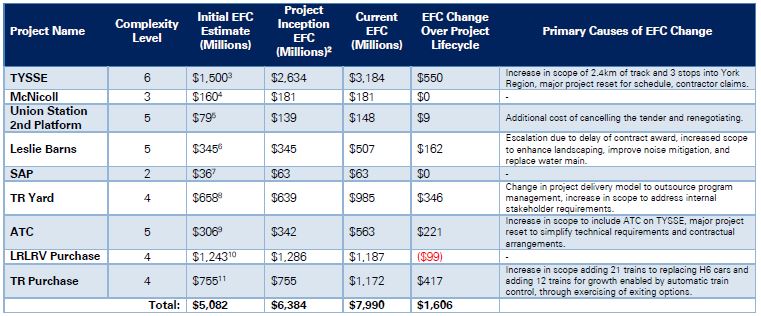
Item “a” of the Council motion asked for a comparison of actual costs and completion dates with original plans. KPMG does not provide this information, and even worse, included a table of selected projects that does not clearly explain their history (see below). There is no “deep dive” into any of the projects and, therefore, no specifics that could be tied to “lessons learned”, to practices that created the problem in the first place.

The table below is the closest the report comes to commenting on Council’s request, but read in isolation it can be misleading. It is ironic that in their presentation to the TTC Board, KPMG did not include this table and made no comment  on it. CEO Andy Byford was not so kind, and emphasized that most of the scope changes were perfectly legitimate.

kpmg_ttc_project_list

Other projects included in KPMG’s review but not in the table above were:

  • Fuel Storage Tank Replacements
  • Subway Station Easier Access Phase III
  • Surface Track
  • On Grade Paving

Of these, only the Easier Access program was flagged as “Challenged” with the others as “Successful”, but the reason for the EAP’s status likely has more to do with the complexity of later stages of the work and a lack of funding than with project management and controls. [See Table 1 at pp. 20-21 of KPMG’s report]

Two of these (track and paving) are the only “Ongoing” programs reviewed by KPMG. These are fundamentally different from “Finite” projects such as the construction of a line or the retrofit of elevators to stations. I will return to this distinction later.

This is a dangerous table in that it shows an apparent growth from $5 billion to almost $8 billion in project costs, a 60% increase.  That was the easy headline in media coverage of this report, and the sort of simplistic comparison that some members of Council would seize on as symptomatic of “waste” at the TTC. Scope change appears as a “primary cause” in five of these projects, but not all such changes arise from the same circumstances.

  • TYSSE’s cost grew due to inflation between the original estimate and the eventual approval of the project, and of course because the line was extended from York University to Vaughan Centre.
  • There was a considerable delay between the approval and actual start of work thanks to foot-dragging by senior governments in finalizing their contribution agreements. No adjustment to the completion date nor allowance for inflation was added to the estimate.
  • Politicians along the line wanted showcase stations, not the standard TTC boxes, and much of the contingency in the project’s budget was consumed by unexpectedly high bids for these structures.
  • The TYSSE project suffered from poor organization with many contractors on competing deadlines. This arose in part because the prevailing wisdom at the time was that work should be parceled out in small enough pieces that multiple mid-size contractors could bid. This arrangement was more a political decision than a technical one.
  • The original project did not foresee a conversion to Automatic Train Control (ATC) because that was not part of the TTC’s plans at the time. This item was added after the fact under a separate project budget, but this work added yet another layer of complexity to overlaps between many subsystem installation contracts.
  • The original fleet plan for TYSSE included the continued use of a portion of the older T1 fleet on the YUS with most, but not all, of the trains coming from the new TR order. After the decision to implement ATC, the T1s were no longer suitable because of the high cost of retrofitting ATC to them, and the TR contract grew accordingly. The TTC has a surplus of T1s, but no place to use them, including the proposed Scarborough subway which will also have ATC. The planned opening date for the SSE occurs well before the planned completion of the replacement of the T1s, a project that will have to be accelerated shifting spending into earlier years than planned.
  • The TTC now has a much larger subway car fleet than foreseen a decade ago thanks to the T1 surplus and cars for improved service under ATC that will not actually be used until 2019 and beyond when the ATC project completes. Additional space will be needed for the T1 replacements that will require concurrent storage space and a significantly different carhouse design from Greenwood Shops. These projects are not yet funded, and are not fully included in the cost estimates for the SSE.
  • The TR purchase, like all TTC vehicle contracts, includes a base order plus an option for additional vehicles. This is a standard arrangement for procurement because the TTC never receives full funding for its plans in one go, and circumstances change causing quantities to go up, or occasionally down. The complete order now includes enough trains for the complete replacement of non-ATC capable trains on YUS, conversion of the Sheppard subway from T1 to TR operation, the Spadina extension to Vaughan and additional trains to run more frequent service once ATC is in use on YUS.
  • The ATC contract evolved out of a dog’s breakfast of plans for new signalling on the YUS. Originally, the plan was simply to replace the aging block signal system on the original part of the line. However, funding for this could only be obtained by misrepresenting necessary maintenance work as something that would enable additional capacity. Eventually, the project grew to have at least two overlapping technologies being installed at the same time so that non-ATC operations could co-exist on an ATC line. This proved unworkable, and the contracts were consolidated into a single ATC project. The extra costs are a direct result of, first, underscoping the project for political reasons, and later from a failure to appreciate the technical complexity of what was being attempted.

The above are only the high points of a much more complex history (available in the linked articles), but what should be evident is that major projects interact with each other even though they are almost always discussed as if they are completely separate entities. This is a major problem in TTC budgeting and in the political context where such projects are debated. KPMG hints at this problem in its review, but does not drag any details out into the open.

The following discussion can only touch on the full report of 273 pages, and is intended to place the report more in the political context of the TTC Board and Council (and through them to the ongoing debates about TTC funding) than KPMG which tended to focus on internal issues of process.

Continue reading

Does Toronto Owe Metrolinx Half a Billion?

Rummaging in financial reports can lead to interesting discoveries, although we usually read about them when some financial hound exposes dubious accounting practices and drives down the value of a company’s shares. Indeed, the Globe’s David Milstead had a long article on just how pervasive the use of non-standard accounting has become in corporate reports.

In the public sector, various mechanisms are used to reduce apparent debt and exposure to future costs. Some of these involve judgements about just when bills and revenue will roll through the door, or of exactly who will pay these bills as they come due.

In a previous article, I wrote about the TTC’s newfound mechanism called “Capacity to Spend” which reduces future funding requirements by roughly as follows:

  • Project estimates show that the TTC will need about $9 billion to fund its “Base Capital Program” over the next ten years. This does not include special projects such as subway extensions, nor does it include a long list of “below the line” projects that have not yet matured to “approved but unfunded” status.
  • Yearly capital spending by the TTC is typically lower than the budgeted value, but the main reason is that work took longer than expected, or projects were rescheduled into future years. Only a few of the underspent accounts arise from actual savings thanks to lower than expected costs or project cancellations.
  • Nonetheless, the TTC has decided that its real funding requirement for 2017-2026 is now almost a billion lower than has been claimed for many years running.

This is a basic case of revaluing the exposure to future costs to make long term funding (including borrowing) needs appear lower than they really are. This year brings an extra incentive with federal funding that requires matching municipal contributions, money Toronto does not have. But hey, presto!, if we reduce the future spending, at least on paper, we have “found” money with which to pay the local share of the fed’s new program.

Meanwhile up the road at Queen’s Park, a lovely myth for the past near-decade is that there is a “municipal share” to the GO Transit capital program. Most people don’t know about this, and Toronto has refused to actually pay into that pot for several years.

The mechanism was set up back when GO Transit was a separate agency, and it has been passed down through successor organizations to its current home, Metrolinx. The amount of money outstanding is not trivial.

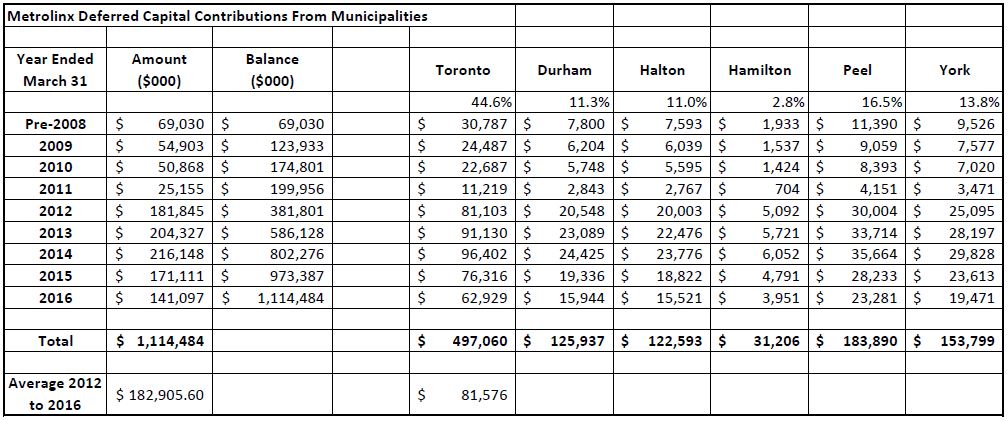
metrolinxmunicipalchargebacksto201603

By the end of Metrolinx’ fiscal year March 31, 2016, the accumulated balance of deferred municipal contributions totalled $1.1 billion. The proportions owed by each municipality are set by regulation, and Toronto’s share is just under half a billion. The proportions assessed to each region have not changed since this charge was instituted although one could argue that population shifts and the focus of GO expansion would suggest a different ratio is in order.

Toronto does not carry an account payable for this amount on its books. Meanwhile, in every financial statement, there is a note in this format:

Metrolinx realized a shortfall in municipal funding related to its capital program. The Province has provided funding to bridge the shortfall in the current year in the amount of $141,097 (2015 – $171,111) and the cumulative amount is $1,114,484 (2015 – $973,387). The Province will work with its municipal partners to address the funding shortfalls. [Note 12 to Metrolinx Draft Financial Statements for the year ended March 31, 2016]

What is unclear is whether Queen’s Park will ever call this debt due, or if it will simply be written off as a provincial contribution to GO expansion.

This charge is intended to recover costs for general GO expansion, and it does not include:

  • Chargebacks for works undertaken as part of a provincial project that improve municipal assets such as replacement of water mains or provision of improved streets. This was a major issue for Toronto on the Georgetown South project.
  • Charges for the abandoned Scarborough LRT project engineering.

Missing from all of the annual reports is any indication of just which GO projects these contributions aided. Indeed, the amounts are intended to go into the general subsidy pot at GO without being tied to its work with the assumption that everyone benefits from “more GO” in the end.

An ongoing problem with provincial funding is that there are various ways that the gas tax grants now paid to municipalities are clawed back. There has been almost no change in the level of gas tax provided, and the amount coming to Toronto has been sitting at about $160m for many years. (Toronto apportions this partly to capital and partly to operations.) The effective value of this contribution falls due to inflation. If Toronto had actually paid their Metrolinx assessment in recent years, this would have wiped out half of the gas tax grant.

In 2017, the TTC is making provision in its budget for additional costs related to Carbon Taxes. This will further erode the contribution from Ontario.

The combined effect of all this will be that, at some point, all of the provincial contribution via gas tax will be consumed by paybacks under various levies and fees.

In an attempt to illuminate this issue, I posed a series of questions to the Minister of Transportation:

Which projects now underway or planned will trigger additions to this outstanding balance including, but not limited to, such things as:

  • Ongoing GO improvements (non-RER)
  • GO RER
  • LRT and BRT projects

In other words, although Ontario has not actually collected on the receivable, will it continue to grow and, in effect, will municipalities be expected to eventually contribute to “provincial” projects, and at what level?

Many projects do not fit into the classic GO Transit model of serving downtown Toronto. For example, York VIVA BRT, The Hurontario and Hamilton LRTs, and the Toronto Crosstown and Finch LRTs serve a very different travel demand from GO’s rail network.

Will the formula for allocating these costs be changed to reflect the service territory and areas benefiting from the projects where municipalities are expected to make a contribution?

Although Ontario makes significant investments in transit, its budgetary effect at the local level will be offset by chargebacks including:

  • The deferred Metrolinx receivable above
  • Future costs for Presto which is expected to become self-sufficient and will require increases in service fees to local providers to do so
  • Future costs for LRT operations

Starting in FY 2011-2012, there was a large increase in the annual charge added to the receivable, an average of $183m/year over the last five years, of which Toronto is responsible for $81.6m/year. What projects contributed to this charge and what was their total value (in effect, my question is what proportion of these projects was back-charged to the municipalities)?

When I receive a reply to these questions, I will update this article.