TTC Service Changes Effective March 15, 2026

The TTC will alter services on March 15, but with far less upheaval than the February round of updates for the opening of Line 5 Eglinton Crosstown.

The primary changes are:

  • Late evening service added on 6 Finch West.
  • Service at Exhibition Place by 29/329 Dufferin modified for the World Cup.
  • Service to Thorncliffe Park and to Leaside by 88 South Leaside changed for Ontario Line Construction.

Details follow the “more” break.

Continue reading

The Lost Promise of Better Streetcar Service

Readers with long memories might recall the early days of plans for a new streetcar order including discussions about how large a vehicle should be purchased. A major concern at the time was the possibility that the TTC would change schedules and run less frequent service with the larger cars just as they had when the articulated version of the CLRV (the previous generation of cars) arrived in the late 1980s.

That concern was softened by a TTC claim that service would actually improve. Peak periods would see slightly less frequent service, but a net increase in capacity, while off-peak periods would see little change in frequency effectively doubling the capacity of service. At the time, crowding was a big issue and this persisted right up to the pandemic in 2020, by which time all of the old cars had been retired. The management proposal was approved in July 2013.

As the CLRV/ALRV fleet aged, there were problems with reliability of older cars and the need to operate buses on some lines thanks to a shortage of working vehicles. Some repairs were done at considerable cost, but these were more cosmetic than a true life extension.

Moving forward to 2026, there has been a lot of talk of restoring pre-pandemic service levels. TTC fudges the numbers on this in many cases citing vehicle hours operated, not actual service frequencies which have been degraded by longer travel times.

(For example, if a round trip, including terminal layovers, takes two hours or 120 minutes, then 20 cars will provide a 6-minute service. If the round trip gets longer but no cars are added, the service is less frequent, but the number of vehicle hours stays the same. From a rider’s point of view, service is worse, but from a budget outlook, there is no change. This is at the heart of the discrepancy between TTC service claims and rider experience.)

After years of changing service levels and demand, the TTC’s Five Year Plan foresees a return to six minute headways, at most, as a new standard for daytime service. This has been rolled out on some routes over the past year, but not all.

  • Already at 6 minutes or better: 504 King, 510 Spadina
  • Improved to 6 minutes: 512 St. Clair (Sept/25), 511 Bathurst (Nov/25), 505 Dundas (Nov/25)
  • Pending, but with no committed date: 501 Queen, 503 Kingston Road, 506 Carlton, 507 Long Branch.

The Five Year Plan (at p. 4) includes provision for extra spending in 2027 and 2028, but this is not tied to specific routes. There is nothing in the Plan for 2026.

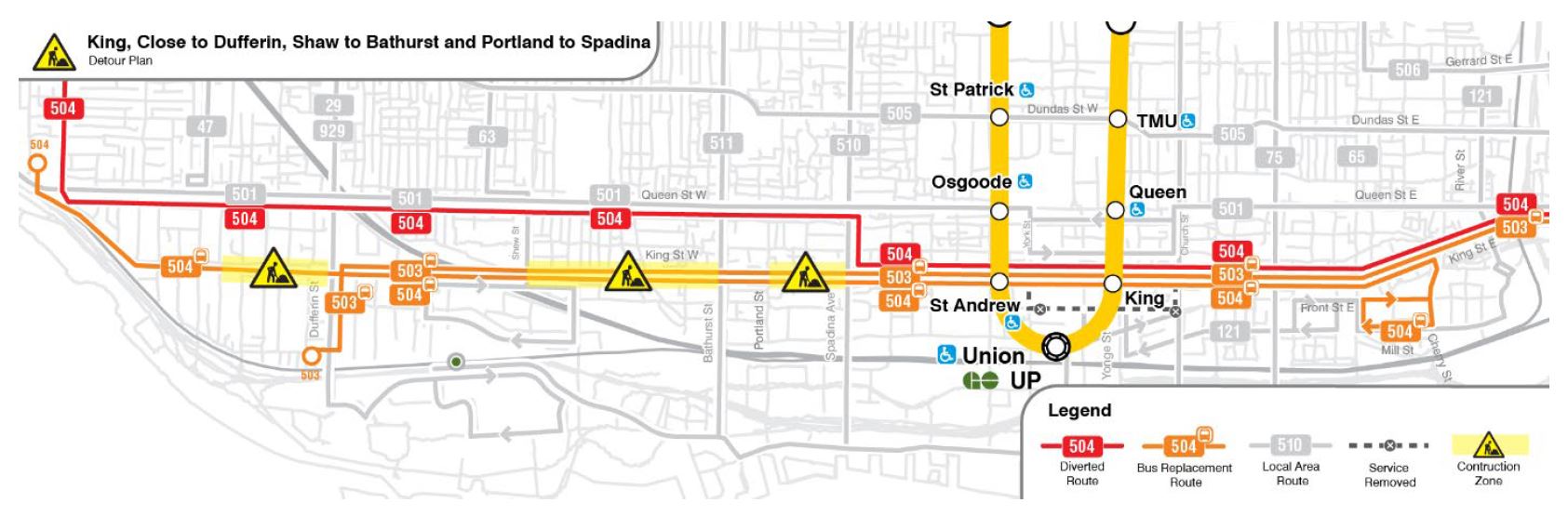
A related issue is the size of the streetcar fleet. Leading up to 2020, the issue was how many cars were actually available, and some service cuts flowed directly from this. With the recent delivery of 60 additional cars, fleet availability should not be an issue although service can still be limited by a lack of operators. The TTC currently schedules 163 cars at peak out of a fleet of 264. If services now operating with buses due to construction were also using streetcars (503 Kingston Road and the Broadview branch of 504 King), the peak requirement would rise to 178. Allowing for maintenance spares this would drive the total requirement to 214 leaving 42 surplus for service improvements (allowing for 8 spares).

February 2026 Schedule PM PeakFull Streetcar ServicePossible Service
Peak Requirement163178220
Spares at 20%333644
Total Requirement196214264
Fleet264264264
Surplus68500

The problem, of course, is that the TTC barely has budget headroom to operate existing services let alone increases.

In theory, some of the surplus cars will eventually operate the Waterfront East LRT extension, but that service is at least 8 years away even assuming Toronto finds the money to build it. In any event this will not require anywhere near all of the current surplus fleet. Another issue is that the “streetcar network” has not operated with 100% streetcar service for a few decades thanks to various construction projects and vehicle shortages.

There are parallel issues with the bus network, but they are complicated by issues of vehicle reliability and the need for a spare pool to cover the unreliable LRT service primarily on Line 6 Finch West. I will turn to the bus fleet in a separate article.

Back in 2013, the TTC proposed how it would operate with the new streetcar fleet. During peak periods, headways would widen particularly where existing service was very frequent. Notably on 501 Queen, there would only be a slight widening of the time between cars in the AM peak and no change in the PM peak. This reflected the fact that Queen was already running with the 75-foot long ALRVs and needed more capacity.

In the off peak, most routes would see no change in service level except for 510 Spadina due to its already frequent service of 50-foot CLRVs that could not be sustained at terminals with the larger new cars.

The overall fleet plan showed a buildup to a peak requirement of 168 cars plus 20% spares.

This plan gave a bright future for streetcar service and capacity growth, but things did not work out that way. Service today is generally lower than originally projected for the new fleet, and part of this reduction is due to slower operating speeds and greater provision for terminal recovery time even on routes with reserved lanes.

A related question is the effect that less frequent service has had on ridership. There is a post-pandemic slump on the streetcar system in part due to work-from-home for office jobs and remote learning for post-secondary students. However, even allowing for the pandemic era drop, the problem remains in attracting riders back to transit when streetcars are less frequent and slower, compounded by chronic problems with service reliability. Charts tracking streetcar ridership from 1976 to 2024, the last year published by TTC, are at the end of the article.

These routes are in the part of Toronto where transit riders should be easy to win, but a long decline in service frequency discourages those who have the option to use another mode including private autos, ride hailing or cycling. Service cuts during economic downturns do not magically get reversed as times improve, and ridership that might be wooed back to transit instead faces less reliable service and a political attitude that favours big spending on subway projects, not surface transit.

The remainder of this article looks at each route in detail to see how the actual service changed from the 2014 plan through the 2020s to today comparing:

  • The 2014 headways for AM Peak, Midday and PM Peak in the management proposal.
  • The proposed headways after routes converted to Flexity streetcars.
  • The actual scheduled service in January 2014, January 2020 (just before the pandemic) and February 2026. Driving times are shown separate from terminal recovery times to illustrate how each component has evolved.

Quite notable on many routes is the growth in both scheduled driving and terminal times. Although it is common in the mid-2020s to regard extended travel times and traffic delays as a recent, post-pandemic phenomenon, this pattern started earlier and is evident in 2014:2020 comparisons. Surplus time, it was argued, would prevent short turns, a claim that is demonstrably false as most riders know on a daily basis, but it slows service, wastes resources and forces wider headways.

Continue reading

TTC Audit Committee: March 11, 2026

The TTC’s Audit & Risk Management Committee will meet in the Boardroom at TTC Headquarters, 1900 Yonge Street, on Wednesday, March 11 at 9:30am. Two items on the agenda are of considerable interest:

The review of customer performance, metrics and real-time information covers at length the many problems with passenger information from the TTC including its website and various outlets for notices including social media and apps. This is an unusually candid review and long overdue.

Also included are charts showing the status of various recommendations from TTC and City audits, as well as from outside reviews. However, these are only summaries and there is no link back to source documents to cross-reference specific items, their severity and status.

Two confidential attachments address “The Subway Tunnel Maintenance and Rehabilitation Audit” as well as some findings from the UITP review.

Updated March 11 at 12:45pm:

Much of the meeting was conducted in camera. In the public session, a few concerns arose from the Committee:

  • There is a large and growing list of outstanding recommendations from both TTC Internal Audit and the City Auditor General, and the Committee was concerned about how, especially, high priority issues are tracked especially when they fall behind previously-promised due dates.
  • Although there was brief discussion of the issues of public facing information and performance metrics, the primary comments had the sense that finally problems are recognized, but without debate on specifics.
  • With respect to overtime, the Auditor will concentrate on exceptional cases where payments exceed expectations. Future reports will break down overtime by cause for clarity, e.g. planned work, weather related, special events, etc.

The presentation deck on Work Car Hydraulic Spills was posted, but there was no public presentation nor debate.

Continue reading

TTC Service Changes Effective February 8, 2026

Updated February 10 at 9:50am: This article was updated in stages. All pending updates are now in place with the most recent being at the end.

Changes:

  • Maps with more detail have been substituted for added clarity.
  • Maps showing bus bay allocations at stations have been added.
  • Changes to routes not affected by Line 5 opening have been added.
  • The list of current construction projects affecting routes has been added.
  • Notes about transfer connections between buses on Don Mills and Don Valley Station.
  • A detailed before-and-after spreadsheet showing operating plans, vehicle and garage assignments, etc.
  • A list of updated destination signs.
  • Construction project list.
  • Vehicle allocation tables.
  • Service budget information.

In addition to Line 5 related changes, there are also updates to:

  • 6 Finch West
  • 7/307 Bathurst
  • 21 Brimley
  • 30 High Park North
  • 31 Greenwood
  • 39 Finch East
  • 80 Queensway
  • 84 Sheppard West
  • 384 Sheppard West Night Bus
  • 101 Downsview Park
  • 106 Sentinel
  • 111 East Mall
  • 116 Morningside
  • 133 Neilson
  • 149 Etobicoke-Bloor
  • 189 Stockyards
  • 927 Highway 27 Express
  • 935 Jane Express
  • 830 Henry Kelsey–Middlefield (new school service)
  • Other routes with school trips.
  • 301/501 Queen
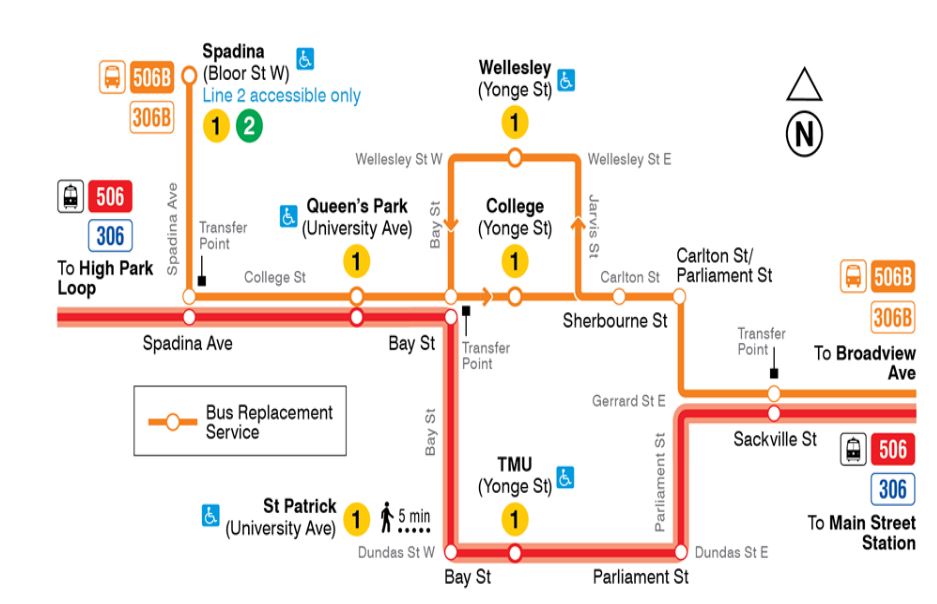
  • 506 Carlton
  • 507 Long Branch

These are described at the end of the article.

Continue reading

TTC Board Meeting: February 3, 2026

The TTC Board will meet on Tuesday, February 3, 2026 at 9:30am in North York Council Chamber. The agenda is rather thin, and there are several confidential issues that will trigger an in camera session. There is no formal item regarding Line 5 Eglinton, although one never knows what might come up in debate.

Of interest are the following items:

Updated February 2 at 10:10am: Slide decks for the invited presentations have been posted on the TTC site. Links to them are added below.

  • CEO’s Report
  • Invited presentations from:
    • Narayan Donaldson on “Opportunities to improve Transit Signal Priority in Toronto”. According to the covering report “This presentation will discuss the strengths and weaknesses of the Transit Signal Priority (TSP) system used on Toronto’s streetcar, bus and LRT systems, compare it to a TSP system commonly used in the Netherlands, and suggest areas of improvement.”
    • Jonathan English on “Developing a Surface Transit Revitalization Plan” According to the covering report “This presentation will discuss steps that can be taken to improve speed and reliability of the streetcar network, as well as new LRT lines.”

After the meeting, I will write up the presentations in an update to this article.

Continue reading

Service Recovery Update: January 2026

When the TTC talks about service levels, a common comparison is to the pre-pandemic period. I have reviewed this issue before:

This article presents an update on previous reviews to service levels in January 2026 comparing it both with January 2020, and with November 2024 to show what has changed over the past year. Also reviewed is the evolution of travel times on major routes to show the effect of congestion-related schedule changes from 2020 to 2026.

All headway and travel time data here come from the TTC’s Scheduled Service Summaries. An archive of these files is available on this site here.

The usual citation is the number of vehicle and train hours operated today versus the “before times”. Here are the raw numbers:

Planned Weekly HoursRegular ServiceConstructionTotal
January 2020185,8257,068192,893
January 2026193,6625,234198,896

These values can be misleading because the 2026 and 2020 networks are not the same. Moreover, one vehicle hour does not provide as much service to riders today because of slower operation and increased recovery times in the schedules.

From a rider’s point of view what matters is the headway, the time between vehicles.

Although many routes have more frequent service today than in 2020, this is not universal. Riders do not travel on “average” routes, but on those needed for each trip. Their experience could reflect a decline in scheduled service on their routes. This is compounded by reliability and the perennial problems of bunching and gapping.

The table below compares January 2020 with January 2026 weekday headways. Five schedule periods are shown in the major groups reading across. Within these are the 2026 and 2020 headways, the percentage change, and the change in wait time.

Where the 2026 and 2020 times are unchanged, the cells are blank to avoid clutter. Otherwise, the 2026 headways are colour coded:

  • Green: Improved
  • Pink: Reduced
  • Blue: New service
  • Red: Service discontinued

There is a lot of pink in these charts indicating that many routes are less frequent today than six years ago.

Note that in January 2020, 503 Kingston Road and 505 Dundas operated with buses, and headways then reflected the lower capacity of those vehicles.

Continue reading

TTC Budget Meeting January 7, 2026

The TTC Board considered its Operating and Capital budgets on January 7 before passing them on to the City as part of the overall budget process. For details on these reports see:

Over roughly three hours there was a staff presentation, public deputations and a debate that often avoided major discussion of alternatives and future policy. A key item for future budgets is the shortfall in funding from provincial and federal governments, but also the city’s appetite for continued increases in the municipal subsidy.

Some commentary and claims about the TTC budget have distorted or missed some key items.

  • Yes, the TTC is asking for more subsidy in 2026, but at a level set by the Mayor’s Office before the budget was completed. We have known for some time that this number was $91-million, and the budget options were chosen to hit this target.
  • There is a confusion between actual cuts within the budget and “efficiencies”. The latter implies that there is always waste to be found that can keep subsidy calls down, but in fact barely $10-million falls under that heading for 2026, and there is even less available going forward into 2027.
  • The big reductions lie in accounting changes shifting depreciation costs to the Capital budget, and booking WSIB costs only for the current year rather than accruing future year costs arising from current incidents. There is also an unspecified corporate wide reduction with no indication of what the impact will be. These cannot be repeated in 2027.
  • The budget-to-budget comparison from 2025 to 2026 looks not too bad because 2025 budget was at a higher level than actual results. The gains needed in 2026 are considerably higher measured against the 2025 actuals which are below the budgeted levels.
  • Discussion of how to eliminate the operating shortfall through the farebox led to the frightening figure of a $1.90 fare increase. This of course would have a huge effect on affordability and ridership especially if programs to improve service were choked off at the same time. That big number is a direct result of years of fare freezes going back into the Tory era and the fact that ridership is still well below 2019 levels. The gap gets wider and wider, and would be paid for by bigger and bigger fare hikes if that approach were taken.
  • Appeals for better operating funding will inevitably run into claims that other cities have raised fares while Toronto chose to keep its fares low. That is a policy decision by the City. Should additional subsidy be paid to support that from other governments? One problem with numbers cited by management is a mix-and-match of cash fares and regular adult fares in some cities that they cite by comparison to Toronto. For example, the MiWay (Mississauga) cash fare is $4.50, but the adult Presto fare is $3.50, only slightly higher than Toronto’s.
  • Fare enforcement has improved revenue by more than expected, but is hampered by available staffing and operating practices such as all-door loading that would cost money and capacity if they were changed. The Board seems incapable of looking at both sides of the ledger and fixates on revenue, enforcement and limiting opportunities for evasion without considering the effect on service delivery.
  • Claims about service improvements in 2026 muddle what is actually in the budget. The subway service improvements were actually implemented in 2025. All the budget does is make provision for full-year funding of this change (and similarly for other 2025 changes). Subway service is constrained by the size of the Line 1 and 2 fleets, plus the limitations of the signal system on Line 2. Current replacement plans do not add to the fleets, and there is considerable expense to keep Line 2 trains running until the new trains arrive. There is some provision for extra bus and streetcar service, but some of that will disappear to congestion effects, and service improvements will not begin until Fall 2026.
  • Commissioner Saxe proposed that the TTC study the elimination of cash fares. Nothing will come back on this for two budget cycles (i.e. at least 2028) because the report is not due until early 2027 and will likely have no effect on that year’s budget.
  • Chair Myers proposed that the 2027 budget and subsidy consider linking goals and metrics for TTC performance. This is a dangerous idea on a few counts. Most obviously, what targets would the TTC aim at? It is no secret that existing metrics leave a lot to be desired and, in some cases, have been cooked to put management in the best light. The last thing we need is a potential cut in funding to arise from failure to meet targets, or to be based on metrics that do not reflect actual rider experience. In turn, that would encourage creative reporting of results when what is needed is transparency and honesty.
Continue reading

29/929 Dufferin Travel Times to December 2025

This article includes reviews of the 29/929 Dufferin local and express services to the end of 2025. The major item of interest is the introduction of “red lanes” south of Bloor Street and their effect on the bus service. Detailed charts are included here for:

  • November and December travel times in both directions between King and Bloor.
  • January 2024 to December 2025 historical stats on travel times.
  • The segment between Lawrence and Wilson that does not have transit priority, but which has much more congestion than at the south end of the route thanks to Yorkdale Mall.

General observations:

  • The benefit of the red lanes is more pronounced for northbound than for southbound trips, and only at certain times of the day.
  • There is much more severe disruption of service northbound near Yorkdale Mall, but no transit priority measures are proposed there.
  • Headways on Dufferin remain widely scattered near terminals (northbound at King, southbound at Transit Road just outside of Wilson Station).
  • Even on Christmas Day when weather was relatively benign and travel times were lower than normal, headways were not reliable.

Part of the improvement in travel time in December 2025 could be due to seasonal effects. When the data are in for early 2026, we will see how long-lived the saving actually is. I will publish an update to this article in a few months when the pattern is clear.

There are a lot of charts in this article, and I have put them all after the “more” break. Those who are interested in the details can open the full article.

I will turn to a review of 511 Bathurst streetcar and 7 Bathurst bus which both saw recent changes in future articles.

Update: For clarity, the red lanes currently extend only as far north as Dundas. After work up to Bloor is completed in the Spring, I will publish an update showing the effect.

Continue reading

TTC 2026 Capital Budget and 2026-2040 Plan

The TTC’s 2026 Capital Budget and Plan will be discussed at a Board meeting on January 7 in advance of passing this on to Council for the beginning of the City’s budget cycle on January 8, 2026. There are four reports in the budget package:

There is a lot of detail in the plans, and reading them can leave one mired in a sea of projects and figures. All the same, this plan is as important to the TTC’s future as the Operating Budget which usually gets most of the attention. Key to the Capital Plan is the “State of Good Repair” (SOGR), the need to keep many parts of the system in working order to provide reliable, safe service and to be a foundation for transit growth. Political effort tends to go to single, large projects such as the replacement of the Line 2 subway fleet, but the combined value of less glamourous capital maintenance is considerably larger.

There are two types of maintenance budgets. One lies in the Operating Budget where day-to-day repairs are funded. The Capital Budget funds major overhauls and replacement of infrastructure and vehicles. The capital side can be “spikier” in individual budget lines because some components are totally replaced but infrequently. This leads to uneven funding needs, and the marquee projects can crowd out routine but necessary work.

Another consideration for capital is that some infrastructure has a very long lifespan, but eventually reaches the point where major investment is needed. The subway system was built in stages from the 1950s onward, and as it ages there are new costs just to keep old infrastructure in good repair. For example, the signal system on Line 1 has been replaced and preliminary work for Line 2 is underway. The Line 2 signals are 60 years old, and they will be even older when they are eventually replaced.

Fleet planning for the rail modes, subway and streetcar, has peaks and valleys of procurement because entire sets of cars are replaced in a single order. On the bus fleet, in theory the procurement should be continuous, but even here there are peaks caused by uneven purchasing in past years, occasional special subsidies for purchase of specific vehicles, uneven reliability among various bus types, and an uneven rate at which old vehicles are retired. Quantities can be affected by manufacturing issues as is now the case with eBus procurement.

Funding programs come in two flavours. One is project specific such as the subway car purchase, while the other comes at a fixed annual rate such as gas taxes and the new Federal transit funding program. Capital spending plans have to fit around the rate at which money flows from many different sources. Major expansions such as the Scarborough Subway used to reside in the TTC’s budget, but they are now completely funded and managed by Metrolinx with provincial funding.

The TTC presents its Capital Budget in three versions with different timelines.

  • A one-year budget for the current year.
  • A ten-year plan corresponding to the City of Toronto’s financial plans.
  • A fifteen-year plan showing all projects beyond the ten-year window but with an important difference to the one- and ten-year versions — all projects are included whether they are funded or not showing the gap between the funded 10-year version and actual needs.

Historically, the 10-year plan was trimmed to fit known and expected funding, and everything else went “below the line” (in the sense that it came at the end of the budget). A common trick was to push enough of the planned spending beyond the 10-year window. In spite of routine hand-wringing about TTC finances, the current budget was always magically kept intact and the hard decisions were left to another day. Now with the 15-year plan, those future costs are visible, and even then new items crop up. The “below the line” segment is now twice the size of the funded budget.

The lack of long-term funding is a major issue for Toronto especially considering Council’s desire to substantially increase transit’s share of travel.

Overview

Here are high level views of the one year, ten year and fifteen year plans.

Although the one year plan for 2026 is about 10 percent of the ten year plan, the spending is uneven with more than half of the total in the first five years. This reflects anticipated funding availability which drops off in the latter half.

Source: TTC Capital Budget

Longer term, over two-thirds of the fifteen-year total is only in the Capital Plan. This does not mean that the TTC would spend the remaining $37-billion in the last five years. This is the “below the line” effect where work that is not yet funded is shown in the long-term plan even though much of that work is needed well before 2036.

The unfunded projects span every aspect of the TTC. The chart below breaks down the funding gap and shows how it grows from the short to long term. (Note: the values reading across are cumulative.) The $37.3-billion here is the difference between the 10-Year Capital Plan ($16.7-billion) and the full 15-year plan ($54.0-billion). This is not an issue for the indefinite future, but one which faces the City today with a shortfall of over $1-billion annually for the next five years, growing to over $2-billion in a 10-year view and even more in a 15-year view.

Note that TransformTO is included at a projected capital cost of $7.3-billion, over half of which would be spent in the first 10 years. If Toronto is really serious about major investments in system capacity and attracting many more riders, the decision to proceed must occur soon together with the spending commitment. Whether this will attract support from other governments is quite another matter, and there is sure to be a debate about competing priorities for transit funding regardless of its source. This will require a long-term political commitment to growth of the whole network, something notably absent except for subways.

Source: TTC Capital Budget

A related issue is the growth of the SOGR backlog as infrastructure and fleets age faster than funding is available to renew them.

Although the TTC has chipped away at the SOGR backlog in the short term, changes in estimates for later years have worsened the problem. Three sources are cited for the increase.

  • eBus procurements, which count as SOGR because they replace existing buses, have increased “by $854.8 million as of 2034, and $1.277 billion as of 2035.” eBuses are proving more expensive to buy, and more or them are needed for projected service levels.
  • Overhaul costs for all modes increase “by $169.1 million as of 2034, and $277.2 million as of 2035”. Some of this is due to changes in fleet plans which push vehicle replacements further into the future requiring more SOGR maintenance on older vehicles, notably subway trains and buses.
  • Subway track goes up “by $123.0 million as of 2034, and $148.7 million as of 2035.” Thanks to new assessments of track condition, the TTC has recognized a need for accelerated replacement of older track.

This is a perennial problem with capital plans — the scope and/or pricing of future projects rises faster than the provisions built into the plan, and there is year-to-year growth even if nothing is added to the shopping list.

Funding

The 10-year plan is funded from various sources as shown in the table below. Some of these are time limited and project-specific. For example, the streetcar funding looks after the tail end of the 60 added car procurement and related changes at Harvey Shops so that it can function, in part, as a carhouse. The Zero Emission Transit Fund only covers current eBus procurement, and it is unclear how much this program will be extended, and what proportion of costs it will cover. Development charges will fall in later years of the plan as the current regime expires and rules for what can be included change. The New Deal with Ontario is also time-limited, although the City and TTC are negotiating an extension.

This only accounts for the funded part of the budget, and much more is required, some of it in the early years.

As things stand, the City carries almost two-thirds of the total cost primarily through debt financed through City Building Fund revenue (essential a property surtax) and by debt supported from general revenue.

From somewhere, the City must find a further $37.3-billion, a number certain to grow, or it must trim some projects from the wish list. The level of support needed from provincial and federal sources is woefully inadequate to address Toronto’s needs. Toronto is not alone with this problem, but it has the biggest funding gap given the size and complexity of the transit system.

Real Estate Investment Plan

A separate report details planning for real estate requirements.

When it was created in 2022, the Real Estate Investment Plan’s goal was to flag the need for property well in advance of actual requirements so that construction would not be delayed. One example of how this happened is the SR busway conversion where a project unforeseen in the plan was delayed awaiting settlement of various property issues.

The REIP highlights needs separately from the main budget, but the report is rather disorganized and is not cross-referenced to the main Capital Plan. Some items are quite small while others such as studies of future use for properties like Hillcrest and the Kipling Yard site are bound up with basic questions of what the TTC will become in future years.

Many parts of the REIP address housing various TTC functions which have grown over the years into an expanding collection of trailers as “temporary space”. The TTC also occupies many leased spaces for offices that have outgrown the Davisville headquarters and other major sites. Talk of a new consolidated Head Office has been heard for years, but nothing concrete emerged. The context now is a wider City plan to consolidate office space. This should primarily affect the Operating Budget both through reduction in rent costs and improved efficiency of co-located staff.

I will leave this report to a separate article.

Continue reading

TTC 2026 Operating Budget

Updated December 30, 2025 at 10:45pm: The description of proposed service changes on the subway has been amended to reflect that the headway changes on Lines 1 and 2 are already in place. They show up as “new” in the 2026 budget because they were not included in 2025.

The Toronto Transit Commission’s Operating and Capital Budgets will be considered by the TTC Board on January 7, 2026, and will go from there to City Council for final approval. This article discusses the Operating Budget, and my next one will deal with the Capital Budget and Plans for 2026-2040.

Through a combination of belt-tightening and accounting magic, some of which cannot be repeated in future years, the TTC manages to freeze fares for a third year, introduce fare capping, retain and improve overall service levels, and stay close to the City’s target of $91-million in added subsidy for the new year. This is roughly equal to the $90.8-million rise in Provincial subsidy for the operation of Lines 5 and 6.

The pie charts below give a high level view of the budget. Note that passenger and ancillary revenues (fares, parking lots, shop rentals, advertising) account for only 39% of the total, and City subsidy is almost half. This is a huge change from the days when the City and Province each paid one sixth of the total, and the lion’s share of the remainder came from fares.

Source: TTC Budget p. 3

Fare Changes

For riders, the biggest news is the fare freeze and capping, to be introduced in September 2026 with a view to further improvement in September 2027. The Adult fare cap is close to the price of a monthly pass, and so riders who already buy passes will see only a small change in their cost. However, the benefit of a capped price will be available to all riders without an upfront payment for a pass.

Youth, Senior and Fair Pass fares will be capped at the same ratio, 47 rides, and this is an improvement over the current higher multiples of 54.5, 57 and 58.6 respectively. Frequent TTC riders in these classes will see reduced costs.

The odd group out here are Post Secondary students whose pass is priced at the same rate as Youth and Seniors, but who pay the full Adult fare if they do not have a pass. This creates a situation where a pass is cheaper than capped single fares. The policy issue here is whether the Post Secondary single fare should be reduced to the Youth level and the monthly pass eliminated.

If the fare cap is reduced to 40 in September 2027 (a decision subject to the 2027 TTC Board and City Council), this will be equivalent to a 15% reduction in the monthly pass cost.

Source: TTC Budget p. 31

The anticipated cost of fare capping in foregone revenue is $3.1-million in 2026, $18.5-million in 2027 and $36.6-million in 2028 assuming that the 40 fare cap is implemented in September 2027.

Source: TTC Budget p. 22

All of this occurs with the hoped-for greater riding and extending the benefits of fixed transit costs to more riders. However, fare freezes and reductions cannot go on forever without also discussing the TTC’s ability to retain and improve transit service. A large “SALE” sign attracts few customers if the shop window is half-empty.

Service Changes

The service budget increases by 2% measured in service hours “to address congestion, adapt to changing travel patterns, deliver world-class service during the FIFA World Cup” with an expected ridership of 426.4-million in 2026 compared to a projected 414.0-million in 2025. Note that this is still lower than the original 2025 projection of 439.4-million. The budget does not explain how much of this increase will show up in more frequent service as opposed to congestion adjustments and the one-time bump for FIFA.

One specific change mentioned in the budget is the restoration of peak service on Lines 1 and 2. For reference, here are the current peak service levels and the levels operated in January 2020. Line 2 is already operating at the 2020 level, and Line 1 would only improve by 6% (measured as trains/hour) in the AM peak. The controlling factors in peak service levels are the signal systems and the fleet sizes which prevent service improvements beyond the 2020 levels.

Updated December 30, 2025 at 10:45pm: The “restoration” of peak subway service appears here because it is a budget-to-budget change even though it was actually implemented in late 2025. This does not represent net new service compared to year-end 2025.

LineAM Dec 2025AM Jan 2020PM Dec 2025PM Jan 2020
1 Yonge University2’30”2’21”2’30”2’36”
2 Bloor Danforth2’20”2’21”2’30”2’31”
Source: TTC Scheduled Service Summaries

Ridership

Conventional system ridership has not done well against budget projections in 2025. The budgeted value (top line, red in the chart below) has been consistently above actual counts (blue at the bottom). 2025 numbers closely tracked 2024 values (green) until the Fall when they fell lower. The shortfalls are attributed to a combination of undue optimism about the effect of return-to-work commuting and the loss late in the year of foreign students.

Source: TTC Budget p. 16

Projections for 2026 are less aggressive and, for budget and service planning, the “medium” increase will be used.

Source: TTC Budget p. 14

Wheel-Trans demand is strong and more growth is expected there in 2026.

Source: TTC Budget p. 15

The issue of future demand affects both the operating and capital budget planning process, and there have been conflicting indications of where the TTC thinks this is headed. In the short term, they expect little growth, but a recent Major Projects Update claims that current projections will accelerate the need for extra capacity on Lines 1 and 2.

Line 1 – Capacity Enhancement Program:

  • This program provides for the expansion of Line 1 capacity by achieving headways of up to 100 seconds, enabling the movement of up to 39,600 passengers per hour at peak hours. […] Headways of 100 seconds by 2037 were based on pre-pandemic projections. The updated ridership demand forecasts will require headways to be achieved earlier (2035). Full schedule and scope impacts are currently being evaluated. [p. 23]

Line 2 – Capacity Enhancement Program:

  • The ridership demand forecasts have been updated and are under review, extending to 2051, and will require the target headways to be achieved earlier than previously planned (135 seconds by 2028, 130 seconds by 2029, 125 seconds by 2030, and 120 seconds by 2037). Full impacts are currently being evaluated and will be outlined in a detailed report to the Board. [pp 20-21]

How this fits with overall system demand, fleet and service needs is not explored in the budget. As the chart below shows, TTC riding has not yet returned to 2019 levels. The “flip side” of that observation is that the pre-pandemic era was noted for overcrowding on many routes and spawned expansion plans such as the Bloor-Yonge project. Toronto should not wait to be back at 2019 and its capacity problems before planning for growth.

Metrics and Targets

The TTC has several metrics to track their operation and associated targets. Notable among these are Customer Satisfaction and On-Time Performance. Although the TTC is working internally on new metrics, these have not yet appeared. A major problem with the concept of “on time” is that it has more meaning for internal purposes than to riders on most routes where service is frequent, but erratic. It is reliability, not the schedule, that matters especially when considerable variation is allowed by TTC standards.

Source: TTC Budget p. 9
Continue reading