Metrolinx “Big 5” Update (November 2009)

Today’s Metrolinx Board Meeting was notable both for the update, in public session, of the project status for five major lines as well as for supplementary information that came out in a press scrum after the public session.

Five projects now have funding and are at various stages in their approval/construction process.

Continue reading

What Should We Do About Fares?

In my previous article, I reviewed the TTC staff report about the proposed fare increase, but didn’t say much (except in the comment thread) about my overall view on the situation.

The most important fact about Tuesday’s TTC decision, whatever it will be, is that it will not set, once and for all, either the fare and service levels for 2010, nor general fare policy for the future.  Any attempt to do so runs directly into the limitations of the TTC’s mandate and the simple truth that neither the City nor Queen’s Park have clearly stated how much the TTC might get in operating subsidies for 2010.

For next Tuesday, as I have said many times, I support the proposed 25-cent token fare increase with all other fares rising proportionately.  The attempt to grab $5 extra a month from Metropass holders is an unfair, precipitous action brought forward by TTC staff who have always fought against making the pass “the better way” to travel.  That the scheme was announced by a press release rather than by a formal proposal from the Commission itself raises serious questions about who is setting policy at the TTC.

If the Commission adopts this fare scheme, the TTC will still be about $50-million in the hole going into the 2010 budget process.  At this point we have no idea what sort of tradeoffs this might entail, and the Commission is asked to implement a fare change without all the facts on the table.

As I mentioned in my previous article, TTC staff claim that the system’s costs will rise by 7% per annum for the foreseeable future, but they do not quantify the source of this magnitude of change.  Some factors listed in the staff report are non-recurring or have a limited effect on future budgets.

Next Tuesday, as we always see when fare increases are on the table, there will be many groups calling for various changes in fare structures ranging from a complete freeze to new discounts for certain groups of riders.  I believe that the Commission, and by extension the City, should not be making fare policy on the fly.  We are all badly served by “debate” that is inevitably presented as a decision that must be taken today lest the sky fall tomorrow. Continue reading

TTC Budget Report: Raise the Fares

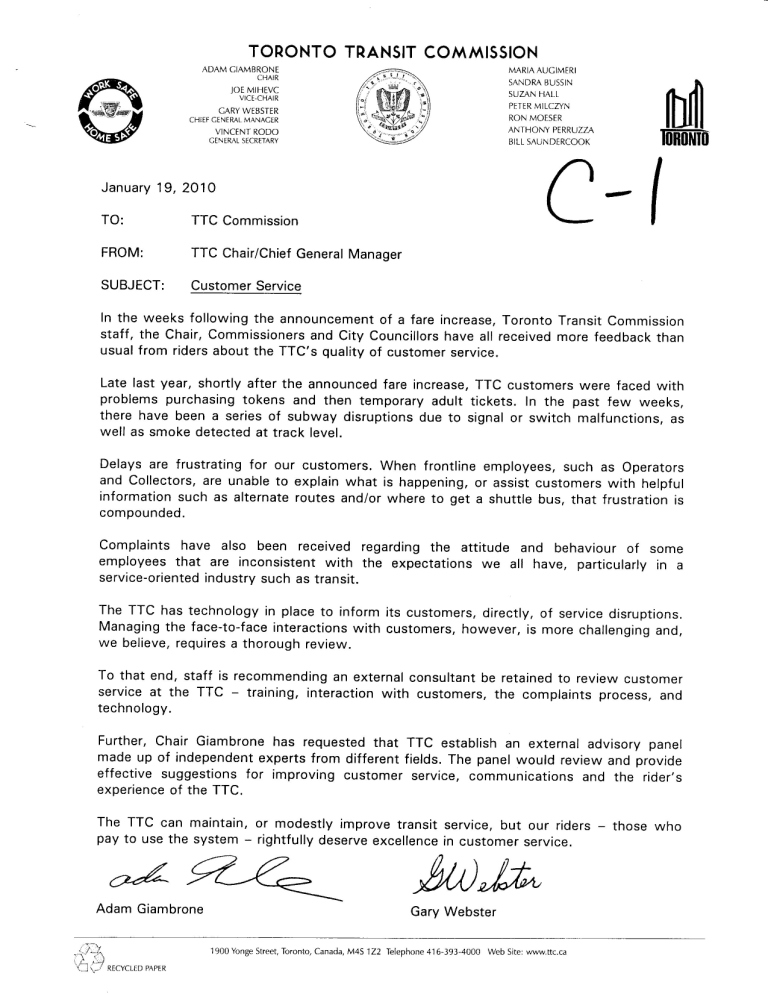
The TTC staff report recommending a fare increase is now available on the TTC’s website.  This will be formally considered at the Commission meeting on November 17, but of course this subject has already been discussed at length in the media and on blogs.

The new price for adult tokens will be $2.50, up 25 cents, with all other fares increased roughly pro-rata.  The one exception is the Metropass for which the proposed fare multiple (the ratio between the pass price and the token price) would be bumped by the equivalent of two fares.  This places the burden of the fare increase disproportionately on the Metropass users.

The TTC projects essentially flat ridership and service for 2010 relative to 2009.  Projected riding is 473-million, up only 2-million over the likely 2009 level.  Other than the full-year effect of service changes added during 2009, no major service improvements are planned for 2010.

A particularly striking comment in the report is that TTC costs are expected to rise next year by 7% and to continue rising at that rate for the foreseeable future.  A number of factors are cited, but they don’t all make sense over an extended period.

  • Labour costs.  The TTC is committed to wage increases at the currently contracted levels, but unless there is a major change in economic circumstances, the next round of bargaining will almost certainly result in a lower rate of increase.
  • Energy costs.  It is unclear whether all of the TTC’s energy costs (diesel fuel, electric power) will rise at greater than the rate of inflation and if so, by how much.
  • General inflation.  Since labour and energy are already out of the mix, this only affects costs such as materials.
  • Annualized service increases.  This affects only 2009.
  • Low floor bus adjustments.  By the end of 2009, high-floor buses are planned to be less than 10% of the bus fleet, and by 2013, last of them will be retired.  The capacity adjustment for changing to low-floor buses will be completely worked into the system substantially in 2010 when 58 of the remaining 100 “New Look”s are retired.
  • Construction and congestion adjustments.  Some additional construction effects can be expected as programs such as watermain replacement ramp up, but this will hit a new plateau at some point.
  • Increased vehicle and facility maintenance requirements.  I can understand better facility maintenance (although stations are covered in a separate bullet), but if anything the vehicle maintenance costs should start to drop with the implementation of large new fleets of vehicles in all modes.

If we are looking at a sustained 7% growth in the TTC’s operating budget, even without service improvements, the underlying reasons must be clearly understood.  This has very serious implications for transit funding, service and fares in the coming decade. Continue reading

A Little Accuracy Would Be Nice

The National Post reported comments by former City budget chief David Soknacki at the Board of Trade in which he claims that in the past decade:

  • The TTC staff went up 13%, while the service operated rose by only 1.3%.
  • The cost to Toronto taxpayers for the TTC went from $125 to $250.

This sort of statement gets red-blooded, tax-chopping politicians, not to mention the Board of Trade, hopping mad.  If only the information were accurate and in context.

First let’s look at service levels.

In 1998, the TTC operated 106.6-million km on its surface network, and by 2008, this was up to 126.3-million.  That 18.5% more, and even allowing for the fact that 2008 was a leap year (and had one more day’s operations in it), that’s a lot better than 1.3%.  The surface fleet rose from 1,744 buses and streetcars to 1,985, or 13.8%.

On the rapid transit network, service rose from 71.7m to 78.2m km, or 9.1%.  Most of the increase came from restoration of mid-90s off-peak service cuts and a small bump from the Sheppard Subway opening.

During this period, the TTC was subject to changes in labour laws restricting hours of work in the transit industry, and this triggered a requirement for more operators to perform the same work.

We can have long debates about the merits of Local 113, not to mention the non-union staff at TTC, but the simple fact is that over the past decade the TTC ran more service and hired more people operate the system.

Second, the “transit tax” per capita.

During the mid 1990s, funding for transit and other municipal services was butchered by Queen’s Park, and the City of Toronto (among others) is still digging its way out of that hole.  Transit services were scaled back, ridership dropped, and the farebox recovery rate went above 80%.

Over the next decade, City policy favoured a return to better service quality (the Ridership Growth Strategy) and to a farebox recovery at the so-called historic level of 68%.  There is nothing magic about this figure.  It just happened to be the level when Toronto and Queen’s Park came to an agreement about the amounts of subsidy each would provide, locking in at the then-current level.

In 1998, an adult token cost $1.60 (and had done so since 1996), while the Metropass cost $83 and was not transferrable.  Today, the token costs $2.25 and the Metropass $109 (leaving aside various discounts available).  That’s an increase of 41% on tokens and 31% on passes.

Better service and a higher proportionate subsidy for service combined to drive up the subsidy required by the TTC.

  • In 1998, the total operating subsidy was $146.3-million paid entirely by the City.
  • This rose to $299.6m by 2007, of which $208.0m came from the City with the rest from other governments. 
  • The next year, 2008, the City contribution dropped back the 1998 level even though the total subsidy continued to rise to $316.9m.
  • For 2009, the total subsidy will be about $400m thanks to the combined effects of inflation and the 2009 fare freeze.

Over the 1998-2008 period, it is roughly correct to say that taxpayers somewhere (local, provincial, federal) roughly doubled their contribution to the TTC, but that increase was paid back to riders in better service and lower fares, relative to the total cost of operation.

Many politicians pay lip service to the need for better public transportation, and if anything, spending is far behind where it should be, especially for system expansion.  None of that will come without higher subsidies.  We can debate whether those the TTC and other transit agencies get today are spent wisely or effectively, but the need for more transit is inescapable.  Talk about efficiency plays well to the mythical taxpayer, but more often this is code for “no more transit money” at a time when that’s the worst possible choice.

For a detailed look at TTC fares and operating statistics, please visit Bob Brent’s website.

Those Vanishing Tokens

Today the TTC announced that token purchases, originally limited to 10-per-customer in the face of a coming fare hike, would now be limited to 5-per person.  If a station collector has run out of tokens, you will pay the cash fare of $2.75.

This has to rank among the more bone-headed moves the TTC has made.

The TTC has a fetish for collecting money, and the more it can get, the better.  In the name of eliminating bogus tickets, the TTC got rid of them for adults.  Ooops!  That was the fallback medium everyone used in the period when tokens vanished before a fare increase, but now it’s gone.

Some people may try to switch to a Metropass rather than taking a chance on token availability during December.  Indeed, some regular pass users who switch to tokens for that “short” month (from a commuter’s point of view) may stay with the Metropass.  Will the TTC have enough?  Don’t count on it, and it’s far too late for them to order more.  If you’re planning to buy a pass, don’t wait until November 30th.

Paying that cash fare doesn’t just hit riders for one direction on their trip.  Someone commuting home via the subway with a bus or streetcar at the end of their trip may try, but fail, to get tokens on their outward trip.  The next morning, they still won’t have tokens and will have to pay cash again for the inbound journey.

If the TTC had wanted to be the tiniest bit generous, it would have lowered the cash fare to $2.50 for the period leading up to the fare hike, at least trying to meet riders half way.  But, no.  The problem the TTC itself created will cost riders 50 cents more per trip for the next seven weeks.

Behind all this lurks the question of smart cards on the TTC.  Once fare collection is automated, the amount of fare can be changed on a whim, with no lead time, and no possibility of hoarding.  However, a lot comes along for the ride with the technology.

The original estimate for implementing Presto! on the TTC was $140-million, and the TTC got Federal funding (CSIF) to pay for it.  There was a small problem.  The estimate ballooned by another $277-million with no money in sight.  (This is one of those many “below the line” projects in the Capital Budget, hidden, but lurking.)

There are many unanswered questions about Smart Cards for Toronto.

  • What is so expensive about bringing them to the TTC?
  • Why is there no public report with details of the new, higher estimate, only a few pages buried in the capital budget (page 1,533 for dedicated readers)?
  • How much will it cost to operate and maintain the new system compared to the existing one, even allowing for the supposed reduction in fare evasion?
  • How much real enforcement will the TTC put in place?
  • What fare structure is contemplated?
  • Is the system designed with an expensive, complex back-end to aid in detailed trip tracking and billing?  What will be the marginal costs and benefits of such a system?
  • What is the role of credit/debit cards as the “smart card” medium rather than a dedicated system?
  • Who will own and maintain the system?  The TTC or Metrolinx?

The world-wide embrace of smart technology shows us that this is hardly something new, something Ontario and Toronto have to develop from scratch.  What’s the problem?

A huge, hidden issue has nothing to do with technology, but with subsidies.  Everyone talks about getting rid of fare boundaries, and there are many ways to slice that pie.  (Please, readers, don’t send in your proposals yet again, I will delete them.)  But switching the fare revenue around inevitably means that some will pay more so that others pay less.

“Paying more” can be achieved by raising some of the fares, but it can also be achieved with increased subsidies.  These are tradeoffs nobody wants to talk about.

To both TTC and Metrolinx:  Stop hiding this debate behind closed doors and start talking about how fares might be collected in a unified system.  How will fares be used to attract both the long-haul commuter and the casual, short-trip rider?  How will boundaries between systems, including those with GO Transit, be eliminated?  When will fares and service be treated as tools to encourage people out of their cars, to support local and regional planning ambitions, not just nuisances to be debated every year at budget time?

TTC Proposes 2010 Fare Increase (Updated)

Updated 11:10 pm November 4:

The TTC has confirmed that existing Metropass subscribers will not pay at the new rate until their renewal comes around.  For example, if your annual renewal is in June, you will pay at the old rate up to and including the May pass.  If your renewal date is January, then you will get the increase as soon as it comes into effect.

New subscriptions are now being taken effective January 2010, and so they will be at the new rate, whatever it winds up being.

Original post:

TTC staff propose that fares rise effective January 3, 2010.

Table of 2010 Fare Increases

As expected, the Metropass takes the brunt of the increase.  Passholders will see their prices go up 16% on Monthly Discount Plan (MDP) subscription, slightly less otherwise.   The token rate will go up only 11.1%.

I am sure that we will hear that 11% figure a lot in the coming weeks even though the primary way adult fares are collected today is by passes.  Any politician who tries to duck that 16% figure deserves to be called out for misrepresentation.

This change represents a triumph of the bean counters, who have always hated passes and regard them as a drain on the system, over equitable increase in TTC fares.  Reducing the fare multiple (the number of token fares represented by a pass) was an integral part of the Ridership Growth Strategy, and the TTC is now moving backward.

Metropass users are loyal, and those who have subscriptions don’t have the option of changing quickly anyhow.  The “elasticity” of this market, as modellers like to say, is quite favourable to the TTC, at least in the short term.

How long into 2010 will it take for staff to tell us that they have still underestimated the use of Metropasses, that the average fare is below their projections, and that for 2011 we must again raise the multiple?  After all it started out at 52 for everyone (there was no MDP in 1980).  Why not just turn the clock back 30 years?

I have no doubt the Commission will endorse what the staff have proposed.  We have been softened up for this announcement for weeks, and the TTC would not issue a press release about it without fair cartainty that the proposal would go through.

There is no question that the TTC needs a fare increase to balance its books.  However, there has been no public discussion about changing the long-range policy of bringing the pass price down relative to tokens.  What other parts of the Ridership Growth Strategy will we abandon next?

We will get a perfunctory debate at the TTC’s November 17 meeting.  There will be much hand-wringing, but in the end I expect the very Commissioners, the “left wing”, are more likely to support their Chair and the staff proposal rather than talk about “fairness” in the fare structure.

Maybe Admiral Adam can explain on his new TV program starting tomorrow night (November 5, 8 pm on CP24) why the TTC will bump Metropass fares so disproportionately.  His constituency should be the people, the transit riders, of Toronto, not his management staff.

TTC Capital Budget 2010-2019 (5): A Question of Accuracy

Yesterday, I was interviewed on CIUT about the TTC’s Capital Budget, and was on the air right after TTC Chair Adam Giambrone.  An issue raised for both of us was my claim that the TTC has just discovered that it has nearly a billion dollars worth of projects that are not only “below the line” (unfunded) but not even in the budget.

(See the previous article in this series, and scroll down to Surprise Projects.)

Giambrone replied that, yes, the TTC knew about these costs and they were in the budget.  Well, no, they are not.  I spent a few hours this morning combing through the budget books, again, checking on these and other items. Continue reading

The War on Metropasses (2)

The TTC’s November Commission meeting has been moved up from the planned November 25th date to the 17th, and an item sure to be on the agenda will be a fare increase for 2010.

There are two questions:

  • How big an increase will the TTC need?
  • How evenly will the increase be applied to different fare types?

As I already reported, TTC management has been up to its usual tricks of blaming heavy use of Metropasses for its financial woes.  For months, they have been preparing us (and priming Commissioners) to tell us how we are losing too much money on passes, and their value, relative to tokens, must go up.

We have heard this song for years, but through a period when lowering pass pricing was an integral part of the Ridership Growth Strategy, it was ignored.  Now, the TTC wants more money, and Metropass holders are convenient, dedicated transit users who can be counted on to cough up almost any increase.

What would, what should a fare increase look like? Continue reading