Metrolinx Contemplates Regional Fare Integration, Again

As regularly as the seasons come and go, Metrolinx produces new reports on its long-running contemplations for a new regional fare system. Like the seasons, reports come and go, but there is little real progress toward an actual solution.

The root problem has always lain with Metrolinx. Although it bemoans the inconsistencies among fares in regional agencies, Metrolinx itself has clung to one fare model – fare by distance – as the Nirvana to which all should aspire. If there is something to be said for the current report, it is that at last there is a shift it focus and a recognition of two essential issues on the provincial side of the discussion:

  • Metrolinx’ existing fare structure is not purely a fare-by-distance system, but contains many inequities and idiosyncrasies built up over the years. In particular it discriminates against short and medium distance travel, but that is only one of its problems.
  • Integration across the 416 boundary will not occur without some new type of subsidy. Previous attempts to craft a revenue-neutral fare scheme inevitably required pillaging from Toronto (where most of the fare revenue is actually collected) to provide a subsidy for the 905.

The Executive Summary includes the following points from a consultant’s study that led to a Draft Business Case (this document has not yet been posted online):

  • All fare structure concepts examined perform better than the current state, offering significant economic value to the region
  • Making use of fare by distance on additional types of transit service better achieves the transformational strategic vision than just adding modifications to the existing structure, but implementation requires more change for customers and transit agencies
  • More limited modifications to the status quo have good potential over the short term
  • Further analysis has been conducted on other aspects of the fare system such as concessions, products, and loyalty programs
  • Metrolinx and GTHA transit agencies continue to independently make decisions regarding fares that widen the gap that fare integration needs to bridge

At the risk of prejudging the outcome, it is quite clear where this is heading. There will be come sort of “limited modifications” to achieve the “good potential over the short term”, and we may never actually reach, nor need to reach, the end state.

Staff recommend that the Board approve the following:

  1. The Metrolinx Board endorse the step-by-step strategy outlined in the Report and that staff report back on December 14th 2017 on means to advance the strategy which
    includes:

    • Discounts on double fares (GO-TTC)
    • Discounts on double fares (905-TTC)
    • Adjustments to GO’s fare structure
    • Fare Policy Harmonization
  2. Staff undertake to engage the public and key stakeholders (including municipal elected officials) on advancing the step-by-step strategy
  3. Staff post the consultant’s Draft GTHA Fare Structure Preliminary Business Case

Metrolinx argues that an integrated fare strategy would require substantial standardization of fare policies notably the discount structures for concession and loyalty fares and rules regarding the validity of transfers. While the 905 systems use time based transfers, the TTC requires a new fare if there is a stop-over or doubling back on a journey. This and any other “local options” complicates Presto, and as we have seen in the case of the TTC leads to odd behaviours due to the difficulty of mapping trips and “valid” transfers under all circumstances. Although the report does not mention this, TTC management have already indicated tentative support for time-based transfers (this is to be part of a forthcoming Ridership Growth Strategy). The problem lies in the political arena where City Council will have to cough up funding to offset the cost.

Until the study is actually published, we should take the statement that “all fare structure concepts examined perform better than the current state” because an essential part of any new structure would be the elimination of the boundary between TTC and other fares. This does not necessarily endorse any of the alternatives.

Like a dog with a bone, Metrolinx simply will not give up on its preferred alternative:

Fare by distance should be a consideration in defining the long-term fare structure for the GTHA

The question here is what is merely “a consideration” and what is an unchangeable goal across the entire network.

Metrolinx acknowledges that it has to talk to people, and that it simply cannot impose its will on the region.

A formal and inclusive decision making process needs to be put in place to establish the longer-term GTHA fare structure vision

This is a rather odd statement considering all of the study this issue has been through, and the degree to Metrolinx has previously claimed widespread agreement. Moreover, it implies that someone might actually disagree, although the outcome of such a position is unclear. Would Queen’s Park welcome local political input (after demolishing the original Metrolinx that included local politicians) if it provided a way to impose unwanted policies on individual members of the region?

What is particularly galling about this summary is that after all this time we still do not see worked examples of possible fare structures and their effects on various types of trips, on groups of riders and on the revenue streams of each transit agency. Possibly this is in the as-yet unpublished report, but if it isn’t, Metrolinx will effectively admit that the real effects are not as rosy as their claims. The most obvious question any new scheme will encounter is “what’s in it for me” both as positive and negative issues.

Appendix 1 discusses “Key Fare Integration Challenges” and is somewhat more realistic than previous attempts at the topic. First up is the question of “tapping off”, a pre-requisite to fare-by-distance. The report acknowledges that tapping off is not the effortless addition to fare collection procedures:

Emerging technological solutions may allow tap on-only customer experience while maintaining compatibility with fare-by-distance or–zone structures

and

As GO fares require origin/destination information, any regional fare structure requires either:

  • acceptance that different customer behaviours will be required depending on service type,
  • moving all transit to tap on/off, or
  • new technological solutions

Other issues include the handling of cash fares and mobile ticketing.

With respect to distance travelled, there is a notable difference between GO and TTC subway fares because the former are distance based and skewed against short trips, while the latter are flat and provide free transfers to connecting services. The report observes:

As GO fares cannot feasibly be flat, any regional fare structure requires either:

  • acceptance of different approaches to distance based on service type, or
  • moving all services to fare by distance/zones

The problem with this statement lies in the term “service type”. Metrolinx has previously touted the idea of “premium” services that would include all rail-based modes, while leaving buses untouched. This arises from a flaw in a previous study that did not consider “bus rapid transit” because (it is claimed) there were no BRT services when it was undertaken. Such is the quality of Metrolinx “research”.

If we decide that some services should pay a premium fare, the obvious questions is “what is a premium service and why should I pay more for it”? This is easy to argue for GO rail because these are express services with widely spaced stops (although even that model is under attack thanks to SmartTrack and the Minister of Transportation’s love for extra stops), but much harder for subways, let alone LRT and BRT that are a much lower step up from local transit than a GO train.

Each municipality has its own local concession fares often in response to local history or to the perceived value of certain types of discounts. Toronto has free rides for children, while seniors’ and students’ fares vary around the region, and there are different approaches to discounts (if any) for disadvantaged groups. How all of these will be reconciled is a knotty question: does the most generous arrangement get implemented across the board, or do the outliers (e.g. Toronto with children’s fares) drop their concessions? What is the appropriate multiple for loyalty programs such as the Metropass?

Unless Queen’s Park is willing to sever the link between farebox revenue and local service costs by providing subsidies for a more generous (and “integrated”) fare system, this discussion won’t get very far. Indeed, it might still run into problems if municipalities that do not now offer “discount X” get a provincial subsidy when others who provide this out of local funds today are left with that cost.

The whole study of Fare Integration has bumbled along for quite some time without any clear answers, but with an attempt to preserve the status quo from Metrolinx’ point of view. This has wasted a great deal of time when a better-informed conversation might have taken place. With an election coming in June 2018, the current proposal adds to the consultation, but conveniently punts a decision beyond the end of the current government’s mandate.
Station Conversion For Presto

Through the fall and winter of 2017-18, the TTC will be converting all remaining stations and entrances to use fare gates and Presto card readers. There are station-specific notices, but for readers’ convenience I have consolidated all of the information here. The first two pages of the following pdf contain the information in textual format, and the remainder is a Gantt chart. The information is current as of September 9, 2017. Stations are in sequence by line. If a station is not shown, either it has already been converted or the TTC has published no information about it.

2017_TTC_Presto_Station_Closings

There are variations on the way the program will roll out depending on the station.

  • Some entrances/stations will not close for this project, but will be converted in stages with access maintained throughout construction for passengers.
  • Some entrances/stations will have only selective late night closings (generally after 11pm), and work will otherwise take place maintaining a pathway for passengers.
  • Some stations/entrances will close completely for some or all of the conversion project. There will be weekend closings for selected stations in the downtown “U” on Line 1 YUS, but many of the secondary entrances will close completely for over a month.

During construction, riders will not be able to purchase fare media from the station collectors while their booths are close.

Even after the shutdown periods, work will continue at some locations for an extended period.

Following the conversion, riders will still be able to pay with all fare media at the main entrance of stations, but the secondary entrances will support either a combination of Metropasses and Presto, or only Presto in some cases. Details are in the linked chart.

Postscript: Notices for the closing of stations on lower Yonge Street include the following info:

During the early and weekend closures subway trains will not stop at the station. Customers should use [nearby] stations to access the subway or board a northbound or southbound 97 Yonge bus.

Of course, the 97 Yonge bus does not run on lower Yonge Street except during weekday peaks when the stations will be open. The TTC has been advised of this and will, in due course, fix the affected pages. No need to kvetch here in the comments.

So You Want A TTC Fare Freeze in 2018

In his continuing program of bribing the electorate with promises that the City cannot afford, Mayor Tory has asked the TTC to bring forth a 2018 operating budget containing no fare increase. This would come, of course, just in time for his re-election campaign where Tory could brag about all the transit wonders he has bestowed on our fair city.

Fare freezes are simplistic approaches to a “transit policy” not unlike fantasy subway maps and promises that tax increases will be held at no more than inflation. Can’t fit it all into the budget? There must be efficiencies, cost cutting that will solve problems, because as we all know public agencies like the TTC are rife with fat just waiting to be trimmed. That’s a great story, and it plays to the wing of Council whose only concern is to be re-elected for keeping taxes down.

The reality is not quite what it is made out to be.

TTC faces a shortfall in its budget for 2018 thanks to increasing costs and expansion of its subway service. The degree of this shortfall has probably been understated. There is no provision for improved service (net of the subway extension) because ridership is expected to remain fairly static. The cost increases cannot be wished away with an appeal to make the TTC more “efficient” both because of their scale, and the many cuts that have been made in recent years responding to subsidy constraints.

Several projects-in-progress are expected to bring efficiency savings to the TTC in future years, but not in 2018. Moreover, some “savings” are really an ability to do a better job with existing resources, not to cut costs.

“Fare equity” means different things to different people, and can be argued from viewpoints that trigger quite different outcomes.

“Poverty reduction” is a key strategy for City Council, but much more as a talking point than a real, financial commitment. TTC fares are part of this strategy, but there is a danger this will get lumped into overall transit costs rather then be recognized as a need for dedicated, separate funding in the City budget.

The inherent economic value of simply having good transit service at an acceptable price rarely enters the discussion even though billions in tax revenue and development opportunities hinge on transit’s existence.

Policy discussions consistently avoid complex issues regarding fare discounts and service quality, and there is little understanding of the menu of options available should Toronto and the TTC choose to pursue them. As in so many past years, the TTC enters its budget cycle in crisis mode – how will we find all the money – having studiously avoided the details of its budget and of revenue options.

Perish the thought that the TTC might actually suggest or even advocate for new fare and service policies without first getting the Mayor’s blessing and staging a press conference to announce his decision.

Continue reading

TTC Service Changes Effective Sunday June 18, 2017

The TTC’s June 2017 schedule changes bring the summer schedules with cutbacks in service on many routes. The effects of lower than expected ridership numbers, fleet and budget pressures show up in the following comment in the covering memo for details of pending changes:

The total number of weekly hours of regular service planned for the June board period will be approximately 2,600 hours below the level specified in the planned 2017  Service Budget for June (August 3, 2016 version). This is a result of current bus and streetcar fleet limitations as well as deeper summer cuts than originally budgeted for.

To put this number in context, the budgeted hours were 175,410 compared to the schedule hours of 172,807, a reduction of about 1.5%.

Scheduled hours to deal with construction-induced delays and diversions are also down from a budget of 38,022 to actual of 24,365 over the first half of 2017. This translates to savings partly in the Operating Budget (costs the TTC absorbs itself), the Capital Budget (service operated to deal with projects like the TYSSE) and recoveries from other parties.

At some point, the fleet limitations will cease to be a valid explanation for service levels, and the TTC will face increased costs simply to operate the service its own standards dictate. Worth watching for will be the fall 2017 schedules and the degree to which the summer cuts are actually restored. TTC’s recent mixed messages complain of lower ridership while observing that service on some major routes is well below the level of demand.

2017.06.18_Service_Changes

Streetcar Diversions

The rider challenge for this summer will be to figure out where all of the streetcar services are actually running.

  • 501 Queen continues with bus operation over the entire route due to various construction projects. Streetcars will return to parts of the route in stages through the fall, but will not operate over its full length from Neville to Long Branch until January 2018.
    • Streetcar service resumes between Connaught (Russell Carhouse) and Roncesvalles in September.
    • Streetcar service will return to Neville in mid-October, but there will be a diversion around trackwork at McCaul & Queen until late November.
    • Streetcar service resumes west of Roncesvalles in January 2018.
  • 502 Downtowner remains as a bus operation at least until mid-fall.
  • 503 Kingston Road Tripper will continue with streetcars in June/July, but will revert to bus operation thanks to construction at Coxwell & Queen later in the summer. Construction on Wellington requires a continued extension of the route westward to Spadina.
  • 505 Dundas will continue its diversion via Bay, College, Carlton and Church around water main and track construction east of Yonge Street until October.
  • 506 Carlton will have two diversions. Bus shuttles will cover the gaps.
    • In the east, for June/July, overhead work requires a diversion via Queen between Coxwell and Broadview/Parliament (EB/WB).
    • In the west, completion of City roadwork begun, but botched by the contractor in 2016, triggers a diversion via Bathurst and Dundas until October.
  • 504 King, 509 Harbourfront, 510 Spadina, 511 Bathurst, 512 St. Clair and 514 Cherry remain on their regular routes with streetcar operation.

504 King

Some of the peak period trippers now operated on King are being removed because of the “on-going delivery of new Low Floor streetcars”. The line is still scheduled as CLRV operation although many ALRVs, freed up from 501 Queen, now operate there at all hours. The real question, of course, will be what will happen in the fall when streetcars return to Queen and the ALRVs are not available for King. Moreover, current plans are for the Flexity cars to go next onto 512 St. Clair, and it is unclear just how the growth of the new fleet removes the need for trippers.

This ties into plans for a King Street transit priority scheme to go into effect late in 2017. It will be counterproductive for the TTC to cut back in service on 504 King just when better priority might be provided.

Keele Yard

The yard east of Keele Station (originally named “Vincent Yard” after the former Vincent Loop) has not been used for revenue vehicles for many years, but the shift of all of the T1 fleet to Line 2 BD has forced the use of all available storage. The TTC will shift four trains to Keele Yard, with remaining capacity (the yard extends underground beside Dundas West Station and can hold eight trains) to be used by work cars. Moves to and from the yard will occur at the beginning and end of service providing added maintenance time in the overnight break in service.

This yard is in a residential neighbourhood, and with its long inactivity the TTC is aware of the potential for disturbing the neighbours:

Morning service train preparations and noise control

Each night, four trains will typically return to Keele Yard at around 2 – 2:20 a.m., when crews will run system checks to ensure the trains are safe-ready for morning service. The trains will then leave the yard between about 5:45 – 6 a.m. Currently, the first westbound train is scheduled to travel past Keele Yard at 6:01 a.m. Local residents are likely to hear two short horn sounds – required for safety – whenever a train is about to move inside the yard, as well as the sound of trains moving. Efforts to minimize noise will include ongoing noise monitoring, regular reminders to staff at Keele Yard to keep noise to a minimum, sounding subway horns only when necessary for safety and ensuring that the warm-up periods of subway workcars parked on outside storage tracks is kept to a minimum.

Subway workcars will generally leave Keele Yard shortly before the four passenger trains arrive at the yard for the night, and workcars will return to the yard minutes before the passenger trains leave the yard for morning service. Workcar storage in the yard will fluctuate depending on scheduled work in the west. [From TTC Notice]

Presto Effects

A new section has been added to the service memo listing changes that will require new Presto transfer definitions. For June 18, this section reads:

506/306 CARLTON – streetcar diversion/shuttle bus operation requires customers transferring between cars and buses for through travel

There are many cases where Presto cannot deal with legitimate transfers, and the TTC expects operators and riders to know how the rules vary from route to route. Even their own web site is inconsistent on this point:

On the main Presto page, they say:

Transfers using PRESTO

If you have a PRESTO card you no longer need a paper transfer. This is because a transfer is applied to your PRESTO card when you first tap onto a card reader. The transfer for your one-way continuous journey is valid for two hours from the first time you tap your card on a reader. Standard transfer rules apply.

More extensive descriptions of bus-to-other mode transfers are on the bus Presto page. Again, the rule is that no transfer is required.

But on a completely different page, the general one for bus routes, the TTC tells riders of an exception:

PRESTO card customers require a paper transfer on the following routes.

Transfers must be shown to station staff when entering Union or Royal York stations and to operators when boarding these buses. Please make sure you obtain a paper transfer at the start of your trip.

15 Evans
121 Fort York
72 Pape
48 Rathburn
73 Royal York
76 Royal York South

This information does not appear on the pages for the individual routes, nor does it appear on the pages describing fare rules.

An Invitation to Dinner

At the recent meeting of the TTC Board, Vice-Chair Alan Heisey proposed that the TTC and Metrolinx Boards should meet regularly to discuss issues of mutual interest. Such a meeting took place a year ago, but despite the best intentions at the time, nothing further came out of this. As Heisey said “It’s not as if we don’t have things to talk about” citing fare integration, Presto, the Crosstown project and SmartTrack. Using fare integration as an example, with some discussion already afoot about just what this entails, it will be better to have these discussions earlier rather than later, said Heisey. The TTC should be in front of discussions on how an integrated system will be structured in Toronto.

Heisey went on to mention that at a recent meeting of the Toronto Railway Club, of which he is a member, he learned things about the Crosstown contract he did not know such as that the operation of the Mount Dennis yard will not be done by the TTC, and that although the TTC is supposed to be operating the line, the company delivering the project would really like to do this work. This is the sort of information Heisey hopes would come out in a joint meeting, and he proposes that the TTC host the event (as Metrolinx did in 2016).

It is no secret that far more information is available outside of formal Board meetings at both TTC and Metrolinx than one ever hears on the record. Those of us who attend Metrolinx meetings regularly know that “information” is thin on the ground at these events where the primary function appears to be telling the staff how wonderful they are and luxuriating in the ongoing success of everything Metrolinx, and by extension the Government of Ontario, touches. “Seldom is heard a discouraging word” could be the Metrolinx motto.

Indeed the TTC has become infected with a similar problem recently where whatever new award(s) they manage to win take pride of place at meetings while serious discussion about ridership and service quality await reports that never quite seem to appear. Budgets do not offer options conflicting with Mayor Tory’s insistence on modest tax increases. Getting an award for the “We Move You” marketing campaign is cold comfort to people who cannot even get on a bus or train because there is no room.

Oddly enough, when TTC Chair Josh Colle contacted his opposite number at Metrolinx, Rob Prichard, the word back was that such a meeting might have to await the appointment of a new CEO. The position is now held on an acting basis with the departure of Bruce McCuaig to greener pastures in Ottawa. That is a rather odd position to take. Is Metrolinx policy and strategy so beyond discussion that without a CEO, they cannot have a meeting? How is the organization managing to push trains out the door, let along host an almost endless stream of photo ops for their Minister?

Commissioner De Laurentiis agreed that there are many issues, and warmed to the idea, but suggested an information sharing/exchange session as opposed to a formal meeting. She concurred that the type of information Heisey is gathering “accidentally” should come the Board’s way formally.

Vice-Chair Heisey noted that he was told he could not see the Crosstown’s Operating Agreement because it was confidential. For what they’re worth, here are a few handy links:

These do not include the operating agreement for the line because, I believe, it does not yet exist beyond a draft format and the intention is not to formalize it until a few years before the line opens in 2021. However, aspects of the proposed agreement are certainly known to TTC staff. Whether their interpretation matches Metrolinx’ intent is quite another issue.

Other topics for a joint meeting suggested by Commissioner Byers included Accessibility, and the working relationship between Metrolinx and Infrastructure Ontario including the topic of risk transfer.

For those who have trouble sleeping, the Crosstown agreement makes interesting, if tedious, reading. One section deals for pages on end with the contractual arrangements between Metrolinx who will procure and provide the fleet, and the project provider who must test, accept and operate (or at least maintain) the cars. This is a perfect example of the complexity introduced by multi-party agreements with the 3P model. Each party must define at length its roles and responsibilities where a consolidated organization would deal with the whole thing in house. Of course some would argue that this simply shows how keeping parts of the overall procurement within Metrolinx adds layers of complexity that a turnkey solution might avoid. That’s a debate for another day, but an important part of any future project design.

Chair Colle observed that just because you invite someone over to your house, they don’t necessarily accept, and the TTC could find itself without a dance partner. Heisey replied that we should invite Metrolinx to dinner and tell them what the menu will be. Dinner invitations are often accepted. Colle observed that any one or two of the suggested items could “keep us well nourished”.

Mihevc added to the list by suggesting both the Finch and Sheppard LRT projects. That should be an amusing discussion considering that Metrolinx and City Planning have gone out of their way to be agnostic on the subject of Sheppard East’s technology considering that there are Councillors and (Liberal) MPPs who would love to see a subway extension there, not LRT. Both Boards, not to mention their respective management teams, would go to great lengths to avoid implying any sort of commitment beyond the next announcement of another GO parking lot or a long-anticipated subway extension’s opening date.

The biggest problem with the Metrolinx-TTC relationship is the province’s heavy-handed approach whereby any move away from the “official” way of doing things will be met with a cut in subsidy. Indeed, despite increasing outlays from Queen’s Park on transit, they keep finding more ways to charge Toronto for their services. The City gets more money on paper for transit, but spends some of it to buy provincial services in a monopoly market. Even if Metrolinx invites Toronto to dinner, they will expect the City to foot the bill.

As a public service, if only to forestall imminent starvation of the TTC Board, the balance of this article explores some of the issues raised by Commissioners.

The video record of the TTC debate is available online.

[For readers in the 905, please note that this is a Toronto-centric article because it deals with issues between the TTC and Metrolinx. Municipalities outside of Toronto have their own problems with the provincial agency, not least of which is its undue focus on moving people to and from Union Station.]

Continue reading

TTC Board Meeting April 20, 2017 (Updated)

The TTC Board will meet on April 20, 2017. Items of interest on the agenda include:

  • The monthly CEO’s Report
  • Repair of SRT Vehicles
  • Disposition of Bay Street Bus Terminal

This article has been updated with a commentary on subway and surface route performance statistics presented at the Board meeting. (Scroll down to the end of the CEO’s Report.)

Continue reading

Metrolinx Board Meeting Wrapup February 17, 2017 (Updated)

The Metrolinx Board met on February 17 with the following items, among others, on their public agenda.

  • Presto Update
  • Regional Express Rail Update: Level Crossings
  • Fare Integration
  • Bombardier LRV Delivery

Updated: Replies from Metrolinx to questions clarifying their process for grade separation prioritization have been added to this article.

Continue reading

The Metrolinx Fetish for Fare By Distance (III) (Updated & Corrected)

Correction: The original version of this article stated that the “Income and Transit Use” paper was the work of Steere Davies Gleave (SDG). This was an assumption on my part – that it was a continuation of their previous work. I have been advised by SDG that this paper is not their work, but that of Metrolinx staff. All references to SDG in connection with this paper have been modified appropriately. My apologies to SDG for mis-attributing work to them.

Updated: This article was updated on February 19 at 6:45 pm to include comments on the things Metrolinx should also be studying, but omitted in their review of incomes and transit use. Scroll down to the end to see the update.

In two previous articles, I have examined the February 2017 update to the Metrolinx Board by staff on Regional Fare Integration, and a June 2016 background study by Steere Davies Gleave [SDG] on fare integration concepts.

This article reviews another June 2016 study by Metrolinx Staff on income equity: GTHA Fare Integration: Income and Transit Use

The context for this study, nominally, is to determine whether a new fare scheme will affect low-income households.

In reviewing potential modifications to the transit fare system across the Greater Toronto and Hamilton Area (GTHA), the social equity implications of transit fare policy must be considered. Lower-income households rely more on transit for their mobility, are more sensitive to the fare they pay for their transit trips than higher-income households, and, as a result, fare policy choices may impact them more. [p. 1]

However, the selective examination of effects by Metrolinx staff focuses on the benefits of a lower fare for “short” trips while playing down the effect on “long” ones.

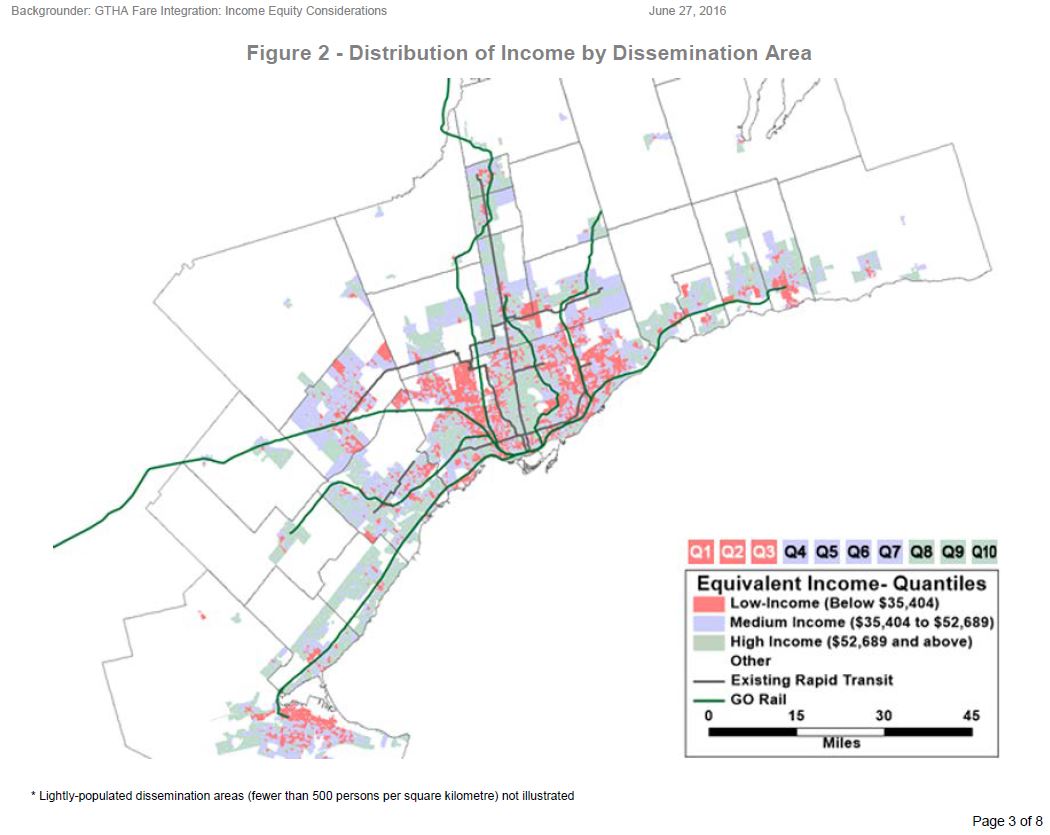
For the purpose of the analysis, Metrolinx looked at a fine-grained version of census data, “dissemination areas”, where each element contains less than 1,000 people.

[these …] typically exhibit greater homogeneity in the household incomes of their residents than larger geographic units. [p. 2]

Each of these areas would lie within one geographic section of travel surveys (the Transportation Tomorrow Survey which, at the time of writing would have been based on 2011 data), and the transit usage for each dissemination area was taken from the corresponding TTS area’s results. Census data on income was used to assign each census area to one of ten income ranges, and through this to map transportation patterns to incomes.

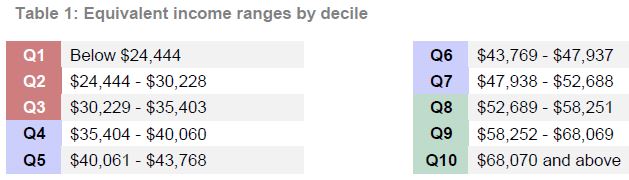
Note that there was no adjustment to reflect the availability of transit in any of the census areas, and the results merge data across the region. The income groupings are based on dividing a population of 6.5 million into roughly equal groups of 650,000. “Equivalent income” is a value derived from a combination of household income and household size.

fareintegration_incomedeciles_201606

The actual distribution of income shows a familiar pattern with higher incomes along the Yonge Street corridor and in some parts of the 905, notably those well-served by GO Transit.

fareintegration_incomedistribution_201606
Continue reading

The Metrolinx Fetish For Fare By Distance (II)

Back in June 2016, Metrolinx received two reports from its consultant, Steere Davies Gleave, that give some insight into the work and philosophy to that point on fare by distance schemes that Metrolinx contemplated.

GTHA Fare Integration Concept Evaluation Backgrounder

GTHA Fare Integration: Income and Transit Use

This article reviews the Concept Evaluation report. I will turn to the Income and Transit Use report in a separate post.

At that point, three concepts were under review:

  • A modified version of the existing flat fare system with adjustments to deal with the high premium for cross-border travel to and from Toronto.
  • A zone-based system
  • A hybrid system with flat fares region-wide for “local” buses (including local expresses and BRTs) and distance based fares for subways, SRT, LRTs and GO Transit (rail and bus).

The recently added fourth option, a full fare by distance tariff, was not in the mix.

The breakdown within the “hybrid” option was acknowledged to be incomplete with assumptions such as the placement of BRT and the need for additional classes of service still up for debate.

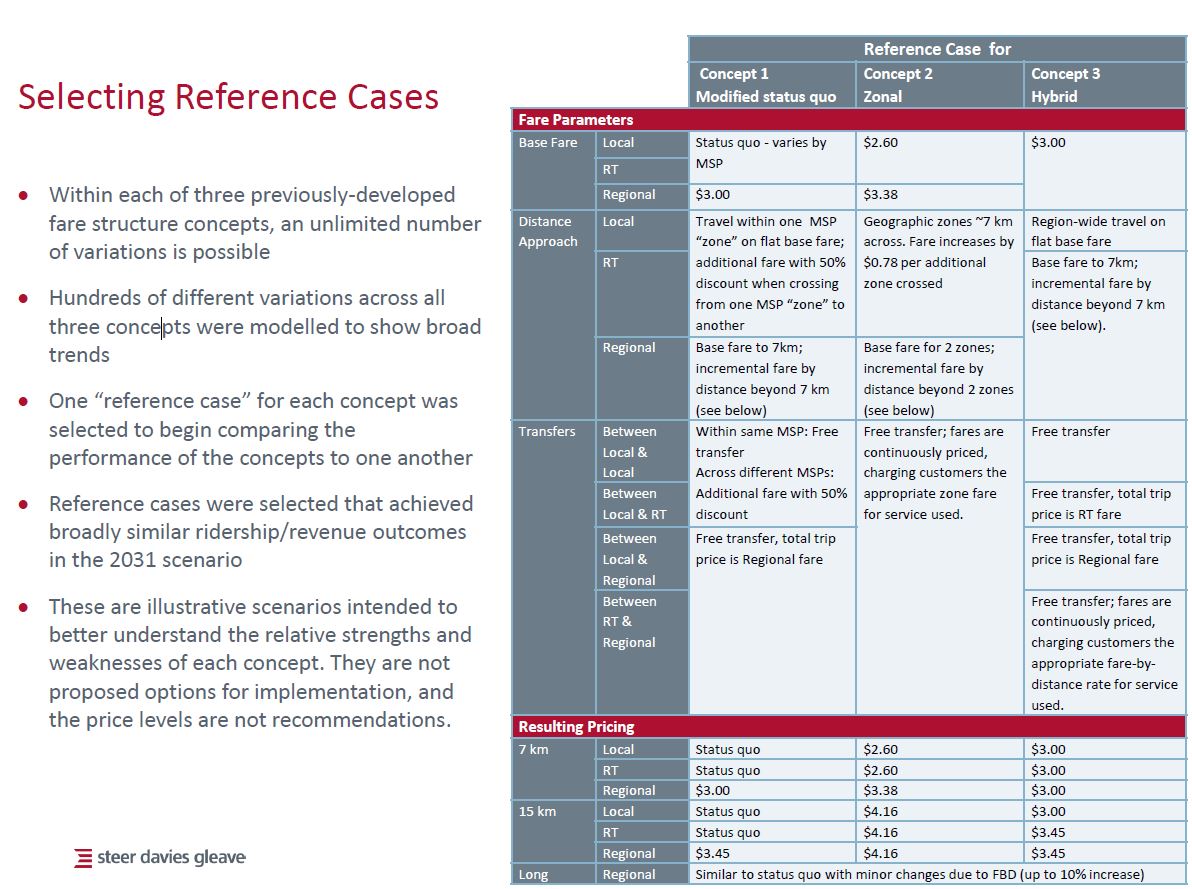
fareintegrationreferencecases_201606

The starting point for all sample fares was the then existing $3.00 cash fare on the TTC. The exact value is less important than the ratio between that base value and other proposed fares.

For Concept 1, there are only two changes. First, transfers between service providers would include a 50% discount on the second fare. This would reduce the cross-boundary fare from 200% of the base value to 150%. On “regional” service (GO), trips up to 7km in length would charge the base fare, and beyond this a distance based tariff would kick in. This would reduce the high premium now charged by GO for very short trips including those within the City of Toronto.

For Concept 2, the zone structure is built on the 7km screen used in Metrolinx proposals for “local” trips. The chart above is misleading for local trips because the chart shows a base fare of $2.60 with an additional $0.78 per zone, but because the second tier of pricing is set at 15km, it adds two extra zones. The pricing for trips that did not involve GO transit and the ratios to the “flat” fare would be:

DistanceFareChange
0 to 7 km$2.6013.3% discount
7 to 14 km$3.3812.7% premium
14 to 21 km$4.1638.7% premium
21 to 28 km$4.94$64.7% premium

For Concept 3, “local” services (buses) would retain the base flat fare, but rail modes (plus GO buses) would see an incremental fare for trips beyond 7km. The example shown here is a $3.45 trip (a 15% premium) for a 15km “rapid transit” trip, but there is no specification of how this pricing would scale for longer or shorter journeys.

Longer “regional” trips on GO would change by up to 10% because the longest trip prices (now lower on a distance basis than short trips) would have to be rebalanced to offset the reduced short trip fares.

This all looks quite reasonable from the abstract viewpoint of a “pay for what you use” philosophy, but the effects on riders are not spelled out geographically. The 7km cutoff for zone size and for the onset of distance based fares implies a fare increase for many trips. To put this in context, here are the bounds of a 7km trip from various points within Toronto. Note that these are “crow fly” distances, not trips plotted on the transit/street network.

FromNorthSouthEastWest
Queen & Yonge.7km N of Eglinton AveN/A.8km E of Woodbine AveGrenadier Pond
Scarborough Ctr Stn.7km N of Steeles AveS of Kingston RdW of Meadowvale RdE of Don Mills Rd
North York Ctr Stn.5km S of Highway 407S of Eglinton AveW of Victoria Pk Ave.7km W of Keele St
York UniversityN of Rutherford Rd.5km N of Lawrence AveYonge St.2 km E of Kipling Ave
Finch & Kipling.8km N of Langstaff Rd.8km N of Eglinton Ave.7km W of Keele St.4km E of Airport Rd
Six PointsHighway 401N/ADundas & Bloor Sts.4km E of Cawthra Rd

The “old” City of Toronto is rather compact, and a great deal of it lies within 7km of the core. This is not unlike the old “Zone 1” of the TTC before zone fares were eliminated. The suburbs are quite another thing, and 7km does not get one very far. Scarborough is 15km east-west at Ellesmere, and 13km north-south at McCowan. Cheaper “local” fares might apply to short trips within Scarborough, but not to trips anywhere else in the region. The “crow fly” distance from STC to York University is almost 20km, and to the business district downtown 17km.

With the goal of reducing cross-boundary fares, a whole new set of “long” trips that will pay a substantial premium for travel simply within the “amalgamated” City of Toronto will be created. Indeed, those cross-boundary riders will not see much of a benefit unless they live fairly close to their work locations. Scarborough Town Centre is more than 7km away from most of the area north of Steeles Avenue. Anyone working living in Rexdale but commuting to Markham faces a trip that will not bring the “cheaper” fare for short hops across the boundary. Richmond Hill is more than 7km north of Steeles.

The big savings would actually come to GO customers who now pay a full TTC fare to switch to that system. Their “local” fare would be bundled with their “regional” one at a premium of at most 10% over current fares.

Continue reading

The Metrolinx Fetish For Fare By Distance

On Friday, February 17, the Metrolinx Board will consider yet another update in the long-running saga of its attempt to develop an integrated regional fare policy.

It is no secret that for a very long time, Metrolinx staff have preferred a fare-by-distance system in which riders pay based on the distance travelled, possibly at different rates depending on the class of service with fast GO trains at the top of the pile. The latest update tells us almost nothing about the progress their studies, but does reveal that a fourth option has been added to the mix.

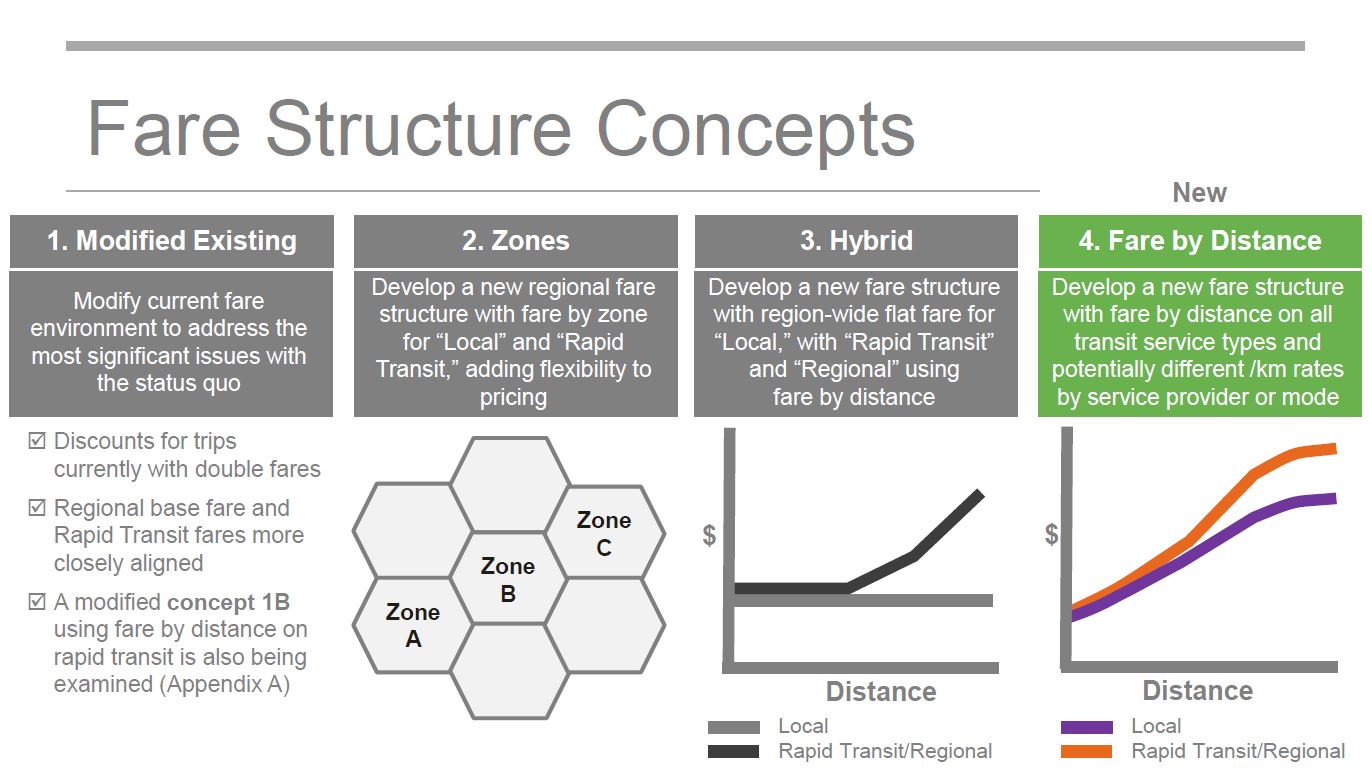
fareconcepts

Option 1, modifying the existing structure, simply adds discounts to smooth the rough edges off of the existing zones between service providers. This has already been implemented for GO Transit “co-fares” with systems in the 905, but it is notably absent for trips to and from the TTC. Riders face a full new fare to transfer between a TTC route and GO or any of the local 905 services.

Option 2, a more finely grained zone structure than exists today, would provide a rough version of fare-by-distance, but would still have step increments in fares at boundaries. Note that this scheme also contemplates a different tariff for “rapid transit”.

Option 3 is a “Hybrid” mix of flat fares for local services and fare-by-distance for “rapid transit” and “regional” services for trips beyond a certain length. The intent is to charge a premium for faster and longer trips on services that are considered “premium”.

Option 4 is new, and it eliminates the “flat” section of the Hybrid scheme so that the charge for a trip begins to rise from its origin and there is no such thing as a “short” trip at a flat rate. The rate of increase would vary depending on the class of service.

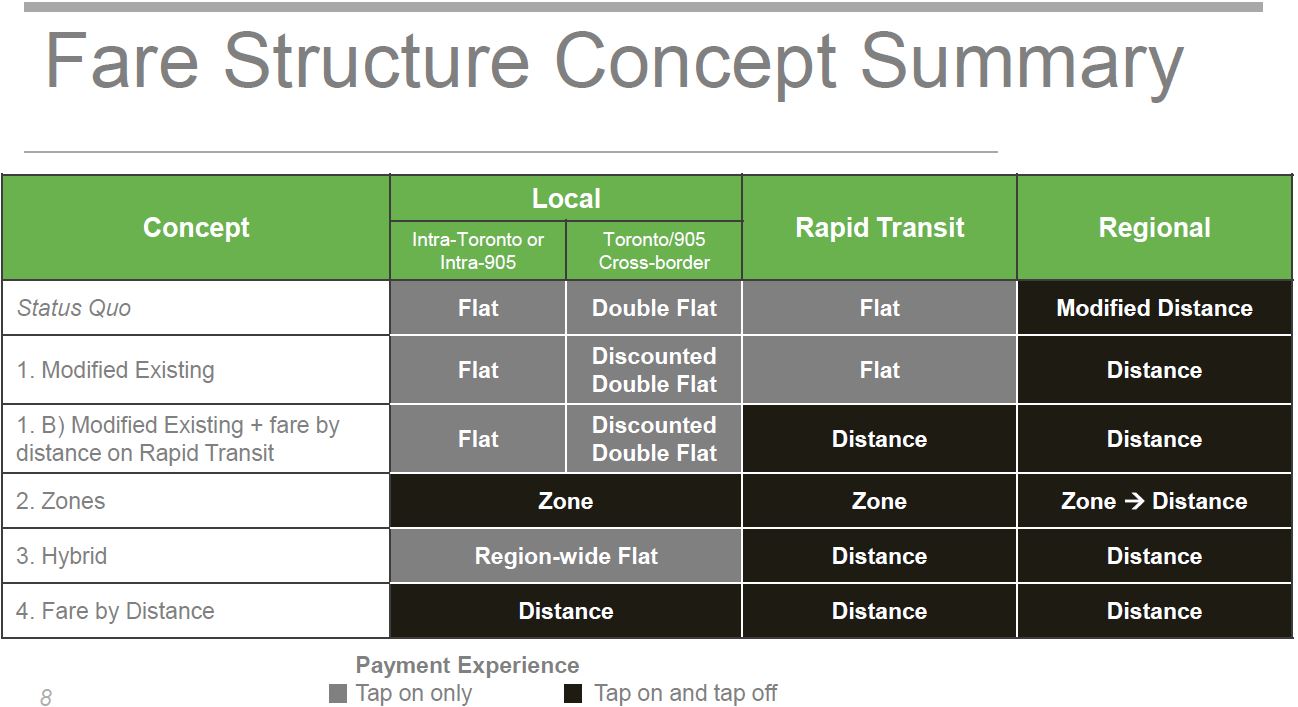
fareconceptsummary

Ever since Metrolinx began to treat “rapid transit” as a separate fare class, this created an inevitable conflict with the Toronto transit network’s design as an integrated set of routes where subways provide the spine. Riders are not penalized with a separate fare for using the subway because it was built to replace and improve on surface streetcar and bus operations. This is fundamentally different from GO Transit which replaced no significant existing transit services in its corridors, and which was designed as a high speed operation to attract commuters out of their cars.

Continue reading