Part 1 of this article reviewed recent approvals and designs for the Eglinton LRT. In part 2, I will turn to the remaining Transit City routes.
The main article follows the break below.

Part 1 of this article reviewed recent approvals and designs for the Eglinton LRT. In part 2, I will turn to the remaining Transit City routes.
The main article follows the break below.
Today’s Metrolinx Board Meeting was notable both for the update, in public session, of the project status for five major lines as well as for supplementary information that came out in a press scrum after the public session.
Five projects now have funding and are at various stages in their approval/construction process.
Updated October 2 at 11:15 pm:
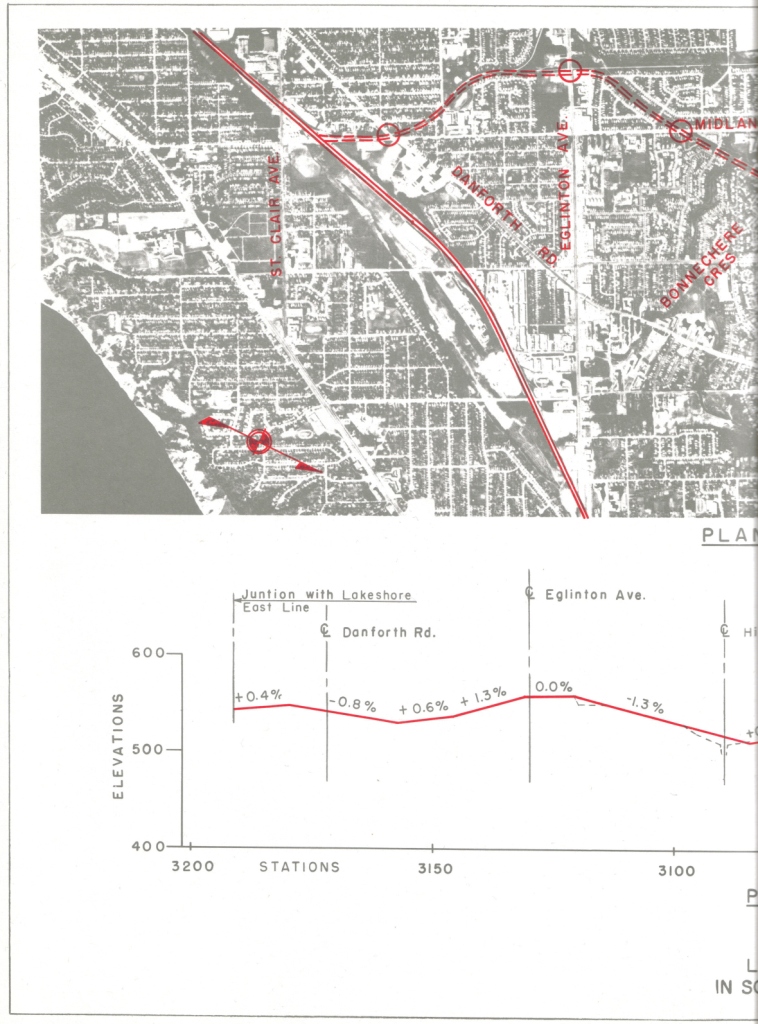
In the comments thread, a question has come up about the originally proposed alignment of the SLRT. This dates back to the Metropolitan Toronto Transportation Plan Review (MTTPR) and a study of alternatives to the Scarborough Expressway. One of these was an LRT line starting at roughly Queen & McCaul running east to the CNR Kingston Sub at Degrassi St., then northeast via the CN to Morningside Avenue. A branch would run north from Scarborough Junction following mainly existing and abandoned rail corridors to the Scarborough Town Centre.
That branch eventually became the SRT, but was moved to follow the Uxbridge Subdivision because the old right-of-way used in the first proposal was very narrow. As you will see from the maps, this is not the very wide Hydro corridor that crosses the SRT line, but a much tighter route.
To orient yourself, the Uxbridge Subdivision runs just below the top edge of these maps which have north to the right.
Updated September 30 at 4:50 pm:
Item SC 28.30, which requests the TTC and Metrolinx to report in November 2009 on an LRT implementation for the SRT, was passed today by Council.
Item SC28.20 was ruled out of order and withdrawn.
Updated September 30 at 12:45 pm:
This morning, in discussion of another Transit City matter on the Council Agenda, Councillor Thompson asked TTC Chief General Manager Gary Webster about the status of the Scarborough project. Among other things, Webster replied that:
The debate will continue this afternoon, but I suspect the items listed in my original post below will not be dealt with until tomorrow given their place on the agenda.
Original post:
Toronto Council’s agenda today, September 30, includes items of interest regarding the Scarborough RT (SRT) line.
My thanks to Peter Miasek who sent me the link to this item on York Region’s website.
Recently, Ontario’s Deputy Minister of Transportation, Bruce McQuaig, wrote to York Region advising on the financial and operational framework for “designated projects” as defined in the recently enacted Metrolinx legislation. This letter can be found among several pieces of correspondence bundled into one PDF starting on pages 12-16.
I understand that a similar letter went to the City of Toronto, but it has not yet appeared in any public debates, partly because there are so few of them currently. It is alluded to in a TTC report on Transit City funding.
The scheme begins with a desire by Queen’s Park to bring its books into line with current accepted accounting principles. What this means, in practice, is that instead of shipping money off to York Region and Toronto, never to be seen again except as part of the Provincial Debt, Ontario will now own the assets purchased with those funds. Nothing in the letter explains how those portions of projects funded by others such as Ottawa would be treated, nor what would happen with extensions of existing lines owned municipally like the Yonge-University Subway.
The assets would be depreciated over their expected lifetimes and would show up as an offset on the provincial books to the debt raised to fund them. This is a neat bit of accounting that ignores the fact that an asset only has a real value if you could sell it and recapture your investment, but it keeps the bean counters happy and makes the books look better for the politicians. To quote the letter:
Through retaining the risks and rewards of asset ownership over regional transportation assets, the Province can best achieve its accounting and financial management objectives.
This, of course, has nothing to do with transit and could equally refer to a hospital, a school or a highway.
There are some fine words about partnerships with the municipal governments coupled with concern about “value-for-money to taxpayers and transit customers”. Then we get into the details.
Ontario, through Metrolinx, will own and control the Sheppard LRT, Eglinton LRT, Finch LRT, Scarborough RT and VIVA Next Bus Rapid Transit. Ownership, from an accounting point of view, requires control and this means that Queen’s Park can’t just build the lines, they have to actually appear to manage them rather than effectively ceding them to municipalities via a long-term lease. This does not prevent Metrolinx from contracting with local agencies for construction, operation and maintenance, but on paper, the lines remain Queen’s Park’s property, and they could be assigned to some other entity if they chose to do so.
Terms of any operating agreement would be set at 75% or less than the expected lifespan of the asset so that, in a worst case scenario, Metrolinx would regain control of a line before it was run into the ground. A great deal of legal verbiage must be created to define the criteria to which local agencies (or any private entity) will be held by Metrolinx. This strikes me as an opportunity for a huge bureaucratic waste of time especially if all parties involved are in the public sector.
Metrolinx will define project scope, budgets and schedules, and any changes will require their approval. Given the total absence of political input from the municipal level to Metrolinx, these discussions will likely happen in private. Of note is the exclusion for Metrolinx funding of ancilliary upgrades to utilities, streetscaping, etc. that are thought to be add-ons of convenience for a municipality rather than an integral part of a transit project. It will be interesting to see what standards Metrolinx defines as the “basic” level it will fund, and how much will fall on municipal budgets.
Queen’s Park wants transit riders to “experience the benefits of a regionally integrated and inter-operable system”, and the Presto fare card will be a requirement for all of the designated lines. In a telling comment, the Deputy Minister states:
… the Province and Metrolinx will … monitor the evolution of technologies, and will consider how to plan for enhancements and improvements as part of an overall strategy to sustain the Presto electronic fare collection system.
“Evolution” will no doubt include a recognition that this is not a situation where Ontario should develop or adapt a proprietary technology, but should work with internationally recognized electronic payment standards and systems. The time is long past when Ontario could get away with building “roll your own” systems, and they need to look at the extensive experience in other jurisdictions.
While Metrolinx is working on the benefits of a regional service, they will also need to address the integration of GO Transit fares and service into the wider regional system. GO, as a separate entity, has remained aloof from regional integration except as it suits them with cost sharing arranements in 905 municipalities. These arrangements are to GO’s advantage because the joint fares with local operators are much cheaper than the cost and development effects of building more parking at stations.
Finally, Infrastructure Ontario will act on Metrolinx’ behalf for projects that are to use Alternative Financing and Procurement (AFP). This is a variation on a PPP in which the asset may actually be built and held by a private company and leased to Metrolinx. The accounting fig leaves are thick on the ground here. One way or another, Ontario borrows money, Metrolinx builds something (or has it built for them), and, likely, the local operating agency contracts to run it.
Lurking under all of this is a clear indication that it is Queen’s Park, not the Metrolinx Board of Directors, who runs the show. To be fair, it is their money (or more accurately our money), but the opportunities for interference and sheer bureaucratic incompetence are legion. There’s a reason transit has been in local hands for decades — the Ministry of Transportation hasn’t the first idea how to operate large systems, nor any feeling for the local issues involved.
Metrolinx itself becomes little more than a construction planning and, later, a holding company on the Province’s behalf. This should not overly tax the skills of the new, non-political Board, for whom all of the important decisions will be made elsewhere.
This series works through the three-part presentation of the proposed Eglinton LRT design that appears on the project’s website. Part 1 brought us east from the Airport to Black Creek, and Part 2 covered most of the remainder east to Warden.
Part 3 of the presentation deals with the short section from Warden to Kennedy as well as various construction issues, notably an alternative scheme for tunnelling.
Updated 11:25 am: Information about maximum gradients added as well as a comment about costing of the underground alignment north of Sheppard.
Last week, the TTC and City conducted an open house for the Scarborough RT extension project. As regular readers here know, I have long advocated that the RT technology be changed from ICTS to LRT, but there is little sign of a move in that direction in the materials on view at the open house. A single panel (page 32 in the presentation) says that the technology is yet to be determined, but the design clearly is based on an RT implementation.
This is rather odd considering that a rethink of the RT/LRT debate has been floating around since last fall when Metrolinx produced its report comparing the benefits and costs of various alternatives for the RT extension. If a real comparison were underway, we would see two designs that reflect the requirements specific to each technology and exploiting the advantages of each. Moreover, the keep/replace decision would be part of the larger context of the future of the existing RT and its place in the context of Transit City.
Back in 2006, after a study of the RT’s future, the TTC adopted a policy of retaining the ICTS technology. The context for that decision was very different from today:
In less than a decade, the RT will truly be a technology orphan, an ICTS line surrounded by a network of LRT lines. However, the 2006 policy decision has yet to be revisited.
The TTC, echoing a tactic used decades earlier, has created a scenario that demands complete grade separation of the RT extension by claiming an 10,000 per peak hour demand for the line. However, this only applies to the section between Scarborough Town Centre and Kennedy, not to the whole line. Demand north of Sheppard is projected to be only 2,500 by 2031. (During the original LRT scheme’s debates in the 1980s, TTC claimed that an elevated LRT would be needed through STC to avoid isolating property south of an LRT right-of-way. The LRT proposal took the hit of what was then considered an intrusive elevated structure thus paving the way for ICTS.)
The design shown at the open house was clearly prepared for an ICTS implementation. All of the illustrations show trains that look suspiciously like Mark II ICTS, and the route is integrated only with the existing RT, not with Transit City for vehicle maintenance.
Several questions remain unanswered:
Difficult though this may be, the TTC needs to address the technology issue for the entire RT line and do this in the larger Transit City context. Many design issues hinge on the technology choice notably the reconfiguration of Kennedy Station. If this will be a junction of three LRT lines (Eglinton, Scarborough-Malvern and “RT”), the layout will be very different from that with ICTS technology on the RT.
The short-sighted 2006 policy decision to retain ICTS must be reviewed. Too often, I hear rumours and comments suggesting that support for ICTS is dwindling among transit professionals in Toronto, but none of this surfaces in public debate. We need that debate now.
Tuesday, June 2 was a long day for members of Toronto Council’s Executive Committee. Many transportation issues were on the agenda including Union Station Revitalization, Western Waterfront Master Plan, Queen’s Quay redesign, and the Gardiner Expressway replacement EA.
As if that wasn’t enough, an open house for the Scarborough RT extension took me out for a ride on the Milner bus.
This transit blogging is harder than my pre-retirement work! Continue reading
The City of Toronto and the TTC will hold an open house for the proposed extension of the SRT:
This open house is described as part of the preliminary planning for an EA for this project. One important outstanding issue is the question of vehicle technology, and this is far from settled. For example, the current proposal included in the meeting notice (not yet available on the City’s website) shows a new yard east of Bellamy and Progress. This yard would not be required if the line is built as LRT because it would share the proposed carhouse for the Sheppard East line.
Also, the station connection at Sheppard will be affected if both routes are LRT because a track connection for carhouse moves will be needed.
Whether these issues are addressed in the presentation materials on June 2 remains to be seen.
Today, Queen’s Park announced that it would fund three of the Transit City projects — Eglinton, Finch and the Scarborough RT rehab/extension — as well as upgrading of York VIVA BRT corridors with dedicated lanes.
The announcement is fascinating in places for what it does not say, or leaves for future decisions. Despite much of the build-it-yesterday rhetoric accompanying the GO/Metrolinx merger, the design and EA processes now under way will run their course. Indeed, the Transit City projects have been proceeding apace thanks to funding at the municipal level to complete this work without waiting for agencies like Metrolinx to get on board.
The estimated cost for the York VIVA project is $1.4-billion with completion in stages from 2011 to 2013. Lines that will connect with VIVA include the Spadina and Yonge subway extensions although full funding for the latter is not yet in place.
The Scarborough RT will undergo vehicle replacement, infrastructure upgrades and extension to Malvern Town Centre or to Markham Road. This project will cost $1.4-billion “depending on the technology choice”, and construction will run from 2010 to 2015. Connecting lines include “the proposed Sheppard East LRT”.
The Eglinton Crosstown line will run from Pearson Airport to Kennedy with a future extension to Malvern (this is the Scarborough-Malvern TC line). The line will be tunneled between Keele and Leslie, and the total pricetag is $4.6-billion. Constuction will run from 2010 to 2016.
The Finch LRT will run from Humber College to Don Mills, and then south to Don Mills Station where it will connect with the “proposed Sheppard Avenue East LRT”. The project will cost $1.2-billion with construction running from 2010 to 2013.
An obvious question in response to this impressive list is “where’s Sheppard East”? First off, as I noted above, some lines mentioned in the announcement don’t have funding yet, and the Sheppard LRT is mentioned twice. Finch is explicitly listed as an LRT project, and the technology choice for the RT is still up in the air (no pun intended). That choice depends on Metrolinx’ own Benefits Case Analysis (BCA) for Eglinton expected to be available, at least in private session, to the Metrolinx Board this month. We know that the Scarborough RT BCA looked favourably on the LRT option.
There isn’t much point in building one lonely LRT line up on Finch if it wouldn’t be connecting with a larger network, and I think this suggests a larger LRT network is in our future.
Although the source of funding for Sheppard isn’t announced yet, Mayor Miller speaks of construction starting this year on Transit City. The only place that is possible is on Sheppard. Also coming up will be the new streetcar order for the “city” network, yet another opportunity for substantial provincial funding. I suspect there are more rabbits waiting to pop out of one or more hats.
Finally, lest our friends to the west think I have ignored them in my haste to talk about Transit City, Queen’s Park will also fund rapid transit studies in Hamilton. No technology is mentioned. There is strong political support for LRT in Hamilton, but will Queen’s Park and Metrolinx let them build anything more than BRT. A lot depends on what the studies will reveal about demand and development impacts.
This month’s TTC agenda includes a long update on the status of the Transit City plans. I will not attempt to précis this report, but will touch on points of particular interest.
Funding is in place to allow continued work on Environmental Assessments [sic] and other engineering work, but the real challenge comes later this year when construction is slated to begin on Sheppard. The fog may clear a bit once the provincial budget is announced and we know just how much money will flow to Metrolinx and to transit in general.
A related problem, of course, is the question of new LRVs for the existing and future streetcar/LRT networks. By the time the budget is out, the TTC should know what the bids for new cars look like, and Queen’s Park will have to decide whether they are serious about paying for them. Continue reading