
This post has had its share of problems including some horrendous rearrangements of the text. Obviously the site does not like the idea of a Queen Subway one bit, and is having indigestion on the subject. Continue reading
Subways
The Queen Street Subway Debate
I have been truly astounded that the post on the new streetcar plan has turned into a pitched battle between the pro and anti LRT/subway forces on this blog. Frankly I am getting a little tired of it because, after all, this is my blog and I happen to believe that LRT is going to rule the day.
This will happen for three reasons:
- We cannot afford a subway network,
- We do not need a subway network, and
- We must not put off transit improvement in the vain hope that someday the tooth fairy will give us the money to build one.
All of the pro and anti subway comments have been edited into this separate thread and I am closing the debate on this issue. Several comments that were sitting in moderation are included here.
If you want to talk about the streetcar plan, fine, I will continue adding to that thread and commenting on it. If you want to tell me how the manifest destiny of downtown Toronto is to have a network of new subway lines, please start your own blog. Continue reading
Walk Left, Stand Right
One of my regular correspondents, David Crawford, passed on this post on the torontoist blog about the disappearing escalator signs.
David comments:
For a group of people who can’t find time to put up clear and current signage (lots of examples on your site) I find it amazing they can find time and man-power to remove signs that seem, to me anyway, as being very useful. They have them in London where the escalators are very orderly, they do not have them in Montreal, where it’s chaotic – draw your own conclusions!)
From my point of view, the most walking that happens on escalators is at times when they are not running at all. This has not been as bad of late as the months I documented earlier in 2006, but it still happens far too often.
As for claims that an escalator cannot be restarted without an extensive technical check, here’s a counter example. A few days ago, at Broadview Station, the oft-stopped escalator was restarted by someone who just arrived on the scene, inserted a key to start it, and then wandered off again. So much for a complex inspection, just another of those wonderful TTC excuses for not providing good service.
How The TTC Will Pay Its Way?
Today’s Star has an article by this title, except there’s no question mark. The question of property development on TTC lands comes up from time to time with an unfortunate feeling that a “gold rush” is just around the corner. The TTC could do everything we want if only it would develop its surplus property. Continue reading
The Subway Diversion Map
For those of you who collect variants on the subway map, here is the version that was published as part of the report to the Commission last week.
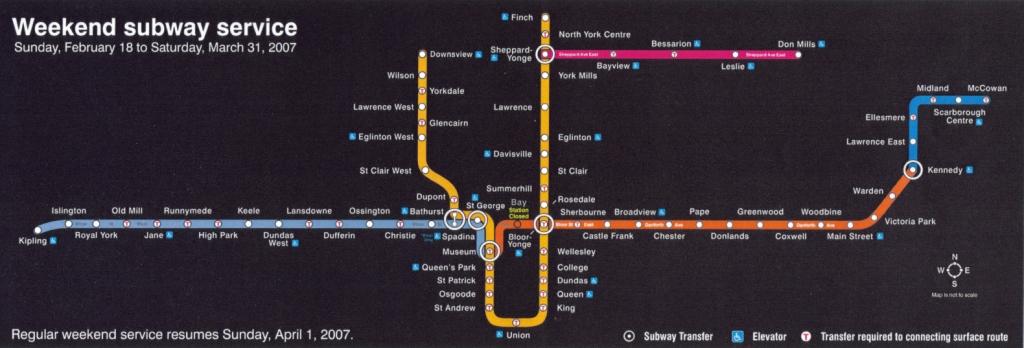
Many people seem to come to this page innocently looking for the real subway map. It can be found on the TTC’s website.
Service For January 2007
January 2007 does not bring much in service changes beyond the return of streetcars to St. Clair west of the Spadina Subway. Buses will continue to run east to Yonge Street until, it is hoped, the middle of February.
The RT will continue to operate with buses on Sundays to allow testing of the new RT signal system. As a regular user of this line, I am looking forward to it actually working on those cold mid-winter days (which surely will be here eventually) when the old system regularly froze up.
There are several minor changes in running times and a few added trips here and there, but nothing major in improved service. Current expectations are that we won’t see anything significant until the fall when sufficient operators, buses, and budget headroom will, in theory, be available.
Meanwhile, the list of services that should be improved or operated, but are not due to funding and other constraints, continues to grow. Continue reading
TTC Meeting Wrapup: December 13, 2006
The first full meeting of the new Moscoe-less TTC took place on Wednesday. Nothing was particularly astonishing. Like all first meetings, we watched as the newcomers found their way around the agenda and the complexity of what’s going on. One can only hope that new Commissioners will learn to address issues rather than making speeches.
To his credit, the new Chair Adam Giambrone stayed on top of the agenda and moved business along as briskly as possible without visibly throttling debate. A few delicate interventions framing the sense of the meeting in a motion rescued us all from interminable rambling.
Meanwhile on the agenda: Continue reading
Automatic Train Operation, Capacity, Night Service and Clean Stations
In a truly breathtaking display mixing unrelated subjects in one press conference, Howard Moscoe has embraced Automatic Train Operation (ATO) as the salvation of much that is wrong with the TTC. A chicken in every pot (provided that you have a Metropass) will follow soon after.
You can read about Moscoe’s scheme on the Star website: TTC Eyes Driverless Subway. Continue reading
How Frequently Can We Run Subway Trains
A comment in my review of David Miller’s platform triggered a technical discussion about this issue. To segregate this from the thread on Miller himself, I have moved the relevant information here. If you plan to add to this issue, please do so here.
The issue was previously reviewed in this post.
I made the comment:
Mayor Miller claims that we will improve capacity on the Yonge line by 40% through new trains and signalling. Running the trains more frequently will require changes at Finch Station (probably a northerly extension) to allow for faster turnarounds, and will definitely require some changes on the Spadina line (currently planned as part of the York U extension). Don’t plan to see those empty, uncrowded trains until a decade from now, at least.
This provoked various responses: Continue reading
Two Kilometers a Year
We hear a lot from subway advocates about the need for an ongoing project to expand the subway system. Leaving aside the question of how we will pay for it, what would we actually see for our efforts?
The building rate proposed is two km/year. If we were going to build west from Yonge Street and we started today, it would be late 2010 before we reached Jane Street, late 2014 to reach the western boundary of the city, somewhere like the airport for example. Every penny we could scrounge would go into that line, and by 2015 we would still have big transit problems in most of the city. This assumes we start tomorrow, and we all know that nothing will happen for at least two years while we debate where the line will go, design it and get EA approval.
If we are serious about expanding the transit network in a meaningful timeframe, we have two choices:
- build much more than two km/year and be prepared to pay for it, or
- use something other than subways to expand transit capacity, and build lots of that.
Mayoral hopefuls and other subway advocates need to be honest about the costs and benefits of their plans. The two km rate was once floated by Rick Ducharme, back when we actually thought that would cost $200-million or so. The Sheppard Subway, our most recent project, was 6 km long and cost us almost $1-billion not including the vehicles that were purchased separately. Even allowing for the huge expense of the junction at Yonge Street, $200-million hasn’t bought two km of subway for a long time.
I will return to the issues involved in building LRT in a future post and will incorporate many of the comments that are stacked up in feedbacks from various readers that have accumulated in my inbox.
 Steve Munro