Furious George Has A Plan (Update 2)

Updated June 8, 2010 at 11:00 pm:

The Smitherman campaign has posted a backgrounder to his transportation plan which has been updated to reflect the funding of inflation by Queen’s Park.

In a previous update, I noted that there was a bit over $1-billion still unaccounted for.  This is explained in the backgrounder as follows:

Once the provincial government formally approves their contribution escalation the Smitherman construction cost increment is reduced to $3.87­billion, or $5-billion once financed to 2021. [Page 3]

Although this issue has been addressed, the method of paying for transit investments has not been changed.  Smitherman still depends on revenue from gas tax and dividends from City agencies, money that is already spoken for by existing budgets at the TTC and the City.  He also depends on new tax revenue from developments along the routes to be built.  However, those taxes traditionally have been at least partly spent to serve new residents and businesses these developments would bring.

While I applaud Smitherman for at least producing a detailed plan, I still do not agree with elements of it such as the Bloor-Danforth subway extensions or with his financing scheme.  (For the record, at Council today TTC staff responded to a question from Councillor Thompson about a subway extension and explained that any subway extension could not be built along the existing SRT corridor.)

The original content of this post follows the break.

Continue reading

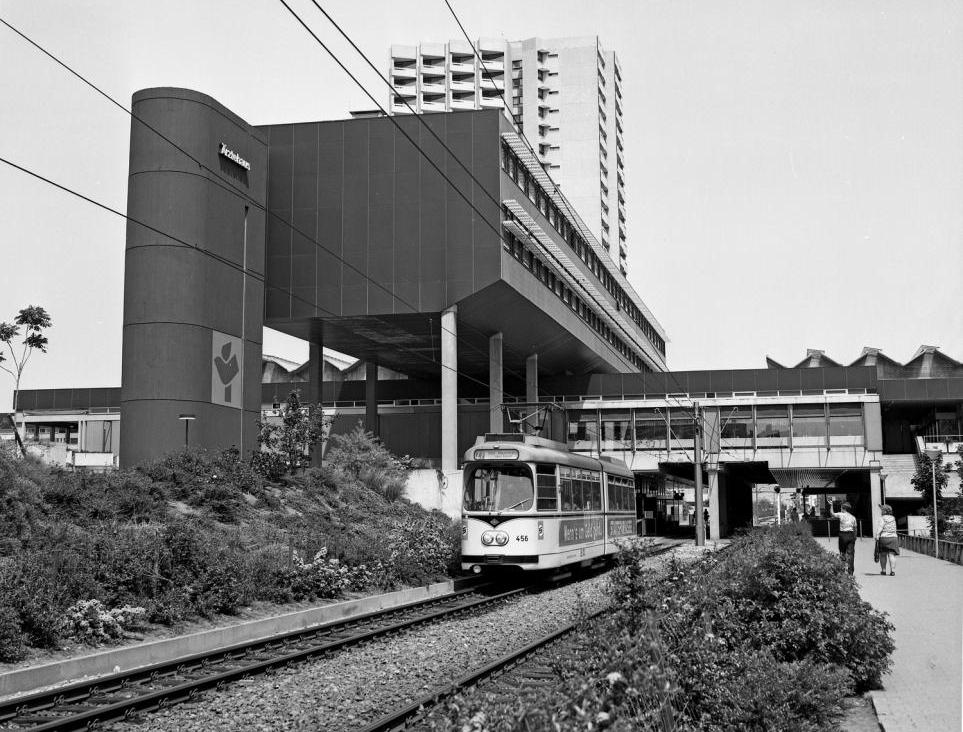
The SRT As It Might Have Been

John F. Bromley sent me a photo of a new LRT line running through a commercial development.

Look familiar?  Can you say Scarborough Town Centre?

The photo is from June 1972.  The cars were the first in Europe to be air conditioned.

This shows the kind of thing done with LRT in Europe even before the TTC reversed its anti-streetcar policy, about the time Queen’s Park decided that we needed an “intermediate capacity” system midway between buses and subways, and before the TTC collaborated with Queen’s Park in destroying an LRT plan that could have been built 40 years ago.

How Clean Is My Station?

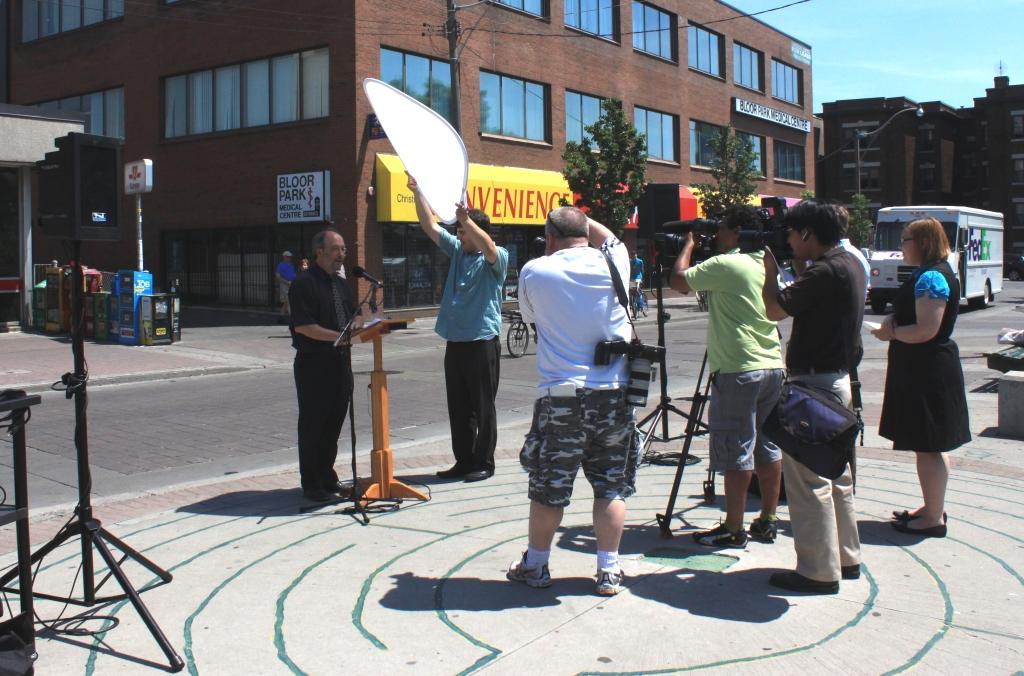
On May 27, TTC Vice-Chair Joe Mihevc staged a most unusual press conference at Christie Station.  The purpose?  To announce a new website, ttcpassengeraudit.com, where riders can report issues about the subway stations they use.

On July 17, 2010, volunteers who sign up for a specific station will audit their sites and post responses via an online form (available only in hard copy as I write this).  Topics to be reviewed include lighting, cleanliness, maintenance, way-finding, the station exterior and surroundings, safety and quality of ride (not strictly speaking a “station” related issue).

The need for customer-based reporting is an admission of failure in “official channels” to get things done.  Customers report lots of things to the TTC today, and some are even addressed, but many languish for months with no apparent action.  The TTC maintains web pages with information about escalator and elevator maintenance, as well as construction projects, but these cover the large, planned works, not day-to-day housekeeping.

Some issues, such as the long-standing closure of the “new” entrance to Broadview Station, are not listed on the TTC site at all.  (As a passing update, some work appears to be taking place, but very slowly, and the notices now claim the entrance will reopen by June 30, 2010.)  Riders should be able to get up-to-date information about the status of such projects online without counting on transit activists or Councillors to chase TTC staff.

The TTC hires an outside agency to audit its stations to give an unbiased view of what is happening.  Although there are goals for improvement, the index for the system as a whole inches up very slowly.  TTC claims that it is hamstrung by the availability of staff and things would be so much better if only there was a greater subsidy.  Whether the staff they have is properly managed and monitored is not discussed, at least not publicly.
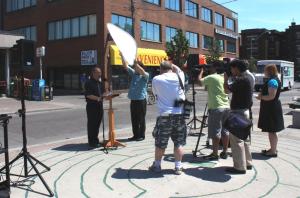
The press conference was unusual in that it had no TTC official presence, and it was conducted, at least initially, outside of the station.  It was very hot, and Mihevc’s assistant Anthony Schein held a reflector to act as a parasol.

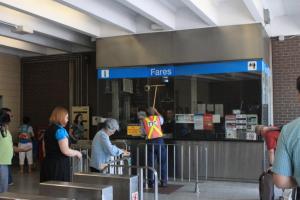
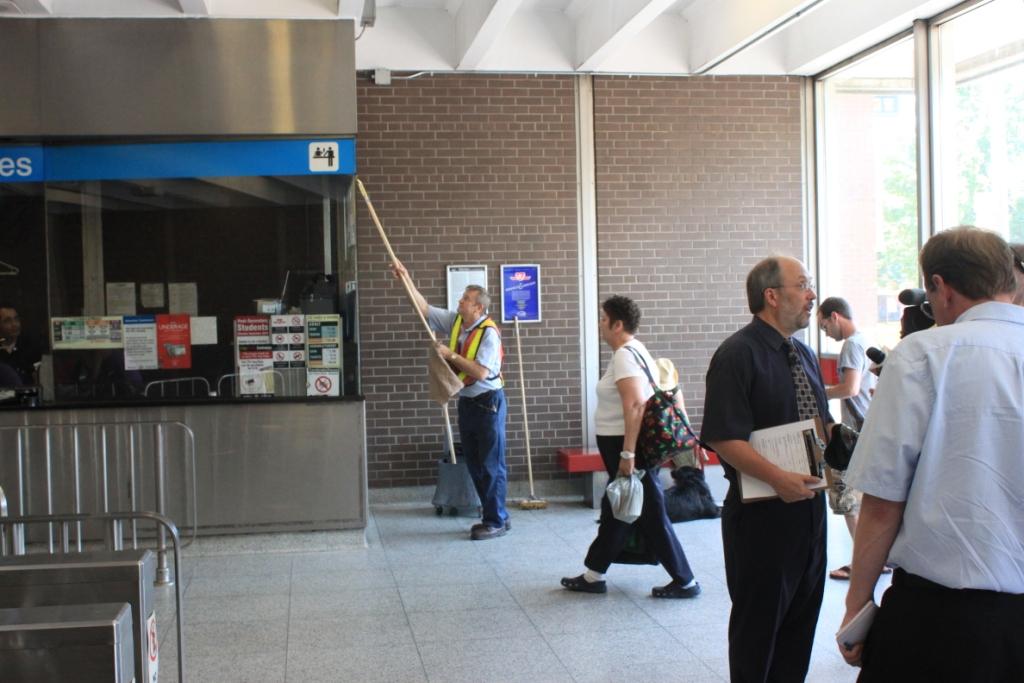
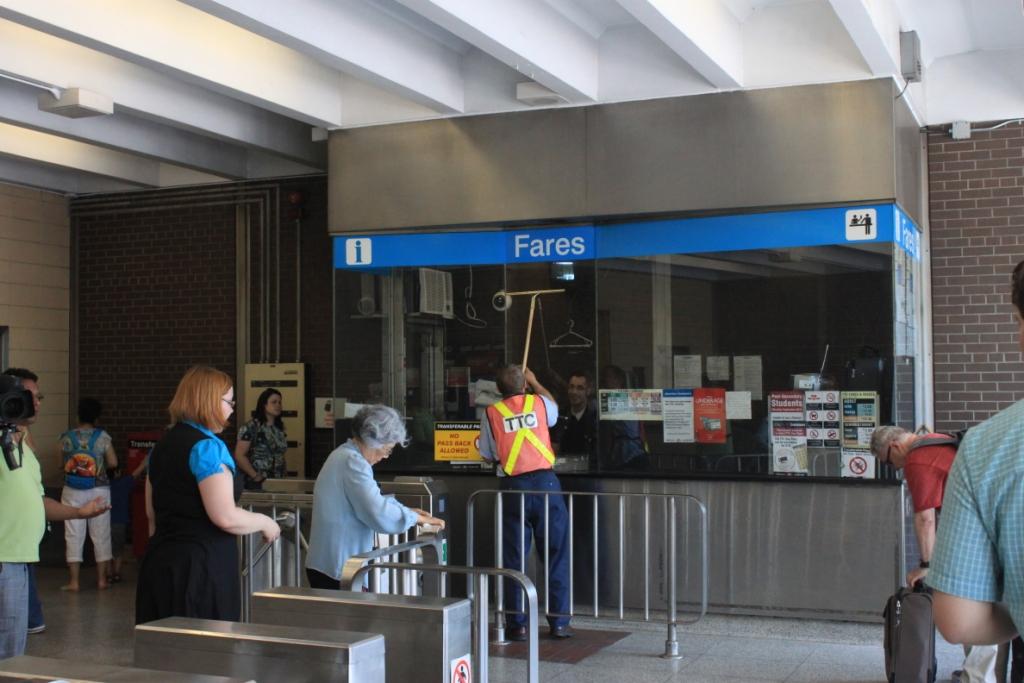
Later, we all moved inside, and things took quite an amazing turn.  Strangely enough, the TTC had two workers on hand cleaning the station.  I had seen one sweeping the platform when I arrived, but upstairs there was another.  As Joe spoke, the cleaner was washing the glass of the Collector’s booth.  I have been riding the subway since it opened, and I have never seen this activity.  Maybe I just don’t frequent the right stations.
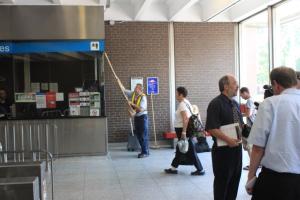
Note also that the signs in the booth window are all lined up.  If you look closely, you will see that only one of them is hand-written.

Meanwhile, elsewhere in the station, we have:
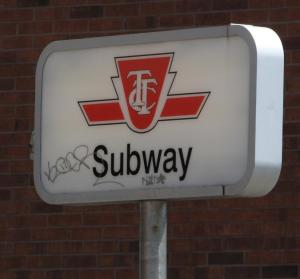
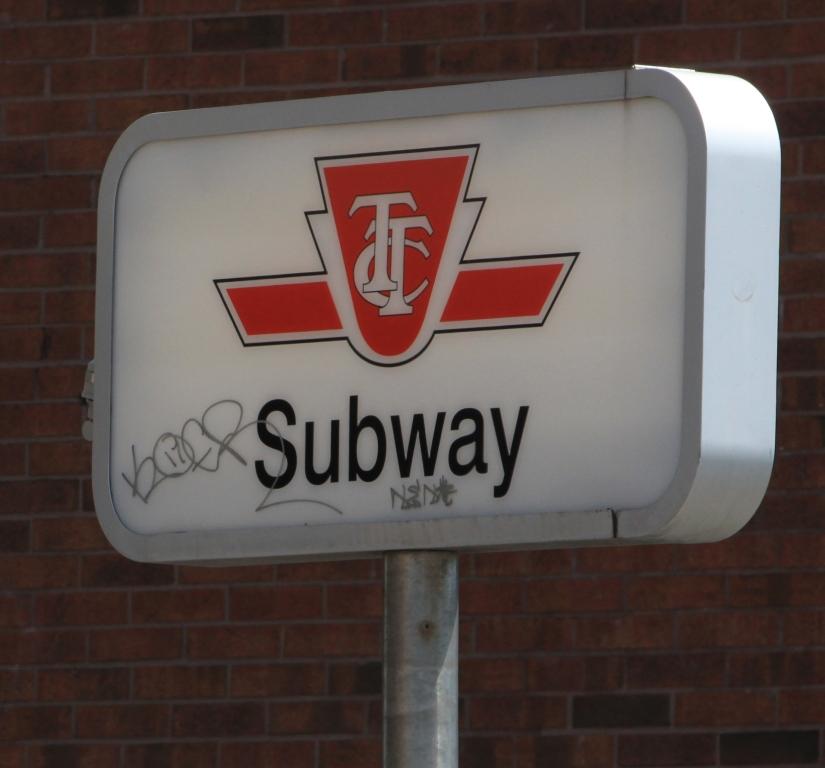
The entrance sign bearing a tag, and …
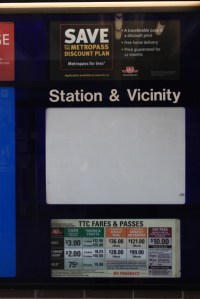
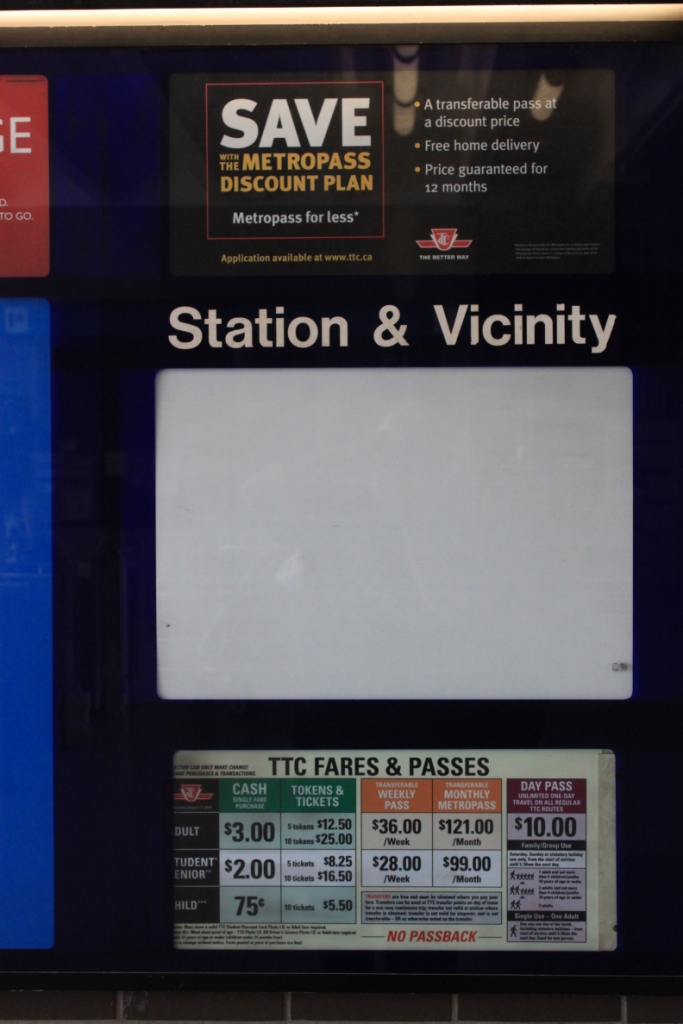
The long-missing vicinity map.  After the debacle of new and wildly inaccurate maps last September, maps that vanished in the blink of an eye once the problem was reported, the TTC assured us that new maps would be in place by November.  It is now May.

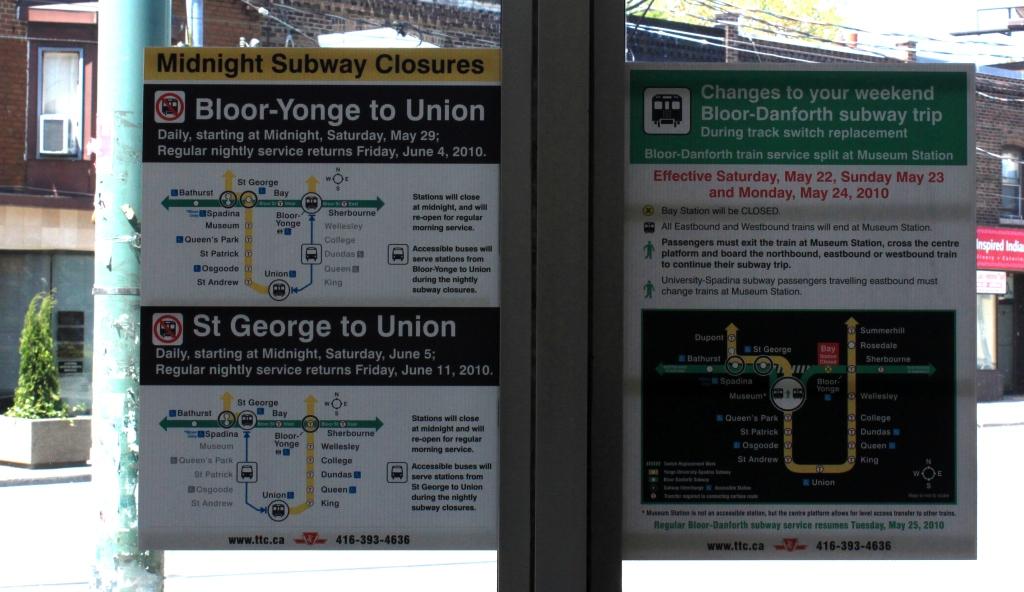
On the subject of removing and installing signs, the TTC has outdone itself in recent days.  An ongoing problem is that old signs are never taken down, they just fall down, eventually, after being vandalized, shredded, or just slowly crumbling off of the wall.  Last weekend, there was a subway diversion at St. George, and posters announced the temporary routing.  Starting this weekend, there are nightly shutdowns of parts of the Yonge-University line.  Signs for the new diversion were installed days after the St. George diversion ended, but the old signs remain in place.

At Broadview, main level, they are side by side.  At the mezzanine level, the St. George notice occupies pride of place at the foot of the main stairway in front of the newsstand, while the YUS notices are tucked away in corners.

Why is it not possible to take down out-of-date notices, especially when the space could be better used for current information?  How long will these two signs languish at my station?  Will we give a prize for the station with the most out-dated signs or maps?

For many years, I have urged the TTC to adopt a simple tactic I saw decades ago in Boston where all notices have a “stale date” and text at the bottom saying “Remove after xxx”.  Station cleaning staff take down old signs as part of normal housekeeping.  Somehow, this simple process is beyond the abilities of the best transit system in the known universe.

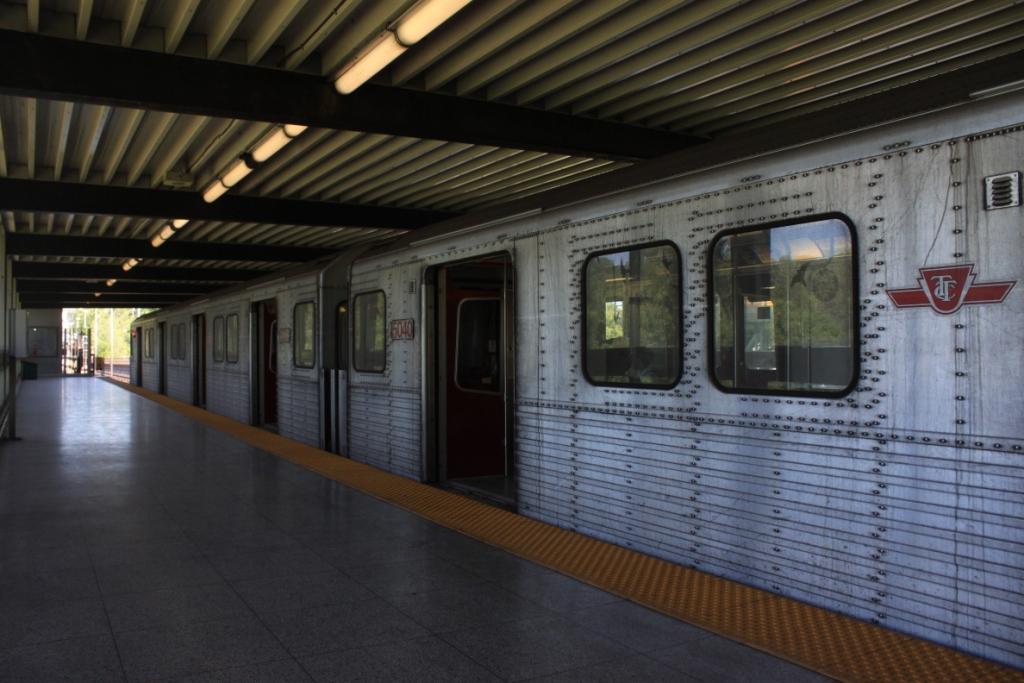
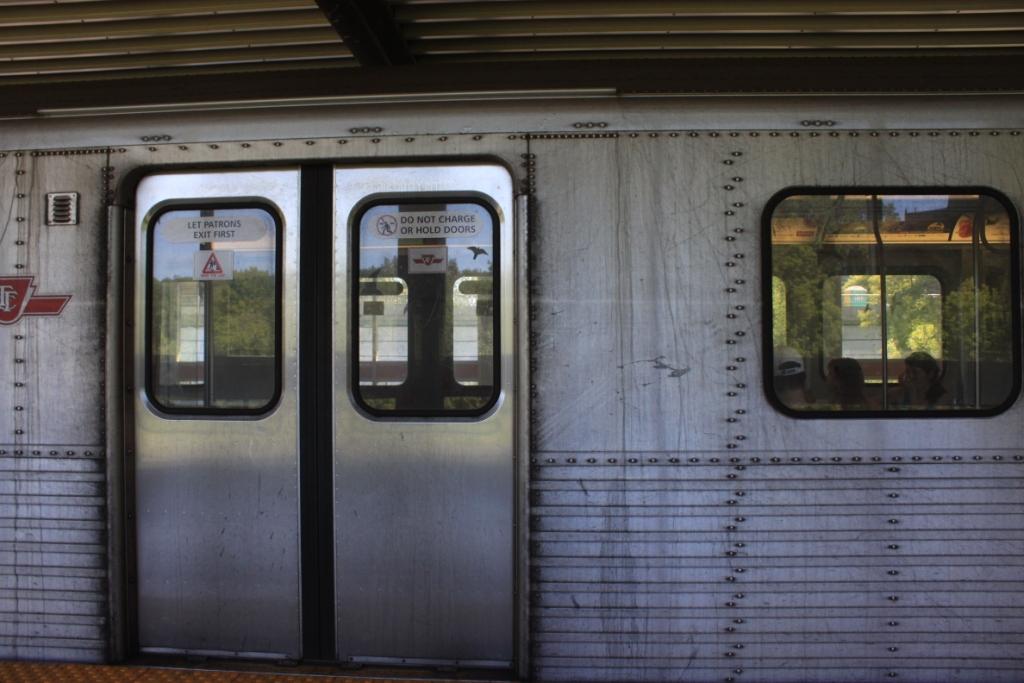
Riding over to Christie Station, I was on a train that was not just dirty, the exterior was black.  The fleet number on one car was covered with a tag, and many people had “finger painted” in the dirt on the windows.  Indeed, I started to notice how few cars did not have such “inscriptions”, and was astounded a day later to see a train that was almost gleaming, the only freshly-washed train I have seen in months.  The problem seems to exist mainly on the Bloor-Danforth line.

This train is fairly typical of BD-line equipment.  Dirt streaks run down from the roof, and although it’s not immediately obvious, the windows are coated with dust.  Our stations may be spotless, but from inside the trains, it’s like looking through a fog.
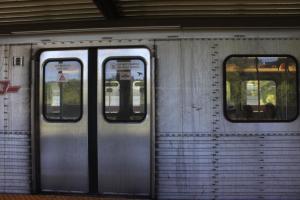
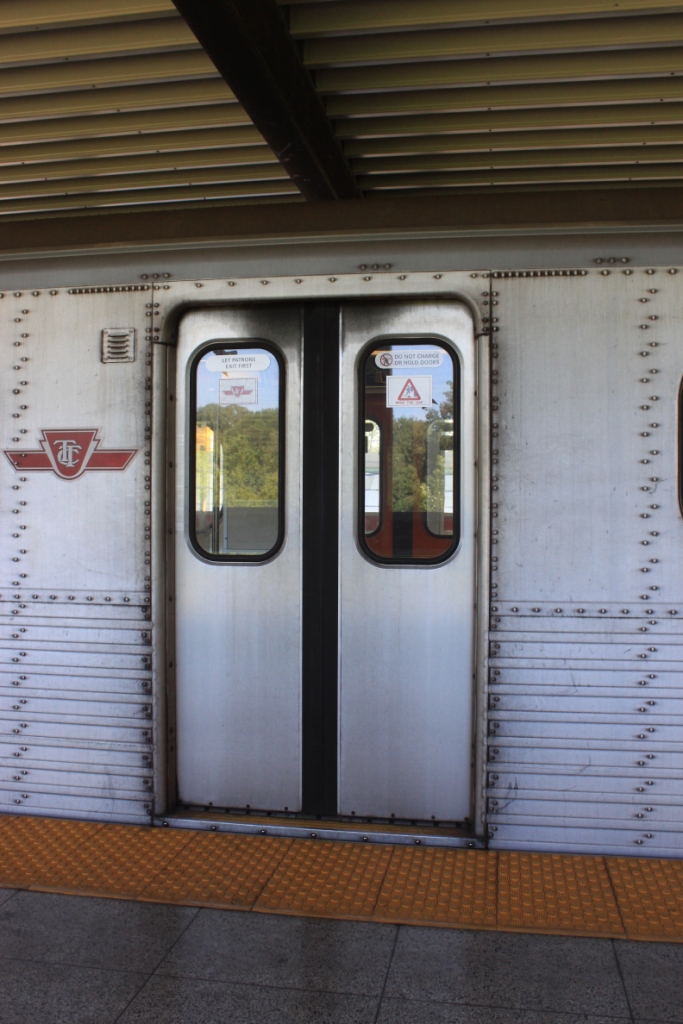
This car has beautiful clean, shiny doors.  That’s the colour the whole thing is supposed to be.  Maybe not mirror-bright, but a decent silver, not a shoddy imitation of pewter.
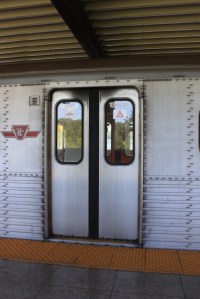
This shows a common problem with doors on cars that are somewhat cleaner than average.  There is an area at the top of the doors that simply doesn’t get scrubbed clean.

[Technical note:  These photos were taken in Old Mill Station using daylight that came in through the north window on a cloudless late afternoon.  You can see the exterior lighting condition in each of these photos, one way or another.]

Joe Mihevc wants riders to have a sense of ownership in their system.  At times, riding the TTC is like living in a run-down apartment building where I want the place to look nice, to be proud to bring friends, but the landlord has excuses for not doing anything.  There is even  plaque in the lobby congratulating him for the condition of his building.

When the TTC starts to care about its system again, when it stops using the “we need more money” excuse as a blanket response to every criticism, riders might really feel they are part of the TTC.

Metrolinx Board Wrapup for May 2010

The Metrolinx Board met on Wednesday, May 19 for an unusually long public session.  Rather than post separate articles, herewith a compendium report.  The major topics are:

  • The Board Speaks!
  • The Managing Director Reports
  • We Have A Vision, We Just Don’t Know What It Is Yet
  • Achieving 5 in 10, or Transit City Rescheduled
  • GO Rail Service Expansion Benefits Cases
  • A Question of Advocacy

The Board Speaks!

Probably the most astounding thing about this meeting, the first anniversary of the “new” Metrolinx, is that the Board members finally found their voices.  I was beginning to wonder if they were ever going to show some indication of earning their keep and actually asking hard questions of staff in public.  We’re not quite there yet, but at least the discussion gave an indication that the Board is thinking about its role.

As regular readers will know, I believe that organizations such as Metrolinx should be publicly accountable through an electoral process and through direct access to one’s representatives.  Boards that answer to nobody but the government which appointed them, and entertain no criticism from the public, can leave much to be desired.

To be fair to Metrolinx, even when it had a political board, much of the “public participation” was managed to achieve concensus with, more or less, what Metrolinx planned to do anyhow.  That other well-known transit board, the TTC, is elected, but has succumbed to the disease of being cheerleaders for the organization right-or-wrong.

Metrolinx has not had to actually do much (as opposed to GO Transit which was simply merged into its new “parent”), and we have yet to see how the Board and the Government will react if Metrolinx badly fouls up any of its projects.

Continue reading

Transit City: Half a Loaf? (Update 4)

Today, May 17, 2010, Metrolinx CEO Rob Prichard addressed the Toronto Board of Trade with an overview of plans for Transit City projects.  The presentation slides are available on the Metrolinx website.

The final transcript version of the accompanying speech is also available online.

Updated May 18 at 6:20pm : An updated version of the Metrolinx plan is now online.  This includes more information about the staging and cash flows for each of the five projects, and confirmation that Metrolinx will be ordering 182 LRVs for the four Transit City lines.

Queen’s Park announced the Ontario Budget in March 2010 including a $4-billion cut to the short-term funding for the “Big 5” Metrolinx projects — VIVA BRT, Sheppard East LRT, Eglinton LRT, Finch West LRT, and Scarborough RT to LRT conversion and extension.  This triggered a vigorous debate between Provincial and Municipal politicians about the real effect of the cut and the true extent of Provincial commitment to transit funding.

The primary concern at Queen’s Park is constraining the growth of the Provincial debt.  In the short term, the Metrolinx projects were seen as easy to shift into future years, beyond the point where debt would be a problem.  However, in political circles, deferral can mean outright cancellation especially if the government changes or another portfolio takes precedence for spending.

Only half of Transit City has any funding commitment to date, and now half of that commitment is in question.  Where does this leave the plan and, more generally, the growth of a robust transit network in the GTA?

Continue reading

Queen’s Park Commits to Transit City, Sort Of

Queen’s Park has announced that it will build the four previously funded Transit City lines (Sheppard East, Finch West, Eglinton and the SRT rebuild/extension) as well as the VIVA busway, but over a longer time than planned.

Tess Kalinowski writes about this in today’s Star.

The construction start dates will be adjusted:

  • Sheppard and VIVA are already underway and will continue.
  • Eglinton will not start until 2012 rather than the originally planned 2010
  • Finch West will not start until 2013 rather than 2010
  • The SRT will continue operating until after the Pan Am Games in 2015 at which point it will close for reconstruction.  Second-hand Mark I ICTS cars will be purchased from Vancouver to supplement the existing fleet in the interim.

Also rumoured is a Metrolinx announcement regarding purchase of cars for these lines from Bombardier.

All of the details will come out at the Metrolinx Board meeting on May 19, 2010.

The City of Toronto has proposed that it would finance the projects starting on the original schedule as this would be cheaper than other capital expenses it would have to undertake (a larger bus fleet and a new garage) to handle system growth pending opening of the Transit City lines.  One might argue that they should just “get by” if this would only be a short-term pressure, but if Queen’s Park’s new promise falls through (there might be a different party in power by the time in came to actually pay up), the TTC would be seriously behind in providing capacity.

Rob Prichard of Metrolinx argues that the financial goal is to minimize provincial debt, and starting the projects early would add to the debt regardless of who pays the interest costs in the short term.  This is really the nub of the debate.  Queen’s Park seeks to minimize its book debt, and must deal with accounting standards that no longer allow governments to hide debt through leases or third-party financing.  Oddly enough, this also affects some privatization schemes because, ultimately, the government is still on the hook to pay for the lines.

There are much larger questions in play here.

Metrolinx “Big Move” plan includes over 50 projects, and we have no idea of how Queen’s Park will pay for them, much less operate the network once it is built.  If the first five projects are stretched over the next decade, when will work begin on the others?  Will any new revenues (tolls, taxes, the Tooth Fairy) be used to fund additional projects, or will they backfill the original five?

Metrolinx’ mandate for a financial plan was explicitly set up to keep funding issues off the radar until after the 2011 provincial election, but that idea (a triumph of politics over good planning) fell apart when the 2010 budget cut funding for transit.

On top of this, there is no word on a provincial role in funding operating costs of local transit systems.  In a best-case scenario, this might show up in the 2011 budget as a pre-election goodie, but Toronto and the TTC will go into their own budget cycle (which is largely complete by the time Queen’s Park announces its own plans) facing a TTC operating subsidy of about half a billion dollars.  Mayoral candidates have a lot to be worried about, and they won’t solve the problem by counting the pencils.

Saving Transit City

Just over two weeks ago, the wheels came off Transit City and many more plans for new transit routes in the GTA.  Queen’s Park, feeling poorly after bailing out the auto industry and promissing tidy sums for non-transit portfolios, decided to defer $4-billion of spending on The Big Move, the GTA’s transit master plan.  The effect was felt most by Transit City whose projects were those already prepared, out the door and ready to build.  Whether the work on VIVA that is also part of the first batch of funded projects will be affected, we don’t yet know.

Metrolinx has been handed the thankless task of figuring out what to do, and they’re being very quiet about it.  Word on the street is that nothing is to be annouced until the May 19, 2010 Metrolinx board meeting.

For months, it was no secret that Metrolinx was working with the TTC to rein in costs on Transit City so that the projects would stay within the funding envelope, and some trimming was expected (if only by way of creating a “phase II” for some projects).  As long as the total stayed within the announced funding, all would be well, or so everyone thought.

Now, Queen’s park wants to push spending (and associated debt) out into future years, and wants to “defer” about half of their previously committed funding.  Reaction at the municipl level was predictable with the Miller administration openly attacking Queen’s Park for renegging on a promise.  Would-be mayors are thrilled with the opportunity to have someone else delay Transit City so that candidates don’t seem obstructionist.  Meanwhile, such bastions of anti-Miller sentiment as the Toronto Star and the Board of Trade have both criticised the transit cutbacks.

The unhappiness does not stop at the 416 border.  Politicians who were expecting funding for transit improvements including BRT and LRT now wonder openly whether their projects will ever see the light of day.

Continue reading

TTC E-Initiatives Update (Revision 2)

Revised April 6 at 7:00 am:  A short section has been added about Google Maps.

Revised April 5 at 10:00 pm:  A section has been added at the end covering those e-initiatives which were not included in the discussion at the TTC.

On March 24, 2010, the Transit Commission received an update from staff on the status of various initiatives broadly relating to the use of information technology.  These include:

Internet Trip Planner (ITP)
Next Vehicle Arrival System (NVAS)
Customer Service Disruption Notification (CSDN)
Narrowcasting
Next Train Arrival System (NTAS)

This article gives a summary of that presentation and a few of my own comments on these and other related matters.

Continue reading

Open Houses: Ashbridge’s Bay Carhouse & Scarborough LRT

Two upcoming open houses may be of interest to readers.

Ashbridge’s Bay Carhouse

April 8, 2010 from 6:30pm to 9:00pm at the Toronto EMS and Fire Academy, 895 Eastern Avenue

The project website includes notes from previous public sessions and a map of proposed alternative routes to the carhouse from the existing streetcar network.

The notice for this meeting also includes reference to information about the new streetcars.  The final design for these cars is not yet determined, and an advisory committee (of which I will be a member) is now being organized by the TTC to assist with this.

Scarborough RT to LRT Conversion

Two public meetings have been scheduled for the Scarborough LRT conversion project.  This is the official launch of the Transit Project Assessment (TPA).

April 12, 2010 from 6:30pm to 9:00pm at Jean Vanier Catholic Secondary School (Cafeteria), 959 Midland Avenue (north of Eglinton)

April 15, 2010 from 6:30pm to 9:00pm at the Chinese Cultural Centre, 5183 Sheppard Avenue East (at Progress Ave)