TTC Meeting Wrapup: May 1, 2012

The TTC board met on May 1.  This was a quiet affair without the political drama of the “old” Ford-stacked Commission, and I almost missed the bumbling antics of the old crew.  The agenda was on the thin side, and everything wrapped up in a few hours.

Major items included:

  • a status report on the LRT projects,
  • proposed changes to the Richmond Hill extension of the Yonge Subway,
  • the Framework Agreement with Metrolinx for implementation of the Presto farecard,
  • the Customer Satisfaction Survey, and
  • the CEO’s report.

Continue reading

Where Should We Put the “Downtown Relief” Line?

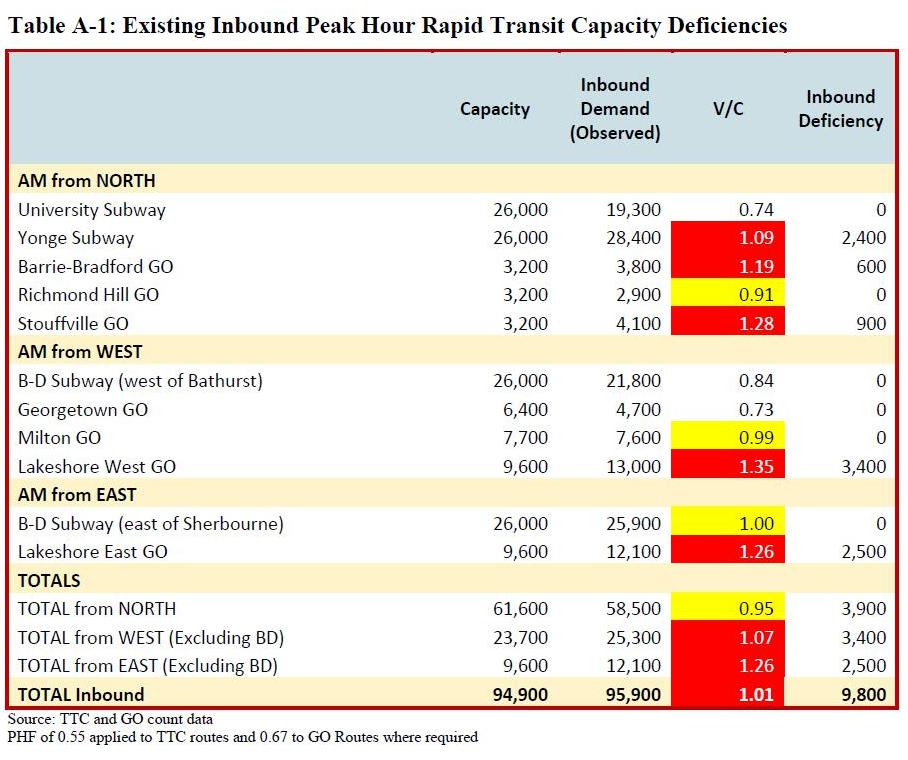
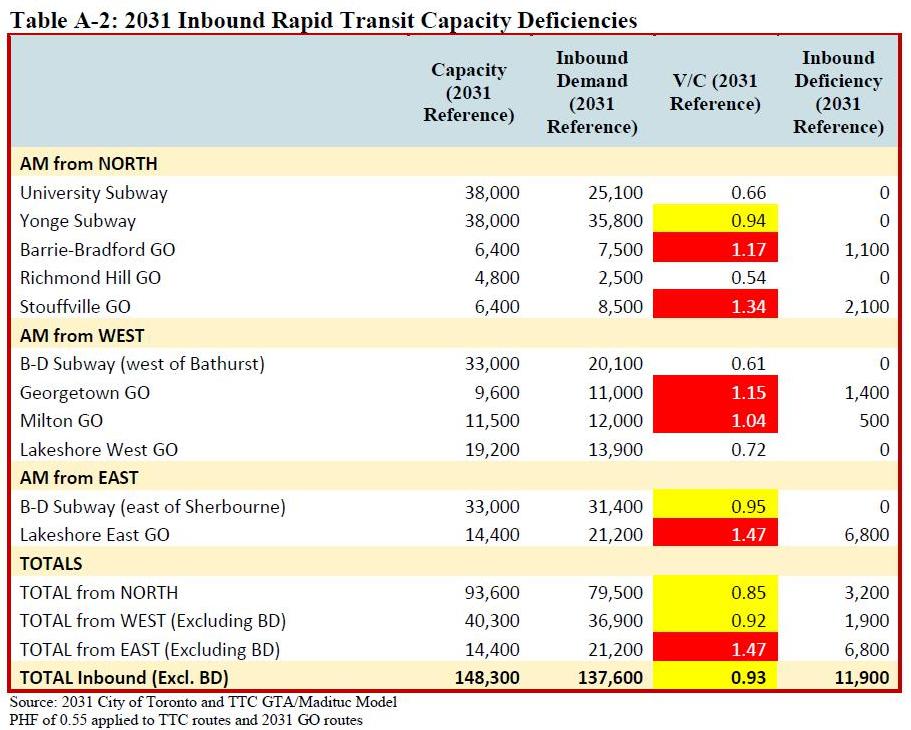
The Downtown Relief Line has been in the news a lot lately, what with dreams of vast new revenues to pay for transit expansion and, at long last, a recognition that more people want to travel downtown than we have transit capacity to handle.

Back in the 1980s, the Network 2011 plan included a line from Union Station to Don Mills and Eglinton by way of the rail corridor, Eastern Avenue, Pape, a bridge across the Don Valley, and Don Mills Road.  This scheme was turned down in favour of the Sheppard Subway as part of a misguided idea that if we simply stopped building new lines into downtown, growth would stop.  In fact, GO Transit did a fine job of providing extra capacity, and more recently the new downtown condos have raised short commutes by streetcar, cycling and foot to levels nobody expected thirty years ago.

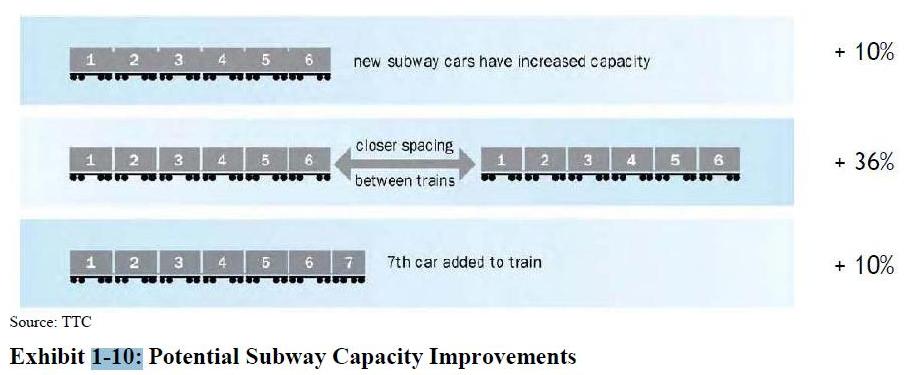
The Yonge subway filled up, for a time,but the pressure fell off thanks to the 1990s recession and the general drop in transit use.  That’s no longer the case, and suddenly everyone wants to “do something” about transit capacity downtown.  The TTC, shamefully, downplayed anything beyond its own mad scheme to stuff thousands more riders onto the Yonge line, a project requiring major changes in signalling, reconstruction of Bloor-Yonge station (and possibly others) for extra capacity, a much larger subway fleet (and yards to hold it) and possibly even the addition of platform doors at all stations.

Council asked the TTC to look at a DRL, and there is even supposed to be a study.  However, its web page is the only sign that anything is going on.

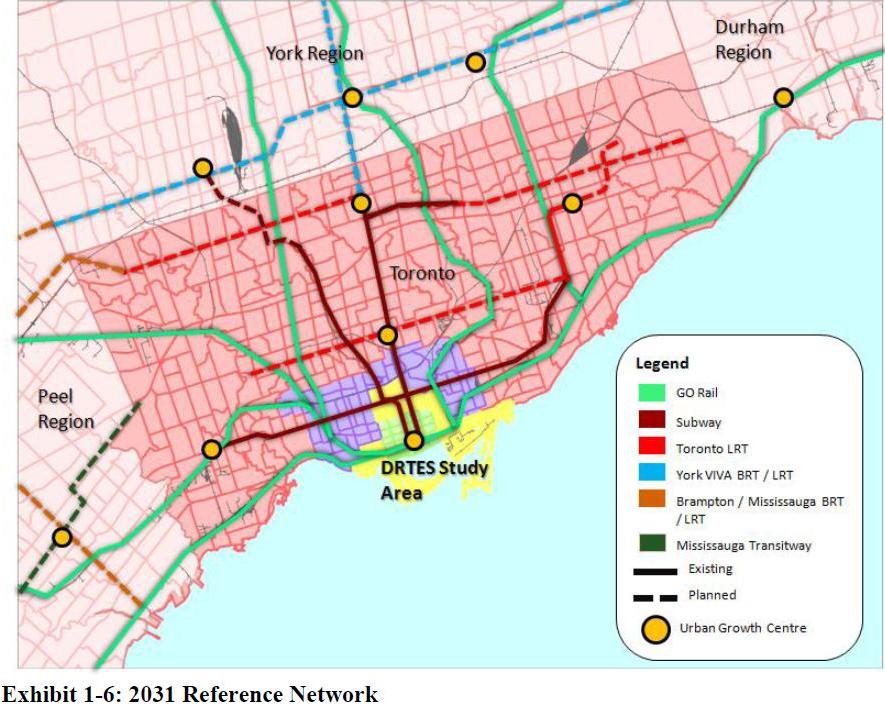
Meanwhile, every would-be transit planner in town is busy drawing maps, to the point where a credible plan can be found simply by dropping a piece of spaghetti on a map of the city and declaring this a route.  (Post-graduate degrees are available to those who can determine the ideal height from which to drop the pasta and cooking time needed to produce the best results.)  What’s missing in a lot of this discussion is a view of how a DRL might fit into a wider network, not to mention a few basics about how a new rapid transit line will, or will not, fit in some of the proposed alignments.

One of the better proposals is on Phil Orr’s DRL Now site.  It’s not perfect (no proposal is, including those I have floated from time to time), but at least this is a place to start with sufficient detail to understand what is going on.  Drawing a swoosh across a map is easy (politicians do it all the time), but designing something that might actually work is a lot harder.

A major challenge with some versions of this line is that proponents try to do too much.  Playing “connect the dots” with a transit route has its limitations, and trying to hit too many of them causes the line to wander out of its way.  This ties back to a fundamental question:  what is a DRL supposed to do?

If we believe some of the simpler plans (notably one in last week’s Star proposed by Councillor Pasternak), the DRL’s sole function is to get people from the Danforth subway to Union Station.  This is far too simplistic and guarantees the line will not be well used except as a peak period relief valve.

Other schemes take the route south of the rail corridor to serve the Port Lands and eastern waterfront.  Aside from the problems of building such a line in landfill beside Lake Ontario, the route would not provide the fine-grained transit access possible with a surface LRT, and would vastly overservice an area whose expected demand is lower than the existing Sheppard subway.  Connection to Union Station from the south would also be a big challenge.

From time to time, I am asked “what would you do”, but to start that discussion, a few first principles:

  • A”DRL” should not exist solely to relieve the Yonge line’s peak traffic problem, but should provide new links within the transit network giving rapid transit to areas of the city that do not have it today.  Indeed, the regional function within the network may well be as important as the “relief” function at Bloor-Yonge.
  • Any proposed route through downtown must respect the actual built form of the streets and buildings.  Diagonal routes through built-up areas should be avoided as they are difficult if not impossible to build.
  • Stations must be located where it is physically possible to build them.  Some routes use rail corridors without considering how either a surface or underground station might fit or be built.
  • A “DRL” is not the complete solution to capacity problems on the subway.  These problems originate north of Steeles Avenue, and a major role in trimming peak demand falls to GO Transit which has several north-south routes that could drain traffic otherwise headed for the Yonge line.

The proposed route on DRL Now (click on “Interactive Map” under the “Station Information” pulldown) includes four phases:

  • Don Mills and Eglinton to City Place
  • City Place to Dundas West
  • Don Mills from Eglinton to Sheppard
  • Dundas West to Pearson Airport

I have concerns with a few details of this plan, but the basics are good.  Another view of the route is available via Google Maps.  This has the advantage of showing the detailed alignment rather than a “route map” graphic.

Continue reading

Metrolinx Resurrects Transit City (Updated)

Updated April 26, 2012 at 1:10pm:  This article has been updated to reflect discussions at the Metrolinx Board meeting of April 25, the press scrum following that meeting, and correspondence between me and Metrolinx to clarify some issues.

Notes from the Board Meeting and Press Scrum:

Chair Rob Prichard asked about the status of unrecoverable losses due to the diversion of Metrolinx effort from the original Transit City plan to the Ford transit Memorandum of Understanding.  Less that $10-million has been spent on preliminary engineering for the Eglinton tunnel east from Laird Station.  Potential extra costs from Bombardier for the vehicle supply contract are not yet known.  If these were simply inflationary increases, then the Metrolinx funding (which includes inflation) should cover this.  However, Bombardier may also claim additional expenses related to the delay.  Prichard urged staff to “negotiate” away as much of such claims as possible.

This issue came up again in the press scrum.  Metrolinx has always said that “others” must bear any extra costs due to the Ford delay, but the identity of this party is unclear.  Elizabeth Church from the Globe noted that Karen Stintz has pointed out that since the Ford MOU was never approved by City Council, the city can hardly be held responsible for the delay.

Both Rob Prichard and CEO Bruce McCuaig dodged around this and other questions related to Metrolinx’ role in pursuing the Ford plan in the absence of Council support, especially considering that Metrolinx hangs its return to LRT on Council’s clear vote for the original Transit City plan as the City’s definitive policy statement.  The Star’s Royson James described Prichard as being good at “ragging the puck”, but never managed to pin him down to an answer.

Prichard hopes that the value of the “extra cost” will be reduced to zero making this a moot point, or at least one small enough to fit under any nearby rug without most people noticing the lump.

Director Lee Parsons asked about the possible funding from P3 Canada and what this might enable.  Bruce McCuaig suggested that it might be possible to add to the scope of work with the additional money available through this federal program, but the dollar value is not large and Metrolinx must still pitch their projects to the P3C board.

Director Richard Koroscil asked what the differences were between the plan proposed here and the previously approved 5-in-10 scheme.

Jack Collins (Vice President, Rapid Transit Implementation) replied that these are mainly the slippage of Sheppard’s completion out to 2018 and the shift of the SRT completion back from 2020 to 2019.  The design team and project manager for the Sheppard project were disbanded when work stopped just over a year ago and a new team must be assembled.  Moreover, the project will now be delivered through Infrastructure Ontario (IO) as an Alternate Finance and Procurement (AFP) scheme, and this adds time for production of the contracts related to managing this process.

In the case of the SRT, the section of the route north of McCowan Station will be built while the existing SRT is still operating and this allows work to start sooner than planned on that line.

Director Rahul Bhardwaj asked about the requirement that the TTC implement the Presto smart card as a precondition of having these projects funded by Queen’s Park.  Bruce McCuaig replied that a proposal from TTC staff for an agreement with Metrolinx and the rollout of Presto will be going to the TTC board at its meeting of May 1.

Director Joe Halstead asked about the roles of three agencies — Metrolinx, the TTC and IO — in these projects.  Metrolinx will be the project owner.  IO will be the procurement agency.  The TTC will provide the design criteria, manage the design consultants and technical details of the projects, and will eventually operate the lines.

Halstead also asked about lessons learned from the St. Clair project.  Collins replied that Metrolinx will maintain a presence in communities to keep them informed as the projects evolve, and noted that the neighbourhood office for the Sheppard LRT that had been closed because of the Ford MOU would have to be reopened.

Director Doug Turnbull asked where Metrolinx stands on the role of subways.  Bruce McCuaig replied that Metrolinx supports subways such as the Spadina extension now under construction, and noted that “The Big Move 2.0” includes both the Richmond Hill extension of the Yonge line and the Downtown Relief Line.  Metrolinx will continue to support subways in this context.  Rob Prichard noted that Toronto Council had asked city planning staff for studies of a Sheppard West connection to Downsview and a Bloor West extension to Sherway.

Turnbull asked whether TBM 2.0 affects any of the four LRT lines up for approval.  Bruce McCuaig replied that the 2.0 document will review progress to date and incorporate new initiatives such as the GO electrification.

During the press scrum, Metrolinx clarified that The Big Move 2.0 will be published at the end of 2012.

Director Stephen Smith asked for a clarification of the AFP bidding process and the meaning of the term “Financial Close” in the project chart.  Jack Collins explained that the procurement would have several stages.  First, bidders would be invited to qualify to bid on the work.  Based on this, three would be chosen, and they would be given funding to prepare a more detailed proposal.  From that work, IO would make its evaluation and select a winner.  At that point, the overall contract and financing details would have to be nailed down, and this would be the “financial close”.  IO will rely on Metrolinx, the TTC and technical consultants for evaluation of the proposals.

Smith asked whether pricing would be affected by the level of activity in the construction market.  Collins replied that preliminary indications from the international market are good because work is drying up overseas.  Also, experienced resources now committed to the Spadina extension will be freed up starting in late 2015.

The report was approved by the Board, and most of us adjourned to the press scrum which was attended by Rob Prichard, Bruce McCuaig, Jack Collins and the usual bevy of Metrolinx communications staff.

After the discussion about “extra costs” noted above, questions turned to the location of the Eglinton tunnel.  It will definitely not go under the Don River because this would involve tunneling through bedrock.  The tunnel boring machines are designed for softer conditions (soil, clay, etc), not for hard rock, and this work would be very expensive.  The line will go under Don Mills Road and will provide for a future connection to a north-south route.

Questions returned to the role of Metrolinx and “the need for a clear and supportive partner” as they put it.  Elizabeth Church asked about the Mayor’s opposition to the LRT scheme.  Bruce McCuaig noted that Council had voted, and had delegated authority to the City Manager to execute contracts for these projects.  Rob Prichard observed that the Mayor and his brother speak for themselves, and that there is a broad consensus for the LRT plan.  Metrolinx won’t stand in the way of debate, but they have lots of room for working with the city.

John Lorinc asked whether Metrolinx is concerned about being “the meat in the sandwich” in the 2014 election?  Prichard replied “no”.  He observed that political actors have strong ideas, and we shouldn’t try to take politics out of transit.  However, we should keep our eyes on the main goal of better transit and less congestion rather than just fixating on four projects.  There will be a contract with the city for these four, and other projects may come.  Metrolinx should be steady in its execution of the projects and although there will be elections along the way, the recommendation is that these projects should be completed.

A few questions on the vehicle contract came up.

Would other cities outside the Metrolinx planning area be able to procure LRVs through the Metrolinx contract?  Jack Collins replied that this decision would be up to the local municipality (e.g. Kitchener-Waterloo or Ottawa).

Given the extended period between vehicle delivery and start of service on the first line (Sheppard), what will Metrolinx do about the warranty that could expire before the cars begin revenue operations?  Bruce McCuaig replied that this would form part of the discussions with Bombardier and final approval of the terms would come from Queen’s Park.  There will be two pilot cars built for Metrolinx but no dates are set yet for their delivery.

Royson James asked about Metrolinx’ role — are they simply following the political path of least resistance, or can we “take their recommendations to the bank”?  Bruce McCuaig replied that Metrolinx would give its best advice regarding regional transportation systems, and that they are the keeper of the long term view.

James asked why Metrolinx keeps changing its mind.  McCuaig replied that there are choices between technologies, and it’s not always a black and white decision.

Rob Prichard chimed in saying that there had also been changes in preference on the City’s side for Eglinton’s technology.  The Ford MOU had tradeoffs — a longer Eglinton tunnel was a gain at the expense of losing the Finch LRT (and the eastern part of a Sheppard line).  Metrolinx need to build projects that make sense, and they are “respecting democracy”.

Elizabeth Church noted that Metrolinx has changed its “expert opinion” especially on Eglinton, and this is frustrating to those who seek technical advice.  Prichard replied that between 2006-08, the original vision for Eglinton was all underground, a faster line attracting more riders.  However, the tradeoffs between costs and benefits led to a subway-surface arrangement.

This exchange led me to write for clarification because at no time did the City of Toronto endorse an all-underground Eglinton line, particularly not once Transit City was announced.  Even before, Eglinton was flagged as a corridor for improved transit and surface priority treatment, but not for a subway.  Prichard is mixing the Metrolinx planners’ fantasies of an all-underground Eglinton with official city and TTC policy decisions, and Metrolinx can hardly claim to be following the City’s changes in policy when in fact the drive for an Eglinton subway came from Metrolinx itself.

I wrote to Metrolinx:

At the media scrum, Rob Prichard talked about the to-and-fro of the city’s position on an Eglinton all-underground line.

It’s worth noting that several reports dating from 2005-6 including the City’s Official Plan and the TTC’s “Building a Transit City” showed Eglinton as a potential transit corridor, but talked much more of surface transit priority than of a subway. ‪

Yes, there was an older proposal for a subway west from Mt. Dennis to Renforth, but the projected demand was quite low and it was not taken seriously.

Therefore to suggest that there was any serious support for an Eglinton line completely underground … is stretching the point.

Metrolinx replied:

As The Big Move was being developed between 2006 and 2008, a variety of transit lines and technologies were modeled and considered in developing the full integrated GTHA system of the future, including Eglinton as a fully-separated rapid transit corridor. The Big Move does not specify whether sections are below ground or above ground.

Also, as Metrolinx worked with the City of Toronto and the Toronto Transit Commission, and a more detailed Benefits Case Analysis was undertaken, Eglinton was confirmed as grade-separated through the central section, and at surface, east of Laird Ave.

It should be noted that the benefits of a totally grade-separated Eglinton were weighed against all other rapid transit projects across the GTHA on a range of issues, including future land use, location of employment, integration with local transit, GHG reductions, the ability to serve communities of higher social need, and travel time.

You can judge for yourself whether there was a city position on the vertical alignment of Eglinton that would support Metrolinx’ claim.

John Lorinc got in a good last word with the question “Will you still support this plan in 2014?”

To assist readers in keeping track of the shifting completion dates for the projects, here is a consolidated chart of the original plans, the revised “5-in-10” plan, and the new 2012 version.

2012.04.25_Project Staging Chart

The original article from April 24 follows below.  Note that some route-specific information has been updated on April 26.

Continue reading

The Sheppard LRT Report (Part IV)

Now we come to what I must call “The Chong Dissent”, the reports prepared under the company “Toronto Transit Infrastructure Limited” (TTIL), a dormant TTC corporation resurrected for the purpose because it had $160k sitting in its bank account.  All this and more was spent to argue the case for a Sheppard Subway.

Council has already opted for an LRT line on Sheppard, but arguments originating from the TTIL reports continue to haunt the debate.  It’s time to expose their threadbare, self-serving nature.

Continue reading

The Sheppard LRT Report (Part III)

Many background presentations informed the Expert Panel’s review of options for the Sheppard corridor.  This article is the first of two summarizing and commenting on this information.

There are six groups of documents:

  • Professor Eric Miller’s comments
  • Metrolinx presentations and reports
  • TTC presentations and reports
  • Toronto Transit Infrsatructure Ltd. (TTIL) presentations and reports
  • City of Toronto presentations and reports
  • Third Party reports

TTIL is the TTC subsidiary through which Dr. Chong’s pro-subway work reported.  Given the amount of material, I will deal with reports from TTIL, the City and Third Parties in the fourth and final article in this series.

Continue reading

Sheppard East Vote Delayed to March 22, 2012

Council did not finish its debate by 8pm on March 21, and a motion to extend time failed, barely, on a vote of 28-15 (a 2/3 majority was needed because this would be a procedural change).

The pro-subway forces are running the clock, but they are simply wasting everyone’s time.  On a simple majority basis, the LRT option will pass.

Come back at 9:30 am on March 22.

The Sheppard LRT Report (Part II)

In the previous article, I reviewed the three main options under study for Sheppard East as well as the comments of the City Planning and Finance departments on various related issues.

In this article, I turn to the Expert Panel’s evaluation of the options, their scoring system, and the question of bias in the process.

The analysis and scoring begins on page 39 of the Expert Panel Report.  The panel chose three broad areas for analysis, and subdivided each of these into three subcategories.

  • Funding & Economic Development
  • Transit Service
  • Sustainability and Social Impact

In each of the 9 subcategories, the highest possible score is 5 points for an overall raw total of 45.  However, the weights assigned to each group are different with Funding & Economic Development getting a weight of 3x, Transit Service 2x, and Sustainability and Social Impact 1.5x. Once the weights are applied, the total potential score is 95 points.  These values are normalized up to a “perfect” score of 100.

Table 15 on page 41 summarizes these scores.  In order that readers can see how the weights affect the outcome, I have recast these data to show the buildup of the weighted scores to a 100-scale. Continue reading

The Sheppard LRT Report (Part I)

On Wednesday, March 21, Toronto Council will consider a report recommending that the Sheppard rapid transit line be built as an LRT from Don Mills Station east, initially, to Morningside.  This is the same scheme that was on the table in the Metrolinx 5-in-10 plan, and approval of this recommendation will more or less put Transit City back on track where it was before the election of Mayor Ford.

There is a main report and many background documents, including an alternative subway proposal, what might be called the “Chong Dissent” from the otherwise pro-LRT conclusions of the panel.  This article provides a summary of material from many sources.  For the definitive word, please refer to the originals as I am not going to attempt to cover every detail here.

As a general observation, the materials present a review of the situation in considerably more detail than we see for many transit planning decisions, notably those surrounding recent budget debates.  With luck, and with a less transit-hostile TTC board, we might see the same level of interest turned to basic questions like “where’s my bus and why can’t I get on when it shows up”.

The pro-subway folks claim that the report is biased, that it is hogwash, and advance their own dissent purporting to show the superiority of a subway option.  The misinformation and factual errors in this dissent are disconcerting, putting it mildly, considering that billions in provincial spending and the future development of our transit network might have depended on such twaddle.  I will turn to this in detail later in a future article.

Continue reading

Union Station / King Station Update

Union Station

Work at Union Station has progressed to the point where the existing link between the railway and subway stations is affected by construction.

The westernmost door leading onto the moat outside of the GO Bay Street Concourse from the subway has been closed, and space in the subway west mezzanine formerly occupied by rather tired shops has been walled off.  There is a narrow passage from the fare barrier to the westernmost stairway down to the subway platform.  (The escalator to the same space was out of service today, March 11, for repairs, but it should be back in operation for Monday, March 12.)

Of the two stairways leading from the south side of Front Street down to the subway, the western one is now closed.

These arrangements will allow for construction of the western part of the new fare control area under Front Street.

IMG_2797c

The moat looking west.  The hot dog vendor is still doing business surrounded by construction, but the westmost exit from the subway mezzanine is fenced off.

IMG_2798c

The moat looking east.

IMG_2801c

The excavation directly in front of the main doors of Union Railway Station. The large concrete box on the left side of the photo is the subway station, and the deep trench will be the space for the new northbound-to-Yonge platform.

King Station and Crossover

On the weekend of March 23 to 26 starting at midnight on Friday the TTC will close the Yonge subway between Bloor and Union for the first stage of installation of the new crossover at King Station.  Preliminary work is already underway, and there is a slow order through this area.  If past experiences at College and St. Clair are any indication, we can expect two more shutdowns in coming months.

Activation of the three new crossovers will not occur until the signal system replacement project finishes in a few years.  The original crossovers at these locations were never electrified and there is no provision in the existing signal system to manage them.

Also, the power feeds on either side of the crossovers are not set up to allow isolation of the crossover territory as a terminal.  When Bloor crossover was done many years ago, new section gaps were added at the south end of the station and midway north to Rosedale so that power could be maintained on both sides of a crossover even if there were a shutdown further north or south of Bloor.  Changes to the power feeds will be done concurrently with the signal work.