How Much Will The Spadina Extension Cost (II)?

In a previous article, I reviewed the history of the Toronto York Spadina Subway Extension (TYSSE). This project has been widely reported to be both late and over budget, but details only began to emerge on March 20, 2015 when TTC CEO Andy Byford fired two senior members of the engineering staff.

On March 21, 2015, Byford presented a briefing to the media as a preview of a report to be discussed by the TTC Board on March 26, 2015. This report includes both current information on the project and an October 2012 update that was issued when the TYSSE deadline was shifted to fall 2016.

The key points of the briefing were:

  • The earliest possible opening date for the TYSSE to Vaughan is the end of 2017.
  • Relations between TTC project management and the various contractors working on the TYSSE are badly strained, and this cannot be remedied by those now in charge.
  • Byford recommends that the TTC “retain a third party project-management firm as an incentivized project manager” (the terms of the proposed arrangement are confidential pending execution of the agreement).
  • Alternate schemes for continuing the TYSSE project with TTC staff in part or all of this role will extend the period needed to resolve outstanding issues and reach project completion, and will increase total project costs.
  • Additional funding to keep the project active to the end of 2017 of $150-million is required with Toronto paying $90m and York Region paying $60m. Toronto’s share could come from a TTC operating surplus in 2015 (mistakenly cited as “2014” in the report), property sales and/or deferral of projects. There is no word on how York Region might fund its share of the extra costs.
  • The project is subject to many claims by contractors against the TTC, and some counterclaims on the TTC’s part. The eventual value of settling these is unknown, and this is a potential additional cost beyond the $150m. Whether this can be accommodated by the existing project budget remains to be seen.

Continue reading

How Much Will The Spadina Subway Extension Cost?

The Toronto York Spadina Subway Extension (TYSSE) to Vaughan has been much in the news lately thanks to its delayed opening and cost overruns. The line was originally expected to open in 2015, even in early rosy estimates before the Pan Am Games, but now will not be in service until 2017. The project was repeatedly cited (as recently as December 2014’s CEO Report) to be on its budget of approximately $2.6-billion. The exact final cost is not known but has been reported to be up to $400-million more.

To date, the TYSSE project is on budget with a total budget of $2,634 Million. The in-service date is targeted for the fall of 2016 however the project is facing a serious schedule challenge. [CEO’s Report for November-December 2014, p. 29]

The “on budget” statement, which had appeared in all previous CEO reports, vanished with the January 2015 report.

A peer review was conducted by an APTA panel in late 2014 largely to assess schedule and budget challenges. A report is expected at the end of January related to schedule and budget challenges and will make recommendations to mitigate these challenges.

Bechtel Ltd., a consulting firm, was also retained at the CEO’s specific direction to conduct a thorough in depth analysis of the project and likewise is expected to present its findings at the end of January. [CEO’s Report for January 2015, p. 30]

The results of these reviews are to be tabled at the March 26, 2015 TTC Board meeting.

There are two issues in play here. First and most obvious is the question of how a major project can suddenly be found to have budget problems, and why these were not discovered and reported sooner. How much oversight did the TTC Board actually have beyond the one-line monthly assurance that the project was “on budget”? Second is the more general question of the tracking of major projects, and why this is not regularly reported to the Board and through them to City Council and other funding governments.

To learn as much as I could from publicly available sources, I culled through TTC meeting reports going back to the early days of design work on the TYSSE. Tracking a project’s history this way can be challenging for various reasons:

  • Some agendas exist only as a PDF file without links to the underlying reports.
  • TTC procurement policy allows contracts of up to $5-million to be approved by management without a report to the TTC Board. (This is in line with the City of Toronto’s policy.)
  • A monthly report listing all expenditures authorized by management in the $1-5m range was discontinued in March 2012.
  • Changes in the total authorized spending on a line item only appear in public when there is an update involving a large contract change.
  • The CEO’s report tracks variations in capital spending, but this is only against the expected amount for the current year, not for a project overall. Because of various delays, the TYSSE tended to underspend versus plans even though the estimated total cost to completion might actually be rising.

Continue reading

City of Toronto Budget Amendments 2015 (Updated)

At its meeting of March 11 and 12, 2015, City Council passed a few budget amendments affecting the Toronto Transit Commission. Some of these reflect a sense that the TTC has not been “minding the store” quite as well as it claims, and a little belt tightening is good for any organization. Others address specific concerns that, quite frankly, should have been on the TTC’s agenda before now, but were buried under the rapid transit debates.

The motions address the following topics:

  • Additional Streetcars
  • Automatic Train Control
  • Waterfront West Transit
  • TTC Staffing and Project Management

Updated March 13, 2015 at 1:50 pm with further information about proposed staffing reductions.

Continue reading

Where Should We Put A (Downtown) Relief Line?

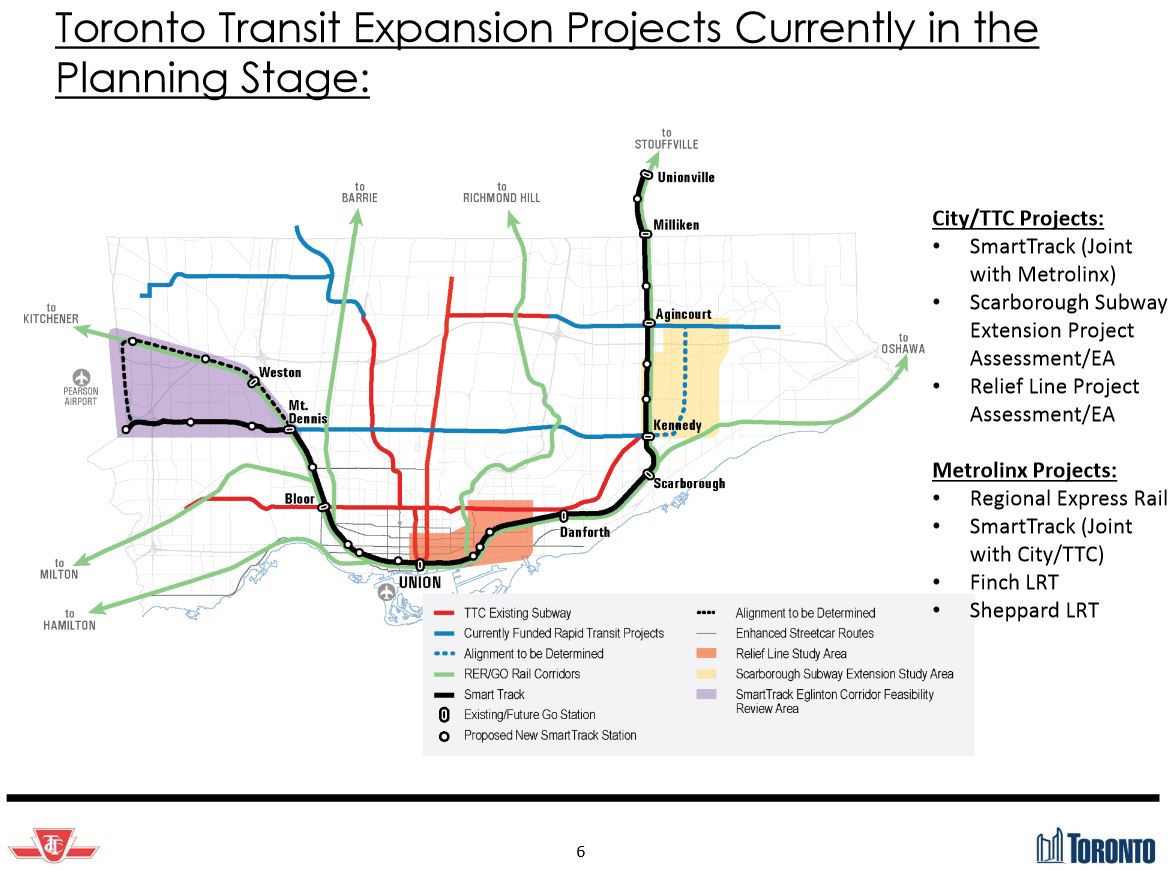
The City of Toronto began a series of public meetings yesterday (March 3) to advance the cause of a a new subway line that would relief capacity constraints into downtown.  This round focuses on the question of station locations in the segment from the core area east and north to the Danforth Subway.

It is no secret that I have strongly supported the “Downtown Relief Line” (DRL) for a long time, and yet I could not help being disappointed by the structure of studies now underway and the public participation process. There is a sense of a process that is too low-key, that may give the impression of movement while failing to advance the cause.

In this article, I will review the presentation deck being used in these meetings, the questions being asked of participants, and the shortcomings in the advocacy for this new subway line.

Continue reading

TTC 2015-2024 Capital Budget: System Expansion Projects

The TTC’s Capital Budget generates much debate over a few items, but there are many, many projects at the detailed level. Understanding those details puts the debate over transit spending, operations and expansion in a better context. This and following articles will look under the covers of the Capital Budget. I will start with the expansion projects because these have seen so much debate, but will turn to the more mundane parts of the budget that keep the wheels turning.

The projects discussed here include:

  • The Toronto York Spadina Subway Extension (TYSSE) to Vaughan Metropolitan Centre
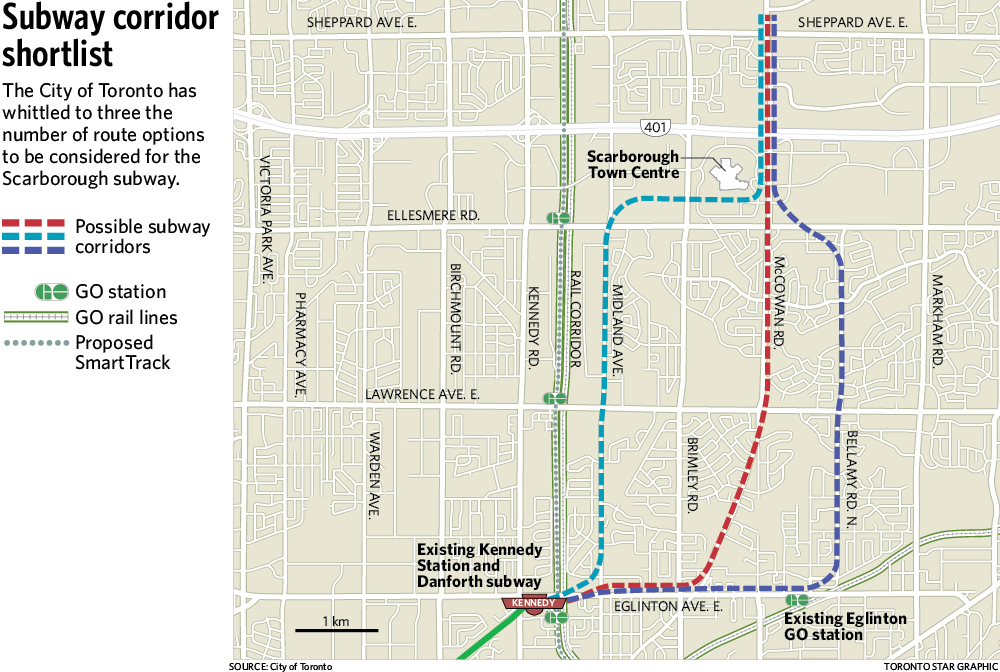
  • The Scarborough Subway Extension (SSE)
  • Various Waterfront proposals

Neither the Downtown Relief Line (DRL) nor the Yonge extension north to Richmond Hill is included because these are not yet official projects.

Continue reading

TTC 2015 Fleet Plans (Updated)

Updated March 2, 2015 at 9:20 am: This article has been extended with additional illustrations and information from the detailed TTC Capital Budget. The original version was published on January 28, 2015.

Within the TTC’s 2015 Capital Budget, the Fleet Plans give an indication of current thinking on the evolution of TTC service. Now that Toronto appears to have a pro-transit administration at City Hall, the plans are somewhat out of sync with a revived interest beyond “subways, subways, subways”. The details in the plans need review, and this will affect planning in future budgets.

Some policy decisions are evident within the fleet plans, although these have not yet surfaced in public discussions.

Continue reading

Toronto Regional Relief Public Meetings

The City of Toronto Planning Department will hold four public meetings regarding their Regional Relief study now in progress.

The meetings will be held between 7:00 and 9:00 pm:

  • Tuesday, March 3, 2015 at Calvary Church, 746 Pape Avenue (Pape Station)
  • Thursday, March 5, 2015 at Riverdale Collegiate, 1094 Gerrard Street East at Jones (506 Carlton car of 83 Jones bus)
  • Monday, March 9, 2015 at St. Lawrence Hall, 157 King Street East at Jarvis (504 King car)
  • Thursday, March 12, 2015 at Christ Church Deer Park, 1570 Yonge Street (St. Clair Station)

The focus of the meetings will be station locations and evaluation criteria.

Platform Edge Doors: Motherhood or a Vital Addition to the TTC Subway? (Updated)

At its meeting of February 11, 2015, Toronto Council debated a report from the Medical Officer of Health on Suicide Prevention. In response to this report, Council approved the following motion (which is a modified version of one of the MOH’s recommendations):

1. City Council request the Toronto Transit Commission to consider the following improvements to passenger safety and suicide prevention in future budget submissions as the automatic train control project is completed:

a. in the design of stations for all future extensions or new lines include Platform Edge Doors or other means for restricting unauthorized access to the subway tracks by members of the public;

b. retrofit existing stations with Platform Edge Doors or other means for restricting unauthorized access to the subway tracks by members of the public.

Please refer to the update at the end of this article for comment about the content of the debate which is now available online.

During the debate, various claims were made for the benefits of Platform Edge Doors (PEDs) on the advice of TTC staff, notably that it would not be possible to increase subway service from 28 trains/hour to 36/hour without the installation of PEDs.

28 trains/hour is equivalent to a headway of 128.6 seconds, somewhat shorter than the current scheduled level of 141 seconds, but within the capabilities of the existing signal system. 36 trains/hour is equivalent to a headway of 100 seconds which is well below the current infrastructure’s capacity.

This is the first time that the TTC has advanced PEDs not just as a “nice to have” option, but as a pre-requisite to improved subway service. The MOH cites a TTC report on the subject, but does not comment on its technical merit only regarding PEDs as a way to eliminate subway suicides, a noble goal.

The TTC received a presentation on this report in September 2010, but only a two-page covering report is online. (The TTC plans to post the longer version, but as I write this it is not yet online.)

According to this report:

In May 2010, SYSTRA Group (an affiliated company of Paris Metro) was retained to conduct a business case study for the installation of PEDS at TTC subway stations.

The SYSTRA report is not publicly available, but the presentation summary will be posted by the TTC soon. It is not yet on the TTC’s site as I write this article, but was provided to me by the TTC’s Brad Ross and is available here.

PEDs Business Case Presentation Sep 28, 2010

This presentation is misleading in that it combines benefits expected to flow from reduced headways through Automatic Train Control (ATC) and those specific to PEDs. A major benefit of the doors is to keep debris from falling onto the tracks where it creates a fire hazard. However, a separate review of TTC operations by an international consulting group noted that the TTC’s ability to operate its advertised service is compromised by several factors including equipment reliability and passenger illness (some of which is a result of overcrowding). Continue reading

A Few Questions About Scarborough

Toronto Council’s agenda for today, February 10, 2015, contains a series of “Administrative Inquiries” by Councillor Josh Matlow regarding various aspects of transit plans for Scarborough. The City Manager’s response appeared late yesterday, but it was not exactly packed with revelations.

In theory, the inquiry process provides a way for questions to flow directly from a Councillor to City staff bypassing the usual mechanism of committee reports where administration majorities might strangle debate. In practice, the information released might or might not fully address the question.

Mayor Tory’s position is quite clear: the subway debate is over, and Matlow’s questions are simply attempts to reopen the question on matters that are already known and decided. Would that it were so simple. Subway champions should pause in their dismissal of Matlow’s position because the report shows how much we don’t know, or at least are not being told, about the subway project.

Continue reading